

Last Updated on May 24, 2026 by Admin
If you are a civil engineering graduate stepping onto your first construction site, you probably know how to read drawings, calculate RCC quantities, and run basic AutoCAD. But here is the uncomfortable truth: most fresh engineers have no idea how an actual construction project flows from the moment a tender notice appears to the day the building is handed over to the client.
ConstructionCareerHub App is LIVE — built ONLY for construction careers. Don’t apply with a weak resume.
Get ATS-ready Resume Lab + Interview Copilot + Campus Placement Prep (resume screening, skill gaps, interview readiness) — in minutes & Other advanced features.
Explore Smarter Construction Career Tools →Quick check. Big impact. Start now.
Understanding the construction project lifecycle is not optional knowledge. It is the single most important framework that separates a field-ready engineer from someone who is still “just a fresher.” Every role on a project site — whether you end up as a planning engineer, quantity surveyor, QA/QC inspector, or project manager — plugs into a specific phase of this lifecycle.
In this guide, we will walk through the complete construction project lifecycle from Tender to Handover, explain what happens at each stage, identify which professionals drive each phase, and show you exactly where AI and modern technology are changing the game in 2026.
Whether you are preparing for a project management interview, studying for a PMP or CMAA certification, or simply trying to understand how the construction industry actually works — this is the guide you need.
Table of Contents
- What Is the Construction Project Lifecycle?
- Phase 1: Tendering and Bid Submission
- Phase 2: Estimation and Costing
- Phase 3: Project Planning and Scheduling
- Phase 4: Procurement and Supply Chain
- Phase 5: Site Execution and Construction
- Phase 6: Quality Assurance and Quality Control (QA/QC)
- Phase 7: Billing, Measurement, and Payment
- Phase 8: Project Handover and Closeout
- Phase 9: Operations and Maintenance (O&M)
- Who Does What: The Construction Project Role Map
- How AI Is Changing the Construction Project Lifecycle in 2026
- Career Advice: Which Phase Should You Target?
- Frequently Asked Questions
🎯 Not Sure Which Construction Role Suits You Best?
Use our free AI-powered Career Planner to match your skills to the right project phase and job role.
What Is the Construction Project Lifecycle?
The construction project lifecycle is the complete sequence of phases that a building, infrastructure, or industrial project passes through — from the initial tender notification all the way to post-construction operations.
Think of it as the “assembly line” of the construction industry, except the product is a bridge, a high-rise, a highway, or a refinery.
Every construction project, regardless of size — whether it is a ₹5 crore residential building or a $2 billion EPC refinery — follows the same fundamental lifecycle:
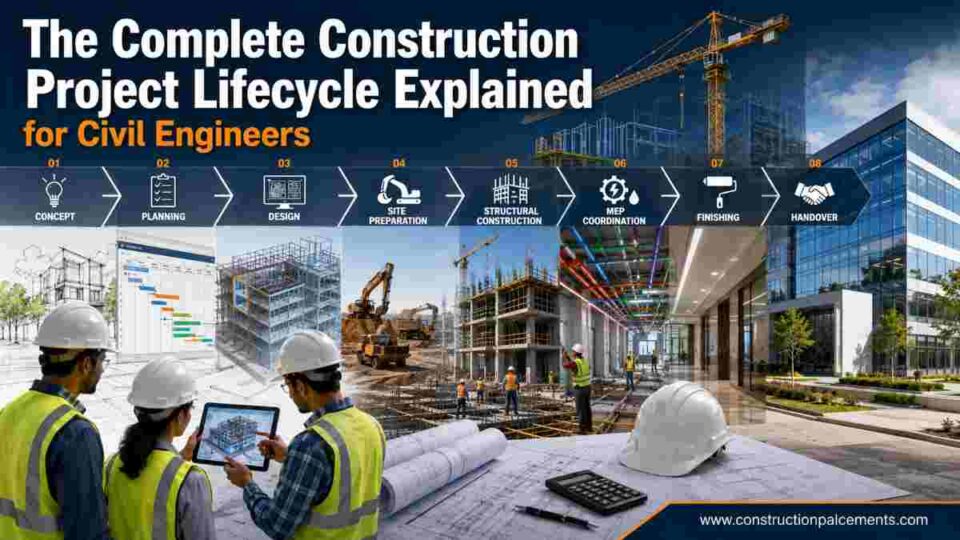
The 9-Stage Construction Project Lifecycle:
Tendering → Estimation → Planning → Procurement → Execution → QA/QC → Billing → Handover → O&M
Each phase feeds into the next. A badly estimated project leads to poor planning. Poor planning causes procurement delays. Procurement delays lead to site execution chaos. And execution chaos results in quality failures, billing disputes, and a handover that nobody is happy about.
Understanding this chain reaction is what separates experienced construction professionals from beginners.
Why Civil Engineering Graduates Must Understand This
Most B.Tech and diploma programs in civil engineering focus heavily on design, structural analysis, geotechnical engineering, and surveying. These are important, but they represent only a small slice of what happens on an actual construction project.
When you join a construction company — whether it is L&T, Tata Projects, Shapoorji Pallonji, or a mid-size contractor — you will be placed into one of these lifecycle phases. Your daily work, your reporting relationships, your growth trajectory, and your salary increments all depend on which phase you operate in and how well you understand the phases around you.
Related reading: Top Career Options After Civil Engineering in 2026
Phase 1: Tendering and Bid Submission
Every construction project begins with a tender. The client — which could be a government body like NHAI, CPWD, or PWD, or a private developer like DLF, Godrej Properties, or Adani Realty — publishes a tender notice inviting contractors to bid for the project.
What Happens During Tendering
The tendering phase involves several critical steps that determine whether a contractor wins the project and at what price:
Tender identification and registration: The business development or contracts team scans government portals (GEM, CPPP, state e-procurement portals) and private invitation databases to identify relevant tenders. The company registers, pays the Earnest Money Deposit (EMD), and downloads the tender documents.
Tender document study: The tender package typically includes the Bill of Quantities (BOQ), scope of work, technical specifications, general conditions of contract (GCC), special conditions of contract (SCC), drawings, and a pre-qualification criteria checklist. The contracts team, estimation team, and technical team review these documents collaboratively.
Site visit and pre-bid meeting: Most tenders require or strongly encourage a mandatory site visit. The project team inspects the site to understand ground conditions, access roads, labour availability, material sourcing distances, and logistical challenges. Pre-bid meetings allow contractors to raise queries and request clarifications from the client.
Decision to bid or not bid (Go/No-Go): Senior management evaluates whether the project aligns with the company’s capabilities, current workload, financial capacity, and strategic goals. This Go/No-Go decision is one of the most important business decisions in construction.
Bid preparation and submission: If the decision is “Go,” the estimation team prepares the commercial bid while the technical team prepares method statements, resource deployment plans, and technical submittals. The complete bid is sealed and submitted before the deadline.
Key Roles in This Phase
The tendering phase is driven by the Business Development Manager, Contracts Manager, and Chief Estimator. The BD team identifies opportunities, the contracts team handles compliance and legal review, and the estimation team builds the pricing.
Related: Complete Guide to a Quantity Surveyor Career in Construction
Phase 2: Estimation and Costing
Estimation is the backbone of every construction project. Get this wrong, and the project is doomed before a single brick is laid. The estimation phase runs parallel to tendering but is so critical that it deserves its own section.
What Estimation Actually Involves
Quantity takeoff: The estimation team extracts quantities from the drawings and BOQ. For a building project, this includes concrete volumes, reinforcement steel tonnage, formwork areas, brickwork quantities, plastering areas, waterproofing areas, and finishing items. In 2026, many firms use BIM-based quantity extraction using tools like Revit, CostX, and Cubicost, which dramatically reduce manual errors.
Rate analysis: Each item in the BOQ gets a detailed rate analysis. For example, the rate for M30 concrete per cubic metre is built up from the cost of cement, aggregates, sand, water, admixtures, batching plant charges, labour for pouring, vibrator charges, curing costs, and overheads. The estimator also accounts for wastage factors, transportation costs, and site-specific conditions.
Subcontractor and supplier quotations: For specialized works like MEP (Mechanical, Electrical, and Plumbing), façade, elevators, HVAC, and fire-fighting, the estimation team invites quotations from subcontractors and vendors. These quotations are negotiated, compared, and incorporated into the overall project cost.
Indirect costs and overheads: Beyond direct construction costs, the estimate must include site establishment costs (offices, stores, labour camps), equipment mobilization, insurance, bank guarantees, taxes (GST), and company overheads. Many projects fail because the estimator underestimated these indirect costs.
Risk contingency and profit margin: A contingency of 3–10% is typically added depending on project complexity and risk profile. The company’s target profit margin — usually 8–15% for private contractors — is then layered on top.
Key Roles in This Phase
The Quantity Surveyor (QS) and Estimation Engineer are the stars of this phase. In larger firms, a BIM Engineer supports quantity extraction, and a Procurement Manager provides current market rates for materials.
Related: BIM Engineer Career Guide: Skills, Salary, and Growth Path
Phase 3: Project Planning and Scheduling
Once the project is awarded, the planning phase begins. This is where the project transitions from a commercial document to an actionable construction plan.
What the Planning Team Does
Work Breakdown Structure (WBS): The planning engineer breaks the entire project into hierarchical work packages. A 40-storey residential tower might be broken into substructure, superstructure floor-by-floor, MEP rough-ins, façade installation, interior finishing, and external development. Each work package gets its own scope, duration, resources, and dependencies.
Master schedule (baseline program): Using Primavera P6 or Microsoft Project, the planning engineer creates the master schedule. This schedule maps out the critical path — the longest chain of dependent activities that determines the project’s minimum completion time. Understanding the critical path is essential for every construction professional.
Look-ahead plans: Beyond the master schedule, the planning team produces 90-day, 30-day, and weekly look-ahead plans. These rolling plans provide increasing detail as activities approach their start dates. The weekly look-ahead is what the site team actually works from day to day.
Resource loading and levelling: The schedule is loaded with resources — labour (masons, carpenters, bar benders, helpers), equipment (cranes, batching plants, transit mixers), and materials. Resource levelling ensures that demands do not exceed availability and that resources are used efficiently.
S-Curve and earned value setup: The planning team establishes the planned S-Curve (cumulative progress over time) and sets up the Earned Value Management (EVM) framework. EVM metrics like CPI (Cost Performance Index) and SPI (Schedule Performance Index) are tracked monthly to assess project health.
Key Roles in This Phase
The Planning Engineer owns this phase. They work closely with the Project Manager, Construction Manager, and QS to ensure the plan is realistic, resource-loaded, and budget-aligned.
Related: Planning Engineer Career Guide: Primavera, Scheduling, and Growth
📄 Build a Construction Resume That Gets Shortlisted
Our AI Resume Lab tailors your resume for specific construction roles — site engineer, QS, planning engineer, and more.
Phase 4: Procurement and Supply Chain
Procurement is the lifeblood of construction execution. No matter how good your plan is, if the materials and equipment do not arrive on time and at the right quality, the project stalls.
What Procurement Covers
Material procurement: This includes bulk materials (cement, steel, aggregates, ready-mix concrete, bricks/blocks), finishing materials (tiles, paint, hardware, sanitary ware), and specialized items (structural steel, precast elements, waterproofing membranes). Each material category has its own lead time, vendor ecosystem, quality standards, and price volatility.
Equipment mobilization: Tower cranes, batching plants, transit mixers, excavators, piling rigs, and other heavy equipment must be planned, ordered, transported, erected, and commissioned well before they are needed on the critical path.
Subcontractor engagement: Specialized works — MEP, elevators, HVAC, fire-fighting, façade, waterproofing, landscaping — are subcontracted to specialist firms. The procurement team manages the entire subcontractor lifecycle: pre-qualification, tender, negotiation, award, mobilization, monitoring, and final account settlement.
Vendor management and approvals: Every material that enters the site must be approved by the client’s engineer or consultant. The procurement team submits material submittals (technical data sheets, test certificates, samples) and tracks the approval pipeline. A single delayed approval can cascade into weeks of site delay.
Key Roles in This Phase
The Procurement Manager and Purchase Engineer lead this phase. The Stores/Warehouse Manager handles receiving, inspection, and inventory control. The QS reviews subcontractor commercial terms.
Related: Top Construction Materials Every Site Engineer Must Know
Phase 5: Site Execution and Construction
This is the phase that most people think of when they hear “construction.” It is the most visible, resource-intensive, and risk-prone phase of the entire lifecycle.
What Happens During Execution
Mobilization: The project team sets up the site — temporary offices, labour camps, material stores, batching plant, tower crane foundation, survey benchmarks, safety barriers, and signage. This “site establishment” phase can take 2–8 weeks depending on project size.
Foundation and substructure: Excavation, piling (if required), pile cap and raft construction, basement retaining walls, waterproofing below ground, and backfilling. This phase is critical because it is largely irreversible — mistakes in foundations are extremely expensive to fix.
Superstructure: Column and slab casting floor by floor, formwork cycling, rebar fixing, concrete pouring and curing, and structural testing. In a typical high-rise project, the superstructure team aims for a 7–10 day floor cycle using jump formwork or table formwork systems.
MEP rough-in and finishing: As the superstructure progresses, MEP teams follow 3–5 floors behind, installing embedded conduits, sleeves, pipes, and ducts. Finishing trades — plastering, tiling, painting, joinery, hardware — follow further behind.
External development: Roads, drainage, landscaping, boundary walls, utility connections (water, sewer, electricity, telecom), and external lighting are executed during the later stages of the project.
Key Roles in This Phase
The Site Engineer is the frontline executor. They are supported by the Construction Manager, Foreman/Supervisor, Safety Officer, and Survey Engineer. The Project Manager oversees the entire execution, resolving conflicts between trades and managing client expectations.
Related: Site Engineer vs Project Engineer: Key Differences Explained
Phase 6: Quality Assurance and Quality Control (QA/QC)
QA/QC runs parallel to execution. It is not a separate “phase” in a strict timeline sense — it is an ongoing, continuous process that covers every activity from foundation to finishing.
QA vs QC: Understanding the Difference
Quality Assurance (QA) is a proactive, process-oriented approach. It focuses on establishing systems, procedures, checklists, inspection and test plans (ITPs), method statements, and audit schedules that prevent defects from occurring. QA asks: “Do we have the right processes in place?”
Quality Control (QC) is a reactive, product-oriented approach. It focuses on inspecting, testing, and measuring the actual construction output to ensure it meets specifications. QC asks: “Does the built product meet the standard?”
What the QA/QC Team Does Daily
Inspection and Test Plans (ITPs): For every construction activity — concrete pouring, rebar fixing, waterproofing application, MEP installation — the QA/QC team prepares an ITP. This document defines what will be inspected, at which hold/witness/review points, by whom, and against which standard or specification.
Material testing: Cube testing for concrete compressive strength (7-day and 28-day), rebar tensile testing, soil compaction testing (field density tests), aggregate sieve analysis, cement consistency tests, and hundreds of other material tests are managed by the QA/QC team in coordination with an approved third-party laboratory.
Site inspections and NCR management: When a defect or non-conformance is found — say, honeycombing in a concrete column, wrong reinforcement spacing, or a waterproofing membrane applied at incorrect thickness — the QA/QC engineer issues a Non-Conformance Report (NCR). The NCR triggers a corrective action process that must be closed before work can proceed.
Documentation and handover dossier: The QA/QC team compiles the quality record dossier that will be submitted during project handover. This includes all test reports, inspection records, as-built markups, material approval logs, and NCR closure evidence.
Key Roles in This Phase
The QA/QC Engineer and QA/QC Manager drive this function. They report independently (not through the construction manager) to ensure objectivity. The Safety Officer works closely with QA/QC to address safety-related quality issues.
Related: QA/QC Engineer Career Guide for Civil Engineers
Phase 7: Billing, Measurement, and Payment
Billing is the financial engine of a construction project. For the contractor, this is how revenue flows. For the client, this is how project expenditure is tracked and controlled.
How Construction Billing Works
Running Account (RA) Bills: The contractor submits monthly or milestone-based RA bills to the client. Each RA bill contains measured quantities of work completed during the billing period, multiplied by the contracted rates. The client’s engineer verifies these measurements through joint measurement surveys before certifying the bill for payment.
Joint measurement: The billing engineer and the client’s quantity surveyor physically measure completed work on site. For concrete, this means measuring column, beam, and slab dimensions. For earthwork, it means comparing survey levels against original ground levels. Joint measurement is where many commercial disputes arise, making it a high-skill activity.
Interim Payment Certificates (IPC): After verifying the RA bill, the client’s engineer issues an IPC. The IPC amount is the gross bill value minus retention (typically 5–10%), minus any advance recovery, minus previous payments, minus any liquidated damages or back-charges.
Variation orders and claims: When the scope of work changes — which happens on virtually every project — the contractor submits variation orders (VOs) or change orders. These must be substantiated with revised drawings, quantity comparisons, rate justifications, and time impact assessments. The commercial/claims team manages this critical process.
Final account and settlement: At project completion, the contractor prepares a comprehensive final account. This document reconciles all RA bills, variation orders, claims, counter-claims, retention release, and any remaining commercial issues. Final account settlement can take months or even years on large projects.
Key Roles in This Phase
The Billing Engineer and Quantity Surveyor (QS) are the central figures. The Contracts Manager handles variation orders and claims. On the client side, the Client’s QS or Project Management Consultant (PMC) verifies and certifies payments.
Related: Billing Engineer Career Guide: Skills, Salary, and Job Scope
Phase 8: Project Handover and Closeout
Project handover is the formal process of transferring the completed construction project from the contractor to the client. It is one of the most document-intensive phases of the entire lifecycle.
What Happens During Handover
Pre-handover punch list (snag list): Before formal handover, the client’s team and the contractor jointly inspect the entire project and create a punch list — a comprehensive list of defects, incomplete items, and cosmetic issues that must be rectified. Depending on project quality, a punch list for a large project can contain 500–5,000+ items.
Testing and commissioning: All systems must be tested and commissioned before handover. This includes fire alarm and suppression testing, elevator load testing, HVAC performance testing, electrical system testing (insulation resistance, earth continuity, power factor), plumbing pressure testing, and BMS integration testing. Each test produces a commissioning certificate.
As-built drawings: The contractor submits as-built drawings that reflect the actual constructed dimensions, routing, and configurations — not the original design intent. As-built drawings are critical for the client’s future maintenance and renovation work.
O&M manuals: Operations and Maintenance manuals for all installed equipment and systems — HVAC units, generators, transformers, fire pumps, elevators, water treatment plants — are compiled and submitted to the client’s facility management team.
Warranties and guarantees: The contractor provides warranty certificates for structural work (typically 10 years), waterproofing (5–10 years), MEP systems (1–2 years), and finishing items (1 year). These warranty periods define the Defect Liability Period (DLP).
Handover certificate: Once the client is satisfied that all punch list items are closed, all documentation is complete, and all systems are commissioned, the formal handover certificate (also called Taking Over Certificate or Completion Certificate) is issued. This triggers the start of the DLP and initiates retention money release.
Key Roles in This Phase
The Project Manager coordinates handover. The QA/QC Manager compiles the quality dossier. The MEP Manager handles testing and commissioning. The Document Controller manages the enormous volume of handover documentation. The Contracts Manager handles the commercial closeout.
Related: Construction Project Manager Career Guide: Path to Leadership
Phase 9: Operations and Maintenance (O&M)
While O&M is technically the client’s responsibility after handover, it represents a growing career domain and an increasingly important phase in the overall project lifecycle.
What O&M Covers
Facility management: Day-to-day operations including HVAC operation, electrical systems management, water supply, waste management, security systems, fire safety systems, and housekeeping coordination. Modern buildings use Building Management Systems (BMS) or Building Automation Systems (BAS) to monitor and control these systems centrally.
Preventive maintenance: Scheduled maintenance activities — filter changes, pump servicing, generator testing, elevator maintenance, facade cleaning, waterproofing inspections — are planned using CMMS (Computerized Maintenance Management Systems) software like IBM Maximo, SAP PM, or newer platforms like UpKeep and Limble.
Defect liability period (DLP) management: During the DLP (typically 12–24 months after handover), the contractor remains responsible for fixing any defects that arise from faulty workmanship or materials. The facility management team logs defects and coordinates rectification with the contractor.
Energy management and sustainability: With increasing focus on green buildings and ESG compliance, O&M teams now manage energy audits, carbon footprint tracking, LEED/GRIHA compliance maintenance, solar panel performance monitoring, and water recycling systems.
Key Roles in This Phase
The Facility Manager, Maintenance Engineer, and Building Services Engineer are the primary professionals in O&M. This is a growing career path, especially in large commercial, hospitality, healthcare, and data centre projects.
Related: Facility Management Career Guide for Civil Engineers
🎤 Ace Your Next Construction Interview
Practice with our AI Interview Copilot — trained on real construction interview questions for every role.
Who Does What: The Construction Project Role Map
One of the biggest confusions for civil engineering graduates is understanding which professional operates in which phase. Here is a clear map showing the primary responsibilities and phase involvement of each key role:
| Role | Tender | Estimate | Plan | Procure | Execute | QA/QC | Billing | Handover | O&M |
|---|---|---|---|---|---|---|---|---|---|
| Project Manager | ◐ | ◐ | ● | ● | ● | ● | ● | ● | ○ |
| Planning Engineer | ◐ | ○ | ● | ◐ | ● | ○ | ◐ | ◐ | ○ |
| Quantity Surveyor | ● | ● | ◐ | ◐ | ○ | ○ | ● | ● | ○ |
| Site Engineer | ○ | ○ | ◐ | ◐ | ● | ◐ | ◐ | ◐ | ○ |
| Billing Engineer | ○ | ◐ | ○ | ○ | ○ | ○ | ● | ● | ○ |
| QA/QC Engineer | ○ | ○ | ◐ | ◐ | ● | ● | ○ | ● | ○ |
| Safety Officer | ○ | ○ | ◐ | ○ | ● | ◐ | ○ | ◐ | ○ |
| BIM Engineer | ◐ | ● | ● | ◐ | ● | ◐ | ◐ | ● | ◐ |
| Procurement Mgr | ◐ | ● | ◐ | ● | ◐ | ○ | ○ | ○ | ○ |
| Facility Manager | ○ | ○ | ○ | ○ | ○ | ○ | ○ | ● | ● |
Legend: ● Primary responsibility | ◐ Supporting/involved | ○ Minimal or no involvement
Save this table. Print it. Stick it on your desk. When you are preparing for interviews, use it to explain how your target role fits into the bigger project picture. Interviewers love candidates who understand the ecosystem, not just their own silo.
How AI Is Changing the Construction Project Lifecycle in 2026
Artificial intelligence is no longer a futuristic buzzword in construction — it is actively reshaping how each phase of the project lifecycle is executed. Here is how AI is impacting each stage:
Tendering: AI-powered bid analytics tools now analyze historical bidding data, competitor pricing patterns, and win probability scores to help contractors make smarter Go/No-Go decisions. Natural Language Processing (NLP) tools can scan tender documents and automatically flag risk clauses, unusual specifications, and compliance requirements.
Estimation: AI-driven quantity takeoff tools (like Togal.AI, CostCertified, and Buildee) use computer vision to extract quantities directly from 2D drawings and BIM models, reducing takeoff time by 50–80%. Machine learning models trained on historical project data can predict cost overrun risks before the first concrete pour.
Planning: AI scheduling assistants integrated with Primavera P6 and Microsoft Project can suggest optimal activity sequences, flag scheduling conflicts, and automatically generate look-ahead plans. Generative AI tools can produce method statements and risk assessments from project parameters.
Procurement: AI-powered procurement platforms predict material price fluctuations, optimize purchase timing, and match projects with the best-fit vendors using multi-criteria scoring algorithms. Supply chain visibility platforms use IoT and AI to track material deliveries in real-time.
Execution: Computer vision on construction sites monitors progress through drone imagery and CCTV feeds, automatically comparing as-built conditions against the BIM model. Wearable sensors and AI safety platforms detect unsafe worker behaviour and PPE violations in real-time.
QA/QC: AI-powered defect detection uses drone and camera imagery to identify concrete surface defects, rebar exposure, and finishing imperfections that human inspectors might miss. Automated report generation tools compile inspection data into formatted QA/QC reports.
Billing: AI automates measurement verification by comparing BIM model quantities against site survey data, reducing billing disputes. Smart contract platforms on blockchain are being piloted for automated milestone-based payments.
Handover: Digital twin technology creates a living 3D model of the completed building that serves as the handover deliverable, replacing thousands of pages of paper documentation. AI-powered commissioning verification tools can automatically validate system performance against design specifications.
Related: How AI Is Transforming the Construction Industry in 2026
Career Advice: Which Phase Should You Target?
If you are a civil engineering graduate or a young professional trying to decide your career direction, here is a practical framework for choosing which phase to specialize in:
If you love numbers and commercial work: Target the Estimation → Billing → QS track. This path leads to commercial management roles and eventually to contracts director or commercial director positions. Quantity surveyors who understand the full lifecycle earn some of the highest salaries in construction.
If you love site work and hands-on construction: Target the Execution track as a site engineer, progressing to section engineer, construction manager, and eventually project manager. This is the traditional career path and remains the most common route to senior leadership.
If you love planning, data, and systems: Target the Planning Engineer track. Planning engineers with strong Primavera P6 skills and EVM knowledge are in high demand globally, especially in the Middle East and Southeast Asian markets. This role also translates well into project controls and PMO positions.
If you love quality and compliance: Target the QA/QC track. This is especially lucrative in oil and gas, petrochemical, and infrastructure projects where quality standards are extremely stringent. ISO Lead Auditor certification significantly boosts your value in this track.
If you love technology: Target the BIM Engineer track and build expertise in Revit, Navisworks, BIM 360, and increasingly, AI-powered construction technology platforms. BIM managers and digital construction leads are among the fastest-growing roles in the industry.
No matter which phase you choose, remember this: the professionals who get promoted fastest are the ones who understand the entire lifecycle, not just their own function. A site engineer who understands billing gets promoted before one who does not. A QS who understands planning earns more than one who only knows measurement.
📚 Recommended Resources
🔹 The AI Construction Career Blueprint — Your complete guide to leveraging AI for a modern construction career. Covers every role discussed in this post with detailed action plans.
🔹 Construction Interview Mastery Guide — 200+ real interview questions organized by role (site engineer, QS, planning engineer, project manager) with model answers.
🔹 Complete Career Toolkit Bundle — Get all our career resources at a discounted bundle price. Includes resume templates, interview guides, and career planning frameworks.
🔹 Remote Construction Jobs Guide — Discover high-paying remote and hybrid roles in construction technology, BIM coordination, project controls, and estimation.
Top Online Courses to Deepen Your Knowledge
If you want to build expertise in specific lifecycle phases, these courses are excellent starting points:
🎓 Construction Project Management — Covers the complete project lifecycle with emphasis on planning, scheduling, and cost management.
🎓 Construction Management MicroMasters — University-level construction management education covering estimation, scheduling, safety, and quality management.
🎓 Primavera P6 Project Planning Masterclass — Essential for anyone pursuing the planning engineer career track. Covers scheduling, resource loading, and progress tracking.
🎓 Construction Scheduling — Focused deep-dive into CPM, scheduling techniques, and delay analysis.
🎓 Quantity Surveying and Cost Estimation — Covers BOQ preparation, rate analysis, and measurement techniques for billing engineers and QS professionals.
Frequently Asked Questions
What is the construction project lifecycle?
The construction project lifecycle is the complete sequence of phases that a project passes through from initial tender to final handover and operations. The standard phases are: Tendering, Estimation, Planning, Procurement, Execution, QA/QC, Billing, Handover, and Operations & Maintenance. Every construction project — whether a small residential building or a mega infrastructure project — follows this fundamental lifecycle.
How many phases are there in a construction project?
A construction project typically has 9 distinct phases: Tendering and Bid Submission, Estimation and Costing, Project Planning and Scheduling, Procurement and Supply Chain, Site Execution, Quality Assurance and Quality Control (QA/QC), Billing and Measurement, Project Handover and Closeout, and Operations and Maintenance (O&M). Some organizations combine certain phases, but the underlying activities remain the same.
What is the difference between tendering and estimation in construction?
Tendering is the process of identifying project opportunities, reviewing tender documents, deciding whether to bid, and submitting the complete bid package. Estimation is a specific activity within the tendering process that focuses on calculating the project cost through quantity takeoff, rate analysis, and pricing. Estimation feeds into tendering, but tendering also includes legal review, compliance checks, technical submittals, and bid strategy.
What does a construction project manager do across the lifecycle?
A construction project manager oversees the entire lifecycle from planning through handover. During planning, they validate the schedule and resource plan. During procurement, they approve vendor selections and subcontractor awards. During execution, they manage day-to-day operations, resolve inter-trade conflicts, and coordinate with the client. During billing, they review and approve RA bills. During handover, they lead the closeout process and ensure all documentation is complete.
What is the handover phase in construction?
The handover phase is the formal transfer of the completed project from the contractor to the client. It includes punch list rectification, system testing and commissioning, submission of as-built drawings and O&M manuals, warranty certificates, and the issuance of a Taking Over Certificate. The handover phase also triggers the start of the Defect Liability Period (DLP) and initiates the release of retained money.
How is AI used in construction project management?
AI is used across the construction lifecycle in 2026. Key applications include AI-powered quantity takeoff from drawings, predictive scheduling and delay analysis, computer vision for site progress monitoring and safety compliance, automated defect detection in QA/QC, machine learning for cost prediction and risk assessment, and digital twin technology for project handover and facility management. AI is not replacing construction professionals but is augmenting their capabilities significantly.
Which construction career path has the highest salary?
Quantity surveyors and commercial managers generally command the highest salaries in construction because they directly impact project profitability. Project managers in EPC (Engineering, Procurement, and Construction) companies also earn premium salaries, especially in oil and gas and infrastructure sectors. BIM managers and digital construction specialists are seeing rapid salary growth due to high demand and limited supply. Planning engineers with international experience (particularly in the Gulf region) also earn competitive compensation.
What is the difference between QA and QC in construction?
Quality Assurance (QA) is a proactive, process-focused approach that establishes systems, procedures, and checklists to prevent defects. Quality Control (QC) is a reactive, product-focused approach that inspects and tests completed work to verify it meets specifications. In simple terms, QA prevents defects while QC detects defects. Both are essential for delivering a quality construction project.
Continue Your Learning
Explore more career guides, industry insights, and professional resources on ConstructionPlacements:
→ Top Career Options After Civil Engineering
→ Construction Management Career Guide
→ Top EPC Companies in India for Civil Engineers
→ MEP Engineer Career Guide
→ Construction Safety Officer Career Guide
📬 Get Weekly Construction Career Insights
Join 10,000+ civil engineers who read our LinkedIn newsletter “Construction Careers” every week.
About the Author
This guide is published by the editorial team at ConstructionPlacements.com, India’s leading construction career and industry knowledge platform. For AI-powered career tools, visit ConstructionCareerHub.com.
