

Last Updated on June 10, 2026 by Admin
You finished your civil engineering degree — or you are about to — and the question that keeps you up at night is deceptively simple: what should I do next?
ConstructionCareerHub App is LIVE — built ONLY for construction careers. Don’t apply with a weak resume.
Get ATS-ready Resume Lab + Interview Copilot + Campus Placement Prep (resume screening, skill gaps, interview readiness) — in minutes & Other advanced features.
Explore Smarter Construction Career Tools →Quick check. Big impact. Start now.
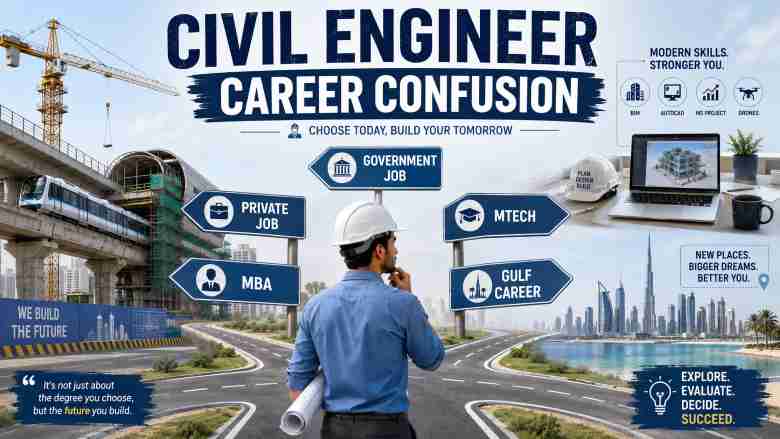
Should you prepare for GATE and aim for a PSU or IIT MTech? Should you clear SSC JE and settle into a government job? Should you accept that ₹12,000–₹18,000 per month site engineer offer from a private contractor? Should you invest two more years in an MBA? Or should you somehow get to Dubai or Saudi Arabia where the salaries look five times higher?
If you are reading this, there is a good chance you have already asked this question on Quora, Reddit, YouTube comments, or in your college WhatsApp group — and received dozens of conflicting answers.
This article is not going to add to that confusion. Instead, it will give you a practical decision-making framework so you can evaluate each option against your own profile, financial reality, academic record, communication skills, family situation, and career ambitions. Because the truth is: there is no single best option for every civil engineer. The right choice depends entirely on who you are, where you stand today, and where you want to be in five to ten years.
Whether you are a final-year B.Tech student, a diploma holder exploring options, a fresher struggling to find a decent job, or someone stuck in a low-paying site role wondering if there is something better — this guide covers all five major paths and helps you pick the one that fits your life, not someone else’s opinion.
Also read: 15 Best Career Options After Civil Engineering (2026)
Table of Contents
Quick Answer: Which Is the Best Career Option for a Civil Engineer?
There is no universally best option. Government jobs are best for stability-focused, exam-strong candidates. Private construction jobs suit those who want practical exposure and fast skill-building. MTech is ideal for technically inclined engineers targeting research, design, or GATE-based PSU entry. MBA works when the goal is management, business leadership, or cross-industry mobility — but only from a reputed institute. Gulf jobs are most rewarding after gaining 2–4 years of Indian experience, strong software skills, and project documentation ability. Evaluate your academic record, financial pressure, communication skill, risk appetite, and long-term goals before choosing. Read the full framework below to find the path that matches your profile.
Civil Engineer Career Confusion: Why This Decision Feels So Difficult
Before evaluating the five options, it helps to understand why this decision is harder for civil engineers than for most other engineering branches.
Entry-level private salaries are demotivating. A fresher civil site engineer in India typically earns ₹12,000 to ₹22,000 per month in 2026 — far below what IT, software, or data science roles offer to engineering graduates from the same batch. This salary gap creates immediate frustration and makes other paths look more attractive by comparison.
Government job preparation creates a time trap. Many graduates begin preparing for government exams like GATE, SSC JE, or state AE/JE right after college. Some clear these exams within one or two attempts. But a significant number spend three, four, even five years in full-time preparation without a job, an income, or meaningful work experience — and the opportunity cost is enormous.
Family expectations add emotional pressure. In India, parents often view a government job as the only acceptable career outcome. This pressure pushes many civil engineers toward exam preparation even when their aptitude, interest, or academic strength may be better suited for a private career, higher education, or an international role.
MTech and MBA confusion stems from unclear ROI. Will an MTech from a tier-2 college improve my placement? Will an MBA help me leave construction? Will the fees be worth it? These questions rarely have clear answers because the outcome depends heavily on the institute, the specialisation, and the effort the student puts in.
Gulf salary numbers look attractive on paper. When someone tells you a planning engineer in Saudi Arabia earns ₹1.5–₹3 lakh per month (tax-free), it naturally creates a pull. But the process of getting there — experience requirements, documentation, agent reliability, contract terms — is often unclear and intimidating.
Lack of career counselling in engineering colleges. Most civil engineering departments in India do not provide structured career guidance. Students graduate with a degree but no framework for evaluating which career path matches their strengths.
Rapid changes in construction technology and roles. The industry itself is transforming. Roles like BIM engineer, project controls specialist, digital construction manager, and sustainability consultant barely existed a decade ago. Many civil engineers are unaware of these emerging paths and limit their thinking to only traditional site engineer or government roles.
If you recognise yourself in any of these situations, you are not alone. The following sections will break down each option with honest advantages, limitations, and best-fit criteria.
Option 1: Government Jobs for Civil Engineers
Who Should Choose Government Jobs?
Government jobs are an excellent fit if you are academically strong, exam-oriented, disciplined in long-term preparation, and value job security, social respect, and structured career progression over rapid salary growth. If clearing competitive exams comes naturally to you and you are comfortable with the idea of preparing for one to three years, this path offers significant long-term rewards.
Popular Government Job Routes
The main pathways include GATE-based PSU recruitment (NTPC, NHPC, GAIL, PGCIL, IOCL, BHEL, WAPCOS, NHAI, and others), SSC JE (for Central PWD, CWC, BRO, MES, and other central departments), UPSC ESE (Engineering Services Examination for Class-I gazetted officer posts), state-level AE/JE examinations (state PWD, irrigation, municipal corporations, rural development), Railways (RRB JE and SSE posts), DMRC and other metro rail corporations, and NHAI recruitment for highway engineers.
For the latest government engineering job notifications, check our government engineering jobs page regularly.
Benefits
Job security, pension and retirement benefits (where applicable), social respect, structured pay scale under the 7th Central Pay Commission (starting at Pay Level 6 for SSC JE with an in-hand salary of approximately ₹44,000–₹62,000 per month), housing and transfer allowances, reasonable work-life balance compared to private construction sites, and opportunities for departmental promotions.
Challenges
Extremely high competition (SSC JE alone receives lakhs of applications), a long and uncertain preparation period, age-limit constraints (especially for those who delay or fail multiple attempts), limited practical site exposure compared to private sector roles, potential for monotonous work in some postings, and the risk of spending three or more productive years without a job or income if exams are not cleared.
Best-Fit Profile
Strong academic record (70%+ or 7+ CGPA), comfort with structured exam preparation, disciplined study habits, willingness to spend one to three years on preparation, family support during the preparation phase, and a preference for stability over rapid financial growth.
Who Should Avoid Depending Solely on Government Jobs?
If you have been preparing for government exams for more than two to three years without clearing any, if your financial situation demands immediate income, or if you find exam preparation frustrating and your interest lies in hands-on project work, it is essential to build a parallel backup plan. Working in a private role while attempting government exams on the side is a far better strategy than full-time preparation beyond the second or third attempt.
Option 2: Private Jobs in Construction, Infrastructure, Real Estate, EPC, and Consultancy
Who Should Choose Private Sector Jobs?
If you are practical-minded, action-oriented, willing to work on construction sites, comfortable with relocation, and want to build real-world skills that make you valuable to employers in India and abroad, the private construction sector is where you should start. This path also serves as the best foundation for a future Gulf career.
Key Role Options
The construction industry offers far more than just the “site engineer” role. The major career tracks include site engineer, planning engineer (using Primavera P6 or MS Project), quantity surveyor, billing and measurement engineer, QA/QC engineer, HSE engineer, BIM engineer, contracts engineer, design coordinator, project coordinator, estimation engineer, and procurement engineer.
To understand the full range of construction career paths, explore our guide on 110 career paths in civil engineering.
Benefits
Immediate earning and work experience from day one, practical exposure to real construction projects, faster skill-building in site execution, documentation, software tools, and contractor management, a wide variety of specialisation options, project-based growth opportunities with salary jumps at the two-year and five-year marks, and strong preparation for Gulf jobs (which prefer candidates with Indian private sector experience over those with only government or academic backgrounds).
Challenges
Lower starting salaries compared to IT or software engineering (₹12,000–₹25,000 per month for freshers at many mid-tier companies), demanding work hours on construction sites, potential frequent relocation, physically tough working conditions especially for site-based roles, and slower salary growth at companies that do not invest in employee development.
Best-Fit Profile
Willingness to learn on-site, comfort with physical work environments, interest in project execution and construction technology, readiness to relocate for project assignments, and a mindset focused on building skills rather than chasing starting salary.
How to Grow Faster in Private Jobs Within 3–5 Years
The engineers who accelerate their private sector careers share a few common habits. They learn at least one industry software beyond AutoCAD — Primavera P6, Revit, Navisworks, CostX, or advanced Excel for construction. They document every project they work on with measurable outcomes. They build a professional LinkedIn profile and network actively. They target companies known for good training programmes — our list of the top 15 construction companies for fresh civil engineers in India is a useful starting point. And they approach their first job as a learning investment, not just a paycheck.
🎯 Build a Stronger Career Foundation: Use the ConstructionCareerHub.com platform to get your resume ATS-ready with the Resume Lab, practise interview questions with the AI Interview Copilot, and benchmark your career readiness — all built exclusively for construction professionals.
Option 3: MTech After Civil Engineering
Who Should Pursue MTech?
MTech is a focused path for civil engineers who have a genuine interest in technical depth, research, analysis, or design — and who want to build a career in specialised engineering roles, academic teaching, R&D, or design consultancy. It is also a strategic route for GATE qualifiers aiming for PSU recruitment or a top-tier engineering institute.
Best MTech Specialisations
The most career-relevant specialisations include structural engineering, geotechnical engineering, transportation engineering, environmental engineering, construction technology and management (CTM), water resources engineering, earthquake engineering, and infrastructure engineering and management. The top construction management institutes in India offer both MTech and MBA tracks in this space.
When MTech Is Useful
MTech adds clear value when you secure admission to an IIT, NIT, IIIT, or a NIRF top-ranked institution. It is also worthwhile when your career goal is structural design consultancy, research at CSIR or DRDO labs, university teaching, or when a GATE-based PSU recruitment offer is the primary target.
When MTech May Not Be Worth It
Pursuing MTech from an average private college with no research infrastructure, no industry connections, and poor placement records is unlikely to justify the two-year investment of time and money. If your reason for choosing MTech is simply to avoid the job market, delay career decisions, or because you did not get a job after B.Tech, the outcome is often disappointing. MTech works best when it is a deliberate choice, not a default fallback.
GATE Relevance
GATE remains the gateway to both MTech admissions at top institutions and PSU recruitment. In 2026, GATE CE covers core subjects with high weightage for structural engineering (20–25 marks), geotechnical engineering (12–15 marks), and engineering mathematics (13–15 marks). If you can realistically aim for a top-5,000 rank, GATE preparation is a worthwhile investment. If you have been attempting for more than two years without progress, consider redirecting your energy to a private career alongside exam preparation.
Option 4: MBA After Civil Engineering
Who Should Choose MBA?
MBA is the right move for civil engineers who are more interested in management, business strategy, leadership, client-facing roles, and cross-industry career flexibility than in technical depth. If you find yourself drawn to project management, business development, real estate strategy, infrastructure finance, or operations management rather than structural calculations or site execution, MBA may be your path.
Best MBA Paths for Civil Engineers
The most relevant MBA specialisations include construction management, project management, infrastructure management, real estate management, finance, operations, supply chain, and business analytics. Dedicated construction management MBA programmes like NICMAR (MBA ACM/APM), RICS SBE Amity (MBA CPM), and SCMHRD (MBA-IDM) are particularly well-suited for civil engineers because they combine management education with industry-specific placement networks.
When MBA Gives Strong ROI
MBA delivers its best returns when pursued from a top-50 institute — IIMs, ISB, XLRI, MDI, SCMHRD, FMS, or NICMAR for construction-specific management. Graduates from these institutes consistently secure roles in project management consulting, real estate advisory, infrastructure finance, and strategic leadership within EPC, PMC, and developer companies. If your CAT, XAT, or NMAT score can get you into a reputed programme, the investment is usually justified.
When MBA May Become Risky
An MBA from a low-ranked or unaccredited college often fails to provide the placement quality, alumni network, or brand value needed to justify the fees (which can range from ₹5 lakh to ₹20 lakh). If the primary motivation for choosing MBA is “I do not want to work on a construction site” rather than a genuine interest in management, the outcome is often a lateral move rather than an upward one.
Career Roles After MBA
Post-MBA career tracks include construction project manager, infrastructure consultant, contracts and procurement manager, business development manager at EPC or real estate firms, project controls lead, real estate strategy analyst, and operations head. Many of these roles also open doors to international opportunities in Gulf PMC firms and global consultancies.
MTech vs MBA: The Core Difference for Civil Engineers
MTech deepens your technical expertise — it makes you a better engineer in a specific domain. MBA broadens your management and business skills — it makes you a better leader, strategist, or business professional. The question is not which degree is “higher” but which career direction excites you more. If your answer is design, analysis, or research, choose MTech. If your answer is management, strategy, or business, choose MBA.
Option 5: Gulf Jobs for Civil Engineers
Who Should Consider Gulf Jobs?
Gulf jobs are an excellent option for civil engineers who have built two or more years of practical construction experience, possess proficiency in at least one industry software tool, have reasonable English communication skills, and are willing to relocate to the Middle East for higher tax-free earnings, international project exposure, and career acceleration. For a comprehensive guide to this path, read Gulf Construction Jobs for Indians 2026: Career Kit.
Best Gulf Markets in 2026
Saudi Arabia leads with the largest project pipeline including NEOM, the Red Sea project, and FIFA 2034 infrastructure. The UAE offers the most mature job market with strong demand in high-rise, fit-out, and smart city projects. Qatar continues infrastructure development post-FIFA 2022. Oman and Bahrain offer less competitive entry points for engineers with fewer years of experience. Kuwait maintains steady demand for oil and gas infrastructure roles. Our detailed guide on Gulf construction jobs for Indians breaks down country-by-country demand.
Most Demanded Roles
Planning engineer (Primavera P6), quantity surveyor, BIM engineer, MEP coordinator, HSE officer, project controls specialist, contracts engineer, QA/QC engineer, site engineer with 3–6 years experience, and design coordinator. The construction salary guide 2026 provides detailed salary benchmarks across these roles for Gulf markets.
Why Freshers Should Be Careful
Reputed Gulf employers almost never hire freshers for well-paying positions. Engineers with zero experience who accept Gulf offers through agents often end up in low-salary labour-category roles, with companies that have poor working conditions, and on contracts that are difficult to exit. The going abroad guide for civil engineers covers the realities you need to understand.
Skills Needed Before Applying for Gulf Jobs
At minimum: AutoCAD proficiency, at least one role-specific software (Primavera P6 for planning, CostX or CATO for QS, Revit or Navisworks for BIM, Aconex or Procore for documentation), English communication strong enough for site meetings and email correspondence, project documentation experience, and familiarity with international standards and quality procedures.
Best Path to Reach Gulf in 2–5 Years
Work for two to four years in a reputed Indian EPC or PMC company. Learn one in-demand software skill deeply. Build a project portfolio with measurable outcomes. Get at least one relevant certification (PMP, NEBOSH, RICS, or Autodesk). Create a strong LinkedIn profile optimised for Gulf recruiter searches — our guide on maximising LinkedIn for construction careers shows you exactly how. Apply through verified channels, not through street-corner agents. And always verify company credentials, visa terms, and contract details before accepting any offer.
Government Job vs Private Job vs MTech vs MBA vs Gulf: Detailed Comparison Table
| Criteria | Government Job | Private Job | MTech | MBA | Gulf Job |
|---|---|---|---|---|---|
| Best for | Stability seekers, exam-strong candidates | Practical learners, skill builders | Research, design, technical depth | Management, business, leadership | High savings, global exposure |
| Minimum preparation | 1–3 years exam prep | Resume + software skill | GATE prep + admission | CAT/XAT/NMAT + admission | 2–4 years Indian experience |
| Starting salary (approx.) | ₹44,000–₹62,000/month (SSC JE level) | ₹12,000–₹25,000/month (fresher) | Stipend ₹12,000–₹18,000/month during MTech | ₹6–₹25 LPA (depends on institute) | ₹80,000–₹2,00,000/month (tax-free, 2–5 yr exp) |
| Salary at 5–7 years | ₹60,000–₹1,00,000/month | ₹40,000–₹1,20,000/month | ₹50,000–₹1,50,000/month (design/research) | ₹10–₹30 LPA (top institutes) | ₹1,50,000–₹4,00,000/month (tax-free) |
| Stability | Very high | Moderate (project-based) | High if in academia/PSU | Moderate to high | Moderate (contract-based) |
| Growth speed | Slow and structured | Fast if skills are strong | Slow initially, strong later | Fast in management track | Fast with right experience |
| Risk level | High (exam uncertainty) | Low to moderate | Medium (institute-dependent) | High (institute-dependent) | Medium (agent and contract risks) |
| Key skill requirement | Exam aptitude, subject knowledge | Site skills, software, documentation | Research aptitude, GATE score | Communication, analytical thinking | Software, English, project portfolio |
| Time to results | 1–3 years | Immediate (salary from month 1) | 2–3 years | 2–3 years | 2–5 years from starting career |
Note: Salary figures are approximate and vary based on location, company, project type, specialisation, and individual negotiation. For detailed salary benchmarks, refer to the Civil Engineering Salary Guide.
Decision Matrix: Which Option Should You Choose?
Instead of guessing, rate yourself honestly on a scale of 1 (low) to 5 (high) on the following ten factors. Then match your profile to the option that fits.
| Factor | If You Score 4–5 | If You Score 1–2 |
|---|---|---|
| Academic strength / exam aptitude | Government jobs (GATE/SSC JE) or MTech from top institute | Private job or Gulf path (skill-based, not exam-based) |
| Financial pressure / need for immediate income | Private job immediately — start earning from month one | Can afford to prepare for exams or pursue higher education |
| Family expectation for “secure” job | Attempt government exams with a parallel private job | Freedom to explore private sector, Gulf, or MBA path |
| English communication confidence | Gulf jobs, MBA, international roles open up | Start with private site jobs in India; improve communication alongside |
| Willingness to relocate | Private sector and Gulf both become accessible | Government jobs (some offer home-state posting preference) |
| Interest in site work and construction execution | Private job → Gulf career is the ideal trajectory | MTech (design/research) or MBA (management track) |
| Interest in technical depth (design, analysis, research) | MTech from a top institute | MBA or private sector management track |
| Interest in management and business leadership | MBA from a reputed institute | Technical career path (government, MTech, or specialised private roles) |
| Risk-taking ability | Gulf jobs, entrepreneurship, or MBA from top tier | Government job (lowest risk after clearing exam) |
| Desire for international exposure | Gulf → international career path | Government or domestic private career |
If you are unsure about your own career strengths, take the free Civil Engineering Career Choice Test on ConstructionPlacements.com to see which roles align with your interests and skills.
Best Career Path Based on Your Situation
Generic advice does not work because everyone starts from a different position. Below are practical recommendations for common real-life situations.
If You Are a Final-Year Civil Engineering Student
Do not wait until results are out to start planning. Apply for campus placements actively — check the Campus Placements Playbook 2026 for a full preparation strategy. Simultaneously, start learning one software tool (Primavera P6, Revit, or AutoCAD Civil 3D). Register for GATE if you have even a moderate interest in government jobs or top-tier MTech. Create a LinkedIn profile now. The students who start their career preparation six months before graduation land better roles than those who start after.
If You Are a Fresher With No Job
Do not stay idle. Apply for private sector jobs through walk-in interviews and direct company career pages. Even a low-paying first job teaches you more in three months than sitting at home for a year. While working, prepare for government exams on the side if that is your interest. Focus intensely on building at least one differentiating skill — the combination of a working role plus a software skill makes you far more competitive within twelve months.
If You Already Have a Low-Paying Site Job
Do not quit impulsively. Use your current role strategically: document every project you work on, learn estimation or billing or planning alongside your site responsibilities, and build your LinkedIn presence. After 18–24 months, your experience, portfolio, and new skills will qualify you for significantly better roles. Engineers who leave after six months without a plan often end up in a worse position.
If You Are Preparing for Government Exams But Not Clearing Them
Set a hard deadline for yourself. If you have not cleared GATE, SSC JE, or state exams after two serious attempts, start working in a private job while continuing to prepare. Full-time preparation beyond the third year without results drains finances, confidence, and career momentum. A private job gives you income, experience, and keeps you employable — you can always attempt exams while working.
If You Want to Go to Gulf
Do not go through unverified agents. First, gain two to four years of solid Indian experience in a reputed construction company. Master one in-demand tool — Primavera P6 and project management software skills are particularly valued in Gulf markets. Earn at least one certification. Apply through LinkedIn, company career pages, and verified recruitment firms. Read the Gulf construction jobs for Indians 2026 guide before making any move.
If You Are Confused Between MTech and MBA
Ask yourself one question: in ten years, do you see yourself leading a design team solving complex structural problems (MTech track) or leading a project team managing budgets, timelines, and stakeholders (MBA track)? If you enjoy analysis, calculations, and technical problem-solving, MTech is the right fit. If you enjoy communication, coordination, strategy, and business decisions, MBA is the answer. The construction management courses guide lists both MTech and MBA options with placement data.
If You Are From a Tier-2 or Tier-3 College
Your college brand matters less than your skills and initiative. The construction industry hires based on practical ability, software proficiency, and attitude — not college rank. Focus on building demonstrable skills (software, documentation, estimation), creating a strong project portfolio, and applying aggressively through walk-ins, LinkedIn, and direct company applications. Many successful construction professionals in India and Gulf started from colleges nobody has heard of — the differentiator was always skill plus effort. Explore alternative careers for civil engineers if you want to explore non-traditional paths.
If Your Communication Skills Are Weak
Start with private site jobs in India where Hindi or your regional language is sufficient for daily operations. Simultaneously, invest thirty minutes daily in improving English — through reading, listening to podcasts, and practising spoken English using free apps. Within six to twelve months of consistent effort, your communication will improve enough to access better opportunities including Gulf roles and MBA programmes. Do not let weak English stop you from starting your career; let your career motivate you to improve your English.
If Your Family Is Pressuring You for a Stable Job
Understand that your family’s concern comes from a place of care, not malice. The most practical approach is a dual strategy: take a private job for immediate income and stability, and prepare for government exams alongside. This way, you are earning, learning, and attempting exams — and your family sees visible progress. If you clear the exam, you transition to a government role. If you do not, you already have a growing private career and meaningful experience.
📋 Not Sure Where You Stand? The ConstructionCareerHub.com Career Planner tool helps you assess your current skills, identify gaps, and build a personalised career roadmap. The AI Interview Copilot also lets you practise role-specific questions before your next interview.
Recommended 12-Month Action Plan for a Confused Civil Engineer
If you feel stuck right now and do not know which path to take, follow this phased plan. It does not lock you into one option — it builds your readiness for multiple paths simultaneously.
Phase 1: Months 1–3 — Foundation and Clarity
Skill audit: List every technical skill you currently have — software, site experience, certifications, academic strengths. Be honest about gaps.
Resume improvement: Create a clean, ATS-friendly resume highlighting projects, software skills, and measurable outcomes. Use the Resume Lab on ConstructionCareerHub for an instant score and improvement suggestions.
LinkedIn setup: Build a professional LinkedIn profile with a clear headline, project descriptions, and relevant keywords. Follow the top LinkedIn construction pages and resources for visibility.
Career exploration: Talk to at least three professionals working in different paths (one government employee, one private sector engineer, one Gulf-based engineer). Ask about their daily reality, not just salary.
Phase 2: Months 4–6 — Skill-Building and Application
Software learning: Pick one software tool and learn it properly. For planning roles, learn Primavera P6. For BIM roles, learn Revit. For QS roles, learn CostX or advanced Excel for estimation. Online courses from platforms like Coursera’s Construction Management Specialization by Columbia University or Primavera P6 on Udemy are a good starting point.
Job application strategy: Apply to at least 10–15 relevant jobs per week using a combination of walk-in interviews, LinkedIn applications, company career pages, and direct referrals.
Government exam decision: If you intend to attempt GATE or SSC JE, start structured preparation now. Allocate fixed study hours daily alongside your job applications or current work. Do not make exam preparation your only activity.
Phase 3: Months 7–9 — Acceleration
Interview preparation: Practise construction interview questions covering both technical and HR rounds. The entry-level civil engineering interview guide and role-specific question banks on ConstructionPlacements.com cover the most commonly asked questions.
Certification selection: If budget allows, pursue one relevant certification. For project management, consider a CAPM or PMP preparation track. For safety, NEBOSH IGC or IOSH. For QS, a RICS-pathway qualification. For BIM, Autodesk certifications.
Portfolio building: Compile documentation from every project you have worked on — photographs, reports, schedules, BOQ samples, or BIM models (with confidential data removed). A portfolio separates you from hundreds of other applicants with similar resumes. Our construction resume and portfolio interview guide explains exactly what interviewers want to see.
Phase 4: Months 10–12 — Decision and Execution
Evaluate results: By month ten, you should have a clearer picture. If your government exam went well, pursue that result. If you have gained meaningful private sector experience, evaluate whether to continue growing domestically or begin Gulf applications. If you have decided on MTech or MBA, begin entrance exam preparation or application processes.
Gulf readiness check: If the Gulf path interests you, verify that you now have the minimum experience, software skills, and documentation needed. Start applying through LinkedIn recruiters and verified agencies. Review the India-to-Gulf Construction Career Kit for a complete checklist.
Career tracking: Set quarterly career goals going forward. Track your salary progression, skill additions, certifications, and network growth. The engineers who actively manage their careers grow significantly faster than those who wait for opportunities to appear.
Common Mistakes Civil Engineers Make While Choosing a Career Path
Thousands of civil engineers lose years of productive career time by making avoidable mistakes. Here are the most common ones:
Preparing for government exams for years without a backup plan. Full-time GATE or SSC preparation beyond two to three years without results creates a dangerous gap in your resume, drains family finances, and reduces your employability in the private sector. Always have a parallel income or job plan.
Joining any private job without skill-building. Taking the first available site engineer job is fine, but spending two or three years doing the same repetitive tasks without learning new software, documentation skills, or specialisation knowledge means your salary and role stagnate.
Choosing MBA only because site work feels difficult. MBA is not an escape route from construction. If you pursue MBA without a genuine interest in management and without admission to a reputed institute, you risk spending a significant amount on fees with limited career improvement.
Doing MTech from any college without career clarity. MTech from a low-ranked institution without clear career goals (research, design consultancy, or PSU) often provides no meaningful advantage over two years of work experience. Choose MTech only if the institute and specialisation justify the investment.
Going to Gulf through unreliable agents. Every year, hundreds of Indian engineers are cheated by fake recruitment agents who collect fees and deliver nothing — or worse, deliver visa categories and contracts that trap you in exploitative conditions. Always verify the company, agent registration, and contract terms before paying anything or leaving India.
Ignoring software skills. In 2026, knowing only AutoCAD is no longer a differentiator. Engineers who add Primavera P6, Revit, Navisworks, project management software, or advanced Excel to their skill set earn more and get hired faster — both in India and abroad.
Not documenting project experience. If you cannot describe your projects with specifics — scope, value, duration, your role, tools used, and measurable outcomes — interviewers have no way to assess your experience. Start documenting from your very first job.
Not building a LinkedIn profile. In 2026, most Gulf and Indian corporate recruiters source candidates through LinkedIn. Engineers without a professional LinkedIn presence are invisible to a large segment of the job market. Follow our LinkedIn job-hunting guide for construction professionals to build yours.
Comparing only salary and ignoring growth. A ₹25,000 per month job at a company that trains you, exposes you to large projects, and builds your portfolio is worth far more than a ₹30,000 per month job at a company where you do repetitive tasks with no learning. Early career decisions should optimise for growth, not just paycheck.
Not understanding the difference between technical and management careers. Some engineers assume that “success” means moving away from technical work into management. Others believe that only technical roles are “real engineering.” Both paths are valid. The mistake is choosing one without understanding what it actually involves. Read about what you can do with a civil engineering degree to understand the full spectrum.
Recommended Resources for Career-Ready Civil Engineers
If you are serious about making a well-informed career decision, the following resources will help:
Online courses: The Construction Management Specialization by Columbia University on Coursera is one of the best structured programmes for civil engineers looking to build project management competence. For software-specific learning, Primavera P6 on Udemy is practical and affordable. Explore our curated list of 30 best online construction courses for 2026 for more options.
Career guides and ebooks: For a complete civil engineering career blueprint, the Great Construction Career eBook covers career planning from graduation to mid-career. The Civil Engineering Interview Guide with 300 Q&A is essential for interview preparation. For a comprehensive bundle, the Construction Career Mastery eBook Collection covers resume writing, interview strategy, software skills, and Gulf readiness in one package. If your target is international or remote roles, the Remote & International Job Hunting Guide provides actionable frameworks.
Interview preparation: Browse the complete library of construction interview questions and answers on ConstructionPlacements.com — covering roles from site engineer and planning engineer to QS, BIM, and project management.
Job listings and walk-ins: Stay updated with the latest walk-in interviews for construction and engineering jobs and government engineering job notifications.
Final Recommendation
If you have read this far, you already know more about your options than most civil engineers who spend years in confusion. Here is the summary framework:
Government job = best for stability, structured career, and exam-oriented candidates. If clearing competitive exams is your strength and you value security, this path rewards patience with long-term benefits. But always have a backup plan running alongside your preparation.
Private job = best for practical exposure, fast skill-building, and Gulf readiness. The starting salary may be low, but the experience you gain on real construction projects is the foundation for every other career move — whether it is Gulf, higher education, or leadership roles.
MTech = best for technical specialisation, research, design, and PSU advantage. Choose this only from a reputed institution and with a clear career goal. MTech from a mediocre college without direction is rarely a good investment.
MBA = best for management, business, leadership, and cross-industry career flexibility. The returns depend almost entirely on the institute. A construction management MBA from NICMAR, SCMHRD, or an IIM opens strong doors; an MBA from an unknown college often does not.
Gulf = best after building strong practical experience, software skills, and a professional network. Do not rush to the Gulf as a fresher. Invest two to four years in India first, and then enter the Gulf job market from a position of strength rather than desperation.
The one thing every successful civil engineer has in common — regardless of which path they chose — is that they made a decision, backed it with consistent action, and did not waste years in confusion.
Your career is not decided by a single choice. It is shaped by what you do this month, this quarter, this year. Choose a direction, commit for twelve months, build skills relentlessly, and course-correct as you gain clarity. The construction industry in 2026 has more opportunities than ever — for those who are willing to prepare and act.
🚀 Take the First Step Today: Visit ConstructionCareerHub.com to get your resume scored with the Resume Lab, practise interviews with the AI Interview Copilot, explore the Career Planner, and build your campus placement strategy — all designed exclusively for construction and civil engineering professionals.
Frequently Asked Questions
Which is better after civil engineering: a government job or a private job?
Government jobs offer unmatched stability, social respect, and structured benefits — ideal for exam-strong candidates willing to invest one to three years in preparation. Private jobs provide immediate income, faster skill development, and real project exposure, which also prepares you for Gulf and international careers. Neither is universally better; the right choice depends on your exam aptitude, financial situation, and career goals.
Is MTech worth it after civil engineering?
Yes, but only from a reputed institution (IIT, NIT, or NIRF top-ranked) and with a clear career target like research, design consultancy, PSU entry, or university teaching. MTech from an average college without direction often delivers less career value than two years of practical work experience.
Is MBA a good option after civil engineering?
MBA is an excellent option if you are genuinely interested in management, business, and leadership roles — and if you can secure admission to a top-50 MBA college. Specialisations like construction management, project management, or infrastructure management are highly relevant. The key risk is pursuing MBA from a low-ranked institute only to avoid site work.
Can a fresher civil engineer get a Gulf job?
Directly, it is very difficult and risky. Most reputed Gulf employers prefer a minimum of two to three years of practical experience. Freshers who go through unverified agents often end up in low-salary, exploitative conditions. The recommended path is to build two to four years of strong Indian experience first, then apply through verified channels.
Which civil engineering field has the best future?
In 2026, BIM engineering, project planning and controls, quantity surveying, HSE, construction project management, and digital construction roles are among the highest-demand specialisations globally. Roles that combine domain knowledge with software proficiency and data skills are growing the fastest.
Should I prepare for GATE or take a private job?
If your GATE mock scores are consistently strong and you can realistically aim for a top-5,000 rank, dedicated preparation makes sense. If you have been attempting for more than two years without progress, take a private job and prepare alongside. Working while studying is harder but eliminates the risk of a career gap.
Which is better: MTech or MBA for civil engineers?
MTech is for those who want to deepen their technical expertise in a specific domain. MBA is for those who want management, leadership, and business skills. Choose based on your ten-year career vision: if you see yourself as a design head or research lead, go MTech. If you see yourself as a project director, business head, or strategy consultant, go MBA.
How can a civil engineer earn more in India?
Learn high-demand software (Primavera P6, Revit, Navisworks, CostX), specialise in growing roles (planning, BIM, QS, project controls), earn relevant certifications (PMP, RICS, NEBOSH, Autodesk), target EPC and PMC companies with better pay scales, build a professional LinkedIn presence, and negotiate based on documented project experience and outcomes.
What skills are needed for Gulf jobs for civil engineers?
Minimum two to three years of hands-on construction experience, proficiency in at least one role-specific software, English communication adequate for site meetings and professional correspondence, project documentation skills, QHSE awareness, and ideally one professional certification. Read our India-to-Gulf Construction Career Kit for a detailed requirements checklist.
What should a confused civil engineer do first?
Conduct an honest skill audit, list your financial constraints and career interests, talk to professionals on different paths, and commit to a 90-day action plan focused on building at least one skill and applying to relevant opportunities. The worst thing you can do is remain idle while waiting for perfect clarity — clarity comes from action, not from overthinking.
Also read: How to Prepare for a Career in Civil Engineering | Civil Engineering Subjects and Syllabus for 2026
Salary data referenced in this article is approximate and varies based on location, company, project type, experience, and individual negotiation. For updated salary benchmarks, refer to the Construction Salary Guide 2026. Course links include affiliate links that help support ConstructionPlacements.com at no additional cost to you.
