

Last Updated on May 17, 2026 by Admin
Choosing between a project engineer and a site engineer role is one of the most common career crossroads for civil engineering graduates entering the construction industry. Both positions are critical to delivering buildings, bridges, highways, and industrial facilities — yet their day-to-day work, skill requirements, salary trajectories, and growth paths are fundamentally different.
ConstructionCareerHub App is LIVE — built ONLY for construction careers. Don’t apply with a weak resume.
Get ATS-ready Resume Lab + Interview Copilot + Campus Placement Prep (resume screening, skill gaps, interview readiness) — in minutes & Other advanced features.
Explore Smarter Construction Career Tools →Quick check. Big impact. Start now.
If you have ever wondered whether you should be coordinating schedules, budgets, and stakeholders from a project office, or solving hands-on technical problems on an active construction site, this guide is for you. We break down the project engineer vs site engineer comparison across every dimension that matters — responsibilities, qualifications, salaries, tools, career progression, and future outlook — so you can make an informed decision in 2026 and beyond.
Whether you are a fresh graduate choosing your first role, a mid-career professional considering a lateral move, or someone preparing for interviews, this comprehensive comparison will help you understand exactly where each role fits in the construction hierarchy.
Table of Contents
What Is a Project Engineer in Construction?
A project engineer in construction is responsible for the overall planning, coordination, technical documentation, and administrative management of a construction project from inception through final handover. They serve as the critical link between the client, design consultants, contractors, and the site execution team.
Project engineers typically operate from a project office (which may be on-site or at a head office) and focus on the “big picture” — ensuring that cost, schedule, quality, and scope objectives are met across every phase of the project lifecycle. According to the U.S. Bureau of Labor Statistics, roles categorised under civil and project engineering are projected to grow 5–7% through 2032, reflecting sustained demand across infrastructure and building sectors.
Key Responsibilities of a Project Engineer
- Reviewing and interpreting design drawings, blueprints, and contract specifications
- Preparing and managing project schedules using tools like Primavera P6, Microsoft Project, or Asta Powerproject
- Tracking project budgets, cost forecasts, and change order documentation
- Coordinating between architects, structural designers, MEP consultants, and the site team
- Managing RFIs (Requests for Information), submittals, transmittals, and technical correspondence
- Preparing progress reports, MIS dashboards, and client presentations
- Conducting risk assessments and developing mitigation strategies
- Reviewing and evaluating subcontractor bids and procurement schedules
- Ensuring regulatory compliance with local building codes, environmental permits, and safety standards
- Supporting claims management and contract administration alongside the commercial team
What Is a Site Engineer in Construction?
A site engineer is the hands-on technical professional who ensures that construction work on the ground is executed accurately, safely, and in accordance with approved drawings and specifications. Site engineers are the first line of quality assurance and technical problem-solving at the work front.
Unlike the project engineer who manages documentation and coordination across teams, the site engineer spends the majority of their working hours physically present at the construction site — setting out levels, checking dimensions, supervising concrete pours, inspecting reinforcement, and resolving real-time execution challenges. For a deeper dive into daily responsibilities, read our detailed guide on what a site engineer does.
Key Responsibilities of a Site Engineer
- Setting out works using total stations, auto levels, GPS RTK systems, and theodolites
- Interpreting structural, architectural, and MEP drawings for field execution
- Supervising concrete casting, rebar placement, formwork erection, and excavation activities
- Conducting daily quality inspections and ensuring compliance with ITP (Inspection and Test Plans)
- Recording daily progress, maintaining site diaries, and preparing daily activity reports
- Coordinating labour gangs, subcontractors, and material deliveries at the work front
- Resolving immediate technical issues such as clashes, dimensional discrepancies, and material deficiencies
- Ensuring health and safety compliance, toolbox talks, and permit-to-work procedures
- Conducting material testing coordination — cube tests, slump tests, soil compaction tests
- Liaising with the project engineer, QA/QC team, and client representatives on technical matters
Project Engineer vs Site Engineer: Head-to-Head Comparison
The following table provides a side-by-side comparison across all the parameters that matter most when evaluating these two roles.
| Parameter | Project Engineer | Site Engineer |
|---|---|---|
| Primary Focus | Planning, coordination, documentation, budget tracking | On-site execution, supervision, quality control |
| Work Location | Project office (on-site or head office), with periodic site visits | Construction site (80–100% of working hours) |
| Scope of Work | Entire project lifecycle — concept to handover | Construction phase — execution and supervision |
| Reporting To | Project Manager or Construction Manager | Site Manager, Senior Site Engineer, or Project Engineer |
| Key Skills | Project management, scheduling, cost control, stakeholder communication | Surveying, quality inspection, material testing, field supervision |
| Software Tools | Primavera P6, MS Project, Procore, Aconex, BIM 360, Excel | AutoCAD, Total Station software, field BIM apps, Fieldwire, PlanGrid |
| Career Progression | Senior Project Engineer → Project Manager → Construction Director | Senior Site Engineer → Site Manager → Project Engineer → Project Manager |
| Risk Exposure | Financial, contractual, and schedule risks | Safety, quality, and execution risks |
| Physical Demands | Moderate — primarily office-based with site visits | High — outdoor work in all weather conditions |
| Industry Demand (2026) | High — growing with digital project management adoption | Very High — persistent shortage globally |
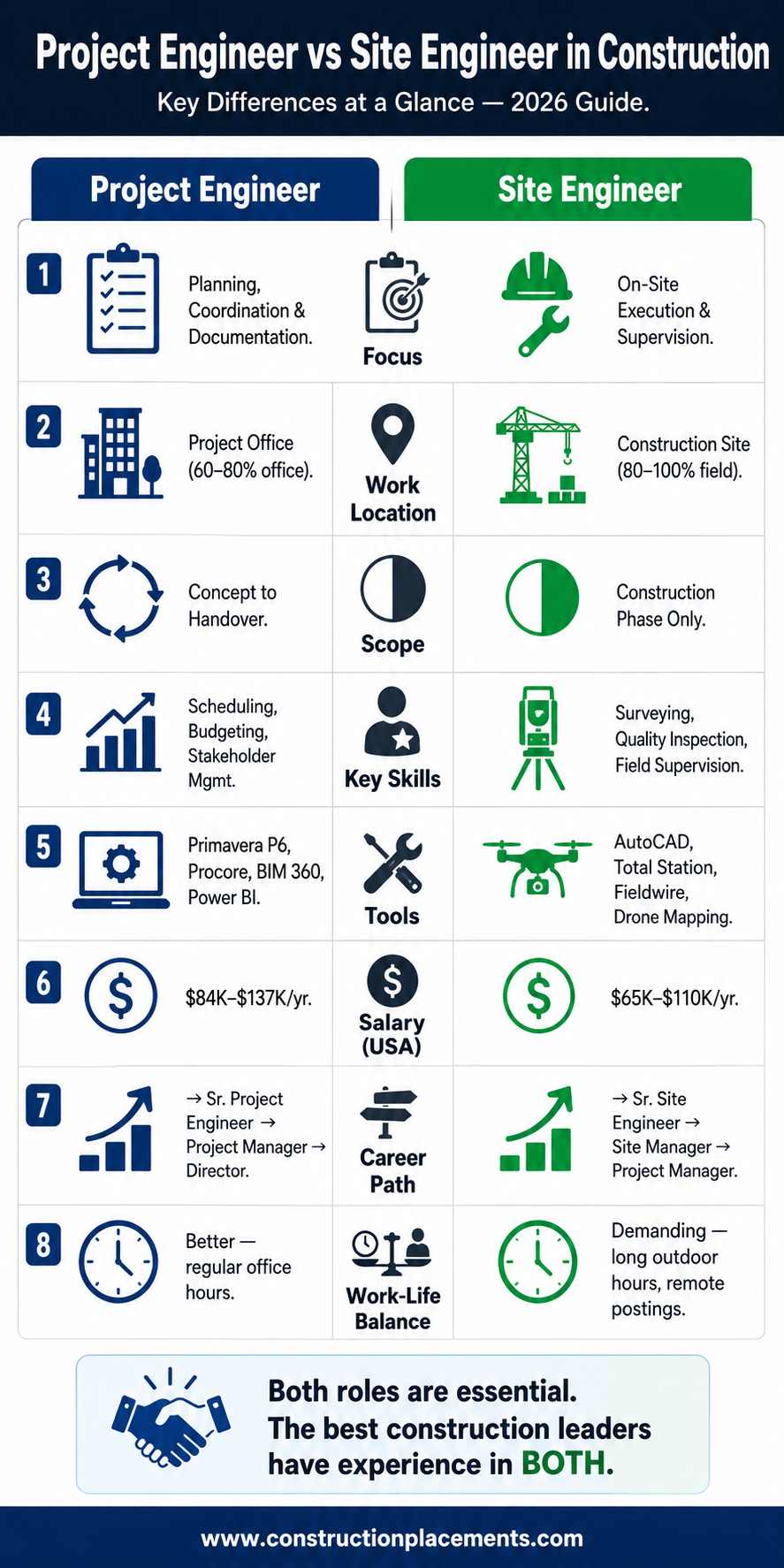
For a broader understanding of where both roles sit in the construction hierarchy, explore our guide on 150+ construction job titles and descriptions. Also, kindly check the infographic below for the Project Engineer vs. Site Engineer key differences.
Salary Comparison: Project Engineer vs Site Engineer (2026)
Salary is often the deciding factor when choosing between these two roles. Here is a realistic, market-verified breakdown across major construction markets in 2026.
United States
According to Glassdoor (April 2026), the average project engineer salary in the U.S. is approximately $106,572 per year, with the typical range falling between $84,000 and $137,000. Construction-specific project engineers earn between $83,000 and $132,000 according to the same source. PayScale reports a slightly lower average of $76,510, with entry-level compensation starting around $67,900.
Site engineers (often titled “field engineers” in the U.S.) typically earn between $65,000 and $95,000 at the entry to mid-level stage, with senior site engineers reaching $100,000–$120,000 in high-demand metropolitan areas.
India
In India, site engineers at the entry level earn approximately ₹2.5–5.0 LPA (lakhs per annum) with Tier-1 contractors like L&T, Shapoorji Pallonji, or Tata Projects. Mid-level site engineers with 5–8 years of experience earn ₹6–12 LPA. Project engineers in India typically command a 15–25% premium over site engineers at equivalent experience levels, with mid-career salaries ranging from ₹8–18 LPA depending on employer type and specialisation. For detailed India-specific data, see our Civil Engineering Scope in India 2026 guide.
Gulf (UAE, Saudi Arabia, Qatar)
The GCC construction market continues to offer the highest savings potential for engineers from South Asia. Site engineers in the Gulf typically earn AED 6,000–12,000 per month (tax-free), while project engineers command AED 12,000–25,000 per month depending on experience and project complexity. According to the Hays GCC Salary Guide 2026, the construction sector saw 58% of professionals receiving a pay increase in 2025, with further optimism for 2026. Read our complete Construction Salary Guide 2026 for market-by-market comparisons.
UK and Australia
In the UK, site engineers earn £28,000–£45,000 per year at early to mid-career stages, while project engineers earn £38,000–£60,000. In Australia, both roles command higher wages — site engineers earn AUD 80,000–110,000, and project engineers earn AUD 100,000–140,000. BIM-proficient engineers in both markets command a 25–40% premium over their peers.
Educational Qualifications and Eligibility
Both project engineers and site engineers typically start with the same educational foundation, but their career divergence often begins with the type of early experience they accumulate and the additional certifications they pursue.
Minimum Qualifications
- Bachelor’s degree in Civil Engineering, Construction Engineering, Structural Engineering, or a related discipline is the baseline requirement for both roles in most countries.
- In some markets (UK, Australia), a diploma in civil engineering or construction management may qualify candidates for site engineer roles, with subsequent progression through professional development.
- A master’s degree in Construction Management, Project Management, or Structural Engineering can accelerate career progression into the project engineer track.
Professional Certifications That Matter
The certifications that add the most value depend on which track you pursue:
For Project Engineers:
- PMP (Project Management Professional) — from Project Management Institute
- PRINCE2 Practitioner — widely valued in UK and Gulf markets
- CCM (Certified Construction Manager) — from CMAA
- Primavera P6 or MS Project certification
- BIM Manager certification (for digital project delivery)
For Site Engineers:
- CSCS Card (UK) — see our guide on how to get a CSCS card
- NEBOSH IGC or IOSH Managing Safely (for health & safety competence)
- PE License (U.S.) — NCEES PE exam
- Land surveying or total station operation certifications
- LEED GA/AP (for green building projects)
For a comprehensive list of career-enhancing certifications, explore our guide on 110 civil engineering career pathways.
Skills Required: Project Engineer vs Site Engineer
While both roles require a strong foundation in engineering fundamentals, the applied skill sets diverge significantly as engineers advance in their careers.
Technical Skills Comparison
| Skill Category | Project Engineer | Site Engineer |
|---|---|---|
| Scheduling & Planning | Advanced (CPM, resource loading, earned value analysis) | Basic to Intermediate (reading schedules, daily planning) |
| Cost Management | Budget tracking, forecasting, variance analysis | Material quantity checks, wastage control |
| Surveying | Conceptual understanding | Hands-on proficiency (total station, GPS, levelling) |
| Drawing Interpretation | Review-level (identifying discrepancies, raising RFIs) | Execution-level (translating drawings to field dimensions) |
| BIM | Project-level BIM coordination, clash management | Field BIM apps, model viewing for execution |
| Contract Knowledge | FIDIC, NEC, AIA — working knowledge essential | General awareness of contractual obligations |
| Safety Management | Policy-level oversight, HSSE reporting | Daily enforcement, toolbox talks, permit-to-work |
Soft Skills That Matter
Project engineers need strong written communication, stakeholder management, analytical thinking, and the ability to manage multiple workstreams simultaneously. They spend significant time in meetings, preparing reports, and negotiating with vendors and consultants.
Site engineers need rapid decision-making, hands-on leadership, the ability to communicate clearly with construction workers and foremen (often across language barriers), physical endurance, and spatial reasoning for translating 2D drawings into 3D structures.
Software Tools and Technology (2026)
The construction industry’s digital transformation in 2026 means both roles now require technology proficiency, though the specific tools differ.
Project Engineer’s Tech Stack
- Scheduling: Oracle Primavera P6, Microsoft Project, Asta Powerproject
- Project Management: Procore, Aconex (Oracle), BIM 360 / Autodesk Construction Cloud
- Cost & Document Control: SAP, EDMS platforms, SharePoint
- BIM: Navisworks (for coordination), BIM 360 Glue, Revit (review level)
- Reporting: Power BI, Excel (advanced), Tableau
- AI Tools (emerging): AI-powered schedule optimisation, predictive analytics for risk management
Site Engineer’s Tech Stack
- Drawing & Design: AutoCAD, Civil 3D, SketchUp
- Surveying: Total station controllers, GPS RTK software, drone mapping (DJI Terra, Pix4D)
- Field Management: Fieldwire, PlanGrid, Procore Field, Dalux
- BIM (Field): BIM 360 Field, Trimble Connect, Revizto
- Quality & Safety: iAuditor (SafetyCulture), Snagstream
- Structural Analysis: STAAD Pro, ETABS (depending on discipline)
For structural analysis interview preparation, explore our STAAD Pro interview questions and ETABS interview questions guides.
Career Progression: Which Role Leads to Project Manager Faster?
This is arguably the most important strategic consideration for early-career engineers. Both roles can eventually lead to project management, but the paths and timelines differ.
Project Engineer Career Path
The project engineer track is often considered the more direct route to project management because it inherently involves planning, coordination, and stakeholder management — the core competencies of a project manager. A typical progression looks like:
- Junior Project Engineer (0–2 years) — Document control, scheduling support, report preparation
- Project Engineer (2–5 years) — Independent management of project documentation, cost tracking, coordination
- Senior Project Engineer (5–8 years) — Leading engineering teams, managing multiple packages, client interface
- Project Manager (8–12 years) — Full P&L responsibility, strategic decision-making, client relationship management
- Senior Project Manager / Construction Director (12+ years) — Multi-project oversight, business development
Site Engineer Career Path
Site engineers build deep technical expertise first and then transition toward management. The path is longer to PM but produces engineers with unmatched field knowledge:
- Junior Site Engineer (0–2 years) — Surveying, daily supervision, learning construction methods
- Site Engineer (2–5 years) — Independent management of construction zones, quality oversight
- Senior Site Engineer (5–8 years) — Managing entire site sections, mentoring juniors, technical sign-offs
- Site Manager / Construction Manager (8–12 years) — Overall site operations, resource management, safety
- Project Manager / General Manager (12+ years) — Full project oversight combining field and management expertise
Key insight: Many top project managers in the construction industry actually started as site engineers. The field experience gives them credibility when making technical decisions and managing construction teams. However, if your goal is to reach the PM level quickly, the project engineer track typically gets you there 2–3 years sooner.
Read more about construction career trajectories in our project engineer job description and salary guide.
A Typical Day: Project Engineer vs Site Engineer
Understanding the daily rhythm of each role helps you decide which working style suits your personality.
A Day in the Life of a Project Engineer
- 7:30 AM — Review emails, check overnight RFIs and submittals from subcontractors
- 8:00 AM — Morning coordination meeting with site team and client representative
- 9:00 AM — Update project schedule in Primavera P6 based on latest progress data
- 10:30 AM — Review cost variance report, flag budget risks to the project manager
- 11:30 AM — Site walk-through to verify progress against schedule milestones
- 1:00 PM — Prepare weekly progress report with photographs and earned value metrics
- 2:30 PM — Design coordination meeting with architect and structural consultant
- 4:00 PM — Process change order documentation and update contract register
- 5:00 PM — Brief project manager on critical issues and next-day priorities
A Day in the Life of a Site Engineer
- 6:30 AM — Arrive at site, check weather conditions, brief labour gangs for the day
- 7:00 AM — Set out column positions and foundation levels using total station
- 8:30 AM — Inspect reinforcement placement before concrete pour — check bar diameters, spacing, cover
- 9:30 AM — Coordinate with concrete supplier on batch timing and mix design
- 10:00 AM — Supervise concrete pouring, conduct slump test, collect cube samples
- 12:00 PM — Walk the site to check ongoing activities — masonry, waterproofing, MEP rough-ins
- 1:30 PM — Resolve a design clash between structural beam and HVAC duct routing
- 2:30 PM — Review material delivery notes, verify quantities against BOQ
- 3:30 PM — Prepare daily progress report and site diary entry
- 4:30 PM — Coordinate next-day requirements — labour, equipment, materials
- 5:00 PM — Handover notes to the night-shift supervisor (if applicable)
Challenges and Rewards of Each Role
Project Engineer: Challenges
- Managing competing priorities from multiple stakeholders with conflicting interests
- Heavy documentation workload — reports, trackers, minutes, correspondence
- Pressure to meet schedule milestones and budget targets simultaneously
- Limited exposure to hands-on construction activities can feel disconnecting
- Navigating contractual disputes and claims without direct site involvement
Project Engineer: Rewards
- Holistic understanding of how construction projects are planned and delivered
- Faster path to leadership and project management roles
- Better work-life balance compared to site-based roles (generally office hours)
- Higher initial salary and stronger negotiating position for promotions
- Transferable skills across industries — infrastructure, oil & gas, industrial, real estate
Site Engineer: Challenges
- Physically demanding — long hours outdoors in heat, rain, dust, and noise
- Remote postings — especially for highway, dam, and pipeline projects
- High-pressure real-time decision-making with limited room for error
- Safety risks inherent to active construction environments
- Less visibility in organisational hierarchy compared to office-based roles
Site Engineer: Rewards
- Tangible satisfaction — seeing structures rise from the ground level
- Deep technical competence that is respected across the industry
- Strong demand and job security globally, especially for experienced engineers
- Rapid skill development through hands-on problem solving
- Opportunity to work on landmark projects — stadiums, bridges, airports, metros
Industry Demand and Future Outlook (2026 and Beyond)
Both project engineers and site engineers are in strong demand across global construction markets in 2026, driven by massive infrastructure investment programmes.
Global Demand Drivers
- India: With over ₹11.11 lakh crore allocated to infrastructure in the Union Budget 2025–26 (source), demand for both roles is at a historic high across metro rail, highway, airport, and smart city projects.
- Gulf/GCC: Saudi Arabia’s Vision 2030 projects (NEOM, The Line, Red Sea, Diriyah Gate) and the upcoming 2034 FIFA World Cup are creating tens of thousands of engineering positions. The GCC construction market is projected to exceed USD 130 billion in annual project awards.
- United States: The Bipartisan Infrastructure Law continues to fund highway, bridge, rail, and broadband projects across all 50 states through 2026.
- UK: HS2, housing targets, and net-zero retrofit programmes are maintaining steady demand for construction engineers at all levels.
For more on Gulf opportunities specifically, see our Gulf Construction Jobs for Indians 2026 guide and the comprehensive India-to-Gulf Construction Career Kit.
How AI and Digital Construction Are Reshaping Both Roles
In 2026, neither role is at risk of being “replaced” by AI. However, both are evolving:
- Project engineers are increasingly using AI-driven scheduling tools, automated progress tracking via drone imagery, and predictive analytics for risk management. The role is becoming more analytical and less administrative.
- Site engineers are adopting robotic total stations, LiDAR scanning, BIM-to-field workflows, and wearable safety tech. Field execution remains inherently human, but the tools are getting smarter.
Engineers who combine traditional construction knowledge with digital skills (BIM, data analytics, drone operations) will command the highest salaries and fastest promotions in the coming decade.
Which Role Should You Choose?
There is no universally “better” role — the right choice depends on your personality, career goals, and working style preferences.
Choose Project Engineer If You:
- Enjoy planning, organising, and managing information
- Are comfortable with documentation, data analysis, and report writing
- Prefer a structured office environment with predictable hours
- Want the fastest possible path to project management
- Are strong at stakeholder communication and multitasking
Choose Site Engineer If You:
- Prefer hands-on, outdoor work and dislike being desk-bound
- Enjoy solving technical problems in real time under pressure
- Want to build deep expertise in construction methods and materials
- Are physically fit and comfortable with demanding site conditions
- Find satisfaction in seeing physical progress — walls going up, slabs being poured
Can You Switch Between the Two Roles?
Absolutely. Many successful construction professionals have transitioned between site engineering and project engineering at various points in their careers. In fact, the combination of site experience and project management skills is considered the gold standard for construction leadership roles. Employers increasingly value engineers who have worked on both sides.
How to Prepare for Project Engineer and Site Engineer Interviews
If you are targeting either role, interview preparation is critical. Here are the resources that will help:
- Primavera P6 Interview Questions — essential for project engineer candidates
- QA/QC Engineer Career Guide — relevant for site engineers focusing on quality
- MEP Engineer Career Guide — for engineers working in building services
For a comprehensive interview preparation resource covering all construction roles, download our Construction Jobs Interview Preparation Guide with 210+ interview questions and model answers.
Recommended Courses to Build Your Skills
Investing in the right courses can accelerate your career in either role. Here are some top-rated options:
- Construction Project Management — Coursera (Columbia University)
- Construction Management — edX
- Primavera P6 Professional — Udemy
- Construction Management Specialisation — Coursera
Recommended Resources
These downloadable resources from our Gumroad store are designed specifically for construction professionals at every career stage:
- 📘 The Civil Engineer’s Career Ebook — complete career roadmap for civil engineering professionals
- 📗 Construction Interview Preparation Guide (210+ Q&A)
- 📦 Construction Career Bundle — ebook + interview guide + resume templates
- 🌍 Remote & International Construction Jobs Guide
Frequently Asked Questions (FAQ)
Is a project engineer higher than a site engineer?
In most construction organisational hierarchies, the project engineer is positioned one level above the site engineer. The project engineer typically oversees the overall project documentation, coordination, and progress tracking, while the site engineer reports on field activities. However, both roles are equally important — the project cannot succeed without strong execution on site, nor without effective planning and coordination from the project office.
Can a site engineer become a project engineer?
Yes. Transitioning from site engineer to project engineer is a very common career move in the construction industry. After gaining 3–5 years of site experience, engineers often move into project engineering roles by developing their project management, scheduling, and documentation skills. Adding a PMP or PRINCE2 certification strengthens this transition.
What is the salary difference between a project engineer and a site engineer?
Project engineers generally earn 15–30% more than site engineers at comparable experience levels. In the United States, a project engineer earns approximately $84,000–$137,000 per year, while site engineers earn $65,000–$110,000. In India, the premium is similar — project engineers earn ₹8–18 LPA versus ₹4–12 LPA for site engineers at mid-career.
Which role has better work-life balance?
Project engineers generally enjoy better work-life balance because their work is primarily office-based with predictable hours. Site engineers often work longer hours (10–12 hour days are common), may be required on weekends during critical pours or deadlines, and may be posted at remote project locations away from family.
Do project engineers go to the construction site?
Yes. Project engineers regularly visit the construction site for progress verification, coordination meetings, and quality walk-throughs. However, they spend the majority of their time (60–80%) in the project office handling documentation, scheduling, and stakeholder communication.
Which role is better for fresh civil engineering graduates?
Starting as a site engineer is generally recommended for fresh graduates. Site experience builds a strong technical foundation in construction methods, materials, and field supervision that will serve you throughout your career — regardless of which direction you eventually take. Many senior project managers and directors started their careers as site engineers.
Is project engineering or site engineering better for international careers?
Both roles offer strong international mobility. However, project engineers may find it slightly easier to relocate because project management methodologies (PMP, PRINCE2) and tools (Primavera, Procore) are standardised globally. Site engineers with BIM, NEBOSH, and international quality certifications (ISO 9001) also have excellent international prospects, particularly in the Gulf, Australia, and the UK.
What is the difference between a project engineer and a construction manager?
A project engineer focuses on the technical and administrative coordination of a project, while a construction manager has overall operational authority on the construction site. The construction manager oversees site logistics, labour, equipment, and safety, and is typically senior to both the project engineer and site engineer in the organisational hierarchy.
Final Thoughts
The project engineer vs site engineer debate is not about which role is “better” — it is about which role aligns with your strengths, career goals, and working style. Both are indispensable to the construction industry, and the most successful construction leaders are those who have spent meaningful time in both capacities.
In 2026, as the construction industry accelerates its digital transformation and global infrastructure investment reaches historic levels, the demand for skilled project engineers and site engineers has never been higher. Whichever path you choose, invest in continuous learning, build both technical depth and management breadth, and do not underestimate the value of hands-on site experience — it is the foundation that every great construction career is built upon.
For more career guides, salary data, and construction industry insights, explore ConstructionPlacements.com — your trusted resource for construction career growth.
