


Last Updated on June 13, 2026 by Admin
Disclaimer: This article is for educational and career guidance purposes only. It does not constitute legal advice. Readers should consult qualified legal professionals for specific contract disputes or legal matters. Contract clause references are explained in general terms for learning purposes and do not reproduce copyrighted text.
ConstructionCareerHub App is LIVE — built ONLY for construction careers. Don’t apply with a weak resume.
Get ATS-ready Resume Lab + Interview Copilot + Campus Placement Prep (resume screening, skill gaps, interview readiness) — in minutes & Other advanced features.
Explore Smarter Construction Career Tools →Quick check. Big impact. Start now.
Construction projects around the world are getting bigger, more complex, and more contractually demanding. With mega-infrastructure programmes in the GCC, rapid highway and metro expansion in India, data center construction booms across the globe, and multibillion-dollar EPC projects in energy and industrial sectors, one thing is certain: disputes, delays, and variations are inevitable. And where disputes and delays exist, the Construction Claims Engineer becomes indispensable.
If you are a civil engineer, quantity surveyor, planning engineer, contract engineer, billing engineer, or project engineer looking for a specialized, high-paying, and globally mobile career, claims engineering is one of the most rewarding paths you can pursue in 2026 and beyond. This guide covers everything you need to know — what the role involves, what skills are required, how to break into the field, salary expectations, certifications, tools, career progression, and practical examples from real construction scenarios.
Table of Contents
What Is a Construction Claims Engineer?

A Construction Claims Engineer is a professional who identifies, prepares, documents, and negotiates contractual claims arising during the execution of construction projects. These claims typically relate to delays, cost overruns, scope changes, disruption, acceleration, or other events that create a contractual entitlement for the affected party — usually the contractor, but sometimes the employer or client.
The claims engineer works at the intersection of project planning, quantity surveying, contract administration, and commercial management. Their core function is to protect their organization’s financial and contractual interests by ensuring that every eligible claim is identified early, substantiated with contemporaneous records, and presented in a structured, defensible format. Understanding FIDIC contracts and their claims procedures is fundamental to this role on international projects.
In practical terms, a claims engineer reads the contract, watches the project for deviations from the agreed scope, schedule, and cost baseline, gathers evidence from daily reports, schedules, correspondence, and cost records, and then writes a formal claim narrative linking the cause of the event to its effect and the contractual basis for compensation.
Why Construction Claims Engineers Are in Demand in 2026
The demand for claims professionals has grown significantly over the past few years, driven by several converging factors across the global construction industry.
The scale and complexity of infrastructure projects has increased dramatically. Metro rail projects, high-speed rail corridors, airports, expressways, data centers, power plants, oil and gas facilities, and EPC projects frequently involve contract values exceeding hundreds of millions or even billions of dollars. Projects of this magnitude almost always encounter delays, design changes, unforeseen ground conditions, and scope modifications, making claims management an operational necessity rather than an optional function.
Governments and international development banks such as the World Bank and Asian Development Bank have increased emphasis on proper contract administration and dispute resolution, requiring more structured claims documentation on publicly funded projects. The growing adoption of FIDIC 2017 editions with tighter notice periods has further raised the bar for claims compliance.
The GCC region, particularly Saudi Arabia’s Vision 2030, NEOM, and The Line, along with ongoing mega-projects in the UAE, Qatar, and Oman, has created a massive shortage of qualified claims engineers and commercial managers. In India, the expansion of national highways, dedicated freight corridors, metro systems, and smart city projects under government flagship programs has similarly driven demand.
In addition, the increased use of digital project controls tools like Primavera P6, Power BI, and construction analytics platforms means that claims can now be substantiated with much richer schedule and cost data — but this also means employers need people who understand both the data and the contracts.
Claims Engineer vs Contract Engineer vs Planning Engineer vs Quantity Surveyor
These four roles frequently overlap, but each has a distinct primary focus. Understanding where they differ is essential for professionals considering a transition into claims.
| Aspect | Claims Engineer | Contract Engineer | Planning Engineer | Quantity Surveyor |
|---|---|---|---|---|
| Primary Focus | Identifying, preparing, and negotiating contractual claims | Overall contract administration, compliance, and procurement | Project scheduling, progress monitoring, and delay analysis | Cost estimation, BOQ preparation, billing, and cost control |
| Core Deliverables | Claim narratives, EOT submissions, variation substantiation | Contract documents, subcontracts, compliance reports | Baseline schedules, progress reports, look-ahead plans | BOQs, interim payment certificates, final accounts |
| Contract Knowledge | Deep — claims clauses, notice provisions, entitlement analysis | Broad — full contract lifecycle management | Moderate — schedule-related contractual obligations | Moderate — measurement, valuation, and payment terms |
| Key Tools | Primavera P6, Excel, Word, delay analysis tools | Contract management software, document control systems | Primavera P6, MS Project, Power BI | CostX, Excel, estimation software, billing tools |
| Career Path Leads To | Claims Manager, Head of Claims, Dispute Resolution Expert | Contracts Manager, Commercial Manager, Procurement Director | Lead Planner, Head of Planning, Project Controls Manager | Senior QS, Commercial Manager, Cost Director |
For a deeper understanding of these adjacent roles, explore our planning engineer job description, quantity surveyor job description, and contracts engineer interview guide.
Key Responsibilities of a Construction Claims Engineer
A Claims Engineer’s day-to-day responsibilities revolve around contract review, project monitoring, record analysis, and claim documentation. Here is what the role typically involves on a live construction project:
- Reviewing the main contract, subcontracts, and purchase orders to identify claims-related provisions, notice requirements, and time bars
- Monitoring project execution daily to spot events that could give rise to a claim — delays, variations, instructions, access restrictions, or force majeure
- Issuing timely contractual notices in accordance with the contract conditions to preserve the right to claim
- Collecting and organizing contemporaneous records including daily progress reports, site instructions, engineer’s instructions, RFIs, photographs, and correspondence
- Coordinating with the planning team to obtain schedule data — baseline vs actual comparisons, critical path analysis, and delay calculations
- Working with the quantity surveying team to quantify the financial impact of delays, variations, and disruptions
- Drafting claim narratives that clearly link the cause (event), the effect (delay or cost impact), and the contractual basis (entitlement under the contract)
- Preparing Extension of Time (EOT) submissions with supporting schedule analysis and documentary evidence
- Preparing variation claims with quantity calculations, rate substantiation, and specification references
- Supporting the contracts team during claim negotiations, dispute adjudication, and arbitration proceedings
- Maintaining a claims register that tracks all active and potential claims, their status, and the estimated value
- Advising project management on contractual risks and recommending proactive measures for dispute avoidance
Types of Construction Claims
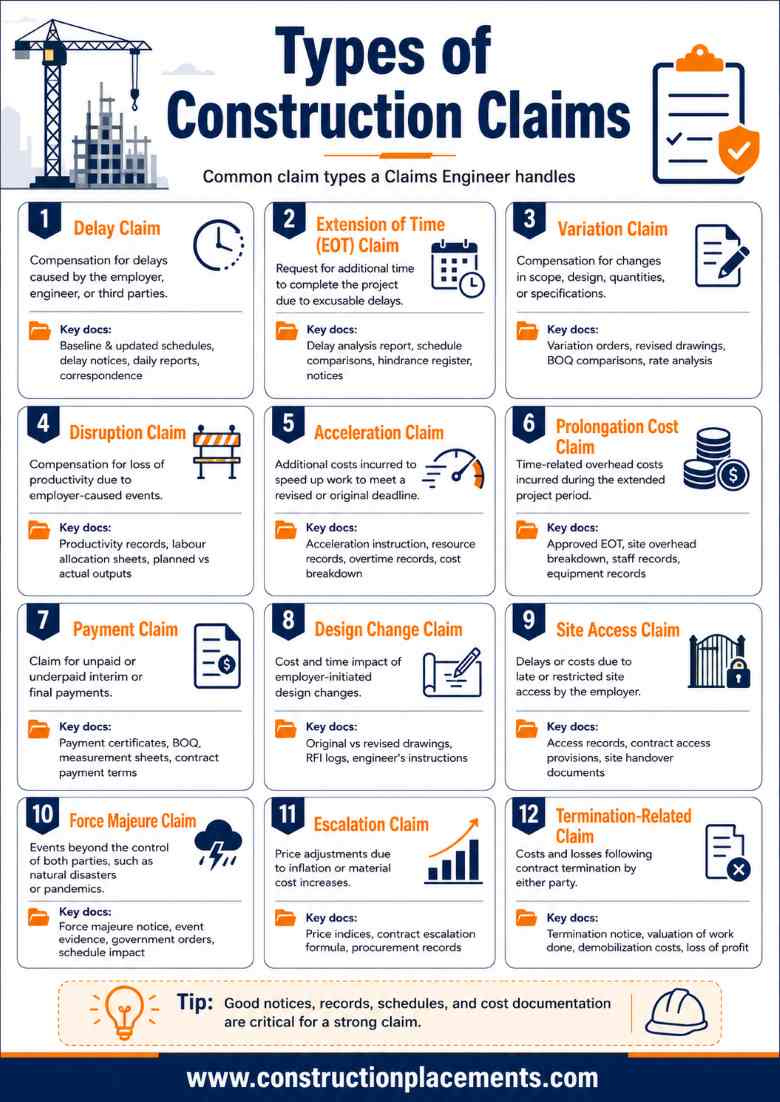
Construction claims come in many forms, depending on the cause of the disruption and the contractual provision under which the claim is made. Here are the most common types a claims engineer handles:
| Claim Type | Description | Key Supporting Documents |
|---|---|---|
| Delay Claim | Compensation for delays caused by the employer, engineer, or third parties | Baseline and updated schedules, delay notices, daily reports, correspondence |
| Extension of Time (EOT) Claim | Request for additional time to complete the project due to excusable delays | Delay analysis report, schedule comparisons, hindrance register, notices |
| Variation Claim | Compensation for changes in scope, design, quantities, or specifications | Variation orders, revised drawings, BOQ comparisons, rate analysis |
| Disruption Claim | Compensation for loss of productivity due to employer-caused events | Productivity records, labour allocation sheets, planned vs actual outputs |
| Acceleration Claim | Additional costs incurred to speed up work to meet a revised or original deadline | Acceleration instruction, resource records, overtime records, cost breakdown |
| Prolongation Cost Claim | Time-related overhead costs incurred during the extended project period | Approved EOT, site overhead breakdown, staff records, equipment records |
| Payment Claim | Claim for unpaid or underpaid interim or final payments | Payment certificates, BOQ, measurement sheets, contract payment terms |
| Design Change Claim | Cost and time impact of employer-initiated design changes | Original vs revised drawings, RFI logs, engineer’s instructions |
| Site Access Claim | Delays or costs due to late or restricted site access by the employer | Access records, contract access provisions, site handover documents |
| Force Majeure Claim | Events beyond the control of both parties, such as natural disasters or pandemics | Force majeure notice, event evidence, government orders, schedule impact |
| Escalation Claim | Price adjustments due to inflation or material cost increases | Price indices, contract escalation formula, procurement records |
| Termination-Related Claim | Costs and losses following contract termination by either party | Termination notice, valuation of work done, demobilization costs, loss of profit |
For a foundational understanding of why tracking delays matters, read our guide on why delay analysis is important in construction.
Role of Claims Engineers Across Project Types
Civil Construction Projects
In building and civil construction, claims engineers typically handle variation claims from design changes, EOT claims from late drawing approvals or material supply delays, and disruption claims from out-of-sequence work. The documentation challenge is often the lack of formal correspondence, making daily site records critical.
EPC and Infrastructure Projects
On EPC projects, claims engineers face more complex scenarios involving design responsibility, procurement delays, interface management between disciplines, and multi-party contracts. Claims on EPC projects typically require forensic delay analysis and detailed cost build-ups covering engineering, procurement, and construction phases separately.
Metro, Railway, Highway, and Bridge Projects
Government-funded transport infrastructure projects carry unique challenges including land acquisition delays, utility diversion issues, environmental clearance delays, and change orders from statutory authorities. Claims engineers on these projects must navigate government contract conditions, which often differ significantly from FIDIC or NEC templates. Understanding construction management principles is essential in these contexts.
Oil and Gas, Power, and Industrial Projects
These projects involve high-value equipment procurement, shutdown-dependent schedules, hazardous working conditions, and strict regulatory compliance. Claims engineers here must coordinate across engineering disciplines and understand the interplay between fabrication, shipping, installation, and commissioning schedules. Exploring top EPC companies in India and top EPC companies in the USA gives you a sense of the employers hiring for these roles.
Skills Required to Become a Construction Claims Engineer
Technical Skills
| Skill Area | What It Involves | Why It Matters for Claims |
|---|---|---|
| Contract Reading and Interpretation | Understanding conditions of contract, special conditions, notice provisions, and time bars | Every claim is rooted in the contract — if you cannot read it, you cannot claim |
| BOQ Understanding | Reading bill of quantities, measurement methods, and rate structures | Variation claims and cost quantification depend on BOQ knowledge |
| Drawings and Specifications | Reading engineering drawings, identifying scope changes, and matching to contract specifications | Design change and variation claims need drawing-based evidence |
| Project Planning and Scheduling | Understanding CPM, baseline schedules, critical path, float, and schedule updates | Delay claims and EOT submissions are built on schedule data |
| Delay Analysis | Methods including as-planned vs as-built, impacted as-planned, collapsed as-built, time impact analysis, and windows analysis | The technical backbone of every delay and EOT claim |
| Quantity Surveying Fundamentals | Measurement, rate analysis, cost estimation, and interim payment processes | Quantifying the financial impact of claims requires QS skills |
| Cost Control and Analysis | Tracking actual costs vs budgeted costs, overhead analysis, earned value metrics | Prolongation and disruption claims require detailed cost substantiation |
| Documentation and Record Management | Organizing project correspondence, daily reports, meeting minutes, and site instructions | Claims are only as strong as the records that support them |
| Claim Narrative Writing | Writing structured, factual, and persuasive claim documents with proper referencing | The claim narrative is the primary deliverable of a claims engineer |
| Correspondence Management | Drafting and managing contractual letters, notices, and responses | Proper correspondence creates the contemporaneous record trail |
Soft Skills
Beyond technical competencies, claims engineers must possess strong analytical thinking to connect scattered project data into a coherent claim narrative. Negotiation skills are essential since many claims are settled through direct discussions before they reach formal dispute resolution. Clear and precise written communication is non-negotiable — a poorly written claim, regardless of its merit, will struggle to succeed. Attention to detail matters enormously because a single missing notice or misquoted clause can weaken an entire claim. Finally, coordination skills are critical since claims preparation requires inputs from site teams, planning, QS, contracts, and sometimes legal departments.
Contract Knowledge Required
A competent claims engineer should be familiar with the following contract forms:
- FIDIC Contracts — Red Book (construction), Yellow Book (design-build), Silver Book (EPC turnkey). Understanding the FIDIC contract framework is essential for international projects.
- NEC Contracts — NEC3 and NEC4, widely used in the UK, Australia, and parts of Africa and Asia.
- EPC/Turnkey Contracts — Lump-sum, design-build arrangements common in oil and gas, power, and industrial projects.
- Government Contracts — GCC, CPWD (India), PWD conditions, and country-specific public procurement contracts.
- Subcontract Agreements — Back-to-back subcontracts, domestic subcontracts, and named subcontract conditions.
- Purchase Orders and Work Orders — Terms and conditions governing material supply and specialist services.
Common Documents Handled by a Claims Engineer
A claims engineer’s effectiveness depends on access to and understanding of project documents. Here is a comprehensive list of the documents that form the backbone of any construction claim:
Contract agreement and conditions of contract, letter of acceptance, bill of quantities (BOQ), engineering drawings and specifications, baseline schedule and all subsequent revisions, daily progress reports, weekly and monthly progress reports, minutes of meetings, site instructions and engineer’s instructions, RFI (Request for Information) logs and responses, drawing approval and submittal logs, hindrance registers, delay notices and contractual notices, variation orders and change orders, interim payment certificates and final account documents, project correspondence (letters, emails, memos), cost records including payroll, equipment logs, material invoices, photographs, drone images, and time-lapse records as site evidence.
For more on managing these records digitally, explore our guide on optimizing document management systems for construction.
Step-by-Step Process to Prepare a Construction Claim
Preparing a construction claim follows a structured sequence. Here is the step-by-step process used by experienced claims engineers on real projects:
Step 1 — Identify the Claim Event. Recognize the event that has caused or will cause a deviation from the contract — a delay, a design change, an instruction, a restriction, or any other qualifying event.
Step 2 — Review the Contract. Read the relevant contract clauses to establish whether the event triggers a contractual entitlement. Identify the notice provisions, time limits, and procedural requirements for submitting a claim.
Step 3 — Issue the Contractual Notice. Issue a formal notice of claim within the time period specified in the contract. Many contracts require notice within 28 days (FIDIC) or shorter periods (NEC). Failure to issue timely notice can result in the loss of entitlement — this is one of the most common mistakes in claims management.
Step 4 — Gather Contemporaneous Records. Collect all relevant documents — daily reports, correspondence, instructions, photographs, schedule data, and cost records — that relate to the claim event. The strength of a claim is directly proportional to the quality and completeness of the records.
Step 5 — Conduct Delay Analysis (if applicable). For delay and EOT claims, perform a schedule-based delay analysis using one of the recognized methodologies — as-planned vs as-built, impacted as-planned, collapsed as-built, time impact analysis, or windows analysis. The SCL Delay and Disruption Protocol published by the Society of Construction Law (scl.org.uk) provides widely accepted guidance on delay analysis best practices.
Step 6 — Quantify the Financial Impact. Calculate the additional costs incurred due to the claim event. This may include direct costs (labour, materials, equipment), indirect costs (site overheads, staff costs), head office overheads, and financing costs. Use actual cost records wherever possible rather than estimated figures.
Step 7 — Write the Claim Narrative. Draft a clear, structured claim document that covers the introduction, contractual basis, factual chronology of events, cause and effect analysis, schedule analysis, cost quantification, and the conclusion stating the amount and time sought.
Step 8 — Compile Supporting Documents. Attach all referenced documents, schedules, calculations, and correspondence as appendices. Number and cross-reference them within the narrative.
Step 9 — Internal Review. Have the claim reviewed by the project manager, contracts manager, and if necessary, the company’s legal team before formal submission.
Step 10 — Submit and Follow Up. Submit the claim to the employer or engineer as per the contract procedures. Follow up with any additional information requested and prepare for negotiation or formal dispute proceedings.
How to Prepare an Extension of Time (EOT) Claim
An EOT claim seeks additional time to complete the project when delays have been caused by events that the contractor is not responsible for. Here is a practical checklist:
EOT Claim Documentation Checklist:
- ☐ Identify the delay event and its start date
- ☐ Issue the contractual notice within the required time period
- ☐ Obtain the approved baseline schedule
- ☐ Obtain all schedule updates during the delay period
- ☐ Identify the critical path activities affected by the delay
- ☐ Perform a delay analysis using a recognized methodology
- ☐ Calculate the number of days of excusable delay
- ☐ Gather daily reports showing the impact of the delay on progress
- ☐ Collect all relevant correspondence, instructions, and notices
- ☐ Compile photographs or video evidence of the delay conditions
- ☐ Reference the specific contract clause granting the EOT entitlement
- ☐ Draft the EOT narrative linking cause, effect, and entitlement
- ☐ Submit as per the contractual procedure with all appendices
Practical Example — EOT Claim Due to Late Drawing Approval: On a residential tower project, the contractor submitted structural drawings for Block B foundations on 1st March, expecting approval within the contractually stipulated 14 days. The engineer’s approval was received on 20th April — a delay of 36 days beyond the contractual review period. Since foundation work was on the critical path, the 36-day drawing approval delay pushed the Block B completion date by the same duration. The claims engineer issued a notice on day 5 of the delay, compiled the RFI log showing the submission and approval dates, extracted the critical path from the Primavera P6 schedule, and submitted an EOT claim for 36 calendar days with supporting delay analysis and correspondence.
How to Prepare a Variation Claim
Variation Claim Documentation Checklist:
- ☐ Identify the variation — what has changed from the original contract scope?
- ☐ Confirm whether a variation order has been issued or whether the work constitutes a deemed variation
- ☐ Compare original drawings and specifications with revised versions
- ☐ Measure the additional or changed quantities
- ☐ Build the rate using contract rates (if applicable) or a new rate with cost build-up
- ☐ Calculate the total cost of the variation
- ☐ Assess whether the variation has a time impact — if so, prepare an associated EOT claim
- ☐ Reference the contract clause governing variations
- ☐ Draft the variation claim narrative
- ☐ Submit with all supporting calculations, drawings, and correspondence
Practical Example — Variation Claim Due to Foundation Design Change: On a commercial building project, the original design specified isolated footings for the ground floor columns. After geotechnical investigation results were revised, the structural engineer changed the design to a raft foundation. The claims engineer identified this as a variation, compared the original and revised structural drawings, calculated the additional concrete, reinforcement, and formwork quantities using BOQ rates, assessed that the design change required an additional 18 working days (which were on the critical path), and submitted a combined variation-plus-EOT claim valued at approximately INR 1.2 crore with 18 days of additional time.
How to Support Claims with Project Records
The single most important factor that separates a successful claim from a failed one is the quality of project records. Here is the difference between weak and strong claim documentation:
| Weak Documentation | Strong Documentation |
|---|---|
| No daily progress reports during the delay period | Daily progress reports signed by both parties showing zero activity due to delay |
| Verbal instructions with no written confirmation | Written site instruction followed by a confirmation letter within 24 hours |
| Delay notice sent 60 days after the event | Delay notice issued within 7 days with reference to the specific contract clause |
| Generic claim narrative saying “the project was delayed” | Detailed narrative with chronological events, cause-effect analysis, and referenced documents |
| No schedule analysis — just a claim for “estimated” days | Delay analysis using time impact analysis method with Primavera P6 schedule data |
| Cost claim based on rough estimates | Cost claim supported by actual invoices, payroll records, equipment logs, and overhead breakdown |
Daily Records Checklist for Site Engineers Supporting Claims:
- ☐ Record weather conditions and any weather-related stoppages
- ☐ Log all labour deployed by trade, activity, and location
- ☐ Record equipment on site — working hours, idle hours, and breakdown hours
- ☐ Document all materials received, used, and wasted
- ☐ Note any hindrances — access restrictions, design hold points, pending approvals
- ☐ Log all instructions received — verbal instructions must be confirmed in writing
- ☐ Take dated photographs of progress, obstructions, and completed work
- ☐ Record visitors, inspections, and test results
- ☐ Note any safety incidents or near-misses
- ☐ Submit the daily report by end of shift — never backdate
Common Mistakes in Construction Claims
Even experienced professionals make errors that weaken their claims. Here are the most frequently observed mistakes:
Failing to issue the contractual notice within the required time frame is the single most damaging error. Many contracts impose strict time bars — if you miss the notice deadline, you may lose your right to claim entirely, regardless of merit. Another common mistake is relying on verbal instructions without written confirmation. In claims and disputes, only documented evidence carries weight. Submitting claims without proper delay analysis, using generic language instead of specific contractual references, mixing multiple claim events into a single document without clear separation, and failing to maintain a proper claims register are all avoidable errors that significantly reduce the chances of a successful outcome.
More Practical Claim Examples
Cost Claim Due to Delayed Site Access: A highway contractor was scheduled to receive access to a 5-km section on 1st January. The employer did not hand over the site until 15th March — a delay of 74 days caused by ongoing land acquisition proceedings. During this period, the contractor’s site establishment (staff, equipment, temporary facilities) was already mobilized, incurring idle costs. The claims engineer compiled the mobilization records, calculated the daily idle costs for staff and equipment, referenced the contract clause requiring timely site access, and submitted a prolongation cost claim for 74 days of idle site establishment.
Delay Claim Due to Client-Supplied Material Delay: On a water treatment plant project, the employer was responsible for supplying imported filtration equipment. The equipment arrived 45 days late, impacting the installation and commissioning schedule. The claims engineer used a time impact analysis to demonstrate the 45-day delay on the critical path, gathered the procurement correspondence showing the original and revised delivery dates, and submitted a combined EOT and prolongation cost claim.
Acceleration Claim Due to Revised Completion Deadline: Midway through a school construction project, the education authority instructed the contractor to complete two months earlier than the original deadline to align with the academic year. The contractor mobilized additional labour crews, procured materials on expedited schedules, and worked overtime and weekends. The claims engineer documented the acceleration instruction, calculated the additional direct and indirect costs of working at an accelerated pace, and submitted a constructive acceleration claim with full cost substantiation.
🎯 Planning Your Claims Engineering Career? Use the AI-powered career tools at ConstructionCareerHub.com to build an ATS-optimized resume highlighting your contract and claims skills, practice claims engineer interview questions with the Interview Copilot, and identify skill gaps with the Skills Gap Analyzer — all designed exclusively for construction professionals.
How Planning Engineers Can Move into Claims
Planning engineers are among the best-positioned professionals to transition into claims because they already possess the scheduling expertise that forms the technical foundation of delay claims. If you are a planning engineer considering this move, here is your transition checklist:
- ☐ Study the conditions of contract on your current project — focus on claims, variations, and EOT clauses
- ☐ Learn delay analysis methodologies beyond basic schedule comparison — study the SCL Delay and Disruption Protocol
- ☐ Volunteer to assist the contracts team during a real claim preparation
- ☐ Practice writing claim narratives — start with a simple EOT claim on your current project
- ☐ Understand how schedule data connects to cost data and contractual entitlement
- ☐ Build knowledge of FIDIC and NEC claims provisions
- ☐ Take a construction claims management course (see recommended courses below)
- ☐ Update your resume to highlight any claims-related contributions you have made
For interview preparation for planning roles, check our planning engineer interview questions and Primavera P6 interview questions guides.
How Quantity Surveyors Can Move into Claims
Quantity surveyors bring strong measurement, cost estimation, and contract knowledge to the claims function. The transition requires deepening your understanding of schedule analysis and claim narrative writing:
- ☐ Develop basic proficiency in Primavera P6 or MS Project — you do not need to be a scheduler, but you must understand how to read and interpret schedule data
- ☐ Study delay analysis methods and how time impact is calculated
- ☐ Strengthen your understanding of the claims and dispute resolution clauses in your current contract
- ☐ Practice building prolongation cost claims using actual project overhead data
- ☐ Get involved in variation claim preparation — you already handle BOQs and rates, so this is a natural extension
- ☐ Consider pursuing RICS or AACE International certifications with a claims specialization
Explore quantity surveying courses and quantity surveying software guides for foundational resources.
How Civil Engineers and Site Engineers Can Move into Claims
Civil and site engineers often have the most direct exposure to the field-level events that give rise to claims — they witness the delays, the design changes, the access restrictions, and the variation instructions firsthand. To move into claims, they need to build the contractual and documentation skills that translate field observations into formal claims.
- ☐ Start maintaining meticulous daily reports — not just progress, but hindrances, instructions, and delays
- ☐ Learn to read your project’s contract conditions, especially the general conditions and special conditions
- ☐ Understand how BOQs, measurement sheets, and payment processes work
- ☐ Develop proficiency in at least one scheduling tool — Primavera P6 is the industry standard
- ☐ Take a contract management or claims management course
- ☐ Request a rotation into the contracts or commercial department on your current project
Build your foundation with our civil engineering career guide and explore 110 career pathways in civil engineering.
Construction Claims Engineer Career Path
| Level | Typical Titles | Experience | Key Responsibilities |
|---|---|---|---|
| Entry Level | Junior Claims Engineer, Claims Coordinator, Assistant Claims Engineer | 0–3 years | Assisting in record collection, document organization, schedule data extraction, and drafting claim sections under supervision |
| Mid Level | Claims Engineer, Contract Claims Engineer, Delay Analyst | 3–7 years | Independent claim preparation, delay analysis, variation claims, EOT submissions, and supporting negotiations |
| Senior Level | Senior Claims Engineer, Claims Manager, Head of Claims | 7–12 years | Leading the claims function for large or multiple projects, negotiating settlements, advising on contractual strategy, and mentoring junior claims staff |
| Leadership Level | Commercial Manager, Head of Commercial, Director of Claims & Disputes, Expert Witness | 12+ years | Strategic commercial management across projects or portfolios, dispute resolution leadership, arbitration support, and expert witness services |
For broader career progression insights, explore our career progression steps in construction management and project management job titles guide.
Salary Potential: India, GCC, and International Markets
| Level | India (INR LPA) | GCC — UAE/Saudi/Qatar (AED/month) | UK (GBP/year) | USA/Canada (USD/year) | Australia (AUD/year) |
|---|---|---|---|---|---|
| Entry Level (0–3 yrs) | ₹3–6 LPA | AED 5,000–9,000 | £28,000–40,000 | $55,000–72,000 | AUD 65,000–85,000 |
| Mid Level (3–7 yrs) | ₹8–15 LPA | AED 10,000–18,000 | £42,000–65,000 | $75,000–100,000 | AUD 90,000–120,000 |
| Senior Level (7–12 yrs) | ₹18–30 LPA | AED 20,000–35,000 | £65,000–95,000 | $100,000–140,000 | AUD 130,000–170,000 |
| Leadership (12+ yrs) | ₹30–50+ LPA | AED 35,000–60,000+ | £90,000–130,000+ | $130,000–200,000+ | AUD 170,000–220,000+ |
GCC salaries are typically tax-free and often include additional benefits such as housing allowance, travel, medical insurance, and annual return flights. For broader salary context, see our construction salary guide. If you are considering a move to the Gulf region, explore our guide on landing construction jobs in Dubai.
Recommended Software and Tools for Claims Engineers
| Tool Category | Recommended Tools | Use in Claims |
|---|---|---|
| Scheduling & Delay Analysis | Oracle Primavera P6, MS Project, Asta Powerproject | Schedule analysis, critical path identification, delay impact calculation |
| Cost Analysis & BOQ | Microsoft Excel, CostX, Candy (CCS) | Cost quantification, rate analysis, prolongation cost calculation |
| Reporting & Visualization | Power BI, Tableau, Excel Charts | Visual dashboards for claim presentations, S-curve analysis, delay summaries |
| Document Control & Collaboration | Oracle Aconex, Procore, SharePoint, BIM 360 | Managing project correspondence, RFIs, submittals, and document trails |
| Claim Writing & Documentation | Microsoft Word, Adobe Acrobat Pro, Bluebeam Revu | Drafting claim narratives, compiling PDF submissions, marking up documents |
| Specialized Delay Analysis | SmartPM, Deltek Acumen, Primavera Risk Analysis | Forensic schedule analysis, automated delay calculations, risk assessment |
Learn more about construction technology through our guides on why you should learn Primavera P6, Power BI for planning engineers, and construction analytics and dashboard tools.
🔧 Sharpen Your Claims Engineering Toolkit — Whether you are preparing for a claims engineer interview or evaluating your skill gaps, ConstructionCareerHub.com offers an Interview Copilot, Resume Lab, and Career Planner tailored specifically for construction professionals. Practice scenario-based claims questions, optimize your CV for commercial roles, and get AI-powered career clarity.
Recommended Certifications and Courses
Professional certifications significantly boost credibility and earning potential for claims engineers. Here are the most recognized credentials:
AACE International (aacei.org) — The Certified Claims Professional (CCP), Certified Estimating Professional (CEP), and Planning and Scheduling Professional (PSP) certifications are highly valued in North America, the GCC, and international markets.
RICS (rics.org) — Becoming a Member of RICS (MRICS) in Quantity Surveying or Project Management provides global recognition and credibility, especially in the UK, GCC, and Commonwealth countries.
CIOB (ciob.org) — The Chartered Institute of Building offers membership and certification pathways for construction management professionals with expertise in commercial and claims management.
CIArb (ciarb.org) — The Chartered Institute of Arbitrators offers membership grades (MCIArb, FCIArb) relevant for claims professionals interested in dispute resolution, adjudication, and arbitration.
PMP (pmi.org) — While not claims-specific, the Project Management Professional certification adds value for claims engineers by demonstrating project management competency. See our guide on becoming a certified construction project manager.
FIDIC-Accredited Courses — FIDIC offers accredited training programmes on contract management and claims procedures through authorized providers. These are particularly valuable for professionals working on international projects governed by FIDIC conditions.
Oracle Primavera P6 Certification — Available through Oracle University, this certification validates scheduling proficiency essential for delay analysis.
Recommended Online Courses
- Construction Claims Management on Udemy — a practical course covering claim identification, preparation, and negotiation
- FIDIC Contracts Course on Udemy — focused on understanding FIDIC conditions for claims and contract administration
- Construction Management Specialization on Coursera (Columbia University) — a comprehensive programme covering project management, scheduling, and cost management
- Project Management courses on edX — foundational project management knowledge relevant to claims professionals
Also, explore our curated guides on construction management courses and top construction management certifications.
Best Books, Resources, and Learning Path
The following books and resources are widely recommended by experienced claims professionals (verify current edition availability before purchasing):
- Construction Claims and Responses by Andy Hewitt — a practical guide with real examples
- Delay Analysis in Construction Contracts by P. J. Keane and A. F. Caletka — comprehensive coverage of delay analysis methodologies
- FIDIC: An Analysis of International Construction Contracts by Axel-Volkmar Jaeger and Götz-Sebastian Hök — essential for understanding FIDIC conditions
- Construction Disputes and Their Resolution by the Society of Construction Law
- Keating on Construction Contracts — the authoritative UK construction law reference
- The SCL Delay and Disruption Protocol — published by the Society of Construction Law
- AACE International Recommended Practices — available from AACE
- Institution of Civil Engineers (ICE) publications on contract administration
Sample Job Description for a Construction Claims Engineer
Here is a realistic sample job description based on what employers typically post for mid-level Claims Engineer roles in 2026:
Position: Claims Engineer
Location: Project-based (GCC/India/International)
Experience: 5–8 years in construction claims, contract management, or project controls
Qualification: Bachelor’s degree in Civil Engineering, Quantity Surveying, or Construction Management
Key Responsibilities: Identify and prepare contractual claims, draft EOT and variation submissions, perform delay analysis using Primavera P6, coordinate with planning and QS teams for data, maintain the project claims register, support negotiation and dispute resolution processes, and advise on contractual risk mitigation.
Required Skills: Strong knowledge of FIDIC or NEC contracts, proficiency in Primavera P6 and MS Excel, excellent written English, experience with claim narrative writing, and demonstrated understanding of delay analysis methodologies. Professional membership in RICS, AACE, or CIOB is preferred.
Sample Resume Keywords for Claims Engineer Roles
| Category | Keywords to Include |
|---|---|
| Core Role Keywords | Claims Engineer, Claims Management, Construction Claims, Contract Claims, Commercial Management |
| Technical Skills | Delay Analysis, Extension of Time, EOT, Variation Claims, Disruption Claims, Prolongation Costs, Forensic Delay Analysis, Time Impact Analysis |
| Contract Knowledge | FIDIC Red Book, FIDIC Yellow Book, NEC3, NEC4, EPC Contracts, Subcontract Management, Contract Administration |
| Software | Primavera P6, MS Project, Microsoft Excel, Power BI, Aconex, Procore, Bluebeam, Adobe Acrobat |
| Deliverables | Claim Narrative, EOT Submission, Variation Substantiation, Delay Analysis Report, Claims Register, Cost Quantification |
| Certifications | CCP (AACE), MRICS, MCIOB, MCIArb, PMP, Primavera P6 Certified |
For resume-building tips, use our free construction resume builder and review the 20-point EPC resume checklist.
Interview Questions for Construction Claims Engineer Jobs
If you are preparing for a claims engineer interview, here are the types of questions you should expect and prepare for:
- What is the first thing you do when you identify a potential claim on a project?
- Explain the difference between a delay claim and a disruption claim.
- What delay analysis methods are you familiar with? Which do you prefer and why?
- How do you ensure that contractual notices are issued on time?
- Walk me through how you would prepare an EOT claim from start to finish.
- What is the role of contemporaneous records in claim substantiation?
- How do you handle a situation where the project team has not maintained proper records?
- Explain the difference between time-related costs and disruption costs in a prolongation claim.
- How do you coordinate with the planning engineer and quantity surveyor during claim preparation?
- What contract forms have you worked with? How do their claims provisions differ?
- How do you approach claim negotiation with the employer or engineer?
- Describe a claim you prepared that was successfully settled. What made it successful?
- What would you do if your employer asked you to inflate a claim beyond what the records support?
- How do you maintain a claims register on a large project?
- What is constructive acceleration and how would you claim for it?
For more interview preparation resources, explore our contracts engineer interview questions, project management interview questions, and challenging construction interview questions guides.
30-Day, 60-Day, and 90-Day Learning Roadmap
| Phase | Focus Area | Actions |
|---|---|---|
| Days 1–30: Foundation | Contract literacy and claims basics | Read your project’s contract conditions cover to cover. Study FIDIC Sub-Clauses related to claims, variations, and EOT. Read the SCL Delay and Disruption Protocol. Take an introductory construction claims course. Start a personal study file of claim examples. |
| Days 31–60: Technical Skills | Delay analysis and claim writing | Learn Primavera P6 at an intermediate level — focus on schedule comparison, baseline vs actual, and critical path analysis. Practice writing a claim narrative for a simple delay or variation scenario. Study at least two delay analysis methodologies in depth. Review real claim documents (if accessible). |
| Days 61–90: Practical Application | Real project involvement and professional development | Volunteer to assist on a live claim on your current project. Draft a complete claim document and get it reviewed by a senior contracts or claims professional. Register for an AACE, RICS, or CIOB certification pathway. Update your resume with claims-related skills and experience. Start applying for claims engineer positions. |
Future Scope of Construction Claims Engineering
The future of claims engineering is shaped by several powerful trends. The continued global investment in infrastructure — from India’s Bharatmala and Sagarmala programmes to Saudi Arabia’s Vision 2030, the EU’s post-pandemic recovery infrastructure, and the US Infrastructure Investment and Jobs Act — ensures a growing pipeline of complex projects that require robust claims management.
Digital transformation is changing how claims are prepared. AI-powered tools can now scan thousands of project documents to identify potential claim events. Construction analytics platforms like SmartPM can automate forensic delay analysis that previously took weeks of manual effort. Power BI dashboards make claim presentations more compelling and data-driven. However, the judgment, negotiation, and narrative writing aspects of claims engineering remain firmly in the domain of human professionals — AI assists but does not replace the claims engineer.
The increasing adoption of Building Information Modelling (BIM) on construction projects is also creating new types of claims and new sources of evidence. 4D and 5D BIM models provide visual proof of scope changes, progress deviations, and design conflicts that can support claims with unprecedented clarity.
For claims professionals willing to invest in continuous learning, the career outlook is exceptionally strong. Those who combine traditional contract and claims knowledge with digital tools proficiency will command the highest salaries and the most interesting project assignments.
🚀 Ready to Launch or Advance Your Claims Engineering Career? Start with a skills assessment at ConstructionCareerHub.com. The platform’s AI-powered Career Planner, Resume Lab, and Interview Copilot are purpose-built for construction professionals targeting commercial, claims, and contract management roles. Take the first step today.
Final Career Advice for Construction Professionals
If there is one piece of advice that experienced claims professionals consistently give, it is this — start documenting everything, now. Whether you are a site engineer, a planning engineer, or a quantity surveyor, the habit of maintaining meticulous records is the single most transferable skill for a claims career. Every daily report you write, every letter you file, and every photograph you take is a potential building block for a future claim.
Do not wait until you have a formal “Claims Engineer” title to start learning. Read your project’s contract. Ask the contracts team about ongoing claims. Volunteer to draft a section of a claim document. Take an online course. Read one book on construction claims. These small investments compound quickly and open doors to one of the most intellectually stimulating and financially rewarding careers in the construction industry.
For further career development resources, explore the comprehensive collection of guides on ConstructionPlacements.com, including our construction project management career guide, what you can do with a construction management degree, and entry-level construction jobs guide.
Recommended eBooks for Career Development
- 📘 Civil Engineering Career Guide eBook — comprehensive career planning resource for civil engineers at all levels
- 📗 Construction Interview Guide eBook — 300+ interview questions and answers for construction job interviews
- 📕 Construction Career Bundle — complete set of career resources at a discounted price
- 📙 Remote Construction Job Hunting System — strategies for finding remote and international construction opportunities
Frequently Asked Questions (FAQ)
What is a Construction Claims Engineer?
A Construction Claims Engineer is a professional who identifies, prepares, and negotiates contractual claims on construction projects. These claims may involve delays, variations, cost overruns, disruption, or other events that create an entitlement under the construction contract. The role combines knowledge of construction contracts, project scheduling, quantity surveying, and technical writing.
What does a Claims Engineer do on a daily basis?
On a typical day, a claims engineer reviews project progress against the contract baseline, monitors for potential claim events, reviews correspondence and instructions, collects records from site and planning teams, works on active claim narratives, and coordinates with contracts and legal departments.
How do you become a Construction Claims Engineer?
Most claims engineers start with a degree in civil engineering, quantity surveying, or construction management, followed by several years of site or project experience. Transitioning into claims requires learning construction contracts, delay analysis, and claim writing — either through formal courses, on-the-job mentoring, or self-study. Professional certifications from AACE International, RICS, or CIOB strengthen your candidacy.
What skills are required for construction claims?
Key skills include contract reading and interpretation, delay analysis, quantity surveying fundamentals, cost analysis, claim narrative writing, correspondence management, proficiency in Primavera P6 and Excel, and strong analytical and communication abilities.
Is claims engineering a good career in 2026?
Yes, claims engineering is one of the highest-demand and highest-paying specializations in the construction industry globally. The increasing complexity of infrastructure and EPC projects, combined with a persistent shortage of qualified claims professionals, ensures strong job security and salary growth for years to come.
What is the difference between a Claims Engineer and a Planning Engineer?
A planning engineer focuses on creating and maintaining project schedules, monitoring progress, and producing planning reports. A claims engineer uses schedule data (among other records) to prepare contractual claims for delays, variations, and additional costs. Planning engineers produce the data; claims engineers interpret it through a contractual lens.
What is the difference between a Claims Engineer and a Quantity Surveyor?
A quantity surveyor manages project costs — estimation, BOQ preparation, measurement, billing, and cost control. A claims engineer focuses on identifying and substantiating contractual claims using cost data, schedule analysis, and project records. QS professionals quantify the financial impact, while claims engineers build the contractual argument around it.
What documents are required for construction claims?
Essential documents include the contract agreement, baseline and updated schedules, daily progress reports, site and engineer’s instructions, RFI logs, delay notices, variation orders, cost records, payment certificates, meeting minutes, hindrance registers, and project correspondence.
Which software is useful for Claims Engineers?
Primavera P6 for schedule analysis, MS Excel for cost calculations, Power BI for visual reporting, Microsoft Word for claim writing, Adobe Acrobat Pro for PDF management, and document control systems like Aconex or Procore for correspondence and record management.
Can a fresher become a Claims Engineer directly?
It is uncommon to enter claims engineering directly as a fresher because the role requires practical understanding of construction projects, contracts, and documentation. Most professionals transition into claims after 2–5 years of experience in planning, quantity surveying, contract administration, or site engineering.
What is the notice period for claims under FIDIC contracts?
Under FIDIC 2017 editions, the contractor is generally required to give notice of a claim within 28 days of becoming aware of (or should have become aware of) the event or circumstance giving rise to the claim. Failure to give timely notice may result in loss of entitlement. Always refer to the specific contract conditions for exact requirements, as particular conditions may modify the general provisions.
What is the SCL Delay and Disruption Protocol?
The SCL Protocol, published by the Society of Construction Law (UK), is a widely referenced guidance document on delay and disruption analysis. It sets out recommended approaches for delay analysis, record-keeping, and claim preparation. While not a legal standard, it is frequently cited in arbitrations and adjudications globally.
This article was last updated in June 2026. Salary figures are indicative and may vary based on employer, project type, location, and individual qualifications. Course recommendations include affiliate links that help support ConstructionPlacements.com at no additional cost to you.
