

Last Updated on June 13, 2026 by Admin
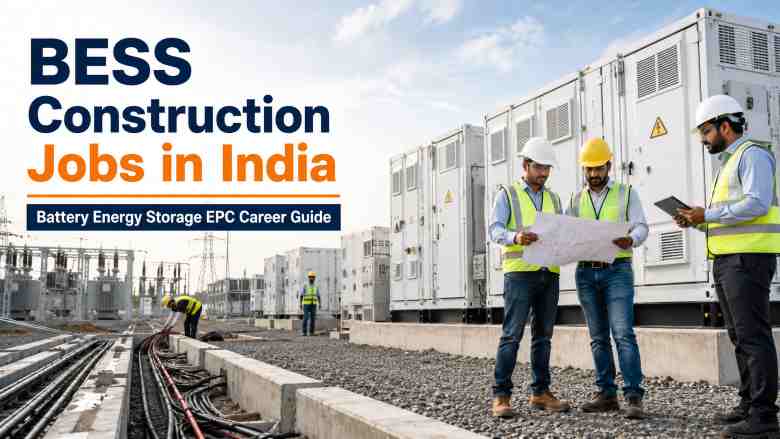
India’s battery energy storage sector has moved from pilot projects to large-scale grid infrastructure — and with it, thousands of new BESS construction jobs are being created across the country. If you are a civil, electrical, or mechanical engineer, a planning engineer, a QA/QC or HSE professional, a commissioning specialist, or a fresher looking to enter the renewable energy sector, Battery Energy Storage System (BESS) EPC projects represent one of the most significant career opportunities available in 2026.
ConstructionCareerHub App is LIVE — built ONLY for construction careers. Don’t apply with a weak resume.
Get ATS-ready Resume Lab + Interview Copilot + Campus Placement Prep (resume screening, skill gaps, interview readiness) — in minutes & Other advanced features.
Explore Smarter Construction Career Tools →Quick check. Big impact. Start now.
According to the India Energy Storage Alliance (IESA), India’s cumulative installed battery energy storage capacity is projected to reach 346 GWh by 2033, up from less than 1 GWh currently. The Central Electricity Authority (CEA) estimates that 236 GWh of BESS capacity alone will be needed by 2031–32. With over 92 GWh of BESS projects already in the pipeline and major policy support through the Ministry of Power’s Viability Gap Funding (VGF) scheme, the construction workforce required to build, install, test, commission, and maintain these projects is growing rapidly.
This career guide covers everything you need to know about BESS construction jobs in India — from understanding what BESS is and how EPC projects work, to the specific job roles available, skills required, career paths, salary scope, companies hiring, and a practical 90-day learning roadmap to help you get started.
Disclaimer: This article is educational and career guidance content. It is not engineering design, legal, financial, or safety compliance advice. Salary figures, job availability, and market data can vary significantly by company, location, project size, technology, experience level, and market conditions. Always verify current information from official sources before making career decisions.
Table of Contents
What Is a Battery Energy Storage System (BESS)?
A Battery Energy Storage System (BESS) is an integrated system that stores electrical energy in batteries and releases it when needed. In utility-scale applications, BESS consists of battery cells (usually lithium-ion, often LFP chemistry), a Battery Management System (BMS), a Power Conversion System (PCS), an Energy Management System (EMS), transformers, switchgear, protection systems, HVAC or thermal management, fire detection and suppression, SCADA, and associated civil and electrical infrastructure.
BESS plays a critical role in India’s energy transition by storing surplus solar and wind energy during peak generation hours and dispatching it during evening peak demand, when renewable generation drops. This is what engineers call “energy shifting” — and it is the fundamental reason why grid-scale battery storage is now a construction priority across the country.
Think of it this way: India had around 130 GW of solar capacity as of mid-2025. All that solar generation peaks between 10 AM and 3 PM. But electricity demand peaks between 6 PM and 10 PM. Without storage, this mismatch creates grid instability, curtailment, and reliance on coal-fired peaking plants. BESS solves this by absorbing excess renewable energy and releasing it precisely when the grid needs it most.
What Are BESS Construction Jobs?
BESS construction jobs are engineering and project management roles involved in the physical construction, installation, testing, commissioning, and handover of Battery Energy Storage System projects on site. These are EPC (Engineering, Procurement, and Construction) roles — the people who build the actual infrastructure, not just design it on paper.
BESS construction jobs include civil engineers building foundations and access roads, electrical engineers installing cables, switchgear, and transformers, mechanical engineers handling battery container placement and HVAC systems, commissioning engineers testing BMS, PCS, EMS, and SCADA integration, QA/QC engineers managing inspection test plans and documentation, HSE engineers ensuring electrical safety and fire risk management, planning engineers scheduling the EPC execution, and project managers coordinating the entire operation.
If you have worked on solar EPC projects, substation construction, power transmission projects, or industrial electrical installations, the transition to BESS construction is very achievable — and this guide will show you exactly how.
Why BESS Construction Jobs Are Growing in India in 2026
Multiple forces are driving the rapid growth of BESS construction jobs across India. This is not a speculative trend — government policy, market tenders, and on-the-ground project activity back it.
National Electricity Plan storage projections. The CEA’s National Electricity Plan projects that India will need 82.37 GWh of total energy storage by 2026–27 and 411.4 GWh by 2031–32, of which 236 GWh is expected to come from BESS. These are infrastructure-scale numbers that require thousands of engineers, technicians, and project managers to construct.
VGF scheme expansion. The Ministry of Power’s VGF scheme, originally targeting 4,000 MWh of BESS capacity with budgetary support of up to 40% of capital costs, has been expanded. In June 2025, the Ministry approved a second tranche supporting 30 GWh of new standalone BESS capacity, with 25 GWh allocated across 15 Indian states and 5 GWh designated for NTPC. This creates immediate construction demand.
Energy Storage Obligation (ESO). The Ministry of Power has mandated that distribution companies (DISCOMs) progressively procure storage-backed power, starting at 1% of supply in FY 2024–25 and rising to 4% by FY 2029–30. This creates sustained procurement demand for BESS projects over the coming years.
Massive tender pipeline. Over 92 GWh of BESS projects are already in India’s active project pipeline. Tenders for standalone BESS and renewable-plus-storage projects are being issued by SECI, NTPC, NHPC, SJVN, and state-level implementing agencies.
Grid flexibility requirements. India’s grid demand swings now reach up to 90 GW, according to GRID India. Solar generation creates a steep “duck curve” — abundant midday power followed by a sharp evening ramp. BESS provides the ramping capacity, frequency response, and peak power that the grid needs, and building this capacity requires large-scale EPC execution.
State-level demand. States such as Gujarat, Rajasthan, Maharashtra, Tamil Nadu, Karnataka, Andhra Pradesh, Telangana, Uttar Pradesh, Madhya Pradesh, and Odisha are actively procuring BESS capacity. Rajasthan has already moved ahead of the national ESO curve, requiring DISCOMs to source 3% of supply from storage-backed contracts by FY 2026–27.
ConstructionCareerHub App is LIVE — built ONLY for construction careers. Don’t apply with a weak resume. Get ATS-ready Resume Lab + Interview Copilot + Campus Placement Prep (resume screening, skill gaps, interview readiness) — in minutes and other advanced features.
Explore Smarter Construction Career Tools →
Why BESS EPC Projects Matter for India’s Energy Transition
India is targeting 500 GW of non-fossil fuel capacity by 2030 under its Paris Agreement commitments. The country has already surpassed 250 GW of installed renewable capacity. But renewable energy is intermittent — solar generates only during the day, wind blows strongest at night and in specific corridors. Without large-scale energy storage, India cannot achieve round-the-clock (RTC) renewable power supply, maintain grid stability, or retire coal-based peaking capacity.
BESS addresses this fundamental challenge by enabling energy shifting (storing cheap midday solar for expensive evening peaks), providing grid ancillary services (frequency regulation, voltage support, spinning reserve), supporting renewable purchase obligations and energy storage obligations, reducing transmission congestion, deferring costly grid infrastructure upgrades, and enabling solar-plus-storage and wind-solar hybrid projects to deliver firm, dispatchable power.
For engineers and construction professionals, this means that BESS is not a niche add-on — it is becoming a core component of India’s power infrastructure. Every new solar park, every wind-solar hybrid project, and every grid modernization initiative increasingly includes a storage component. The EPC career opportunities in this space are multiplying rapidly.
Difference Between Solar EPC Jobs and BESS EPC Jobs
Many engineers working on solar EPC projects are interested in transitioning to BESS. While there is significant overlap, the two disciplines have important differences that engineers should understand.
| Aspect | Solar EPC | BESS EPC |
|---|---|---|
| Primary Equipment | PV modules, inverters, mounting structures, transformers | Battery containers/racks, PCS, BMS, EMS, transformers, HVAC |
| Civil Works | Module foundations, cable trenches, substation, roads, fencing | Equipment pads, container foundations, cable trenches, control room, fire-rated structures |
| Electrical Complexity | DC string wiring, AC collection, transformer, switchgear | DC battery circuits, AC power conversion, bi-directional power flow, protection coordination |
| Safety Focus | Electrical safety, working at height, heat stress | Electrical safety, fire risk, thermal runaway, battery electrolyte handling, arc flash hazard |
| Commissioning | String testing, inverter commissioning, grid sync, performance ratio testing | BMS commissioning, PCS testing, EMS validation, SCADA integration, grid synchronization, round-trip efficiency testing |
| O&M | Panel cleaning, inverter monitoring, vegetation management | Battery health monitoring (SoC, SoH), thermal management, degradation tracking, firmware updates |
| Key Additional Knowledge | Solar irradiance, PVSyst, string sizing | Battery chemistry, C-rate, DoD, thermal management, fire suppression, energy trading basics |
The key takeaway: if you already work in solar EPC, your civil works, cable installation, substation, switchgear, transformer, and project management skills transfer directly to BESS. The new knowledge areas are battery technology basics, BMS/PCS/EMS systems, fire safety, and thermal management. These are learnable — and this article gives you a roadmap to do so.
Difference Between BESS Construction, BESS Design, BESS Commissioning, and BESS O&M Roles
Understanding where you fit in the BESS project value chain is critical for targeting the right job.
BESS Construction roles involve physical site work: building foundations, installing battery containers, laying cables, erecting transformers and switchgear, installing fire safety systems, and coordinating subcontractors on site. These are hands-on EPC execution roles.
BESS Design roles involve engineering calculations, SLD preparation, equipment sizing, layout drawings, cable sizing, protection coordination studies, and thermal management design. These are typically office-based or engineering-center roles.
BESS Commissioning roles involve testing and verifying every system before grid synchronization: BMS functional checks, PCS power tests, EMS logic validation, SCADA point verification, protection relay testing, grid sync procedures, and performance guarantee testing. Commissioning engineers are among the highest-paid and hardest-to-hire specialists in BESS projects.
BESS O&M roles involve ongoing operation, monitoring, maintenance, degradation tracking, firmware updates, and performance optimization after the project is handed over. O&M professionals need deep knowledge of battery health parameters like State of Charge (SoC), State of Health (SoH), and capacity degradation patterns.
Typical BESS EPC Project Lifecycle
Every BESS construction project follows a structured lifecycle. Understanding this lifecycle helps you identify where your skills fit and where the job opportunities are.
| Phase | Key Activities | Key Roles Involved |
|---|---|---|
| 1. Feasibility and Site Assessment | Grid study, land survey, soil investigation, environmental clearance | Design Engineer, Project Manager |
| 2. Engineering and Design | SLD, GA drawings, layout, cable schedule, protection scheme, thermal analysis | Design Engineer, Electrical Engineer, SCADA Engineer |
| 3. Procurement | Battery cells/modules, PCS, transformers, switchgear, cables, HVAC, fire systems | Procurement Engineer, Contracts Engineer |
| 4. Civil Works | Site clearing, foundations, equipment pads, cable trenches, drainage, roads, fencing, control room | Civil Engineer, Site Engineer, QA/QC Engineer |
| 5. Electrical Installation | Cable pulling, terminations, earthing, lightning protection, cable testing | Electrical Engineer, Site Engineer |
| 6. Battery Container/Rack Installation | Unloading, positioning, anchoring battery containers on foundations, internal connections | Mechanical Engineer, Site Engineer, HSE Engineer |
| 7. PCS/Inverter Installation | PCS cabinet placement, DC/AC cabling, communication wiring | Electrical Engineer, Site Engineer |
| 8. Transformer and Switchgear Installation | Step-up transformer erection, HT switchgear, bus-bar connections, metering | Electrical Engineer, QA/QC Engineer |
| 9. SCADA/BMS/EMS Integration | Communication wiring, protocol configuration, point mapping, alarm setup | SCADA Engineer, Commissioning Engineer |
| 10. Fire Safety System Installation | Detection panels, suppression systems, alarm integration, container-level protection | HSE Engineer, Mechanical Engineer |
| 11. Testing and Commissioning | Individual equipment tests, integrated system tests, protection verification | Commissioning Engineer, Electrical Engineer |
| 12. Grid Synchronization | Grid connectivity approval, synchronization procedure, initial charge/discharge | Commissioning Engineer, Protection Engineer |
| 13. Performance Testing | Round-trip efficiency test, capacity test, ramp rate test, availability test | Commissioning Engineer, Project Manager |
| 14. O&M Handover | As-built drawings, O&M manuals, training, warranty documentation, defects list | Project Manager, Document Controller, O&M Engineer |
Practical example: A planning engineer working on a 100 MW / 400 MWh solar-plus-BESS project in Rajasthan would prepare the EPC schedule starting from engineering design approval through procurement, civil works, parallel electrical and mechanical installation, SCADA/BMS integration, individual system testing, integrated commissioning, grid synchronization, and performance testing — typically a 12-to-18-month execution window. The schedule would be built in Primavera P6 with critical path analysis, resource loading, and milestone tracking.
Key BESS Project Components
Engineers working on BESS construction need to understand the major components that make up a typical grid-scale BESS project. Each component involves specific engineering disciplines and construction activities.
Battery cells, modules, and racks form the core energy storage element. Most utility-scale BESS projects in India use lithium-ion cells, predominantly LFP (Lithium Iron Phosphate) chemistry for its safety and cycle-life advantages. Cells are assembled into modules, which are stacked into racks inside containers or cabinets.
Battery containers or cabinets are the physical enclosures (typically 20-foot or 40-foot ISO-type containers) that house the battery racks, internal cabling, cooling systems, fire detection, and BMS hardware. Container placement on civil foundations is a key construction activity.
Battery Management System (BMS) monitors individual cell voltages, temperatures, and current; manages charge/discharge limits; protects against overcharge, over-discharge, and thermal events; and communicates with the higher-level EMS.
Power Conversion System (PCS) is the bi-directional inverter that converts DC battery power to AC grid power (and vice versa during charging). PCS units are typically containerized or skid-mounted and require DC cabling from the battery containers and AC cabling to the transformer.
Energy Management System (EMS) is the software and control platform that dispatches the BESS based on grid signals, market instructions, or programmed schedules. EMS decides when to charge, when to discharge, and at what power level.
SCADA (Supervisory Control and Data Acquisition) provides real-time monitoring, remote control, alarm management, and data logging for the entire BESS plant. SCADA integration is a critical commissioning activity.
Other major components include step-up transformers (to connect PCS output to the grid voltage level), HT/LT switchgear and protection panels, HVAC or liquid cooling systems for thermal management, fire detection and suppression systems (critical for battery safety), earthing and lightning protection, power cables and cable trays, civil foundations and equipment pads, site roads, fencing, drainage, and the control room.
Major Job Roles in BESS Construction and EPC
The following table summarizes the major job roles in BESS construction projects, along with primary responsibilities. These are the roles that EPC companies, renewable energy developers, and battery OEMs are actively hiring for across India.
| Job Role | Primary Responsibilities |
|---|---|
| BESS Project Engineer | Coordinate overall project execution, manage interfaces between civil/electrical/mechanical teams, track progress, resolve site issues, liaise with client and vendors |
| BESS Site Engineer | Supervise daily construction activities, manage labour and equipment, ensure work follows drawings and specifications, coordinate material deliveries |
| Electrical Engineer | Oversee cable installation, terminations, switchgear erection, transformer installation, earthing system, cable testing, and electrical safety compliance |
| Civil Engineer | Execute foundations, equipment pads, cable trenches, drainage, roads, fencing, control room construction, and quality control of concrete and structural work |
| Mechanical Engineer | Handle battery container placement, HVAC/cooling system installation, fire suppression equipment, mechanical assembly, and equipment alignment |
| Planning Engineer | Prepare and update project schedule in Primavera P6 or MS Project, track progress, perform critical path analysis, prepare look-ahead schedules and progress reports |
| Testing & Commissioning Engineer | Execute system testing — BMS, PCS, EMS, SCADA, protection relays, grid synchronization, performance testing, and prepare commissioning documentation |
| QA/QC Engineer | Develop and manage ITPs, conduct inspections, witness FAT/SAT, verify cable test reports, manage NCRs, ensure compliance with technical specifications |
| HSE Engineer | Manage electrical safety, fire risk assessment, battery handling protocols, emergency response planning, PPE compliance, LOTO procedures, incident investigation |
| SCADA Engineer | Configure SCADA system, set up communication protocols, map data points, integrate BMS/EMS/PCS data, configure alarms and HMI screens |
| Protection & Control Engineer | Design and verify protection schemes, set relay parameters, coordinate with grid operator, ensure fault clearance compliance |
| Design Engineer | Prepare SLD, GA drawings, cable schedule, earthing layout, equipment layout, protection scheme drawings using AutoCAD and ETAP |
| Procurement Engineer | Manage vendor evaluation, purchase orders, delivery tracking, material inspection, and supply chain coordination for battery, PCS, transformer, and BoS components |
| Contracts Engineer | Manage EPC contract administration, variation orders, claims, milestone billing, and contractual compliance |
| Quantity Surveyor | Prepare BOQ, measure work quantities, process interim and final bills, manage cost tracking and budget reporting |
| Document Controller | Manage project document flow — drawings, submittals, transmittals, test reports, as-built documentation, and handover packages |
| Project Manager | Lead overall project delivery — scope, schedule, cost, quality, safety, stakeholder management, and client relations |
| O&M Engineer | Manage post-commissioning operation, monitor battery health (SoC, SoH), coordinate maintenance, track degradation, manage warranty claims |
For a broader view of engineering roles in construction, explore our comprehensive guide on 150+ construction job titles and descriptions.
Role-Wise Responsibilities in BESS Construction
Civil Engineers in BESS Projects
Civil engineers on BESS sites handle foundations for battery containers (typically reinforced concrete pads designed to carry container dead loads plus dynamic loads from HVAC vibration), PCS equipment foundations, transformer plinths, cable trench construction, site grading and drainage, access roads capable of handling heavy transport vehicles carrying battery containers, perimeter fencing, and control room/substation building construction. The civil scope is smaller than a solar farm in area but more concentrated and structurally demanding per square meter.
Practical example: A civil engineer transitioning from solar EPC to a BESS project in Gujarat would find that instead of designing thousands of module mounting foundations across hundreds of acres, they are now designing fewer but heavier-duty equipment pads for battery containers (each weighing 20-30 tonnes when fully loaded), PCS skids, and transformers — all within a compact 5-to-10-acre site. The drainage design is more critical because battery containers must be protected from flooding. Fire-rated separation walls between container rows may also be in scope.
Electrical Engineers in BESS Projects
Electrical engineers are the most in-demand discipline on BESS construction sites. Responsibilities include DC cable installation between battery containers and PCS units, AC cable installation from PCS to transformers, HT switchgear erection, transformer installation and oil filling, earthing grid installation and testing, lightning protection system installation, cable testing (insulation resistance, continuity, hi-pot), cable termination and jointing, power cable pulling through cable trays and trenches, and coordination with SCADA and protection engineers for integrated system testing.
Electrical engineers in BESS need to understand bi-directional power flow (unlike solar, BESS charges and discharges), DC circuit protection, arc flash hazards in battery systems, and the specific cable sizing considerations for battery circuits operating at different voltage levels.
Mechanical Engineers in BESS Projects
Mechanical engineers handle battery container unloading and placement using cranes, HVAC system installation for container climate control (battery cells require temperature management within specific ranges, typically 15-35°C), liquid cooling system installation (for high-density BESS configurations), fire suppression system installation (clean agent or aerosol systems inside containers), mechanical assembly of PCS and transformer auxiliaries, and structural integrity checks of containerized equipment.
Planning Engineers in BESS Projects
Planning engineers prepare the baseline project schedule, perform critical path analysis, prepare weekly and monthly progress reports with S-curves, manage look-ahead schedules (typically 3-week and 6-week look-aheads), coordinate procurement delivery timelines with construction sequence, track milestones for billing and contractual compliance, and support delay analysis and extension-of-time (EOT) claims when required. Primavera P6 is the industry-standard tool for EPC project scheduling, and Power BI is increasingly used for progress dashboards.
QA/QC Engineers in BESS Projects
QA/QC engineers develop Inspection and Test Plans (ITPs) for all construction activities, witness Factory Acceptance Tests (FAT) at vendor facilities, conduct Site Acceptance Tests (SAT), manage cable test reports (insulation resistance, continuity, hi-pot), verify concrete cube test results, inspect welding and structural work, manage non-conformance reports (NCRs), and compile quality handover documentation. For a comprehensive understanding of QS roles in construction projects, see our quantity surveying interview questions guide.
Practical example: A QA/QC engineer on a 200 MWh BESS project would manage ITPs covering concrete foundation inspection, cable pull and termination inspection, switchgear erection checks, transformer oil test verification, BMS sensor calibration verification, PCS pre-commissioning checks, and fire system functional tests. They would track all FAT certificates from battery, PCS, transformer, and switchgear vendors, verify them against technical specifications, and flag any deviations through NCRs.
HSE Engineers in BESS Projects
HSE engineers on BESS projects manage a safety profile that is distinctly different from traditional construction. Key responsibilities include electrical safety management (working with live battery systems that cannot be fully de-energized), fire risk assessment and management (lithium-ion batteries carry inherent thermal runaway risk), battery handling safety protocols (safe lifting, transport, and connection of heavy battery modules), lockout-tagout (LOTO) procedures for battery and PCS circuits, emergency response planning including battery fire response, PPE management (arc flash protection, chemical-resistant gloves for electrolyte exposure), and incident investigation and reporting.
Practical example: An HSE engineer on a BESS site in Maharashtra would develop a site-specific emergency response plan covering battery thermal runaway scenarios, coordinate with local fire services on battery fire response protocols (water-based suppression is not always appropriate for lithium-ion fires), ensure all workers have completed electrical safety induction including battery-specific hazards, and maintain an arc flash hazard analysis with appropriate PPE requirements for different work zones.
Commissioning Engineers in BESS Projects
Commissioning engineers are the professionals who verify that every system works as designed before the BESS project is energized and connected to the grid. They check BMS functionality — verifying cell voltage reading accuracy, temperature sensor readings, charge/discharge limit enforcement, and alarm triggers. They test PCS operation — confirming power conversion at rated capacity, checking waveform quality, and verifying response times. They validate EMS dispatch logic — ensuring the system charges and discharges according to programmed schedules or grid signals. They verify SCADA integration — confirming all data points are mapped correctly, alarms trigger properly, and remote control functions work. They test protection relays — confirming fault detection and clearance times. And they execute grid synchronization — the critical moment when the BESS connects to the live grid for the first time.
Practical example: A commissioning engineer on a 100 MWh standalone BESS project would check that the BMS correctly reports State of Charge (SoC) within ±2% accuracy, verify that the PCS achieves rated round-trip efficiency (typically 85-90% for modern systems), confirm that the EMS correctly dispatches charge/discharge commands at scheduled times, verify that SCADA displays all critical parameters in real-time and triggers alarms for out-of-range conditions, and execute the grid synchronization procedure in coordination with the state load dispatch centre.
Project Managers in BESS Projects
Project managers lead the entire BESS EPC project — managing scope, schedule, cost, quality, safety, procurement, subcontractor coordination, client relations, and regulatory compliance. They need a combination of technical understanding (enough to make informed decisions about engineering and construction issues) and project management skills (planning, budgeting, risk management, stakeholder communication). PMP certification and experience with construction management are highly valued.
Quantity Surveyors and Contracts Professionals
Quantity surveyors handle BOQ preparation, cost estimation, interim payment certification, final account settlement, and cost reporting. Contracts professionals manage EPC contract administration, variation orders, milestone tracking, and claims. The contract structures in BESS projects are typically EPC turnkey or EPC with separate battery supply, and understanding these structures is important for career growth.
Skills Required for BESS Construction Jobs
| Skill Category | Specific Skills |
|---|---|
| Electrical Systems | HT/LT switchgear, transformer, cable sizing, earthing, lightning protection, protection coordination, power systems basics |
| Battery Technology | Lithium-ion basics, LFP vs NMC chemistry, C-rate, DoD, round-trip efficiency, SoC, SoH, degradation, thermal runaway awareness |
| BESS Systems | BMS, PCS, EMS, SCADA, grid interconnection, containerized BESS layout, bi-directional power flow |
| EPC Execution | Site coordination, subcontractor management, material tracking, method statements, work permits |
| Drawings and Documents | SLD, GA, layout, cable schedule, earthing layout, BOQ, technical specifications, ITPs |
| Safety | Electrical safety, fire detection/suppression, LOTO, arc flash, battery handling, PPE, emergency response |
| Testing and Commissioning | Insulation resistance testing, cable testing, relay testing, BMS/PCS commissioning, grid sync procedures |
| Project Controls | Scheduling, progress tracking, cost tracking, earned value, delay analysis, reporting |
| Quality Control | ITP management, FAT/SAT, NCR management, inspection documentation, test report verification |
| Vendor Coordination | Battery OEM liaison, PCS vendor coordination, transformer vendor inspection, and delivery scheduling |
Technical Knowledge Engineers Should Learn for BESS Careers
You do not need to become a battery chemist to work in BESS construction. But you do need a working understanding of key concepts that will come up daily on site and in project meetings.
Lithium-ion battery basics. Understand that lithium-ion cells store energy through lithium-ion movement between anode and cathode. Know the difference between LFP (Lithium Iron Phosphate — safer, longer cycle life, lower energy density) and NMC (Nickel Manganese Cobalt — higher energy density but higher thermal risk). Most utility-scale BESS projects in India use LFP.
C-rate. This describes how fast a battery charges or discharges relative to its capacity. A 1C rate means the battery fully discharges in 1 hour. A 0.5C rate means it discharges in 2 hours. Most grid-scale BESS projects in India are designed for 2-to-4-hour duration (0.25C to 0.5C rate).
Depth of Discharge (DoD). This is the percentage of battery capacity that is actually used in each cycle. Operating at 80% DoD instead of 100% significantly extends battery life. Understanding DoD helps engineers appreciate why EMS dispatch logic and BMS protection settings matter.
Round-trip efficiency. The ratio of energy output to energy input, typically 85-90% for modern lithium-ion BESS. The losses occur in the PCS (conversion losses), BMS (parasitic loads), and thermal management system.
State of Charge (SoC) and State of Health (SoH). SoC indicates how full the battery is at any moment (like a fuel gauge). SoH indicates the battery’s current capacity relative to its original capacity — it decreases over time due to degradation.
Battery degradation. All batteries lose capacity over time due to calendar aging and cycle aging. Understanding degradation helps engineers appreciate the importance of thermal management, DoD limits, and proper commissioning.
Thermal runaway. This is the most critical safety concept in BESS. Thermal runaway occurs when a battery cell overheats, triggering a self-sustaining exothermic reaction that can propagate to adjacent cells. This is why fire safety, thermal management, and BMS protection are paramount in BESS construction.
Grid interconnection basics. Understanding how a BESS connects to the grid — through PCS, step-up transformer, switchgear, and metering equipment — is essential. Know the basic grid code compliance requirements and the role of protection systems in isolating the BESS from the grid during faults.
Software and Tools Useful for BESS Careers
| Tool/Software | Used For | Relevant Roles |
|---|---|---|
| AutoCAD | Layout drawings, GA drawings, cable routing, foundation drawings | Design Engineer, Civil Engineer, Electrical Engineer |
| ETAP | Power system studies, short-circuit analysis, protection coordination, load flow | Design Engineer, Protection Engineer |
| DIgSILENT PowerFactory | Grid integration studies, dynamic simulation, stability analysis | Design Engineer, Grid Integration Engineer |
| PVSyst / HelioScope | Solar-plus-storage system design and energy yield estimation | Design Engineer (solar-plus-BESS projects) |
| Primavera P6 | Project scheduling, critical path analysis, resource management, progress tracking | Planning Engineer, Project Manager |
| MS Project | Project scheduling for smaller projects or preliminary planning | Planning Engineer, Project Engineer |
| Microsoft Excel | BOQ, cost tracking, cable schedules, test result compilation, reporting | All roles |
| Power BI | Project dashboards, progress visualisation, KPI reporting | Planning Engineer, Project Manager |
| SCADA platforms | Real-time monitoring, control, alarm management, data logging | SCADA Engineer, Commissioning Engineer |
| BIM / Revit | 3D modelling for complex substation and BESS facility design | Design Engineer (larger projects) |
| Document control platforms (Aconex, Wrench, SharePoint) | Drawing management, transmittal tracking, document versioning | Document Controller, Project Engineer |
For a detailed guide on learning Primavera P6, see our article on courses for construction management.
Education and Eligibility for BESS Jobs
BESS construction jobs in India are open to engineers from several disciplines. The most relevant qualifications include BE/B.Tech in Electrical Engineering or Electrical and Electronics Engineering (most in-demand for BESS roles), BE/B.Tech in Civil Engineering (for site construction roles), BE/B.Tech in Mechanical Engineering (for container installation, HVAC, fire systems), Diploma in Electrical, Civil, or Mechanical Engineering (for site engineer and technician roles), BE/B.Tech in Power Engineering or Energy Engineering, BE/B.Tech in Instrumentation and Control Engineering (for SCADA and BMS roles), and graduates with specialization in Renewable Energy Engineering.
Freshers with a degree in electrical, civil, or mechanical engineering can enter BESS EPC projects as Graduate Engineer Trainees (GET), junior site engineers, or project coordinators. Prior experience in solar EPC, substation construction, power transmission, or industrial electrical projects gives experienced engineers a significant advantage when transitioning to BESS. Explore diploma engineering job opportunities and 110+ civil engineering career pathways for a broader context.
BESS Career Path: Fresher to Senior Professional
| Career Stage | Typical Role | Experience | Focus Area |
|---|---|---|---|
| Entry Level | Graduate Engineer Trainee / Junior Site Engineer | 0–2 years | Learning site execution, following instructions, and documentation |
| Early Career | Site Engineer / Project Engineer | 2–5 years | Independent execution, discipline-specific expertise, vendor coordination |
| Mid Career | Senior Engineer / Commissioning Engineer / Planning Engineer | 5–8 years | Specialisation, team leadership, cross-discipline coordination |
| Senior Level | BESS Project Manager / Construction Manager | 8–12 years | Full project ownership, P&L responsibility, client management |
| Leadership | Energy Storage Specialist / Renewable Energy Project Director | 12+ years | Portfolio management, business development, strategic planning |
Planning your next career move? Use the Career Planner on ConstructionCareerHub.com to map your progression from junior engineer to BESS project manager, identify skill gaps, and benchmark your salary against market data for India, UAE, UK, and Australia.
Salary Scope in India for BESS Construction Professionals
Salary ranges for BESS construction professionals in India are evolving as the sector matures. Based on available industry data, job portal information, and market observations, here is a broad indicative framework. Please note: actual compensation varies significantly by company (Tier-1 EPC vs smaller contractor), project location, technology (standalone BESS vs solar-plus-storage), specific role, and individual negotiation. These are approximate ranges and should not be treated as guaranteed figures.
| Experience Level | Indicative Annual Range (₹ LPA) | Notes |
|---|---|---|
| Fresher / GET (0–2 years) | ₹3–6 LPA | Entry-level site engineer or trainee roles; varies by company tier and location |
| Early Career (2–5 years) | ₹5–12 LPA | Project engineers, discipline engineers with growing responsibility |
| Mid Career (5–10 years) | ₹10–20 LPA | Senior engineers, commissioning specialists, planning engineers with P6 expertise |
| Senior / PM (10+ years) | ₹15–30+ LPA | Project managers, construction managers, energy storage specialists; senior OEM and developer roles can go higher |
Commissioning engineers and SCADA/protection specialists tend to command premium salaries due to the scarcity of qualified candidates. Professionals with combined solar-plus-BESS experience are also increasingly valued. These figures are indicative and based on available job postings and industry observations. Always verify current salary data from reputed job portals and direct company sources.
Top Sectors Hiring BESS Professionals in India
BESS construction professionals are being hired across multiple sectors and company types. The major hiring sectors include renewable energy developers and IPPs (such as ReNew, Adani Green, Tata Power Renewable, NTPC REL, and JSW Energy), solar and renewable EPC companies executing BESS and hybrid projects, wind-solar hybrid project developers, power transmission companies (including PowerGrid and state transcos), battery OEMs establishing manufacturing and project teams in India, PCS and inverter companies, data center infrastructure companies (requiring backup power and energy optimization storage), industrial energy solution providers, utilities and DISCOM-linked BESS projects, engineering consulting firms, project management consultancies (PMCs), and O&M contractors specializing in energy storage assets.
For a comprehensive list of potential employers, explore our guides on top EPC companies in India, top EPC companies in the world, and top solar EPC companies in India.
Types of BESS Projects in India
Understanding the different types of BESS projects helps you target your job search more effectively. The major project types include standalone grid-scale BESS (pure storage projects connected to the grid for energy shifting and ancillary services), solar-plus-storage projects (co-located solar PV and BESS for firm renewable power delivery), wind-solar hybrid with BESS (integrated hybrid projects combining wind, solar, and storage), round-the-clock (RTC) renewable energy projects (BESS integrated to deliver 24×7 power from renewable sources), captive industrial BESS (large industrial consumers installing storage for power quality and demand charge management), commercial and industrial (C&I) storage (mid-scale storage for manufacturing, commercial buildings, and campuses), data center backup and energy optimization (using BESS alongside or instead of diesel generators), EV charging plus storage (co-located storage to manage grid impact of fast-charging stations), and microgrid and remote power systems (storage-based power systems for remote sites, islands, or areas with weak grid connectivity).
Important Indian Policy and Market Drivers
Understanding the policy landscape helps you speak confidently about the sector in interviews and professional discussions.
National Electricity Plan. The CEA’s National Electricity Plan identifies specific storage requirements — 82.37 GWh by 2026–27 and 411.4 GWh by 2031–32 — establishing storage as a core component of India’s power system planning.
Ministry of Power National Framework. The Ministry of Power’s National Framework for Promoting Energy Storage Systems (August 2023) provides a comprehensive policy roadmap covering storage quantum requirements, VGF provisions, bidding guidelines for competitive procurement, and BESS obligation targets.
VGF Scheme. The Viability Gap Funding scheme provides budgetary support of up to 40% of capital costs for BESS projects. The initial scheme targeted 4,000 MWh with a total outlay of ₹94 billion. The expanded second tranche supports 30 GWh of additional capacity. Implementation agencies include NVVN, SECI, NTPC, NHPC, and SJVN.
Energy Storage Obligation (ESO). The Ministry of Power has mandated that DISCOMs progressively procure storage-backed power, creating sustained demand from 1% in FY 2024–25 to 4% by FY 2029–30.
Renewable Purchase Obligation (RPO) framework. RPO mandates requiring DISCOMs and large consumers to source a specified percentage of power from renewable sources create indirect demand for BESS, as storage enables renewables to deliver firm power.
Falling battery costs. Lithium-ion battery pack costs have declined significantly over the past decade, improving project viability. However, cost competitiveness remains a challenge for some project configurations, which is precisely why VGF support exists.
BIS and CEA standards. Technical standards for battery safety, grid connectivity, and BESS performance are being developed and notified by the Bureau of Indian Standards (BIS) and CEA, creating a regulatory framework that requires qualified engineers to implement.
Credible external references for further reading include IEEFA, CEEW, NITI Aayog, International Energy Agency, and PIB.
Safety and Quality in BESS Construction
Safety in BESS construction deserves special attention because it involves hazards that are relatively new to the Indian construction workforce. This section does not provide engineering design instructions — it highlights awareness areas that every BESS construction professional should understand.
Electrical safety is paramount. Battery systems carry significant stored energy that cannot be easily isolated. Work on DC battery circuits requires strict LOTO procedures, arc flash protection, and specific training. Engineers must understand that unlike traditional AC systems, DC faults do not have natural zero crossings, making arc flash events potentially more severe.
Fire detection and suppression is critical for battery enclosures. Each battery container typically has its own fire detection system (smoke, heat, gas detection) and suppression system (clean agent, aerosol, or water mist). Understanding fire system integration with BMS alarm triggers is important for HSE and commissioning engineers.
Thermal management keeps battery cells within their optimal operating temperature range. Cooling system failure can lead to accelerated degradation or, in extreme cases, thermal runaway. Mechanical engineers overseeing HVAC installation and commissioning play a critical safety role.
Battery container spacing must comply with design specifications and applicable safety standards to prevent fire propagation between containers. Civil engineers and site engineers must ensure that as-built container positions match the approved layout drawings.
Emergency response planning must specifically address battery fire scenarios, including evacuation routes, access for emergency vehicles, water supply availability (noting that water may be appropriate for cooling surrounding structures but not always for the battery cells themselves), and communication protocols with local emergency services.
Other safety areas include PPE and LOTO, cable testing (insulation resistance, hi-pot), earthing testing (fall-of-potential method, grid resistance verification), commissioning safety (energization procedures, test boundaries), and thorough documentation and handover.
BESS Safety Checklist
- Electrical safety induction completed for all site personnel
- Battery-specific hazard awareness training delivered
- Arc flash hazard analysis completed with PPE zones defined
- LOTO procedures established for battery and PCS circuits
- Fire detection and suppression systems installed, tested, and commissioned
- Thermal management system functional and alarm-linked
- Container spacing verified against approved layout drawings
- Emergency response plan developed with battery fire scenarios
- Local fire services briefed on battery fire response protocols
- Earthing system installed and tested (fall-of-potential method)
- All cable testing completed and documented (IR, continuity, hi-pot)
- Commissioning safety plan approved before energization
- PPE inventory maintained — arc flash suits, insulated gloves, face shields
- First aid provisions include burn treatment and electrolyte exposure protocols
BESS Construction Documents Engineers Should Know
BESS construction involves extensive engineering and project documentation. Familiarity with these document types is essential for any engineer or project professional working on BESS EPC projects.
Key documents include the Single Line Diagram (SLD) — the master electrical reference showing the power flow from batteries through PCS, transformer, switchgear to the grid connection point. General Arrangement (GA) drawings showing equipment layout and spatial relationships. Layout drawings for site planning, container positions, cable routes, and access roads. Cable schedule listing every cable with size, type, route, and termination details. Earthing layout showing the earthing grid, electrode positions, and connection points. Protection scheme showing relay settings, trip logic, and coordination with the grid.
Other critical documents include fire protection drawings, equipment foundation drawings, BOQ (Bill of Quantities), technical specifications for all major equipment, method statements for key construction activities, ITPs (Inspection and Test Plans), FAT (Factory Acceptance Test) and SAT (Site Acceptance Test) reports, testing and commissioning checklists, O&M manuals, and as-built drawings reflecting the final constructed condition.
BESS QA/QC Documentation Checklist
- ITPs developed and approved for all construction activities
- FAT certificates received and verified for battery, PCS, transformer, switchgear
- SAT procedures prepared and witness points defined
- Concrete cube test reports maintained for all foundation pours
- Cable test reports (IR, continuity, hi-pot) compiled for all circuits
- Earthing resistance test reports documented
- Transformer oil test reports verified
- BMS sensor calibration certificates collected
- NCRs (Non-Conformance Reports) tracked to closure
- Welding and structural inspection reports maintained
- Fire system functional test reports documented
- All manufacturer certificates and warranties compiled
- As-built drawings updated and submitted
- Final handover documentation package compiled
How Civil Engineers Can Enter BESS EPC Jobs
Civil engineers have a direct and practical entry path into BESS construction. Your skills in foundation design, concrete work, structural construction, site management, drainage, roads, and quality control are directly applicable. The learning gap is understanding battery container specifications (load requirements, vibration considerations), fire-rated structural requirements (separation walls, fire barriers), and the specific layout constraints of BESS sites (container spacing, access for maintenance vehicles and emergency response).
Start by reviewing your existing solar or substation project experience and highlighting foundation work, equipment pad construction, cable trench installation, and site infrastructure. Learn the basics of containerized BESS layout — understand why containers are placed at specific spacings and orientations. Study fire safety requirements for battery enclosures. Position yourself as a civil engineer with renewable energy EPC experience who understands the specific civil requirements of BESS projects.
How Electrical Engineers Can Enter BESS EPC Jobs
Electrical engineers are the most sought-after discipline for BESS construction. If you have experience in cable installation, switchgear erection, transformer installation, earthing systems, or protection systems from any power sector project, you are already qualified for most BESS site engineer and project engineer roles. The additional knowledge areas are battery DC circuit protection, PCS operation basics, BMS communication architecture, and the specific testing requirements for BESS systems. Study lithium-ion battery basics, understand bi-directional power flow, and learn the fundamentals of BMS and EMS operation.
How Mechanical Engineers Can Enter BESS Jobs
Mechanical engineers can enter BESS construction through HVAC system installation (container climate control), fire suppression system installation, heavy equipment handling (battery container placement using cranes), and structural/mechanical assembly work. Your project management and site coordination skills also transfer well to general BESS site engineer roles.
How Planning Engineers Can Move into Renewable Energy and BESS Projects
If you are a planning engineer with Primavera P6 expertise from any construction or EPC sector, transitioning to BESS is straightforward. The scheduling methodology is the same — WBS structures, activity sequencing, critical path analysis, resource loading, progress tracking, and reporting. You need to learn the specific BESS construction sequence (which activities can be parallelised, what the long-lead procurement items are, where the commissioning bottlenecks typically occur) and understand the EPC project lifecycle described in this guide.
How Freshers Can Start a BESS Career
Freshers entering the BESS sector should target Graduate Engineer Trainee (GET) positions at renewable energy developers, solar-plus-storage EPC companies, or companies like NTPC, SECI, and major EPC contractors that are executing BESS projects. Focus your learning on electrical fundamentals, basic battery technology concepts (LFP chemistry, SoC, SoH, C-rate), renewable energy basics, and site construction processes. Build familiarity with AutoCAD, Excel, and at least one scheduling tool (Primavera P6 or MS Project). Apply through company career pages, walk-in drives (such as Bechtel India career fairs), and job portals.
For campus placement preparation, consider using the tools on ConstructionCareerHub.com — including Resume Lab for building an ATS-ready resume and Interview Copilot for practising technical interview questions.
How Experienced Solar EPC Professionals Can Transition into BESS
If you already work in solar EPC, the transition to BESS is highly achievable. Your cable installation, substation construction, transformer erection, switchgear, earthing, project management, and documentation skills transfer directly. The new knowledge areas are battery technology basics (LFP, SoC, SoH, C-rate, DoD, thermal runaway awareness), BMS/PCS/EMS system understanding, BESS-specific fire safety, thermal management, and the testing/commissioning procedures specific to battery systems. Target companies that execute both solar and BESS projects — many solar EPC companies in India are adding BESS to their portfolio as solar-plus-storage tenders increase.
Resume Keywords for BESS Construction Jobs
When applying for BESS construction jobs, ensure your resume includes relevant keywords that pass ATS screening. Here is a reference list of high-value resume keywords for BESS roles. See our detailed 20-point EPC resume checklist for formatting and optimization tips.
| Category | Keywords to Include |
|---|---|
| Technology | Battery Energy Storage System, BESS, lithium-ion, LFP, BMS, PCS, EMS, SCADA, energy storage, grid-scale storage |
| Project Type | Solar-plus-storage, wind-solar hybrid, standalone BESS, renewable energy, EPC, utility-scale, grid integration |
| Construction Skills | Site execution, cable installation, switchgear erection, transformer installation, earthing, foundation construction, equipment installation |
| Testing & Commissioning | Commissioning, grid synchronization, protection testing, insulation resistance, SAT, FAT, performance testing |
| Safety | Electrical safety, fire safety, LOTO, arc flash, thermal management, HSE, risk assessment, emergency response |
| Tools | AutoCAD, ETAP, Primavera P6, MS Project, Power BI, SCADA, Excel |
| Quality | QA/QC, ITP, NCR, inspection, quality assurance, quality control, FAT, SAT, documentation |
| Project Management | Project planning, scheduling, cost control, progress reporting, vendor coordination, subcontractor management, EPC project management |
Build your BESS-ready resume today. Use the Resume Lab on ConstructionCareerHub.com to create an ATS-optimised resume with the right keywords, project descriptions, and formatting that gets shortlisted by EPC recruiters. Pair it with the Interview Copilot to practise BESS-specific technical questions.
Interview Questions for BESS EPC Jobs
Prepare for the following types of questions when interviewing for BESS construction roles.
Technical fundamentals: What is a Battery Energy Storage System? What is the difference between BMS, PCS, and EMS? What is LFP battery chemistry and why is it preferred for utility-scale BESS? What is thermal runaway and how is it prevented? What is round-trip efficiency? Explain the difference between SoC and SoH. What is C-rate and how does it affect battery sizing?
Construction execution: Describe the typical BESS EPC project lifecycle. What civil works are involved in a BESS project? How is a battery container installed on site? What are the key cable testing procedures for BESS? What safety precautions are specific to BESS construction? How does BESS commissioning differ from solar commissioning?
Role-specific: (For electrical engineers) How do you size cables for DC battery circuits? What earthing system is used for a BESS site? (For planning engineers) How would you structure a WBS for a BESS EPC project? What are the critical path activities in BESS construction? (For QA/QC) What ITPs would you develop for a BESS project? How do you verify FAT certificates from a battery OEM?
Situational: A battery container arrives on site and the foundation is not yet ready. How do you manage the situation? The BMS is showing inconsistent cell voltage readings during commissioning. What is your troubleshooting approach? A fire alarm triggers inside a battery container during testing. What is the emergency response protocol?
30-Day, 60-Day, and 90-Day BESS Career Learning Roadmap
| Phase | Focus Area | Actions |
|---|---|---|
| Days 1–30: Foundation | Core knowledge building | Study lithium-ion battery basics (LFP, NMC, SoC, SoH, C-rate, DoD, thermal runaway). Learn what BMS, PCS, EMS, and SCADA do. Read the BESS EPC project lifecycle. Study a typical BESS SLD. Review government policy (VGF, ESO, NEP storage targets). Complete an introductory renewable energy course on Coursera or edX. |
| Days 31–60: Depth | Role-specific skill building | For electrical: Study DC cable sizing for battery systems, earthing for BESS, protection coordination. For civil: Study container foundation design loads, BESS site layout constraints. For planning: Create a sample BESS EPC schedule in Primavera P6. For all: Learn about BESS fire safety, containerized BESS layout, commissioning procedures. Study BESS project examples from SECI/NTPC tenders. |
| Days 61–90: Application | Job search and positioning | Update resume with BESS keywords. Build a LinkedIn profile highlighting renewable energy and storage interest. Apply to BESS EPC positions at target companies. Prepare for interviews using the questions in this guide. Network with BESS professionals on LinkedIn. Follow IESA, SECI, and MNRE for tender updates and industry news. |
Common Mistakes Job Seekers Make While Applying for BESS Roles
Avoid these common mistakes when targeting BESS construction jobs. Not learning battery basics before interviews — even if you are applying for a civil or planning role, interviewers will test whether you understand the fundamental technology you are building. Using a generic resume — your resume must include BESS-specific keywords and highlight transferable experience from solar, substation, or power sector projects. Ignoring fire safety knowledge — this is a differentiator; BESS fire safety is a critical topic that many candidates overlook. Not following industry tenders — understanding the SECI and NTPC tender pipeline shows interviewers you understand the market. Undervaluing commissioning experience — if you have any testing and commissioning background, highlight it prominently; these skills command premium salaries in BESS.
BESS Site Engineer Checklist
- Daily toolbox talk completed with attendance record
- Work permits issued for all construction activities
- Material delivery verification against approved specifications
- Foundation dimensions checked against approved drawings before pour
- Cable route verification before cable pulling begins
- Container placement coordinates confirmed against layout drawing
- Earthing connection points verified during installation
- Cable termination inspection before energization
- Quality inspection requests submitted at hold/witness points
- Daily progress photographs taken and recorded
- HSE incidents reported immediately through proper channels
- Material receipt and issue records maintained
- Subcontractor work quality monitored continuously
- Drawing revisions checked before executing any activity
BESS Commissioning Checklist
- All pre-commissioning tests completed and documented (cable IR, continuity, hi-pot)
- Earthing system tested and resistance values within specification
- BMS functionality verified — cell voltages, temperatures, alarms, protection limits
- PCS functional test completed — charge/discharge at rated capacity
- EMS dispatch logic verified — scheduled charge/discharge, grid signals response
- SCADA point mapping verified — all data points, alarms, controls tested
- Protection relay settings verified and tested (primary injection/secondary injection)
- Fire detection and suppression system functional test completed
- Thermal management system verified — cooling performance under load
- Grid synchronization procedure rehearsed and approved by SLDC
- Performance tests completed — round-trip efficiency, capacity, ramp rate, availability
- All commissioning certificates signed and documented
- Punch list items identified and tracked to closure
- O&M training delivered to operations team
- Final handover documentation compiled and submitted
BESS Job Seeker Skill Checklist
- Understand what a BESS is and how it integrates with the grid
- Know the basics of lithium-ion battery technology (LFP, SoC, SoH, C-rate, DoD)
- Understand the functions of BMS, PCS, EMS, and SCADA
- Know the BESS EPC project lifecycle from feasibility to O&M handover
- Understand BESS fire safety and thermal management basics
- Can read and interpret a BESS SLD
- Know at least one relevant software tool (AutoCAD, ETAP, P6, Excel)
- Understand India’s BESS policy context (VGF, ESO, NEP)
- Have a resume with BESS-relevant keywords
- Can explain the difference between solar EPC and BESS EPC
- Following SECI/NTPC/IESA for industry updates
- LinkedIn profile updated with renewable energy and storage focus
Future Scope of BESS Construction Jobs in India
The future trajectory of BESS construction jobs in India is strongly positive, driven by fundamental structural factors. India needs 236 GWh of BESS capacity by 2031–32 according to CEA projections, and industry forecasts suggest up to 346 GWh of cumulative installed capacity by 2033. The current installed base is less than 1 GWh — meaning virtually all of this capacity needs to be constructed over the next 7-8 years.
This translates directly into massive demand for construction professionals. Each GWh of BESS capacity requires teams of civil, electrical, mechanical, commissioning, QA/QC, HSE, planning, and project management professionals to build, test, and commission. As the sector scales, specialised roles like energy storage specialists, BESS construction managers, and storage-specific commissioning leads will emerge as high-value career positions.
Additional growth drivers include the expansion of solar-plus-storage and RTC renewable projects, increasing data center construction requiring storage for power reliability, EV charging infrastructure development with co-located storage, industrial decarbonisation driving captive BESS demand, and the potential development of domestic battery cell manufacturing under PLI schemes, creating additional engineering jobs in the manufacturing segment.
Engineers who build BESS expertise now — during the early growth phase of the Indian market — will be positioning themselves for leadership roles as the sector matures. The career parallels with solar energy are instructive: engineers who entered solar EPC 8-10 years ago, when it was still a niche sector, now lead major project portfolios. BESS offers the same early-mover advantage in 2026.
For more career options in the green economy, explore our guide on top green jobs for 2025 and beyond.
Final Career Advice for Engineers Entering the BESS Sector
Start with what you know. Your existing construction, EPC, or power sector experience is your greatest asset. BESS construction uses the same project management processes, the same documentation standards, the same safety frameworks, and many of the same electrical and civil construction techniques that you already practice. The battery-specific knowledge is an addition, not a replacement.
Learn the fundamentals, not the extremes. You need to understand what LFP is, what SoC means, why thermal management matters, and how a PCS works. You do not need to understand battery cell electrochemistry at a PhD level. Aim for practical, construction-relevant knowledge.
Follow the tenders. SECI, NTPC, and state-level implementing agencies publish BESS tenders regularly. Reading tender documents — even if you are not bidding — teaches you about project specifications, technical requirements, and contract structures that will directly apply to your job.
Build your network. Follow BESS industry events, join IESA, connect with renewable energy professionals on LinkedIn, and attend webinars on energy storage. The BESS community in India is still relatively small, and early networking creates lasting professional relationships.
Invest in your resume and interview preparation. Use the EPC resume checklist to optimize your CV with BESS keywords, and practise BESS-specific interview questions. Consider using the career tools on ConstructionCareerHub.com for AI-powered resume building and interview preparation.
Recommended Courses
The following courses can help you build foundational knowledge relevant to BESS careers:
- Solar Energy System Design (SUNY, Coursera) — covers solar system fundamentals applicable to solar-plus-storage projects
- Renewable Energy and Green Building Entrepreneurship (Coursera) — broad renewable energy fundamentals
- Primavera P6 Construction Management Planning & Scheduling (Udemy) — essential for planning engineer roles
- Energy Within Environmental Constraints (MITx, edX) — energy systems fundamentals
Recommended Career Resources
- Civil Engineering Interview Questions and Answers eBook — comprehensive technical Q&As for construction interviews
- Construction Job Interview Preparation Guide — interview strategy and preparation
- Complete Construction Career Bundle — combined career resources package
- Electric Vehicles: The Future of Transportation
- From Backup Power to Grid Flexibility: Exploring the Versatile Functions of Battery Storage
- The Ultimate Guide to EPC Contractors: Meaning, Role, and How They Shape Modern Construction
- Remote & International Construction Jobs Guide — for professionals targeting global opportunities
Frequently Asked Questions (FAQ)
What are BESS construction jobs?
BESS construction jobs are engineering and project management roles involved in the physical construction, installation, testing, commissioning, and handover of Battery Energy Storage System projects. These include site engineers, electrical engineers, civil engineers, mechanical engineers, commissioning engineers, QA/QC engineers, HSE engineers, planning engineers, and project managers who work on EPC projects that build grid-scale battery storage infrastructure.
What is a Battery Energy Storage System?
A Battery Energy Storage System (BESS) is an integrated system that stores electrical energy in batteries (typically lithium-ion) and releases it when needed. A utility-scale BESS includes battery cells, modules, and racks; a Battery Management System (BMS); a Power Conversion System (PCS); an Energy Management System (EMS); SCADA; transformers; switchgear; protection systems; thermal management; fire safety systems; and supporting civil and electrical infrastructure.
Why are BESS jobs growing in India?
BESS jobs are growing in India because the country needs large-scale energy storage to integrate its rapidly expanding solar and wind capacity. The CEA projects 236 GWh of BESS capacity by 2031–32. Government support through VGF, Energy Storage Obligations, and competitive tendering by SECI and NTPC is driving a pipeline of over 92 GWh of BESS projects. Each of these projects requires skilled engineers and construction professionals to build.
How can civil engineers enter BESS EPC jobs?
Civil engineers can enter BESS EPC through their existing skills in foundation construction, cable trench work, site grading, drainage, road construction, and structural work. The additional learning needed is understanding battery container load specifications, BESS site layout constraints, fire-rated structural requirements, and containerised BESS configurations. Civil engineers with solar EPC or substation construction experience have a particularly strong entry path.
What skills are required for BESS construction jobs?
Key skills include electrical systems knowledge (HT/LT, cable installation, earthing), battery technology basics (lithium-ion, LFP, SoC, SoH, C-rate), BESS system understanding (BMS, PCS, EMS, SCADA), EPC project execution, safety compliance (especially electrical and fire safety), construction documentation (SLD, GA drawings, ITPs, BOQ), and relevant software tools (AutoCAD, ETAP, Primavera P6, Excel).
Is BESS a good career in India?
BESS represents a strong career opportunity in India given the massive projected growth — from less than 1 GWh of installed capacity currently to potentially 236–346 GWh within the next 7-8 years. This rapid scaling creates sustained demand for construction and engineering professionals. Engineers who build BESS expertise during this early growth phase can position themselves for leadership roles as the sector matures. However, like any sector, career outcomes depend on individual skills, effort, and market conditions.
What is the difference between solar EPC and BESS EPC?
While both involve renewable energy EPC execution, BESS EPC adds battery-specific complexity: containerised battery installation, BMS/PCS/EMS/SCADA systems, bi-directional power flow, battery fire safety, thermal management, and specialised commissioning and performance testing (round-trip efficiency, capacity tests). The civil and electrical foundations are similar, but BESS requires additional knowledge of battery technology, energy storage systems, and storage-specific safety protocols.
Which software is useful for BESS engineers?
Key software tools include AutoCAD (drawings), ETAP (power system studies), DIgSILENT PowerFactory (grid integration studies), Primavera P6 (project scheduling), MS Project, Excel (data management, BOQ), Power BI (dashboards), and familiarity with SCADA platforms. PVSyst and HelioScope are useful for solar-plus-storage projects. BIM/Revit is relevant for larger, more complex BESS facilities.
What does a BESS commissioning engineer do?
A BESS commissioning engineer tests and verifies all systems before the project connects to the grid. This includes BMS functional checks, PCS power testing, EMS logic validation, SCADA point verification, protection relay testing, fire system functional tests, grid synchronization procedures, and performance guarantee testing (round-trip efficiency, capacity, ramp rate, availability). Commissioning engineers are among the highest-paid specialists in BESS projects.
What is the salary range for BESS engineers in India?
Indicative salary ranges vary significantly by role, experience, company, and location. Broadly, freshers may expect ₹3–6 LPA, early career engineers (2–5 years) ₹5–12 LPA, mid-career specialists (5–10 years) ₹10–20 LPA, and senior project managers (10+ years) ₹15–30+ LPA. Commissioning specialists and SCADA engineers often command premium compensation. Always verify current salary data from job portals and company sources.
Which companies hire for BESS jobs in India?
Major hiring entities include renewable energy developers (ReNew, Adani Green, Tata Power Renewable, NTPC REL, JSW Energy), solar and renewable EPC companies expanding into storage, battery OEMs, PCS/inverter manufacturers, engineering consultancies, power transmission companies, data center builders, and project management consultants. SECI, NTPC, NHPC, and SJVN are implementing agencies for government-backed BESS projects.
Can freshers get BESS construction jobs?
Yes. Freshers with BE/B.Tech or Diploma in Electrical, Civil, or Mechanical Engineering can enter BESS projects as Graduate Engineer Trainees or junior site engineers. Focus on building foundational knowledge of battery technology, renewable energy basics, and construction processes. Target companies executing BESS and solar-plus-storage projects, attend walk-in recruitment drives, and use platforms like ConstructionPlacements.com and ConstructionCareerHub.com for job search and career preparation.
This article was last updated in June 2026. Market data, salary ranges, and policy information may change. Always verify current information from official government and industry sources before making career decisions. This article is published on ConstructionPlacements.com — India’s trusted platform for construction career guidance.
