


Last Updated on July 30, 2026 by Admin
Bid leveling is one of the last major preconstruction tasks still done almost entirely by hand. An estimator opens every subcontractor proposal, types numbers into a spreadsheet, and reads nine pages of differently worded qualifications hoping to catch the one sentence that changes the award. On a thirty-package project that work runs to roughly 150 hours. A wave of AI tools now claims to compress it. This guide examines which categories actually deliver, where the risk sits, and what the shift means for estimating careers.
ConstructionCareerHub App is LIVE — built ONLY for construction careers. Don’t apply with a weak resume.
Get ATS-ready Resume Lab + Interview Copilot + Campus Placement Prep (resume screening, skill gaps, interview readiness) — in minutes & Other advanced features.
Explore Smarter Construction Career Tools →Quick check. Big impact. Start now.
Table of Contents
What is bid leveling?
Bid leveling is the process of normalising subcontractor proposals to a common scope so they can be compared on equal terms. Because bidders rarely include identical work, the estimator adds or deducts value for whatever is missing or extra, producing a leveled total for each bidder. The leveled totals, not the submitted prices, reveal who is genuinely lowest.
It is worth separating three terms that get used interchangeably:
| Term | What it means |
| Bid tabulation | The record of what each bidder submitted |
| Bid leveling | Normalising those submissions to a common scope and working out what they mean |
| Bid management | Getting invitations out, tracking responses, managing subcontractor networks |
A bid tab identifies the apparent low bidder. Leveling identifies the actual one. Bid management happens before either.
Why bid leveling consumes so many hours
Consider an electrical package with three bidders on a warehouse project. Sub A submits a two-page letter with exclusions written into prose. Sub B sends a line-item spreadsheet export. Sub C sends a six-page CSI-coded proposal. Sub A is lowest by a comfortable margin.
The honest cost of leveling that by hand is several hours of retyping three formats into one spreadsheet, then reading every qualification paragraph looking for the phrase that matters. On this set, it is one sentence in Sub A’s fourth qualifications paragraph excluding fire alarm devices. Subs B and C both carry fire alarm. Miss it, and the award memo records a saving that the project buys back later as a change order.
Nothing about that is an analytical failure. Every experienced estimator knows to hunt for buried exclusions. What changes at eleven o’clock on bid day is whether there are hours left to do it as thoroughly on the eighth package as on the first.
Key insight: The bottleneck in bid leveling is not judgement. It is throughput. Tools should be evaluated on how many hours they return, not on whether they can make a decision.
The four categories of bid leveling tool
| Category | Built for | Where it falls short |
| Excel | Complete template control, no software cost | Manual entry for every line; quality varies with fatigue |
| Bid management platforms | Invitations, subcontractor networks, response tracking | Leveling sits on top as a comparison view, not a scope engine |
| General-purpose AI | Quick, unstructured document questions | No template memory, no traceability, no division reasoning |
| Purpose-built AI leveling | Scope extraction and normalisation specifically | Narrow by design; most cover one step of preconstruction |
Most contractors will end up running more than one of these. The common and expensive mistake is buying from one category expecting the behaviour of another.
Bid management platforms
BuildingConnected and SmartBid are mature, well-regarded platforms, and that deserves saying plainly. BuildingConnected in particular maintains a subcontractor network north of a million profiles, and its bid distribution and prequalification tooling is genuinely strong.
But going through the leveling features of both, it becomes clear this is not what either is optimised for. They are built to get bids in the door and organised: invitations, tracking, compliance. Normalising scope across a dozen subs who each describe their exclusions differently is a different problem. Leveling functionality sits on top as a comparison view rather than a deep scope-extraction engine.
That is not a criticism of either platform. It is a mismatch, and only a mismatch if leveling is the actual bottleneck rather than subcontractor outreach.
General-purpose AI
The tempting route for a team that does not want to buy new software is pointing ChatGPT or Claude at a stack of subcontractor PDFs and asking for a leveled comparison. On the surface it works. The models will produce something that looks like a bid tab.
The problem is not the overall hit rate. It is which items get missed. Errors in this task are not evenly distributed noise. They cluster on exactly the content that matters: the line where a sub buried an exclusion in paragraph four, or where two subs used different terminology for the same scope item and the model treated them as separate work.
There is also no traceability. When a general model produces a number, there is no link back to the page it came from, so verifying the output means re-reading the proposals, which is most of the work the tool was supposed to remove. For a quick sanity check on a single document it is useful. As a production process for a decision affecting project margin, it is not.
Purpose-built AI leveling tools
A smaller set of tools targets the leveling step specifically rather than treating it as a feature attached to a larger platform.
Consight leans on speed and collaborative scope-sheet building, with multiple estimators working the same live sheet to avoid version-control problems, and publishes a claim of up to 40 hours saved per project.
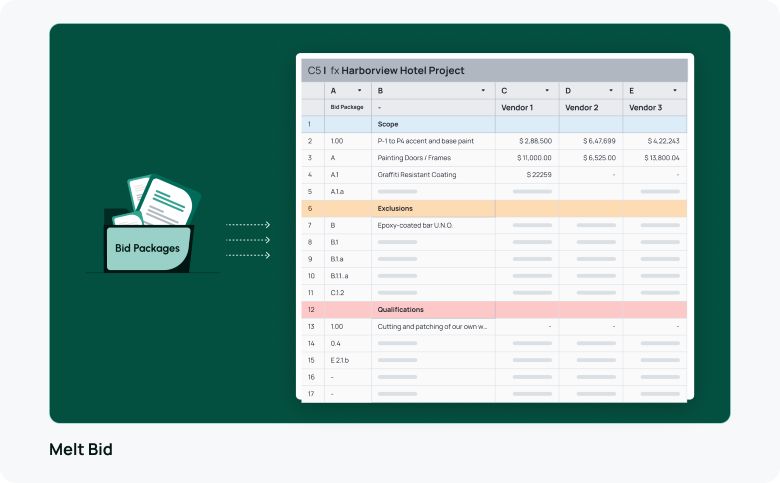
Melt Bid, from the preconstruction platform MeltPlan, is the one where reported customer feedback is most specific. A precon manager at an ENR top-10 general contractor reported saving roughly 150 hours across a thirty-package bid list, about five hours a package, almost entirely on the tally-filling step. A VP of preconstruction at a mid-size regional contractor described a different value: their subs mostly submit lump-sum bids with no consistent format, and the tool’s usefulness was surfacing inclusions and exclusions cleanly even when every sub wrote them up differently.
Three design decisions stand out.
It reads whatever format a sub actually sends. Handwritten, scanned, free-form or standard bid forms, rather than requiring clean digital input. This matters more than it sounds, because a large share of the real mess in bid week is exactly this kind of format chaos, and it is not something a general contractor controls.
It levels into a firm’s own Excel template. Rather than imposing a proprietary format, the firm uploads the template it already uses, once, and subsequent packages level into it. This addresses what is probably the real reason construction AI tools stall at adoption. The problem is rarely that the model is poor. It is that asking an estimator to abandon a workflow built over a decade is a much bigger request than it looks like on a sales call.
Every extracted value is traceable. Each number in the leveled comparison links back to the exact line and document it came from, so verification means opening a source rather than re-reading the bid set. Reported review time runs under 30 minutes per package.
The platform also flags what manual review tends to miss under deadline pressure: scope no bidder carried, exclusions buried in prose, and line items that may belong to an adjacent trade package, with CSI division reasoning attached. It integrates with Autodesk BuildingConnected so invitations can be issued from within the workflow, and it drafts post-bid clarification requests for scope a bidder did not price.
Note: the tools discussed here are presented for informational purposes and are not ranked in any particular order.
What to be sceptical about?
None of this amounts to a case for handing the process to AI wholesale, and to their credit, none of these vendors claim otherwise. The judgement calls stay with the estimator in every version of the pitch: which sub’s number is real, which scope gap is a genuine risk rather than a paperwork technicality, who gets the award. The honest sell across the category is hours returned per package, not decisions made on your behalf.
Two things deserve caution.
Performance claims across this category are self-reported. That is standard for where the market sits, but it is exactly what should be proven live, against a genuinely messy bid set rather than a cleaned-up sample, before anyone signs anything.
Extraction degrades on the documents that need it most. Poorly scanned proposals, tables rendered as images and highly non-standard layouts all reduce reliability. Ask any vendor to run your ugliest package during evaluation, ideally one with a handwritten submission and a late addendum, and then trace a randomly chosen value back to its source page.
What this means for estimating careers?
The professional consequence of this shift is worth stating directly, because it is not job displacement.
What automation removes from an estimator’s week is transcription: measuring quantities, typing bid numbers into a tally sheet, reconciling two proposals that describe identical work in different words. None of that requires expertise, and all of it currently consumes it.
What it does not touch is the part that earns a salary. Knowing that a particular subcontractor consistently bids low and recovers through change orders. Judging whether an allowance is adequate for what the market is doing this quarter. Reading how much risk a specific owner will actually tolerate.
For estimators and quantity surveyors, that suggests a practical direction:
- Scope literacy becomes more valuable, not less. AI tools cannot build a scope baseline independently. Someone still has to know what a complete electrical package looks like on a healthcare project.
- Verification is a distinct skill. Reviewing AI output quickly and knowing which items warrant a source check is different from doing the extraction yourself, and teams are starting to hire for it.
- Tool fluency is becoming a differentiator in precon hiring, in the same way BIM proficiency became one for design and coordination roles a decade ago.
- The estimator’s judgement is the defensible part of the role. Professionals who lean into scope interpretation, risk assessment and commercial negotiation are moving away from the parts of the job most exposed to automation.
Frequently Asked Questions
What is bid leveling in construction?
Bid leveling is the process of adjusting subcontractor proposals to a common scope so they can be compared on equal terms. Because bidders rarely carry identical work, the estimator adds or deducts value for what is missing or extra, producing a leveled total. The leveled totals, not the submitted prices, show who is actually lowest.
How is bid leveling different from bid tabulation?
A bid tabulation records what each bidder submitted. Leveling normalises those submissions to a common scope and determines what they mean. The tab identifies the apparent low bidder; leveling identifies the real one.
Can AI fully automate bid leveling?
No, and no serious vendor in the category claims it can. AI reliably automates extraction, normalisation and gap flagging. It does not know which subcontractor underbids and recovers through change orders, whether an allowance is adequate for current market conditions, or how much risk a particular owner will accept. Those remain estimator judgements.
What is the difference between a scope gap and an exclusion?
An exclusion is work a bidder states it is not carrying. It is disclosed, so the estimator can price it. A scope gap is work no bidder carried, usually because it fell between two trade packages. Exclusions are a reading problem. Gaps are a reasoning problem, and generally the more expensive of the two.
What is a plug number in bid leveling?
An estimator’s judgement of what a missing scope item would have cost had the bidder included it, added to bring an incomplete bid up to full scope for comparison. Plug numbers should always be recorded as estimates rather than confirmed prices, because they are an assumption rather than something the subcontractor has agreed to.
Do bid leveling tools work with handwritten or scanned proposals?
Some do and many do not, which is worth testing directly. Tools built around portal submission generally cannot process a handwritten scan. Melt Bid reads handwritten price pages, though scan quality affects extraction reliability on photocopied or poorly scanned documents.
Will AI replace construction estimators?
It is replacing the data entry inside the estimating role, not the role. The measurement, transcription and normalisation work is genuinely automatable. Scope interpretation, risk assessment and award decisions are not, and professionals who develop those areas are positioning themselves in the part of the job least exposed to automation.
How should a contractor evaluate a bid leveling tool?
Run the messiest package from your last project through it, ideally one with several bidders, a handwritten submission and a late addendum. Check that a bidder’s silence is flagged rather than left blank, that a scope gap you already knew about is caught, and that a randomly chosen value traces back to its source page. Confirm which capabilities are shipping today and which are roadmap.
Conclusion
The bid leveling category turns out to be more split than the marketing suggests. Bid management platforms are strong at a different job from the one they are often bought to solve. The DIY AI route is tempting but leaves real risk on exactly the line items that matter most. A smaller set of purpose-built tools has customer feedback that supports the pitch, provided a contractor does the obvious thing and asks to see it proven against its own worst bids first.
For estimators, the useful framing is not whether AI can level a bid. It is which parts of the week are worth defending. The hours spent typing numbers into a spreadsheet were never the valuable part of the job.
Related Posts:
- Urban Exclusion: Understanding the Impact of Hostile Architecture
- The Ultimate Construction Bids Guide for 2026
- Decoding the Construction Bidding Process: A Comprehensive Guide
- The Ultimate Guide to a Successful Career Path as a Construction Estimator
- Top Qualities to Look for When Hiring a Construction Company
