
Last Updated on May 31, 2026 by Admin
Construction contract management is the backbone of every project that finishes on time, within budget, and without legal disputes. Yet the skill remains one of the most under-taught and in-demand competencies across the global construction industry. According to the Associated General Contractors of America (AGC), over 91% of construction firms report difficulty filling professional positions — and contract management specialists are near the top of that shortage list.
ConstructionCareerHub App is LIVE — built ONLY for construction careers. Don’t apply with a weak resume.
Get ATS-ready Resume Lab + Interview Copilot + Campus Placement Prep (resume screening, skill gaps, interview readiness) — in minutes & Other advanced features.
Explore Smarter Construction Career Tools →Quick check. Big impact. Start now.
With global construction output projected to reach $15.2 trillion by 2030 (Oxford Economics), the commercial complexity of projects is increasing rapidly. FIDIC, NEC4, AIA, and JCT contract suites are evolving, AI-powered contract analytics are entering mainstream use, and cross-border EPC projects require professionals who can navigate procurement, claims, variations, and dispute resolution across multiple legal jurisdictions.
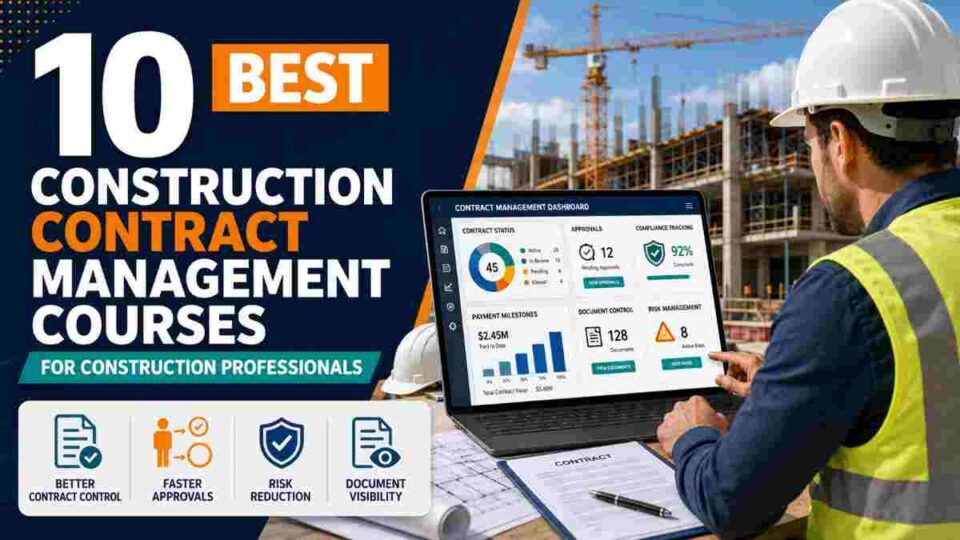
Whether you are a civil engineer aiming to transition into a commercial role, a quantity surveyor deepening your contractual knowledge, a project manager strengthening your procurement skills, or a fresh graduate building your first credential, the right construction contract management course can accelerate your career by years. This guide reviews the 10 best construction contract management courses available in 2026, compares their content, cost, and career impact, and helps you choose the right programme for your goals.
For a broader understanding of the field, start with our foundational guide on construction contract management and types of construction contracts.
🚀 ConstructionCareerHub.com — AI-Powered Career Tools for Construction Professionals
Before you invest in a course, make sure your career foundation is solid. Use the Resume Lab to create an ATS-ready resume tailored to contracts and commercial roles. Try the Interview Copilot for AI-powered mock interviews on FIDIC, NEC, and claims topics. Quick check. Big impact. Start now.
Table of Contents
Why Construction Contract Management Training Matters in 2026
Contract management is no longer a “back-office” function. In 2026, the professionals who understand contract administration, risk allocation, and dispute resolution hold the commercial power on every project. Here is why investing in formal training pays off:
Financial impact is massive. According to McKinsey & Company, large construction projects typically run 80% over budget and 20 months behind schedule. Poor contract management — unclear scope definitions, mishandled variations, and delayed claims — is a primary contributor to these overruns.
Legal complexity is increasing. The 2017 FIDIC suite introduced standing Dispute Adjudication Boards (DABs) as default, NEC4 expanded early warning and compensation event provisions, and digital contract management platforms are now standard in Tier 1 firms. Professionals without current training risk falling behind. For more on dispute processes, see our construction dispute resolution guide.
Career demand is strong. The U.S. Bureau of Labor Statistics projects 9% growth in construction management employment through 2034, and contracts-specific roles (contracts engineers, commercial managers, claims consultants) consistently command salary premiums of 15–30% over general site roles. Our contracts manager salary guide covers detailed compensation benchmarks across India, the Gulf, the USA, and the UK.
Digital transformation demands new skills. AI contract review tools, automated compliance checking, and blockchain-based payment systems are entering project workflows. The best courses in 2026 now integrate these digital competencies alongside traditional contractual knowledge.
How We Selected and Ranked These Courses
We evaluated over 40 construction contract management programmes globally using the following criteria:
Curriculum relevance: Does the course cover current contract forms (FIDIC 2017, NEC4, AIA A201), contemporary procurement methods, and practical claims/variation management?
Instructor credibility: Is the course taught by industry practitioners, university faculty, or professionals with verifiable project experience?
Practical application: Does the programme include case studies, real-world contract exercises, or project-based assessments — not just theory?
Flexibility and accessibility: Can working professionals complete the course online, at their own pace, from anywhere in the world?
Certification value: Does the course offer a credential recognised by employers, professional bodies, or academic institutions?
Cost-to-value ratio: Does the investment deliver meaningful career advancement relative to its price?
10 Best Construction Contract Management Courses in 2026
1. Construction Management Specialization — Columbia University (Coursera)
Platform: Coursera
University: Columbia University
Duration: Approximately 4 months (5 courses)
Cost: Free to audit; paid certificate (~$49/month for Coursera Plus)
Level: Beginner to Intermediate
This remains the gold-standard online construction management programme on Coursera, taught by Professor Ibrahim Odeh of Columbia University. The specialization covers project initiation and planning, construction scheduling, cost estimating and cost control, project delivery methods, and construction finance — all of which directly underpin contract management competence.
Why it matters for contract management: You cannot manage contracts effectively without understanding cost control, scheduling baselines, and project delivery methods. This specialization builds the foundational knowledge that every contracts professional needs. The project delivery methods module specifically addresses contract types, procurement strategies, and owner-contractor relationships.
Best for: Fresh graduates, early-career engineers, and professionals transitioning into construction management who need a comprehensive foundation before specializing in contracts.
For more free options on this platform, see our guide to free construction courses on Coursera.
2. Project Delivery Methods and Contracts in Construction Management — University of Maryland (edX)
Platform: edX
University: University of Maryland
Duration: 8 weeks (3–5 hours/week)
Cost: Free to audit; verified certificate available
Level: Intermediate
Part of the University of Maryland’s Construction Management Professional Certificate on edX, this course dives specifically into project delivery methods, contract types, bidding and procurement, change management, and the construction phase from a contractual perspective. It covers lump-sum vs. cost-plus contracts, CM at-risk vs. design-build arrangements, and the use of preconstruction services.
Why it matters for contract management: This is one of the few university-backed online courses that focuses exclusively on contracts and delivery methods rather than treating them as a side topic within broader project management. The module on change orders and contract modifications is particularly practical.
Best for: Mid-career professionals in the US construction market who want a university credential specifically in contracts and procurement. Also excellent for international professionals working with US contract standards (AIA, ConsensusDocs).
3. Contracts Management in Construction Projects — Udemy
Platform: Udemy
Instructor: Akhil Krishna (MEP QS, India & Middle East experience)
Duration: 2.5 hours on-demand video
Cost: ~$15–$30 (frequent Udemy sales)
Level: Beginner to Intermediate
This focused Udemy course covers FIDIC Red Book timelines, standard contract forms (FIDIC, NRM, JCT), contract commencement procedures, variation procedures, payment terms, termination and suspension clauses, and dispute resolution mechanisms. It also includes a practical module on drafting contractual letters and understanding bank guarantees in construction projects.
Why it matters for contract management: The FIDIC Red Book timeline walkthrough — which condenses the entire Conditions of Contract for Construction into a structured 30-minute lecture — is exceptionally practical for engineers and QS professionals working in the Middle East and international EPC environments.
Best for: Quantity surveyors, contracts engineers, and project coordinators working on FIDIC-governed projects in the Gulf, Africa, and Asia. Also useful for freshers wanting a quick, affordable introduction to construction contract administration.
4. Masterclass in Construction: Winning FIDIC Contracts — Udemy
Platform: Udemy
Instructor: B. Kaan Ozarda (MSc Civil Engineer, international project management experience)
Duration: 4+ hours on-demand
Cost: ~$15–$30 (Udemy sales pricing)
Level: Intermediate to Advanced
This is a deeper, strategy-focused programme covering procurement routes, payment methods, risk allocation in different contract types, and claims practices specifically within FIDIC contracts. The instructor brings experience from large-scale international construction projects, and the course goes beyond basic administration into game-winning contractual strategies.
Why it matters for contract management: While many courses teach the “what” of contract clauses, this one teaches the “how” — how to structure claims, how to allocate risk effectively, and how to use FIDIC provisions strategically during project execution. This is the type of knowledge that separates a contracts administrator from a contracts manager.
Best for: Mid-career contracts engineers and commercial managers working on international EPC and infrastructure projects. Especially valuable for professionals targeting FIDIC-governed markets (Middle East, Africa, Southeast Asia, Europe).
For interview preparation in these roles, our top 50 contracts engineer interview questions guide is an essential companion resource.
5. Construction Management Professional Certificate — University of Maryland (edX)
Platform: edX
University: University of Maryland
Duration: 6–8 months (self-paced)
Cost: Subscription-based (~$50/month)
Level: Intermediate to Advanced
The full Professional Certificate programme includes multiple courses spanning the construction industry overview, project delivery methods and contracts, sustainable construction management, and project financial analysis. For professionals who want to build comprehensive construction management competence with a strong contractual and commercial thread running throughout, this is the most complete university-backed online programme available on edX.
Why it matters for contract management: The programme connects contract knowledge with financial analysis, sustainability requirements, and strategic project planning — reflecting the reality that contract managers in 2026 must understand the business side of construction, not just the legal clauses.
Best for: Professionals seeking a full professional certificate from a US university to strengthen their credentials for roles such as construction manager, contracts manager, or project director. Also see our guide on online certificates in construction management in the US.
6. Mastering Construction Contract Administration & Procurement — Udemy
Platform: Udemy
Instructor: Industry practitioner with contract administration focus
Duration: 3+ hours on-demand
Cost: ~$15–$30 (Udemy sales)
Level: Beginner to Intermediate
This comprehensive Udemy course covers the full construction contract lifecycle: from procurement and tendering through contract document interpretation (BOQs, specifications, drawings), variation management, extensions of time (EOT), progress claims, final accounts, and dispute resolution methods (adjudication, arbitration, mediation). It also addresses international contract considerations including FIDIC, AS4000, and JCT frameworks.
Why it matters for contract management: The course covers the complete contract administration workflow end-to-end, making it one of the most practical programmes on Udemy for professionals who need to manage real contracts on live projects. The modules on variations, EOT, and progress payments reflect day-to-day contract management tasks that many theoretical courses skip.
Best for: Site engineers, project coordinators, and junior QS professionals who are stepping into contract administration roles for the first time. Excellent for professionals in Australia, the UK, and the Middle East where multiple contract standards overlap.
7. Contracts Management (MUST HAVE Knowledge) — Udemy
Platform: Udemy
Instructor: Reem Ibrahim (MRICS, MCIArb, PMI-RMP, 20+ years GCC & North Africa experience)
Duration: 3+ hours on-demand
Cost: ~$15–$30 (Udemy sales)
Level: Beginner to Intermediate
Taught by an MRICS and MCIArb-qualified instructor with over two decades of construction contracts experience in the Gulf and North Africa, this course defines the roles of contracts administrators vs. contracts managers, covers contract types and procurement strategies, explains party relationships under different contract forms, and develops contractual awareness for identifying claims and variations early.
Why it matters for contract management: The instructor’s RICS and CIArb credentials bring genuine authority. The focus on distinguishing between contract administration and contract management — and the specific skill sets each requires — is something rarely addressed in other online programmes. FIDIC principles are highlighted throughout.
Best for: Construction managers, procurement managers, project managers, and technical office managers working on projects in the GCC, North Africa, and international markets. Also ideal for professionals preparing for RICS or CIArb accreditation pathways.
8. FIDIC Certified Contract Manager (FCCM) Preparation Course — Udemy
Platform: Udemy
Duration: On-demand CPD format
Cost: ~$15–$30 (Udemy sales)
Level: Advanced
The FIDIC Certified Contract Manager (FCCM) is one of the most respected credentials in international construction contract management. This preparatory course provides structured guidance on the FCCM pathway, assessment structure, and preparation strategy. It is built around MCQ-based learning aligned with the FIDIC Conditions of Contract and is designed for quantity surveyors, contract administrators, commercial managers, engineers, and project professionals working under FIDIC contracts.
Why it matters for contract management: The FCCM credential from FIDIC itself is the industry’s gold-standard certification for contract managers working on international projects. This prep course gives you a structured path to achieving it, rather than attempting self-study without guidance.
Best for: Experienced contracts professionals (5+ years) who are planning to pursue the official FIDIC FCCM certification and want structured, focused preparation material.
9. Construction Cost Estimating and Cost Control — Columbia University (Coursera)
Platform: Coursera
University: Columbia University
Duration: 4 weeks (~20 hours)
Cost: Free to audit; certificate with Coursera Plus
Level: Intermediate
While not exclusively a contract management course, construction cost estimating and cost control is an inseparable component of effective contract management. This Columbia University course covers estimating techniques, cost control methods, earned value management, cash flow forecasting, and the financial dimensions of construction project management.
Why it matters for contract management: Every variation assessment, claims valuation, interim payment certificate, and final account depends on cost data. Contracts professionals who lack cost estimating skills will always be at a disadvantage when negotiating change orders, evaluating contractor claims, or preparing budget forecasts. This course fills that gap directly.
Best for: Contracts engineers and QS professionals who want to strengthen the financial and estimating competencies that underpin all contract administration work. Also see our 30 best online construction courses for additional options.
10. The Complete Guide to Construction Management — Udemy
Platform: Udemy
Duration: 7+ hours on-demand
Cost: ~$15–$30 (Udemy sales)
Level: Beginner to Intermediate
This comprehensive Udemy course covers the complete construction project lifecycle from inception to handover, including FIDIC-based contractual and financial models, payment processing methods, BOQ types, lump-sum and provisional items, tendering processes, claims and variations, and contract termination scenarios. The course includes a downloadable 50-page project manual for reference.
Why it matters for contract management: The course provides multidisciplinary context — connecting contractual models with engineering systems, materials, and project phases — which reflects how contract management operates in practice. The real-life case studies on claims, variations, accidents, and contract termination are particularly valuable.
Best for: Fresh graduates and early-career professionals who want a single, comprehensive course covering both the technical and commercial sides of construction management before specializing in contracts.
📋 Plan Your Contract Management Career Path
Use the Career Planner on ConstructionCareerHub.com to map your 5–10 year trajectory with salary projections, certification milestones, and role benchmarks tailored to contracts and commercial management. Get your personalized career roadmap today.
Construction Contract Management Course Comparison Table
| Course | Platform | Duration | Cost | Best For |
|---|---|---|---|---|
| Construction Mgmt Specialization (Columbia) | Coursera | ~4 months | Free audit / $49/mo | Foundation building |
| Project Delivery & Contracts (UMD) | edX | 8 weeks | Free audit / cert fee | US contract standards |
| Contracts Mgmt in Construction Projects | Udemy | 2.5 hours | ~$15–30 | FIDIC beginners |
| Winning FIDIC Contracts Masterclass | Udemy | 4+ hours | ~$15–30 | FIDIC strategy & claims |
| CM Professional Certificate (UMD) | edX | 6–8 months | ~$50/mo subscription | Full professional cert |
| Contract Admin & Procurement Mastery | Udemy | 3+ hours | ~$15–30 | End-to-end admin skills |
| Contracts Mgmt (MUST HAVE) | Udemy | 3+ hours | ~$15–30 | GCC/MENA professionals |
| FCCM Preparation Course | Udemy | On-demand | ~$15–30 | FIDIC certification prep |
| Cost Estimating & Cost Control (Columbia) | Coursera | 4 weeks | Free audit / $49/mo | Financial skills for contracts |
| Complete Guide to Construction Mgmt | Udemy | 7+ hours | ~$15–30 | Comprehensive beginners |
What You Will Learn in a Construction Contract Management Course
A quality construction contract management course should cover several core areas that directly impact your ability to manage projects commercially. Here is what to expect:
Contract types and procurement methods. Understanding the differences between lump-sum, cost-plus, unit-rate, design-build, CM at-risk, and integrated project delivery (IPD) contracts is fundamental. Each contract type allocates risk differently, and the procurement route determines the owner-contractor-designer relationship for the entire project lifecycle. Our article on construction contract management and contract types provides a solid primer.
Standard contract forms. The FIDIC suite (Red Book, Yellow Book, Silver Book), NEC4 Engineering and Construction Contract, AIA A201 General Conditions, JCT Standard Building Contract, and AS4000/AS2124 in Australia each govern billions of dollars in annual construction spend. Knowing how these forms allocate risk, handle variations, and structure dispute resolution is essential for any contracts professional.
Variation and change order management. Scope changes are inevitable on every construction project. Understanding how to identify, document, value, and negotiate variations — and how different contract forms handle them — is one of the most commercially valuable skills in the industry.
Claims preparation and management. Construction claims for extensions of time (EOT), loss and expense, disruption, and acceleration are complex to prepare and even more complex to defend. A good course teaches you how to identify entitlement, build the evidentiary record, quantify the claim, and present it in a format that withstands scrutiny. For deeper reading, see our construction claims management guide.
Dispute resolution mechanisms. From negotiation and mediation through adjudication, Dispute Adjudication Boards (DABs), and international arbitration (ICC, LCIA, SIAC), understanding the full spectrum of dispute resolution options — and when each is appropriate — is a critical competency for senior contracts professionals.
Payment mechanisms and financial administration. Interim payment applications, payment certificates, retention, performance bonds, bank guarantees, and final account preparation form the financial backbone of contract administration. For related financial skills, our construction project management career guide covers cost control and budgeting fundamentals.
Who Should Take a Construction Contract Management Course?
Contract management training benefits a wide range of construction professionals. Here are the key audiences and how the right course impacts their careers:
Contracts engineers and contracts administrators — These are the professionals on the front line of contract administration on live projects. A formal course strengthens their handling of daily tasks like variations, progress claims, and correspondence, and prepares them for promotion to contracts manager or commercial manager roles.
Quantity surveyors (QS) — QS professionals manage the financial side of contracts, including measurement, valuation, interim payments, and final accounts. Contract management training deepens their understanding of the legal and procedural frameworks that govern these processes. See our QS interview preparation guide for role-specific preparation.
Project managers and construction managers — Senior PMs and CMs are ultimately responsible for commercial outcomes on their projects. Understanding contract provisions, risk allocation, and dispute avoidance is essential at this level. Our construction manager job description guide covers the full scope of this role.
Civil engineers transitioning to commercial roles — Many civil engineers move from site engineering into contracts, claims, or commercial management as their careers mature. A structured course provides the business and legal vocabulary needed for this transition.
Fresh graduates — For engineering and construction management graduates entering the job market, contract management training creates an immediate differentiator on the resume. In competitive markets, employers prioritise candidates who understand commercial fundamentals from day one.
Procurement and supply chain professionals — Those managing subcontracts, supplier agreements, and procurement processes benefit from understanding the contractual frameworks within which they operate.
Key Skills You Will Gain
Completing one or more of the courses listed above will build practical competencies that directly impact your performance and earning potential:
Contract drafting and interpretation: The ability to read, interpret, and apply standard contract clauses — and to draft amendments and particular conditions — is the foundational skill of contract management.
Risk identification and allocation: Understanding how different contract forms distribute risk between parties, and how to negotiate more favourable risk positions during procurement, directly impacts project outcomes. Our guide on risks in contract management covers this in depth.
Negotiation and commercial strategy: From pre-contract negotiations to mid-project variation settlements and post-completion final accounts, effective negotiation skills are essential. The best courses include case studies and role-play exercises that develop this capability.
Delay analysis and scheduling interface: Understanding critical path method (CPM) scheduling, concurrent delay, and the relationship between schedule impact and contractual entitlement is increasingly important. Our review of construction scheduling software covers the tools used in this analysis.
Digital contract management tools: Proficiency with contract lifecycle management (CLM) platforms, AI-powered contract review tools, and digital document management systems is now expected by Tier 1 employers. The best 2026 courses introduce these technologies alongside traditional knowledge.
Salary Impact of Contract Management Training
Contract management skills directly correlate with higher earning potential across the global construction industry. Here are representative salary benchmarks for 2026:
Contracts Engineer (3–5 years experience): $60,000–$90,000 (USA) | AED 12,000–20,000/month (UAE) | INR 6–12 LPA (India)
Contracts Manager (7–12 years experience): $95,000–$150,000 (USA) | AED 25,000–45,000/month (UAE) | INR 15–35 LPA (India)
Commercial Manager / Head of Commercial (12+ years): $130,000–$200,000+ (USA) | AED 35,000–60,000/month (UAE) | INR 25–50+ LPA (India)
Claims Consultant / Specialist: $100,000–$180,000 (USA/UK) | AED 20,000–40,000/month (UAE)
These figures are drawn from industry salary surveys and job market data. For detailed, role-specific salary comparisons, see our contracts manager salary guide and our broader project management career guide.
Professionals with certifications like PMP, CCM, MRICS, or FCCM consistently command 15–30% salary premiums over uncertified peers in the same roles. Our guide to top construction management certifications in 2026 covers the most valuable credentials.
Certifications That Complement Contract Management Training
Online courses build knowledge, but professional certifications validate it to employers. Consider pairing your coursework with one or more of these credentials:
FIDIC Certified Contract Manager (FCCM) — Issued directly by FIDIC, this is the premier certification for professionals managing contracts under FIDIC conditions. It covers the entire FIDIC contract suite and is recognized globally on EPC and infrastructure projects.
Project Management Professional (PMP) — Issued by PMI, the PMP is the most widely recognized project management certification globally. While not contract-specific, it covers procurement, stakeholder, and risk management — all directly relevant to contract managers. PMP-certified professionals earn approximately 32% more on average, according to PMI’s salary survey.
Certified Construction Manager (CCM) — Issued by the Construction Manager Certification Institute (CMCI) in the USA, the CCM covers the full spectrum of construction management, including contract administration, cost management, and quality assurance.
RICS Membership (MRICS) — The Royal Institution of Chartered Surveyors pathway is the gold standard for quantity surveyors and commercial managers, particularly in the UK, Middle East, and Commonwealth markets. MRICS-chartered professionals are recognized globally for their contractual and commercial expertise.
Member of the Chartered Institute of Arbitrators (MCIArb) — For professionals specializing in dispute resolution, CIArb membership demonstrates expertise in arbitration, adjudication, and mediation — increasingly important competencies as construction disputes grow in complexity.
For a comprehensive list of credentials, see our guide on free construction certifications you can earn online.
How to Choose the Right Course for Your Career Stage
With 10 courses to consider, selecting the right one depends on where you are in your career and what you want to achieve:
If you are a fresh graduate or career-changer: Start with the Columbia University Construction Management Specialization on Coursera (Course #1) or The Complete Guide to Construction Management on Udemy (Course #10). These provide comprehensive foundations before you specialize.
If you are an early-career contracts engineer or QS: The Contracts Management in Construction Projects course (Course #3) and the Mastering Construction Contract Administration & Procurement course (Course #6) offer practical, immediately applicable knowledge at an affordable price point.
If you work on FIDIC-governed projects: Prioritize the Winning FIDIC Contracts Masterclass (Course #4) and the FCCM Preparation Course (Course #8). These are specifically tailored to the FIDIC contract suite used on the majority of international infrastructure and EPC projects.
If you want a university credential: The University of Maryland’s Construction Management Professional Certificate on edX (Course #5) offers the most comprehensive university-backed programme with strong contract management content.
If you want to strengthen the commercial/financial side: Pair the Cost Estimating and Cost Control course from Columbia (Course #9) with any of the contract-specific programmes for a well-rounded commercial skill set.
For a broader exploration of all available options, see our comprehensive guide to construction courses and our curated list of the 30 best online construction courses in 2026.
Industry Trends Shaping Contract Management in 2026
The construction contract management landscape is evolving rapidly. Here are the key trends that make upskilling in this area urgent:
AI-powered contract analytics. Tools using natural language processing (NLP) and machine learning are now being deployed by Tier 1 contractors to review contract terms, identify risky clauses, flag inconsistencies across document sets, and even predict dispute likelihood. Professionals who understand both the technology and the underlying contract principles will be the most valuable.
Integrated project delivery (IPD) and alliance contracts. Traditional adversarial contract models are gradually giving way to collaborative frameworks like IPD, alliancing, and early contractor involvement (ECI). These require a fundamentally different approach to risk sharing, pain/gain mechanisms, and team-based dispute avoidance.
ESG and sustainability clauses. Environmental, Social, and Governance (ESG) requirements are now being embedded directly into construction contracts. Carbon reporting obligations, sustainable procurement standards, and social value commitments are becoming standard contractual requirements on public-sector projects across the UK, EU, and Australia.
Cross-border EPC contract complexity. With mega-projects spanning multiple jurisdictions — from NEOM in Saudi Arabia to semiconductor fabrication plants in the US — contracts professionals must navigate different legal systems, currencies, labour laws, and regulatory frameworks simultaneously.
Digital twins and contract compliance. Building Information Modeling (BIM) and digital twin technologies are creating new contractual obligations around data standards, model ownership, and information exchange requirements. The ISO 19650 BIM management standard now has direct contractual implications. For more on this, see our guide on best BIM software in 2026.
Supplementary Resources for Contract Management Professionals
Beyond formal courses, the following resources will deepen your construction contract management knowledge:
Industry bodies and standards organizations:
- FIDIC — International Federation of Consulting Engineers (publishers of the FIDIC contract suite)
- RICS — Royal Institution of Chartered Surveyors (professional body for QS and commercial management)
- NEC Contracts — Publishers of the NEC4 contract suite
- CMAA — Construction Management Association of America (CCM certification body)
Recommended reading from ConstructionPlacements:
- Construction Claims Manager: A Proactive Career Option
- Insurance and Liability in Construction: Comprehensive Guide
- Construction Management Career Guide for 2026
- Best Universities for Construction Management in the USA
- Construction Project Manager Job Description and Salary
Ebooks for deeper study:
- 📘 Civil Engineering Interview Questions & Answers eBook — 102 researched Q&As covering contracts, estimation, and core civil engineering topics.
- 📘 Construction Interview Guide — Comprehensive preparation for contracts, commercial, and project management interviews.
- 📘 Complete Construction Career Bundle — All-in-one resource combining career strategy, interview prep, and industry insights.
- 📘 Remote Job Hunting System for Construction Professionals — For professionals targeting remote and hybrid contract management roles with international firms.
🎯 Ready to Land a Contracts Role? Prepare Smarter.
ConstructionCareerHub.com is the AI-powered career platform built exclusively for construction professionals. Use the Resume Lab for ATS-optimized CVs, the Interview Copilot for AI-driven mock interviews on FIDIC, NEC, and claims topics, and the Career Planner to benchmark your trajectory against industry peers. Quick check. Big impact. Start now.
Frequently Asked Questions (FAQ)
What is construction contract management?
Construction contract management is the process of creating, negotiating, executing, and monitoring contracts between parties on a construction project — including owners, contractors, subcontractors, and suppliers. It encompasses contract drafting, variation management, payment administration, claims handling, and dispute resolution to ensure projects are completed within agreed scope, cost, and time parameters while managing commercial and legal risk.
Which is the best online course for construction contract management in 2026?
The best course depends on your career stage and goals. For a comprehensive university-backed foundation, the Construction Management Specialization from Columbia University on Coursera is the top choice. For FIDIC-specific training, the Masterclass in Construction: Winning FIDIC Contracts on Udemy offers the most strategic content. For a full professional certificate, the University of Maryland’s Construction Management Professional Certificate on edX provides the most complete programme.
Are free construction contract management courses worth it?
Yes. Both Coursera and edX offer free audit access to university-level construction management courses that include substantial contract management content. While you will not receive a verified certificate without paying, the knowledge gained from free access is genuine and career-relevant. See our guide to free construction certifications online for more free options.
What certifications are most valuable for construction contract managers?
The FIDIC Certified Contract Manager (FCCM) is the most internationally recognized certification specific to contract management. The PMP (Project Management Professional) from PMI, CCM (Certified Construction Manager) from CMCI, and MRICS (Member of RICS) chartered status are also highly valued. The right certification depends on your market and specialization — FCCM for international FIDIC projects, RICS for QS/commercial roles, PMP for broader project management credibility.
How much does a construction contracts manager earn?
In the USA, construction contracts managers earn between $95,000 and $150,000 annually, with senior commercial managers exceeding $200,000. In the UAE, salaries range from AED 25,000 to AED 45,000 per month. In India, experienced contracts managers earn INR 15–35 LPA. Professionals with FIDIC, RICS, or PMP certifications consistently earn 15–30% more than uncertified peers in equivalent roles.
Can I learn construction contract management online?
Absolutely. Platforms like Coursera, edX, and Udemy offer comprehensive online programmes taught by university professors and industry practitioners. Online learning provides flexibility for working professionals, and many courses include practical case studies, downloadable resources, and peer forums that replicate the benefits of classroom learning. The 10 courses reviewed in this guide are all available fully online.
What is the difference between contract administration and contract management?
Contract administration focuses on the day-to-day execution of contract provisions — processing claims, managing variations, handling correspondence, and ensuring compliance with contractual timelines. Contract management is a broader strategic function that includes contract administration but also encompasses procurement strategy, risk allocation, commercial negotiation, and dispute avoidance at the organizational level. Senior roles typically require contract management competence, while junior roles focus on administration.
Do I need a law degree to work in construction contract management?
No. Most construction contract managers come from engineering, quantity surveying, or construction management backgrounds. While legal knowledge is important, the emphasis is on commercial acumen, project understanding, and practical contract administration — not legal theory. The courses listed in this guide are designed specifically for construction professionals, not lawyers.
This article was researched and published by the ConstructionPlacements Career Intelligence Team, drawing on current course catalogue data, industry salary benchmarks, and global construction workforce trends. All course information was verified at the time of publication (May 2026) and is subject to change by the respective platforms.
About ConstructionPlacements: ConstructionPlacements.com is a trusted global resource for construction professionals, providing career guides, job market intelligence, salary benchmarks, and industry insights across India, the Middle East, USA, UK, and Australia.
