

Last Updated on July 15, 2026 by Admin
Construction projects involve unique processes, different stakeholders, tight budgets, and strict regulatory requirements, making frictionless project management essential. Many firms are using artificial intelligence (AI) to simplify project management, allowing them to spend less time on administration and more time delivering successful projects.
ConstructionCareerHub App is LIVE — built ONLY for construction careers. Don’t apply with a weak resume.
Get ATS-ready Resume Lab + Interview Copilot + Campus Placement Prep (resume screening, skill gaps, interview readiness) — in minutes & Other advanced features.
Explore Smarter Construction Career Tools →Quick check. Big impact. Start now.
Here are six ways AI is making project management far more frictionless in construction.
Table of Contents
1. Automating Document Management
Document management is one of the most time-consuming administrative tasks of any construction project. Each construction project generates vast amounts of documentation, which must be updated, shared, and stored correctly, including:
- Daily progress reports: A summary of the work completed each day, labor hours, weather conditions, and equipment used.
- Incident and accident reports: A report of any workplace accidents and safety concerns used for compliance and preventing future risks.
- Change orders: A document that outlines the approved changes to the original project scope, design, schedule, or budget after construction has commenced.
- Timesheets: A document of all employee and subcontractor working hours, used for payroll processing, time tracking, and budget monitoring.
- Permit applications and approvals: A set of documents that confirm planning permissions, building permits, and regulatory approvals required for a project.
AI can automatically draft, organize, and store documents. This reduces valuable time spent on manual paperwork and ensures documents are easy to access and up to date throughout the entire project.
2. Speeding Up Decision-Making
Project managers often need to collect, verify, and analyze information from multiple sources to make important business decisions. This process can be slow if information is spread across spreadsheets, emails, paper documents, and disconnected systems.
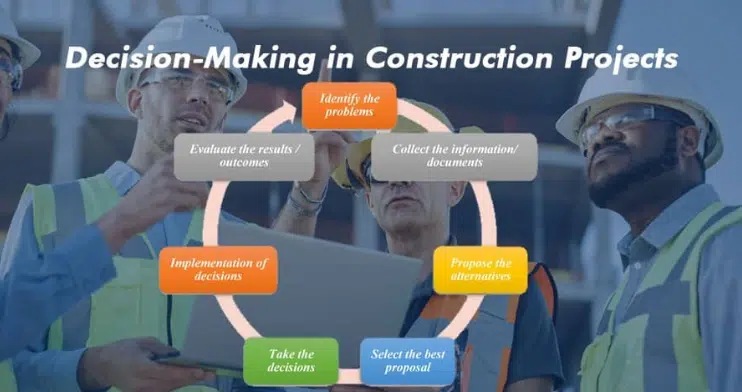
AI-powered construction software can analyze trends and quickly summarize project information from a range of sources, providing project managers with a real-time overview of project performance. This assists project managers in making faster, more accurate decisions.
Quick decision-making is crucial in construction because projects have ever-changing schedules, budgets, weather conditions, labor availability, and material supplies. Delays in decision-making can affect the entire project, increasing costs and pushing back completion dates.
3. Centralizing Project Data
Centralized project data makes it easier for teams to collaborate, monitor progress, and meet deadlines. However, traditional software often isn’t enough to plan, organize, track, and manage each unique project from start to finish.
No-code and low-code application builders allow firms to quickly and easily create custom construction software tailored to unique projects. Using natural language prompts rather than manual programming, construction firms can create the exact project management tools they need without the usual lengthy and expensive software development process.
4. Keeping Project Schedules Up-To-Date
Clear and up-to-date project schedules are very important in the construction industry, as schedules regularly change due to weather conditions, labor availability, material delays, and design modifications.
AI-powered scheduling tools can automatically update project timelines, notify stakeholders of any changes, and identify scheduling conflicts before they create delays.
5. Improving Collaboration and Communication
Successful construction projects rely on effective collaboration and communication between office staff, project managers, site supervisors, subcontractors, suppliers, architects, and clients.
AI-powered collaboration tools can centralize project updates, automate notifications, and ensure every stakeholder has access to the latest information, minimizing communication breakdowns.
Meanwhile, AI-powered chatbots improve communication by providing team members with real-time updates and instant answers to project-related queries. AI chatbots can also automatically generate and distribute progress reports, keeping all stakeholders in the loop.
6. Enhancing Budget Monitoring
Construction projects are typically planned around strict budgets. Unexpected costs can reduce profit margins, damage cash flow, and cause project delays.
AI-powered construction software can continuously monitor project spending, compare actual costs against outlined budgets, and flag unusual spending patterns or budget overruns. This enables project managers to take action before poor budget monitoring leads to a project becoming financially unviable.
The Future of AI in Construction Project Management
As AI continues to integrate into every industry, project management is likely to see a digital transformation. By centralizing project data, improving collaboration, automating document management, and speeding up decision-making, AI is helping construction firms reduce friction and improve project outcomes.
Whilst AI is set to be a powerful project management assistant, enabling construction teams to work more efficiently, experienced project managers remain essential for leadership and human oversight. Together, AI and project managers can create a frictionless project management process.
Related Posts
- Enhance Your Career with Our Free Online Decision-Making Test for Construction Professionals!
- 12 Reasons Why Every Construction Company Needs a Project Management Software
- How BIM and AI Will Revolutionize the Construction Industry
- Free Career Assessment Tool for AEC Job Seekers In India: Transform Your AEC Career
- AI Skills Every Construction Professional Should Learn in 2025
