
Last Updated on June 1, 2026 by Admin
Civil engineers today know that Autodesk Civil 3D is one of the most valuable software skills for infrastructure design careers. But finding the right course is harder than it should be. Many Civil 3D courses are generic AutoCAD tutorials repackaged with a different title. Others teach isolated tools without showing how they connect in a real project workflow for roads, highways, grading, land development, or drainage design.
ConstructionCareerHub App is LIVE — built ONLY for construction careers. Don’t apply with a weak resume.
Get ATS-ready Resume Lab + Interview Copilot + Campus Placement Prep (resume screening, skill gaps, interview readiness) — in minutes & Other advanced features.
Explore Smarter Construction Career Tools →Quick check. Big impact. Start now.
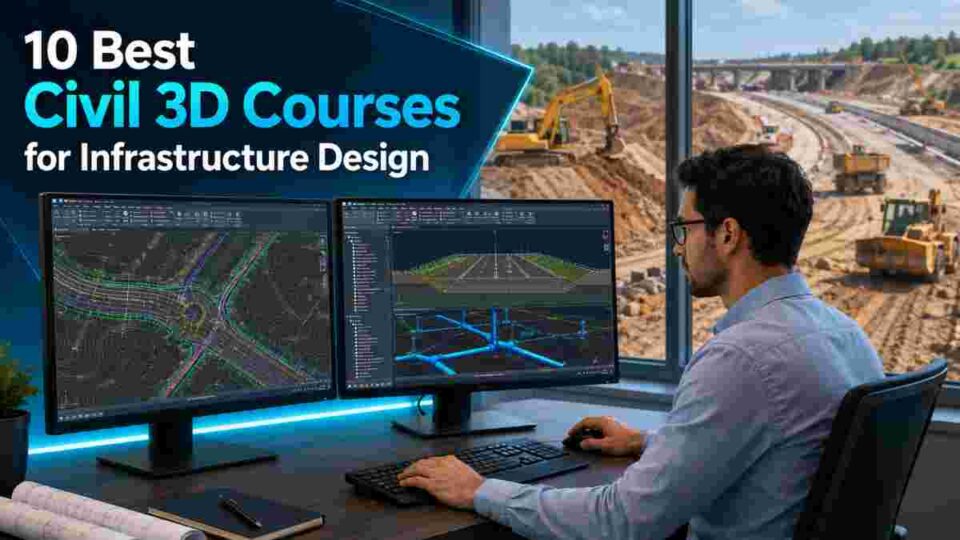
This guide cuts through the noise. It ranks the 10 best Civil 3D courses available in 2026, evaluated specifically for infrastructure design relevance — not just for software proficiency. Whether you are a civil engineering student building your first portfolio, a site engineer transitioning into design, or a CAD technician upgrading to Civil 3D, this guide helps you choose the course that matches your career goals, skill level, and budget.
Every course listed here is real, currently available, and verified against official platform pages. No ratings, prices, or certificates have been invented. Where details may change, you are directed to verify on the official course page.
Quick Answer — Best Civil 3D Courses at a Glance:
- Best Overall: Autodesk Civil 3D 2025 Essential Training – LinkedIn Learning
- Best for Certification: Autodesk Certified Professional: Civil 3D for Infrastructure Design Exam Prep – Coursera
- Best for Road/Highway Design: The Ultimate Civil 3D For Road Design Course – Udemy
- Best Budget Option: The Complete Course of Autodesk Civil 3D – SourceCAD
- Best Free Official Resource: Civil 3D for Infrastructure Design Professional Certification Prep – Autodesk Learn
- Best for Job-Ready Portfolio: Civil 3D Certification Course Online – VDCI
Table of Contents
Why Civil 3D Skills Matter for Infrastructure Design Careers in 2026
Autodesk Civil 3D is the industry-standard design authoring platform for civil infrastructure projects. It is used by transportation departments, civil engineering consultancies, land development firms, and infrastructure contractors across the United States, United Kingdom, Middle East, Australia, and India to design roads, highways, site grading, drainage systems, utility networks, and land subdivisions.
What makes Civil 3D essential in 2026 is the convergence of several career-shaping trends. The U.S. Bureau of Labor Statistics projects civil engineering employment to grow 5% from 2024 to 2034, with approximately 23,600 job openings per year (BLS Occupational Outlook). Infrastructure investment worldwide continues to expand — the Global Infrastructure Hub estimates that $94 trillion in infrastructure investment is needed globally by 2040. At the same time, BIM adoption is accelerating across civil infrastructure, and Civil 3D sits at the center of that digital design workflow.
Civil 3D supports the full infrastructure design pipeline: creating terrain surfaces from survey data, designing horizontal and vertical alignments for roads, building corridor models, modeling pipe and pressure networks for stormwater and sewer systems, performing grading and earthwork calculations, generating cross-sections and quantity takeoffs, and producing construction plan sheets. These are not abstract software features — they are the daily work output of design engineers at firms building real roads, highways, and subdivisions.
For civil engineers, the practical career benefit is straightforward: proficiency in Civil 3D makes you competitive for design engineer, highway design engineer, land development designer, CAD technician, and BIM career roles that are consistently among the better-compensated positions in civil engineering. If you are serious about working in infrastructure design rather than general site supervision, Civil 3D is the skill that bridges theory and employable output.
How We Ranked These Civil 3D Courses
Every course on this list was evaluated using a consistent framework designed for infrastructure design learners — not just general software users. Here are the criteria:
- Infrastructure design relevance: Does the course teach tools in the context of real civil infrastructure projects (roads, grading, drainage, land development)?
- Core tool coverage: Does it cover surfaces, alignments, profiles, corridors, grading, pipe networks, cross-sections, and quantity takeoffs?
- Beginner friendliness: Can a learner with basic AutoCAD knowledge follow the course without prior Civil 3D experience?
- Project-based learning: Does the course include hands-on project exercises using real or realistic design data?
- Instructor and provider credibility: Is the instructor a practicing professional or recognized Autodesk expert? Is the platform established?
- Certificate value: Does the course offer a certificate, and does it prepare for Autodesk Certified Professional exams?
- Recency: Has the course been updated for recent Civil 3D versions (2024, 2025, or 2026)?
- Career relevance: Does the course help learners build portfolio-ready output for job applications?
- Value for money: Is the course reasonably priced relative to its depth and outcomes?
No single course received a numerical score because score precision would imply false objectivity. Instead, each course is evaluated against these criteria with transparent strengths and limitations noted.
Comparison Table: Best Civil 3D Courses for Infrastructure Design
| Rank | Course | Platform | Best For | Skill Level | Key Strength | Certificate | Ideal Learner |
|---|---|---|---|---|---|---|---|
| 1 | Autodesk Civil 3D 2025 Essential Training | LinkedIn Learning | Best Overall | Beginner | Full tool coverage through residential project | LinkedIn certificate | Engineers starting Civil 3D from scratch |
| 2 | ACP: Civil 3D for Infrastructure Design Exam Prep | Coursera (Autodesk) | Best for Certification | Intermediate | Maps directly to Autodesk exam objectives | Coursera certificate | Engineers preparing for ACP exam |
| 3 | The Ultimate Civil 3D For Road Design Course | Udemy | Best for Road Design | Beginner–Intermediate | Real 6 km road project with quantity takeoffs | Udemy certificate | Highway design enthusiasts |
| 4 | Civil 3D Infrastructure Design Cert Prep | Autodesk Learn | Best Free Official Resource | Intermediate–Advanced | Official Autodesk content with practice test | No (exam separate) | Experienced users prepping for certification |
| 5 | Civil 3D Certification Course Online | VDCI | Best for Job-Ready Portfolio | Beginner–Intermediate | Accredited institution + exam voucher included | Autodesk ACP (voucher) | Career changers and serious learners |
| 6 | AutoCAD Civil 3D 2025 Complete Road Design | Udemy | Best for Complete Beginners | Beginner | Starts from AutoCAD basics, builds to roads | Udemy certificate | Students with zero CAD experience |
| 7 | AutoCad Civil 3D 2026 Step by Step Training | Udemy | Best Step-by-Step Approach | Beginner | Complete project from scratch to final stage | Udemy certificate | Learners wanting gradual skill building |
| 8 | Cert Prep: ACP Civil 3D for Infrastructure Design | LinkedIn Learning | Best for Quick Exam Review | Intermediate–Advanced | Structured by exam objective domains | LinkedIn certificate | Engineers reviewing before the ACP exam |
| 9 | The Complete Course of Autodesk Civil 3D | SourceCAD | Best Budget Option | Beginner–Intermediate | Free tier available + project-oriented approach | SourceCAD certificate | Budget-conscious learners and students |
| 10 | Civil3D Classic Course (Road, Tunnel & Arch Bridge) | Udemy | Best for Advanced Projects | Beginner–Advanced | Multi-project: road + tunnel + arch bridge | Udemy certificate | Learners wanting diverse project exposure |
10 Best Civil 3D Courses for Infrastructure Design in 2026
1. Autodesk Civil 3D 2025 Essential Training – LinkedIn Learning
Best for: Best overall Civil 3D course for civil engineers and designers starting from scratch
Skill level: Beginner
Course focus: Comprehensive Civil 3D workflow through a residential development project
Key modules: Civil 3D interface and workspace, surface modeling from survey data, parcel layout and subdivision, road alignment design in plan and profile, corridor creation, cross-section modeling, gravity and pressure pipe networks, feature lines and grading objects, surface analysis and annotation.
Why this course stands out: Taught by Eric Chappell, a recognized Civil 3D instructor, this course walks through nearly every major tool in Civil 3D using a single residential development project. This project-based approach means learners see how each tool connects to the next in a realistic workflow — not as isolated feature demonstrations. The course is structured logically from site setup through final documentation, which mirrors how design work actually progresses in a civil engineering office.
Pros:
- Covers surfaces, alignments, profiles, corridors, pipe networks, grading, and annotation in one course
- Project-based structure helps learners understand design sequence
- Available with LinkedIn Learning subscription (often included with company or university accounts)
- Regularly updated for recent Civil 3D versions
Limitations:
- Focuses on residential development — road/highway-specific workflows are covered at a general level only
- Learners seeking advanced corridor assemblies or intersection design may need supplemental courses
- Requires a LinkedIn Learning subscription
Career relevance: After completing this course, learners should be able to open Civil 3D confidently, create a surface from points, lay out road geometry, build a corridor, and produce basic plan sheets — the minimum competency most employers expect from a junior design engineer or CAD technician using Civil 3D.
Official course link: Autodesk Civil 3D 2025 Essential Training on LinkedIn Learning
2. Autodesk Civil 3D 2025 Unleashed – Coursera (Packt)
Best for: Engineers and BIM professionals seeking advanced Civil 3D workflows, automation, and BIM integration skills
Skill level: Beginner to intermediate (basic understanding of civil engineering software and BIM recommended)
Course focus: Advanced Civil 3D 2025 capabilities including BIM integration, Dynamo automation, rail design, reality capture, custom parts, and multi-platform collaboration
Key modules: Advanced Civil 3D workflows and CIM fundamentals, data sharing and project management, advanced corridor modeling and utility analysis (gravity and pressure networks), rail design alignments and assemblies, reality capture and point cloud integration, grading optimization with cloud-based tools, custom pressure parts with Content Catalog Editor, custom utility modeling with Infrastructure Parts Editor, custom roadway design with Subassembly Composer, information modeling with property sets, Project Explorer for BIM model management, automating workflows with Dynamo for Civil 3D, and extending BIM designs to Navisworks and InfraWorks for collaboration and visualization.
Why this course stands out: While most Civil 3D courses teach the standard design pipeline (surfaces, alignments, corridors), this 13-module course goes significantly further — covering advanced topics that are rarely addressed in other online courses. It teaches Dynamo scripting for automation, custom subassembly and utility part creation, rail design capabilities, reality capture workflows using point cloud data, and the full BIM interoperability pipeline from Civil 3D to Revit, Navisworks, and InfraWorks. These are the skills that separate a Civil 3D operator from a Civil 3D power user. The course was updated in November 2025 and is included with Coursera Plus.
Pros:
- Covers advanced topics rarely found in other courses — Dynamo automation, custom subassemblies, rail design, reality capture, and BIM collaboration workflows
- 13 well-structured modules with video content, readings, and graded assignments
- Teaches multi-platform BIM integration (Civil 3D to Revit, Navisworks, InfraWorks) — essential for modern infrastructure delivery
- Included with Coursera Plus subscription; shareable certificate upon completion
- Recently updated (November 2025) for Civil 3D 2025
Limitations:
- Not a beginner-friendly introduction to basic Civil 3D tools — learners should already understand surfaces, alignments, and corridors before enrolling
- Produced by Packt (a tech learning publisher), not directly by Autodesk — though the course content aligns with current Civil 3D 2025 capabilities
- Primarily reading-based modules supplemented with overview videos — learners who prefer full-length instructor-led video walkthroughs may find the format different from typical Udemy or LinkedIn Learning courses
- Does not prepare specifically for the Autodesk Certified Professional exam (use the Autodesk Learn cert prep course for that)
Career relevance: The advanced BIM workflows, automation skills, and multi-tool integration covered in this course are directly relevant for BIM coordinators, senior design engineers, and infrastructure BIM managers. Engineers who can automate repetitive tasks with Dynamo, create custom subassemblies, and manage Civil 3D-to-Navisworks/InfraWorks workflows are significantly more valuable to firms delivering complex infrastructure projects. For professionals moving toward BIM career roles, this course fills the advanced skill gap that most beginner courses leave open.
Official course link: Autodesk Civil 3D 2025 Unleashed on Coursera
3. The Ultimate Civil 3D For Road Design Course – Udemy
Best for: Highway and road design engineers seeking a dedicated roadway design course
Skill level: Beginner to intermediate
Course focus: Complete road design workflow using a real 6 km road project
Key modules: Road design principles, Civil 3D interface for road design, point creation and surface generation, horizontal alignment, vertical alignment (profile design), assemblies and subassemblies, corridor modeling, cross-sections and sample lines, quantity takeoff and reporting, plan production and engineering drawing standards.
Why this course stands out: Taught by Engineer James Murithi — a highway design engineer with the Kenya National Highways Authority and an Autodesk Certified Professional in Civil 3D for Infrastructure Design — this course is built around a real 6 km road project. It covers the full road design pipeline from raw survey data to final quantity reports and plan sheets. The instructor’s background as a practicing highway design engineer means the content reflects real production workflows rather than textbook theory.
Pros:
- Dedicated road design focus — not a generic Civil 3D overview
- Instructor is a practicing highway design engineer and Autodesk Certified Professional
- Real 6 km road project with practical quantity takeoff exercises
- Covers plan production and engineering drawing standards
Limitations:
- Heavy focus on road design — learners interested in land development or site grading will need supplemental training
- Pipe network and drainage design are not the primary focus
- Pricing varies with Udemy promotions — verify the current price on the course page
Career relevance: After completing this course, learners should be able to design a complete road project from survey data through plan sheets — directly relevant for highway design engineer, road design technician, and transportation design roles.
Official course link: The Ultimate Civil 3D For Road Design Course on Udemy
4. Civil 3D for Infrastructure Design Professional Certification Prep – Autodesk Learn
Best for: Experienced Civil 3D users who want free, official exam preparation from Autodesk
Skill level: Intermediate to advanced
Course focus: Self-paced certification prep with hands-on video lessons and a practice test
Key modules: Alignments, profiles, and sections with annotation, terrain surfaces and grading models, pipe and pressure networks, data sharing and template management, coordinate systems, survey points and parcels, corridor modeling, material quantity takeoffs.
Why this course stands out: This is Autodesk’s own self-paced certification preparation course hosted on the Autodesk Learn platform. It is free to access with an Autodesk account. The course aligns with the updated ACP exam objectives and reflects workflows from the most recent Civil 3D versions. It includes practice exercises, challenge assignments, and a realistic practice test — making it one of the most cost-effective exam preparation options available.
Pros:
- Free with an Autodesk account — no subscription or payment required
- Created and maintained by Autodesk, ensuring alignment with the latest exam format
- Includes a practice test that simulates the real exam experience
- Updated to reflect the most recent Civil 3D versions and exam objectives
Limitations:
- Designed for experienced users — not a teaching course for beginners
- Does not issue its own certificate; you must take the ACP exam separately
- Self-paced only — no instructor support or live Q&A
Career relevance: Completing this prep course and passing the ACP exam adds a globally recognized credential to your resume. This is particularly valuable for engineers applying to positions in the United States, Middle East, and international infrastructure firms.
Official course link: Civil 3D Infrastructure Design Cert Prep on Autodesk Learn
5. Civil 3D Certification Course Online – VDCI
Best for: Career changers and serious learners seeking structured, accredited training with a certification exam voucher
Skill level: Beginner to intermediate
Course focus: Comprehensive Civil 3D training for civil engineering design and documentation with exam preparation
Key modules: Civil 3D interface and toolspace, point management, surface creation and analysis, horizontal and vertical alignment design, corridor modeling, grading and feature lines, pipe networks, cross-sections, plan production, data management, and construction documentation workflows.
Why this course stands out: VDCI is an accredited institution and an Autodesk Authorized Training Center. Their Civil 3D Certification Course includes hands-on training, instructor mentorship, access to Civil 3D software during enrollment, and — critically — a free Autodesk Certified Professional exam voucher with one free retake. The course has strong alumni outcomes, with multiple reviews citing direct job placements in civil engineering firms after completion. It is rated 4.5 out of 5 based on 362 student reviews.
Pros:
- Accredited institution with Autodesk Authorized Training Center status
- Includes Autodesk ACP exam voucher and one free retake
- Instructor support and mentorship (not just self-paced video)
- Strong alumni outcomes — multiple reviews cite direct job placements
- Civil 3D software access included during enrollment
Limitations:
- Significantly higher price than platform-based courses — pricing starts around $2,299 for the combined AutoCAD + Civil 3D bundle (verify current pricing on the VDCI website)
- Longer commitment (150 hours for the full bundle)
- Best suited for learners who are making a serious career investment, not casual explorers
Career relevance: This course is designed for career outcomes. Multiple student reviews specifically mention landing civil engineering jobs after completing the VDCI program. For learners who want both the training and the certification pathway bundled together with institutional support, this is the strongest all-in-one option.
Official course link: Civil 3D Certification Course Online at VDCI
6. AutoCAD Civil 3D 2025 Complete Road Design Course – Udemy
Best for: Complete beginners with no prior Civil 3D or AutoCAD experience
Skill level: Beginner
Course focus: From AutoCAD fundamentals through complete Civil 3D road design workflows
Key modules: AutoCAD basics (interface, commands, layers, Xrefs, annotations), Civil 3D introduction, point creation, surface modeling, alignment design, profile creation, assemblies and corridors, cross-sections, and road design plan production.
Why this course stands out: Most Civil 3D courses assume you already know AutoCAD. This one starts from absolute zero — covering AutoCAD fundamentals including commands, layers, Xrefs, dimensions, and hatching before transitioning into Civil 3D road design workflows. It is specifically designed for civil engineering students and infrastructure professionals who need to build technical foundations alongside Civil 3D skills.
Pros:
- No prerequisites — starts from AutoCAD basics and builds progressively
- Clear step-by-step progression from drafting fundamentals to road design
- Built with AutoCAD Civil 3D 2025, ensuring compatibility with current software
- Budget-friendly (Udemy pricing with frequent promotions)
Limitations:
- Time must be spent on AutoCAD basics, which experienced users may find slow
- Does not focus on pipe networks, grading, or land development in depth
- Certificate is Udemy course completion — not an Autodesk credential
Career relevance: Ideal for civil engineering students and fresh graduates who need a single course to take them from no software experience to producing basic road design drawings — an immediately useful skill for entry-level design roles.
Official course link: AutoCAD Civil 3D 2025 Complete Road Design Course on Udemy
7. AutoCad Civil 3D 2026 Step by Step Training – Udemy
Best for: Learners who prefer a gradual, methodical approach with a complete project outcome
Skill level: Beginner
Course focus: Step-by-step Civil 3D training culminating in a complete road project from scratch
Key modules: Civil 3D environment setup, points and survey data, surface creation, contour analysis, alignment design, profile and profile view, assemblies, corridor modeling, cross-sections, grading fundamentals, and complete road project development.
Why this course stands out: Updated for Civil 3D 2026, this course is structured around a patient, lesson-by-lesson approach that builds understanding of the logic behind Civil 3D workflows — not just which buttons to click. By the end, learners produce a complete road project from raw data through final engineering drawings. The instructor emphasizes understanding design logic alongside software operations.
Pros:
- Updated for Civil 3D 2026 — one of the most current courses available
- Gradual teaching approach suits learners who prefer patience over speed
- Produces a complete road project portfolio piece by end of course
- Accessible for beginners with basic engineering knowledge
Limitations:
- Pipe networks and drainage may not be covered in full depth
- Pacing may feel slow for experienced CAD users
- Newer course — may have fewer reviews at time of enrollment
Career relevance: Completing this course gives learners a portfolio-ready road design project and working confidence in Civil 3D 2026 — positioning them well for applying to design technician and junior road design roles.
Official course link: AutoCad Civil 3D 2026 Step by Step Training on Udemy
8. Cert Prep: Autodesk Certified Professional – Civil 3D for Infrastructure Design – LinkedIn Learning
Best for: Experienced Civil 3D users who need a fast, focused review before the ACP exam
Skill level: Intermediate to advanced
Course focus: Quick-reference exam review organized by ACP objective domains
Key modules: Points and point group display, parcels, survey and mapcheck analysis, surface analysis, grading criteria, alignment and profile labels, corridor objects, sample lines and section views, material computation, pipe and pressure network annotation, plan production (sheets), data shortcuts and external references.
Why this course stands out: This LinkedIn Learning course is structured precisely around the 12 exam objective domains of the Autodesk Certified Professional: Civil 3D for Infrastructure Design certification. Each section targets a specific exam area with concise demonstrations and exercise files. It is the most time-efficient exam review option for engineers who already use Civil 3D daily and want a focused refresher before sitting for the exam.
Pros:
- Organized by exam objective domain — efficient for focused review
- Concise — designed for review, not learning from scratch
- Exercise files included for hands-on practice
- Available with LinkedIn Learning subscription
Limitations:
- Not suitable for beginners — assumes substantial existing Civil 3D knowledge
- Does not teach infrastructure design workflows comprehensively
- Works best as a complement to the Coursera or Autodesk Learn prep courses, not as a standalone
Career relevance: This course is a final review tool before the ACP exam. Pairing it with either the Coursera exam prep course (#2) or the Autodesk Learn cert prep (#4) creates the most thorough exam preparation pathway.
Official course link: Cert Prep: Civil 3D for Infrastructure Design on LinkedIn Learning
9. The Complete Course of Autodesk Civil 3D – SourceCAD
Best for: Budget-conscious learners who want comprehensive coverage with a free starting option
Skill level: Beginner to intermediate
Course focus: Complete Civil 3D training from basics through advanced tools, project-oriented
Key modules: Civil 3D foundations, points and coordinate geometry, surface creation and analysis, alignment design, profiles and profile views, corridors, grading and feature lines, pipe networks, cross-sections, plan production, and practical assessments.
Why this course stands out: SourceCAD offers a free account tier that gives access to basic course content, making it one of the most affordable entry points for learning Civil 3D. The course is taught by Seth Cohen, a CAD Director with over 25 years of civil engineering experience across multiple state departments of transportation. The project-oriented approach and section-end practical assessments help learners test their understanding progressively.
Pros:
- Free account tier available — low barrier to start learning
- Instructor has 25+ years of production experience across state DOTs
- Project-oriented lessons with section assessments
- Covers both basic and advanced Civil 3D tools
Limitations:
- Built with Civil 3D 2022/2023 — compatible with newer versions but interface screenshots may differ slightly
- Full course access requires premium subscription
- Less structured for certification exam preparation than Coursera or Autodesk Learn options
Career relevance: For students and early-career engineers on a tight budget, SourceCAD provides a solid foundation in Civil 3D that can be supplemented with a certification prep course later. The instructor’s DOT background adds credibility for transportation engineering roles.
Official course link: The Complete Course of Autodesk Civil 3D on SourceCAD
10. Civil3D Classic Course (Road, Tunnel & Arch Bridge) – Udemy
Best for: Learners seeking diverse, multi-project Civil 3D experience including advanced infrastructure types
Skill level: Beginner to advanced
Course focus: Three infrastructure projects — road design, tunnel, and arch bridge — using Civil 3D and 3D solid modeling
Key modules: AutoCAD 2D/3D commands, Civil 3D navigation and fundamentals, surface and terrain creation, road alignment and corridor design, 3D solid modeling for tunnel and arch bridge structures, coordinate systems, practical tips from international infrastructure projects.
Why this course stands out: Most Civil 3D courses focus exclusively on road or site design. This course adds tunnel and arch bridge modeling — exposing learners to a broader range of infrastructure project types. Built in Civil 3D 2024 with source files, the course is taught by a civil engineer with geomatics and geodesy expertise who draws on over a decade of international infrastructure project experience. The multi-project format is unique among available courses.
Pros:
- Unique multi-project format: road, tunnel, and arch bridge
- Includes 3D solid modeling techniques beyond typical Civil 3D tools
- Source files included for hands-on practice
- International project perspective with practical tips
Limitations:
- Bridge and tunnel components use 3D solid modeling rather than standard Civil 3D infrastructure tools
- Less focus on grading, pipe networks, and plan production than courses higher on this list
- Project files require Civil 3D 2024 or newer
Career relevance: This course helps learners differentiate their portfolio by including non-standard project types. Having a tunnel or bridge project alongside a road design project in your portfolio demonstrates broader infrastructure design capability — valuable for firms working on diverse public infrastructure.
Official course link: Civil3D Classic Course (Road, Tunnel & Arch Bridge) on Udemy
What Skills Should a Good Civil 3D Course Teach?
Not all Civil 3D courses are created equal. A course focused on infrastructure design should build competency in these core areas, which are also the skills most frequently required in job descriptions for design engineers and CAD technicians:
- Creating and managing surfaces — importing survey points, building TIN surfaces, analyzing slopes and contours, and creating volume surfaces for earthwork calculations.
- Working with alignments and profiles — designing horizontal and vertical geometry for roads, highways, channels, and utilities.
- Corridor modeling — assembling subassemblies into corridor models that represent the 3D form of a roadway, median, ditch, or utility trench.
- Road and highway design workflows — applying design standards, managing superelevation, working with intersections, and understanding design speed constraints.
- Grading and site design — using feature lines, grading groups, and pads for building sites, parking lots, and drainage swales.
- Pipe networks and drainage — creating gravity pipe networks for stormwater and sewer systems, and pressure pipe networks for water distribution.
- Quantity takeoff — computing cut/fill volumes, material quantities from corridor models, and generating earthwork reports.
- Plan production — creating plan/profile sheets, cross-section sheets, view frames, and match lines for construction documentation.
- BIM coordination and data exchange — using data shortcuts for multi-user projects, exporting to IFC, and coordinating with Revit, InfraWorks, and Navisworks.
- Portfolio and project output — producing a finished design project that can be shown to employers as evidence of practical skill.
When evaluating any Civil 3D course, check its syllabus against this list. A course that only covers surfaces and alignments without reaching corridors, pipe networks, or plan production will leave meaningful gaps in your practical skills.
Best Civil 3D Learning Path for Beginners
If you are starting from zero, here is a practical sequence that builds Civil 3D skills progressively without skipping foundational steps:
Step 1: Learn AutoCAD basics. Before opening Civil 3D, ensure you are comfortable with AutoCAD navigation, layers, basic drawing commands, Xrefs, and annotation. Many Civil 3D courses include an AutoCAD refresher, or you can take a standalone AutoCAD fundamentals course. For a broader view of essential computer skills for civil engineers, see the ConstructionPlacements guide.
Step 2: Understand civil engineering drawing standards. Learn how engineering drawings are organized — plan views, profile views, cross-sections, sheet layouts, scales, and annotation conventions. This context makes Civil 3D tools meaningful rather than abstract.
Step 3: Learn the Civil 3D interface and settings. Understand the Toolspace (Prospector, Settings, Survey), the ribbon layout, drawing templates, styles, and how Civil 3D objects differ from standard AutoCAD objects. The Autodesk Civil 3D built-in tutorials are a free resource for this step.
Step 4: Practice surfaces and alignments. Create terrain surfaces from point data, analyze contours and slopes, and design your first horizontal alignment.
Step 5: Build profiles and corridors. Design vertical alignment profiles, create assemblies from subassemblies, and build your first corridor model. This is where road design starts to feel real.
Step 6: Learn grading and pipe networks. Practice feature line grading for building pads and site grading, and create gravity pipe networks for stormwater or sewer systems.
Step 7: Create sheets and quantities. Generate cross-section views, compute earthwork volumes, and produce plan/profile sheet sets for documentation.
Step 8: Build a portfolio project. Complete a full project — a residential subdivision or road design — from raw data through finished plans. This is the artifact that proves your skills to employers.
Step 9: Prepare for interviews and job applications. Combine your Civil 3D portfolio with a polished resume and interview preparation. ConstructionPlacements’ interview preparation guide covers technical and behavioral questions. For resume building, interview practice, and career readiness tools, ConstructionCareerHub.com offers an AI-powered Resume Lab, Interview Copilot, and Career Planner designed specifically for construction and civil engineering professionals.
Civil 3D vs AutoCAD vs Revit vs InfraWorks: Which Should Civil Engineers Learn?
Civil engineers often face confusion about which Autodesk tool to learn. Here is a practical comparison:
AutoCAD is the drafting foundation. It handles 2D drawing, annotation, and general CAD work. Every civil engineer should have basic AutoCAD proficiency because Civil 3D is built on top of it. AutoCAD alone, however, does not support intelligent civil design objects like surfaces, corridors, or pipe networks.
Civil 3D is the civil infrastructure design tool. It is specifically built for roads, highways, site grading, land development, drainage, and utility design. If your career focus is infrastructure — not buildings — Civil 3D is the primary tool you need. This is the software covered in this guide.
Revit is the building BIM tool. It handles architectural, structural, and MEP design for buildings. If you work in building design or structural engineering, Revit is essential. However, for civil infrastructure work (roads, grading, drainage), Revit is not the right tool. For more on the relationship between BIM and civil engineering, see the ConstructionPlacements guide on BIM in civil engineering.
InfraWorks is a conceptual infrastructure modeling tool. It allows engineers to create 3D contextual models of infrastructure projects early in the design process, before detailed design in Civil 3D. InfraWorks is useful for client presentations, design alternatives analysis, and preliminary road corridor studies. It complements Civil 3D rather than replacing it.
Navisworks is a coordination and review tool. It combines models from multiple sources (Civil 3D, Revit, structural models) for clash detection, project review, and 4D scheduling. It is a downstream tool used during coordination, not during initial design.
GIS tools (ArcGIS, QGIS, AutoCAD Map 3D) handle mapping, spatial analysis, and geospatial data. For civil engineers working with large-scale planning, environmental analysis, or utility network mapping, GIS skills complement Civil 3D design work.
Practical advice: If you are a civil engineer focused on infrastructure, learn AutoCAD basics first, then Civil 3D as your primary design tool. Add InfraWorks for conceptual design and Navisworks for coordination as your career progresses. Learn Revit only if your work involves building projects. For a deeper exploration of career paths that combine these tools, see the site engineer to BIM specialist career shift guide.
Who Should Take a Civil 3D Course?
Civil 3D courses serve a wide range of learners. Here is who benefits most:
- Civil engineering students — building software skills before graduation gives a significant edge in campus placements and entry-level job applications.
- Fresh graduates — employers increasingly expect design software proficiency from day one. A Civil 3D course plus a portfolio project bridges the gap between academic knowledge and workplace readiness.
- Site engineers moving into design — engineers with field experience who want to transition into office-based design roles need Civil 3D skills to make that move.
- CAD technicians — technicians proficient in AutoCAD who want to upgrade to Civil 3D can command higher salaries and access more specialized roles.
- Road and highway engineers — engineers in transportation departments or highway design consultancies who need to produce road designs digitally.
- Land development engineers — professionals working on residential subdivisions, commercial site plans, and grading for real estate development.
- BIM modelers and coordinators — BIM professionals expanding their tool set to include civil infrastructure modeling. For context on essential skills for BIM professionals, see the ConstructionPlacements guide.
- Infrastructure professionals upskilling — experienced engineers adding digital design capability to their existing domain expertise.
- International job seekers — engineers in India, the Middle East, Southeast Asia, and Africa targeting infrastructure roles in the US, UK, Australia, or Gulf countries where Civil 3D proficiency is often a stated job requirement.
How to Choose the Right Civil 3D Course
Use this checklist to evaluate any Civil 3D course before enrolling:
- Does it teach infrastructure design workflows — not just isolated tool demos?
- Does it include downloadable project files for hands-on practice?
- Does it cover corridors, pipe networks, and plan production — the tools that separate basic from job-ready proficiency?
- Is it suitable for your current skill level (beginner, intermediate, or advanced)?
- Has it been updated for Civil 3D 2024, 2025, or 2026?
- Does it provide a certificate — and if so, is it a platform certificate or an Autodesk credential?
- Does it help you build a portfolio project you can show to employers?
- Is the instructor a practicing professional or recognized Autodesk expert?
- Are learner reviews positive and recent?
No single course will check every box perfectly. But using this checklist will help you prioritize what matters most for your situation — whether that is certification, portfolio projects, budget, or road-design specialization.
Final Recommendation
Here is a practical summary based on the most common learner profiles:
- Best overall option: Start with the Autodesk Civil 3D 2025 Essential Training on LinkedIn Learning. It provides the broadest, most structured introduction through a real project workflow. If your company or university provides a LinkedIn Learning subscription, this is a zero-cost starting point.
- Best beginner option: If you have zero AutoCAD or Civil 3D experience, the AutoCAD Civil 3D 2025 Complete Road Design Course on Udemy or the AutoCad Civil 3D 2026 Step by Step Training on Udemy build from absolute fundamentals.
- Best job-ready option: The VDCI Civil 3D Certification Course combines structured training, instructor mentorship, and an Autodesk exam voucher — the strongest career investment for serious learners willing to commit.
- Best budget option: The SourceCAD Complete Civil 3D Course offers a free starting tier and DOT-experienced instruction. Supplement it later with a certification prep course.
- Best certification path: Take the Coursera Civil 3D Exam Prep course (created by Autodesk) and pair it with the free Autodesk Learn Cert Prep course and the LinkedIn Learning Cert Prep review. This three-course combination thoroughly covers the ACP exam objectives.
Take Action: Pick one course from this list that matches your skill level and goal. Complete it within 4–8 weeks. Then build one complete infrastructure design project — a road design or residential subdivision — and add it to your portfolio. If you need help creating an ATS-optimized resume for infrastructure design roles, preparing for Civil 3D or BIM interview questions, or planning your career trajectory, ConstructionCareerHub.com provides AI-powered tools including a Resume Lab, Interview Copilot, and Career Planner built specifically for construction and civil engineering professionals.
FAQs on the Best Civil 3D Courses
Which Civil 3D course is best for beginners?
The Autodesk Civil 3D 2025 Essential Training on LinkedIn Learning provides the most structured introduction to Civil 3D for beginners. It covers the full tool set through a residential development project. For absolute beginners with no AutoCAD experience, the AutoCAD Civil 3D 2025 Complete Road Design Course on Udemy starts from drafting fundamentals. The free Autodesk Civil 3D Quick Start Guide on Autodesk Learn is also an excellent zero-cost starting point.
Is Civil 3D useful for civil engineers?
Civil 3D is one of the most directly career-relevant software tools a civil engineer can learn. It is the industry standard for designing roads, highways, site grading, land subdivisions, drainage systems, and utility networks. Civil engineering firms, transportation departments, and infrastructure consultancies worldwide use Civil 3D as their primary design platform. Proficiency in Civil 3D significantly improves job prospects for design-focused roles.
Can I learn Civil 3D without AutoCAD experience?
It is technically possible but not recommended. Civil 3D is built on the AutoCAD platform, and basic familiarity with AutoCAD commands, layers, drawing navigation, and annotation is assumed by most Civil 3D courses. If you have no AutoCAD experience, choose a course that includes an AutoCAD fundamentals module (such as the VDCI certification bundle or the Udemy Complete Road Design Course) or complete a basic AutoCAD course first.
How long does it take to learn Civil 3D?
Basic working proficiency — being able to create a surface, design an alignment, build a simple corridor, and produce a plan sheet — typically takes 4 to 8 weeks of consistent practice. Job-ready proficiency including corridors, pipe networks, grading, and complete plan production usually requires 3 to 6 months of focused learning and practice. For the Autodesk Certified Professional exam, Autodesk recommends 400 to 1,200 hours of hands-on software experience.
Is Civil 3D good for road design?
Civil 3D is one of the leading software tools for road and highway design globally. Its alignment, profile, corridor, and cross-section tools are purpose-built for roadway geometry. Many state departments of transportation, national highway authorities, and transportation design consultancies use Civil 3D as their primary road design platform. The Ultimate Civil 3D For Road Design Course on Udemy is specifically built for this use case.
Which is better for civil engineers: Civil 3D or Revit?
This depends entirely on what you design. Civil 3D is designed for civil infrastructure — roads, grading, drainage, land development, and highway design. Revit is designed for building design — architectural, structural, and MEP BIM. If your career focus is infrastructure, learn Civil 3D. If you work on building projects, learn Revit. Many larger firms use both, and BIM career roles increasingly require familiarity with multiple Autodesk tools.
Are Civil 3D certificates useful for getting jobs?
The Autodesk Certified Professional (ACP) in Civil 3D for Infrastructure Design is globally recognized and valued by employers because it represents verified, exam-tested software competency. Course completion certificates from Udemy, Coursera, or LinkedIn Learning show initiative and continuous learning but carry less employer weight than the ACP credential. For the strongest job application, combine a certificate with a portfolio project and a well-prepared resume — tools like the ConstructionCareerHub Resume Lab can help with this.
What projects should I build after learning Civil 3D?
Start with a residential subdivision project that includes surface creation from survey data, lot parceling, road alignment, corridor modeling, and a basic pipe network. Then progress to a road or highway design project with horizontal and vertical alignment, cross-sections, quantity takeoffs, and plan/profile sheets. These two projects form a solid portfolio that demonstrates the core skills employers look for. For guidance on presenting your portfolio in interviews, see entry-level civil engineering interview questions.
Is Civil 3D used in infrastructure BIM?
Yes. Civil 3D is a core component of infrastructure BIM workflows. It integrates directly with InfraWorks for conceptual design, Navisworks for model coordination, and Revit for building elements. Civil 3D models can be shared across project teams using data shortcuts, IFC exports, and Autodesk Construction Cloud. As digital design adoption accelerates, Civil 3D proficiency becomes foundational for engineers working in BIM-enabled infrastructure delivery.
Which Civil 3D skills are most important for jobs?
Based on common job descriptions for infrastructure design roles, the most in-demand Civil 3D skills include: surface creation and analysis, horizontal and vertical alignment design, corridor modeling, grading and earthwork calculations, pipe network design (gravity and pressure), cross-section generation, quantity takeoffs, and plan production. Employers also value data management skills — templates, data shortcuts, coordinate systems, and standards management — which are often the difference between a competent user and a productive team member.
Disclaimer: Course prices, ratings, availability, and certificates may change. Readers should verify current details on the official course page before enrolling. Some links in this article may be affiliate links — this does not affect the editorial ranking or recommendations.
This guide is prepared for civil engineering learners and infrastructure job seekers by ConstructionPlacements.com, a career and education platform focused on construction, infrastructure, engineering, and project careers. Last updated: June 2026.
Recommended Resources for Civil Engineering Career Growth
If you are serious about building a career in infrastructure design, software skills alone are not enough. You also need a strong resume, interview preparation, and a clear career strategy. These resources complement your Civil 3D learning:
- The Construction Job Blueprint — a practical guide for civil engineering job seekers covering job search strategy, resume structure, and application optimization for construction and infrastructure roles.
- Civil Engineering Interview Guide — 300+ interview questions and answers covering technical, behavioral, and software-specific questions for civil engineering roles.
- Complete Construction Career Bundle — a comprehensive career preparation package combining job search, interview prep, and resume resources.
- Remote Job Hunting System — for civil engineers and construction professionals exploring remote and hybrid infrastructure design roles in global markets.
For AI-powered career tools — including an ATS-optimized Resume Lab, AI Interview Copilot, and Salary Calculator — visit ConstructionCareerHub.com.
