
Last Updated on June 4, 2026 by Admin
The construction industry is undergoing a fundamental shift. Where software skills like Primavera P6, AutoCAD, and Revit once defined the digital edge for engineers, the conversation in 2026 has moved decisively toward artificial intelligence. AI-powered tools are now embedded in BIM platforms, scheduling engines, cost estimation workflows, safety monitoring systems, and document control processes across the AEC sector.
ConstructionCareerHub App is LIVE — built ONLY for construction careers. Don’t apply with a weak resume.
Get ATS-ready Resume Lab + Interview Copilot + Campus Placement Prep (resume screening, skill gaps, interview readiness) — in minutes & Other advanced features.
Explore Smarter Construction Career Tools →Quick check. Big impact. Start now.
For civil engineers, project managers, BIM professionals, quantity surveyors, and planning engineers, the question is no longer whether AI is relevant to construction — it is which AI skills to learn first and where to learn them. The challenge is that construction-specific AI courses remain an emerging niche. Most of the best learning resources are general AI courses that require deliberate effort to connect back to construction workflows.
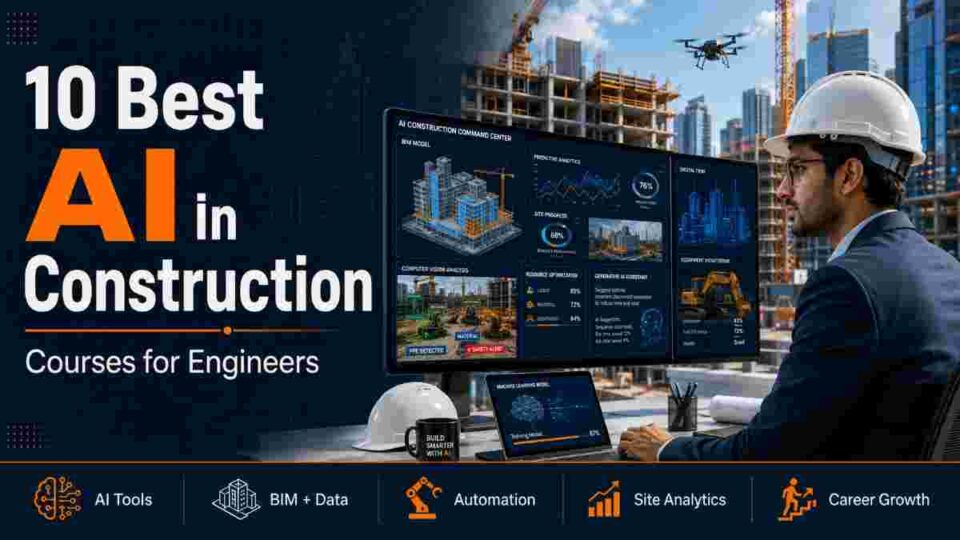
This guide evaluates the 10 best AI in construction courses available to engineers in 2026. Each course was selected based on construction relevance, practical skill development, provider credibility, certificate value, and accessibility for professionals who may not have a programming background. The goal is to help you invest your learning time wisely — in courses that genuinely advance your AI-driven construction career.
Table of Contents
Quick Answer: Best AI in Construction Courses for Engineers in 2026
The best AI in construction courses for engineers in 2026 include the PMI AI in Infrastructure and Construction Projects course for construction-specific content, AI for Everyone by DeepLearning.AI for foundational understanding, Google AI Essentials for practical workplace AI skills, the Udemy Artificial Intelligence for Construction Managers course for hands-on construction workflows, and IBM SkillsBuild AI Fundamentals for a free entry point with a digital credential. Pair any foundational course with a construction-focused option for the strongest career outcome.
Why AI Skills Matter in Construction in 2026
Artificial intelligence in construction refers to the use of machine learning algorithms, natural language processing, computer vision, and generative AI models to automate, optimise, and improve construction workflows across the project lifecycle. In practice, this includes everything from AI-assisted schedule forecasting to automated document analysis and predictive safety analytics.
Here is where AI is making the most tangible impact across construction roles in 2026:
BIM and VDC workflows. AI-powered clash detection, automated model checking, and generative design tools are reducing manual review cycles in BIM coordination. Professionals who understand how these tools work — and how to evaluate their outputs — are increasingly valuable to design and coordination teams. Learn more about essential skills for BIM professionals.
Project planning and scheduling. AI-driven scheduling platforms like ALICE Technologies use machine learning to generate and compare construction sequences, helping planning engineers optimise resource allocation and identify schedule risks before they materialise on site. See our guide to Power BI for planning engineers for related analytics skills.
Quantity takeoff and cost estimation. AI tools now automate quantity extraction from 2D drawings and BIM models, reducing the time needed for preliminary estimates from days to hours. Quantity surveyors who understand how AI takeoff tools work — and their limitations — can deliver faster, more accurate preconstruction outputs.
Construction safety. Computer vision systems analyse site camera feeds in real time to detect PPE violations, unsafe behaviours, and proximity hazards. AI safety analytics platforms flag high-risk observations before incidents occur, shifting site safety from reactive to predictive.
Document control and claims management. Generative AI tools can summarise lengthy contract documents, extract key clauses, draft RFI responses, and organise delay claim documentation. These capabilities are directly relevant to project managers, contracts engineers, and QS professionals. Explore AI applications in civil engineering for more examples.
Digital twins and predictive analytics. Digital twin platforms use AI to combine BIM data with real-time sensor feeds, enabling predictive maintenance, energy optimisation, and lifecycle performance monitoring for built assets.
Career competitiveness. The updated PMP exam launching in July 2026 now includes AI as a testable topic within the Business Environment domain, alongside sustainability and value delivery. This signals that AI literacy is becoming a baseline expectation for project management professionals, not just a differentiator. For a broader view of salary and career benchmarks, see how much construction workers make in 2026.
How We Selected These Courses
Selecting the right AI course for construction professionals requires different evaluation criteria than a generic “best AI courses” list. Here is what we prioritised:
Construction relevance. Does the course content connect to real construction workflows — scheduling, estimating, BIM, safety, document control, or project controls? Courses with direct AEC application scored higher than purely theoretical programmes.
Practical AI skills. Does the course teach usable skills — prompt engineering, tool evaluation, workflow automation, or data interpretation — rather than just concepts? Professionals need skills they can apply on Monday morning.
Provider credibility. Is the course offered by a recognised institution, technology company, or industry body? We prioritised providers like PMI, Google, IBM, Microsoft, UC Davis, and Procore whose credentials carry professional weight.
Certificate value. Does completion earn a certificate, digital badge, or PDUs that add demonstrable value to a resume or LinkedIn profile?
Beginner accessibility. Can a civil engineer, site engineer, or project manager with no coding background complete this course successfully? AI learning should not require a computer science prerequisite.
Current relevance in 2026. Has the course been updated recently? Is the content aligned with current AI tools and industry practices, not outdated 2022-era material?
Verified course details. All course names, providers, and links in this guide were verified at the time of publication. Readers should always confirm the latest pricing, availability, and syllabus details on the official provider page before enrolling, as these may change.
AI in Construction Courses: Comparison Table
| # | Course Name | Provider | Best For | Skill Level | Key Skills | Certificate | Why It Is Useful |
|---|---|---|---|---|---|---|---|
| 1 | AI for Everyone | Coursera / DeepLearning.AI | All construction professionals new to AI | Beginner | AI concepts, ML basics, AI strategy, ethics | Yes | Builds foundational vocabulary to evaluate AI tools in construction contexts |
| 2 | Google AI Essentials | Coursera / Google | Engineers wanting practical prompt skills | Beginner | Prompt engineering, AI decision-making, responsible AI | Yes | Teaches hands-on prompt writing applicable to daily construction tasks |
| 3 | AI in Infrastructure and Construction Projects | PMI | Project managers, planning engineers | Beginner–Intermediate | AI scheduling, RFP optimisation, risk ID, lessons learned | PDUs | Only major course built specifically for construction project professionals |
| 4 | Artificial Intelligence for Construction Managers | Udemy | Construction managers, site engineers | Beginner | AI workflows, automation, construction-specific AI tools | Yes | Taught by an instructor with 10 years of construction experience |
| 5 | IBM SkillsBuild: AI Fundamentals | IBM / Cisco NetAcad | Students, freshers, budget-conscious learners | Beginner | NLP, computer vision, neural networks, ML model building, AI ethics | Yes (digital credential) | Free, comprehensive, and includes hands-on ML model simulation |
| 6 | Microsoft Azure AI Fundamentals (AI-900) | Microsoft Learn | Engineers in Microsoft-stack organisations | Beginner | Azure AI services, ML concepts, NLP, computer vision, generative AI | Yes (paid exam) | Globally recognised Microsoft certification, relevant for firms using Azure and Power BI |
| 7 | AI in Construction Training | CivilsAI | Civil engineers, PMs wanting hands-on AEC tools | Beginner–Intermediate | AI contract analysis, inspection reports from photos, no-code tools, Python basics | Yes (AEC qualification) | 100% construction-focused with hands-on projects for contracts, photos, and reports |
| 8 | AI in Construction | UC Davis CPE | Construction managers, digital construction leaders | Intermediate | Prompt engineering, no-code AI agents, document analysis, visual AI for construction | Yes (digital skills badge) | University-backed, live instruction, culminating project with construction focus |
| 9 | ML & AI: Data in Construction Series Part 3 | Procore | Site managers, project managers using Procore | Beginner–Intermediate | ML on the jobsite, neural networks, AI safety tools, productivity prediction | AIA CES credits | Free, built by a major construction platform, grounded in real jobsite use cases |
| 10 | Real-World AI for Everyone | Coursera / Anthropic | All professionals wanting practical generative AI skills | Beginner | AI fundamentals, prompt design, document analysis, critical AI evaluation | Yes | Teaches practical generative AI collaboration skills directly applicable to construction documentation |
10 Best AI in Construction Courses: Detailed Reviews
1. AI for Everyone — DeepLearning.AI (Coursera)
Provider: Coursera / DeepLearning.AI | Instructor: Andrew Ng | Skill Level: Beginner | Duration: Approximately 6 hours | Certificate: Yes (Coursera certificate)
AI for Everyone remains one of the most widely completed AI courses globally, with consistent ratings around 4.8 out of 5 on Coursera. Andrew Ng designed this course specifically for non-technical professionals who need to understand AI concepts, terminology, and strategic implications without writing a single line of code.
Key topics covered: What AI can and cannot do, machine learning fundamentals, data strategy, building AI in organisations, AI and society.
Why this course is relevant for construction professionals: Construction engineers and managers frequently encounter AI tool vendors and platform features labelled as “AI-powered.” This course gives you the conceptual foundation to evaluate these claims critically. When a scheduling tool says it uses machine learning, you will understand what that means — and what questions to ask. It also covers AI strategy, which is directly useful for construction technology managers evaluating digital transformation roadmaps.
Ideal learners: Civil engineers, project managers, construction executives, and anyone new to AI who wants a credible starting point.
Limitations: This is a general AI course with no construction-specific content. You will need to actively translate concepts to your AEC context. Skip this if you already understand ML fundamentals.
Official course link: AI for Everyone on Coursera
2. Google AI Essentials (Coursera)
Provider: Coursera / Google (Grow with Google) | Skill Level: Beginner | Duration: Approximately 8 hours across 5 courses | Certificate: Yes (Google certificate)
Google AI Essentials is the most-enrolled Google AI programme on Coursera, designed by Google’s own AI experts for workers across every industry. The course teaches practical prompt engineering, responsible AI use, and strategies for integrating AI into daily work — with no technical prerequisites.
Key topics covered: Generative AI fundamentals, prompt writing for real tasks, AI-assisted decision-making, evaluating AI bias, staying current with AI tools.
Why this course is relevant for construction professionals: The prompt engineering skills taught here are immediately applicable to construction document work. Writing effective prompts to summarise specifications, compare contract clauses, or draft method statements requires the same structured thinking this course develops. The Google brand name also carries weight with employers globally.
Ideal learners: Site engineers, QS professionals, and construction managers who want to start using generative AI tools more effectively in their daily work.
Limitations: Uses general workplace examples, not construction-specific scenarios. No coding content. Best as a starting point rather than a complete AI education.
Official course link: Google AI Essentials on Coursera
3. AI in Infrastructure and Construction Projects — PMI
Provider: Project Management Institute (PMI) | Skill Level: Beginner to Intermediate | Duration: Approximately 3 hours | Certificate: PDUs (Professional Development Units)
This is the most construction-specific AI course from a major professional body currently available. PMI developed this programme with interviews and site visits to leading construction organisations, featuring experts like Dr. René Morkos (CEO of ALICE Technologies) and Professor Anil Sawhney discussing real-world AI deployment in infrastructure and construction.
Key topics covered: AI-driven construction scheduling, RFP optimisation, risk identification, lessons learned management, resource optimisation, future trends in AI adoption for construction.
Why this course is relevant for construction professionals: This is the only course on this list built from the ground up for infrastructure and construction project professionals. With the PMP exam updating in July 2026 to include AI as a testable topic, completing this course earns PDUs while building exactly the kind of AI awareness the new exam expects. It is particularly strong for understanding how AI fits into project management decision-making.
Ideal learners: Project managers, planning engineers, PMPs, and construction leaders who want domain-specific AI knowledge with PMI credential alignment.
Limitations: At three hours, this is an awareness-level course. It introduces concepts and shows applications but does not teach you how to build or configure AI tools yourself.
Official course link: AI in Infrastructure and Construction Projects on PMI
4. Artificial Intelligence for Construction Managers — Udemy
Provider: Udemy | Instructor: Tim Fairley | Skill Level: Beginner | Duration: Under 5 hours | Certificate: Yes (Udemy certificate) | Rating: 4.5/5
Created by an instructor with 10 years of hands-on construction experience, this course focuses on practical AI implementation for construction workflows. It was last updated in January 2026, making it one of the more current construction-AI courses on any platform.
Key topics covered: AI fundamentals for construction, actionable automation strategies, AI tool integration into construction workflows, data management on projects, overcoming adoption barriers like limited tech budgets and change resistance.
Why this course is relevant for construction professionals: Unlike general AI courses, this one addresses real construction constraints — limited budgets, resistance to change, fragmented data. The instructor’s construction background means the examples and strategies are grounded in jobsite reality rather than Silicon Valley theory. Explore our guide to the best AI tools for construction project teams to see these concepts in action.
Ideal learners: Construction managers, superintendents, and site engineers who want immediately actionable AI strategies.
Limitations: Smaller enrolment base compared to Coursera/Google courses. Certificate carries less brand weight than Google or IBM credentials. Confirm the latest syllabus and pricing on the Udemy course page before enrolling.
Official course link: Artificial Intelligence for Construction Managers on Udemy
5. IBM SkillsBuild: Artificial Intelligence Fundamentals
Provider: IBM SkillsBuild / Cisco Networking Academy | Skill Level: Beginner | Duration: Approximately 10 hours (6 courses) | Certificate: Yes (IBM digital credential via Credly)
IBM’s AI Fundamentals learning plan is completely free — a significant advantage for students and early-career professionals in construction markets like India, Southeast Asia, and Africa where course costs can be a barrier. The programme covers AI history, machine learning, deep learning, NLP, computer vision, and includes a hands-on simulation where you build and test a machine learning model using IBM Watson Studio.
Key topics covered: AI concepts and history, supervised and unsupervised learning, neural networks and deep learning, natural language processing, computer vision, AI ethics and bias, building an ML model.
Why this course is relevant for construction professionals: Computer vision (the basis for AI safety cameras on sites) and NLP (the basis for AI document analysis) are both covered here with practical context. The IBM digital credential is globally recognised and adds verifiable proof of AI literacy to your LinkedIn profile. For freshers exploring construction career pathways, this free course is an excellent starting point.
Ideal learners: Civil engineering students, fresh graduates, and professionals on a limited learning budget.
Limitations: The content is general AI, not construction-specific. The Watson Studio interface may feel unfamiliar to engineers used to construction software. The course is entry-level and will not make you an AI practitioner on its own.
Official course link: IBM SkillsBuild AI Fundamentals
6. Microsoft Azure AI Fundamentals (AI-900)
Provider: Microsoft Learn | Skill Level: Beginner | Duration: Self-paced (learning path) | Certificate: Yes (paid certification exam — AI-900, updated April 2026)
The Azure AI Fundamentals certification covers core AI concepts, machine learning on Azure, computer vision, NLP, and generative AI workloads. The learning path on Microsoft Learn is free; the certification exam is paid (pricing varies by region). Microsoft updated the exam in April 2026, ensuring the content reflects current AI capabilities.
Key topics covered: AI workloads and considerations, ML principles on Azure, computer vision, natural language processing, generative AI fundamentals.
Why this course is relevant for construction professionals: Many large construction and EPC firms use the Microsoft ecosystem — Power BI for project dashboards, Azure for cloud infrastructure, Microsoft 365 for collaboration. Understanding Azure AI services positions you to suggest and implement AI-powered solutions within these existing enterprise environments. This pairs well with construction analytics and dashboard tools skills.
Ideal learners: Engineers and project controls professionals in organisations that use Microsoft tools, and anyone wanting a globally recognised AI certification.
Limitations: The certification exam is paid and requires preparation beyond the free learning path. Content is Azure-specific, which may not be relevant if your organisation uses different cloud platforms. Some Python knowledge is helpful for deeper understanding.
Official course link: Microsoft Azure AI Fundamentals on Microsoft Learn
7. AI in Construction Training — CivilsAI
Provider: CivilsAI (civils.ai) | Skill Level: Beginner to Intermediate | Duration: Self-paced | Certificate: Yes (Construction AI Specialist AEC qualification)
CivilsAI offers the most hands-on, construction-specific AI training currently available. The course teaches you to use AI to analyse PDF construction contracts, draft site inspection reports from photographs, restyle building designs using AI prompts, and build custom tools using both no-code platforms and basic Python scripts.
Key topics covered: AI for construction contract risk analysis, AI-generated inspection reports from site photos, prompt engineering for construction documents, no-code AI tool customisation, basic Python scripting for construction AI applications.
Why this course is relevant for construction professionals: This is the most practically applicable course on this list for day-to-day construction work. Generating a draft inspection report from site photos, or highlighting risk clauses in a subcontract using AI, solves real problems that civil engineers and project managers face weekly. The AEC qualification also demonstrates specialised competence to employers. For a broader view, see our article on AI in construction skills and tools that get you hired.
Ideal learners: Civil engineers, project managers, contracts engineers, and QS professionals who want to build real AI tools for construction tasks.
Limitations: Smaller provider compared to Coursera or Microsoft, so brand recognition may be lower with some employers. Confirm current pricing and syllabus directly on the CivilsAI website before enrolling.
Official course link: AI in Construction Training on CivilsAI
8. AI in Construction — UC Davis CPE
Provider: UC Davis Continuing and Professional Education | Skill Level: Intermediate | Duration: Multi-week (synchronous online via Zoom) | Certificate: Yes (digital skills badge for LinkedIn and resume)
UC Davis CPE offers a university-backed AI in Construction course delivered through live synchronous sessions. The course covers prompt engineering for construction documentation, building no-code AI agents, document analysis tools, and visual AI applications — all within a construction management context. It includes a culminating project focused on real-world construction AI implementation.
Key topics covered: Advanced prompt engineering for reports and project documentation, no-code AI agent development, document analysis tools for construction workflows, visual AI for site applications, strategies for leading AI innovation within construction organisations.
Why this course is relevant for construction professionals: This is the only university-backed course on this list designed specifically for AI in construction. The live instruction format with group discussions and a culminating project creates a deeper learning experience than self-paced alternatives. The UC Davis digital skills badge also carries academic credibility. This pairs well with the university’s broader construction project management courses.
Ideal learners: Construction managers, digital construction leaders, and mid-career professionals who prefer structured, instructor-led learning with academic backing.
Limitations: Synchronous delivery requires time commitment during scheduled sessions. Pricing and scheduling vary by cohort — confirm directly on the UC Davis CPE website. May not be suitable for learners who prefer fully self-paced courses.
Official course link: AI in Construction on UC Davis CPE
9. Machine Learning & AI: Data in Construction Series Part 3 — Procore
Provider: Procore (learn.procore.com) | Skill Level: Beginner to Intermediate | Duration: Self-paced | Certificate: AIA CES continuing education credits
This course is part of Procore’s five-part Data in Construction Series and focuses specifically on machine learning and AI for construction project managers and site managers. It is free, developed by one of the largest construction technology platforms, and registered with AIA CES for continuing professional education credit.
Key topics covered: Foundations of AI and ML for construction, neural networks, supervised and unsupervised learning, AI for jobsite productivity prediction, AI for equipment needs forecasting, risk prediction, differences between AI, ML, and traditional construction software.
Why this course is relevant for construction professionals: Built by a construction technology company for construction professionals, this course grounds every AI concept in jobsite reality. The distinction between AI, ML, and traditional software is particularly valuable for construction managers who encounter these terms in vendor pitches. AIA CES credits add formal professional development value. See our review of best construction management software for context on how these tools integrate.
Ideal learners: Site managers, project managers, and field engineers — especially those already using Procore or similar construction platforms.
Limitations: Part of a five-part series, so completing Parts 1 and 2 first (on data fundamentals and data analysis) is recommended for the best learning experience. Content focuses on awareness rather than hands-on AI tool building.
Official course link: ML & AI: Data in Construction on Procore
10. Real-World AI for Everyone — Anthropic (Coursera)
Provider: Coursera / Anthropic (Advancing Women in Tech) | Skill Level: Beginner | Duration: Self-paced | Certificate: Yes (Coursera certificate)
Sponsored by Anthropic, this specialisation teaches practical AI collaboration skills — how to work with AI assistants to create content, revise documents, analyse information, and make informed decisions. No technical background is required.
Key topics covered: AI assistant fundamentals, prompt design and context setting, collaborative document revision, tailored communication using AI, information analysis and critical evaluation of AI outputs.
Why this course is relevant for construction professionals: Construction work generates enormous volumes of documents — contracts, RFIs, submittals, daily reports, specifications, change orders. The document revision and information analysis skills taught here translate directly into faster, more accurate construction document workflows. Learning to critically evaluate AI outputs is especially important in construction, where errors in AI-generated content can have safety, legal, and financial consequences.
Ideal learners: Any construction professional who uses AI assistants for document work, communication, or research — from site engineers drafting daily reports to project managers reviewing contract documents.
Limitations: General-purpose course with no construction-specific examples. Best paired with a construction-focused course like PMI or CivilsAI for maximum career impact.
Official course link: Real-World AI for Everyone on Coursera
Best Learning Path for Construction Professionals
Not every construction role requires the same AI learning sequence. Here are tailored learning paths for different career stages and specialisations. For a broader career mapping tool, explore the construction career path planner.
Civil Engineering Students and Freshers
Start with IBM SkillsBuild AI Fundamentals (free, foundational) followed by AI for Everyone (conceptual depth). Focus your learning on understanding what AI can and cannot do in engineering contexts before you specialise. Build your domain foundation first — BIM, estimation, construction processes — then add AI as an enhancement layer.
Site Engineers
Begin with Google AI Essentials (prompt skills for daily tasks) and then take the Procore ML & AI course (construction-specific context). Apply prompt skills immediately to daily report writing, safety observations, and site query resolution.
BIM and VDC Professionals
Start with AI for Everyone (foundational), then CivilsAI Training (hands-on construction AI). Focus on understanding how AI integrates with BIM coordination — clash detection automation, model checking, and quantity extraction. See top BIM certifications for complementary credentials.
Planning and Project Control Engineers
Begin with Google AI Essentials, then the PMI AI in Infrastructure and Construction Projects course for domain-specific scheduling and risk content. Add Microsoft Azure AI Fundamentals if your organisation uses the Microsoft stack for project dashboards and analytics. This pairs well with Power BI skills for planning engineers.
Quantity Surveyors and Cost Engineers
Start with Google AI Essentials (prompt writing for document analysis), then CivilsAI Training (contract risk analysis, AI takeoff awareness). Focus on AI-assisted quantity extraction, cost data analysis, and automated claim documentation.
Project Managers
Begin with the PMI AI in Infrastructure and Construction Projects course (PDUs plus domain alignment), then Real-World AI for Everyone (document collaboration skills). Add AI for Everyone if you need foundational AI vocabulary for stakeholder conversations and vendor evaluation.
Digital Construction Leaders
Start with AI for Everyone (strategic understanding), then UC Davis CPE AI in Construction (university-backed, culminating project). Add Microsoft Azure AI Fundamentals for enterprise AI platform knowledge. This combination provides the strategic, practical, and technical breadth needed to lead AI adoption initiatives across an organisation.
After completing your chosen learning path, strengthen your professional profile using ConstructionCareerHub.com. The Resume Lab helps you build an ATS-optimised resume that highlights your new AI skills alongside construction expertise. The Interview Copilot provides practice questions tailored to digital construction and AI-related roles. The Career Planner helps map your progression from your current role toward AI-enabled construction positions.
Which AI Tools Should Construction Professionals Learn Alongside These Courses?
Courses build understanding. Tools build capability. Here are the practical tool categories construction professionals should explore alongside AI coursework. For a comprehensive guide, see the best construction software to learn for career growth.
Generative AI assistants. Tools like ChatGPT, Claude, and Google Gemini for document drafting, summarisation, data analysis, and research. Master prompt engineering to extract maximum value from these tools for construction tasks.
BIM and model-checking tools. AI-powered features within Autodesk Construction Cloud, Revit, Navisworks, and dedicated platforms like Invicara or Archistar that automate clash detection, design checking, and model validation. See BIM career opportunities for role-specific guidance.
Scheduling and project controls tools. AI-enabled scheduling platforms like ALICE Technologies, Oracle Primavera Cloud with AI features, and Microsoft Project with Copilot integration. These tools use machine learning to optimise construction sequences and predict schedule risks.
Data analytics and dashboarding tools. Power BI, Tableau, and construction-specific analytics platforms that use AI to visualise project performance trends and predict cost or schedule variances. Explore construction analytics and dashboard tools for platform comparisons.
Document automation tools. AI-powered document management systems that automate RFI routing, submittal tracking, contract clause extraction, and specification searching. These are increasingly standard in platforms like Procore, Aconex, and PlanGrid.
Computer vision and safety analytics tools. Platforms like Smartvid.io (now part of Autodesk) and Versatile that use camera feeds and sensor data to monitor PPE compliance, track equipment usage, and flag safety hazards in real time.
Digital twin platforms. Tools like Bentley iTwin, Autodesk Tandem, and Azure Digital Twins that combine BIM data with IoT sensor feeds for asset lifecycle management. Learn more about becoming a digital twin specialist.
AI in Construction Career Opportunities
AI skills are creating new role categories and enhancing existing ones across the construction industry. Here are the career paths where AI competence provides the strongest advantage. For a comprehensive career mapping tool, explore the construction management career guide.
BIM automation specialist. Develops and manages AI-powered BIM workflows — automated clash detection rules, model validation scripts, and generative design integrations. Requires strong BIM proficiency plus AI tool knowledge.
Digital construction engineer. Bridges traditional construction engineering with digital tools and AI platforms. Implements technology solutions on active projects and trains teams on AI-assisted workflows.
Construction data analyst. Analyses project performance data using AI tools and dashboards. Creates predictive models for cost, schedule, and quality metrics. This role is growing rapidly as firms invest in construction analytics capabilities.
AI-enabled project controls engineer. Uses AI-assisted scheduling, earned value analysis, and risk prediction tools to provide more accurate and forward-looking project controls reporting.
VDC coordinator with AI capabilities. Manages virtual design and construction workflows with AI-enhanced coordination tools, improving clash resolution speed and model quality.
Construction technology manager. Leads AI tool evaluation, selection, and deployment across construction organisations. Requires strategic AI understanding combined with deep construction domain knowledge.
Planning engineer with AI skills. Combines traditional scheduling expertise with AI-driven sequence optimisation, resource levelling, and predictive analytics. See our guide to construction software skills to get hired for complementary skills.
Cost estimation analyst. Uses AI-powered takeoff tools and historical cost databases to deliver faster, more accurate estimates. AI augments quantity extraction while professional judgment validates outputs.
Digital twin analyst. Manages the creation, maintenance, and analysis of digital twin models for built assets. Combines BIM expertise with IoT data interpretation and AI-driven predictive maintenance. Prepare for interviews with our digital twin interview questions guide.
Preparing for interviews in AI-enabled construction roles? Use the ConstructionCareerHub.com Interview Copilot to practise technical and HR questions tailored to digital construction, BIM, project controls, and AI-related positions. Also explore our comprehensive construction job interviews guide and project management interview questions.
Common Mistakes to Avoid While Learning AI for Construction
Learning AI without domain application. Completing an AI course and then not connecting it to any construction workflow is the most common waste of learning time. Every AI concept you learn should be immediately tested against a real construction task — can I use this to improve daily reports, speed up takeoffs, or summarise RFIs?
Ignoring BIM and project management fundamentals. AI is an enhancement layer, not a replacement for core competence. An AI tool that generates a schedule is useless if you do not understand critical path methodology. BIM remains a career multiplier — learn it before or alongside AI, not instead of it.
Depending only on prompts without verification. Generative AI outputs in construction require professional verification. A prompt-generated method statement, cost estimate, or safety plan is a draft, not a deliverable. Engineers who blindly trust AI outputs on technical decisions risk professional and legal liability.
Not building a portfolio. Certificates demonstrate learning. Portfolios demonstrate capability. Employers increasingly want to see what you have built with AI, not just which courses you completed.
Not learning data basics. AI runs on data. If you do not understand how construction data is structured — cost codes, WBS hierarchies, schedule activities, BIM parameters — you will struggle to use AI tools effectively. Basic data literacy (spreadsheets, databases, structured data) is a prerequisite for AI competence.
Ignoring ethics, privacy, and accuracy. Construction projects involve confidential contracts, proprietary designs, and sensitive client information. Using AI tools without understanding data privacy implications, IP considerations, and the potential for AI hallucinations can create serious professional risks.
Blindly trusting AI outputs on engineering decisions. AI is a tool, not an engineer. Structural calculations, safety assessments, code compliance checks, and engineering judgments require qualified professional review regardless of what any AI tool suggests. The AI skills every construction professional should learn guide covers this principle in depth.
Practical Mini Portfolio Ideas
After completing one or more AI courses, build these small projects to demonstrate applied AI capability to employers. Each project can be completed in a few hours and produces a tangible deliverable you can share on LinkedIn or in job interviews.
AI-based RFI summary workflow. Use a generative AI tool to create a system that summarises incoming RFIs, extracts key questions, suggests relevant specification sections, and drafts preliminary responses for engineer review.
Construction risk register generator. Build a prompt-based workflow that analyses project documents (contract, drawings list, site conditions) and generates a preliminary risk register with categorised risks, likelihood assessments, and mitigation suggestions.
BIM clash issue summariser. Create an AI workflow that takes clash detection reports from Navisworks or BIM 360 and generates plain-language summaries grouped by trade, severity, and recommended resolution sequence.
Site safety observation classifier. Use AI to categorise site safety observations from daily reports into predefined categories (PPE, housekeeping, fall protection, electrical) and flag high-priority items for safety officer review.
Cost estimate explanation assistant. Build a prompt template that takes a line-item cost estimate and generates clear explanations of each cost component for client or stakeholder presentations.
Project delay claim document organiser. Create an AI-assisted workflow that analyses project correspondence, daily reports, and change orders to identify and organise evidence relevant to a delay claim or extension of time submission.
AI-powered method statement draft reviewer. Develop a prompt chain that reviews draft method statements against a checklist of safety requirements, regulatory references, and best practices, flagging gaps for the engineer to address.
Resume and LinkedIn optimisation for construction roles. Use AI tools to analyse job descriptions for construction positions and optimise your resume and LinkedIn profile to match the specific requirements. ConstructionCareerHub.com offers specialised tools for this purpose.
Construction document Q&A assistant. Build a retrieval-augmented generation (RAG) workflow that allows you to upload project specifications or contracts and ask natural-language questions about their contents.
Dashboard combining project progress and AI insights. Create a Power BI or spreadsheet dashboard that pulls project progress data and uses AI-generated narrative summaries to explain variances and recommend corrective actions. Related reading: construction analytics and dashboard tools.
Recommended Ebooks for Construction Professionals
Complement your AI learning with these focused career resources from the ConstructionPlacements digital library:
Civil Engineering Career Handbook — Career roadmap covering specialisations, certifications, salary insights, and growth strategies for civil engineers and construction professionals.
Construction Interview Preparation Guide — Comprehensive Q&A guide with technical and HR questions for planning, QS, site, BIM, and project management roles.
Complete Career Bundle (Best Value) — Get the Civil Engineering Career Handbook and Interview Guide together at a discounted bundle price.
Remote & International Construction Jobs Guide — Strategies and resources for landing construction roles in the Gulf, UK, Australia, and international markets.
Conclusion: Choosing the Right AI in Construction Course
AI in construction is not a future trend — it is a present-day career requirement that is gaining momentum with every platform update, every new AI-powered feature in BIM and project management tools, and every job posting that lists “AI literacy” as a preferred skill. The updated PMP exam launching in July 2026 is perhaps the clearest signal yet that AI competence is becoming a baseline expectation for construction project professionals.
The best approach is not to chase a single course but to build a layered learning path: start with one foundational AI course (AI for Everyone, Google AI Essentials, or IBM SkillsBuild), then add a construction-specific course (PMI, CivilsAI, UC Davis, or Procore), and finally build a mini portfolio that demonstrates applied capability. This combination of knowledge, context, and proof is what sets you apart in a competitive construction job market.
AI will not replace civil engineers, project managers, or construction leaders. But professionals who understand AI — who can evaluate tools critically, use them productively, and apply them to real construction problems — will increasingly outperform those who do not. The courses on this list are your starting point. For ongoing career tools, resources, and job market intelligence, continue exploring best online construction courses and the wider ConstructionPlacements resource library.
Ready to translate your new AI skills into career advancement? Visit ConstructionCareerHub.com to build an ATS-ready resume with the Resume Lab, practise interview questions with the Interview Copilot, and map your career progression with the Career Planner — all designed specifically for construction professionals.
Frequently Asked Questions
What is the best AI in construction course for civil engineers in 2026?
For civil engineers, the PMI AI in Infrastructure and Construction Projects course offers the most directly relevant content, covering AI-driven scheduling, risk identification, and RFP optimisation specific to construction. Pair it with AI for Everyone by DeepLearning.AI for foundational concepts if you are new to AI. For hands-on construction AI projects, the CivilsAI training provides contract analysis and inspection report automation.
Can civil engineers learn AI without coding?
Yes. Several courses on this list, including AI for Everyone, Google AI Essentials, IBM SkillsBuild AI Fundamentals, and the PMI course, require no programming experience. They focus on AI concepts, prompt engineering, and practical application rather than writing code. Coding is beneficial for advanced AI applications but is not a prerequisite for building useful AI competence in construction.
Is AI useful for BIM engineers?
AI is highly relevant for BIM engineers. AI-powered tools now automate clash detection, generate quantity takeoffs from models, predict design conflicts, and assist with model checking. Platforms like Autodesk Construction Cloud are embedding AI features directly into BIM workflows. BIM professionals who understand AI concepts can leverage these tools for faster and more accurate project delivery. Explore our guide to essential skills for BIM professionals for more.
Which AI skills are most useful in construction project management?
The most useful AI skills for construction project managers include prompt engineering for document analysis (contracts, RFIs, specifications), understanding predictive analytics for schedule and cost forecasting, using AI-assisted risk identification, and knowing how to evaluate AI tool outputs critically before making project decisions. The PMI AI in Infrastructure and Construction Projects course addresses these areas directly.
Are AI courses worth it for site engineers?
Yes. Site engineers who understand AI can use computer vision tools for safety monitoring, automate daily report writing using generative AI, use AI-assisted document retrieval to resolve site queries faster, and communicate more effectively with technology teams implementing AI solutions on their projects. Even a foundational course like Google AI Essentials adds meaningful career value.
Which is better for construction professionals: AI, BIM, or data analytics?
These are not competing skills — they are complementary layers. BIM provides the structured data foundation, data analytics helps interpret that data for decision-making, and AI automates analysis and generates insights at scale. The strongest career position in 2026 combines all three in a layered learning approach. Start with your role’s primary skill requirement, then add the others progressively.
Can AI replace civil engineers?
AI cannot replace civil engineers. Engineering judgment, site understanding, regulatory knowledge, safety accountability, professional liability, and stakeholder management require human expertise that AI cannot replicate. AI is a productivity tool that augments engineering workflows — automating repetitive tasks, surfacing insights from data, and accelerating document work — but the professional responsibility for engineering decisions remains firmly with qualified humans.
How can construction professionals build an AI portfolio?
Start with small, practical projects: build an AI-based RFI summary workflow, create a construction risk register generator, or design a site safety observation classifier. Document your process (problem, approach, tools used, results), share the outputs on LinkedIn, and demonstrate how AI solved a real construction problem. The mini portfolio ideas section above provides ten starter projects.
Are Coursera and edX AI certificates useful for construction careers?
Coursera and edX certificates from recognised providers like Google, IBM, Microsoft, and DeepLearning.AI carry genuine professional value when combined with construction domain expertise. They demonstrate initiative and AI literacy to employers. However, certificates are most impactful when paired with a portfolio of construction-specific AI projects that show applied capability.
What should fresh civil engineers learn before AI?
Fresh civil engineers should first develop a solid understanding of core construction processes — project planning, cost estimation, BIM fundamentals, construction contracts, and site management. Once this domain foundation is in place, AI courses become significantly more useful because you can connect AI capabilities to real construction workflows. AI without domain knowledge is like having a powerful tool without knowing what to build.
