

Last Updated on July 21, 2026 by Admin
Transmission line construction jobs cover the planning, design, surveying, civil works, tower erection, conductor stringing, testing, commissioning, safety, quality control and maintenance activities required to move bulk electricity from generating stations to substations and regional grids. The field offers careers for electrical, civil, structural, mechanical and geotechnical engineers, as well as diploma holders, ITI candidates, surveyors, supervisors, linemen, riggers, equipment operators and project-management professionals.
ConstructionCareerHub App is LIVE — built ONLY for construction careers. Don’t apply with a weak resume.
Get ATS-ready Resume Lab + Interview Copilot + Campus Placement Prep (resume screening, skill gaps, interview readiness) — in minutes & Other advanced features.
Explore Smarter Construction Career Tools →Quick check. Big impact. Start now.
These careers are becoming increasingly important as countries expand power networks, connect renewable-energy projects, strengthen interregional links and modernise ageing grid assets. India’s transmission programme alone is expected to require major additions in high-voltage lines, substations, transformation capacity and interregional transfer capability through 2032. This guide explains the major transmission-line roles, qualifications, salaries, technical skills, software, safety requirements, employers and career paths available in India, the Gulf and other international markets.
Career snapshot: Civil engineers are commonly recruited for route surveys, foundations, tower erection, billing, planning and quality roles. Electrical engineers work in line design, conductor and insulation studies, earthing, substations, protection, testing and commissioning. Diploma and ITI candidates can enter through technician, lineman, survey, erection, stringing, fitting, welding, electrical and equipment-operation positions.
Table of Contents
- What Is Transmission Line Construction?
- Why Transmission-Line Careers Are Growing
- How a Transmission Line Is Constructed
- Major Transmission Line Construction Jobs
- Best Roles for Civil Engineers
- Best Roles for Electrical Engineers
- Opportunities for Diploma and ITI Candidates
- Qualifications and Entry Requirements
- Essential Skills and Software
- Useful Certifications
- Transmission Line Construction Salaries
- Major Employers and EPC Companies
- Transmission Line Jobs in Gulf Countries
- How Freshers Can Enter the Industry
- Career Progression
- Working Conditions and Challenges
- Transmission Line Construction Safety
- Future Technologies and Career Opportunities
- How to Find Transmission Line Jobs
- Resume Tips
- Interview Questions
- Advantages and Disadvantages
- Courses and Career Resources
- Frequently Asked Questions
What Is Transmission Line Construction?
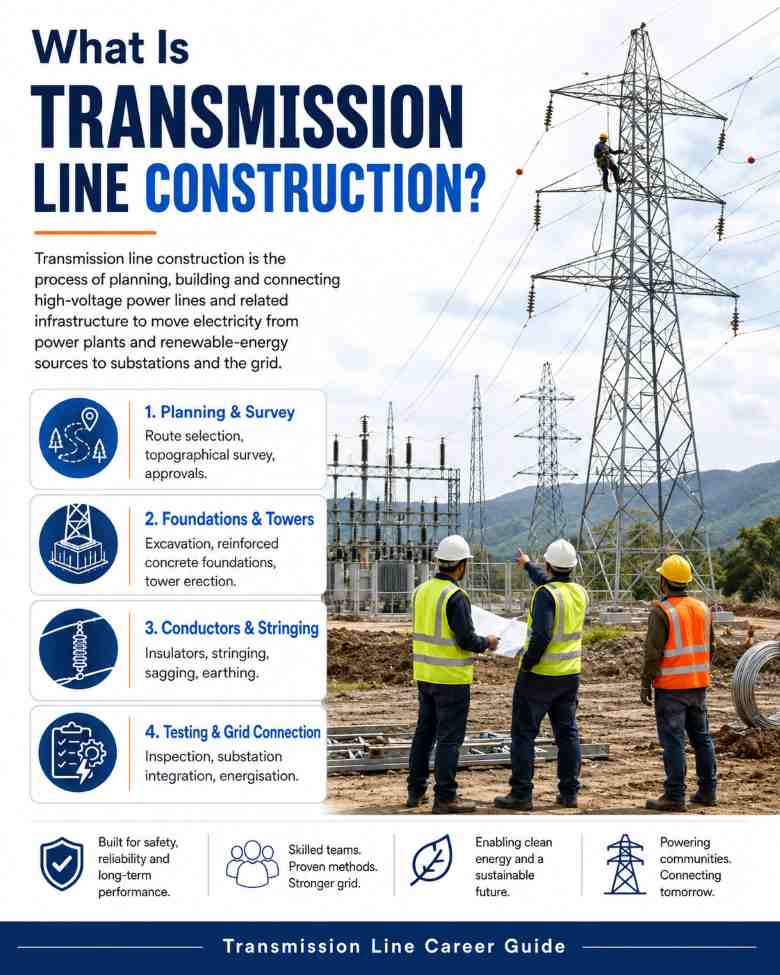
Electricity is generally produced at generating stations, transmitted in bulk over long distances and then distributed at lower voltages to homes, industries and commercial users. Transmission lines form the high-capacity link between power generation and distribution networks. They also connect regions, states, renewable-energy zones, industrial clusters and neighbouring grids.
A transmission-line project may include overhead lines supported by lattice towers, monopoles or specialised structures; underground high-voltage cables; subsea links; associated substations; communication systems; protection systems; and grid-control infrastructure. Most long-distance systems use high-voltage alternating current, while high-voltage direct current is often selected for very long distances, bulk power transfer, asynchronous interconnections or certain underground and subsea applications.
Typical project components include:
- Towers or poles: Structures designed to support conductors, insulators, earth wires and communication cables under electrical, wind, terrain and loading requirements.
- Conductors: Metallic cables that carry electrical current. Their type and configuration depend on voltage, capacity, losses, mechanical loading and project specifications.
- Insulator strings: Assemblies that electrically isolate energised conductors from supporting structures.
- Earth wires and optical ground wire: Overhead wires used for lightning protection, earthing continuity and, in the case of OPGW, telecommunications and protection signalling.
- Foundations: Reinforced-concrete, pile, raft, rock-anchor or other systems selected according to tower loading, soil conditions, groundwater, terrain and constructability.
- Substations: Facilities that switch circuits, transform voltage, protect the system, measure performance and connect transmission assets to other parts of the grid.
- Right of way: The legally and technically controlled corridor required for construction, operation, maintenance, clearances and public safety.
Voltage classifications differ among countries and utilities, so job seekers should avoid assuming that one universal threshold applies everywhere. Project documents, national regulations, utility standards and the applicable contract specifications remain the governing references.
For a broader overview of related occupations, read the Power Infrastructure Construction Careers guide and the guide to electrical engineering jobs in the construction industry.
Why Transmission-Line Careers Are Growing
Grid development is being driven by rising electricity demand, renewable-energy integration, urbanisation, industrial growth, electrification and the need to improve reliability. The Ministry of Power Annual Report 2025–26 states that India’s National Electricity Plan for transmission anticipates electricity demand of about 388 GW by 2031–32. It also describes planned additions of more than 1.91 lakh circuit-kilometres of transmission lines and approximately 1,270 GVA of transformation capacity at 220 kV and above during the 2022–23 to 2031–32 period.
The same plan envisages an expansion of India’s transmission network to approximately 6.48 lakh circuit-kilometres by 2032, with interregional transfer capacity rising from around 120 GW in December 2025 to about 168 GW by 2032. It identifies an investment opportunity exceeding ₹9.15 lakh crore through 2032 and includes systems for renewable-energy zones, storage projects and emerging green hydrogen and green ammonia hubs.
The international outlook is equally significant. The International Energy Agency’s grid analysis explains that electricity networks can become a bottleneck in clean-energy transitions unless transmission investment, planning and permitting accelerate. The IEA has also reported that at least 3,000 GW of renewable-energy projects were waiting in grid-connection queues worldwide, highlighting the scale of required network development.
This expansion creates demand not only for electrical design engineers, but also for civil foundations, route surveys, tower fabrication, logistics, project controls, contracts, quality, safety, environmental management, commissioning, digital inspection and asset maintenance.
How Is a Transmission Line Constructed?
A transmission line is delivered through a sequence of technical, regulatory, commercial and construction activities. The exact order may overlap on large EPC projects, but the following lifecycle provides a practical overview.
- System planning and feasibility: Power-system planners assess demand, generation evacuation, network reliability, transfer requirements, voltage level and possible connection points.
- Route selection: Engineers compare alternative corridors based on length, terrain, settlements, protected areas, road and railway crossings, airports, rivers, forests, constructability and lifecycle cost.
- Topographical and geotechnical surveys: Survey teams establish coordinates, ground profiles, crossing details and access conditions. Geotechnical teams investigate soil and rock properties for foundation design.
- Environmental and social assessment: Specialists study ecological impacts, land use, community effects, cultural sites, forests and mitigation measures required by permits or lenders.
- Right-of-way and permissions: Land, legal and liaison teams obtain corridor access, statutory clearances and crossing permissions while addressing compensation and stakeholder concerns.
- Detailed engineering and tower spotting: Designers determine tower locations, spans, tower types, extensions, clearances, conductor behaviour, loading and foundation requirements.
- Procurement and fabrication: Towers, conductors, insulators, fittings, OPGW, earthing materials, reinforcement steel, concrete ingredients and specialised equipment are purchased, inspected and delivered.
- Access development and site preparation: Temporary access roads, working platforms, storage areas and safe lifting zones are prepared with environmental controls.
- Foundation construction: Teams set out tower legs, excavate, stabilise excavations, install reinforcement and templates, place concrete, cure the foundation and complete backfilling.
- Tower assembly and erection: Tower members are assembled and erected using cranes, gin poles, derricks or approved erection methods. Bolting, alignment, tightening and member checks follow the approved procedure.
- Insulator and hardware installation: Insulator strings, clamps, spacers, dampers and associated fittings are installed and checked.
- Conductor and OPGW stringing: Pilot ropes, pullers, tensioners and controlled stringing methods are used to install conductors and earth wires without damaging them or creating unacceptable public risk.
- Sagging and clipping: Conductors are adjusted to specified sag and tension for the relevant span, temperature and design condition, then clipped into position.
- Earthing and bonding: Tower earthing, continuity and resistance are checked against project and regulatory requirements.
- Inspection, testing and punch-list closure: Teams verify foundations, tower geometry, fasteners, clearances, conductor condition, accessories, earthing, crossings, documentation and route readiness.
- Substation integration and commissioning: Line protection, metering, communication, teleprotection and control interfaces are tested before energisation.
- Energisation and handover: The owner and system operator complete approved energisation procedures, as-built records, asset data and operational handover.
- Operations and maintenance: Inspection, vegetation control, thermography, drone surveys, hardware replacement, corrosion treatment and emergency restoration support long-term reliability.
Major Transmission Line Construction Jobs
Transmission-line projects employ multidisciplinary teams. Job titles vary among utilities, consultants and EPC contractors, but the following groups cover the most common career routes.
Engineering and Design Roles
| Role | Main Responsibilities | Typical Background | Career Direction |
|---|---|---|---|
| Transmission Line Design Engineer | Route modelling, tower spotting, sag-tension studies, clearance checks, loading coordination, structure selection and design documentation. | BE/BTech in Electrical, Civil or Structural Engineering; utility standards and line-design software knowledge. | Senior Design Engineer, Lead Engineer, Engineering Manager or Technical Specialist. |
| Tower or Structural Design Engineer | Analysis and design of lattice towers, poles, members, connections and load combinations; review of tower tests and fabrication drawings. | Civil or Structural Engineering; structural analysis, steel design and relevant codes. | Lead Structural Engineer, Tower Design Lead or Engineering Manager. |
| Foundation Design Engineer | Selects and designs foundations using tower reactions, soil reports, groundwater, uplift, settlement, constructability and durability requirements. | Civil, Structural or Geotechnical Engineering. | Senior Foundation Specialist, Geotechnical Lead or Civil Design Manager. |
| Survey or Route Alignment Engineer | Topographical surveys, route alternatives, profile data, crossing schedules, tower coordinates and GIS records. | Civil Engineering, Surveying, Geomatics or Diploma Civil with field experience. | Survey Manager, GIS Lead, Route Engineering Lead or Project Survey Head. |
| Geotechnical Engineer | Plans investigations, interprets soil and rock data, recommends design parameters and supports difficult foundations or slope conditions. | Civil Engineering with geotechnical specialisation. | Senior Geotechnical Engineer, Discipline Lead or Technical Consultant. |
| Electrical Line Engineer | Conductor selection, electrical clearances, insulation coordination, line parameters, losses, corona, earthing and interface studies. | Electrical or Power Engineering. | Lead Line Engineer, Power-System Specialist or Engineering Manager. |
| Substation Engineer | Coordinates line bays, switchgear, transformers, bus systems, control, protection and civil interfaces at terminal substations. | Electrical Engineering; civil engineers also support substation structures and foundations. | Lead Substation Engineer, Commissioning Manager or Project Engineering Manager. |
| Protection and Control Engineer | Protection philosophy, relay settings, communication interfaces, schematics, interlocks and functional testing. | Electrical Engineering with power-system protection knowledge. | Protection Lead, Grid Integration Specialist or Technical Manager. |
| Testing and Commissioning Engineer | Pre-commissioning checks, protection tests, communication tests, energisation documentation and system handover. | Electrical Engineering or Diploma Electrical with relevant experience. | Commissioning Lead, Commissioning Manager or Operations Specialist. |
Construction, Project Management and Commercial Roles
| Role | What the Role Involves | Useful Skills |
|---|---|---|
| Project Manager | Accountable for scope, programme, cost, quality, safety, stakeholder coordination, contracts, risk and client reporting. | EPC delivery, leadership, commercial awareness, scheduling, claims, risk management and utility coordination. |
| Construction Manager | Directs field execution across foundations, tower erection, stringing, access, logistics and subcontractors. | Construction sequencing, resource planning, lifting operations, productivity and safety leadership. |
| Site or Project Engineer | Coordinates daily work, drawings, quantities, inspections, permits, subcontractors, progress and records. | Drawing interpretation, method statements, measurement, reporting and problem-solving. |
| Planning or Project Controls Engineer | Develops schedules, baselines, progress updates, look-ahead plans, resource curves, delay analysis and forecasts. | Primavera P6 or Microsoft Project, earned-value concepts, reporting and schedule logic. |
| Contracts Engineer | Administers contractual notices, variations, claims, correspondence, subcontract terms and commercial risk. | Contract interpretation, records, negotiation and construction law fundamentals. |
| Billing Engineer or Quantity Surveyor | Measures completed work, prepares bills, reconciles quantities, evaluates variations and maintains payment records. | BOQ interpretation, measurement, Excel, drawings and contract rates. |
| Procurement Engineer | Handles technical enquiries, vendor evaluation, purchase orders, expediting and inspection coordination. | Specifications, vendor management, supply schedules and commercial comparison. |
| Logistics Coordinator | Plans movement of tower members, drums, heavy equipment and materials to remote work fronts. | Route surveys, transport permits, inventory, site coordination and damage prevention. |
| Right-of-Way Coordinator | Coordinates access, landowners, authorities, compensation records, local issues and work-front availability. | Communication, documentation, local regulations, negotiation and stakeholder management. |
| Document Controller | Controls drawings, revisions, transmittals, inspection records, approvals, correspondence and handover dossiers. | Document-management systems, accuracy, revision control and disciplined filing. |
Civil professionals moving from execution into scheduling can follow this site engineer to planning engineer roadmap. Candidates preparing for project-controls interviews may also review these Primavera P6 interview questions and answers.
Quality, Safety and Environmental Roles
- QA/QC Engineer: Prepares inspection and test plans, verifies materials, controls records, raises non-conformance reports and confirms corrective actions. Learn more from this QA/QC Engineer career guide.
- Quality Inspector: Checks excavation, reinforcement, templates, concrete, tower members, fasteners, stringing hardware, earthing and workmanship against approved documents.
- HSE Manager or Safety Engineer: Leads risk assessments, permit systems, lifting controls, work-at-height safety, emergency planning, audits and incident prevention.
- Safety Officer: Conducts inductions, toolbox talks, field inspections, PPE checks and close monitoring of high-risk activities.
- Environmental Engineer: Manages waste, erosion, vegetation, water, noise, biodiversity and permit commitments.
- Environmental and Social Specialist: Coordinates community impacts, livelihood concerns, stakeholder engagement and lender or regulatory requirements.
- Permit-to-Work Coordinator: Controls authorisation, isolation, energisation boundaries and simultaneous activities.
Those considering safety careers should read the guide to construction safety jobs and practise with these HSE interview questions and answers.
Field, Technician and Trade Roles
- Tower Erection Supervisor: Plans assembly sequence, manpower, tools, lifting arrangements, bolt control, alignment and safe completion.
- Stringing Engineer or Supervisor: Coordinates puller-tensioner setup, drum scheduling, crossing protection, communication, sagging, clipping and conductor protection.
- Foundation Supervisor: Manages setting out, excavation, shoring, reinforcement, stub templates, concreting, curing and backfilling.
- Surveyor: Establishes control points, tower centres, leg levels, profiles and as-built coordinates.
- Lineman or Transmission Technician: Supports installation, inspection, maintenance, hardware replacement and approved work on transmission assets.
- Tower Technician, Rigger and Fitter: Assemble members, work with lifting systems, install bolts and hardware, and perform height work under competent supervision.
- Welder: Completes approved fabrication or site-welding tasks where permitted by design and procedure.
- Electrician: Supports temporary power, equipment, earthing, testing and construction electrical systems within authorised limits.
- Crane, Excavator and Equipment Operators: Operate lifting and earthmoving machinery under lift plans, access controls and competency requirements.
- Storekeeper: Maintains receipt, issue, traceability, storage and preservation of tower members, fittings, insulators and consumables.
Operations, Inspection and Maintenance Roles
- Transmission Line Maintenance Engineer: Plans inspections, outages, repairs, strengthening and emergency response.
- Grid Maintenance Technician: Performs approved inspection and maintenance under operational safety rules.
- Drone Inspection Specialist: Captures structured visual, thermal or LiDAR data for asset assessment, subject to aviation and utility permissions.
- Thermography Technician: Uses infrared inspection to identify abnormal heating and potential defects.
- Asset Management Engineer: Prioritises intervention using condition, risk, performance and lifecycle cost.
- Emergency Restoration Specialist: Supports rapid assessment, temporary structures, material mobilisation and restoration after storms, floods, fire or structural failure.
- Vegetation Management Coordinator: Manages corridor clearance while balancing safety, reliability, environmental rules and landowner requirements.
Best Transmission-Line Jobs for Civil Engineers
Civil engineers are essential because every tower depends on accurate surveying, suitable access, safe foundations and controlled erection. The most relevant civil-engineering roles include:
- Route survey and tower-location planning
- Topographical and construction surveying
- Geotechnical investigation and foundation recommendations
- Foundation design and checking
- Access roads, drainage and erosion control
- Foundation execution and concrete quality
- Tower erection supervision
- Quantity estimation and billing
- Planning and project controls
- Contracts and claims
- QA/QC and material inspection
- Construction management and project management
- Right-of-way coordination
Useful civil-engineering subjects include surveying, soil mechanics, foundation engineering, reinforced concrete, structural analysis, steel structures, construction planning, quantity surveying, contracts, hydrology and construction safety. Freshers should become comfortable reading plan-profile drawings, tower schedules, foundation drawings, reinforcement details, method statements and inspection formats.
Job seekers beginning their careers may benefit from the civil engineering fresher jobs guide, the broader construction career guide for 2026 and these civil engineer resume keywords by role.
Best Transmission-Line Jobs for Electrical Engineers
Electrical engineers work on the electrical performance, grid integration, protection and commissioning of transmission assets. Typical responsibilities include:
- Selection and review of conductor configurations
- Electrical clearance studies
- Insulation coordination
- Line-parameter calculations and power-system models
- Loss, corona and performance studies
- Earthing and lightning-protection coordination
- Substation line-bay interfaces
- Protection, control and telecommunication systems
- SCADA and control integration
- Testing, commissioning and energisation
- Operations, outage planning and maintenance
- Condition monitoring and asset analytics
Strong fundamentals in power systems, electrical machines, high-voltage engineering, protection, measurements and control systems are valuable. Depending on the role, engineers may use ETAP, PowerFactory, PSCAD, MATLAB, line-design software, protection-testing tools and utility-specific applications.
For role ideas and job-description guidance, review the Electrical Engineer job description and career guide.
Opportunities for Diploma and ITI Candidates
Transmission construction is not limited to graduate engineers. Diploma and ITI candidates can build strong careers through practical field competence, safety discipline and progressive responsibility.
| Qualification | Possible Entry Roles | Typical Progression |
|---|---|---|
| Diploma Civil Engineering | Junior Site Engineer, Survey Assistant, Foundation Supervisor, Billing Assistant, QA/QC Inspector | Site Engineer, Senior Supervisor, Planning or Quality Engineer, Construction Manager |
| Diploma Electrical Engineering | Electrical Supervisor, Line Technician, Testing Assistant, Substation Technician, O&M Technician | Senior Technician, Commissioning Supervisor, Maintenance Supervisor, Assistant Engineer |
| Diploma Mechanical Engineering | Equipment Coordinator, Plant and Machinery Supervisor, Rigging Coordinator, Maintenance Technician | Equipment Engineer, Lifting Supervisor, Plant Manager |
| ITI Electrician | Electrician, Electrical Helper, Earthing Technician, Maintenance Assistant | Senior Electrician, Electrical Supervisor, Technician |
| ITI Fitter | Tower Fitter, Assembly Technician, Mechanical Helper | Senior Fitter, Erection Supervisor, General Foreman |
| ITI Welder | Welder or Fabrication Assistant under an approved welding procedure | Qualified Welder, Welding Supervisor or Inspector after additional certification |
| ITI Draughtsman | CAD Technician, Drawing Assistant, As-Built Documentation Assistant | Senior CAD Technician, Design Coordinator |
| Survey Trade or Practical Survey Training | Survey Assistant, Chainman, GPS or Total-Station Assistant | Surveyor, Senior Surveyor, Survey Manager |
Apprenticeships, trainee programmes and supervised site assignments provide valuable entry routes. Candidates should never undertake tower climbing, lifting, electrical work or other high-risk activities without the required training, authorisation, equipment and competent supervision.
Qualifications and Entry Requirements
| Career Area | Common Minimum Education | Preferred Knowledge | Experience Pattern |
|---|---|---|---|
| Line Design | BE/BTech Electrical, Civil or Structural | Line routing, clearances, loading, sag-tension and design software | Graduate trainee to senior specialist |
| Tower and Foundation Design | BE/BTech Civil or Structural; postgraduate study can help | Steel design, geotechnical data, foundations and structural software | Design-office experience commonly preferred |
| Site Execution | BE/BTech or Diploma in Civil/Electrical/Mechanical | Drawings, method statements, measurements, safety and reporting | Freshers may enter as trainee or junior engineer |
| Planning and Controls | Engineering degree or diploma | Primavera P6, Microsoft Project, progress measurement and reporting | Site experience improves planning effectiveness |
| QA/QC | Engineering degree or diploma | Inspection plans, materials, concrete, tower and documentation controls | Entry through junior quality or site role |
| HSE | Engineering, science or recognised safety qualification as required | Risk assessment, permits, height safety, lifting and emergency response | Employer and jurisdiction-specific requirements apply |
| Survey | Degree, diploma or recognised surveying/geomatics training | Total station, GNSS, levelling, GIS and route profiles | Field competence is highly valued |
| Technician and Trade Work | ITI, apprenticeship or recognised trade qualification | Practical trade skills, safety and equipment competence | Supervised entry followed by trade progression |
| Project Management | Engineering degree commonly preferred | EPC delivery, contracts, leadership, cost, schedule and stakeholder management | Usually requires substantial project experience |
Requirements vary with the employer, voltage class, utility rules, contract, country and risk profile. A qualification that is accepted for one position may not satisfy statutory or utility requirements elsewhere. Candidates applying internationally should also check degree recognition, trade licensing, visa rules and professional-registration requirements.
Essential Technical Skills and Software
Technical Skills
- Reading plan-profile, tower, foundation, reinforcement and stringing drawings
- Route survey, levelling, total-station and GNSS fundamentals
- Tower spotting and crossing identification
- Soil-investigation interpretation and foundation selection
- Concrete inspection, cube testing, curing and traceability
- Tower assembly, erection sequencing and bolt control
- Rigging, lifting-plan awareness and equipment exclusion zones
- Conductor handling, stringing, sagging and clipping concepts
- Electrical clearances, earthing and induced-voltage awareness
- Inspection and test plans, checklists and non-conformance control
- Quantity take-off, billing and reconciliation
- Planning, progress measurement and look-ahead scheduling
- Contract records, variation control and correspondence
- Risk assessment, job safety analysis and permit-to-work systems
- Technical reporting, as-built documentation and handover dossiers
Software Commonly Used
| Software or Tool | Typical Use | Relevant Roles |
|---|---|---|
| PLS-CADD | Route modelling, terrain profiles, tower spotting, clearances and line design | Transmission Line Design Engineer, Route Engineer |
| PLS-TOWER / PLS-POLE | Analysis and design of towers and poles | Structural and Tower Design Engineers |
| AutoCAD | Plans, profiles, details, layouts and as-built drawings | Design Engineers, CAD Technicians, Site Engineers |
| Civil 3D | Terrain, survey, alignments, surfaces and access-road work | Survey, Civil and Route Engineers |
| STAAD.Pro / SAP2000 | Structural analysis where adopted by the designer | Structural, Tower and Foundation Engineers |
| ETAP / PowerFactory / PSCAD | Power-system, protection, load-flow, transient or grid studies according to project scope | Electrical, Protection and Grid Engineers |
| MATLAB | Engineering calculations, models and data analysis | Power-System and Research Engineers |
| ArcGIS / QGIS | Route selection, spatial analysis, environmental constraints and asset mapping | GIS, Survey, Route and Environmental Teams |
| Primavera P6 / Microsoft Project | Scheduling, critical path, progress, resources and forecasting | Planning Engineers, Project Controls and Managers |
| Revit and BIM Platforms | Substation, building and multidisciplinary coordination where BIM is included | BIM, Civil, Structural and MEP Teams |
| Common Data Environments | Controlled drawings, reviews, workflows, records and collaboration | Engineering, QA/QC, Document Control and Project Management |
| Drone and Photogrammetry Tools | Survey mapping, inspection imagery, point clouds and condition records | Surveyors, Drone Pilots, GIS and Asset Inspection Teams |
No candidate needs to master every application. Select software according to the intended role. A fresher targeting site execution may gain more immediate value from AutoCAD, Excel, drawing interpretation and surveying, while a line-design aspirant should prioritise specialised line-design concepts and software.
Useful Certifications and Training
Certifications can strengthen a profile, but they do not replace practical competence or statutory authorisation. Useful areas include:
- Project management: PMP or other recognised project-management training for experienced professionals.
- Planning: Primavera P6 and project-controls training. Compare suitable options in this guide to Primavera P6 certification courses.
- Construction safety: Recognised occupational-safety qualifications relevant to the country and employer.
- Work at height and rescue: Practical training covering fall protection, rescue planning and equipment inspection.
- Rigging and lifting: Rigger, signal person, lifting supervisor or crane-operation credentials as required.
- First aid and emergency response: Current training suited to remote construction sites.
- Quality management: ISO 9001 awareness, internal-auditor training and discipline-specific inspection competence.
- Welding and NDT: Welder qualification, welding inspection or non-destructive testing certification for relevant roles.
- GIS and surveying: Total-station, GNSS, GIS and drone-mapping training.
- Environmental management: Environmental system, biodiversity or impact-assessment training for specialist roles.
Certification requirements are not universal. Always check the applicable law, utility standard, client specification and job description before paying for training.
Transmission Line Construction Salary Guide
Compensation depends on location, employer, voltage level, project risk, rotation pattern, allowances, qualifications and experience. The following ranges are editorial market estimates reviewed in July 2026; they are not official pay scales or guaranteed offers.
Indicative Salaries in India
| Role or Level | Typical Experience | Indicative Annual Range |
|---|---|---|
| Graduate Trainee / Junior Site Engineer | 0–2 years | ₹3.0–6.0 lakh |
| Site or Project Engineer | 2–6 years | ₹4.5–10.0 lakh |
| Transmission Line Design Engineer | 2–7 years | ₹5.0–14.0 lakh |
| Planning / Project Controls Engineer | 2–7 years | ₹5.0–14.0 lakh |
| QA/QC or HSE Engineer | 2–7 years | ₹4.5–12.0 lakh |
| Surveyor / Site Supervisor | 2–8 years | ₹3.5–8.0 lakh |
| Transmission Technician / Tower or Stringing Trade | Varies | ₹3.0–7.0 lakh, often with project allowances |
| Construction Manager | 8–15 years | ₹12–28 lakh |
| Project Manager | 10–20 years | ₹16–40 lakh or more on major projects |
| Senior Lead / Engineering Manager | 12+ years | ₹20–45 lakh or more, depending on responsibility |
Public-sector and government-linked employers may use formal pay scales and allowances rather than market-style packages. Candidates should rely on the relevant recruitment notification for exact compensation.
Indicative Gulf Salary Ranges
| Role | UAE Indicative Monthly Range | Saudi Arabia Indicative Monthly Range |
|---|---|---|
| Engineer with 4–8 years of relevant experience | AED 8,000–18,000 | SAR 9,000–20,000 |
| Senior or Lead Engineer | AED 15,000–28,000 | SAR 16,000–30,000 |
| Project / Construction Manager | AED 22,000–40,000+ | SAR 24,000–45,000+ |
| Supervisor / General Foreman | AED 4,000–9,000 | SAR 4,500–10,000 |
| Skilled Tower, Line or Stringing Trade | AED 2,000–5,000 | SAR 2,200–6,000 |
A Gulf package may include company accommodation, transport, food or allowance, medical insurance, annual leave, air tickets, overtime and end-of-service benefits. Compare the full package, working hours, rotation, accommodation standard, project location and overtime rules rather than evaluating only the basic salary.
International Benchmarks
- United States: The U.S. Bureau of Labor Statistics reported a May 2024 median annual wage of $92,560 for electrical power-line installers and repairers. The occupation normally requires extensive training and may involve apprenticeship pathways.
- Canada: The Government of Canada Job Bank lists a national median wage of approximately C$46 per hour for powerline technicians, while provincial rates and trade requirements vary.
- United Kingdom: The National Careers Service explains entry routes and working conditions for electricity distribution workers, including college, apprenticeship and direct-application pathways.
- Australia: Jobs and Skills Australia provides occupational information for electrical linesworkers, including workforce and qualification patterns.
These figures are occupation-level benchmarks rather than offers for a particular transmission project. Licensing, union agreements, overtime, remote-work allowances and regional demand can materially change earnings.
Major Employers and EPC Companies
Transmission professionals work for national and state utilities, private transmission developers, EPC contractors, engineering consultants, renewable-energy companies, tower and conductor manufacturers, testing organisations and maintenance contractors.
Examples in India
- POWERGRID Job Opportunities
- State transmission utilities and state power corporations
- NTPC and its power-infrastructure subsidiaries or project entities
- Adani Energy Solutions
- Tata Projects
- Larsen & Toubro
- KEC International
- Kalpataru Projects International Careers
- Sterlite Power Careers
- Techno Electric & Engineering
- Hitachi Energy
- Siemens Energy
- GE Vernova
- Major renewable-energy developers and balance-of-plant contractors
International Employer Categories
- National Grid and other regulated transmission-system operators
- Gulf utilities, grid companies and major EPC contractors
- Quanta Services and specialist line-construction contractors
- Bechtel, Black & Veatch, Burns & McDonnell, AECOM and AtkinsRéalis
- Global OEMs supplying substations, grid automation and high-voltage equipment
- Renewable-energy and interconnector developers
Company inclusion does not mean that vacancies are currently open. Always verify opportunities on the official career portal and read the full job description before applying.
Transmission Line Jobs in Gulf Countries
Saudi Arabia, the UAE, Qatar, Oman and Kuwait periodically recruit specialists for grid expansion, renewable-energy connections, substations and utility upgrades. Common vacancies include transmission line engineer, project manager, construction manager, tower erection supervisor, stringing supervisor, planning engineer, QA/QC engineer, HSE engineer, surveyor, testing engineer and technician.
Employers often prefer candidates with:
- Direct experience on high-voltage or EHV overhead lines
- Utility-approved project exposure
- Evidence of voltage levels, line lengths and project scope handled
- Strong work-at-height, lifting and electrical-safety knowledge
- Experience coordinating multicultural site teams
- Recognised engineering degree or trade qualification
- Previous GCC experience for senior or client-facing positions
- Documented testing, commissioning, quality or HSE competence
Before accepting an offer, verify the employer, recruitment agency, visa category, contract, salary breakdown, accommodation, transport, medical insurance, working hours, overtime, leave, air-ticket provisions and probation terms. Do not pay unauthorised recruitment fees or share sensitive documents with unverified contacts.
Candidates planning a move can use the India-to-Gulf Construction Career Kit for a structured preparation roadmap.
How Freshers Can Enter the Transmission Industry
- Choose a target role: Decide whether the initial goal is design, site execution, survey, quality, safety, planning, testing or a skilled trade.
- Learn the project sequence: Understand route survey, foundations, tower erection, stringing, testing and handover.
- Strengthen role-specific fundamentals: Civil candidates should focus on surveying, foundations, concrete and drawings; electrical candidates should focus on power systems, clearances, earthing, protection and commissioning.
- Build practical software skills: Start with AutoCAD, Excel and reporting, then add GIS, Primavera P6, ETAP or specialised line-design tools according to the target role.
- Complete safe practical training: Seek supervised internships, apprenticeships, laboratory work, site visits and recognised safety training.
- Create a targeted resume: Highlight relevant projects, software, coursework, internships and measurable academic or practical outcomes.
- Apply to trainee routes: Search for Graduate Engineer Trainee, Diploma Engineer Trainee, Apprentice, Junior Site Engineer, Survey Trainee, QA/QC Trainee and Technician Apprentice positions.
- Prepare for technical interviews: Practise explaining project stages, foundation checks, tower erection, conductor sag, clearances, earthing and site safety.
- Accept learning-rich assignments: Early field exposure can build valuable understanding of drawings, crews, quantities, logistics and risk.
- Document every project: Maintain a private record of line voltage, route length, tower types, responsibilities, software, achievements and lessons for future resumes and interviews.
A Practical 90-Day Learning Plan
- Days 1–30: Learn transmission fundamentals, tower components, construction sequence, drawing terminology and key safety concepts.
- Days 31–60: Practise AutoCAD, Excel, surveying or electrical-analysis basics. Study real job descriptions and identify recurring requirements.
- Days 61–90: Complete one portfolio project, tailor the resume, practise interviews and apply systematically through official portals.
For additional guidance, see where freshers find construction jobs in India.
Career Progression
Career movement depends on competence, leadership, qualifications, project exposure, and organisational structure. Typical paths include:
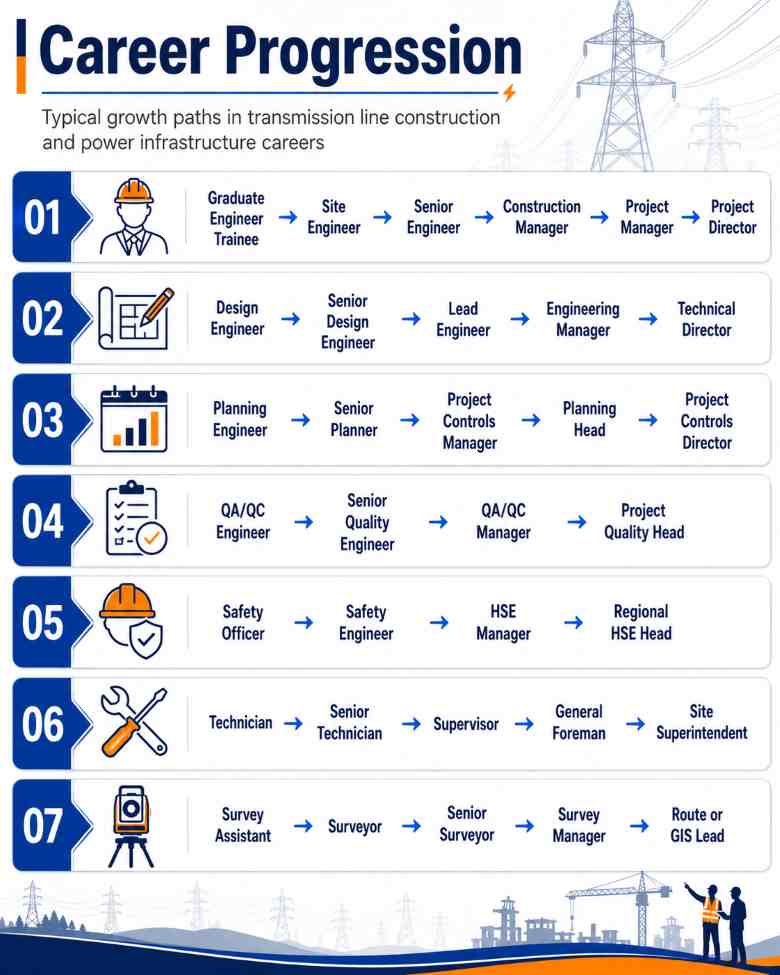
- Graduate Engineer Trainee → Site Engineer → Senior Engineer → Construction Manager → Project Manager → Project Director
- Design Engineer → Senior Design Engineer → Lead Engineer → Engineering Manager → Technical Director
- Planning Engineer → Senior Planner → Project Controls Manager → Planning Head → Project Controls Director
- QA/QC Engineer → Senior Quality Engineer → QA/QC Manager → Project Quality Head
- Safety Officer → Safety Engineer → HSE Manager → Regional HSE Head
- Technician → Senior Technician → Supervisor → General Foreman → Site Superintendent
- Survey Assistant → Surveyor → Senior Surveyor → Survey Manager → Route or GIS Lead
Professionals can also move between construction, design, asset management, proposals, estimation, contracts, consulting, operations and business development after building credible project knowledge.
Working Conditions and Challenges
Transmission careers offer major-project exposure, but field conditions can be demanding. Projects frequently cross remote, hilly, forested, desert, agricultural or densely populated areas. Workers may face heat, rain, wind, difficult access, long travel, temporary accommodation and relocation between projects.
Common challenges include:
- Remote work fronts and complex logistics
- Changing terrain and ground conditions
- Work at height and lifting hazards
- Electrical hazards from existing or nearby circuits
- Road, railway, river and utility crossings
- Right-of-way delays and community concerns
- Environmental restrictions and seasonal constraints
- Pressure to meet outage, energisation or contractual dates
- Coordination among design, procurement, civil, erection and stringing teams
- Maintaining quality records across dispersed locations
The positive side is the opportunity to gain specialised infrastructure experience, manage large teams, work internationally and contribute to critical electricity systems.
Transmission Line Construction Safety
Transmission construction includes high-risk activities and must be performed only by trained, competent and authorised personnel under approved procedures. The applicable national law, utility rules, project standards and manufacturer instructions always take precedence.
In India, relevant references include the Central Electricity Authority regulations on measures relating to safety and electric supply and the CEA Technical Standards for Construction of Electrical Plants and Electric Lines Regulations, 2022. For an international example, the U.S. OSHA Electric Power Transmission and Distribution standard covers construction requirements such as job briefings, protective equipment, grounding, overhead lines and substations.
Critical Safety Controls
- Activity-specific risk assessment and job briefing
- Approved method statements and permit-to-work controls
- Fall prevention, fall arrest and rescue planning
- Inspection and correct use of harnesses, lanyards, lifelines and anchors
- Competent rigging, lifting plans, crane setup and exclusion zones
- Weather monitoring for lightning, wind, heat and storms
- Safe conductor-stringing zones and protected crossings
- Control of induced voltage, earthing and equipotential work zones
- Verified isolation, lockout/tagout and testing before work
- Minimum approach distances and electrical clearances
- Equipment inspection and operator competence
- Excavation stability, access, water control and edge protection
- Traffic management and public protection
- Emergency communication, first aid and remote-site evacuation plans
- Fatigue, hydration and heat-stress management
- Stop-work authority when conditions become unsafe
Safety warning: This career guide is not a work instruction. Tower climbing, rigging, stringing, energised work, electrical isolation, lifting and commissioning must be performed only under approved procedures by competent and authorised personnel.
Future Technologies and Career Opportunities
Transmission careers are becoming more digital and multidisciplinary. The IEA’s Building the Future Transmission Grid report highlights the need to expand and modernise transmission systems, while India’s transmission planning documents identify technologies such as dynamic line rating, advanced conductors, hybrid substations and flexible AC transmission systems.
Important growth areas include:
- Renewable-energy evacuation corridors: Lines connecting solar, wind, hydro and hybrid renewable projects.
- HVDC systems: Bulk transfer, long-distance links and selected cross-border or subsea applications.
- Grid-enhancing technologies: Dynamic line rating, power-flow control and advanced monitoring.
- Digital substations: Greater use of digital protection, communication and asset data.
- Drone and LiDAR inspection: Faster survey, vegetation analysis and condition assessment.
- GIS-based asset management: Integrated route, land, maintenance and risk information.
- Artificial intelligence and predictive maintenance: Data-led defect identification and intervention planning.
- Digital twins and BIM: Better coordination, visualisation, data handover and lifecycle management.
- Climate-resilient design: Greater attention to heat, wildfire, flooding, wind, icing and extreme-weather risk.
- Underground and subsea cable systems: Specialist opportunities in constrained corridors and interconnectors.
- Battery-storage integration: New grid interfaces and control requirements. Explore related careers in this BESS construction jobs guide.
- Solar and grid integration: Learn about adjacent roles in the Solar EPC Engineer career guide.
Future-ready candidates should combine core engineering fundamentals with data literacy, GIS, digital inspection, project controls, cybersecurity awareness and strong safety competence.
How to Find Transmission Line Jobs
- Check official utility, EPC contractor, consultant and OEM career portals.
- Use government and public-sector recruitment notices. ConstructionPlacements maintains a regularly updated page for government engineering jobs.
- Review current walk-in interviews for construction and engineering jobs.
- Search LinkedIn using exact role and voltage-related keywords.
- Register on recognised apprenticeship portals and employer graduate programmes.
- Follow professional institutions, power-sector conferences and university placement cells.
- Build relationships with former colleagues, vendors, consultants and project professionals without requesting unethical referrals.
- Set job alerts for “transmission line engineer,” “tower erection,” “stringing engineer,” “EHV project,” “substation engineer,” “project controls” and related terms.
Verify every vacancy through the official employer or authorised agency. Be cautious of copied job advertisements, personal email addresses, advance fees and guaranteed-offer claims.
Resume Tips for Transmission Line Jobs
A strong resume should show the scale, technical context and measurable result of the candidate’s work. Include relevant details such as:
- Voltage level and line configuration
- Route length or number of towers
- Foundation and tower types
- Terrain and crossing conditions
- Construction, stringing or commissioning scope
- Software and instruments used
- Team or subcontractor responsibility
- Safety, quality, cost or schedule achievements
- Client, utility or international experience where disclosure is permitted
- Certifications and current competency records
Example Resume Bullets
- Coordinated survey, foundation and tower-erection activities across multiple work fronts while maintaining approved inspection and progress records.
- Prepared weekly look-ahead schedules, quantity forecasts and recovery actions for civil and tower-erection packages.
- Reviewed reinforcement, stub-setting, concrete and backfilling inspections against approved drawings and inspection plans.
- Supported conductor-stringing readiness by coordinating access, crossing protection, equipment locations and permit requirements.
- Maintained drawing revision control, non-conformance records and handover documentation for completed transmission-line sections.
Replace these examples with truthful achievements and verified project data. Do not disclose confidential information. Candidates can use ConstructionCareerHub.com to access Resume Lab, ATS Resume Score, Interview Copilot, Career Planner, Salary Calculator and construction-focused Job Alerts.
Transmission Line Construction Interview Questions
- What are the main stages of transmission-line construction?
A strong answer should cover planning, survey, permissions, engineering, procurement, foundations, tower erection, stringing, testing, commissioning and handover. - How is a transmission-line route selected?
Discuss technical feasibility, length, terrain, settlements, crossings, environmental constraints, right of way, access, cost, reliability and permissions. - What is tower spotting?
Explain that tower locations and types are selected along the route profile to satisfy span, angle, loading, clearance, terrain and constructability requirements. - What factors affect foundation selection?
Mention tower reactions, soil and rock conditions, groundwater, uplift, settlement, slope, flooding, access, construction method and durability. - What is conductor sag?
Define sag as the vertical distance between the conductor and the straight line joining its support points, noting that it varies with span, temperature, tension and loading. - Why is sag and tension control important?
It protects clearances, structural loading, conductor performance and long-term reliability. - What is a transmission-line right of way?
Describe the controlled corridor needed for construction, statutory clearances, safe operation, inspection and maintenance. - How are tower-erection risks controlled?
Cover approved sequence, competent rigging, lifting plans, equipment inspection, fall protection, weather limits, communication and exclusion zones. - What checks are required before stringing?
Mention route readiness, tower completion, hardware, equipment setup, drum records, crossings, permits, communication, earthing and public protection. - How do you inspect a tower foundation?
Discuss set-out, excavation, soil condition, reinforcement, cover, stub/template position, concrete quality, curing, backfilling and records. - What is the purpose of tower earthing?
Explain lightning-current dissipation, fault-current path and system safety in accordance with design and utility requirements. - How would you handle a drawing discrepancy?
Stop affected work, preserve safety, compare approved revisions, raise a formal technical query and proceed only after authorised clarification. - How do you manage work-at-height safety?
Include competency, fall prevention, certified equipment, anchor arrangements, rescue planning, supervision and weather monitoring. - Which documents should be approved before starting an activity?
Typical examples include drawings, method statement, risk assessment, inspection plan, permits, equipment certificates and competent-person records. - How is quality controlled across dispersed sites?
Discuss standard inspection plans, trained inspectors, traceability, hold points, digital records, audits, non-conformance control and handover dossiers.
For broader preparation, browse the Construction Interviews resource centre.
Advantages and Disadvantages of a Transmission Career
| Advantages | Challenges |
|---|---|
| Work in an essential infrastructure sector | Remote locations and frequent relocation |
| Long-term demand from grid and renewable expansion | Outdoor work and severe weather exposure |
| Opportunities in India and international markets | High-risk activities requiring strict discipline |
| Strong technical specialisation | Project deadlines and outage constraints |
| Exposure to major EPC and utility projects | Right-of-way and stakeholder complexity |
| Clear engineering, supervision and management pathways | Some roles are project-based or rotational |
| Transferable skills in planning, quality, safety and contracts | Continuous learning and certification may be required |
Recommended Courses and Career Resources
Relevant Online Courses
- Electric Power Systems — University at Buffalo on Coursera. Useful for power-system fundamentals, generation, transmission and distribution concepts.
- Power System: Generation, Transmission and Protection Specialization — Coursera. Relevant to electrical engineers seeking structured power-system learning.
- Power Distribution and Automation Specialization — L&T EduTech on Coursera. Useful for grid, distribution and automation context.
- GIS, Mapping and Spatial Analysis Specialization — University of Toronto on Coursera. Useful for route planning, mapping and spatial analysis.
- Construction Project Management — Columbia University on Coursera. Relevant to execution, planning and management pathways.
Course availability, pricing and certificates can change. Review the current syllabus and enrolment terms on the provider’s official page before purchasing.
Career eBooks
- Civil Engineering Interview Questions and Answers PDF eBook — a supplementary interview-preparation resource for civil and construction candidates.
- The Remote Job Hunting System — guidance on building a structured online job-search process.
- Browse the Digitslick eBook store for current construction-career and job-search resources.
Build a Job-Ready Transmission Career
Transmission-line construction offers a broad career ecosystem spanning design, foundations, surveying, tower erection, stringing, substations, testing, planning, contracts, quality, safety and maintenance. Civil engineers, electrical engineers, diploma holders and ITI candidates can all find suitable entry points when they combine technical fundamentals with safe, practical project skills.
The strongest long-term careers are built by documenting real project exposure, learning the standards that apply to each employer and country, developing digital skills and never compromising on safety. Use official career portals for applications, continue learning from current grid projects and tailor every resume to the actual role.
Prepare before you apply: Visit ConstructionCareerHub.com to use construction-focused tools including Interview Copilot, Resume Lab, ATS Resume Score, Career Planner, Salary Calculator and Job Alerts.
Frequently Asked Questions
What are transmission line construction jobs?
Transmission line construction jobs involve planning, surveying, designing, building, inspecting, commissioning and maintaining high-voltage lines and associated infrastructure. Roles include line design engineer, civil site engineer, tower erection supervisor, stringing engineer, surveyor, planner, QA/QC engineer, safety officer, technician, rigger and project manager.
Which engineering degree is best for transmission line jobs?
Electrical engineering is highly relevant to line performance, substations, protection and commissioning. Civil and structural engineering are equally important for surveys, towers, foundations, construction and project management. Mechanical, geotechnical, environmental and geomatics qualifications also support specialised roles.
Can civil engineers work in transmission line projects?
Yes. Civil engineers work in route surveying, geotechnical investigation, foundation design, access roads, tower erection, billing, planning, contracts, quality control and construction management. Knowledge of soil mechanics, reinforced concrete, steel structures, surveying and project planning is especially valuable.
Can electrical engineers work in tower construction?
Electrical engineers can work on transmission-line execution, particularly conductor, insulator, earthing, clearance, stringing, substation-interface, protection and commissioning activities. Pure structural and foundation design is normally led by appropriately qualified civil or structural engineers.
Are transmission line jobs suitable for freshers?
Yes. Freshers may enter through Graduate Engineer Trainee, Diploma Engineer Trainee, apprentice, junior site engineer, survey trainee, QA/QC trainee, CAD technician or technician roles. Employers value strong fundamentals, drawing knowledge, software ability, willingness to work at project sites and disciplined safety behaviour.
What is the salary of a transmission line engineer in India?
Indicative private-sector salaries may range from about ₹3–6 lakh annually for graduate trainees to ₹16–40 lakh or more for experienced project managers. Actual compensation varies significantly by employer, voltage level, project size, location, experience, allowances and responsibility.
Which software is used in transmission line design?
Common tools include PLS-CADD for line modelling and tower spotting, PLS-TOWER or PLS-POLE for structures, AutoCAD for drawings, GIS software for routing and ETAP, PowerFactory or PSCAD for selected electrical studies. Software choice depends on the employer and project specification.
What qualifications are required for transmission line jobs?
Engineering roles commonly require a BE, BTech or diploma in a relevant discipline. Technician and trade positions may require ITI, apprenticeship or recognised trade qualifications. Safety-critical work also requires role-specific training, competence and authorisation under applicable regulations.
Are transmission line jobs available in Gulf countries?
Yes. Gulf utilities, EPC contractors and renewable-energy projects recruit engineers, supervisors, planners, QA/QC staff, HSE professionals, surveyors, commissioning specialists and technicians. Senior positions frequently require direct high-voltage project experience and familiarity with local utility requirements.
Is transmission line construction a dangerous career?
The work includes serious hazards such as height, lifting, electricity, traffic, excavation and extreme weather. Risk must be controlled through competent supervision, approved procedures, permits, fall protection, grounding, isolation, equipment inspection, emergency planning and strict compliance with utility and legal requirements.
What is the career growth for a transmission line site engineer?
A typical path is Site Engineer, Senior Engineer, Construction Manager, Project Manager and Project Director. Engineers may also move into planning, quality, contracts, design coordination, proposals, commissioning or asset management after gaining relevant project experience.
How can diploma and ITI candidates get transmission line jobs?
They can apply for apprenticeships, technician, survey assistant, foundation supervisor, tower fitter, electrician, welder, rigger, equipment-operator and maintenance roles. Recognised trade training, practical competence, height and lifting safety, and documented project experience support progression.
Which companies hire transmission line professionals?
National and state utilities, private transmission developers, EPC contractors, consultants, renewable-energy developers and equipment manufacturers hire transmission specialists. Examples include POWERGRID, state transmission utilities, KEC International, Kalpataru Projects, Sterlite Power, Tata Projects, Larsen & Toubro and international grid contractors.
Which skills will be important for future transmission careers?
Future-ready skills include HVDC and grid integration, GIS, LiDAR, drone inspection, dynamic line rating, digital substations, asset analytics, predictive maintenance, BIM, digital twins, climate-resilient design, project controls and cybersecurity awareness, supported by strong engineering and safety fundamentals.
Authoritative References
- Ministry of Power Annual Report 2025–26
- Central Electricity Authority — Safety and Electric Supply Regulations
- CEA Technical Standards for Construction of Electrical Plants and Electric Lines Regulations, 2022
- International Energy Agency — Electricity Grids and Secure Energy Transitions
- International Energy Agency — Building the Future Transmission Grid
- IRENA Renewable Energy and Jobs Annual Review 2025
- OSHA Subpart V — Electric Power Transmission and Distribution
Editorial note: Technical requirements, wages, job availability, company names, course listings and regulations can change. Candidates and employers should confirm current information from the relevant official source before making career, hiring, training or project decisions. Publication review by an experienced transmission-line or power-infrastructure professional is recommended.
