

Last Updated on July 21, 2026 by Admin
ConstructionCareerHub App is LIVE — built ONLY for construction careers. Don’t apply with a weak resume.
Get ATS-ready Resume Lab + Interview Copilot + Campus Placement Prep (resume screening, skill gaps, interview readiness) — in minutes & Other advanced features.
Explore Smarter Construction Career Tools →Quick check. Big impact. Start now.
Table of Contents
Quick Answer: What Career Opportunities Are Available in STP, WTP and Desalination Plants?
STP, WTP and desalination projects offer careers in process design, civil engineering, mechanical equipment, electrical systems, instrumentation, SCADA, construction, commissioning, operations, maintenance, laboratory analysis, environmental compliance, project controls and plant management. Opportunities are available for engineering graduates, diploma holders, ITI professionals, chemists, microbiologists, operators and experienced project professionals.
Why Water and Wastewater Careers Matter
Reliable water services support public health, housing, manufacturing, power generation, agriculture, tourism, construction and economic development. The World Bank’s water-sector resources describe water security as fundamental to development, employment and climate resilience.
At the same time, many cities face ageing water networks, insufficient sewage-treatment capacity, groundwater stress, industrial pollution and rising demand. These challenges are generating investment in:
- Municipal water-supply systems
- Sewerage networks and sewage treatment plants
- Industrial effluent-treatment facilities
- Wastewater recycling and reuse projects
- Zero Liquid Discharge systems
- Seawater and brackish-water desalination
- Smart metering and digital water networks
- River-rejuvenation and pollution-control projects
- Operations, maintenance and asset-management contracts
Professionals exploring the wider sector can also read the environmental engineering career guide and the detailed guide to becoming a water resources engineer.
What Are STP, WTP, ETP and Desalination Plants?
What Is a Sewage Treatment Plant?
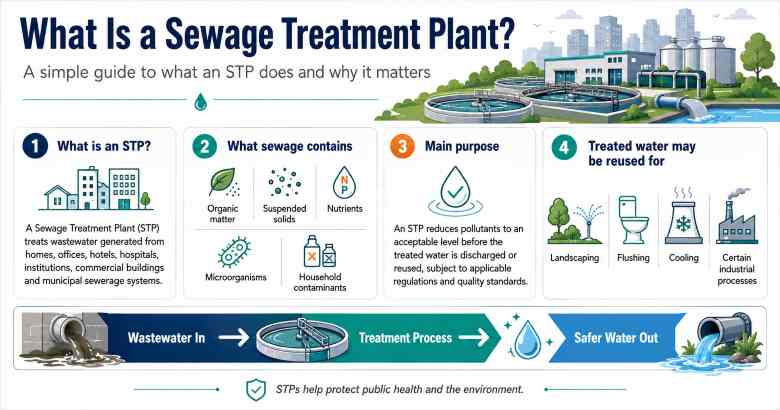
A Sewage Treatment Plant, commonly known as an STP, treats wastewater generated from homes, offices, hotels, hospitals, institutions, commercial buildings and municipal sewerage systems. Sewage typically contains organic matter, suspended solids, nutrients, microorganisms and household contaminants.
The purpose of an STP is to reduce pollutants to an acceptable level before the treated water is discharged or reused for applications such as landscaping, flushing, cooling or certain industrial processes, subject to applicable regulations and quality standards.
What Is a Water Treatment Plant?
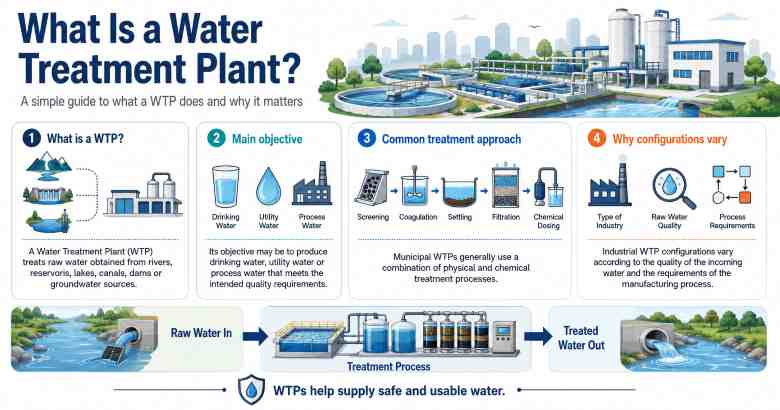
A Water Treatment Plant, or WTP, treats raw water obtained from rivers, reservoirs, lakes, canals, dams or groundwater sources. Its objective may be to produce drinking water, utility water or process water that meets the intended quality requirements.
Municipal WTPs generally use a combination of physical and chemical treatment processes. Industrial WTP configurations vary according to the quality of the incoming water and the requirements of the manufacturing process.
What Is an Effluent Treatment Plant?
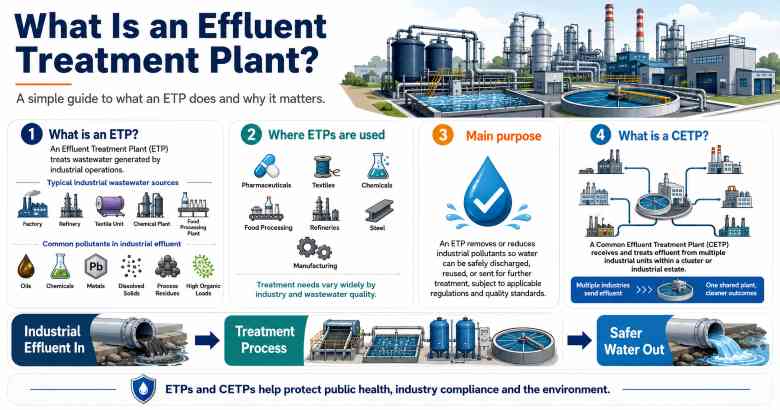
An Effluent Treatment Plant, or ETP, treats wastewater generated by industrial operations. The pollutants may include oils, chemicals, metals, dissolved solids, process residues or high organic loads. Treatment requirements vary considerably between industries such as pharmaceuticals, textiles, chemicals, food processing, refineries, steel and manufacturing.
A Common Effluent Treatment Plant, or CETP, receives and treats effluent from multiple industrial units within a cluster or industrial estate.
What Is a Desalination Plant?
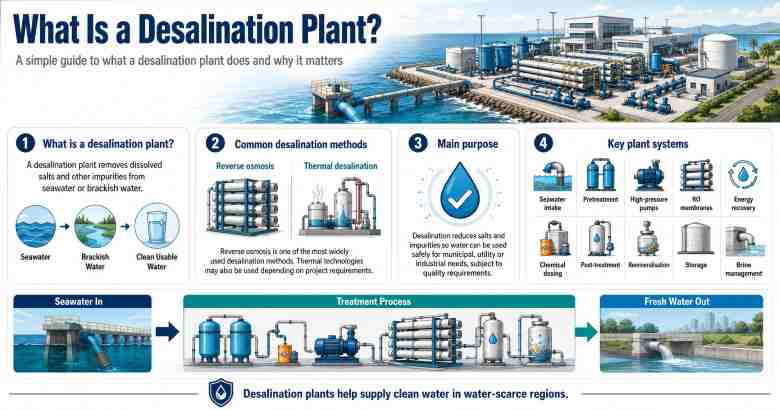
A desalination plant removes dissolved salts and other impurities from seawater or brackish water. Reverse osmosis is currently one of the most widely used desalination methods, although thermal technologies may also be used depending on project requirements.
A large desalination facility may include seawater intake systems, pretreatment units, high-pressure pumps, reverse-osmosis membranes, energy-recovery devices, chemical-dosing systems, post-treatment, remineralisation, product-water storage and brine-management systems.
What Is a Zero Liquid Discharge Plant?
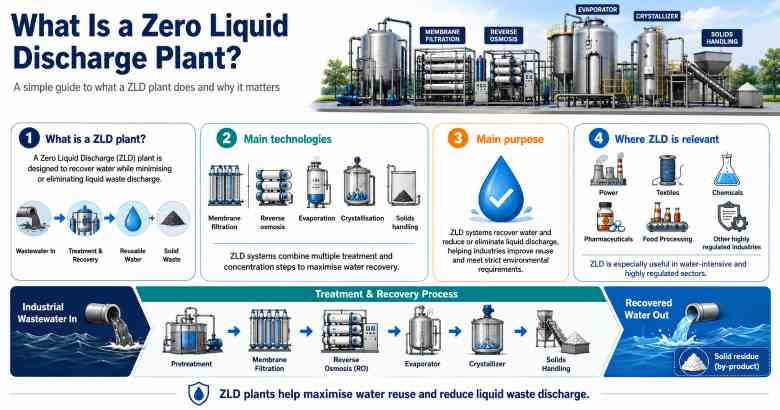
A Zero Liquid Discharge, or ZLD, system is designed to recover water while minimising or eliminating liquid waste discharge. Such systems may combine membrane filtration, reverse osmosis, evaporation, crystallisation and solids handling. ZLD facilities are particularly relevant to water-intensive and highly regulated industries.
STP vs WTP vs ETP vs Desalination Plant
| Facility | Main Input | Primary Purpose | Common Processes | Typical Career Areas |
|---|---|---|---|---|
| STP | Domestic or municipal sewage | Remove organic matter, solids and pathogens | Screening, biological treatment, clarification, filtration and disinfection | Process design, civil works, operations, laboratory testing, maintenance and compliance |
| WTP | River, reservoir, lake or groundwater | Produce potable or process water | Coagulation, flocculation, sedimentation, filtration and disinfection | Hydraulics, process engineering, equipment, distribution, quality control and operations |
| ETP or CETP | Industrial wastewater | Remove industry-specific pollutants | Physical, chemical, biological and advanced treatment | Environmental compliance, chemistry, process engineering, ZLD and industrial operations |
| Desalination Plant | Seawater or brackish water | Remove salts and produce usable water | Pretreatment, reverse osmosis, energy recovery, post-treatment and brine management | Membrane technology, mechanical systems, energy optimisation, commissioning and plant operations |
How Does an STP Work?
The configuration of an STP depends on the sewage characteristics, treatment capacity, discharge or reuse standards, site conditions and selected technology. A typical treatment sequence may include the following stages.
1. Preliminary Treatment
Bar screens remove large objects such as plastics, rags and debris. Grit chambers remove sand, gravel and other heavy inorganic materials that could damage pumps and downstream equipment.
2. Primary Treatment
Primary clarifiers allow settleable solids to separate from wastewater. Skimming equipment may remove grease and floating materials. Some compact or advanced systems may use different arrangements.
3. Biological Treatment
Microorganisms consume biodegradable organic matter. Common biological technologies include:
- Activated Sludge Process
- Sequential Batch Reactor
- Moving Bed Biofilm Reactor
- Membrane Bioreactor
- Extended aeration systems
- Trickling filters in certain applications
4. Secondary Clarification
Biological solids are separated from treated water. A portion of the settled biomass may be returned to the biological process, while excess sludge is removed for treatment.
5. Tertiary Treatment and Disinfection
Depending on reuse or discharge requirements, the water may undergo filtration, nutrient removal, activated-carbon treatment, membrane treatment or disinfection using chlorine, ultraviolet systems or other approved methods.
6. Sludge Treatment
Sludge may be thickened, digested, dewatered, dried or processed for authorised disposal or beneficial use. Sludge handling is a major operational, safety and environmental responsibility.
The CPHEEO Manual on Sewerage and Sewage Treatment Systems is an important technical reference for professionals working on Indian municipal sewerage projects.
How Does a WTP Work?
A conventional municipal water treatment plant may include:
- Raw-water intake: Water is collected from an approved surface-water or groundwater source.
- Screening: Large debris is removed before treatment.
- Aeration: Air may be introduced to remove certain dissolved gases or support oxidation.
- Coagulation: Chemicals are added to destabilise fine suspended particles.
- Flocculation: Gentle mixing encourages particles to combine into larger flocs.
- Sedimentation: Flocs settle in clarifiers or sedimentation basins.
- Filtration: Water passes through granular media or membrane systems.
- Disinfection: Pathogenic microorganisms are controlled before distribution.
- Storage and pumping: Treated water is stored and supplied to the distribution system.
The exact treatment process must be selected based on raw-water characteristics and the intended use. The CPHEEO Manual on Water Supply and Treatment Systems provides current Indian guidance, while the World Health Organization’s drinking-water resources explain the global public-health importance of safe water.
How Does a Desalination Plant Work?
A typical seawater reverse-osmosis plant follows these broad stages:
- Seawater intake: Water enters through an open-ocean or subsurface intake system.
- Pretreatment: Screens, clarification, media filtration, dissolved-air flotation or membrane filtration may be used to protect downstream RO membranes.
- Chemical conditioning: Chemicals may be added under controlled procedures to manage scaling, biological growth and membrane performance.
- High-pressure pumping: Seawater is pressurised before entering the membrane system.
- Reverse osmosis: Water passes through semi-permeable membranes, while most dissolved salts remain in the concentrate stream.
- Energy recovery: Energy-recovery devices reduce the plant’s overall energy consumption.
- Post-treatment: Product water may be remineralised, stabilised and disinfected before storage or distribution.
- Brine management: Concentrated brine is managed according to approved environmental requirements.
Desalination professionals must understand membrane performance, intake-water quality, pretreatment, corrosion, pumps, instrumentation, energy efficiency and environmental compliance. Organisations such as the International Desalination and Reuse Association and the International Water Association publish industry knowledge and professional-development resources.
Major Career Areas in Water and Wastewater Projects
Planning and Feasibility
Planning professionals assess water demand, wastewater generation, source availability, treatment alternatives, land requirements, environmental constraints, capital costs and lifecycle costs.
Process Design
Process engineers prepare design bases, mass balances, process-flow diagrams, treatment calculations, equipment requirements, process descriptions and operating philosophies.
Civil and Structural Engineering
Civil and structural engineers design tanks, clarifiers, channels, pump houses, buildings, equipment foundations, pipe supports, drainage systems, roads and other infrastructure. Those beginning in the profession may also review the broader civil engineering career guide.
Mechanical Engineering
Mechanical engineers work with pumps, blowers, compressors, mixers, screens, sludge-handling equipment, dewatering systems, valves, piping and rotating machinery.
Electrical Engineering
Electrical professionals design and maintain power distribution, transformers, motor-control centres, variable-frequency drives, emergency power systems, lighting, earthing and protection systems.
Instrumentation, Automation and SCADA
Instrumentation engineers select and maintain flow, level, pressure, turbidity, pH, conductivity, dissolved-oxygen and analytical instruments. Automation professionals configure programmable logic controllers, control systems, alarms, interlocks and Supervisory Control and Data Acquisition systems.
Construction and Site Execution
Site teams coordinate civil, mechanical, electrical, piping and instrumentation installation. Responsibilities may include inspection, method statements, subcontractor coordination, measurement, documentation, quality control and site safety.
Testing and Commissioning
Commissioning engineers verify equipment installation, conduct pre-commissioning checks, support dry and wet trials, test control logic, establish operating parameters, identify defects and assist with performance testing.
Operations and Maintenance
Operations personnel monitor treatment processes, equipment conditions, chemical consumption, laboratory results, alarms and regulatory parameters. Maintenance teams conduct preventive, predictive and corrective work.
Laboratory and Water-Quality Management
Chemists, microbiologists and laboratory technicians collect samples, maintain testing records, evaluate treatment performance and support compliance reporting.
Commercial and Project-Control Roles
Planning engineers, quantity surveyors, estimators, contract administrators, procurement specialists and cost-control professionals manage schedules, quantities, tenders, budgets and supplier packages. Site professionals planning to move into scheduling roles can read the guide on transitioning from site engineer to planning engineer.
Popular STP, WTP and Desalination Job Roles
| Job Role | Primary Responsibilities | Common Qualification | Typical Level |
|---|---|---|---|
| Water Treatment Engineer | Process selection, calculations, equipment coordination and performance review | Civil, environmental or chemical engineering | Entry to senior |
| Wastewater Process Engineer | Biological-process design, mass balances, process troubleshooting and optimisation | Environmental, chemical or civil engineering | Graduate to lead |
| Desalination Process Engineer | Pretreatment, RO configuration, membrane performance, recovery and energy optimisation | Chemical, environmental or mechanical engineering | Experienced or specialist |
| Civil Design Engineer | Hydraulic structures, tanks, buildings, drainage and site development | Civil engineering | Entry to lead |
| Structural Engineer | Design of reinforced-concrete tanks, buildings and equipment foundations | Civil or structural engineering | Design to lead |
| Hydraulic Engineer | Flow analysis, pumping, pipeline hydraulics and hydraulic profiles | Civil or water-resources engineering | Graduate to specialist |
| Mechanical Engineer | Pumps, blowers, mixers, screens, dewatering systems and equipment packages | Mechanical engineering | Entry to lead |
| Piping Engineer | Piping materials, layouts, routing, valves, supports and stress coordination | Mechanical engineering | Junior to lead |
| Electrical Engineer | Power distribution, motors, MCCs, drives, protection and backup systems | Electrical engineering | Entry to lead |
| Instrumentation Engineer | Instrument selection, data sheets, control philosophy, loops and field installation | Instrumentation, electronics or electrical engineering | Entry to lead |
| SCADA or Automation Engineer | PLC programming, HMI screens, control logic, alarms, communication and data systems | Instrumentation, electronics, electrical or automation engineering | Junior to specialist |
| Project Engineer | Multidisciplinary coordination, schedule tracking, documentation and client interface | Relevant engineering degree | Mid-level |
| Site Engineer | Construction supervision, measurements, inspection and subcontractor coordination | Degree or diploma | Entry to mid-level |
| Commissioning Engineer | Equipment checks, trials, start-up, control verification and performance testing | Process, mechanical, electrical or instrumentation engineering | Experienced |
| STP or WTP Operator | Monitor plant parameters, equipment, chemical systems, samples and operating logs | ITI, diploma, operator training or relevant experience | Entry to senior operator |
| Maintenance Engineer | Preventive maintenance, breakdown analysis, spares planning and reliability | Mechanical, electrical or instrumentation engineering | Junior to manager |
| Laboratory Analyst | Sampling, chemical and microbiological tests, records and quality reporting | Chemistry, microbiology or environmental science | Entry to laboratory manager |
| Environmental Compliance Officer | Permits, monitoring reports, regulatory coordination and environmental records | Environmental engineering or science | Junior to manager |
| Planning Engineer | Schedules, progress measurement, resource analysis and reporting | Engineering with Primavera P6 or project-controls knowledge | Junior to manager |
| Proposal or Estimation Engineer | Tender review, quantities, vendor enquiries, costing and technical proposals | Relevant engineering degree or diploma | Junior to senior |
| Plant Manager | Operations, maintenance, safety, compliance, staffing, budgets and performance | Engineering degree with extensive plant experience | Senior management |
Career Opportunities by Engineering Discipline
Civil Engineers
Civil engineers can work in hydraulic design, pipeline networks, reinforced-concrete tank design, site development, structural coordination, quantity estimation, construction supervision and project management.
Useful knowledge includes fluid mechanics, open-channel flow, pumping systems, reinforced-concrete design, drainage, geotechnical engineering, AutoCAD, Civil 3D, hydraulic modelling and BIM coordination.
Environmental Engineers
Environmental engineers are well-suited to process design, wastewater characterisation, biological treatment, environmental impact assessment, regulatory compliance, water reuse, sludge management, and pollution-control consulting.
Chemical Engineers
Chemical engineers frequently work in process calculations, chemical dosing, membrane treatment, ion exchange, industrial effluent treatment, ZLD, process optimisation and desalination.
Mechanical Engineers
Mechanical engineers work with pumps, blowers, compressors, mixers, screens, centrifuges, filter presses, valves, pipelines, HVAC, material-handling systems and preventive maintenance.
Electrical Engineers
Electrical engineers support incoming power, transformers, switchgear, motor-control centres, drives, cables, earthing, protection systems, standby generators and plant electrical maintenance. Relevant openings may also be tracked through the electrical engineering jobs section.
Instrumentation and Electronics Engineers
These professionals work with field instruments, control valves, PLCs, SCADA, telemetry, communication protocols, online analysers and automated process control.
Chemists and Microbiologists
Laboratory professionals test water and wastewater samples, verify treatment efficiency, assess chemical and microbiological parameters, maintain calibration records and support regulatory reporting.
Diploma Engineers and ITI Professionals
Diploma and ITI professionals can build careers as plant operators, mechanical technicians, electricians, instrument technicians, fitters, pump technicians, laboratory assistants, shift supervisors and maintenance coordinators.
Hands-on experience, safety awareness, equipment troubleshooting and accurate record-keeping are especially important for plant-based roles.
Construction and Project-Control Professionals
Planning engineers, quantity surveyors, cost engineers, procurement specialists and contract administrators can work across water EPC projects even without specialising in treatment-process design.
Educational Qualifications
Common qualifications include:
- BE or BTech in Civil Engineering
- BE or BTech in Environmental Engineering
- BE or BTech in Chemical Engineering
- BE or BTech in Mechanical Engineering
- BE or BTech in Electrical Engineering
- BE or BTech in Electronics and Instrumentation Engineering
- MTech or ME in Environmental, Water Resources or Chemical Engineering
- MSc in Chemistry, Environmental Science or Microbiology
- Diploma in Civil, Mechanical, Electrical, Chemical or Environmental Engineering
- ITI qualifications in fitter, electrician, instrument mechanic, pump operator or related trades
- Recognised water or wastewater operator training
A postgraduate degree can support research, specialist process-design and academic careers, but it is not mandatory for every role. Employers generally consider the combination of qualification, project exposure, software skills, practical knowledge and communication ability.
Essential Technical Skills
The most useful skills depend on the target role. Core areas include:
- Water and wastewater-treatment fundamentals
- Understanding of BOD, COD, TSS, pH, turbidity and dissolved solids
- Hydraulic calculations and pump-system basics
- Process-flow diagrams and P&IDs
- Equipment data sheets and technical specifications
- Biological-treatment fundamentals
- Coagulation, flocculation, filtration and disinfection
- Membrane filtration and reverse osmosis
- Sludge treatment and dewatering
- Pipeline materials, valves and fittings
- Mechanical and electrical troubleshooting
- Instrumentation and process-control basics
- Preventive maintenance and asset management
- Water-quality sampling and documentation
- Environmental, health and safety compliance
- Technical report writing
- BOQ, tender and specification review
- Testing and commissioning procedures
Software Used in STP, WTP and Desalination Careers
Design and Drafting Software
- AutoCAD
- AutoCAD Plant 3D
- Revit
- Navisworks
- Civil 3D
- STAAD.Pro
- ETABS
Hydraulic and Water-Network Software
- WaterGEMS
- SewerGEMS
- OpenFlows applications
- EPANET
- SWMM
- GIS platforms
Project-Management Software
- Primavera P6
- Microsoft Project
- Microsoft Excel
- Power BI
- Document-management platforms
Plant Operations and Automation
- SCADA platforms
- PLC programming environments
- Human-machine interface software
- Computerised Maintenance Management Systems
- Laboratory Information Management Systems
- Energy-monitoring and asset-management platforms
It is not necessary to learn every application. A civil design engineer may prioritise AutoCAD, Civil 3D, hydraulic modelling and structural tools, while an automation engineer should focus on PLCs, SCADA, instrumentation and industrial communication.
Professionals interested in digital delivery can also explore the MEP BIM career roadmap and opportunities associated with smart water infrastructure jobs.
Useful Certifications and Additional Training
Useful training may include:
- Water or wastewater treatment operations
- Reverse-osmosis and membrane systems
- PLC and SCADA programming
- Primavera P6 or project controls
- ISO 14001 environmental-management systems
- ISO 9001 quality-management systems
- Occupational health and safety
- Confined-space awareness and authorised-entry training
- Electrical safety and lockout-tagout procedures
- Chemical handling and emergency response
- First aid and fire safety
- Laboratory analysis and instrument calibration
- Project-management certification
- Energy management and maintenance reliability
Country-specific treatment-plant operator roles may require licences or competency certificates. Candidates should verify requirements through the relevant state, province, municipality or national authority. A short online course does not replace a legally required operating licence.
Confined spaces, chemicals and electrical systems can present serious hazards. The US Occupational Safety and Health Administration’s confined-space resources provide an authoritative introduction to confined-space risk management.
Typical Career Progression
Engineering Graduate Path
Graduate Engineer Trainee → Junior Engineer → Design, Process, Project or Operations Engineer → Senior Engineer → Lead Engineer → Engineering Manager or Project Manager → Technical Director or Business Head
Diploma or ITI Path
Trainee Operator or Technician → Plant Operator or Technician → Senior Operator or Senior Technician → Shift In-Charge → Maintenance or Operations Supervisor → Plant Superintendent
Laboratory Career Path
Laboratory Assistant → Laboratory Technician → Water Quality Analyst → Senior Chemist or Microbiologist → Laboratory Manager → Quality or Compliance Head
Project-Execution Path
Site Engineer → Project Engineer → Package Manager → Construction Manager → Project Manager → Project Director
Actual progression depends on the size of the organisation, project type, technical expertise, leadership ability and willingness to accept site, shift or international assignments.
How Can Freshers Enter the Water-Treatment Sector?
- Select a specific target role. Choose process design, site execution, operations, maintenance, laboratory work, planning, BIM or automation.
- Learn treatment fundamentals. Understand the basic process flow of an STP, WTP, ETP and RO plant.
- Study common equipment. Learn the purpose of pumps, blowers, screens, clarifiers, filters, dosing systems and instruments.
- Read engineering drawings. Practise interpreting process-flow diagrams, P&IDs, layouts, sections and equipment data sheets.
- Learn one role-relevant software package. Avoid listing ten applications without practical ability.
- Complete a portfolio project. Prepare a simple process diagram, WTP layout, pump calculation, maintenance plan or project schedule.
- Search for apprenticeships and trainee roles. Consider EPC contractors, operators, utilities, equipment suppliers and environmental consultants.
- Tailor the resume. Align qualifications and projects with the job description.
- Prepare for technical interviews. Practise explaining treatment stages and equipment clearly.
- Remain open to site and shift work. Early operational exposure can strengthen long-term technical understanding.
Fresh graduates can use the civil engineering placement guide and the construction job blueprint to develop a more structured job-search strategy.
Portfolio Project Ideas
- Process-flow diagram for a small sewage treatment plant
- Conceptual layout for a conventional WTP
- Basic pump head and power calculation
- Hydraulic profile of a gravity-based treatment process
- Preventive-maintenance checklist for pumps and blowers
- Water-quality monitoring dashboard
- Conceptual desalination process diagram
- Primavera schedule for constructing a treatment plant
- Revit or Plant 3D model of a treatment facility
- Equipment comparison sheet for screens, pumps or filtration systems
Career Options for Experienced Professionals
Experienced engineers and plant professionals can specialise in:
- Advanced wastewater-process design
- Industrial effluent treatment
- Membrane and reverse-osmosis systems
- Desalination commissioning
- Plant optimisation and energy reduction
- Reliability and asset management
- Digital twins and smart-water systems
- Water reuse and ZLD
- Proposal engineering and tendering
- Project and programme management
- Technical sales and business development
- Environmental compliance and auditing
- International EPC and operations projects
- Independent consulting and technical training
STP, WTP and Desalination Salary Guide
Important: The figures below are broad, indicative 2026 market ranges. Actual compensation varies by employer, city, qualification, plant capacity, project stage, shift pattern, technical specialisation, overtime, allowances, tax treatment and local licensing. The figures should not be treated as guaranteed salary offers.
Indicative Salary Ranges in India
| Career Level | Indicative Annual Range | Examples |
|---|---|---|
| Operator, technician or laboratory assistant | ₹2.4 lakh–₹5 lakh | Plant operator, electrician, fitter, laboratory technician |
| Graduate or junior engineer | ₹3.5 lakh–₹7 lakh | Site engineer, junior process engineer, design engineer |
| Mid-level engineer | ₹6 lakh–₹14 lakh | Project engineer, commissioning engineer, senior operations engineer |
| Lead or specialist | ₹12 lakh–₹25 lakh | Lead process engineer, desalination specialist, engineering lead |
| Project manager or plant manager | ₹15 lakh–₹35 lakh or more | Project manager, O&M manager, plant head |
Professionals with experience in large EPC projects, ZLD, desalination, process guarantees, commissioning, international standards or multidisciplinary leadership may command higher compensation.
Indicative Monthly Salary Ranges in the GCC
| Region | Operators and Technicians | Engineers | Senior, Lead or Managerial Roles |
|---|---|---|---|
| United Arab Emirates | AED 3,500–8,000 | AED 8,000–20,000 | AED 20,000–40,000+ |
| Saudi Arabia | SAR 3,500–8,000 | SAR 7,000–18,000 | SAR 18,000–35,000+ |
| Qatar | QAR 4,000–9,000 | QAR 8,000–20,000 | QAR 18,000–35,000+ |
| Oman | OMR 350–800 | OMR 700–1,600 | OMR 1,500–3,000+ |
GCC packages may include accommodation, transport, food, medical insurance, annual flights, site allowances or overtime. Candidates should compare the full employment package rather than the basic salary alone.
International Salary Benchmarks
| Country | Published Benchmark | Important Context |
|---|---|---|
| United States | Water and wastewater treatment plant operators: median annual pay of approximately US$58,260. Environmental engineers: approximately US$104,170. | Figures are national medians published by the US Bureau of Labor Statistics for May 2024. |
| United Kingdom | Water treatment workers: approximately £24,000 at entry level to £40,000 with experience. | Published by the UK National Careers Service; shift and standby work may apply. |
| Canada | Water treatment plant operators: national median of approximately C$36.06 per hour. Water-resources engineers: approximately C$48.56 per hour. | Provincial wages, licensing and employment conditions vary. |
| Australia | Operators commonly fall within approximately A$65,000–A$100,000, while engineers may earn approximately A$80,000–A$140,000 or more. | Ranges vary by state, employer, remote work, roster and experience. Check current Jobs and Skills Australia information. |
For authoritative labour-market information, consult the US Bureau of Labor Statistics operator profile, the environmental engineer profile, the UK National Careers Service, the Government of Canada Job Bank and Jobs and Skills Australia.
Water and Wastewater Career Opportunities in India
Indian professionals may find opportunities in:
- Municipal corporations and urban local bodies
- Public Health Engineering Departments
- State water and sewerage boards
- Jal Jeevan Mission projects
- AMRUT 2.0 projects
- River-cleaning and sewerage programmes
- Industrial water and effluent-treatment facilities
- Real-estate and township STPs
- Power, refinery, steel, chemical and pharmaceutical plants
- Water EPC and operations companies
- Environmental consultancies and laboratories
- Equipment, membrane and chemical suppliers
- Smart-city and water-reuse projects
Professionals should monitor the AMRUT 2.0 portal, the Central Pollution Control Board, relevant state departments and official recruitment portals.
ConstructionPlacements regularly publishes government engineering job updates and construction and engineering walk-in interview alerts.
Desalination and Water Career Opportunities in the GCC
The UAE, Saudi Arabia, Qatar, Oman, Kuwait and Bahrain rely heavily on desalination and large-scale water infrastructure. Employment can be found across development, EPC construction, commissioning, utility operations, maintenance and asset management.
Skills that can improve GCC employability include:
- Seawater reverse-osmosis experience
- Membrane pretreatment and cleaning knowledge
- Large pumps and pipeline systems
- Commissioning and performance testing
- SCADA, PLC and online instrumentation
- Corrosion and material-selection awareness
- Energy-recovery systems
- International HSE practices
- Primavera P6 and project controls
- Operations and maintenance documentation
- Process troubleshooting and reporting
Indian professionals planning an overseas move can refer to the India-to-Gulf construction career guide. Overseas employment should always be pursued through verified employers, authorised recruitment channels and written contracts.
Opportunities in the United States, UK, Canada and Australia
Developed markets offer opportunities with municipal utilities, engineering consultancies, environmental regulators, construction contractors, laboratories, industrial facilities and equipment suppliers.
However, candidates must understand that:
- Plant-operator roles may require local certification or licensing.
- Professional engineering work may require registration or supervised experience.
- Qualification recognition varies by country and province or state.
- Work authorisation and visa rules are separate from technical eligibility.
- Local codes, environmental regulations and safety practices must be learned.
International candidates should check official government, licensing and professional-registration websites rather than relying solely on recruitment advertisements.
Companies and Employers to Research
The organisations listed below are examples of companies and employer categories active in water, wastewater, desalination, environmental engineering or related infrastructure. Inclusion does not mean that every organisation is currently hiring.
India-Based and India-Focused Employers
- VA Tech WABAG
- Ion Exchange
- Thermax
- Tata Projects Water Business
- Larsen & Toubro
- SUEZ India
- Veolia India
- Welspun Enterprises
- SPML Infra
- EMS Limited
- Ramky Infrastructure
- Municipal corporations, water boards and government departments
Global Consultancies and EPC Organisations
- AECOM
- Jacobs
- WSP
- Stantec
- Black & Veatch
- AtkinsRéalis
- Arcadis
- Mott MacDonald
- Veolia
- SUEZ
- Metito
Desalination Developers, Utilities and Technology Companies
- ACWA Power
- IDE Technologies
- TAQA
- DEWA
- Saudi Water Authority and associated operators
- Energy Recovery
- DuPont Water Solutions
- Toray
- LG Water Solutions
- Xylem
- Grundfos
- Metito
Twenty STP, WTP and Desalination Interview Questions
1. What is the difference between an STP, ETP and WTP?
An STP treats domestic or municipal sewage, an ETP treats industrial wastewater, and a WTP treats raw water to produce potable or process water. A strong answer should also mention that treatment stages depend on influent quality and required output standards.
2. What are BOD and COD?
Biochemical Oxygen Demand indicates the oxygen used by microorganisms to break down biodegradable organic matter. Chemical Oxygen Demand estimates the oxygen equivalent required to chemically oxidise organic and certain inorganic matter. COD results are usually obtained faster than BOD results.
3. How does the activated sludge process work?
Wastewater is mixed with microorganisms in an aeration tank. The microorganisms consume biodegradable matter. The mixture then enters a clarifier, where biological solids settle. Part of the sludge is returned to maintain biomass, while excess sludge is removed.
4. What is an SBR?
A Sequential Batch Reactor performs filling, biological reaction, settling and decanting in a timed batch sequence, often within the same basin.
5. What is an MBBR?
A Moving Bed Biofilm Reactor uses plastic carrier media that provide surface area for biological growth. The media move within the reactor while retained biofilm treats the wastewater.
6. What is an MBR?
A Membrane Bioreactor combines biological treatment with membrane filtration. It can produce high-quality effluent and reduce the need for conventional secondary clarification, although membrane operation and maintenance require specialised attention.
7. Why is sludge treatment necessary?
Sludge contains concentrated solids, organic matter, microorganisms and moisture. Treatment reduces volume, improves stability and prepares the sludge for authorised reuse, further treatment or disposal.
8. What factors are considered when selecting a pump?
Important factors include design flow, total dynamic head, fluid characteristics, solids content, pump efficiency, operating range, material compatibility, suction conditions, reliability and maintenance accessibility.
9. Why is disinfection used?
Disinfection reduces pathogenic microorganisms before treated water is discharged, reused or distributed. The selected method depends on water quality, required residual, contact time, safety and regulatory requirements.
10. What causes RO membrane fouling?
Fouling may result from suspended solids, microorganisms, organic material, colloids or mineral scaling. Effective pretreatment, monitoring and approved operating procedures help control fouling.
11. What do recovery and salt rejection mean in reverse osmosis?
Recovery is the proportion of feed water converted to product water. Salt rejection represents the membrane’s ability to prevent dissolved salts from passing into the product stream.
12. Why is pretreatment important in desalination?
Pretreatment protects RO membranes and high-pressure equipment by reducing suspended solids, biological activity, fouling potential and scaling risk.
13. What is the purpose of chemical dosing?
Chemical dosing may support coagulation, pH correction, disinfection, dechlorination, scale control or process optimisation. Chemicals must be handled only under approved procedures, risk controls and trained supervision.
14. What is the difference between a PFD and a P&ID?
A Process Flow Diagram shows the major process equipment and principal flow streams. A Piping and Instrumentation Diagram provides more detailed information about piping, valves, instruments, controls and equipment connections.
15. What is SCADA?
Supervisory Control and Data Acquisition is a system used to monitor equipment, process values, alarms, trends and plant controls from operator workstations or remote locations.
16. Why is preventive maintenance important?
Preventive maintenance reduces unexpected breakdowns, improves safety, protects process reliability, supports equipment life and allows planned use of labour and spare parts.
17. How would you investigate poor treated-water quality?
A structured answer should include verifying laboratory results, reviewing influent changes, checking process parameters, inspecting equipment and instruments, confirming chemical systems, reviewing alarms and escalating according to the operating procedure.
18. What are the risks of confined-space work?
Risks can include toxic gases, oxygen deficiency, engulfment, restricted access, biological hazards and difficult rescue. Entry must follow the applicable permit, testing, isolation, ventilation, standby and rescue procedures.
19. What happens during commissioning?
Commissioning normally includes installation verification, cleaning and flushing, equipment checks, electrical and instrument testing, control-logic verification, dry trials, wet trials, process stabilisation and performance testing.
20. Why is environmental compliance important?
Compliance protects public health and the environment, supports legal operation, prevents unauthorised discharge and ensures that monitoring, reporting and operating obligations are met.
For additional preparation, explore the engineering interview questions and answers and construction interview preparation resources.
How to Write a Resume for Water-Treatment Jobs
A role-specific resume should highlight relevant achievements instead of presenting a generic list of responsibilities.
Useful Resume Keywords
- STP design and commissioning
- WTP operations
- Wastewater process design
- Reverse-osmosis systems
- P&ID review
- Hydraulic calculations
- Pump selection
- Equipment data sheets
- SCADA monitoring
- PLC troubleshooting
- Preventive maintenance
- Water-quality analysis
- Environmental compliance
- BOQ preparation
- Primavera P6 scheduling
- BIM coordination
- Testing and commissioning
- Operations and maintenance
Only include skills that can be demonstrated during an interview. The guide to civil engineer resume keywords by role can help candidates tailor applications more effectively.
Example Achievement Statements
- Assisted in commissioning a 10 MLD sewage treatment plant and prepared equipment inspection records.
- Monitored daily operating parameters and supported corrective actions that improved treated-water consistency.
- Prepared mechanical BOQs and vendor comparisons for pumps, blowers and sludge-handling equipment.
- Developed a Primavera P6 baseline schedule covering civil, mechanical, electrical and commissioning activities.
- Created coordinated BIM layouts for process piping, equipment and electrical systems.
Every statement should be truthful and supported by project records or genuine work experience.
How to Search for STP, WTP and Desalination Jobs
Use a combination of official company career pages, government portals, professional networking, recruitment platforms, apprenticeship portals and employee referrals.
Useful Search Terms
- STP process engineer jobs
- WTP design engineer jobs
- Wastewater project engineer
- Desalination commissioning engineer
- RO plant operator
- Water-treatment proposal engineer
- STP electrical engineer
- Wastewater instrumentation engineer
- Water-quality analyst
- Treatment-plant maintenance technician
- Water EPC planning engineer
- Desalination mechanical engineer
- Wastewater laboratory chemist
- Water utility graduate engineer
Applicants should also understand how construction and engineering hiring works, especially the importance of role alignment, project evidence and targeted networking.
Challenges of Working in STP, WTP and Desalination Facilities
- Rotating shifts and standby duties
- Remote or industrial project locations
- Exposure to odour and difficult site conditions
- Strict confined-space and chemical-safety requirements
- Emergency equipment breakdowns
- Continuous monitoring and documentation
- Regulatory and water-quality responsibilities
- Pressure during commissioning and performance testing
- Project-based or contract employment
- Need for continuous technical learning
- Country-specific licensing and registration requirements
These challenges are manageable when employers provide proper training, personal protective equipment, approved procedures, competent supervision and a strong safety culture.
Future of Water, Wastewater and Desalination Careers
Smart Water Networks
Sensors, telemetry and data platforms are improving leak detection, pressure management, water-quality monitoring and asset performance.
Artificial Intelligence and Predictive Maintenance
Machine-learning systems may help identify abnormal operating patterns, predict equipment failure and optimise energy or chemical consumption. Human engineering judgement remains essential.
Digital Twins
Digital twins can combine design data, live plant information and simulation models to support operations, training and maintenance planning.
Advanced Membrane Technology
Improvements in membranes, pretreatment and energy-recovery systems may reduce desalination energy consumption and improve reliability.
Water Reuse and Resource Recovery
Treated wastewater is increasingly viewed as a resource. Future projects may recover reusable water, biogas, nutrients and other materials rather than treating wastewater only as a disposal problem.
Renewable-Energy-Powered Desalination
Integrating solar, wind and other low-carbon energy sources with desalination is an important area of research and project development.
Decentralised Treatment
Compact treatment systems may become more important for campuses, buildings, industrial estates and communities that need local water reuse.
The UN-Water resources on water quality and wastewater provide broader context on the need to improve treatment, reuse and resource recovery.
Advantages and Limitations of This Career
| Advantages | Potential Limitations |
|---|---|
| Work that supports public health and environmental protection | Some positions require shifts or standby duty |
| Opportunities across design, construction and operations | Plants may be located in remote or industrial areas |
| Demand across municipal and industrial sectors | Strict safety and compliance responsibilities |
| International opportunities, particularly in water-scarce regions | Overseas roles may require local licensing or prior regional experience |
| Scope for technical specialisation | Continuous learning is required as technologies and regulations change |
| Pathways for engineers, diploma holders and ITI professionals | Entry-level compensation can be modest in some markets |
Who Should Consider a Water-Treatment Career?
This sector may suit professionals interested in:
- Environmental protection and public infrastructure
- Process engineering and problem-solving
- Mechanical, electrical and control systems
- Chemistry, microbiology and laboratory analysis
- Construction, commissioning and plant operations
- Data, automation and smart infrastructure
- International EPC and utility projects
- Long-term technical specialisation
Recommended Online Courses
The following courses may help candidates build relevant knowledge. Course content, availability, certificates and fees may change, so verify the latest information on the provider’s website.
- New Paradigms in Wastewater Management – Suitable for learners interested in wastewater reuse, resource recovery and sustainable treatment.
- Water: An Essential Resource – Useful for understanding water challenges, management and sustainability.
- Water Resources Management and Policy – Relevant to professionals interested in water governance, policy and resource management.
- Design of General Utility Systems – Helpful for engineers working with utility systems and industrial facilities.
- Construction Project Management – Suitable for site engineers and professionals moving into project coordination or management.
- Industrial IoT Integration with Micro850 PLC – Relevant to automation and instrumentation professionals interested in PLC and industrial connectivity.
Career Resources for Job Seekers
Construction Career Hub provides AI-assisted career-planning and job-preparation tools for construction and engineering professionals, including Interview Copilot, Resume Lab, ATS Resume Score, Career Planner, Salary Calculator and Job Alerts.
Additional career resources include:
90-Day Career Development Plan
Days 1–30: Build the Foundation
- Select one target job role.
- Study STP, WTP, ETP and desalination fundamentals.
- Learn the purpose of major plant equipment.
- Review at least 20 current job descriptions.
- Identify gaps in qualifications, software and practical knowledge.
Days 31–60: Develop Practical Evidence
- Learn one role-relevant software tool.
- Complete a small portfolio project.
- Update the resume and LinkedIn profile.
- Prepare answers for common technical questions.
- Connect with water-sector professionals and companies.
Days 61–90: Apply Systematically
- Apply to carefully selected roles each week.
- Contact recruiters and former colleagues professionally.
- Attend technical webinars or industry events.
- Practise mock interviews.
- Track applications, responses and feedback.
- Improve the resume based on genuine market response.
Conclusion
STP, WTP and desalination careers combine engineering, environmental responsibility, public infrastructure and long-term technical development. Opportunities are available throughout the project lifecycle—from feasibility and design to construction, commissioning, operations and asset management.
The strongest career strategy is to choose a specific track and build demonstrable expertise. A civil engineer may focus on hydraulic structures and pipelines, a mechanical engineer on pumps and equipment, an instrumentation engineer on SCADA and automation, and an environmental or chemical engineer on process design and water quality.
Freshers should begin with treatment fundamentals, drawings, equipment knowledge and one practical portfolio project. Experienced professionals can progress into membrane technology, desalination, commissioning, process optimisation, digital water, project management or international EPC roles.
Frequently Asked Questions
Is water treatment a good career?
Water treatment can be a rewarding career for professionals interested in infrastructure, environmental protection, public health and plant engineering. The sector offers roles in design, construction, operations, maintenance, laboratories, automation and project management.
Which engineers can work in an STP?
Civil, environmental, chemical, mechanical, electrical and instrumentation engineers can work in STP projects. Their responsibilities differ according to discipline, ranging from process design and structural engineering to equipment, power, controls and commissioning.
What qualification is required for an STP operator?
Requirements vary by employer and location. Operators may hold an ITI qualification, technical diploma, vocational certificate or relevant plant experience. Some jurisdictions require formal operator certification or licensing.
Can a civil engineer work in a water treatment plant?
Yes. Civil engineers work in hydraulic design, pipelines, treatment tanks, structural design, site development, quantity estimation, construction supervision and project management.
Can a mechanical engineer work in an STP?
Yes. Mechanical engineers are responsible for pumps, blowers, screens, mixers, sludge equipment, valves, pipelines, preventive maintenance and equipment reliability.
What is the salary of a water-treatment engineer in India?
Entry and junior-level engineers may earn approximately ₹3.5 lakh to ₹7 lakh annually, while experienced engineers, specialists and managers may earn substantially more. Salary depends on location, employer, plant size, project type and technical expertise.
Are desalination jobs available in the Middle East?
Yes. The UAE, Saudi Arabia, Qatar, Oman, Kuwait and Bahrain operate or develop major desalination and water-infrastructure projects. Opportunities exist in design, construction, commissioning, operations, maintenance and asset management.
Which software is used in STP and WTP design?
Common tools include AutoCAD, Civil 3D, Revit, Plant 3D, WaterGEMS, SewerGEMS, EPANET, STAAD.Pro, Primavera P6, Excel and GIS platforms. The required software depends on the specific role.
What is the difference between an STP and a WTP?
An STP treats sewage or municipal wastewater, while a WTP treats raw water to produce potable or process water. Their sources, treatment objectives and operating processes are different.
How can a fresher get a wastewater-treatment job?
A fresher should study treatment fundamentals, learn to read PFDs and P&IDs, understand common equipment, develop one relevant software skill, complete a small portfolio project and apply for trainee, apprenticeship, site or operator roles.
Which certifications are useful for water-treatment careers?
Useful training includes treatment-plant operations, occupational safety, confined-space awareness, ISO 14001, PLC and SCADA, Primavera P6, laboratory testing, membrane systems and project management. Statutory operator licences must be obtained separately where required.
Is wastewater engineering in demand?
Demand is supported by urban development, industrial environmental compliance, ageing infrastructure, water scarcity, wastewater reuse and pollution-control investment. Opportunities vary by country, public funding and project pipeline.
What does a desalination process engineer do?
A desalination process engineer works on pretreatment, membrane configuration, process calculations, chemical systems, recovery, salt rejection, energy optimisation, operating procedures and performance analysis.
Do treatment-plant operators work in shifts?
Many treatment plants operate continuously, so operators may work rotating shifts, weekends, holidays or standby schedules. The arrangement depends on plant capacity, automation and staffing.
Is a postgraduate degree necessary for water-treatment jobs?
No. Many design, site, operations and maintenance roles accept bachelor’s degrees, diplomas or technical qualifications. A postgraduate degree is more useful for advanced process design, research, consulting or specialist positions.
