

Last Updated on May 22, 2026 by Admin
The U.S. construction industry is facing a historic labor shortage — and that means record-high salaries for skilled professionals. In 2026, there are more construction careers that pay over 100K than at any point in the industry’s history. From construction managers and civil engineers to elevator installers who earn six figures without a college degree, the opportunities are real and well-documented. This guide breaks down 15 verified career paths with BLS salary data, entry requirements, top certifications, and actionable strategies to help you reach the $100K threshold faster.
ConstructionCareerHub App is LIVE — built ONLY for construction careers. Don’t apply with a weak resume.
Get ATS-ready Resume Lab + Interview Copilot + Campus Placement Prep (resume screening, skill gaps, interview readiness) — in minutes & Other advanced features.
Explore Smarter Construction Career Tools →Quick check. Big impact. Start now.
Table of Contents
Why Construction Careers Are Breaking the Six-Figure Barrier in 2026
The construction industry in the United States is not what it was a decade ago. Between a structural labor shortage — the Associated Builders and Contractors (ABC) estimates the industry needs 349,000 net new workers in 2026 alone — and historic federal investment through the Bipartisan Infrastructure Law, demand for skilled construction professionals is outpacing supply at every level. The result? Six-figure salaries that rival, and in many cases exceed, traditional white-collar compensation.
According to the U.S. Bureau of Labor Statistics (BLS), the median annual wage for construction managers reached $106,980 in May 2024, with the top 10 percent earning over $176,990. And construction management is only one of many six-figure pathways in this industry.
Whether you are a recent engineering graduate, a skilled trades professional eyeing a leadership track, or a career changer attracted by the stability and earnings potential, this guide breaks down 15 construction career paths where total compensation regularly exceeds $100,000 per year — with verifiable data, real entry requirements, and practical strategies to get there.
Related resource: If you are exploring the full landscape of roles in this industry, start with our 150+ Construction Job Titles & Descriptions Guide.
🔧 Build a Stronger Career Foundation
Use ConstructionCareerHub.com to get an ATS-ready resume, practice interviews with the AI Interview Copilot, and benchmark your salary — all purpose-built for the construction industry.
How We Selected These 15 Career Paths
Every role on this list meets at least one of the following criteria:
- The median annual wage exceeds $100,000 according to BLS Occupational Employment and Wage Statistics (OEWS) data from May 2024.
- The experienced or senior-level salary range consistently crosses $100,000 based on industry compensation surveys, including data from the Birmingham Group’s 2026 Construction Salary Guide and professional association reports.
- The role is directly embedded in the construction value chain — from preconstruction through closeout — not a peripheral support function.
Salary figures reflect nationwide data. Actual compensation varies significantly by state, metro area, project type, union affiliation, and employer. For state-by-state breakdowns, see our Construction Worker Pay Guide.
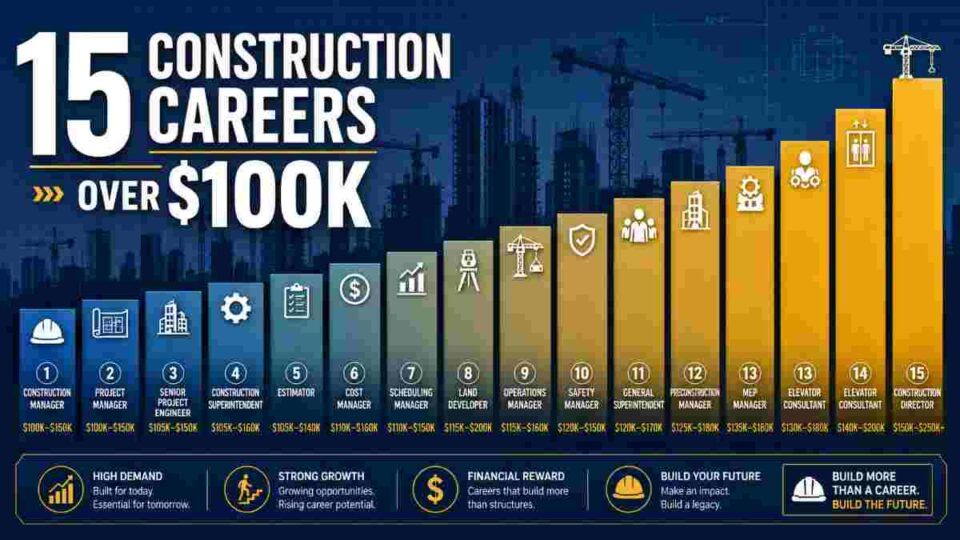
15 Construction Career Paths That Pay Over $100K
1. Construction Manager
Median Salary: $106,980/year (BLS, May 2024)
Top 10% Earn: $176,990+
Projected Growth: 9% through 2034 (~46,800 openings/year)
Typical Education: Bachelor’s degree in construction management, civil engineering, or architecture
Construction managers plan, coordinate, and supervise construction projects from inception through completion. They manage budgets that can range from a few hundred thousand dollars on residential projects to hundreds of millions on commercial and infrastructure work. The role demands fluency in scheduling, cost control, subcontractor coordination, building codes, and safety compliance.
What separates high earners from the median: professionals managing data center construction, large-scale infrastructure, or industrial projects in high-cost metros like New York, San Francisco, and Washington D.C. consistently earn $140,000–$180,000+. The Certified Construction Manager (CCM) credential from the Construction Management Association of America (CMAA) is one of the strongest salary accelerators in the field.
Learn more: Construction Manager Job Description and Salary Details
2. Civil Engineer (Senior/Specialized)
Median Salary: $99,590/year (BLS, May 2024)
Top 10% Earn: $160,990+
Projected Growth: 5% through 2034
Typical Education: Bachelor’s degree in civil engineering; PE license for advancement
Civil engineers who specialize in structural, geotechnical, or transportation engineering — and who hold a Professional Engineer (PE) license — regularly break the $100K threshold by mid-career. The American Society of Civil Engineers (ASCE) 2024 Salary Report found a median primary income of $130,000 among its membership, significantly higher than the BLS median because the survey captures licensed, experienced professionals.
The highest-paid civil engineers in construction tend to be structural specialists working on seismic retrofits, bridge rehabilitation, and high-rise projects, where errors carry catastrophic consequences and expertise commands a premium.
Learn more: Civil Engineering Salary Guide | 110 Civil Engineering Career Paths
3. Project Director / VP of Construction
Salary Range: $140,000–$250,000+
Typical Education: Bachelor’s or master’s degree + 10–20 years of progressive experience
Key Credential: PMP, CCM, or DBIA certification
Project directors and vice presidents of construction occupy the executive tier of the industry. They provide strategic oversight across entire project portfolios, manage client relationships, lead business development efforts, and carry profit-and-loss responsibility for their divisions. In major general contractors and program management firms, total compensation (base + bonus + equity/profit-sharing) routinely exceeds $200,000.
This is not an entry point — it is the destination of a 15–20 year career arc that typically runs through project engineer, project manager, and senior project manager roles. The path rewards leadership range, commercial acumen, and the ability to manage risk across multiple simultaneous projects.
Related guide: Construction Management Career Guide
4. Structural Engineer
Salary Range: $80,000–$128,000 (median); top 10% exceed $160,000
Typical Education: Bachelor’s or master’s degree in structural/civil engineering; SE or PE license
Projected Growth: 5% through 2034
Structural engineers design the load-bearing frameworks — foundations, beams, columns, slabs — that keep buildings and infrastructure standing. In construction specifically, they review shop drawings, respond to field RFIs, evaluate structural modifications during construction, and stamp design changes. Specialists in seismic design, tall buildings, or long-span structures are especially well-compensated.
A Structural Engineer (SE) license, available in states like California and Illinois, carries more weight than a general PE license and typically correlates with $10,000–$20,000 higher compensation.
5. Electrical Engineer (Construction)
Median Salary: $109,370/year (BLS, May 2024 — all electrical engineers)
Top 10% Earn: $166,000+
Typical Education: Bachelor’s degree in electrical engineering
Electrical engineers working in construction design power distribution, lighting, fire alarm, low-voltage, and communications systems for buildings and infrastructure. The current surge in data center construction — driven by AI and cloud computing demand — has created an acute talent shortage for electrical engineers who understand high-voltage switchgear, redundant power architectures, and emergency generator systems. Salaries for data center electrical engineers have spiked significantly, with experienced professionals commanding $130,000–$170,000+ in major markets.
6. Mechanical / MEP Engineer
Median Salary: $99,510/year (BLS, May 2024 — mechanical engineers)
Top 10% Earn: $146,000+
Typical Education: Bachelor’s degree in mechanical engineering; PE license for senior roles
MEP (mechanical, electrical, and plumbing) engineers design and coordinate the systems that make buildings functional — HVAC, plumbing, fire protection, and process piping. The coordination complexity of modern buildings, especially healthcare facilities and cleanrooms, puts experienced MEP engineers in high demand. BIM-proficient MEP engineers who can run clash detection in Revit and Navisworks are particularly sought after.
Related reading: Exploring BIM Careers: Top Opportunities for Engineers and Architects
7. Construction Superintendent (Senior)
Salary Range: $95,000–$150,000+
Typical Education: No degree required (though increasingly preferred); 7–15 years of field experience
Key Skills: Scheduling, subcontractor management, safety compliance, quality control
The superintendent is the job site’s commanding officer. General superintendents who oversee multiple simultaneous projects for large general contractors routinely earn $120,000–$150,000+, often supplemented with vehicle allowances, project completion bonuses, and benefits packages worth an additional $20,000–$30,000 annually.
This is one of the most accessible six-figure paths in construction because it does not require a college degree. Many superintendents rise through the trades — starting as carpenters, electricians, or ironworkers — and advance into field leadership by demonstrating scheduling discipline, crew management ability, and a safety-first mentality.
Learn more: Construction Superintendent Job Description and Salary
8. Chief Estimator / Senior Cost Estimator
Salary Range: $98,000–$160,000+
Typical Education: Bachelor’s degree in construction management, engineering, or a related field
Key Credential: Certified Professional Estimator (CPE) from ASPE
Chief estimators develop the comprehensive cost models that determine whether a contractor wins work — and whether that work will be profitable. They synthesize material takeoffs, labor productivity rates, equipment costs, subcontractor bids, and contingency allowances into proposals that can span hundreds of pages. In major general contracting and design-build firms, chief estimators carry enormous influence over the company’s competitive positioning and profit margins.
Senior estimators who combine deep trade knowledge with proficiency in estimating software like Sage, ProEst, or PlanSwift, along with BIM-integrated quantity takeoff workflows, command the highest salaries in this track.
9. Elevator Installer and Repairer
Median Salary: $106,580/year (BLS, May 2024)
Top 10% Earn: $149,250+
Top-Paying State: Nevada ($151,500 mean)
Typical Education: High school diploma + 4–5 year apprenticeship
Elevator installers and repairers hold one of the most remarkable positions on this list: a six-figure median salary with no college degree required. The BLS reports approximately 24,200 workers in this trade with about 2,000 openings per year projected through 2034.
Entry is through a competitive apprenticeship administered by the National Elevator Industry Educational Program (NEIEP) and the International Union of Elevator Constructors (IUEC). Apprentices complete 600 hours of classroom instruction and 8,000 hours of on-the-job training over four to five years. The combination of high technical skill requirements, physical demands, moderate danger exposure, and the small total workforce keeps compensation elevated.
10. Boilermaker
Median Salary: $68,370/year (BLS, May 2024 — all boilermakers)
Experienced/Overtime Earnings: $100,000–$120,000+
Typical Education: High school diploma + 4-year apprenticeship
Boilermakers assemble, install, maintain, and repair boilers, closed vats, and other large vessels that hold liquids and gases. While the BLS median is below $100K, the practical reality for experienced boilermakers in industrial construction — refineries, power plants, petrochemical facilities — is very different. Overtime, per diem, travel premiums, and hazard pay frequently push annual earnings well above $100,000. Union boilermakers on shutdown and turnaround projects regularly earn $120,000–$140,000+ in a year.
This is one of the few skilled trades where the combination of difficult working conditions and specialized expertise creates six-figure earning potential without management responsibility.
11. Plumbing Contractor / Master Plumber
Salary Range: $75,000–$130,000+ (employed); self-employed contractors can earn significantly more
Typical Education: High school diploma + 4–5 year apprenticeship + master plumber license
Projected Growth: Plumbers and pipefitters — 6% through 2034
Master plumbers who run their own contracting businesses or who hold senior positions in large mechanical contractors regularly exceed $100,000 in annual income. The path from apprentice plumber to master plumber typically takes 8–10 years: a 4–5 year apprenticeship, followed by 2–4 years as a journeyman, and then the master plumber licensing exam. The license allows you to pull permits, bid on projects independently, and supervise other plumbers.
The shift toward sustainable building systems — rainwater harvesting, greywater recycling, and high-efficiency mechanical systems — is creating premium demand for plumbers with specialized design-build capabilities.
12. Construction Health, Safety, and Environmental (HSE) Director
Salary Range: $100,000–$160,000+
Typical Education: Bachelor’s degree in occupational safety, environmental science, or engineering
Key Credential: CSP (Certified Safety Professional) from BCSP
While site-level safety managers earn $70,000–$95,000, HSE directors — who oversee company-wide safety programs, manage regulatory compliance across multiple projects, and report directly to senior leadership — regularly earn $120,000–$160,000+. The financial stakes are enormous: a single worker fatality can cost upward of $1.15 million in direct and indirect costs, and OSHA penalties for willful violations can reach $161,323 per instance.
HSE directors with CSP certification, experience in high-hazard sectors (heavy civil, industrial, energy), and a track record of reducing TRIR (Total Recordable Incident Rate) are among the most highly valued professionals in construction.
Related reading: Career Guide to Construction Safety Jobs
13. BIM Manager / VDC Director
Salary Range: $95,000–$150,000+
Typical Education: Bachelor’s degree in architecture, engineering, or construction management
Key Skills: Revit, Navisworks, BIM 360/ACC, Dynamo, ISO 19650
BIM Managers and Virtual Design and Construction (VDC) Directors are responsible for the digital backbone of modern construction projects. They develop BIM execution plans, manage federated models, run clash detection coordination, and increasingly integrate 4D scheduling and 5D cost modeling into the project delivery workflow.
The role has evolved rapidly. In 2026, VDC Directors at large general contractors are expected to lead digital twin initiatives, manage reality capture (LiDAR/drone) workflows, and drive AI-enabled constructability reviews. This expanded scope has pushed senior-level compensation above $140,000 in major markets.
Related reading: Why BIM Is Becoming a Career Multiplier | Career Shift: Site Engineer to BIM Specialist
14. Preconstruction Manager
Salary Range: $95,000–$140,000+
Typical Education: Bachelor’s degree in construction management or engineering
Key Skills: Estimating, value engineering, scheduling, client presentations, risk assessment
Preconstruction managers lead the critical planning phase before ground is broken. They coordinate feasibility studies, develop conceptual estimates, manage bid solicitation processes, conduct constructability reviews, and often serve as the primary client-facing representative during the pursuit and preconstruction phases. This role bridges the gap between business development and operations — and that cross-functional value is reflected in compensation.
In design-build and construction management at-risk (CMAR) delivery models, preconstruction managers carry significant responsibility for setting budget expectations that the operations team must then deliver against. Getting it right — or wrong — has direct impact on project profitability.
15. Renewable Energy Construction Manager
Salary Range: $105,000–$160,000+
Typical Education: Bachelor’s degree in engineering, construction management, or environmental science
Key Sectors: Solar utility-scale, wind farm, battery energy storage (BESS), EV infrastructure
The clean energy transition is creating an entirely new tier of construction management careers. Utility-scale solar, onshore and offshore wind, battery storage, and EV charging infrastructure projects require construction managers who understand both traditional field operations and the specialized technical requirements of energy systems.
The Inflation Reduction Act and state-level renewable portfolio standards have catalyzed a pipeline of projects worth hundreds of billions of dollars. Construction managers with renewable energy experience — particularly in utility-scale solar and battery storage — are among the most aggressively recruited professionals in the industry.
Explore further: How Civil Engineers Can Thrive in the Age of AI
📊 Where Do You Stand?
Benchmark your construction salary and get a personalized career growth plan with the AI-powered Salary Calculator and Career Planner at ConstructionCareerHub.com.
Quick Comparison: All 15 Roles at a Glance
| Career Path | Salary Range ($) | Degree Required? | Key Credential |
|---|---|---|---|
| Construction Manager | $107K–$177K+ | Yes (Bachelor’s) | CCM |
| Civil Engineer (Senior) | $100K–$161K+ | Yes (Bachelor’s) | PE License |
| Project Director / VP | $140K–$250K+ | Yes | PMP, CCM, or DBIA |
| Structural Engineer | $80K–$161K+ | Yes (Bachelor’s/Master’s) | SE or PE License |
| Electrical Engineer | $109K–$166K+ | Yes (Bachelor’s) | PE License |
| MEP Engineer | $100K–$146K+ | Yes (Bachelor’s) | PE License |
| Construction Superintendent | $95K–$150K+ | No | OSHA 30, CCM optional |
| Chief Estimator | $98K–$160K+ | Yes (preferred) | CPE (ASPE) |
| Elevator Installer/Repairer | $107K–$149K+ | No | State License |
| Boilermaker (Industrial) | $100K–$140K+* | No | ASME Certifications |
| Master Plumber / Contractor | $100K–$130K+ | No | Master Plumber License |
| HSE Director | $100K–$160K+ | Yes (Bachelor’s) | CSP (BCSP) |
| BIM Manager / VDC Director | $95K–$150K+ | Yes (preferred) | Autodesk ACP, buildingSMART |
| Preconstruction Manager | $95K–$140K+ | Yes (Bachelor’s) | LEED AP, PMP |
| Renewable Energy CM | $105K–$160K+ | Yes (Bachelor’s) | PMP, NABCEP |
*Boilermaker figure includes overtime, per diem, and travel premiums typical of industrial shutdown work.
5 Strategies to Accelerate Your Path to $100K+ in Construction
1. Stack Credentials Strategically
Certifications are not decorative. A PMP, CCM, CSP, or PE license signals verified competency and separates you from candidates who rely solely on experience. Target the credential most valued in your specific career track, not generic certifications with no industry weight.
2. Specialize in High-Growth Sectors
Data center construction, renewable energy, healthcare, and semiconductor fabrication facilities are the four highest-paying construction sectors entering 2026. Professionals who concentrate their experience in one of these niches earn 15–30% more than generalists at the same experience level.
3. Master Digital Construction Tools
BIM coordination, drone surveying, reality capture, and AI-powered scheduling tools are no longer optional skills — they are baseline expectations at top-tier contractors. Engineers and managers who combine field experience with digital fluency are disproportionately well-compensated. For a structured upskilling path, see our guide on 10 Best Online Courses for Civil Engineers in 2026.
4. Be Willing to Relocate — At Least Temporarily
Geographic mobility remains one of the fastest salary accelerators in construction. States with strong project pipelines and labor shortages — Texas, Florida, Arizona, North Carolina, and the Pacific Northwest — offer the best combination of high compensation and manageable cost of living. Travel-intensive roles (shutdown work, remote infrastructure projects) often include per diem and housing allowances worth $15,000–$30,000+ annually on top of base salary.
5. Build a Personal Brand in Your Niche
The construction industry is relationship-driven. Professionals who contribute to industry publications, present at conferences, mentor apprentices, and maintain active professional networks (LinkedIn, ASCE, AGC, ABC local chapters) receive more inbound recruitment interest — and stronger offers when they decide to move. Our Construction and Management Jobs in the USA Guide covers job search strategies in detail.
📚 Go Deeper with These Resources
- AI Construction Career Blueprint eBook — Navigate the AI-era job market in construction
- Construction Interview Preparation Guide — 200+ questions and expert answers
- Complete Career Bundle — Resume templates, interview prep, and career planning in one package
- Hidden Construction Careers eBook — Discover remote and unconventional roles in the industry
Which Construction Careers Pay $100K Without a College Degree?
One of the most important takeaways from this list: you do not need a four-year degree to earn $100,000+ in construction. The following roles on our list are accessible through apprenticeships and on-the-job training alone:
- Elevator Installer/Repairer — $106,580 median with a high school diploma and apprenticeship
- Construction Superintendent — $95,000–$150,000+ through trades-to-leadership progression
- Boilermaker (Industrial) — $100,000–$140,000+ with overtime and per diem in industrial settings
- Master Plumber / Plumbing Contractor — $100,000–$130,000+ with a master plumber license
These paths typically take 8–12 years from entry to six-figure earnings — but they involve zero student debt and paid training from day one of an apprenticeship. For a complete breakdown, see our Highest Paying Construction Jobs in the US guide.
Industry Trends Driving Six-Figure Construction Salaries in 2026
Several macro-level forces are converging to push construction salaries higher than at any point in the industry’s modern history:
Labor shortage pressure: ABC estimates the industry needs 349,000 net new workers in 2026. This supply-demand imbalance gives experienced professionals significant negotiating leverage — particularly in specialized trades and project management.
Infrastructure spending: The Bipartisan Infrastructure Law’s $550 billion in new federal spending is still flowing into transportation, water, broadband, and energy projects across the country. This sustained public investment creates long-term demand for construction talent at every level.
Technology transformation: Companies adopting BIM, AI-assisted scheduling, robotic process automation, drone surveying, and modular/prefabricated construction methods are paying premium salaries for professionals who can implement and manage these technologies. Digital fluency has become a salary multiplier.
Energy transition: The clean energy buildout — solar, wind, battery storage, EV charging networks, grid modernization — is creating tens of thousands of new construction roles with compensation that reflects the urgency and scale of the transition.
Data center boom: Hyperscale data center construction, driven by AI infrastructure demand from companies like Microsoft, Amazon, Google, and Meta, has become one of the highest-paying subsectors. Construction managers and MEP engineers with data center experience are commanding premiums of 20–40% above comparable roles in commercial construction.
Recommended Courses to Accelerate Your Career
Investing in targeted professional development can meaningfully accelerate your path to six-figure earnings. Here are courses worth considering:
- Construction Management Specialization — Columbia University (Coursera)
- Construction Project Management courses (edX)
- Construction Project Management — Udemy
- Construction Scheduling — Columbia University (Coursera)
For a curated list of high-ROI courses, see our 10 Best Online Courses for Civil Engineers in 2026.
Frequently Asked Questions
What is the highest-paying job in construction?
Project directors and vice presidents of construction are the highest-paid professionals in the construction industry, with total compensation ranging from $140,000 to $250,000+. Among hands-on management roles, construction managers earn a median of $106,980, with the top 10 percent exceeding $176,990 according to BLS May 2024 data.
Can you make $100K in construction without a degree?
Yes. Elevator installers and repairers earn a median salary of $106,580 with just a high school diploma and apprenticeship. Construction superintendents, boilermakers in industrial construction, and master plumbers also regularly earn over $100,000 without college degrees.
Which construction trade pays the most?
Elevator installation and repair is the highest-paying construction trade by median salary ($106,580/year). Boilermakers in industrial construction and union ironworkers/pipefitters also reach six figures when overtime, per diem, and travel premiums are included.
How long does it take to reach a $100K salary in construction?
It depends on the path. Engineers with a bachelor’s degree and PE license can reach $100K within 5–8 years. Skilled trades professionals who advance into supervision or specialize in high-demand niches typically reach $100K within 8–12 years. Accelerators include certifications, geographic mobility, and specialization in high-growth sectors like data centers or renewable energy.
Is construction management a good career in 2026?
Construction management is one of the strongest career choices in 2026. BLS projects 9% employment growth through 2034 (nearly double the national average), with about 46,800 annual openings. The combination of high demand, competitive salaries, and clear advancement pathways makes it an attractive field for both new graduates and career changers.
What certifications help construction professionals earn more?
The highest-impact certifications include: CCM (Certified Construction Manager) from CMAA, PMP (Project Management Professional) from PMI, PE (Professional Engineer) license from NCEES, CSP (Certified Safety Professional) from BCSP, and LEED AP from USGBC. Each certification correlates with measurable salary premiums in its respective specialty area.
Are construction salaries rising in 2026?
Yes. Construction wages are rising faster than at any point in the last decade, driven by the structural labor shortage, sustained infrastructure investment, and competition for specialized talent. The BLS reported construction manager median wages increased 3.9% year-over-year from 2023 to 2024, outpacing general inflation.
Final Takeaway
The construction industry in 2026 offers 15 distinct career paths where six-figure earnings are not aspirational — they are achievable and well-documented. Whether you pursue a degree-based engineering track, rise through the skilled trades into field leadership, or specialize in the digital and sustainability technologies reshaping the industry, the data is clear: construction rewards competence, commitment, and strategic career planning with some of the strongest compensation in the American economy.
Start by identifying which of these 15 paths aligns with your strengths and interests, invest in the right credentials and skills, and position yourself in the high-growth sectors where demand — and compensation — are highest.
Your next step: Use the ConstructionCareerHub AI Career Planner to map out a personalized roadmap to your target role and salary, or explore current opportunities on ConstructionPlacements.com.
Sources: U.S. Bureau of Labor Statistics (BLS) Occupational Outlook Handbook and OEWS, May 2024 data; Associated Builders and Contractors (ABC) 2026 Workforce Analysis; ASCE 2024 Salary Report; The Birmingham Group 2026 Construction Salary Guide. All salary figures represent U.S. national data and may vary by state, metro area, project type, and employer.
