
Last Updated on May 18, 2026 by Admin
The construction industry doesn’t reward credentials for the sake of credentials. It rewards proof that you can do the job better, faster, and safer than the next candidate. Yet with dozens of certifications available — from weekend online courses to multi-year licensure tracks — most professionals struggle to separate the genuinely career-accelerating credentials from the ones that collect dust on a résumé.
ConstructionCareerHub App is LIVE — built ONLY for construction careers. Don’t apply with a weak resume.
Get ATS-ready Resume Lab + Interview Copilot + Campus Placement Prep (resume screening, skill gaps, interview readiness) — in minutes & Other advanced features.
Explore Smarter Construction Career Tools →Quick check. Big impact. Start now.
This guide cuts through the noise. We analyzed salary survey data from the NCCER 2026 Construction Craft Salary Survey, PMI’s 2025 Earning Power Report, ASCE’s 2025 Salary Survey, and current job market trends to identify the 12 construction certifications that deliver a measurable, documented salary boost — not vague “career advancement” promises, but real dollar-value premiums that hiring managers and payroll departments recognize.
Whether you’re an entry-level site worker looking for your first edge, a mid-career project manager eyeing six figures, or an engineer planning your next licensing milestone, this list is organized by career stage so you can find your highest-ROI move right now.
Use the AI Career Planner on ConstructionCareerHub.com to get a personalized certification roadmap based on your experience, location, and salary goals.
Table of Contents
How We Ranked These Certifications
Every certification on this list meets three strict criteria that separate it from the hundreds of training badges and participation certificates flooding the construction industry:
Documented salary premium: Independent salary surveys, BLS data, or large-sample employer reports must show a measurable pay increase for holders versus non-holders in equivalent roles. We did not rely on self-reported testimonials or issuing-body marketing claims alone.
Employer demand signal: The credential must appear consistently in job postings, RFP requirements, or hiring-manager preference surveys across multiple geographies — not just a single niche market.
Return on investment timeline: The total cost of obtaining the certification (exam fees, study materials, prerequisite training) must be recoverable through the salary premium within 12 to 24 months for most professionals.
We also weighted certifications that demonstrate strong cross-market portability — credentials recognized across the US, UK, Gulf countries, India, and Australia — since construction professionals increasingly move between markets throughout their careers.
Entry-Level Certifications (0–3 Years Experience)
1. OSHA 30-Hour Construction Safety Certification
Issuing Body: U.S. Department of Labor — Occupational Safety and Health Administration (OSHA)
Salary Premium: $5,000–$10,000 annually over non-certified workers
Cost: $59–$700 (online vs. in-person premium programs)
Time to Complete: 4–5 days (30 hours of instruction)
ROI Recovery: 1–3 months
The OSHA 30-Hour card is the single fastest path to a measurable pay bump for anyone entering the construction industry. While the OSHA 10-Hour provides baseline hazard awareness for general laborers, the 30-Hour course positions you for supervisory and foreman-track roles from day one. In cities like New York, where the Site Safety Training (SST) Act mandates specific OSHA training hours for all workers on major sites, this card is literally a prerequisite for employment.
The salary premium is well-documented: workers with OSHA 30-hour certification and NCCER credentials consistently earn 10–20% more than uncertified peers in equivalent roles, according to employer hiring data and the 2026 NCCER salary survey. For a laborer earning $50,000, that translates to $5,000–$10,000 in additional annual income from a certification that costs under $200 online.
Beyond the immediate pay increase, the OSHA 30 opens a critical career pipeline. Safety-conscious employers fast-track OSHA 30 holders into lead roles, and the credential stacks cleanly with every other certification on this list.
🎓 Recommended Courses:
- OSHA 30-Hour Construction — OSHA Education Center (official DOL card included)
- OSHA 30-Hour Construction — ClickSafety
- OSHA 30-Hour Construction — CareerSafe Online
Best for: Laborers, apprentices, new trade workers, anyone entering the US construction market
Where it matters most: USA (mandatory in many jurisdictions), recognized globally
2. NCCER Certification (National Center for Construction Education and Research)
Issuing Body: NCCER
Salary Premium: $5,000–$15,000 annually depending on craft and level
Cost: Varies by program ($500–$3,000 for comprehensive tracks)
Time to Complete: 6 months–4 years (multi-level craft training)
ROI Recovery: 2–6 months
NCCER certification is the industry-standard validation of craft competency across electrical, pipefitting, welding, carpentry, heavy equipment operation, and dozens of other trades. The 2026 NCCER Construction Craft Salary Survey — drawing data from 153 organizations representing approximately 225,000 employees — shows that NCCER-credentialed workers in the top 10 highest-paid crafts earn between $79,000 and $116,000 annually.
What makes NCCER particularly powerful is its stackable, progressive structure. You begin with Level 1 craft training and advance through increasingly specialized modules. Each completed level expands your documented skill set and directly increases your market rate. Combo welders — those certified across multiple NCCER welding processes — exemplify this: their versatility across structural, pipeline, and industrial settings drives average annual earnings to $79,221.
NCCER also functions as a career-ladder accelerant. Workers with NCCER craft certifications plus OSHA 30-Hour credentials see immediate promotion opportunities to foreman and superintendent roles, where annual salaries jump to the $85,000–$150,000 range.
🎓 Recommended Courses:
- NCCER Craft Training Programs — Official NCCER
- Construction Management Specialization — Columbia University (Coursera)
Best for: Skilled trade workers across all construction crafts
Where it matters most: USA (industry standard), increasingly recognized internationally
3. NEBOSH International General Certificate (IGC)
Issuing Body: National Examination Board in Occupational Safety and Health (UK)
Salary Premium: 16–30% over non-certified professionals ($10,000–$30,000 in US markets)
Cost: $1,500–$3,500 (including training and exam fees)
Time to Complete: 3–6 months
ROI Recovery: 2–4 months
While OSHA dominates the American market, the NEBOSH IGC is the gold-standard safety credential for construction professionals working internationally — particularly in the Gulf (UAE, Saudi Arabia, Qatar, Kuwait, Oman), the UK, and across Asia-Pacific markets. For professionals targeting roles with multinational contractors, EPC firms, or oil-and-gas construction companies, NEBOSH opens doors that OSHA alone cannot.
The salary premium is substantial. NEBOSH-certified professionals consistently command 16–30% more than comparable professionals without the credential, which translates to $20,000–$30,000 in additional annual earnings in US markets. In the Gulf region — where construction booms continue across Saudi Arabia’s NEOM and Vision 2030 projects — NEBOSH certification is frequently listed as a mandatory requirement for HSE officer, safety manager, and site supervisor positions.
The curriculum goes beyond compliance checklists. NEBOSH’s two-unit structure (management principles plus practical risk assessment) builds genuine analytical capability in hazard identification, legal frameworks, and systematic safety management — skills that translate directly into higher-responsibility, higher-paid roles.
🎓 Recommended Courses:
- NEBOSH IGC — Official NEBOSH (find accredited Learning Partners)
- NEBOSH International General Certificate — Complete Guide (Udemy)
- NEBOSH IGC Preparation: Health & Safety Essentials (Udemy)
Best for: Safety officers, HSE professionals, anyone targeting Gulf/UK/international construction markets
Where it matters most: UK, Middle East, Asia-Pacific, multinational EPC contractors worldwide
📖 Related: NEBOSH vs OSHA: Cost, Duration & Salary Guide (2025)
Mid-Career Certifications (3–10 Years Experience)
4. PMP — Project Management Professional
Issuing Body: Project Management Institute (PMI)
Salary Premium: 33% median increase ($12,000–$18,000+ annually in construction roles)
Cost: $405–$555 exam fee + $1,500–$3,000 prep courses
Time to Complete: 3–6 months of preparation (requires 36 months project management experience with bachelor’s degree)
ROI Recovery: 3–6 months
The PMP certification delivers the single largest documented salary premium of any project management credential in the world. PMI’s 14th Edition Earning Power Salary Survey (published November 2025) reports that PMP-certified professionals earn a median of 33% more than non-certified project managers globally. In construction-specific roles in the United States, PMP holders typically earn between $95,000 and $150,000 or more annually, depending on project complexity and geographic market.
The PMP is particularly valuable because it operates as a cross-industry passport. Unlike construction-only credentials, the PMP is recognized in over 200 countries and across every sector that manages complex projects — from tech to healthcare to energy. For construction professionals, this means career optionality: you can move between sectors, transition into owner’s-representative roles, or pivot into program management without credential barriers.
The salary premium is especially pronounced on large-scale infrastructure projects, data center construction, semiconductor fabrication facilities, and multi-sector programs where cross-industry project management expertise commands top compensation.
🎓 Recommended Courses:
- Google Project Management Professional Certificate (Coursera) — fulfils 35-hour PMP training requirement
- PMP Exam Prep Certification Training (Coursera) — 35 PDUs included
- Microsoft Project Management Professional Certificate (Coursera)
- PMP Exam Preparation Courses (Udemy)
Best for: Project managers, assistant PMs transitioning to lead PM roles, construction professionals seeking cross-industry mobility
Where it matters most: Globally recognized in 200+ countries
📖 Related: CCM vs PMP: Best Certification for Construction (2026)
5. CCM — Certified Construction Manager
Issuing Body: Construction Management Association of America (CMAA) via the Construction Management Certification Institute (CMCI)
Salary Premium: 10–15% over non-certified construction managers ($5,000–$15,000 annually)
Cost: $400–$900 exam fee + prep materials
Time to Complete: 3–6 months of preparation (requires 48 months of CM experience)
ROI Recovery: 2–6 months
If the PMP is the universal project management passport, the CCM is the construction-industry-specific seal of authority. Accredited by the American National Standards Institute (ANSI) under ISO 17024 standards, the CCM is the only construction management certification that meets this international accreditation benchmark — which is why it’s often called the “gold standard” of construction management credentials.
The salary data tells a clear story. CCM holders earn approximately 10% more than construction managers without the credential, with CCM-certified professionals at major firms like AECOM and Jacobs reporting average salaries around $142,000–$166,000 according to PayScale data. But the CCM’s true financial value extends beyond base salary: many construction owners now list CCM as a preference or requirement in RFPs and RFQs, meaning the certification directly influences your firm’s ability to win work — and your value to your employer.
The CCM and PMP complement each other rather than compete. Professionals who hold both credentials are positioned for senior leadership roles, executive positions, and consulting engagements where clients expect both industry depth and cross-industry project management competence.
🎓 Recommended Courses:
- CCM Certification — CMAA Official
- Construction Management Specialization — Columbia University (Coursera)
- Sustainable Construction Management — University of Maryland (Coursera)
Best for: Mid-to-senior construction managers, owner’s representatives, public-sector CM professionals
Where it matters most: USA (dominant), increasingly recognized in international markets
6. LEED AP BD+C — Leadership in Energy and Environmental Design
Issuing Body: U.S. Green Building Council (USGBC)
Salary Premium: $8,000–$12,000 annually; 15–20% premium on sustainability-focused projects
Cost: $250–$450 (LEED Green Associate) / $350–$550 (LEED AP with Specialty)
Time to Complete: 2–4 months of preparation
ROI Recovery: 1–3 months
Sustainability has crossed the threshold from “nice-to-have” to contractual requirement on most major commercial and institutional construction projects in 2026. Industry data suggests that roughly 70% of modern construction projects now involve some form of sustainability targets, and LEED certification remains the dominant framework for measuring and validating green building performance.
The salary premium for LEED-credentialed professionals reflects this market reality. LEED AP holders earn $8,000–$12,000 more annually than non-credentialed peers in comparable roles, with the premium expanding significantly on projects that specifically pursue LEED certification — where having a LEED AP on the project team can earn the owner additional LEED points.
The USGBC offers two tiers. The LEED Green Associate is the entry-level credential — ideal for early-career professionals demonstrating baseline sustainability literacy. The LEED AP with Specialty (particularly BD+C — Building Design and Construction) is the credential that drives the larger salary premiums and positions you as a subject-matter expert on green building projects.
Workers with BIM and digital modeling skills combined with LEED credentials often earn 15–20% salary premiums as digital delivery and sustainability converge into a single project delivery requirement.
🎓 Recommended Courses:
- LEED Professional Credentials — USGBC Official
- Complete LEED Green Associate Training (Udemy) — 100% pass rate guarantee
- Green Building Assessment & Certification — L&T EduTech (Coursera)
- Sustainable Construction Management — University of Maryland (Coursera)
Best for: Construction managers, project engineers, estimators, architects working on commercial/institutional projects
Where it matters most: USA, Canada, India, UAE, globally growing
Practice with real-world scenario questions using the AI Interview Copilot on ConstructionCareerHub.com — tailored to your certification level and target role.
7. CSP — Certified Safety Professional
Issuing Body: Board of Certified Safety Professionals (BCSP)
Salary Premium: $15,000–$25,000+ annually over non-certified safety professionals
Cost: $300–$530 exam fee + prep materials
Time to Complete: 3–6 months of preparation (requires bachelor’s degree + 4 years safety experience)
ROI Recovery: 1–4 months
The CSP is the premier safety management credential for professionals targeting director-level and organizational-leadership safety roles in construction. While OSHA 30 opens the door to supervisory positions and NEBOSH dominates international markets, the CSP is what separates site-level safety officers from the professionals who design, implement, and manage enterprise-wide safety programs.
The salary data is compelling. CSP-certified professionals earn an average of approximately $110,000 annually in the United States, with the range spanning $98,000 to $125,000 depending on industry, geography, and organizational scope. Construction safety managers — particularly those working in institutional construction, infrastructure, and heavy industrial settings where regulatory compliance is mission-critical — consistently command salaries of $70,000–$95,000 at mid-level and well above six figures at the director level.
The CSP is also one of the few safety credentials that carries significant weight in legal and regulatory contexts. Many government agencies and large owners require or strongly prefer CSP-certified professionals for safety leadership positions on federally-funded projects, making it a prerequisite for an entire category of high-paying roles.
🎓 Recommended Courses:
- CSP Certification — BCSP Official
- Occupational Health and Safety Courses (Coursera)
- Workplace Health & Safety Courses (Udemy)
Best for: Safety managers, HSE directors, professionals targeting organizational safety leadership
Where it matters most: USA (dominant), recognized in Canada, Australia, and select international markets
8. AWS CWI — Certified Welding Inspector
Issuing Body: American Welding Society (AWS)
Salary Premium: $15,000–$25,000 annually over non-certified welding professionals; NDT endorsements add another 20–30%
Cost: $2,000–$3,500 (application, training seminar, and exam fees)
Time to Complete: 2–6 months of preparation (requires 5 years of welding-related experience with high school diploma)
ROI Recovery: 2–6 months
The AWS Certified Welding Inspector credential occupies a unique position on this list because it’s one of the few certifications that creates an entirely new career track rather than simply boosting pay within an existing role. Certified welding inspectors move from production welding into quality assurance and inspection — a shift that fundamentally changes earning potential, career trajectory, and working conditions.
The average annual salary for AWS CWI holders is approximately $75,000, with experienced inspectors in high-demand markets (Texas, New York, pipeline corridors) earning $90,000–$100,000 or more. CWIs working in specialized sectors like aerospace, pipeline, or renewable energy fabrication regularly exceed $100,000, particularly when they stack NDT (Non-Destructive Testing) certifications that add 20–30% to base salary.
The CWI credential carries global recognition. AWS CWI is directly comparable to the UK’s CSWIP 3.1, meaning certified inspectors can pursue opportunities across the US, Middle East, Australia (where mining and infrastructure drive strong demand), and Asia-Pacific markets. In Australia specifically, CWI-equivalent inspectors earn AUD $80,000–$120,000 annually, with senior roles in mining and oil-and-gas reaching AUD $130,000–$190,000.
🎓 Recommended Courses:
Best for: Experienced welders transitioning to inspection, QA/QC professionals, welding engineers
Where it matters most: USA, Middle East, Australia, Canada — globally recognized
Senior-Level & Specialist Certifications (10+ Years Experience)
9. PE License — Professional Engineer
Issuing Body: National Council of Examiners for Engineering and Surveying (NCEES) via state licensing boards
Salary Premium: ~$40,000 annually (~30–40% premium over unlicensed engineers)
Cost: $375–$600 (FE + PE exam fees) + prep courses ($500–$2,000)
Time to Complete: 4–6 years from graduation (FE exam → 4 years supervised experience → PE exam)
ROI Recovery: 1–3 months (once obtained)
The Professional Engineer license delivers the largest single salary premium of any credential on this list in absolute dollar terms. The American Society of Civil Engineers’ 2025 Salary Report found that PE-licensed engineers earn approximately $40,000 more annually than unlicensed engineers — a roughly 30–40% premium. PE-licensed civil engineers report average base salaries around $140,000, compared to approximately $98,000 for their unlicensed counterparts.
The PE’s financial value is tied directly to its legal authority. Only licensed PEs can seal and sign engineering drawings, approve structural calculations, and take legal responsibility for design decisions on public projects. This signing authority makes PE-licensed engineers indispensable to every design-build firm, structural engineering consultancy, and government infrastructure agency — which is why the salary premium is so large and so consistent.
The pathway is long — typically 4 to 6 years from graduation through the FE exam, supervised work experience, and the PE exam itself — but the ROI is extraordinary. Once obtained, the PE license compounds in value throughout your career as it unlocks principal engineer roles, firm ownership, and expert-witness opportunities that are inaccessible to unlicensed professionals.
🎓 Recommended Courses:
- PE Exam Information — NCEES Official
- Construction Management Specialization — Columbia University (Coursera)
- Civil Engineering & FE/PE Exam Prep Courses (Udemy)
Best for: Civil, structural, mechanical, and geotechnical engineers in construction
Where it matters most: USA (legally required for many roles), equivalent licensure recognized globally
📖 Related: Best-Paying US States for Civil Engineers in 2026
10. CHST — Construction Health and Safety Technician
Issuing Body: Board of Certified Safety Professionals (BCSP)
Salary Premium: $5,000–$10,000 annually
Cost: $200–$350 exam fee
Time to Complete: 2–3 months of preparation (requires 3 years of construction safety experience or equivalent combination of education and experience)
ROI Recovery: 1–2 months
The CHST is a construction-specific safety credential that occupies the sweet spot between the broad OSHA 30-Hour card and the advanced CSP designation. While the CSP targets organizational safety leadership, the CHST validates hands-on, field-level safety competence — making it the ideal credential for superintendents, foremen, and site safety technicians who manage safety programs on active construction sites.
The salary data supports its value. Construction safety professionals with CHST certification consistently earn $5,000–$10,000 more annually than peers without it. CSP and CHST certifications are typically required at the senior safety manager level, where total compensation reaches $70,000–$95,000 for mid-level roles and well above that for senior positions overseeing multiple projects or regions.
The CHST’s real power lies in its stacking potential. Pair it with OSHA 30, and you demonstrate both compliance knowledge and field-level safety management capability. Add a CSP later, and you’ve built a complete safety credential ladder that takes you from site technician to director of safety — with each step delivering measurable salary increases along the way.
🎓 Recommended Courses:
- CHST Certification — BCSP Official
- OSHA 30-Hour Construction (foundation course) — OSHA Education Center
- Workplace Health & Safety Courses (Udemy)
Best for: Site safety technicians, superintendents, foremen with safety responsibilities
Where it matters most: USA (construction-specific credential)
11. BIM Professional Certification (Autodesk Certified Professional / buildingSMART)
Issuing Body: Autodesk (Revit/Civil 3D certifications) / buildingSMART International (openBIM Professional Certification)
Salary Premium: 15–30% over non-certified professionals ($10,000–$25,000 annually)
Cost: $175–$300 per exam (Autodesk) / varies for buildingSMART
Time to Complete: 2–4 months of preparation
ROI Recovery: 1–3 months
Building Information Modeling has evolved from a “nice-to-know” software skill to a core competency that directly drives salary premiums in 2026. Certified BIM professionals earn 25–30% more than comparable field positions, with salaries ranging from $65,000 to $95,000 for coordinators and BIM managers, and significantly more for digital construction directors at large firms.
The premium reflects a genuine market gap. As AI-powered planning, digital twin integration, and clash detection become standard requirements on federal and commercial projects, the demand for certified BIM professionals dramatically outpaces supply. Workers with BIM and digital modeling skills often earn 15–20% salary premiums as digital delivery becomes the norm, and professionals who combine field experience with advanced BIM certification command the highest rates.
Drone-certified staff with BIM skills can add an additional $8,000–$12,000 to annual pay through surveying and progress monitoring capabilities. Robotics and automation specialists who layer BIM expertise onto their profiles are starting at $85,000–$115,000 as firms pilot automation for repetitive construction tasks.
The choice between Autodesk-specific certifications (Revit, Civil 3D, AutoCAD) and vendor-neutral buildingSMART openBIM certifications depends on your market. Autodesk certifications dominate North American and Indian markets; openBIM credentials carry more weight in European and UK contexts where interoperability standards are increasingly mandated.
🎓 Recommended Courses:
- BIM in Practice Specialization — L&T EduTech (Coursera)
- Complete BIM Course: Revit, Dynamo, Navisworks, BIM 360 (Udemy)
- BIM – Revit Architecture 2026: Zero to Advanced (Udemy)
- All Revit & BIM Courses (Udemy)
Best for: BIM coordinators, VDC managers, project engineers, design-build professionals
Where it matters most: Globally — digital construction skills carry premiums everywhere
12. PMI-CP — Construction Professional in Built Environment Projects (formerly PMI-CP)
Issuing Body: Project Management Institute (PMI)
Salary Premium: $8,000–$15,000 annually over non-certified construction professionals
Cost: $400–$600 exam fee
Time to Complete: 3–5 months of preparation (requires construction-specific project experience)
ROI Recovery: 2–5 months
The PMI-CP bridges the gap between the broadly-applicable PMP and the construction-specific CCM. Launched by PMI to specifically address the construction industry’s unique project delivery challenges, this credential validates expertise in construction-specific project management methodologies including design-build, integrated project delivery (IPD), and lean construction principles.
For early-to-mid-career professionals who haven’t yet accumulated enough experience for the CCM’s 48-month requirement, the PMI-CP offers a faster pathway to a recognized construction management credential. It’s particularly valuable for assistant project managers making the transition to full PM responsibilities, where a documented construction management credential can accelerate that promotion by 2–3 years.
The PMI-CP pairs powerfully with other PMI credentials. Professionals who stack PMI-CP with PMP demonstrate both construction-specific expertise and cross-industry project management competence — a combination that appeals particularly to owners, developers, and CM-at-risk firms managing complex, multi-stakeholder projects.
🎓 Recommended Courses:
- PMI-CP Certification — PMI Official
- Google Project Management Professional Certificate (Coursera)
- Construction Management Specialization — Columbia University (Coursera)
- Construction Management Programs (edX)
Best for: Early-to-mid-career construction project managers, assistant PMs, construction engineers transitioning to management
Where it matters most: USA, growing international recognition through PMI’s global network
📚 Recommended Career Resources:
📘 The Civil Engineer’s Career Handbook — Comprehensive guide to certifications, salary negotiation, and career progression in construction engineering.
📗 Construction Interview Mastery Guide — 500+ real interview questions with model answers across all certification domains.
📦 Complete Construction Career Bundle — All career resources in one discounted package.
🌍 Remote & International Construction Jobs Guide — How to land high-paying construction roles in the Gulf, USA, UK, and Australia.
The Certification Stacking Strategy: How to Maximize Your Salary Premium
Individual certifications deliver measurable returns. But the professionals who command the highest total compensation in construction don’t hold just one credential — they hold strategically chosen combinations that cover complementary competency domains.
The most powerful certification stacks in 2026, based on salary data and employer demand patterns, look like this:
For Field Leaders (target: $85,000–$150,000): OSHA 30 + NCCER Craft Certification + CHST. This combination validates safety compliance, trade competency, and field-level safety management — the three pillars that employers evaluate when promoting foremen to superintendent and superintendent to general superintendent roles.
For Project Managers (target: $120,000–$180,000+): PMP + CCM + LEED AP. This triple stack positions you as a cross-industry project management expert (PMP), a construction-industry authority (CCM), and a sustainability-competent leader (LEED AP). Professionals holding all three are positioned for the senior PM and program director roles on mega-projects that command the highest compensation.
For Engineers (target: $140,000–$200,000+): PE License + BIM Certification + PMP. The PE provides legal authority and the largest individual salary premium. BIM certification adds digital delivery capability. PMP validates your ability to manage projects, not just engineer solutions. This combination opens paths to principal engineer, VDC director, and design-build leadership roles.
For Safety Professionals (target: $95,000–$140,000+): OSHA 30 + NEBOSH IGC + CSP. This stack covers domestic compliance (OSHA), international standards (NEBOSH), and organizational safety leadership (CSP). It positions you for director-of-safety roles at multinational contractors and EPC firms operating across multiple regulatory jurisdictions.
The key insight is that each credential in the stack should cover a different competency domain. Two safety certifications of similar scope don’t stack effectively. But a safety credential plus a management credential plus a technical credential creates multiplicative value because you become qualified for roles that sit at the intersection of all three domains — and those intersectional roles consistently pay the highest premiums.
Use the AI Salary Calculator on ConstructionCareerHub.com to model how specific certifications would impact your earnings based on your role, experience, and location.
Certification Cost vs. Salary Boost: The ROI Comparison Table
| Certification | Total Cost (USD) | Annual Salary Boost | ROI Payback | Career Level |
|---|---|---|---|---|
| OSHA 30-Hour | $59–$700 | $5,000–$10,000 | 1–3 months | Entry |
| NCCER | $500–$3,000 | $5,000–$15,000 | 2–6 months | Entry |
| NEBOSH IGC | $1,500–$3,500 | $10,000–$30,000 | 2–4 months | Entry–Mid |
| PMP | $2,000–$3,500 | $12,000–$18,000+ | 3–6 months | Mid |
| CCM | $400–$900 | $5,000–$15,000 | 2–6 months | Mid–Senior |
| LEED AP BD+C | $350–$550 | $8,000–$12,000 | 1–3 months | Mid |
| CSP | $300–$530 | $15,000–$25,000 | 1–4 months | Mid–Senior |
| AWS CWI | $2,000–$3,500 | $15,000–$25,000 | 2–6 months | Mid–Senior |
| PE License | $875–$2,600 | ~$40,000 | 1–3 months | Senior |
| CHST | $200–$350 | $5,000–$10,000 | 1–2 months | Mid–Senior |
| BIM Professional | $175–$300 | $10,000–$25,000 | 1–3 months | Mid–Senior |
| PMI-CP | $400–$600 | $8,000–$15,000 | 2–5 months | Mid |
What Makes Certifications Pay More in 2026 Than Ever Before?
The construction industry is experiencing a structural talent shortage that amplifies the value of every credential on this list. The Associated Builders and Contractors (ABC) estimates the industry needs to attract over 650,000 additional skilled workers to meet project demand in 2026 — and that shortfall is occurring against a backdrop of retiring baby boomers, expanding infrastructure investment, and accelerating data-center and renewable-energy construction.
This supply-demand imbalance means certified professionals hold more negotiating leverage than at any point in the past decade. Industry salary models project overall construction salary growth of 8–12% in 2026, significantly outpacing the broader US economy’s average of 3.5–4%. But certified professionals capture a disproportionate share of that growth because their credentials reduce employer risk: a CCM on a project team strengthens RFP submissions, a PE stamp eliminates the need for outsourced engineering review, and an OSHA 30-certified foreman reduces the safety incidents that drive up insurance premiums.
The other structural factor driving certification premiums higher is technology convergence. Construction roles are absorbing digital requirements faster than universities and trade programs can produce qualified graduates. BIM, AI-powered scheduling, drone operations, and digital twin management are being layered onto traditional construction roles — and the professionals who hold both traditional certifications (PE, CCM, OSHA) and digital credentials (BIM Professional, Autodesk Certified) are commanding premium packages that reflect their scarcity.
Top Recommended Training Courses to Prepare for These Certifications
Choosing the right preparation course can significantly impact your pass rate and study efficiency. Here are verified, high-quality programs for the certifications covered in this guide:
🎓 Google Project Management Professional Certificate (Coursera) — Fulfils the 35-hour PMP training requirement. Beginner-friendly with hands-on projects; 75% of graduates report a career outcome within 6 months.
🎓 Construction Management Specialization — Columbia University (Coursera) — 5-course specialization covering project initiation, scheduling, cost estimating, and construction financials. Ideal for CCM and PMI-CP preparation.
🎓 PMP Exam Prep Certification Training (Coursera) — 35 PDUs/contact hours included, aligned with PMBOK 7th Edition. Covers People, Process, and Business Environment domains with exam-style practice questions.
🎓 Complete LEED Green Associate Training (Udemy) — Comprehensive LEED GA exam prep with practice tests; taught by a LEED trainer with 5+ years of experience and a 100% pass rate guarantee.
🎓 BIM in Practice Specialization — L&T EduTech (Coursera) — Covers BIM origins, Revit modeling, design coordination, clash detection, 4D/5D BIM, and emerging construction technologies including digital twins and IoT.
Frequently Asked Questions
Which construction certification gives the highest salary boost?
The PE (Professional Engineer) license delivers the largest documented salary premium in absolute terms — approximately $40,000 more annually, representing a 30–40% increase over unlicensed engineers, according to ASCE’s 2025 Salary Report. However, it requires the longest preparation pathway (4–6 years from graduation). For the highest percentage-based premium with a shorter preparation timeline, the PMP certification offers a 33% median salary increase according to PMI’s 2025 Earning Power data.
What is the easiest construction certification to get that still pays well?
The OSHA 30-Hour Construction Safety Certification offers the best combination of low barrier to entry and measurable salary impact. It can be completed in as little as 4–5 days, costs under $200 online, and consistently delivers a $5,000–$10,000 annual salary premium for construction workers. The ROI payback period is often under 3 months, making it the single fastest certification-to-salary-increase pathway in the industry.
Can I get construction certifications without a college degree?
Yes — several high-value certifications on this list do not require a college degree. OSHA 30-Hour has no educational prerequisites. NCCER certifications are skills-based and accessible through apprenticeship programs. The AWS CWI requires 5 years of welding-related experience with a high school diploma. The CHST requires 3 years of construction safety experience (or equivalent combinations of education and experience). Even the PMP allows candidates without a degree to qualify with 60 months of project management experience.
Are construction certifications valid internationally?
Portability varies significantly by credential. The PMP is recognized in over 200 countries, making it the most globally portable certification on this list. NEBOSH IGC is the dominant safety credential in the UK, Middle East, and Asia-Pacific. The AWS CWI carries recognition comparable to the UK’s CSWIP 3.1 across international markets. LEED is growing rapidly in India, UAE, and Canada. The PE license is US-specific but has equivalency pathways (such as Chartered Engineer status) in many countries. OSHA and NCCER are primarily US-focused but recognized by international contractors operating on US-origin projects.
How many certifications should I pursue at once?
We recommend a staged approach rather than pursuing multiple certifications simultaneously. Start with the highest-ROI credential for your current career stage (typically OSHA 30 for entry-level, PMP or CCM for mid-career), commit to passing it, then plan your next certification 6–12 months later. The most effective strategy is building a “certification stack” across different competency domains — for example, one safety credential, one management credential, and one technical credential — rather than collecting multiple certifications within the same domain.
Do certifications matter more than experience in construction hiring?
Certifications and experience are complementary, not competitive. In construction hiring, experience remains the primary filter — but certifications consistently serve as the tiebreaker between equally experienced candidates. More importantly, certifications accelerate promotion timelines. Industry data suggests that certified professionals advance to leadership roles 2–3 years faster than non-certified peers with equivalent experience, and many owner organizations now list specific certifications (CCM, PMP, LEED AP) as preferences or requirements in their RFPs and hiring criteria.
Your Next Move: Turn Knowledge Into Income
The data in this guide makes one thing clear: the right construction certification isn’t an expense — it’s the single highest-ROI professional investment you can make. Every credential on this list pays for itself within 6 months or less, and most deliver returns that compound throughout your career as they unlock progressively higher-paying roles and opportunities.
The construction industry’s structural talent shortage isn’t temporary. It’s a multi-year dynamic driven by demographics, infrastructure investment, and technology transformation that will continue to reward certified professionals with premium compensation. The question isn’t whether certifications are worth it — the salary data answers that definitively. The question is which certification delivers the highest return for your specific career stage, market, and goals.
Pick one credential from this list. Set a target exam date. And execute. Your future salary will reflect the decision.
Last Updated: May 2026 | Data Sources: NCCER 2026 Construction Craft Salary Survey, PMI 14th Edition Earning Power Survey (2025), ASCE 2025 Salary Report, BLS OEWS May 2024 Data, PayScale, ZipRecruiter, BCSP Salary Survey, industry hiring data.
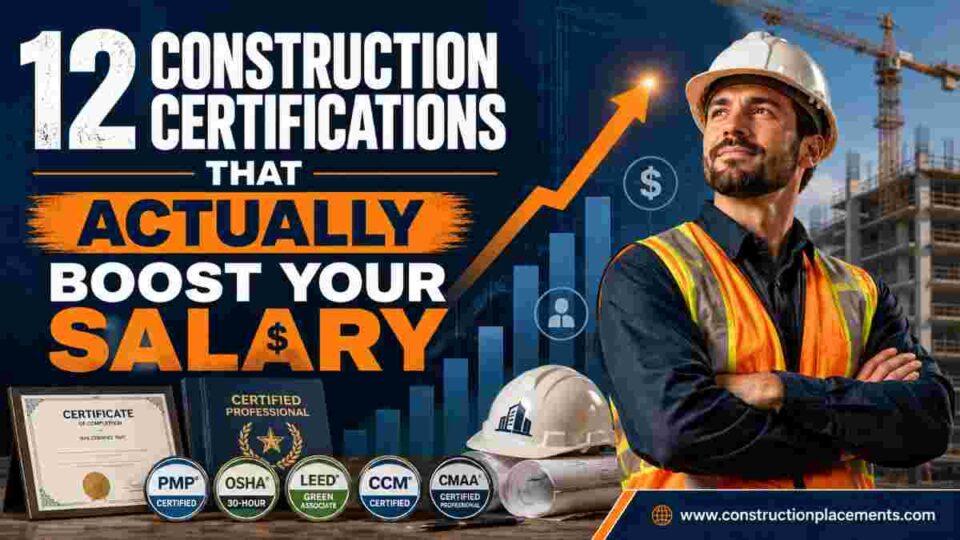
12 Construction Certifications That Actually Boost Your Salary
12 Construction Certifications That Actually Boost Your Salary is a data-backed guide to the construction certifications with the highest documented salary premiums in 2026. This guide covers PE, PMP, CCM, OSHA 30, LEED AP, NEBOSH, CSP, AWS CWI, NCCER, CHST, BIM Professional, and PMI-CP, along with salary premiums, ROI payback timelines, and certification stacking strategies.
Top 12 Construction Certifications That Can Boost Your Salary
- OSHA 30-Hour Construction Safety Certification
Salary Premium: $5,000–$10,000/year. Fastest entry-level path to a measurable pay bump. - NCCER Certification
Salary Premium: $5,000–$15,000/year. Industry-standard craft competency validation. - NEBOSH International General Certificate (IGC)
Salary Premium: 16–30% ($10,000–$30,000/year). Gold-standard international safety credential. - PMP — Project Management Professional
Salary Premium: 33% median increase ($12,000–$18,000+/year). Largest documented PM salary premium. - CCM — Certified Construction Manager
Salary Premium: 10–15% ($5,000–$15,000/year). ANSI-accredited construction management gold standard. - LEED AP BD+C
Salary Premium: $8,000–$12,000/year. Essential for sustainability-focused commercial projects. - CSP — Certified Safety Professional
Salary Premium: $15,000–$25,000+/year. Premier safety management credential for director-level roles. - AWS CWI — Certified Welding Inspector
Salary Premium: $15,000–$25,000/year. Creates an entirely new career track in QA/QC inspection. - PE License — Professional Engineer
Salary Premium: ~$40,000/year (30–40%). Largest absolute dollar premium on this list. - CHST — Construction Health and Safety Technician
Salary Premium: $5,000–$10,000/year. Construction-specific field safety credential. - BIM Professional Certification
Salary Premium: 15–30% ($10,000–$25,000/year). Digital construction skills commanding growing premiums. - PMI-CP — Construction Professional in Built Environment Projects
Salary Premium: $8,000–$15,000/year. Bridges PMP and CCM for construction-specific PM validation.
Frequently Asked Questions
Which construction certification gives the highest salary boost?
The PE (Professional Engineer) license delivers the largest documented salary premium — approximately $40,000 more annually, representing a 30–40% increase over unlicensed engineers, according to ASCE’s 2025 Salary Report. For the highest percentage-based premium with a shorter preparation timeline, the PMP certification offers a 33% median salary increase according to PMI’s 2025 Earning Power data.
What is the easiest construction certification to get that still pays well?
The OSHA 30-Hour Construction Safety Certification offers the best combination of low barrier to entry and measurable salary impact. It can be completed in 4–5 days, costs under $200 online, and consistently delivers a $5,000–$10,000 annual salary premium with an ROI payback period of under 3 months.
Can I get construction certifications without a college degree?
Yes — several high-value certifications do not require a college degree. OSHA 30-Hour has no educational prerequisites. NCCER certifications are skills-based. The AWS CWI requires 5 years of welding-related experience with a high school diploma. The CHST requires 3 years of construction safety experience. Even the PMP allows candidates without a degree to qualify with 60 months of project management experience.
Are construction certifications valid internationally?
Portability varies by credential. PMP is recognized in 200+ countries. NEBOSH IGC dominates the UK, Middle East, and Asia-Pacific. AWS CWI carries global recognition comparable to CSWIP 3.1. LEED is growing in India, UAE, and Canada. The PE license is US-specific but has equivalency pathways in many countries.
How many certifications should I pursue at once?
A staged approach works best. Start with the highest-ROI credential for your current career stage, such as OSHA 30 for entry-level professionals or PMP/CCM for mid-career professionals. After passing one certification, plan the next credential 6–12 months later. Build a stack across different competency domains — one safety, one management, and one technical credential — instead of collecting multiple certifications in the same domain.
Do certifications matter more than experience in construction hiring?
Certifications and experience are complementary. Experience remains the primary hiring filter, but certifications serve as the tiebreaker between equally experienced candidates. Certified professionals often advance to leadership roles faster than non-certified peers, and many owners list specific certifications such as CCM, PMP, and LEED AP as requirements in RFPs and hiring criteria.
