

Last Updated on May 22, 2026 by Admin
Every successful construction project starts long before the first shovel hits the ground — and the preconstruction manager is the professional who makes that happen. If you’re searching for a detailed preconstruction manager job description, this guide covers everything: core responsibilities, salary benchmarks from Glassdoor and Salary.com for 2026, the five-stage career path from junior estimator to VP, required qualifications, top certifications, and the tools reshaping the role today. Whether you’re pursuing this career or hiring for it, here’s what you need to know.
ConstructionCareerHub App is LIVE — built ONLY for construction careers. Don’t apply with a weak resume.
Get ATS-ready Resume Lab + Interview Copilot + Campus Placement Prep (resume screening, skill gaps, interview readiness) — in minutes & Other advanced features.
Explore Smarter Construction Career Tools →Quick check. Big impact. Start now.
Table of Contents
What Is a Preconstruction Manager?

A preconstruction manager is the professional who takes a construction project from concept to shovel-ready. Before a single foundation is poured or a crane arrives on site, someone has to evaluate feasibility, develop cost estimates, coordinate with architects and engineers, assess risks, and build a project budget that stakeholders can trust. That someone is the preconstruction manager.
In practical terms, this role sits at the intersection of estimating, project management, and business development. Preconstruction managers work for general contractors, construction management firms, design-build companies, and large specialty subcontractors. They lead the planning phase that determines whether a project moves forward—and on what terms.
According to the U.S. Bureau of Labor Statistics, employment for construction managers (the broader category that includes preconstruction roles) is projected to grow 9 percent from 2024 to 2034, significantly faster than the average for all occupations. With roughly 46,800 openings projected annually over the next decade, the demand for professionals who can manage the front end of construction projects is strong and growing.
If you are considering this career path or looking to hire for this position, this guide covers everything you need to know—from daily responsibilities and required qualifications to salary benchmarks, career progression, and the tools shaping the role in 2026.
Preconstruction Manager Job Description: Core Responsibilities
The preconstruction manager’s primary responsibility is ensuring that every project enters the construction phase with accurate budgets, realistic schedules, clearly defined scopes, and thoroughly vetted risk profiles. Here is a detailed breakdown of what the role involves day to day.
Cost Estimating and Budget Development
Preconstruction managers lead the development of conceptual, schematic, and detailed cost estimates at each design milestone. They analyze blueprints, specifications, and site conditions to produce budgets that reflect actual market pricing. This includes soliciting subcontractor bids, benchmarking material costs against current indices, and building contingency allowances based on project complexity. According to Salary.com, professionals with strong estimating skills in this role command salaries at the higher end of the pay scale.
Constructability and Value Engineering Reviews
A significant part of the preconstruction manager’s value lies in reviewing architectural and engineering drawings for constructability—identifying design elements that will be difficult, expensive, or time-consuming to build and suggesting practical alternatives. Value engineering sessions, where the team looks for ways to reduce cost without sacrificing quality or function, are a core deliverable of this phase.
Scheduling and Phasing
Preconstruction managers develop preliminary project schedules that account for permitting timelines, long-lead material procurement, phasing requirements, and seasonal constraints. These schedules become the baseline against which the construction team measures progress once the project is under way.
Risk Assessment and Mitigation
Every project carries risk—site access challenges, soil conditions, regulatory hurdles, supply chain volatility, labor availability. Preconstruction managers identify these risks early, quantify their potential cost and schedule impacts, and develop mitigation strategies. This proactive approach protects the contractor’s margin and gives the owner confidence in the project plan.
Subcontractor and Vendor Coordination
Preconstruction managers manage the bidding process for trade packages, prequalify subcontractors, evaluate proposals, and negotiate scope and pricing. Building and maintaining relationships with reliable subcontractors is essential, as the quality of the trade base directly affects project outcomes.
Client Relationship Management
In many firms, preconstruction managers are the primary client-facing contact during the planning phase. They present budgets, explain cost drivers, facilitate design decision-making, and build the trust that wins repeat business. Strong client relationships often determine whether a firm is selected for negotiated work.
Project Handoff to Operations
One of the most critical—and often underestimated—responsibilities is the handoff from preconstruction to the field team. Preconstruction managers must ensure that all assumptions, exclusions, allowances, and risk items are clearly documented and communicated to the project manager and superintendent who will execute the work. A poor handoff is a leading cause of budget overruns on otherwise well-estimated projects.
Proposal and Bid Preparation
For competitively bid work, preconstruction managers oversee the preparation of proposals that position the firm to win. This includes developing bid strategies, writing qualification statements, preparing technical narratives, and assembling pricing packages that demonstrate value to the client.
For more context on how estimating fits into the broader construction management ecosystem, explore the Estimation Engineer Career Guide on ConstructionPlacements.com.
Required Qualifications and Skills
Employers hiring for preconstruction manager positions typically look for a combination of formal education, field experience, and specialized competencies. Here is what the standard qualification profile looks like in 2026.
Educational Background
Most preconstruction managers hold a bachelor’s degree in one of the following fields:
- Construction Management
- Civil Engineering
- Architecture
- Mechanical or Structural Engineering
- Quantity Surveying
A growing number of employers also value candidates with a master’s degree in construction management or an MBA with a focus on real estate or infrastructure development. To explore degree options and outcomes, read What Can You Do With a Construction Management Degree?
Experience Requirements
Most job postings specify a minimum of 5 to 10 years of progressive experience in construction estimating, project management, or preconstruction services. Experience across multiple project types—commercial, healthcare, education, industrial, or data center—strengthens a candidate’s profile. Hiring managers particularly value candidates who have worked through complete project life cycles, from initial pursuit through construction closeout.
Technical Skills
- Estimating software: Proficiency in tools like ProEst, HCSS HeavyBid, Sage Estimating, or PlanSwift for quantity takeoff and cost estimation.
- BIM coordination: Working knowledge of Revit, Navisworks, and BIM 360 for model-based estimating and constructability reviews.
- Scheduling software: Competence with Primavera P6 or Microsoft Project for developing preconstruction schedules.
- Spreadsheet modeling: Advanced Excel skills for building custom budget models, cash flow projections, and bid analysis templates.
- Project management platforms: Familiarity with Procore, PlanGrid, Bluebeam, or similar platforms used during the preconstruction phase.
For a deeper look at estimating technology, see the Top Estimating Software for Construction roundup.
Soft Skills and Leadership Competencies
- Communication: Preconstruction managers translate complex cost and technical data into clear presentations for clients, executives, and design teams.
- Negotiation: Effective negotiation with subcontractors and vendors directly impacts project profitability.
- Analytical thinking: The ability to evaluate multiple design options, compare trade-offs, and make data-driven recommendations is central to the role.
- Team leadership: Senior preconstruction managers mentor estimators, coordinate with business development teams, and lead cross-functional project pursuit efforts.
- Client management: Building and maintaining trust with project owners requires empathy, transparency, and responsiveness.
Professional Certifications That Strengthen Your Profile
While not always mandatory, certifications demonstrate commitment to the profession and can accelerate career advancement:
- Certified Construction Manager (CCM) – Issued by the Construction Management Association of America (CMAA), this is the industry’s gold-standard credential, accredited under ANSI ISO 17024.
- Project Management Professional (PMP) – Offered by the Project Management Institute (PMI), this certification is valued across industries and demonstrates mastery of project management fundamentals.
- Certified Professional Estimator (CPE) – Awarded by the American Society of Professional Estimators (ASPE), this credential validates estimating expertise.
- LEED AP – For preconstruction managers working on sustainable projects, this certification from the U.S. Green Building Council demonstrates green building knowledge.
- Design-Build Institute of America (DBIA) Associate or Professional – Valuable for those working in the growing design-build delivery space.
For a comprehensive comparison, read CCM vs PMP: Which Certification Is Better for Construction Professionals? and Top Construction Management Certifications 2026.
Preconstruction Manager Salary in 2026
Compensation for preconstruction managers varies based on experience, geography, project sector, and company size. Here is a consolidated view of the latest salary data from multiple sources.
| Source | Average / Median Salary (USD) | Salary Range (USD) |
|---|---|---|
| Glassdoor (April 2026) | $134,699 average | $103,642 – $224,541 |
| Salary.com (January 2026) | $148,226 average | $116,732 – $175,028 |
| Salary.com Job Postings (April 2026) | $122,405 average | $95,459 – $144,409 |
| ZipRecruiter (April 2026) | $81,677 average | $50,000 – $137,500 |
The wide variation in reported figures reflects differences in methodology—Glassdoor and Salary.com tend to capture total compensation packages including bonuses and profit sharing, while ZipRecruiter reflects base salary from job postings. A realistic expectation for a mid-career preconstruction manager at a mid-size to large contractor in a major U.S. metro area is $110,000 to $160,000 in total annual compensation.
Factors That Influence Salary
- Geography: Preconstruction managers in high-cost markets like New York, San Francisco, Boston, and Washington, D.C. consistently earn 15 to 30 percent more than the national average.
- Project sector: Data center, healthcare, and life sciences sectors tend to pay the highest premiums due to project complexity and specialized knowledge requirements.
- Company size: Large national contractors (Turner, Skanska, Hensel Phelps, DPR, Holder) typically offer higher base salaries and more comprehensive benefits packages than smaller regional firms.
- Certifications: Holding a CCM, PMP, or CPE can add $10,000 to $20,000 to annual compensation.
- Years of experience: Professionals with 15+ years and a proven track record of winning and delivering projects command premium compensation.
For a broader look at construction management compensation, see the Construction Manager Job Description and Salary Details guide.
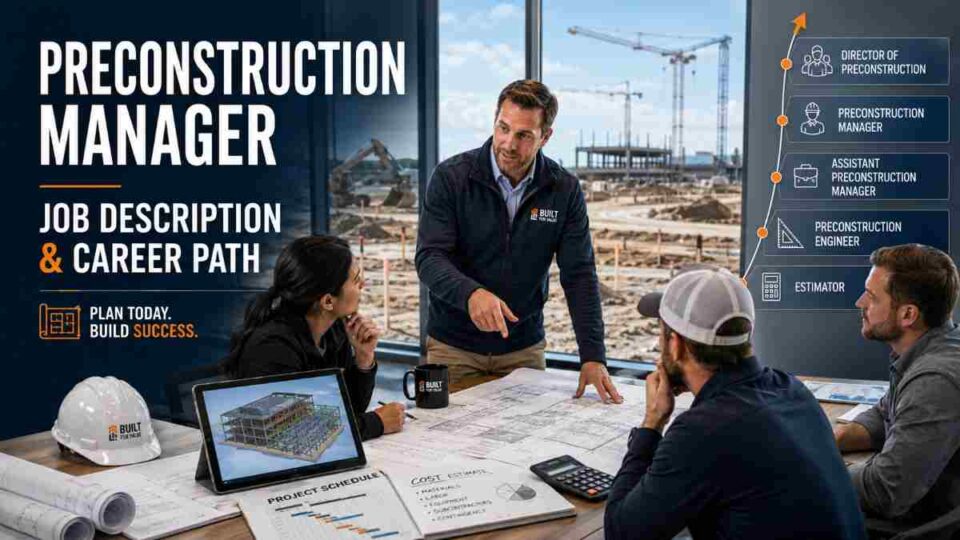
Preconstruction Manager Career Path: From Entry Level to Executive
The preconstruction career track follows a well-defined progression. Here is what each stage typically looks like.
Stage 1: Entry-Level Estimator or Project Engineer (0–3 Years)
Most preconstruction managers begin their careers as junior estimators, project engineers, or assistant project managers. In these roles, they learn quantity takeoff procedures, subcontractor bid management, basic scheduling, and project documentation. This is the foundation-building phase where technical skills are developed under the guidance of senior team members.
Entry-level salaries typically range from $55,000 to $75,000 depending on location and employer size. Read more about starting positions in the Guide to Entry-Level Construction Management Jobs.
Stage 2: Estimator or Assistant Preconstruction Manager (3–7 Years)
At this stage, professionals begin leading estimate development for small to mid-size projects independently. They take on more client-facing responsibilities, participate in value engineering sessions, and start building their subcontractor network. Compensation typically ranges from $75,000 to $110,000.
Stage 3: Preconstruction Manager (7–12 Years)
This is the target role covered in this guide. Preconstruction managers lead the entire planning phase for major projects, manage estimating teams, present to clients, and play a key role in business development. Total compensation at this level ranges from $110,000 to $175,000 depending on the factors discussed in the salary section above.
Stage 4: Senior Preconstruction Manager or Director of Preconstruction (12–18 Years)
Senior-level professionals oversee preconstruction departments, manage multiple pursuit teams simultaneously, and contribute to company-wide strategy decisions. They mentor junior staff, refine estimating processes, and serve as the firm’s subject-matter experts on cost and constructability. Compensation ranges from $150,000 to $220,000+.
Stage 5: Vice President of Preconstruction or Chief Estimator (18+ Years)
At the executive level, these professionals shape the firm’s market strategy, decide which projects to pursue, and manage client relationships at the C-suite level. They are accountable for the firm’s overall win rate and preconstruction profitability. Total compensation, including bonuses and equity participation, can exceed $250,000 at large national contractors.
For a visual overview of how construction management careers progress, explore the Construction Management Career Guide.
Day in the Life: What a Preconstruction Manager Actually Does
Understanding the daily rhythm of this role helps candidates evaluate whether it matches their working style and professional interests.
A typical day for a preconstruction manager might include reviewing overnight subcontractor bid submissions and updating the bid comparison spreadsheet during the morning hours. Mid-morning often involves a design team meeting with the architect and owner’s representative to review schematic drawings and discuss budget alignment. The afternoon could include a constructability review session with the superintendent, followed by preparing a conceptual estimate presentation for a new project pursuit. Late afternoon is frequently spent on business development—attending an industry networking event or following up with a prospective client.
The role is primarily office-based, though preconstruction managers regularly visit project sites to evaluate existing conditions, attend owner meetings, and participate in preconstruction walkthroughs. Travel requirements vary by firm and portfolio—managers covering a regional territory may travel 20 to 40 percent of the time.
Tools and Technology Shaping Preconstruction in 2026
The preconstruction landscape is being transformed by technology. Professionals entering or advancing in this field should be familiar with the following trends and platforms.
AI-Powered Estimating
Artificial intelligence is automating quantity takeoff processes, with some platforms completing takeoffs in under one minute compared to 45–60 minutes manually. AI tools analyze historical project data to identify cost patterns and predict potential overruns before they occur. While AI will not replace the judgment of experienced preconstruction professionals, it is dramatically accelerating their work and improving accuracy.
5D BIM
Five-dimensional BIM integrates cost data directly with three-dimensional design models, allowing preconstruction teams to see the budget impact of design changes in real time. This capability is quickly becoming standard on complex commercial and institutional projects. For an overview of how BIM intersects with cost estimation, see the Construction Estimating Services Complete Guide.
Cloud-Based Collaboration Platforms
Platforms like Procore, Autodesk Construction Cloud, and PlanGrid have made it possible for preconstruction teams to collaborate seamlessly across offices and with external partners. Document management, bid distribution, RFI tracking, and drawing review all happen in centralized, cloud-based environments.
Data Analytics and Benchmarking
Leading preconstruction departments now use proprietary databases of historical project costs to benchmark new estimates against completed projects. These databases, enhanced with analytics dashboards, allow managers to identify cost outliers, validate subcontractor pricing, and present data-backed recommendations to clients.
Industries and Sectors Hiring Preconstruction Managers
Preconstruction managers are in demand across virtually every construction sector. Here are the sectors where hiring activity is strongest in 2026.
- Data Centers: Explosive growth in AI computing infrastructure is driving unprecedented demand for preconstruction expertise in mission-critical facilities.
- Healthcare: Hospital expansions, ambulatory care centers, and specialty medical facilities require preconstruction managers with deep knowledge of regulatory and infection-control requirements.
- Commercial Office and Mixed-Use: Despite shifts in remote work patterns, adaptive reuse and ground-up mixed-use developments remain active.
- Industrial and Manufacturing: Reshoring initiatives and semiconductor fabrication plant construction are creating high-value preconstruction opportunities.
- Education (K-12 and Higher Education): School bond measures and university campus expansions continue to generate steady project volume.
- Infrastructure: Federal infrastructure investment is fueling demand for preconstruction professionals in heavy civil, transportation, and water/wastewater sectors.
For a broader perspective on construction job markets, see Construction and Management Jobs in USA: Salary & Hiring Trends.
Preconstruction Manager vs. Related Roles
Job seekers sometimes confuse the preconstruction manager role with similar-sounding positions. Here is how it compares to related roles.
| Role | Primary Focus | Key Difference |
|---|---|---|
| Preconstruction Manager | Planning, estimating, and project pursuit before construction starts | Focused exclusively on the pre-build phase |
| Project Manager | Executing the project during construction | Takes over after preconstruction handoff |
| Chief Estimator | Leading the estimating function across all projects | More narrowly focused on cost estimation |
| Construction Manager | Overseeing all phases of a project | Broader scope spanning preconstruction through closeout |
| Business Development Manager | Winning new work through client relationships | Less technical, more relationship and strategy driven |
Understanding these distinctions helps job seekers target the right opportunities and helps employers write accurate job descriptions. For deeper reading on the construction manager role specifically, see How to Become a Construction Manager.
Challenges Facing Preconstruction Managers in 2026
The role comes with significant challenges that candidates should understand before pursuing it.
Material Price Volatility
Construction input prices rose 4.8 percent year-over-year as of March 2026, according to data compiled from the Bureau of Labor Statistics Producer Price Index. This volatility makes accurate long-range estimating increasingly difficult, requiring preconstruction managers to build more sophisticated escalation models and manage client expectations around pricing uncertainty.
Labor Shortages
According to the Associated Builders and Contractors (ABC), the construction industry needs an estimated 349,000 net new workers in 2026 and 456,000 in 2027. Eighty percent of firms report difficulty filling salaried positions. Preconstruction managers must account for labor availability and wage escalation when developing project budgets.
Compressed Timelines
Owners increasingly demand faster delivery, pushing preconstruction managers to develop estimates and schedules on accelerated timelines. The expectation to produce reliable budgets from incomplete design documents requires sophisticated risk quantification and contingency management skills.
Technology Adoption
While technology offers tremendous benefits, the pace of adoption creates a learning curve. Preconstruction managers must stay current with evolving software platforms, AI tools, and digital workflows while managing their existing project workloads.
How to Break Into Preconstruction Management
For professionals looking to transition into this role from related positions, here is a practical roadmap.
Step 1: Build Your Estimating Foundation
If you are currently in project management, field engineering, or a related role, seek opportunities to assist with estimating on your current projects. Volunteer for bid preparation tasks, attend subcontractor bid openings, and study how your company’s estimating team operates. The Types of Estimate in Civil Engineering guide provides a solid technical foundation.
Step 2: Develop Technical Proficiency
Invest in learning the estimating and BIM tools used in your sector. Online courses from platforms like Coursera, edX, and Udemy offer accessible training:
- Construction Cost Estimating and Cost Control
- Construction Management
- Construction Estimating Courses
Also, explore the Best Project Management Online Courses for 2026 and Best Construction Management Online Programs for accredited learning pathways.
Step 3: Get Certified
Pursue the CPE from ASPE or the CCM from CMAA to validate your expertise. These credentials signal to employers that you are serious about preconstruction as a career discipline, not just a stepping stone. For a step-by-step certification walkthrough, read How to Become a Certified Construction Project Manager in 2026.
Step 4: Build Your Network
Join professional associations like CMAA, ASPE, the Associated General Contractors of America (AGC), and your local chapters. Attend industry events, preconstruction roundtables, and owner-contractor forums. Many preconstruction roles are filled through referrals rather than job postings.
Step 5: Optimize Your Application Materials
When applying for preconstruction manager positions, tailor your resume to highlight estimating accuracy, project wins attributed to your preconstruction work, and client relationship outcomes. Use the ConstructionCareerHub Resume Lab to build an ATS-optimized resume that highlights preconstruction-specific competencies. Also prepare for interviews using the Interview Copilot tool for role-specific practice questions.
For additional resume guidance, see How to Write a Civil Engineering Resume and Top 25 Resume & Portfolio Questions Asked in Construction Interviews.
Future Outlook for Preconstruction Managers
The long-term outlook for preconstruction management professionals is exceptionally positive. Several converging factors support sustained demand.
Federal infrastructure investment continues to flow through programs established by the Bipartisan Infrastructure Law, creating project pipelines that will extend well into the 2030s. The data center construction boom, driven by the growth of artificial intelligence and cloud computing, shows no signs of slowing—and these projects require intensive preconstruction planning due to their technical complexity and compressed delivery schedules.
At the same time, the aging construction management workforce is creating succession planning challenges. As senior professionals retire, firms need experienced preconstruction managers to fill leadership gaps. Professionals who combine strong technical estimating skills with business development capability and digital fluency will be positioned for the strongest career trajectories.
The construction industry is also moving toward earlier contractor involvement in the design process through integrated project delivery (IPD), progressive design-build, and construction manager at risk (CMAR) delivery methods. All of these models elevate the importance of the preconstruction function and create more demand for professionals who excel in early-phase project leadership.
Recommended Resources for Aspiring Preconstruction Managers
Building expertise in preconstruction management requires continuous learning. Here are curated resources to support your development.
Digital Career Guides
- AI Construction Career Blueprint eBook – A comprehensive guide to navigating construction career paths with AI-powered strategies.
- Construction Interview Preparation Guide – 225+ interview questions and answers tailored for construction professionals at all career stages.
- Construction Career Bundle – A combined resource pack covering resumes, interviews, and career planning.
- Remote Construction Jobs Guide – For preconstruction professionals exploring hybrid and remote estimating positions.
Industry Associations
- Construction Management Association of America (CMAA)
- American Society of Professional Estimators (ASPE)
- Associated General Contractors of America (AGC)
- Design-Build Institute of America (DBIA)
Career Tools
Take advantage of AI-powered career planning tools on ConstructionCareerHub.com, including the Resume Lab for ATS-optimized resume building, Interview Copilot for role-specific interview practice, Career Planner for personalized roadmaps, and Salary Calculator for compensation benchmarking.
Also explore the Construction Job Compatibility Analyzer to evaluate whether preconstruction management aligns with your skills and working style.
Frequently Asked Questions
What does a preconstruction manager do?
A preconstruction manager oversees the planning phase of construction projects before building begins. Their responsibilities include developing cost estimates, conducting constructability reviews, leading value engineering sessions, assessing project risks, managing the subcontractor bidding process, and coordinating with architects, engineers, and owners to establish project budgets and schedules.
How much does a preconstruction manager earn?
In the United States, preconstruction managers earn between $95,000 and $175,000 per year in total compensation as of 2026, with the average falling around $120,000 to $148,000 depending on the data source. Top earners at large national contractors in major metro areas can exceed $200,000 annually when bonuses and incentives are included.
What qualifications do you need to become a preconstruction manager?
Most employers require a bachelor’s degree in construction management, civil engineering, or architecture, plus 5 to 10 years of experience in estimating or construction project management. Professional certifications like CCM, PMP, or CPE strengthen candidacy. Strong proficiency with estimating software, BIM tools, and scheduling platforms is also expected.
What is the difference between a preconstruction manager and a project manager?
A preconstruction manager focuses on the planning and estimating phase before construction starts—developing budgets, assessing risks, and winning work. A project manager takes over after the preconstruction handoff and is responsible for executing the project during the construction phase, managing field operations, budgets, and schedules through completion.
Is preconstruction management a good career?
Yes. Preconstruction management offers competitive compensation, strong job growth (9 percent projected through 2034 per the BLS), intellectual variety, and a clear path to senior leadership. Professionals in this role influence high-value decisions early in the project life cycle and are central to their firm’s business development success.
What software do preconstruction managers use?
Common tools include ProEst, HCSS HeavyBid, Sage Estimating, and PlanSwift for cost estimation; Revit, Navisworks, and BIM 360 for model-based coordination; Primavera P6 and Microsoft Project for scheduling; Procore and Bluebeam for project management and document review; and advanced Excel for custom cost modeling.
Can you become a preconstruction manager without a degree?
While a degree is the most common pathway, some professionals advance into preconstruction management through extensive field experience combined with professional certifications and demonstrated estimating expertise. This path typically requires significantly more years of experience and a proven track record of accurate project estimating.
What industries hire preconstruction managers?
Preconstruction managers are employed across all construction sectors, including commercial, healthcare, education, data centers, industrial and manufacturing, infrastructure, residential (large-scale multifamily and master-planned communities), and specialty sectors like life sciences and mission-critical facilities.
