

Last Updated on June 2, 2026 by Admin
Construction projects are built on planning, coordination, and accurate financial decisions. Before a contractor purchases materials, assigns labor, or prepares a project schedule, one important step determines whether the project begins on solid ground: cost estimation. Estimating is not simply a process of calculating numbers. It affects project feasibility, bidding strategy, resource allocation, and overall profitability.
ConstructionCareerHub App is LIVE — built ONLY for construction careers. Don’t apply with a weak resume.
Get ATS-ready Resume Lab + Interview Copilot + Campus Placement Prep (resume screening, skill gaps, interview readiness) — in minutes & Other advanced features.
Explore Smarter Construction Career Tools →Quick check. Big impact. Start now.
In today’s construction environment, projects are becoming more complex due to changing material prices, labor shortages, regional regulations, and tight deadlines. Companies that rely on rough calculations or outdated methods often face budget overruns and unexpected project challenges. This is one reason why many contractors, developers, builders, and project managers now rely on a professional construction estimating service to improve cost accuracy and planning efficiency.
However, choosing the right estimating company is not always simple. Numerous providers offer estimating solutions, but not every service delivers the same quality, accuracy, or industry knowledge. Hiring the wrong estimating partner can create expensive consequences, while selecting the right one can improve bidding success and project performance.
This article explores the most important factors to consider when hiring a construction estimating service and explains how businesses can make informed decisions.
Table of Contents
Why Construction Estimating Matters
Before understanding what to look for in a service provider, it is important to understand the role estimating plays in construction.
Construction estimating serves several purposes:
- Predicting total project costs
- Identifying labor and material requirements
- Supporting competitive bidding
- Assisting with project planning
- Managing financial risks
- Improving decision-making
Even small estimation errors can significantly affect project outcomes. Underestimating costs may reduce profits or create budget shortages, while overestimating may make bids uncompetitive.
Accurate estimates help contractors submit realistic proposals and manage projects efficiently from start to finish.
Understanding Construction Estimating Services
Construction estimating services are specialized solutions that provide cost calculations and quantity takeoffs for construction projects. These services support contractors and construction companies by delivering detailed analyses of labor, materials, equipment, overhead, and project expenses.
Estimating services may cover different project sectors, including:
- Residential construction
- Commercial buildings
- Industrial projects
- Civil infrastructure
- Mechanical systems
- Electrical systems
- Plumbing systems
Some providers focus on specific trades, while others offer complete estimating solutions for multiple construction categories.
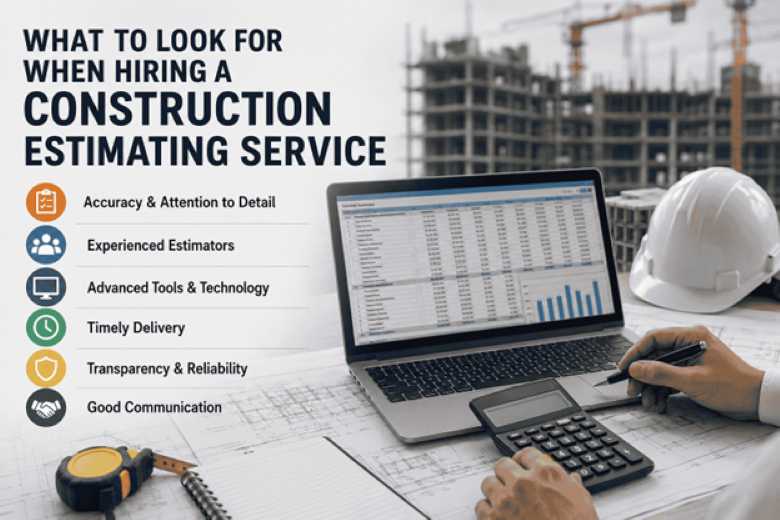
Experience Within the Construction Industry
One of the first things to evaluate is industry experience.
Estimating requires more than mathematical calculations. It requires an understanding of construction practices, materials, field operations, and project challenges.
A company with extensive experience understands:
- Construction terminology
- Building methods
- Material usage patterns
- Labor productivity rates
- Local market conditions
- Project scheduling considerations
For example, estimating a residential renovation project differs greatly from estimating a large industrial facility. Industry-specific experience helps estimators identify hidden costs and avoid inaccurate assumptions.
Ask questions such as:
- How many years has the company been operating?
- Which types of projects do they estimate?
- What industries do they specialize in?
- Can they provide project examples?
Experience often translates into stronger accuracy and better judgment.
Accuracy and Attention to Detail
Accuracy should remain one of the highest priorities when selecting an estimating partner.
A detailed estimate should include:
- Material quantities
- Labor costs
- Equipment expenses
- Subcontractor pricing
- Contingencies
- Overhead costs
- Profit margins
Some estimating providers produce general summaries with limited details. Others create comprehensive breakdowns that allow contractors to understand every component of the estimate.
Look for providers that demonstrate careful attention to detail and provide transparent documentation.
Important indicators include:
- Clear cost breakdowns
- Organized reports
- Itemized quantities
- Supporting calculations
- Assumption documentation
Reliable estimates reduce uncertainty and support better project decisions.
Knowledge of Estimating Software and Technology
Modern estimating depends heavily on technology.
Advanced software tools improve speed, consistency, and accuracy. They also help estimators manage complex calculations more effectively.
Popular estimating software platforms include:
- PlanSwift
- Bluebeam
- CostX
- RSMeans
- Sage Estimating
- Trimble
- STACK
Technology allows estimating teams to analyze drawings, generate quantity takeoffs, and produce detailed cost reports.
When evaluating a provider, ask:
- Which software platforms do they use?
- How do they maintain cost databases?
- How often do they update pricing information?
Technology alone does not guarantee quality, but skilled use of technology significantly improves estimating performance.
Ability to Understand Project Scope
Many estimation problems begin with a misunderstanding of project scope.
Project scope includes:
- Work requirements
- Specifications
- Materials
- Design elements
- Deliverables
- Construction methods
An estimator who fails to understand scope details may omit important costs or include unnecessary items.
Strong estimating providers spend time reviewing:
- Drawings
- Specifications
- Project requirements
- Bid documents
- Site conditions
They also ask questions when information appears incomplete or unclear.
A provider that actively communicates during the review process usually delivers stronger results.
Turnaround Time and Deadlines
Construction projects frequently operate under strict schedules.
Contractors often have limited time to prepare bids and submit proposals. Delays in estimates can cause missed opportunities.
When selecting a service provider, evaluate their ability to meet deadlines consistently.
Questions to ask include:
- What is the average turnaround time?
- Can they handle urgent projects?
- How do they manage workload capacity?
Fast delivery is valuable, but speed should never compromise quality.
The goal is finding a balance between efficiency and accuracy.
Reputation and Client Feedback
Past performance often reveals future reliability.
Researching a company’s reputation can help identify strengths and weaknesses.
Sources of information may include:
- Client testimonials
- Online reviews
- Industry recommendations
- Professional references
- Case studies
Positive feedback may indicate:
- Reliable communication
- Accurate estimates
- Consistent performance
- Professional behavior
Pay attention to repeated concerns or complaints because patterns often reveal potential issues.
Understanding Regional Construction Markets
Construction costs vary significantly between regions.
Factors affecting costs include:
- Labor rates
- Material pricing
- Transportation costs
- Building regulations
- Economic conditions
An estimating company with local market knowledge can provide more realistic cost projections.
For example, regional pricing differences may affect projects in major cities compared to smaller communities.
Many contractors working with construction estimator professionals UK recognize the value of understanding local regulations, supplier networks, and market pricing conditions when preparing project estimates.
Regional awareness helps reduce unexpected cost variations during project execution.
Communication and Responsiveness
Communication is often overlooked but plays a critical role in project success.
An estimating provider should be responsive and accessible throughout the process.
Effective communication includes:
- Answering questions promptly
- Clarifying assumptions
- Explaining calculations
- Providing updates
- Addressing concerns
Poor communication can create misunderstandings and delay projects.
During initial interactions, evaluate:
- Response times
- Professionalism
- Clarity of explanations
- Willingness to answer questions
Strong communication often indicates a collaborative working relationship.
Flexibility and Scalability
Construction workloads frequently change.
Some contractors need estimating support occasionally, while others require ongoing assistance across multiple projects.
The ideal estimating partner should adapt to changing demands.
Consider whether the provider can:
- Handle small projects
- Manage large projects
- Support multiple bids simultaneously
- Scale services during busy periods
Flexibility becomes particularly valuable during periods of business growth or high bidding activity.
Transparency in Pricing Structure
Understanding service costs prevents future surprises.
Some estimating companies charge:
- Fixed project fees
- Hourly rates
- Percentage based fees
- Subscription models
Before hiring a provider, ask for complete pricing information.
Transparency should include:
- Service inclusions
- Additional charges
- Revision costs
- Rush fees
A low price does not always represent the best value.
Poor quality estimates can cost far more than initial service fees.
Confidentiality and Data Security
Construction projects often involve sensitive information.
Documents may include:
- Project budgets
- Drawings
- Specifications
- Client details
- Bid strategies
Protecting confidential information should be a priority.
Ask providers about:
- Data protection practices
- Confidentiality agreements
- File storage systems
- Security protocols
Reliable providers understand the importance of maintaining privacy and protecting client information.
Quality Control Processes
Quality control systems improve consistency and reduce errors.
Professional estimating companies often use internal review procedures before delivering estimates.
Quality control may include:
- Multiple review stages
- Senior estimator oversight
- Error-checking systems
- Cross verification processes
Ask whether estimates undergo review before final delivery.
Companies with strong quality assurance systems generally produce more reliable results.
Ability to Provide Customized Solutions
Every project has different requirements.
Some clients may need:
- Quantity takeoffs only
- Full cost estimates
- Bid preparation support
- Value engineering
- Budget analysis
Avoid providers that use a one-size-fits-all approach.
Customized services often provide greater value because they align with specific project goals and business needs.
Questions to Ask Before Hiring
Before making a final decision, contractors can ask several practical questions:
- What project types do you specialize in?
- How do you maintain cost accuracy?
- What software do you use?
- Can you provide references?
- How do you handle revisions?
- What is your turnaround time?
- How do you protect confidential information?
- What quality control measures do you follow?
These questions help reveal a provider’s capabilities and working process.
Final Thoughts
Hiring an estimating partner should not be treated as a simple purchasing decision. It represents an investment in project success, financial control, and long-term business performance.
The right estimating service combines industry experience, technical knowledge, accuracy, communication skills, and market awareness. Contractors who take time to evaluate these factors are more likely to establish productive relationships and improve project outcomes.
As construction projects continue becoming more demanding, accurate estimating remains one of the most important foundations for successful planning and execution. Choosing the right estimating service today can help reduce risks and create stronger opportunities for growth tomorrow.
Related Posts:
- 10 Important Things To Be Included In A Construction Estimate
- What is Estimation and Costing in Civil Engineering?
- Construction Estimating Services: The Complete Guide to Accurate Cost Estimation and Project Success in 2026
- 150 Interview Questions and Answers on Construction Estimating and Cost Control
- The Ultimate Construction Bids Guide for 2026
