

Last Updated on June 27, 2026 by Admin
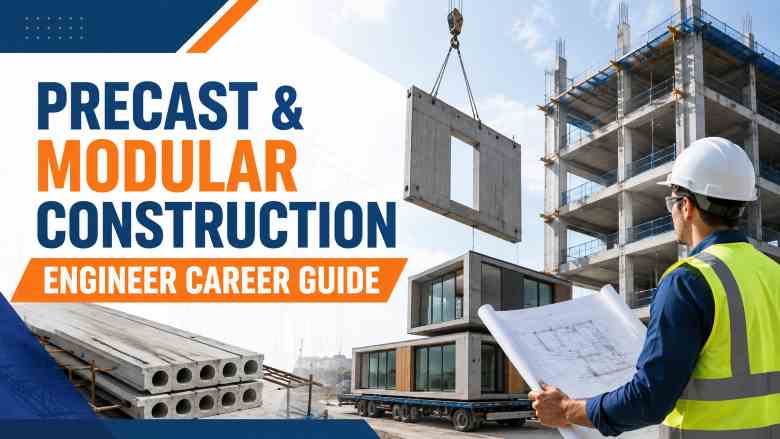
While most civil engineering graduates still compete for traditional site engineering roles, a quieter revolution is reshaping how buildings actually get built. Factory floors are replacing open-air casting yards. Overhead cranes are lifting fully finished bathroom pods into high-rise frames. And the engineers coordinating this shift — precast and modular construction engineers — are among the most sought-after professionals in the global construction workforce in 2026.
ConstructionCareerHub App is LIVE — built ONLY for construction careers. Don’t apply with a weak resume.
Get ATS-ready Resume Lab + Interview Copilot + Campus Placement Prep (resume screening, skill gaps, interview readiness) — in minutes & Other advanced features.
Explore Smarter Construction Career Tools →Quick check. Big impact. Start now.
The numbers make the case clearly. The global modular construction market is valued at approximately $119–125 billion in 2026 and is projected to reach over $207 billion by 2033, growing at a compound annual growth rate of 7–9%. The precast concrete market is estimated at $134–149 billion in 2026, forecast to surpass $190 billion by 2033. Behind those revenue figures is a workforce gap: the industry needs engineers who understand both structural design and factory manufacturing, both BIM coordination and crane-lift sequencing, both material science and supply chain logistics.
This guide covers everything you need to know about building a career as a precast or modular construction engineer in 2026 — from the daily responsibilities and salary benchmarks across global markets to the skills and certifications that set top candidates apart, and the career progression paths that lead from graduate trainee to director of offsite operations.
🚀 ConstructionCareerHub App is LIVE — built ONLY for construction careers. Don’t apply with a weak resume. Get ATS-ready Resume Lab + Interview Copilot + Campus Placement Prep (resume screening, skill gaps, interview readiness) — in minutes & other advanced features. Explore Smarter Construction Career Tools →
Table of Contents
Quick Answer: What Is a Precast / Modular Construction Engineer?
A precast modular construction engineer designs, coordinates, and oversees the production and assembly of factory-manufactured building components — from individual precast concrete panels, beams, and columns to complete three-dimensional volumetric modules containing structural frames, internal finishes, and MEP services. The role bridges structural engineering, manufacturing process management, BIM coordination, logistics planning, and on-site erection supervision. These engineers work across residential, commercial, industrial, data centre, healthcare, and infrastructure projects, ensuring that factory-produced elements meet structural codes, quality standards, and project schedules before being transported and installed on site.
Why This Role Matters in 2026
Several macro-forces are converging to make precast and modular construction engineering one of the most strategically important roles in the industry.
Chronic labour shortages. Construction industries across North America, Europe, Australia, and the Gulf are struggling to find enough skilled workers. The U.S. Bureau of Labor Statistics projects steady growth in construction employment, but the supply of field workers cannot keep pace. Offsite manufacturing reduces on-site manpower requirements by up to 30–40%, making precast and modular methods essential for project delivery. Engineers who can design for factory production and coordinate assembly with smaller site crews are solving one of the industry’s most persistent problems.
Speed-to-market pressure. Data centre developers, affordable housing programmes, and hospitality chains need buildings delivered in months rather than years. Modular construction can reduce project timelines by 30–50% by running factory production in parallel with site preparation. Precast engineers who can optimise designs for rapid manufacturing and just-in-time delivery are directly accelerating revenue for project owners.
Sustainability mandates. Factory-controlled production generates significantly less material waste than traditional construction. Precast concrete elements can incorporate recycled aggregates and low-carbon cement formulations. Governments across the UK, EU, and Asia-Pacific are introducing carbon reporting requirements and green building mandates that favour offsite construction methods. Engineers who understand embodied carbon calculations and sustainable material specification within precast systems are positioning themselves at the intersection of regulation and construction technology.
Government policy and BIM mandates. Singapore mandates Prefabricated Prefinished Volumetric Construction (PPVC) for selected building types. The UK government has pushed Modern Methods of Construction (MMC) for affordable housing delivery. India’s government-backed housing programmes are promoting prefabrication to meet urban housing targets. BIM mandates aligned with ISO 19650 are accelerating digital workflows for precast coordination — creating demand for engineers who can operate in both the physical factory and the digital model.
Precast Engineer vs Modular Construction Engineer: What Is the Difference?
While the terms are sometimes used interchangeably, there are meaningful distinctions between these two specialisations — and understanding the difference helps you target the right career path.
A precast engineer focuses on the design, manufacture, and installation of individual precast concrete components: wall panels, beams, columns, hollow-core floor slabs, precast stairs, facade panels, culverts, and bridge girders. The work centres on structural analysis, connection design, mould design, concrete mix optimisation, reinforcement detailing, and erection sequencing. Precast engineers often work for PCI-certified precast manufacturers, structural engineering consultancies, or general contractors with in-house precast divisions.
A modular construction engineer works with complete volumetric modules — factory-built three-dimensional units that may include structural framing, insulation, internal wall and ceiling finishes, flooring, plumbing, electrical wiring, HVAC ductwork, and fixtures. The work involves Design for Manufacture and Assembly (DfMA) optimisation, module connection engineering, transportation and crane-lift analysis, MEP routing within volumetric constraints, and on-site assembly coordination. Modular engineers typically work for modular building manufacturers, main contractors adopting offsite delivery, or specialist design firms.
In practice, many projects combine both approaches — using precast structural frames with modular volumetric infill — and engineers increasingly work across both domains. The shared foundation is an understanding of factory-based construction processes, structural engineering, BIM coordination, and logistics management.
Core Responsibilities
The day-to-day work of a precast or modular construction engineer varies by career stage and employer type, but the core responsibilities span several key areas.
Design and Engineering
Structural analysis and design of precast elements and modular units using relevant codes (ACI 318, Eurocode 2, PCI Design Handbook, BS EN 13369). Connection design between precast elements and with cast-in-situ structures. Mould and formwork design for factory production. Reinforcement detailing including prestressing and post-tensioning for specific applications. DfMA optimisation — designing components that are efficient to manufacture, transport, and assemble. Temporary works design for lifting, transportation, and erection stages. Seismic and wind load analysis for modular stacked assemblies.
BIM Coordination and Detailing
Creating and managing structural BIM models in Tekla Structures or Autodesk Revit for precast components. Clash detection and resolution with architectural, MEP, and civil models using Navisworks or Solibri. Generating production drawings, erection drawings, and shop drawings from BIM models. 4D scheduling integration — linking precast manufacturing and erection sequences to the project programme. Coordinating with the project CDE (Common Data Environment) for drawing approvals, RFIs, and document control under ISO 19650 workflows.
Factory and Production Management
Overseeing precast concrete production including batching, casting, curing, finishing, and quality inspection. Developing and reviewing Inspection and Test Plans (ITPs) for factory-produced elements. Managing casting schedules to align with site erection sequences and just-in-time delivery requirements. Coordinating with factory QA/QC teams on concrete strength testing, dimensional tolerances, and surface finish standards. Troubleshooting production issues — formwork alignment, reinforcement congestion, concrete workability, curing defects.
Logistics, Transportation, and Erection
Planning transportation routes for oversized precast elements and volumetric modules — including road permits, escort requirements, and bridge load restrictions. Developing crane-lift plans and rigging calculations for element weights, lift radii, and sequencing. Coordinating with site teams on erection methodology, temporary bracing, grouting, and connection completion. Supervising on-site installation to ensure correct positioning, levelling, alignment, and connection integrity.
Quality Assurance and Compliance
Ensuring compliance with relevant standards: PCI MNL-116 (quality control for precast), PCI MNL-135 (architectural precast), EN 13369, and local building codes. Managing document trails for material test certificates, concrete test results, production records, and inspection sign-offs. Participating in design reviews, technical submissions, and regulatory approvals. Reviewing method statements and risk assessments for lifting, transport, and erection operations.
Salary Benchmarks: How Much Do Precast and Modular Construction Engineers Earn?
Salaries vary significantly by geography, experience, specialisation, and employer type. The following benchmarks reflect 2026 market data from ZipRecruiter, Glassdoor, Payscale, and industry salary surveys.
United States
Entry-level precast engineers (0–3 years): $62,000–$85,000 per year. Mid-level (3–7 years): $85,000–$120,000. Senior precast engineers (8+ years): $104,000–$173,000, with an average of approximately $126,500 for senior roles. Precast project managers and design leads can exceed $150,000 in metropolitan markets. For context, the highest-paying construction jobs in the US include construction managers at a median of $106,980 — precast engineering specialists with strong BIM and PE credentials frequently exceed this benchmark.
United Kingdom
Graduate precast/modular engineers: £28,000–£35,000. Mid-level (5–8 years): £42,000–£58,000. Senior engineers and DfMA leads: £60,000–£80,000. Offsite construction directors and heads of MMC at major contractors: £85,000–£120,000+. London and the South East command the highest premiums.
India
Entry-level precast/modular engineers: ₹4–7 LPA. Mid-level (5–8 years): ₹8–15 LPA. Senior precast engineers and project managers: ₹18–30+ LPA. Multinational EPC firms and large Indian infrastructure groups (L&T, Shapoorji Pallonji, Tata Projects) offer the strongest packages for precast specialists. For broader civil engineering salary benchmarks, see our comprehensive guide.
Gulf Region (UAE, Saudi Arabia, Qatar)
Junior precast engineers: AED 8,000–14,000 per month. Mid-level: AED 15,000–25,000. Senior precast/modular leads: AED 25,000–40,000+. Saudi Arabia’s NEOM and related mega-projects are creating premium demand for precast and modular specialists, with some positions offering housing, transport, and annual flight allowances on top of base salary. Use our GCC CV keyword bank to optimise your resume for Gulf-region applications.
Australia
Graduate engineers: AUD 65,000–80,000. Mid-level (5+ years): AUD 90,000–130,000. Senior precast project engineers: AUD 130,000–170,000+. Sydney, Melbourne, and Brisbane lead in precast construction activity driven by residential and infrastructure projects.
📘 For detailed salary comparisons across all construction roles, explore our highest-paying construction jobs guide and the construction management salary breakdown.
Essential Skills and Competencies
Success as a precast or modular construction engineer requires a combination of structural engineering knowledge, manufacturing awareness, digital tool proficiency, and coordination capability. Here are the skill clusters that employers evaluate.
Structural Engineering Fundamentals
Reinforced and prestressed concrete design (ACI, Eurocode, or Indian Standards). Connection engineering — wet joints, dry mechanical connections, moment-resisting precast joints. Understanding of load paths through precast systems, diaphragm action, progressive collapse resistance, and robustness. Temporary stability analysis during erection stages. Foundation interface design — base plate connections, grouted pockets, dowel anchors.
BIM and Digital Construction Tools
Tekla Structures — the industry-standard tool for precast and steel detailing, producing production drawings, assembly marks, and CNC data for factory equipment. Autodesk Revit — for architectural coordination, MEP clash checking, and multi-discipline design integration. Structural analysis software: STAAD.Pro, ETABS, SAFE, SP-Slab, SP-Column, RISA. AutoCAD for supplementary 2D detailing. Navisworks or Solibri for federated model review and clash detection. Synchro or Primavera P6 for 4D construction scheduling. Understanding of BIM workflows and ISO 19650 information management is increasingly non-negotiable.
Manufacturing and Production Knowledge
Concrete technology: mix design, admixtures, curing regimes, self-compacting concrete (SCC), ultra-high-performance concrete (UHPC). Formwork and mould engineering: steel moulds, battery moulds, tilting tables, carousel production lines. Pre-tensioning and post-tensioning processes. Quality control testing: slump, compressive strength (cube/cylinder), dimensional tolerance checks, surface finish classification. Factory production planning and sequencing. Understanding of automated casting systems, robotic rebar placement, and CNC bending equipment.
Logistics and Erection Skills
Crane capacity calculations, lift planning, and rigging design. Transportation engineering: load distribution on trailers, route surveys, oversize permit procedures. Erection sequence planning and temporary stability design. Grouting and connection completion procedures. Site safety for lifting operations (LOLER compliance in the UK, OSHA crane safety standards in the US).
Soft Skills
Cross-functional coordination: precast engineers work at the intersection of design offices, factory floors, logistics teams, and construction sites. Technical communication: presenting design solutions to architects, reviewing shop drawings with detailers, explaining erection methodology to site teams. Problem-solving under production pressure: factory casting schedules and site erection programmes create real-time deadlines that demand rapid engineering judgment.
Educational Pathways and Certifications
The entry point for a precast or modular construction engineer career typically begins with formal education in engineering or construction management, followed by industry-specific certifications and continuous professional development.
Degree Requirements
A bachelor’s degree in civil engineering, structural engineering, or construction management is the standard requirement for most positions. Some roles, particularly in advanced structural design and project leadership, favour candidates with a master’s degree in structural engineering, precast/prestressed concrete, or construction engineering and management. Diploma-holders in civil engineering can enter through precast production and site erection roles, then progress into engineering positions with additional qualifications and experience. For a broader view of educational pathways, see our civil engineering career guide.
Key Certifications
PCI Certification (Precast/Prestressed Concrete Institute): The PCI offers plant certification programmes (Categories A through C4A) and a Design Educator and Professional certification that validates precast design competence. PCI certification is highly valued across North American precast manufacturers and engineering firms.
Professional Engineer (PE) Licence / Chartered Engineer (CEng): A PE licence (US) or CEng status (UK via ICE or IStructE) significantly accelerates career progression and is required for senior design and sign-off responsibilities. The PE licence can increase earnings by $15,000–$40,000 annually for structural engineers.
Autodesk Certified Professional — Revit for Structural Design: Validates BIM competence for precast coordination workflows.
Tekla Structures Certification: Trimble offers certification tracks that validate proficiency in precast and steel BIM detailing. For preparation resources, see our Tekla Structures interview questions guide.
PMP (Project Management Professional): Valuable for precast and modular engineers moving into project management, with PMP holders earning 22–33% more than non-certified peers in construction management roles.
LEED AP / BREEAM Assessor: Relevant for engineers working on sustainable precast and modular projects requiring green building certification compliance.
Recommended Online Courses
These courses provide structured learning paths for building the technical and management skills required in precast and modular construction:
- Construction Management Specialization — Columbia University (Coursera) — Covers project management, scheduling, cost estimating, and BIM fundamentals.
- Construction Project Management — University of Maryland (edX) — Practical programme covering project delivery, scheduling, and cost control.
- BIM Fundamentals for Infrastructure — Politecnico di Milano (Coursera) — Foundation course for BIM workflows relevant to precast coordination.
- Construction Management Courses — Udemy — Affordable, project-based courses covering BIM, estimation, Tekla, Primavera P6, and more.
📘 Deepen your preparation with these career resources:
- Civil Engineering & Construction Career eBook — Comprehensive career roadmap for construction professionals.
- Comprehensive Civil Engineering Interview Guide — 300+ questions with detailed answers covering precast, structural, and project management scenarios.
- Construction Career Resource Bundle — Combined kit for resume, interview preparation, and salary negotiation.
- Remote & Global Construction Jobs Kit — For precast engineers targeting Gulf, Australia, or US opportunities.
Career Progression Path
Precast and modular construction engineering offers clearly defined career progression with multiple branching specialisations. Here is the typical trajectory from graduate entry to senior leadership.
Stage 1: Junior Precast Engineer / Graduate Trainee (0–3 Years)
Entry-level roles typically involve assisting senior engineers with design calculations, preparing detailing drawings, supporting factory QC inspections, and learning erection procedures under supervision. Graduates rotate between the design office, factory, and construction site to build cross-functional understanding. Key milestone: completing your first independently designed precast element package.
Stage 2: Precast Design Engineer / Modular Coordinator (3–6 Years)
At this stage, engineers take ownership of specific element groups within a project — for example, all facade panels, all floor slabs, or the bathroom pod package. Responsibilities expand to include connection design, BIM model management, coordination with architects and MEP consultants, and production drawing approvals. This is the stage where proficiency in Tekla Structures or Revit Structure becomes a differentiator. Key milestone: managing the precast package coordination for a complete building project.
Stage 3: Senior Precast Engineer / DfMA Lead (6–10 Years)
Senior engineers lead the precast or modular engineering scope across multiple projects or a major programme. They make design decisions on connection systems, review structural calculations, mentor junior engineers, lead technical submissions, and coordinate with principal designers and contractors. DfMA lead roles involve advising project teams on optimal offsite strategies — deciding what gets precast versus cast-in-situ, what gets built as volumetric modules versus panelised systems, and how to optimise designs for manufacturing efficiency. Key milestone: establishing yourself as the technical authority for precast or modular delivery within your firm.
Stage 4: Precast Project Manager / Head of Offsite Construction (10–15 Years)
Project management-oriented engineers at this level oversee the full delivery chain: design procurement, factory production capacity planning, supply chain management, logistics coordination, site erection programmes, and commercial management. Some engineers transition into business development, winning precast and modular contracts through technical proposals and client engagement. Key milestone: delivering a major programme (multiple buildings or a landmark project) from concept through precast strategy, production, and completed erection.
Stage 5: Director of Offsite / VP Modular Operations (15+ Years)
Strategic leadership roles that shape the company’s offsite construction capability — including factory investment decisions, technology adoption (automation, robotics, digital twins), workforce development, and market positioning. Directors in this space are shaping how major contractors and developers integrate offsite methods into their core delivery models.
For a broader view of construction career progression across all specialisations, explore our career options after civil engineering guide and the Construction Career Path Planner tool on ConstructionCareerHub.
Where Precast and Modular Engineers Work: Employer Types
Understanding the types of employers hiring precast and modular engineers helps you target your job search and understand the working environment for each path.
Precast manufacturers (PCI/NPCA-certified plants): Companies like Wells, Coreslab Structures, Stresscon, Tindall Corporation, and Bison Precast (UK) employ design engineers, production engineers, and project engineers in factory environments. Work is a mix of office-based design and factory-floor production management.
Modular building manufacturers: Firms like Laing O’Rourke (Australia/UK), CIMC MBS, Volumetric Building Companies, and Premier Modular hire engineers who manage design-to-factory-to-site delivery for volumetric modular projects.
Main contractors and general contractors: Large contractors such as Skanska, Balfour Beatty, L&T, Bouygues, and top EPC companies hire precast coordinators and DfMA leads to manage offsite packages within larger construction programmes.
Structural engineering consultancies: Firms like Arup, WSP, Meinhardt, and Robert Bird Group employ precast design engineers who work on the consultant side, designing precast solutions and coordinating with manufacturers.
Specialist precast/modular consultancies: Niche firms that advise clients on offsite construction strategies, DfMA optimisation, and precast system selection.
Infrastructure and bridge engineering: Precast engineers working on segmental bridge construction, precast tunnel segments, precast culverts, and utility infrastructure for government and DOT projects.
How to Transition Into Precast/Modular Engineering From Related Roles
If you are a site engineer, structural designer, Tekla detailer, or BIM coordinator looking to move into precast and modular construction, here is a practical transition roadmap.
From site engineering: Your concrete operations, formwork, and crane coordination experience translates directly. Add Tekla Structures or Revit Structure proficiency, study precast connection design, and seek a factory placement or precast erection project assignment to bridge the gap. Read our benefits and challenges of modular construction to understand the industry context.
From structural design (RCC/steel): Your analysis and detailing skills are the foundation. Shift your design mindset from cast-in-situ to factory-produced: learn about mould constraints, demoulding cycles, transportation load cases, and temporary erection stability. Study the PCI Design Handbook or relevant Eurocode precast provisions.
From BIM/VDC coordination: Your digital skills are increasingly central to precast delivery. Deepen your structural knowledge — understand load paths, connection mechanics, and concrete technology — and learn factory production workflows. BIM’s career multiplier effect is especially powerful in precast, where models drive both design and manufacturing.
From quantity surveying / estimation: Move into precast commercial roles — estimating, procurement, and contract management for precast packages — then transition into technical project management. Understanding of cost structures, material pricing, and contract types gives you a commercial edge that pure engineers often lack.
🚀 Assess your readiness for this transition with the Career Planner and Resume Lab on ConstructionCareerHub.com — built exclusively for construction career planning.
Key Industry Trends Shaping the Role in 2026 and Beyond
Understanding where the industry is heading helps you position your career for maximum relevance and earning potential.
AI and Automation in Precast Manufacturing
Automated batching, robotic rebar placement, CNC bending, and AI-driven quality inspection are transforming factory operations. Engineers who understand these systems — and can optimise designs for automated production — are at the leading edge of the profession.
Digital Twins and IoT Integration
Precast elements embedded with IoT sensors feed data into digital twin platforms for structural health monitoring, predictive maintenance, and lifecycle management. Engineers who can specify embedded sensors and interpret the resulting data are bridging construction and digital construction careers.
Hybrid Construction Systems
The binary choice between “traditional” and “offsite” is dissolving. Modern projects increasingly combine precast structural frames with modular volumetric infill, panelised facade systems, and cast-in-situ cores — requiring engineers who understand the interfaces between all these methods.
Sustainable and Low-Carbon Precast
Geopolymer concrete, ultra-high-performance concrete (UHPC), recycled aggregate incorporation, and carbon capture in curing are all advancing rapidly. Engineers who can specify and validate these materials within precast production processes are meeting growing regulatory and client demands for embodied carbon reduction.
Data Centre and Healthcare Specialisation
Data centre construction — one of the fastest-growing segments globally — relies heavily on precast concrete for speed, structural mass, and vibration control. Healthcare facility construction uses modular bathroom pods, patient room modules, and precast structural systems for accelerated delivery. Both sectors offer premium salaries for precast engineers with relevant project experience.
Growth of Precast in Infrastructure
Segmental precast bridge construction, precast tunnel lining segments, precast retaining walls, and utility vaults are expanding infrastructure applications. Government infrastructure spending (including the US Infrastructure Investment and Jobs Act) is driving demand for precast solutions that accelerate construction timelines on public projects.
Interview Preparation for Precast / Modular Construction Engineer Roles
Preparing for a precast engineering interview requires demonstrating both structural engineering competence and manufacturing/assembly awareness. Interviewers typically explore these areas:
Technical knowledge: Precast connection types (wet vs dry), prestressing methods (pre-tension vs post-tension), concrete mix design for precast production, tolerance standards, demoulding strength requirements, fire resistance ratings for precast elements.
BIM and software proficiency: Tekla Structures workflows for precast detailing, model sharing, numbering, and drawing production. Revit interoperability. Clash detection methodology. 4D scheduling for erection sequence planning.
Project experience: Walk through a precast project you contributed to — from design through production through erection. Describe specific challenges (a connection detail that needed redesign, a transportation constraint that forced element resizing, a casting defect that required a non-conformance report and repair procedure).
Safety and quality: Lifting safety for precast elements (LOLER, OSHA crane standards), QC documentation (ITPs, concrete test reports, dimensional check records), and non-conformance handling processes.
For comprehensive interview preparation, use our top 50 construction interview questions guide and the project management interview questions resource. Practice with the AI-powered Interview Copilot on ConstructionCareerHub.com for construction-specific mock interviews with real-time feedback.
Global Demand Hotspots in 2026
The following markets offer the strongest demand for precast and modular construction engineers in 2026:
United States: Data centre construction boom, affordable housing mandates, infrastructure renewal, and persistent skilled-labour shortages are driving precast adoption across all building types. The Modular Building Institute (MBI) reports accelerating commercial interest in permanent modular construction.
United Kingdom: Government MMC frameworks, NHS healthcare construction, and residential delivery targets are creating sustained demand. The UK is one of the most mature markets for DfMA engineers and modular specialists.
Saudi Arabia and UAE: NEOM, The Red Sea, AMAALA, and Saudi giga-project construction are driving unprecedented demand for precast engineers with structural BIM capability. Dubai’s ongoing commercial and residential development continues to favour precast delivery for speed and quality control.
Australia: Infrastructure investment (rail, road, water) and high-rise residential construction in Sydney, Melbourne, and Brisbane create strong demand for precast engineers with local code knowledge (AS 3600).
India: Government housing programmes (PMAY), metro rail expansion, and the growth of organised construction companies adopting prefabrication are expanding the domestic precast market. L&T, Tata Projects, Shapoorji Pallonji, and Godrej Construction are actively hiring precast engineers.
Singapore: PPVC mandates make Singapore one of the world’s most structured markets for modular construction engineers. Government policy directly creates engineering demand through mandated offsite construction percentages.
For more on global construction career markets, explore our guides on top emerging construction roles and LinkedIn construction pages to follow for job market intelligence.
Building Your Precast/Modular Construction Engineer Resume
Your resume needs to communicate three things clearly: structural engineering competence, factory/offsite construction experience, and BIM proficiency. Here are the elements that hiring managers and ATS systems look for.
Software keywords: Tekla Structures, Autodesk Revit (Structure), STAAD.Pro, ETABS, SAFE, AutoCAD, Navisworks, Trimble Connect, BIM 360, Autodesk Construction Cloud, Primavera P6, MS Project.
Technical keywords: Precast concrete design, prestressed concrete, DfMA, connection design, mould design, reinforcement detailing, bar bending schedule, hollow-core slabs, sandwich panels, volumetric modules, crane-lift planning, erection sequence, temporary works, ITP, method statement.
Achievement metrics: Number and types of precast elements designed, production volumes managed, project values, cost savings achieved through DfMA optimisation, schedule acceleration, clash reduction percentages, zero-defect delivery records.
Certifications to list: PE/CEng, PCI certification, Tekla certification, Autodesk Certified Professional, PMP, LEED AP, OSHA 30, CSCS/SMSTS (UK).
For detailed resume guidance tailored to construction roles, see our construction interview and resume guide and explore the full construction job titles directory to find the exact job title that matches your target role.
Common Mistakes to Avoid When Entering This Career
Treating precast engineering as “just site work with bigger pieces.” Precast engineering requires manufacturing knowledge that traditional site engineers do not have. If you do not understand mould cycles, curing regimes, and factory production constraints, you will design elements that are structurally sound but impossible or uneconomical to manufacture.
Ignoring BIM as optional. Precast production increasingly relies on BIM models for automated drawing generation, CNC data output, and factory scheduling. An engineer who cannot operate in Tekla Structures or Revit Structure is at a significant disadvantage in the 2026 job market. Read our analysis of why BIM is becoming a career multiplier.
Neglecting logistics and transportation. A beautifully designed precast panel that cannot fit on a standard trailer or exceeds road weight limits creates project delays and cost overruns. Precast engineers must consider transportation constraints from the earliest design stages.
Underestimating connection design. Connections are where precast buildings fail if engineering is inadequate. Spending insufficient time on connection design, detailing, and on-site installation procedures is the most common source of precast project problems.
Staying in one domain too long. Engineers who spend their entire career in factory-only or site-only roles miss the cross-functional understanding that creates the most valuable precast professionals. Rotate between design, factory, and site assignments in your first five years.
Frequently Asked Questions
What does a precast modular construction engineer do?
A precast modular construction engineer designs, coordinates, and oversees the manufacturing, transportation, and on-site assembly of factory-produced building components such as precast concrete panels, volumetric modules, beams, columns, and facade elements. They work across the full lifecycle from structural design and BIM coordination through factory production quality control to crane-lift sequencing and on-site erection.
What salary can a precast construction engineer expect in 2026?
In the United States, entry-level precast engineers earn $62,000–$85,000 per year, mid-level professionals earn $85,000–$120,000, and senior precast engineers average approximately $126,500 with top earners exceeding $170,000. In India, entry-level salaries range from ₹4–7 LPA, mid-level from ₹8–15 LPA, and senior roles from ₹18–30+ LPA. Gulf-region salaries for experienced professionals range from AED 15,000–35,000 per month.
What qualifications do I need to become a precast modular construction engineer?
Most employers require a bachelor’s degree in civil engineering, structural engineering, or construction management. A PE licence or CEng status accelerates career growth. PCI certification in precast design is highly valued in North America. Proficiency in Tekla Structures, Autodesk Revit, STAAD.Pro, and BIM coordination tools is increasingly essential.
Is precast and modular construction a good career in 2026?
Yes. The global modular construction market is valued at approximately $119–125 billion in 2026 and growing at 7–9% CAGR. The precast concrete market is estimated at $134–149 billion. Chronic labour shortages, government housing mandates, data centre demand, and sustainability targets are driving rapid expansion and creating strong demand for engineers with precast and modular expertise.
What software tools do precast modular construction engineers use?
Core tools include Tekla Structures for structural BIM and precast detailing, Autodesk Revit for architectural and MEP coordination, STAAD.Pro and ETABS for structural analysis, AutoCAD for 2D detailing, Navisworks for clash detection, Synchro or Primavera P6 for 4D scheduling, and Trimble Connect or Autodesk Construction Cloud for CDE and collaboration.
What is the difference between a precast engineer and a modular construction engineer?
A precast engineer focuses on individual factory-produced concrete elements — panels, beams, columns, slabs, and facades. A modular construction engineer works with complete three-dimensional volumetric modules that include structural frames, internal finishes, and MEP services. In practice, roles increasingly overlap as hybrid construction systems combine both approaches.
Which countries have the highest demand for precast and modular construction engineers?
The highest demand exists in the United States, United Kingdom, Australia, the Gulf states (UAE and Saudi Arabia), Singapore, China, and India — driven by infrastructure investment, housing shortages, data centre construction, and government mandates for offsite construction methods.
Can a site engineer transition into a precast or modular construction engineer role?
Yes. Site engineers with RCC and formwork experience have a strong foundation. The key steps are learning Tekla Structures or Revit Structure, understanding DfMA principles, gaining factory exposure, and developing crane-lift planning skills. BIM coordination experience significantly accelerates the transition.
Final Perspective
The construction industry’s shift toward factory-based production is not a temporary trend — it is a structural response to labour shortages, schedule pressures, quality expectations, and sustainability mandates that are not going away. Precast and modular construction engineers are the professionals making this transition work in practice, bridging the gap between design intent and manufactured reality, between factory floors and construction sites, between BIM models and bolted connections.
If you have a structural engineering foundation, an interest in manufacturing processes, a willingness to learn BIM tools like Tekla Structures, and the adaptability to work across office, factory, and site environments, this career path offers strong compensation, global mobility, and growing strategic importance within the industry.
The engineers who position themselves now — by building the right combination of structural knowledge, digital tool proficiency, and manufacturing awareness — will be the ones leading construction delivery for the next two decades.
For comprehensive career planning across all construction specialisations, explore the Construction Career Path Planner, read the careers in prefab and modular construction guide, and use the full suite of career tools on ConstructionCareerHub.com — including the AI Resume Lab, Interview Copilot, and Career Planner built exclusively for construction professionals.
Did this guide help you map your precast or modular construction career? Share it with a colleague or classmate who is still exploring their next move in construction, and drop your questions in the comments below.
