

Last Updated on June 26, 2026 by Admin
Ask a project owner what they want from their general contractor’s technology and the answer is rarely a longer feature list. Owners do not buy software. They buy buildings, and they buy a degree of confidence that the building will arrive on time, on budget, and as designed. Every tool the contractor uses is judged against that single question, whether it helps the owner believe the project is actually on track.
ConstructionCareerHub App is LIVE — built ONLY for construction careers. Don’t apply with a weak resume.
Get ATS-ready Resume Lab + Interview Copilot + Campus Placement Prep (resume screening, skill gaps, interview readiness) — in minutes & Other advanced features.
Explore Smarter Construction Career Tools →Quick check. Big impact. Start now.
The problem is that owners have learned, often expensively, to distrust the polished monthly update. They have sat through status meetings where everything looked green until the month it did not. That experience shapes how they evaluate a contractor’s technology, and it explains a persistent gap between what contractors present and what owners actually want to see.
Table of Contents
Why owners start from skepticism
Owner skepticism is earned, not irrational. An analysis of more than a century of large infrastructure projects, published by strategy+business, found that roughly nine in ten exceed their budgets, with a mean cost overrun of about 62 percent and a long tail of far worse outcomes. An owner who has read even a fraction of that history walks into a project assuming that the reported numbers and the real numbers may drift apart, and that the drift tends to surface late, when options are limited and expensive.
The pattern holds even for sophisticated owners with rigorous controls. A 2026 Government Accountability Office review of major construction projects found that one federal owner’s portfolio had seen cumulative cost overruns climb to 4.8 billion dollars and cumulative schedule delays reach 30 years, with management and oversight gaps among the contributing factors. If an owner backed by federal resources and dedicated oversight staff still struggles to keep major projects on plan, a private owner has every reason to want continuous, independent visibility rather than a reassuring summary delivered once a month.
What owners actually want
That skepticism shapes what owners look for in technology. The category often described as construction management software for owners exists precisely because owners want their own line of sight into a project, rather than a picture filtered entirely through the contractor’s reporting. The underlying request is consistent across owners of very different projects: give me an accurate, current, and verifiable view of progress, cost, and risk, and let me confirm it without having to take anyone’s word for it.
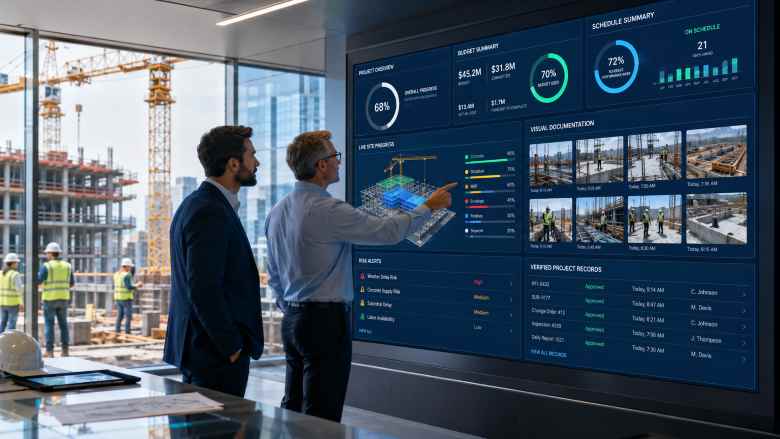
In practice, that breaks down into a few concrete wants. Owners want to see real conditions, not just a status color, which is why visual documentation of the site over time has become so valued. They want the current number, not last month’s, because a figure that is four weeks old is a figure they cannot act on. They want to trace a claim back to its evidence, so that when a question arises about what was built and when, the answer exists in the record rather than in someone’s memory. None of this is about controlling the contractor. It is about reducing the surprises that hurt both sides.
There is also a time dimension that owners weigh more heavily than contractors often realize. The value of a project record does not end at closeout. Owners hold and operate the asset for decades, and a complete, organized history of how it was built becomes a reference for maintenance, future renovation, and the dispute that surfaces years after everyone has moved on. A contractor whose technology produces that durable record is handing the owner something genuinely useful long after the final invoice has been paid, which is the kind of thing that gets a firm invited back.
The gap between the report and the reality
When that visibility is missing, problems compound quietly until they are expensive. A Construction Executive analysis of contractor dispute prevention observed that disputes rarely begin with a single dramatic failure. They build as unclear expectations and inconsistent documentation accumulate across the life of a project, and technology that improves transparency and traceability reduces how often they escalate. The gap between a tidy report and the messier reality on site is exactly where that accumulation happens.
The dynamic is familiar to anyone who has lived through a contentious closeout. The contractor reports steady progress; the owner senses something is off but cannot prove it; and by the time the discrepancy is undeniable, the schedule has already absorbed the slip. A shared, verifiable record changes the shape of that conversation. When the owner and the contractor are looking at the same time-stamped evidence, disagreements resolve on facts instead of dueling recollections, and the relationship survives the hard moments that every project eventually produces.
It is worth being precise about why the gap persists at all. Reporting is a summary, and summaries are assembled by people with a stake in how the project looks. That reflects the structure of the situation rather than any bad faith. An owner who sees only the summary is trusting both the underlying data and the judgment of whoever prepared it, while direct visibility removes one of those two leaps of faith at once. That is the practical reason owners keep pressing for access rather than accepting a cleaner version delivered after the fact.
Closing the gap
Contractors who win repeat work from demanding owners tend to treat transparency as a feature of their service rather than a risk to be managed. A few practices separate them:
- Give owners direct, read-only access to current project conditions, rather than routing every question through a monthly deck.
- Document the site visually on a consistent cadence, so progress can be confirmed by looking rather than asking.
- Keep cost and schedule reporting current enough to act on, since data an owner cannot act on is data they will not trust.
- Maintain a traceable record that links claims and change orders back to evidence, so disputes resolve quickly and fairly.
- Make the same information available to the field, the office, and the owner, so nobody is working from a different version of the truth.
These practices cost something in the short term, mostly in the discomfort of being seen clearly. The return is a category of trust that is hard to buy any other way. An owner who can verify the project for themselves stops second-guessing the contractor at every turn, which frees both parties to spend their energy on building rather than on managing each other’s anxiety.
Transparency also changes the conversation inside the contractor’s own organization. When the field knows the owner can see the same record, the temptation to paper over a problem until the next reporting cycle largely disappears. Issues surface earlier, while they are still small and cheap to solve, and the team develops a habit of accuracy because the record is no longer private. A practice adopted to reassure the client ends up improving how the contractor runs the job for everyone’s benefit.
Why the gap is worth closing
The owners with the most leverage in the market are increasingly choosing contractors on the strength of the visibility they provide, not only on price. They have learned that the cheapest bid attached to an opaque process can become the most expensive project. For a general contractor, closing the gap between what is reported and what is real is no longer a courtesy extended to nervous clients. It is becoming a condition of being trusted with the next job, and the technology that delivers that honesty is steadily moving from a differentiator to an expectation.
Related Posts:
- The Ultimate Guide to Building Maintenance: Tips and Best Practices
- Subcontractor Management in Construction: Best Practices & Software 2026
- Who’s Actually Liable When a Construction Project Goes Wrong?
- How to Explain Employment Gaps on Your Construction Resume (Without Lying)
- Who Pays for Builders Risk Insurance? Key Answers
