

Last Updated on June 10, 2026 by Admin
Disclosure: This article may contain affiliate links. If you enrol through our link, we may earn a commission at no extra cost to you. We only recommend courses we believe can genuinely help construction professionals.
ConstructionCareerHub App is LIVE — built ONLY for construction careers. Don’t apply with a weak resume.
Get ATS-ready Resume Lab + Interview Copilot + Campus Placement Prep (resume screening, skill gaps, interview readiness) — in minutes & Other advanced features.
Explore Smarter Construction Career Tools →Quick check. Big impact. Start now.
Table of Contents
Why Civil Engineers Need Data Analytics Skills in 2026
If you are a civil engineer, site engineer, planning engineer, quantity surveyor, or BIM professional, your day already revolves around data — daily progress reports, BOQ sheets, cost trackers, billing summaries, schedule updates, safety observations, and material consumption records.
The difference between an average engineer and one who gets promoted faster is the ability to turn that raw project data into clear decisions.
Construction teams today rely on dashboards, automated reports, data-driven forecasts, and visual project summaries. Employers across India, the Gulf, and global EPC firms increasingly expect engineers who can work with tools like Excel, SQL, Tableau, Python, and Power BI — not just AutoCAD and Primavera.
The Google Data Analytics Professional Certificate on Coursera is one of the most widely enrolled analytics programmes in the world. But is it useful for someone in civil engineering or construction?
This guide answers that question specifically for construction professionals — covering how the course content maps to real construction roles, who should take it, who should skip it, and how to get the most career value from it.
For a detailed general course breakdown, read our full Google Data Analytics Professional Certificate review.
Is Google Data Analytics worth it for civil engineers?
Yes, for most civil engineers and construction professionals, the Google Data Analytics Professional Certificate can be a worthwhile investment. It teaches structured data thinking, spreadsheets, SQL, Python, Tableau, and dashboard building — skills that directly apply to project reporting, cost control, schedule tracking, and construction analytics. It is especially valuable for planning engineers, quantity surveyors, BIM coordinators, project controls professionals, and freshers who want to stand out in a competitive job market. However, it is not a construction-specific course, so you will need to practise applying these skills to construction datasets on your own.
Start the Google Data Analytics Certificate on Coursera
Course Snapshot: Google Data Analytics Professional Certificate
The table below summarises the essential course details. Always verify the latest information — including fees, syllabus, and duration — directly on the official Coursera course page before enrolling, as these may change.
| Detail | Information |
|---|---|
| Course Name | Google Data Analytics Professional Certificate |
| Provider | |
| Platform | Coursera |
| Level | Beginner — no prior degree or experience required |
| Structure | 9-course series (updated January 2026 with new AI skills) |
| Key Skills | Spreadsheets, SQL, Python, Tableau, data cleaning, data analysis, data visualisation, data storytelling, AI-assisted analytics |
| Best For (Construction) | Planning engineers, QS, BIM coordinators, project controls, PMO/reporting, freshers entering analytics-driven roles |
| Prior Experience | Not required |
| Certificate | Shareable professional certificate from Google |
| Learning Mode | Self-paced online (estimated 6 months at 10 hours/week) |
| Enrolment | 3.6 million+ learners enrolled globally |
| Final Verdict | Strong analytics foundation for construction professionals willing to apply skills to industry datasets |
Check Fees, Syllabus & Enrolment Options
Why Data Analytics Matters for Civil Engineers in 2026
Construction may still feel like a boots-on-the-ground profession, but the back-end of every modern project runs on data. Consider what a typical project team handles every week:
- Daily progress reports (DPR) with quantities, manpower, and equipment logs
- BOQ and quantity take-off sheets with hundreds of line items
- Cost reports comparing budgeted vs. actual expenditure
- Billing and running account data for subcontractors and vendors
- Material consumption and procurement records
- Equipment utilisation and idle-time logs
- Labour productivity tracking across trades
- Safety observations, near-miss reports, and incident records
- Quality checklists, inspection results, and NCR logs
- Planning schedules in Primavera P6 or MS Project with earned value data
- BIM model data including clash reports, 4D simulations, and quantity extraction
- RFI/submittal tracking logs
- Delay analysis records and extension-of-time submissions
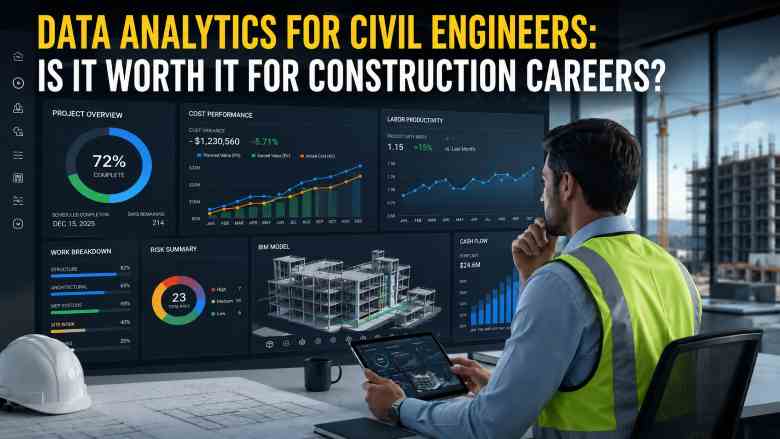
Most engineers collect this data but struggle to convert it into insights. Those who can build a dashboard showing cost variance trends, create a labour productivity chart, or automate weekly reporting immediately become more valuable to project managers, PMO heads, and senior management.
This is exactly where a structured data analytics course helps — it teaches you how to clean messy data, analyse patterns, build visualisations, and present findings. If you are aiming for roles in project monitoring and control, construction PMO, commercial management, or digital construction, these skills are no longer optional.
🛠️ Build a Stronger Construction Career
Use AI-powered career tools at ConstructionCareerHub.com — get an ATS-ready resume, personalised interview preparation, skill-gap analysis, and career planning built specifically for civil engineers and construction professionals.
What Is the Google Data Analytics Professional Certificate?
The Google Data Analytics Professional Certificate is a beginner-level, self-paced online programme created by Google and hosted on Coursera. It consists of nine courses covering the full data analytics lifecycle — from understanding what data analytics is, through data cleaning, analysis, and visualisation, to building a capstone project and preparing for job applications.
As of the latest update (January 2026), the certificate includes AI-assisted analytics content and teaches tools including Google Sheets, SQL, Python, and Tableau. It is designed so that someone with no prior analytics or programming experience can complete it in approximately six months at around ten hours per week, though many learners finish faster.
The programme has enrolled over 3.6 million learners globally and carries a 4.8 average rating. Upon completion, graduates receive a shareable professional certificate from Google.
This is a general-purpose analytics certificate, not a construction-specific programme. Its strength for construction professionals lies in the transferable skills — structured data thinking, SQL querying, dashboard building, and data storytelling — that can be applied directly to construction project data. For the complete course-by-course breakdown, see our full Google Data Analytics Professional Certificate review.
Note: Course structure, syllabus, fees, and tools may change. Always verify the latest details on the Coursera course page before enrolling.
How the Google Data Analytics Course Skills Apply to Construction Careers
This is the most important section for civil engineers evaluating this course. The table below maps each core skill taught in the certificate to specific construction applications and the roles where it is most useful.
| Course Skill | What You Learn | Construction Application | Useful For |
|---|---|---|---|
| Spreadsheets | Formulas, pivot tables, data organisation, conditional formatting | BOQ tracking, DPR analysis, cost sheets, material reconciliation, running account summaries | QS, billing engineers, site engineers, cost controllers |
| Data Cleaning | Handling missing values, duplicates, inconsistencies, formatting errors | Cleaning messy DPR data, fixing vendor records, standardising material codes, preparing QS data for billing | QS, planning engineers, PMO analysts, project coordinators |
| SQL | Querying databases, filtering, joining, aggregating data | Querying project databases, pulling material procurement records, filtering subcontractor payment data, analysing workforce records | Project controls, PMO, data analysts, BIM data coordinators |
| Python | Basic programming for data analysis and automation | Automating weekly reports, analysing productivity trends, delay impact calculations, large-dataset processing | Project controls engineers, digital construction roles, operations analysts |
| Tableau | Building interactive dashboards and visual reports | Project progress dashboards, cost variance visuals, safety trend boards, resource utilisation charts | PMO, project reporting engineers, planning engineers, management |
| Data Visualisation | Choosing the right chart types, design principles, clarity | Presenting earned value charts, S-curves, manpower histograms, and cost breakdowns to stakeholders | All construction roles preparing reports for clients or management |
| Data Storytelling | Presenting data-driven findings to non-technical audiences | Explaining project delays to clients, presenting cost overrun analysis to senior management, monthly project review presentations | Project managers, PMO heads, site-in-charges, planning engineers |
| Case Study / Capstone Project | End-to-end data analysis project with portfolio presentation | Opportunity to build a construction-themed portfolio project — e.g. a DPR dashboard, labour productivity tracker, or cost variance report | Freshers, career switchers, anyone building a data portfolio |
| AI-Assisted Analytics | Using AI tools to assist in data analysis tasks | Speeding up data exploration, generating preliminary analysis, augmenting reporting workflows | All roles adapting to AI-augmented construction workflows |
If you are a planning engineer working with Primavera P6, adding SQL and Tableau to your toolkit can help you build automated schedule performance dashboards. If you are a quantity surveyor, data cleaning and spreadsheet skills directly improve BOQ accuracy and billing efficiency. The course does not teach construction-specific software, but the analytical thinking it builds applies across every construction role. Browse our best online courses for civil engineers for role-specific options.
Check Course Details on Coursera
Who Should Take This Course?
Civil Engineering Freshers and Graduates
If you have recently graduated with a B.Tech, BE, or diploma in civil engineering and are struggling to stand out in job applications, a Google Data Analytics certificate adds a differentiated skill to your resume. Most freshers only list AutoCAD and basic Excel. Adding SQL, Tableau, and Python immediately signals that you can handle project data — making you a stronger candidate for project coordination, PMO assistant, and junior planning roles. Explore more at our civil engineering career guide.
Site Engineers
Site engineers deal with DPRs, material tracking, and daily quantity records. Learning data cleaning and spreadsheet analysis helps you produce error-free reports and reduce rework in documentation — a skill that project managers notice and reward.
Planning Engineers
Planning engineers already work with Primavera P6 or MS Project. Adding data analytics skills means you can pull schedule data into Tableau or Python, build earned value dashboards, analyse delay patterns, and present insights to clients. This combination makes you a strong candidate for senior planning or project controls roles.
Quantity Surveyors and Billing Engineers
QS professionals handle large volumes of measurement data, BOQs, variation orders, and payment certificates. Data cleaning, spreadsheet mastery, and SQL are directly relevant. If you want to move toward cost analytics or commercial analytics, this course gives you the analytical foundation. See our top quantity surveying courses for domain-specific training.
BIM Engineers and Coordinators
BIM models generate significant amounts of structured data — element quantities, clash reports, model health metrics, and 4D/5D outputs. Understanding how to query, clean, and visualise this data using SQL and Tableau makes you more effective as a BIM data coordinator. Learn more about essential skills for BIM professionals.
Project Controls Professionals
Project controls is one of the most data-intensive roles in construction. Cost tracking, schedule performance, earned value analysis, forecasting, and variance reporting all require strong analytical skills. The Google certificate builds exactly these foundations, and combining it with Power BI or Tableau makes you a high-value hire for EPC firms.
PMO and Reporting Professionals
If you work in a construction PMO, your primary job is consolidating data from multiple projects into management reports and dashboards. SQL, Tableau, data cleaning, and data storytelling are core skills for this function. The certificate covers all of them in a structured manner.
Gulf Job Seekers from India
Gulf construction employers — particularly in Saudi Arabia, the UAE, and Qatar — increasingly value digital skills alongside traditional construction knowledge. A Google certificate on your resume, combined with Primavera P6, Excel, and domain expertise, strengthens your application for project controls, planning, and PMO roles in the Middle East. Read our analysis on whether going abroad is worth it for civil engineers.
Construction Managers Who Want Better Reporting
Senior engineers and project managers who feel stuck creating manual Excel reports will benefit from learning Tableau dashboards, data visualisation principles, and Python-based automation. Even completing the first few courses can noticeably improve your reporting quality.
📘 Recommended Reading: The Construction Career Blueprint 2026 — a practical career strategy guide for civil engineers and construction professionals planning their next career move.
Who Should Avoid This Course?
Being honest about who should not enrol is important — it saves time and improves the value of genuine recommendations.
- If you need AutoCAD, Revit, or Primavera P6 training: This course does not cover any construction-specific software. For BIM and Revit courses or project management courses, explore dedicated options.
- If you expect a construction management course: The content is entirely about data analytics. It does not teach construction contracts, scheduling, estimation, or site management.
- If you want advanced data science or machine learning: This is an entry-level analytics certificate. For advanced topics, Google offers a separate Advanced Data Analytics Certificate.
- If you only want Power BI: The course teaches Tableau, not Power BI. If Power BI is your primary requirement, look for a dedicated Power BI course.
- If you are not willing to practise with real datasets: The certificate provides structured learning, but applying analytics to construction data requires self-practice. If you only want the certificate without building practical skills, the value will be limited.
This course is a skill-building tool, not a guaranteed job pathway. Treat it as one part of a broader career development strategy.
Construction Career Paths Where Data Analytics Can Help
The following table outlines construction career paths where the skills from this certificate add tangible value, along with additional tools or certifications you may want to combine.
| Career Path | How Data Analytics Helps | Recommended Extra Skills |
|---|---|---|
| Planning Engineer | Schedule performance dashboards, earned value analysis, delay pattern identification | Primavera P6, MS Project, Power BI |
| Project Controls Engineer | Cost vs. budget tracking, forecasting, variance analysis, S-curve generation | Primavera, Power BI, ERP systems |
| PMO Analyst | Multi-project reporting, executive dashboards, KPI tracking | Power BI, Excel (advanced), project management |
| Construction Data Analyst | Full-cycle analysis of project data — cleaning, analysis, visualisation, reporting | Python (advanced), SQL, Power BI, domain knowledge |
| Quantity Surveyor (Analytics-Driven) | BOQ data analysis, cost trend tracking, automated measurement summaries | CostX, PlanSwift, Excel (advanced), BIM tools |
| BIM Data Coordinator | BIM data extraction, model health metrics, clash trend analysis | Revit, Navisworks, Dynamo, Power BI |
| Cost Control Engineer | Real-time cost dashboards, procurement data analysis, budget vs. actual reports | ERP systems, Excel (advanced), Power BI |
| Project Reporting Engineer | Automated report generation, visual data summaries, KPI tracking | Power BI, Tableau, Python scripting |
| Operations Analyst | Equipment utilisation analysis, workforce productivity trends, operational efficiency | SQL (advanced), Python, Power BI |
| Digital Construction Coordinator | Integrating data from BIM, IoT sensors, project management platforms | BIM, IoT basics, Power BI, Python |
The certificate alone may not guarantee a specific role, but it strengthens your candidacy when combined with construction domain knowledge and relevant software skills. Think of it as the analytics layer on top of your engineering foundation. Explore construction management courses for complementary learning.
📘 Preparing for interviews? Get the Construction Interview Questions & Answers eBook — 300+ questions with detailed answers for civil engineering job interviews.
Suggested Learning Roadmap for Civil Engineers
Here is a practical roadmap for civil engineers taking the Google Data Analytics Certificate, with suggestions on how to make each stage construction-relevant.
| Stage | Focus Area | Construction Application Tip |
|---|---|---|
| Week 1–2 | Spreadsheet and data fundamentals | Practice with a sample BOQ or DPR spreadsheet from your site experience |
| Week 3–4 | Data cleaning and preparation | Clean a messy material consumption or manpower log dataset |
| Week 5–6 | SQL basics and database querying | Practice querying a sample project database with material and vendor tables |
| Week 7–8 | Dashboards, visualisation, and Tableau | Build a project progress dashboard or cost variance chart in Tableau |
| Week 9–10 | Python and data analysis | Analyse labour productivity trends or equipment utilisation data using Python |
| Week 11–12 | Capstone project and portfolio | Build a construction-themed portfolio project and add certificate to resume/LinkedIn |
Construction Portfolio Project Ideas
During the capstone stage, consider building one of these construction-relevant projects for your portfolio:
- Daily Progress Report (DPR) dashboard tracking quantities, manpower, and equipment
- Labour productivity analysis dashboard comparing planned vs. actual output
- Material consumption tracker with variance alerts
- Cost variance dashboard showing budget vs. actual across work packages
- Delay analysis report with visual timelines and cause categorisation
- Safety observation dashboard tracking incident types, frequency, and trends
- Quantity tracking dashboard for BOQ monitoring
- Equipment utilisation dashboard comparing active hours vs. idle time
- Project progress dashboard with S-curve and earned value metrics
A construction-specific portfolio project is far more impressive on a resume than a generic analysis. It shows employers that you can apply analytics thinking to real industry problems.
📋 Get Your Resume Reviewed for Free
Use the ConstructionCareerHub Resume Lab to check your resume against ATS filters, identify skill gaps, and get role-specific improvement suggestions — built exclusively for construction professionals.
Resume and LinkedIn Benefits for Civil Engineers
Completing the certificate gives you concrete additions for your professional profile:
Resume bullet point examples:
- “Created a construction progress dashboard using cleaned project data, tracking quantity completion, manpower, and equipment utilisation across work packages.”
- “Applied data analytics concepts to track cost, schedule, and labour productivity trends using spreadsheets, SQL, and Tableau.”
- “Built a sample cost variance dashboard for a construction project, visualising budget vs. actual expenditure across 15+ line items.”
- “Completed the Google Data Analytics Professional Certificate covering spreadsheets, SQL, Python, Tableau, and data storytelling.”
LinkedIn optimisation tips:
- Add “Data Analytics | SQL | Tableau | Python” to your LinkedIn headline alongside your construction role title
- Add the certificate to your LinkedIn certifications section with the Google issuer
- List SQL, Tableau, Python, Data Visualisation, and Data Cleaning in your skills section
- Share your capstone project as a LinkedIn post to demonstrate practical application
- Mention your analytics skills in interview answers when discussing how you approach project reporting or data-driven decision-making
For a step-by-step approach to career planning, explore our 90-day career plan for civil engineers.
Is the Google Data Analytics Course Useful for Gulf Construction Jobs?
For Indian civil engineers and construction professionals targeting Gulf jobs in Saudi Arabia, the UAE, Qatar, Oman, or Bahrain, data analytics skills are becoming increasingly relevant.
Gulf mega-projects — NEOM, Diriyah Gate, Dubai Urban Master Plan, Qatar infrastructure programmes — operate with centralised PMO teams, project controls departments, and digital construction platforms. These projects require engineers who can produce dashboards, handle large datasets, build automated reports, and present data-driven project updates to multinational stakeholders.
The Google Data Analytics certificate is especially useful for Gulf job seekers when combined with:
- Primavera P6 for scheduling and planning
- Advanced Excel for cost and quantity analysis
- Power BI or Tableau for dashboard building
- Cost control and quantity surveying knowledge
- BIM coordination skills (Revit, Navisworks)
- Project controls and earned value management
Gulf recruiters look for a combination of domain expertise and digital skills. A Google certificate on your resume — alongside construction-specific qualifications — can differentiate you from candidates with identical construction experience but no analytics capability.
However, the certificate alone will not secure a Gulf job. It needs to be part of a broader profile that includes relevant construction experience, software skills, and domain knowledge. Avoid treating any single certificate as a guaranteed employment pathway. For more insights, read our guide on working abroad as a civil engineer.
📘 Planning to work in the Gulf? Download the India-to-Gulf Construction Career Kit — a step-by-step guide covering visa processes, resume formatting, recruiter outreach, and salary negotiation for Gulf construction jobs.
Google Data Analytics vs. Construction-Specific Courses
Understanding where this certificate fits alongside construction-specific training helps you make a smarter investment decision.
| Course Type | Best For | Limitations | Recommended For |
|---|---|---|---|
| Google Data Analytics Certificate | Analytics foundations — spreadsheets, SQL, Python, Tableau, data storytelling | Not construction-specific; requires self-practice with industry data | Anyone wanting analytics skills applicable across construction roles |
| Power BI Course | Dashboard building using Microsoft’s BI tool | Narrower focus; limited to one tool | Engineers who need Power BI specifically for PMO or reporting roles |
| Primavera P6 Course | Project scheduling, planning, and earned value management | Does not cover analytics or dashboarding | Planning engineers, schedulers, project controls |
| BIM / Revit Course | 3D modelling, clash detection, BIM workflows | Does not cover data analytics | BIM engineers, architects, design coordinators |
| Project Controls Course | Cost control, earned value, schedule management | May not cover modern analytics or dashboard tools | Project controls engineers, cost engineers |
| Quantity Surveying Course | Measurement, estimation, BOQ, contracts | Typically does not include analytics tools | QS professionals, billing engineers |
The best approach for most construction professionals is to combine the Google Data Analytics certificate with one or two construction-specific courses relevant to their target role. For a curated list, see our top 30 online construction courses for 2026 and free construction courses on Coursera.
Start Learning Data Analytics for Construction Careers
Pros and Cons of the Google Data Analytics Certificate for Civil Engineers
Pros
- Beginner-friendly with no prior experience or degree required
- Created and maintained by Google — globally recognised credential
- Covers practical, in-demand analytics skills (SQL, Python, Tableau, spreadsheets)
- Dashboard and visualisation skills directly applicable to construction reporting
- Helps career transitions into analytics, project controls, and PMO roles
- Supports civil engineers moving toward digital construction and data-driven workflows
- Self-paced — can be completed alongside a full-time job or studies
- Recently updated (January 2026) with AI-assisted analytics content
- Over 3.6 million learners — large community for peer support
Cons
- Not construction-specific — examples use general business scenarios, not project data
- Requires self-motivation to practise with construction datasets after the course
- Does not replace construction-specific tools (Primavera, Revit, Power BI, ERP)
- Not a guaranteed pathway to a specific job or salary
- May require additional Power BI training since the course teaches Tableau
- Entry-level focus — not suitable for engineers seeking advanced data science or machine learning skills
📘 Career Bundle: Get the Complete Construction Career eBook Bundle — career blueprint, interview guide, Gulf career kit, and hidden careers guide — all at a discounted bundle price.
Final Verdict: Is the Google Data Analytics Course Worth It for Civil Engineers?
Yes, the Google Data Analytics Professional Certificate can be a worthwhile investment for civil engineers and construction professionals in 2026 — with realistic expectations.
If you are a planning engineer, quantity surveyor, BIM professional, project controls engineer, PMO analyst, or a fresh civil engineering graduate looking to differentiate yourself, this course builds a strong foundation in data analytics that is directly applicable to construction reporting, dashboarding, cost tracking, and data-driven project management.
The key is combining it with construction domain expertise. A Google certificate plus Primavera P6 experience, or SQL plus quantity surveying knowledge, or Tableau plus BIM data skills — these combinations make you genuinely more employable than either skill alone.
The course will not teach you construction management, and it will not guarantee a job. But it will teach you how to think analytically, work with data professionally, and present insights clearly — skills that every construction organisation needs and increasingly expects from its engineers.
Bottom line: If you are ready to invest the time in structured learning and willing to practise applying these skills to real construction data, the Google Data Analytics Professional Certificate is a solid, affordable, and globally recognised addition to your professional profile.
Enroll in the Google Data Analytics Professional Certificate
🎯 Not Sure Which Construction Career Path to Choose?
Take the ConstructionCareerHub Career Direction Tool — get personalised career recommendations based on your skills, interests, and experience level. Built exclusively for construction industry professionals.
Frequently Asked Questions
Is Google Data Analytics good for civil engineers?
Yes. The certificate teaches spreadsheets, SQL, Python, Tableau, and data visualisation — all of which are directly useful for construction reporting, project controls, cost tracking, and dashboard building. Civil engineers who add analytics skills to their technical knowledge become stronger candidates for planning, PMO, and digital construction roles.
Can civil engineers become data analysts?
Civil engineers can transition into data analyst roles, especially within construction, infrastructure, and real estate companies. The combination of engineering domain knowledge and data analytics skills is valuable because you understand both the data and the industry context. Roles like construction data analyst, project controls analyst, and PMO analyst are natural transition paths.
Is Google Data Analytics useful for construction jobs?
The skills are highly relevant for construction jobs involving reporting, cost control, scheduling analysis, BIM data management, and project controls. The certificate is general-purpose, so you will need to apply the skills to construction-specific datasets, but the analytical thinking and tool proficiency transfer directly to construction workflows.
Is this course useful for planning engineers?
Very useful. Planning engineers can use SQL to query schedule databases, Tableau to build earned value and progress dashboards, and Python to automate report generation. Combining this certificate with Primavera P6 skills creates a strong profile for senior planning and project controls roles.
Is this course useful for quantity surveyors?
Yes. Quantity surveyors handle large volumes of measurement and cost data. Data cleaning, spreadsheet analysis, and SQL skills help improve accuracy, speed up billing processes, and enable cost trend analysis. The QS interview preparation guide also covers analytics-related questions.
Is this course useful for BIM engineers?
BIM generates significant structured data. SQL and data visualisation skills help BIM engineers analyse model data, track clash resolution trends, and create BIM health dashboards. It complements BIM-specific courses well.
Does the course teach Power BI?
No. The course primarily teaches Tableau for data visualisation and dashboarding. If your target role requires Power BI specifically, you will need a separate Power BI course. However, the data analysis and visualisation principles taught in the certificate transfer directly to Power BI.
Does the course teach SQL?
Yes. SQL is a core component of the certificate. You will learn to write queries, filter data, join tables, and aggregate information — skills that are directly applicable to querying construction project databases and enterprise systems.
Does the course teach Python?
Yes. The course now includes Python as part of its updated syllabus (January 2026 update). Python is taught for data analysis and automation. Note that earlier versions of the certificate focused on R programming, so always verify the current syllabus on the Coursera course page.
Can this certificate help with Gulf construction jobs?
It can strengthen your profile for Gulf construction roles, particularly in project controls, PMO, planning, and reporting positions. Gulf mega-projects increasingly require engineers with dashboard and analytics skills alongside traditional construction knowledge. It works best when combined with Primavera P6, Power BI, and domain-specific expertise.
Is the Google Data Analytics Certificate worth it in 2026?
For construction professionals, it remains one of the best value-for-money analytics certificates available in 2026. The recent update adding AI skills and Python makes it more relevant than before. It is not a replacement for construction-specific training, but as an analytics foundation, it is hard to beat given the Google branding, structured curriculum, and affordable pricing.
What should civil engineers learn after this course?
After completing the Google certificate, civil engineers should consider learning Power BI (widely used in construction PMOs), advancing their Python skills for automation, and taking a construction-specific course such as Primavera P6, BIM, or quantity surveying, depending on their target role. Explore top civil engineering courses on Udemy for affordable options.
Further Reading on ConstructionPlacements.com
- Civil Engineering Career Guide 2026
- Best Construction Management Courses for 2026
- Best Online Courses for Civil Engineers
- Top Quantity Surveying Software Tools
- Civil Engineering Fresher Jobs Guide
- Diploma Civil Engineering Jobs for Freshers
- Best Construction Management Books
