

Last Updated on June 25, 2026 by Admin
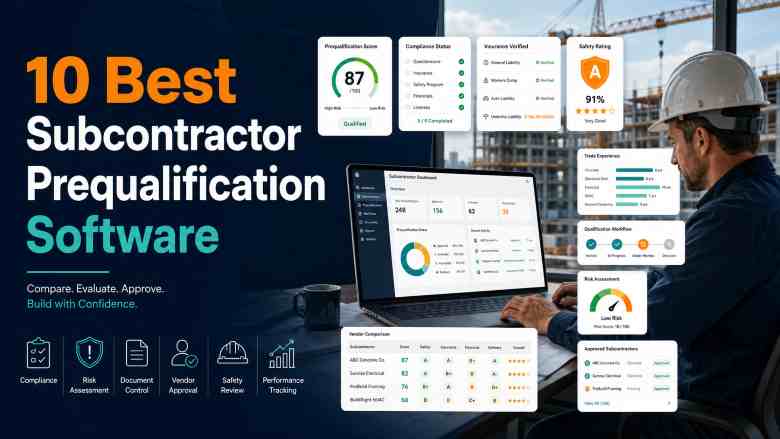
When subcontractors perform over 70 percent of the work on a typical commercial construction project, vetting the wrong trade partner is not a minor setback — it is a direct threat to your schedule, budget, and safety record. Subcontractor prequalification software gives general contractors a structured, data-driven way to evaluate financial health, insurance compliance, safety performance, and licensing before a contract is ever signed. Instead of chasing documents through email threads and tracking expiry dates in spreadsheets, the right platform centralises the entire qualification process — from initial vendor screening to ongoing compliance monitoring. In this guide, we compare the best subcontractor prequalification software platforms for 2026, break down the features that matter most, and walk through a step-by-step framework for choosing the right tool for your construction business.
ConstructionCareerHub App is LIVE — built ONLY for construction careers. Don’t apply with a weak resume.
Get ATS-ready Resume Lab + Interview Copilot + Campus Placement Prep (resume screening, skill gaps, interview readiness) — in minutes & Other advanced features.
Explore Smarter Construction Career Tools →Quick check. Big impact. Start now.
Table of Contents
Quick Answer — What Is the Best Subcontractor Prequalification Software?
The best subcontractor prequalification software for general contractors depends on your firm’s size, primary risk concern, and existing technology stack. For GCs already using Procore, Procore Prequalification offers the tightest workflow integration. For firms where financial default risk is the biggest exposure, PreQual by Vertikal RMS provides expert human financial analyst review on every submission. For enterprises managing large subcontractor networks with a strong safety compliance mandate, Highwire delivers AI-powered safety risk analytics with documented incident reduction ROI. And for GCs whose biggest challenge is subcontractor friction and bidder pool retention, COMPASS by Bespoke Metrics reduces administrative burden through its standardised 1Form approach.
Below, we compare the ten best contractor prequalification software platforms for 2026, break down the features that actually matter, and provide a step-by-step framework for choosing the right tool for your construction business.
What Is Subcontractor Prequalification Software?
Subcontractor prequalification software is a digital platform that automates the evaluation and verification of subcontractors before they are awarded work on a construction project. Instead of collecting financial statements, insurance certificates, safety records, and licences through email and tracking them in spreadsheets, a prequalification platform centralises the entire vetting process in one system.
The software typically handles document collection and storage, financial health analysis, safety performance evaluation (including EMR and TRIR metrics), insurance certificate verification and expiry tracking, licence and certification validation, vendor risk scoring, and compliance monitoring. For a broader look at how subcontractor management fits into the project lifecycle, see our comprehensive guide on subcontractor management in construction.
At its core, prequalification software replaces manual, inconsistent vetting with a standardised, data-driven approach that gives general contractors visibility into the real risk profile of every trade partner in their network.
Why General Contractors Need Subcontractor Prequalification Software in 2026
On any given commercial construction site today, the general contractor’s own workforce typically accounts for less than 30 percent of the labour on the ground. The remaining 70-plus percent is performed by specialised subcontractors — electricians, mechanical crews, concrete finishers, steel erectors, drywall installers, and dozens of other trades whose performance directly determines whether a project ships on time, on budget, and to specification.
This reliance on subcontractors means that a single unqualified or financially unstable trade partner can derail an entire project. Industry research from Trestle indicates that a typical subcontractor default costs general contractors 1.5 to 3 times the original subcontract value when factoring in replacement costs, schedule delays, liquidated damages, surety claims, and operational disruption. On a $500,000 mechanical subcontract, that translates to $750,000 to $1.5 million in total exposure.
The safety dimension is equally critical. According to the U.S. Bureau of Labor Statistics data cited by OSHA, there were 1,034 construction fatalities in 2024. Falls alone accounted for 389 of those deaths. General contractors bear legal and ethical responsibility for jobsite safety, even when the workers involved are employed by subcontractors. Prequalifying subcontractors on safety performance — using metrics like EMR and TRIR — is one of the most effective ways to reduce incident rates before work begins. For deeper context on construction safety management, read our guide on importance of construction safety management.
Beyond default risk and safety, prequalification software addresses several pain points that grow more acute as project complexity increases. Insurance certificates expire without notice, and an expired certificate discovered during an audit — not before a claim — is an unpriced exposure. Licences lapse. A subcontractor with an EMR of 0.9 last year may now carry a 1.8 rating, and nobody updated the record. Manual processes simply cannot keep pace with the volume and velocity of compliance data that general contractors must track across dozens or hundreds of active subcontractor relationships.
Manual vs. Software-Based Subcontractor Prequalification
Understanding the gap between traditional and software-based prequalification helps general contractors quantify the business case for investing in a platform.
| Criteria | Manual Process (Spreadsheets & Email) | Prequalification Software |
|---|---|---|
| Document collection | Email chains, follow-up calls, scattered folders | Automated requests with reminders and status tracking |
| Financial analysis | Limited to what the PM can interpret from the balance sheets | Automated scoring or expert analyst review with risk ratings |
| Insurance tracking | Manual checks, expiry dates are missed frequently | Automated COI verification, renewal alerts, coverage gap detection |
| Safety evaluation | Phone calls to check OSHA logs, inconsistent data | EMR/TRIR tracking, safety score benchmarking, trend analysis |
| Consistency | Varies by person, project, and day | Standardised questionnaires and scoring applied to every subcontractor |
| Audit readiness | Difficult to reconstruct the decision rationale | Complete audit trails with timestamps and decision records |
| Qualification timeline | Weeks of back-and-forth | Days or hours for repeat subcontractors |
| Scalability | Breaks down beyond 20–30 active subcontractors | Designed for hundreds or thousands of vendor relationships |
The operational reality is straightforward. When bid invitations go out via email, responses come back in different formats, and follow-ups happen in separate threads, the preconstruction team spends more time organising information than evaluating it. This coordinator bottleneck delays mobilisation schedules, award dates, and project starts. For a deeper look at how bid management fits into the general contractor workflow, see our guide on how to win construction bids.
Comparison Table — Best Subcontractor Prequalification Software (2026)
Before we examine each platform in detail, here is a side-by-side comparison to help general contractors quickly identify which tools align with their priorities.
| Software | Best For | Standout Strength | Pricing Model | Ideal Company Size |
|---|---|---|---|---|
| Procore Prequalification | Existing Procore users | Seamless bid-to-award workflow integration | Custom quote (ACV-based) | Mid to large GCs |
| Autodesk TradeTapp | Autodesk ecosystem GCs | 250,000+ registered subcontractor network | Custom quote | Mid to large commercial GCs |
| PreQual by Vertikal RMS | Financial default risk reduction | Human financial analyst review | Per-submission ($6–$165/sub) | Mid to large GCs |
| COMPASS (Bespoke Metrics) | Reducing subcontractor friction | Standardised 1Form, Q Score analytics | Custom quote | Mid to large GCs |
| Highwire | Safety compliance and risk analytics | AI-driven safety risk scoring | Custom quote | Large GCs, owners |
| ISNetworld (ISN) | Enterprise contractor management | 70,000+ prequalified contractor database | Contractor-paid + enterprise sub | Enterprise, high-risk sectors |
| Avetta | Supply chain risk management | Global compliance across multiple industries | Custom enterprise pricing | Enterprise, multi-sector |
| Oracle Textura | Oracle construction ecosystem users | Configurable workflows, cross-department collaboration | Custom enterprise pricing | Large enterprise GCs |
| Contractor Compliance | Streamlined contractor onboarding | Cloud-based onboarding and compliance tracking | Custom quote | Small to mid-size GCs |
| Billy for Insurance | Insurance certificate management | Affordable, transparent COI tracking | $3–$30/vendor/year | Small to mid-size GCs |
Best Subcontractor Prequalification Software — Detailed Reviews
1. Procore Prequalification — Best for Existing Procore Users
Procore’s prequalification module lives inside the broader Procore construction management ecosystem, which means prequalification data flows directly into bid invitations, contract awards, and project execution workflows without manual hand-offs. For general contractors already using Procore for project management, adding prequalification requires no new data connectors or separate logins.
Key features: Configurable prequalification questionnaire builder, automated document requests and renewal reminders, bid-to-award workflow integration, centralised subcontractor directory, insurance certificate tracking, safety record collection, and financial document storage.
Why it is useful for general contractors: The real strength of Procore Prequalification is ecosystem connectivity. When a subcontractor completes prequalification, that data is immediately available to the preconstruction team for bid invitations, the contracts team for award processing, and the project team for field execution. This eliminates the duplicate data entry and information silos that plague firms using standalone prequalification tools alongside separate project management platforms.
Pros: Seamless integration with Procore’s project management, financial, and quality modules. Unlimited users on all plans. Strong mobile experience for field teams. Large and active user community. Extensive training resources through Procore University.
Limitations: Limited to one questionnaire template per company, which restricts flexibility for firms that need trade-specific or project-specific prequalification forms. Financial analysis depth is lighter than dedicated platforms — Procore collects financial documents but does not provide the expert-level analysis that specialist tools offer. Pricing is based on annual construction volume, which can be expensive for mid-size firms.
Pricing: Custom quotes based on annual construction volume (ACV). Industry reports suggest pricing starts around $375/month for smaller firms, with large enterprises paying significantly more. All plans include unlimited users and storage.
Ideal user: Mid-to-large general contractors already on Procore who want to add prequalification without introducing another vendor into their tech stack.
Website: procore.com/prequalification
For a broader look at how Procore fits into the construction technology ecosystem, see our guide on best construction software to learn for career growth.
2. Autodesk TradeTapp (BuildingConnected) — Best for Autodesk Ecosystem GCs
TradeTapp, now part of Autodesk Construction Cloud (ACC), is one of the most widely deployed prequalification platforms among mid-to-large commercial general contractors. It combines prequalification with bid management through the BuildingConnected network, giving GCs access to over 250,000 registered subcontractors.
Key features: Financial metric evaluation including revenue trends, backlog capacity, and credit data. Safety performance benchmarking with EMR tracking. Customisable qualification workflows with collaborative decision tools. Access to the BuildingConnected subcontractor network for bid invitations. Integration with Autodesk Construction Cloud for BIM-to-field workflows.
Why it is useful for general contractors: TradeTapp’s combination of prequalification and bid management in a single platform is a significant efficiency gain. Instead of prequalifying subcontractors in one system and then inviting bids through another, the entire preconstruction workflow — from initial vendor screening to bid levelling to contract award — can happen within the Autodesk ecosystem.
Pros: Large subcontractor network reduces cold outreach. Strong financial and safety benchmarking tools. Native integration with ACC for design-build and BIM-centric firms. Collaborative review workflows allow multiple stakeholders to evaluate subcontractors.
Limitations: Works best within the Autodesk ecosystem; interoperability with non-Autodesk tools can be limited. Some users report that the interface has a learning curve for smaller teams. Financial analysis, while solid, relies on automated scoring rather than human expert review.
Pricing: Custom quote-based. Contact Autodesk for current pricing.
Ideal user: Mid-to-large commercial GCs already using Autodesk Construction Cloud who want prequalification and bid management in a single, integrated platform.
Website: construction.autodesk.com
3. PreQual by Vertikal RMS — Best for Financial Default Risk Reduction
PreQual by Vertikal RMS takes a fundamentally different approach to financial prequalification. Instead of relying solely on automated algorithms to score financial statements, every financial submission goes through a review by human financial analysts who examine balance sheets, income statements, and credit data with professional judgement. This makes PreQual the strongest option when financial default risk is the primary concern.
Key features: Expert financial analyst review of every submission. Risk assessment covering financial stability, credit history, and bonding capacity. Integration with CertFocus (also by Vertikal RMS) for certificate of insurance (COI) verification and management. Customisable prequalification workflows. Risk scoring and vendor ratings.
Why it is useful for general contractors: Most prequalification platforms collect financial documents and run them through automated scoring algorithms. The challenge is that construction financial statements are complex — current ratios, working capital trends, backlog-to-capacity ratios, and bonding utilisation all require contextual interpretation that automated tools frequently miss. PreQual addresses this gap by putting experienced analysts on every review.
Pros: Highest depth of financial analysis among prequalification platforms. Human analyst review catches nuances that automated scoring misses. CertFocus integration covers the full compliance cycle (financial analysis plus insurance tracking). Clients typically report positive ROI through risk reduction and time savings.
Limitations: Specialist platform focused on financial analysis and COI tracking — does not offer the full project management integration of Procore or the bid management capabilities of TradeTapp. May require pairing with a separate bid management tool for complete preconstruction coverage.
Pricing: Self-service plans start at approximately $6 per subcontractor per year. Full analyst review runs $30 to $165 per submission, depending on the depth of analysis required.
Ideal user: General contractors and project owners managing high-value projects where a single subcontractor default could cause significant financial damage, and who need expert-level financial analysis that goes beyond automated scoring.
Website: vertikalrms.com
4. COMPASS by Bespoke Metrics — Best for Reducing Subcontractor Friction
COMPASS is a prequalification platform designed to reduce the administrative burden that traditional prequalification places on subcontractors. Its standout feature is the standardised 1Form — a prequalification application that subcontractors complete once and can reuse across any general contractor using the COMPASS network. This addresses one of the biggest pain points in construction procurement: subcontractors abandoning bid opportunities because each GC requires a different, time-consuming prequalification process.
Key features: Standardised 1Form prequalification application. Q Score analytics for data-driven vendor risk assessment. Pre-qualified subcontractor network access. COMPASS SRP for subcontractor risk management. COMPASS Eval for internal review tracking. Data Control module for secure data sharing.
Why it is useful for general contractors: Bidder pool retention is a growing challenge for general contractors. When prequalification is burdensome, smaller and mid-size subcontractors — often the most competitive bidders — simply skip the process. COMPASS solves this by making prequalification a one-time effort for subcontractors, which increases bid participation rates and gives GCs access to a wider, more competitive trade partner pool.
Pros: Dramatically reduces subcontractor administrative burden. Q Score provides transparent, data-driven risk analytics. Grows the available bidder pool by lowering barriers to entry. Allows subcontractors to manage their own data.
Limitations: Effectiveness depends on network adoption — the 1Form’s value increases as more GCs join the platform. Financial analysis depth is not as granular as specialist platforms like PreQual by Vertikal RMS.
Pricing: Custom quote-based. Contact Bespoke Metrics for current pricing.
Ideal user: General contractors whose biggest prequalification challenge is subcontractor friction, low bid participation, or maintaining a large and diverse trade partner database.
Website: bespokemetrics.com
5. Highwire — Best for Safety Compliance and Risk Analytics
Highwire is purpose-built for safety compliance and contractor risk management. Originally developed as a risk assessment system at Harvard University, Highwire now operates as an independent platform serving owners, general contractors, and facilities managers who need to assess and mitigate risks related to safety, financial stability, quality, and sustainability throughout project lifecycles.
Key features: AI-driven safety risk analytics. Dynamic prequalification assessments that tailor questions based on trade, scope, and project location. Continuous monitoring and real-time compliance updates. Project-specific risk scoring. Insurance verification and tracking. Integration with major construction management platforms.
Why it is useful for general contractors: Highwire’s dynamic assessment approach means subcontractors only answer questions relevant to their specific trade and project scope, which reduces completion time and improves data quality. The AI-powered safety risk analytics go beyond static EMR checks to provide predictive risk insights based on historical patterns and industry benchmarks.
Pros: Strongest safety risk analytics in the prequalification category. Dynamic assessments improve subcontractor experience and data relevance. Documented ROI in incident reduction. Strong adoption among owners and infrastructure clients where safety metrics carry the most weight.
Limitations: Primarily oriented toward safety and compliance — financial analysis depth is not as deep as PreQual by Vertikal RMS. Enterprise pricing may be less accessible for smaller GC firms.
Pricing: Custom enterprise pricing. Contact Highwire for quotes.
Ideal user: Large general contractors, project owners, and facilities managers where safety performance is a primary evaluation criterion and incident reduction has a measurable impact on project outcomes. Particularly strong for firms operating in high-risk environments. For more on safety best practices, see our guide on health and safety in construction.
Website: highwire.com
6. ISNetworld (ISN) — Best for Enterprise Contractor Management
ISNetworld is one of the longest-established contractor management platforms, with a repository of over 70,000 prequalified contractors. It serves as a comprehensive compliance verification and risk assessment platform for enterprises across construction, oil and gas, manufacturing, and other high-risk industries.
Key features: Extensive compliance verification including safety audits, insurance tracking, and training management. Performance grading system (Silver, Gold) based on rigorous audits. Real-time monitoring and auditing capabilities. Advanced analytics, reporting, and integration with ERP and PM systems. OSHA log verification and injury tracking.
Why it is useful for general contractors: ISNetworld’s scale is its primary advantage. For enterprise GCs managing large subcontractor networks across multiple regions and project types, ISN provides a single platform for ongoing compliance monitoring — not just initial prequalification. The platform’s third-party verification processes (rather than relying solely on self-reported data) add an additional layer of trust to the qualification process.
Pros: Largest prequalified contractor database in the industry. Rigorous third-party verification processes. Strong analytics and reporting. Proven track record with enterprise clients across multiple industries.
Limitations: Steep learning curve and complex interface for new users. Lengthy onboarding process for subcontractors to achieve full prequalification status. Contractor-paid model means subcontractors bear significant registration fees, which can reduce bidder pool participation among smaller trade partners.
Pricing: Custom enterprise subscription starting at approximately $5,000 or more annually for the hiring client. Subcontractor registration fees typically range from $875 to $1,000+ per year depending on services selected.
Ideal user: Enterprise-level general contractors in high-risk sectors who need robust, scalable subcontractor vetting and ongoing compliance monitoring across large vendor networks.
Website: isnetworld.com
7. Avetta — Best for Global Supply Chain Compliance
Avetta is a supply chain risk management platform that helps construction and industrial companies manage contractor compliance, safety, and sustainability across global operations. While it serves multiple industries, Avetta’s construction capabilities include prequalification, insurance verification, safety management, and workforce qualification tracking.
Key features: Contractor compliance management across multiple regulatory environments. Insurance certificate verification and tracking. Safety prequalification and audit management. Workforce qualification tracking. ESG and sustainability compliance monitoring. Multi-language and multi-jurisdictional support.
Why it is useful for general contractors: For GCs operating across international markets — particularly those with projects spanning the US, Middle East, Europe, and Asia-Pacific — Avetta’s global compliance capabilities are a strong fit. The platform handles the complexity of varying regulatory requirements across jurisdictions, which is increasingly important as construction companies expand their geographic footprint.
Pros: Strong global compliance capabilities. Multi-industry coverage provides flexibility. Comprehensive contractor lifecycle management. ESG monitoring for sustainability-focused clients.
Limitations: Primarily oriented toward enterprise clients with large supply chains. Not as construction-specific as platforms like Procore or TradeTapp. Pricing is geared toward large organisations.
Pricing: Custom enterprise pricing. Contact Avetta for quotes.
Ideal user: Large construction companies and EPC firms with global operations that need contractor compliance management across multiple countries and regulatory environments.
Website: avetta.com
8. Oracle Textura Pre-Qualification Management — Best for Oracle Ecosystem
Oracle Textura Pre-Qualification Management Cloud Service automates the subcontractor prequalification process within the broader Oracle Construction and Engineering ecosystem. For general contractors already invested in Oracle’s construction technology stack (including Oracle Primavera for scheduling and Oracle Aconex for document management), Textura provides a tightly integrated prequalification solution.
Key features: Configurable prequalification workflows. Centralised data storage for subcontractor compliance documents. Automated tracking and expiry management. Cross-departmental collaboration tools for prequalification reviews. Integration with Oracle Construction and Engineering suite. Ongoing prequalification with automatic expirations and renewal triggers.
Why it is useful for general contractors: Oracle’s construction technology suite is widely used among large infrastructure contractors, EPC firms, and government-funded project clients. Textura brings prequalification into this ecosystem, allowing data to flow between scheduling (Primavera), document management (Aconex), and vendor qualification without manual transfers.
Pros: Deep integration with Oracle Construction and Engineering products. Enterprise-grade security and scalability. Configurable workflows support complex, multi-stage prequalification processes. Strong cross-departmental collaboration features.
Limitations: Most valuable within the Oracle ecosystem — less compelling as a standalone prequalification tool. Enterprise complexity and pricing may be prohibitive for smaller firms. Implementation typically requires Oracle partner support.
Pricing: Custom enterprise pricing. Contact Oracle for quotes.
Ideal user: Large infrastructure contractors and EPC firms already using Oracle Primavera, Aconex, or other Oracle construction products who want prequalification integrated into their existing technology stack. For broader context on construction scheduling tools, see our construction scheduling software comparison.
Website: oracle.com/industries/construction-engineering
9. Contractor Compliance — Best for Streamlined Contractor Onboarding
Contractor Compliance is a cloud-based platform that focuses on simplifying the contractor onboarding and prequalification process. It is designed for construction companies that need an efficient way to collect registration documents, track worker qualifications, and manage compliance without the complexity and cost of enterprise platforms.
Key features: Digital contractor onboarding workflows. Document collection and centralised storage. Worker qualification and status tracking. Compliance monitoring with automated alerts. Custom prequalification forms. Reporting and analytics.
Why it is useful for general contractors: Not every GC needs an enterprise-grade platform with AI-driven analytics. For mid-size general contractors managing 50 to 200 active subcontractor relationships, Contractor Compliance provides the essential prequalification and compliance tracking capabilities without the overhead of larger platforms.
Pros: Simple, focused feature set. Lower complexity compared to enterprise platforms. Effective for mid-size contractor onboarding workflows. Cloud-based with mobile accessibility.
Limitations: Lacks the advanced financial analysis, safety scoring, and large subcontractor network features of dedicated prequalification platforms. May not scale well for enterprise-level operations.
Pricing: Custom quote-based. Contact Contractor Compliance for current pricing.
Ideal user: Small to mid-size general contractors looking for a straightforward, affordable contractor onboarding and compliance tracking solution.
10. Billy for Insurance — Best for Affordable COI Tracking
Billy focuses specifically on contractor insurance certificate management — the single most common compliance gap at GC firms of all sizes. It automates the collection, verification, and renewal tracking of general liability, workers’ compensation, umbrella, and other insurance documents for every subcontractor and vendor in a GC’s database.
Key features: Automated COI collection and verification. Renewal tracking with expiry alerts. Coverage gap detection. Self-service and full-service (AI plus human review) options. Transparent, published pricing. Integration with construction management platforms.
Why it is useful for general contractors: Insurance compliance is often the weakest link in manual prequalification processes. Certificates expire, coverage limits change, and additional insured endorsements get missed. Billy addresses this specific problem at a price point that makes it accessible to GCs of all sizes — including small firms that cannot justify the cost of enterprise prequalification platforms.
Pros: Most affordable option in the prequalification category. Transparent, published pricing. Focused, effective COI management. Low friction for subcontractors.
Limitations: Does not provide financial analysis, safety scoring, or comprehensive prequalification capabilities. Best used as a complement to a broader prequalification process, not a replacement for full-platform tools.
Pricing: Self-service plans start at approximately $3 to $10 per vendor per year. Full-service (AI plus human review) runs $10 to $30 per vendor per year.
Ideal user: Small to mid-size general contractors who need affordable, focused insurance certificate management. Also works as a complement to platforms that handle financial and safety prequalification but lack deep COI tracking. For more on insurance in construction, see our builder’s risk insurance guide.
Quick check. Big impact. Use ConstructionCareerHub.com to assess your readiness for procurement, contracts, and project management roles. The Resume Lab identifies skill gaps. The Interview Copilot prepares you for behavioural and technical questions. Start now.
Key Features General Contractors Should Compare
Not all prequalification platforms solve the same problem. The features that matter most depend on your firm’s primary risk exposure, project types, and existing technology stack. Here are the capabilities that should drive your evaluation.
Financial analysis depth: The difference between platforms is significant. Some collect financial documents and store them. Others run automated algorithms to generate risk scores. The most thorough platforms (like PreQual by Vertikal RMS) put human financial analysts on every review. The right level depends on the dollar value of your subcontracts and your firm’s in-house financial analysis capability.
Safety performance evaluation: At minimum, the platform should track EMR (Experience Modification Rate) and TRIR (Total Recordable Incident Rate). More advanced platforms like Highwire provide predictive safety analytics that go beyond static historical metrics to assess project-specific risk based on trade, scope, and location.
Insurance certificate management: Look for automated COI collection, verification against your coverage requirements, expiry alerts, and coverage gap detection. This is the compliance area where manual processes fail most often — and where a missed expiration can create uninsured exposure on an active project.
Questionnaire flexibility: Can you create different prequalification forms for different trades, project types, or risk levels? Platforms limited to a single questionnaire template force a one-size-fits-all approach that either over-qualifies low-risk vendors or under-qualifies high-risk ones.
Integration with existing systems: Prequalification does not exist in isolation. Data needs to flow into bid management, contract administration, project management, and accounting systems. Evaluate how tightly the platform integrates with your existing construction project management software and construction accounting software.
Vendor risk scoring: A composite risk score that weighs financial health, safety performance, insurance compliance, licensing status, and past project performance gives the preconstruction team a quick, objective basis for qualification decisions. Look for platforms that allow you to customise scoring weights based on your firm’s risk priorities.
Document management and audit trails: Every prequalification decision should be traceable. The platform should maintain a complete record of what was submitted, when, who reviewed it, and what decision was made. This is essential for internal governance, owner audits, and legal protection. For broader document management best practices, see our construction document management guide.
Subcontractor experience: Prequalification platforms that are burdensome for subcontractors shrink your bidder pool. Evaluate the subcontractor-facing experience — how long does the form take to complete, can data be reused across multiple GCs, and what is the cost to the subcontractor.
Subcontractor Risk Scoring Explained
Risk scoring is the quantitative engine behind modern prequalification software. Rather than relying on subjective judgements about whether a subcontractor “seems solid,” risk scoring assigns a numerical or categorical rating based on measurable criteria.
A typical risk scoring framework evaluates subcontractors across several dimensions. Financial stability includes metrics like current ratio, working capital, debt-to-equity ratio, revenue trends, bonding capacity, and credit history. Safety performance encompasses EMR, TRIR, DART rate (Days Away, Restricted, or Transferred), number and severity of OSHA citations, and safety programme maturity. Insurance compliance covers active coverage verification, limits adequacy relative to project requirements, additional insured endorsements, and certificate currency. Operational capacity includes current backlog relative to bonding capacity, workforce availability, equipment resources, geographic coverage, and relevant project experience.
Advanced platforms weight these dimensions based on the GC’s priorities. A contractor working on a hospital project may weight safety performance at 40 percent, financial stability at 30 percent, and insurance compliance at 20 percent. The same contractor on a low-rise commercial fit-out might weight financial stability more heavily. The ability to customise scoring weights — and apply them consistently across every subcontractor evaluation — is a core advantage of software-based prequalification over manual processes.
How Prequalification Software Improves Bid Decisions
Prequalification and bid management are not separate workflows — they are sequential steps in the same preconstruction pipeline. The quality of your bid decisions is directly limited by the quality of your prequalification data.
When prequalification data is current, comprehensive, and accessible, the preconstruction team can make faster and more confident bid invitation decisions. They know which subcontractors are pre-approved for specific trade scopes, which vendors have expiring insurance that needs renewal before a bid can be accepted, and which firms have the financial capacity and backlog room to take on a new project.
This is especially valuable during competitive bid cycles where the preconstruction team is managing multiple concurrent pursuits. Rather than spending days collecting and verifying subcontractor credentials for each bid opportunity, the team can draw from a pre-qualified vendor database and focus their energy on scope evaluation, pricing analysis, and negotiation. For a comprehensive look at bid management strategies, see our guide on how to win construction bids in 2026.
Benefits of Subcontractor Prequalification Software for General Contractors
The business case for prequalification software is built on risk reduction, operational efficiency, and compliance assurance — all of which have measurable financial impact.
Reduced subcontractor default risk: By systematically evaluating financial health before awarding contracts, GCs can identify and avoid subcontractors who lack the financial capacity to complete their scope. One prevented default can pay for years of platform costs.
Improved safety outcomes: Prequalifying subcontractors on safety performance — and continuously monitoring safety metrics — helps GCs build project teams with proven safety cultures. According to OSHA data, companies that invest in safety programmes see returns of $4 to $6 for every $1 invested.
Insurance compliance assurance: Automated certificate tracking eliminates the risk of having uninsured subcontractors on active projects — a gap that can expose the GC to significant liability if an incident occurs.
Faster preconstruction cycles: Automated document collection and pre-qualified vendor databases reduce the time from bid invitation to contract award, helping projects start on schedule.
Consistent evaluation standards: Every subcontractor is assessed against the same criteria, eliminating the inconsistency that comes with different project managers applying different standards.
Audit readiness: Complete digital records of prequalification decisions, supporting documents, and approval workflows satisfy internal governance requirements and owner audit demands.
Competitive bidding advantage: GCs who prequalify efficiently attract and retain better subcontractors, leading to more competitive pricing and higher-quality project delivery.
Best Prequalification Software by Company Size
Best for Small General Contractors (Under $25M Annual Revenue)
Small GCs typically manage 20 to 50 active subcontractor relationships and need affordable, focused tools without enterprise complexity. Billy for Insurance provides the most critical compliance function — COI tracking — at $3 to $10 per vendor per year. Paired with Contractor Compliance for broader onboarding workflows, small GCs can build effective prequalification processes without enterprise budgets.
Best for Mid-Size General Contractors ($25M–$250M Annual Revenue)
Mid-size GCs managing 50 to 300 subcontractor relationships need platforms that balance capability with cost. COMPASS by Bespoke Metrics is strong for firms focused on bidder pool retention. Procore Prequalification is the natural choice for firms already on Procore. TradeTapp offers excellent preconstruction workflow coverage for firms in the Autodesk ecosystem.
Best for Enterprise General Contractors ($250M+ Annual Revenue)
Enterprise GCs managing hundreds or thousands of subcontractor relationships across multiple regions need scalable, deeply analytical platforms. ISNetworld provides the largest pre-qualified contractor database. Highwire delivers the deepest safety risk analytics. PreQual by Vertikal RMS provides the most thorough financial analysis. Oracle Textura integrates tightly with enterprise Oracle construction ecosystems. For a broader look at enterprise-grade construction technology, see our best construction management software guide for 2026.
Step-by-Step Selection Guide for General Contractors
Choosing the right prequalification platform is a business strategy decision, not just a technology purchase. Here is a practical framework for making the right choice.
Step 1 — Identify your primary risk exposure. Is your biggest concern financial default risk? Safety incidents? Insurance compliance gaps? Subcontractor friction reducing your bidder pool? The answer determines which platform category to prioritise.
Step 2 — Map your existing technology stack. List every system your prequalification tool must integrate with — project management, accounting, scheduling, document control, ERP. Integration gaps are the most common cause of platform implementation failures.
Step 3 — Assess your subcontractor volume. A GC managing 30 subcontractors has different needs than one managing 500. Enterprise platforms are overkill for small firms, and lightweight tools break down at enterprise scale.
Step 4 — Evaluate the subcontractor experience. Request a demo from the subcontractor’s perspective, not just the GC administrator’s. How long does it take to complete the prequalification form? Can data be reused? What are the costs to the subcontractor? Platforms that frustrate your trade partners ultimately hurt your competitive position.
Step 5 — Calculate total cost of ownership. Include platform subscription fees, implementation costs, training time, ongoing administration, and any costs passed to subcontractors. Compare this against the cost of a single subcontractor default or insurance compliance failure.
Step 6 — Run a pilot project. Before committing to an annual contract, deploy the platform on a single live project. Involve your project managers, preconstruction team, and IT staff. Measure adoption rates, time savings, and user satisfaction before signing a long-term agreement. For a broader framework on evaluating construction software, see our guide on general contractor software.
Implementation Checklist for General Contractors
Successful implementation of prequalification software requires more than purchasing a licence. Use this checklist to ensure a smooth rollout.
Pre-implementation: Define your prequalification criteria and scoring weights before configuring the platform. Document your current process (including pain points) so you can measure improvement. Identify an internal champion — typically someone from preconstruction, procurement, or risk management — who will own the rollout. Establish data migration requirements for existing subcontractor records.
Configuration: Build your prequalification questionnaires, starting with a general form and adding trade-specific or project-specific variants as needed. Configure insurance requirements (coverage types, minimum limits, additional insured requirements) by project type. Set up automated document collection workflows and expiry alerts. Define user roles and approval workflows. Test integration with your existing construction project management software.
Rollout: Train your internal team before inviting subcontractors to the platform. Communicate the change to your subcontractor base with clear instructions and a timeline. Start with a pilot group of 10 to 20 subcontractors to identify issues before full-scale deployment. Set expectations — prequalification data takes time to accumulate, and the platform’s value compounds as your vendor database grows.
Ongoing management: Assign responsibility for monitoring document expirations and following up on incomplete submissions. Review and update prequalification criteria annually based on lessons learned. Track platform adoption metrics and gather user feedback for continuous improvement.
Common Mistakes When Selecting Prequalification Tools
General contractors frequently make avoidable mistakes during the prequalification software evaluation process. Here are the most common pitfalls and how to avoid them.
Choosing based on features alone without evaluating integration. A platform with impressive features that does not integrate with your existing project management, accounting, or ERP systems creates data silos and duplicate work. Integration capability should be a top-three evaluation criterion.
Ignoring the subcontractor experience. Platforms that are easy for the GC administrator but frustrating for subcontractors will shrink your bidder pool over time. The best prequalification process is one that qualified subcontractors actually complete.
Over-specifying requirements for your firm’s current stage. A 15-person GC doing $20M in annual revenue does not need an enterprise platform designed for ENR Top 100 firms. Start with a tool that matches your current scale and upgrade as your business grows.
Confusing document storage with risk analysis. Some platforms excel at collecting and storing subcontractor documents but do not actually analyse the data to generate meaningful risk insights. If your primary goal is risk reduction (not just document collection), evaluate the depth and quality of the platform’s analytical capabilities.
Failing to account for ongoing administration costs. The platform subscription is only one component of total cost. Factor in the time required for internal staff to manage the system, follow up on incomplete submissions, and maintain data quality. For insights on procurement and tendering processes in construction, see our detailed guide.
The Future of AI in Subcontractor Prequalification
Artificial intelligence is reshaping how general contractors evaluate and select trade partners. Several trends are already visible in the prequalification software market, and their impact will accelerate through 2026 and beyond.
Predictive default modelling: AI models trained on historical subcontractor performance data are beginning to predict default risk before traditional financial indicators would flag a problem. By analysing patterns across revenue trends, backlog growth rates, payment behaviour, and market conditions, these models can provide early warning signals months before a subcontractor reaches financial distress.
Dynamic safety risk assessment: Platforms like Highwire are already using AI to move beyond static EMR tracking toward project-specific safety risk predictions that consider trade type, geographic location, project complexity, and historical incident patterns. This allows GCs to apply risk-appropriate prequalification standards rather than one-size-fits-all criteria.
Automated document processing: Natural language processing (NLP) is being applied to automatically extract key data from financial statements, insurance certificates, and safety reports — reducing the manual data entry burden and improving accuracy. For more on how AI is transforming construction workflows, see our guide on best AI tools for construction project teams.
Continuous qualification monitoring: Rather than prequalifying subcontractors once and re-evaluating annually, AI-powered platforms are moving toward continuous monitoring that automatically alerts GCs when a subcontractor’s risk profile changes — a new OSHA citation, a credit downgrade, a bonding capacity reduction, or an insurance lapse.
Network intelligence: As more GCs adopt prequalification platforms, the aggregate data across vendor networks becomes increasingly valuable. Platforms can benchmark subcontractor performance across the industry, flag vendors with deteriorating performance trends, and identify high-performing trade partners that a specific GC may not have worked with previously.
These capabilities do not replace the human judgment that experienced preconstruction professionals bring to vendor selection. They augment it — providing data-driven insights that help GCs make faster, more informed decisions about which subcontractors to trust with their projects. The construction technology landscape is evolving rapidly, and keeping current with technology trends in construction management is essential for a competitive advantage.
Career Relevance for Construction Professionals
Proficiency in subcontractor prequalification software is increasingly relevant for several construction career paths. Procurement managers oversee the sourcing, prequalification, and onboarding of subcontractors and suppliers — making prequalification software a core tool for this role. Contracts managers and contract administrators manage subcontract agreements, compliance requirements, and commercial risk, all of which intersect with prequalification workflows. Preconstruction managers and estimators use prequalification data to inform bid decisions and subcontractor selection during the preconstruction phase.
Project managers benefit from understanding prequalification data because it directly impacts project risk, schedule reliability, and safety outcomes. Risk management professionals in larger GC firms use prequalification analytics to identify and mitigate portfolio-level vendor risk. For professionals looking to build expertise in these areas, the following courses provide relevant foundations.
Recommended courses:
- Construction Project Management — Coursera
- Construction Management Professional Certificate — edX
- Contract Management Essentials — Coursera
- Construction Risk Management — Udemy
For construction professionals looking to build a stronger career foundation across digital construction skills, procurement roles, and project management careers, explore the career tools at ConstructionCareerHub.com. The Resume Lab helps you build an ATS-optimised resume highlighting software proficiency. The Interview Copilot prepares you for behavioural and technical interview questions in procurement, contract administration, and project management roles.
You can also explore these career-focused resources:
- The Great Construction Career — Career Blueprint Ebook
- Construction Interview Mastery Guide
- Complete Construction Career Kit (Bundle)
- Remote Construction Jobs Guide
For further career context, see our guides on becoming a certified construction manager and the phases of the construction project life cycle.
Final Recommendation
There is no single “best” subcontractor prequalification software — the right choice depends on your firm’s specific risk profile, technology stack, and operational priorities. Here is a practical decision framework.
If you are already on Procore: Start with Procore Prequalification. The integration value alone is worth evaluating before introducing another platform.
If financial default risk is your primary concern: PreQual by Vertikal RMS provides the deepest financial analysis with human expert review on every submission.
If safety compliance drives your prequalification requirements: Highwire delivers the strongest safety risk analytics with documented ROI in incident reduction.
If subcontractor friction and bidder pool retention is your biggest challenge: COMPASS by Bespoke Metrics reduces administrative burden through its standardised 1Form approach.
If you need enterprise-scale contractor management, ISNetworld provides the largest pre-qualified contractor database with rigorous third-party verification.
If you are a small GC and need affordable insurance compliance, Billy for Insurance offers focused COI tracking at the lowest price point in the category.
Whichever platform you choose, the key is to start. Manual prequalification processes do not scale, they miss critical compliance gaps, and they create inconsistent evaluation standards that let risky subcontractors through. Even a basic prequalification platform delivers more consistency, visibility, and protection than spreadsheets and email chains. For a comprehensive view of the construction management software landscape, explore our construction management software guide for builders and contractors.
Ready to level up your construction career? Whether you’re targeting procurement, contract administration, or project management roles, ConstructionCareerHub.com gives you the tools to compete. ATS-ready Resume Lab + Interview Copilot + Career Planner — designed exclusively for construction professionals.
Explore Smarter Construction Career Tools →
Frequently Asked Questions
What is subcontractor prequalification software?
Subcontractor prequalification software is a digital platform that automates the evaluation and verification of subcontractors before they are awarded work on a construction project. It collects, organises, and analyses financial statements, insurance certificates, safety records, licences, bonding capacity, and past project experience to help general contractors identify qualified trade partners and avoid high-risk vendors.
Why do general contractors need subcontractor prequalification software?
General contractors need prequalification software because manual vetting processes using spreadsheets and email are slow, inconsistent, and prone to gaps. A single subcontractor default can cost 1.5 to 3 times the original subcontract value. Prequalification software standardises evaluation criteria, automates document collection and expiry alerts, and provides data-driven risk scoring to reduce project risk.
What is the best overall subcontractor prequalification software in 2026?
The best overall platform depends on your firm’s size and primary risk concern. For GCs already using Procore, Procore Prequalification offers seamless workflow integration. For firms where financial default risk is the primary concern, PreQual by Vertikal RMS provides expert human financial analyst review. For enterprises focused on safety compliance, Highwire delivers AI-powered safety risk analytics.
How much does subcontractor prequalification software cost?
Pricing varies significantly by platform and model. GC-paid subscription models typically range from $3,000 to $15,000 per year based on project volume and user count. Contractor-paid models shift costs to subcontractors, typically $875 to $1,000+ per year. Some platforms offer per-submission pricing (PreQual by Vertikal RMS starts at $6 per subcontractor per year for self-service). Most enterprise platforms require custom quotes.
What features should general contractors look for in prequalification software?
Key features include financial analysis capabilities, safety record evaluation (EMR and TRIR tracking), insurance certificate management with automated expiry alerts, customisable prequalification questionnaires, vendor risk scoring, integration with existing construction management software, document management with audit trails, and reporting dashboards.
What is the difference between EMR and TRIR in subcontractor prequalification?
EMR (Experience Modification Rate) compares a company’s workers’ compensation claims history to the industry average — 1.0 is average, below 1.0 is better. TRIR (Total Recordable Incident Rate) measures OSHA-recordable injuries and illnesses per 200,000 hours worked. Both are standard metrics used by general contractors to evaluate subcontractor safety performance during prequalification.
Can prequalification software integrate with construction management platforms like Procore?
Yes, most modern prequalification platforms offer integration with major construction management software. Procore has its own built-in prequalification module. TradeTapp integrates natively within Autodesk Construction Cloud. Highwire, COMPASS, and PreQual by Vertikal RMS offer API integrations with various ecosystems. Integration allows prequalification data to flow into bid invitations, contract awards, and project execution workflows.
What is subcontractor risk scoring?
Subcontractor risk scoring is a quantitative assessment method used by prequalification software to assign a rating based on financial stability, safety performance, insurance compliance, licensing status, bonding capacity, and past project experience. Risk scores help general contractors make objective, data-driven decisions about subcontractor selection and contract awards.
Related reading on ConstructionPlacements.com:
- Subcontractor Management in Construction: Best Practices 2026
- Best Construction Management Software Guide 2026
- Best Construction Analytics and Dashboard Tools for Project Controls
- Best Common Data Environment (CDE) Platforms for Construction
- Construction Data: How It’s Revolutionising the Industry in 2026
- Best Jobsite Communication Apps for Construction Teams
- Top Estimating Software for Construction
- Mastering Construction Analytics
