
Last Updated on May 29, 2026 by Admin
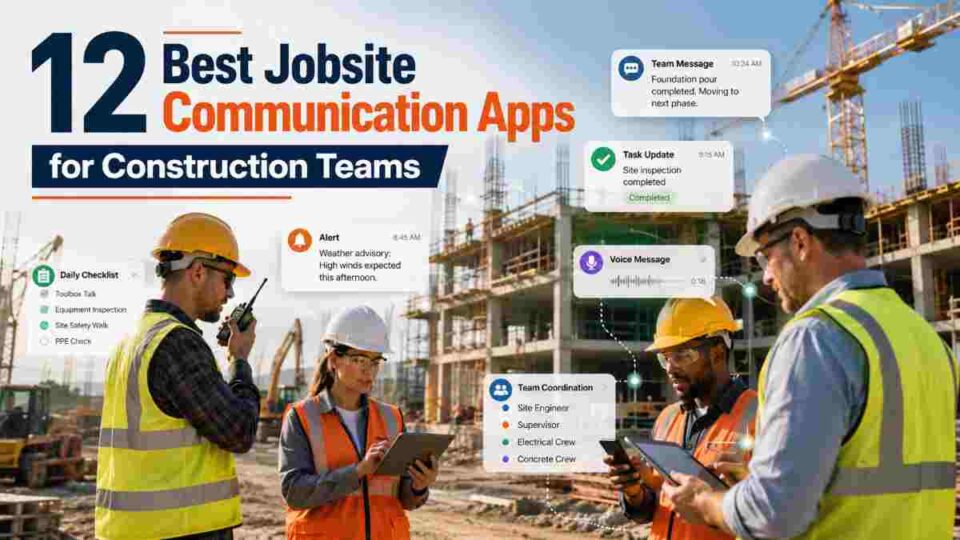
Missed messages on a construction site don’t just cause confusion — they cause rework, safety incidents, and budget overruns. According to a 2024 FMI report, poor communication and misaligned project data cost the U.S. construction industry over $31 billion annually. In 2026, with projects growing more complex, distributed crews working across multiple sites, and subcontractor coordination becoming a daily headache, having the right jobsite communication app isn’t optional — it’s operational infrastructure.
ConstructionCareerHub App is LIVE — built ONLY for construction careers. Don’t apply with a weak resume.
Get ATS-ready Resume Lab + Interview Copilot + Campus Placement Prep (resume screening, skill gaps, interview readiness) — in minutes & Other advanced features.
Explore Smarter Construction Career Tools →Quick check. Big impact. Start now.
Whether you’re a general contractor coordinating 15 subcontractors, a superintendent running daily standups from the trailer, or a project manager tracking RFIs from the office, the tools you use to communicate can make or break your project timelines. But here’s the problem: “communication” in construction isn’t one thing. It’s real-time crew updates, document sharing, safety alerts, daily logs, photo markup, task assignments, and multilingual coordination — all happening simultaneously.
This guide breaks down 12 of the best jobsite communication apps for construction teams in 2026, covering their key features, pricing, ideal use cases, and practical limitations so you can choose the right tool for how your team actually works.
Don’t apply with a weak resume. Get ATS-ready with Resume Lab + Interview Copilot + Career Planner — built only for construction careers. Explore smarter construction career tools →
Table of Contents
Why Jobsite Communication Apps Matter More Than Ever in 2026
Construction has long been one of the least digitized industries globally. But the gap between digitally mature firms and those still relying on phone calls and paper logs is widening fast. The companies adopting purpose-built communication tools are seeing measurable returns in project delivery, safety compliance, and labor retention.
Here’s why jobsite communication has become a critical priority:
- Labor shortages demand efficiency: With the Associated General Contractors of America (AGC) reporting that 94% of construction firms struggled to fill positions in 2025, teams must accomplish more with fewer people. Eliminating communication gaps means less rework and fewer wasted hours.
- Safety compliance is tightening: OSHA‘s 2026 enforcement priorities emphasize documented safety communication. Digital records of toolbox talks, hazard alerts, and incident reports create an audit trail that paper cannot match.
- Remote and multi-site management is the norm: Superintendents and project managers frequently oversee two or three projects simultaneously. Real-time visibility into each jobsite’s status is essential.
- Multilingual crews need inclusive tools: Construction crews in the U.S., Gulf countries, and parts of Europe are increasingly multilingual. Apps with built-in translation and visual communication features bridge language barriers that text-heavy emails cannot.
If you’re working in construction project management, understanding these tools isn’t just a tech question — it’s a career competency.
How We Evaluated These Jobsite Communication Apps
Every app on this list was assessed across six criteria that matter most to construction teams working in the field:
- Mobile-first design: Does the app work smoothly on a phone or tablet with dirty fingers and a cracked screen protector? If a tool was designed for desktops and adapted for mobile, it scored lower.
- Real-time messaging and alerts: Can crews send and receive urgent updates without delay? Push notifications, in-app chat, and SMS fallback were all considered.
- Document and photo sharing: Construction communication isn’t just text. The ability to share annotated photos, drawings, daily logs, and inspection reports within the same platform is critical.
- Ease of adoption: A tool is only effective if your crew actually uses it. Intuitive interfaces and minimal training requirements scored higher.
- Integration ecosystem: Does the app connect with scheduling software, accounting systems, and other construction management platforms your team already uses?
- Pricing transparency and scalability: Apps with clear pricing, per-user models, and free tiers for small teams received preference over opaque enterprise-only quotes.
12 Best Jobsite Communication Apps for Construction Teams in 2026
Below is a concise comparison before we dive into each app in detail.
| App | Best For | Starting Price | Free Plan |
|---|---|---|---|
| Procore | Large GCs & enterprise teams | Custom (from ~$375/mo) | No |
| Connecteam | Small-to-mid crews & workforce management | $29/mo (up to 30 users) | Yes (up to 5 users) |
| Fieldwire | Task management & field coordination | $39/user/mo | Yes (basic) |
| PlanGrid (Autodesk Build) | Drawing management & markup | Custom pricing | No |
| Buildertrend | Residential builders & client communication | $199/mo (Essential) | No |
| Microsoft Teams | Office-to-field video & document collaboration | Free / $4/user/mo | Yes |
| Slack | Channel-based team communication | Free / $8.75/user/mo | Yes |
| Crew | Frontline scheduling + messaging | Free / $4/user/mo | Yes |
| Yourco | SMS-based communication for deskless crews | Custom pricing | No |
| Beekeeper | Multilingual frontline teams | Custom pricing | No |
| Mattermost | Self-hosted secure communication | Free (self-hosted) / $10/user/mo | Yes |
| Buildbite | Small project teams & subcontractor coordination | Free / from $15/user/mo | Yes |
1. Procore — Best for Large-Scale Commercial and Infrastructure Projects
Procore is the industry’s most widely adopted construction management platform, and its communication capabilities are deeply embedded across every module — from RFI workflows and submittal tracking to daily logs and safety observations. Rather than offering communication as a standalone feature, Procore treats it as contextual: every message, update, and notification is tied to a specific project, document, or task.
Key communication features:
- In-app messaging tied to project documents, RFIs, submittals, and change orders
- Real-time daily log sharing between field and office teams
- Mobile app with photo capture, annotation, and direct upload to project files
- Procore Copilot (AI-powered) for summarizing project documents and answering data queries
- Integration with Microsoft Teams, Slack, and 500+ third-party applications
Pricing: Custom quotes based on Annual Construction Volume (ACV). Starts around $375/month for small firms; large enterprises pay $10,000–$55,000+ annually. All plans include unlimited users and storage.
Best for: General contractors, ENR Top 400 firms, and owner-developers managing multiple concurrent projects worth $5 million and above.
Limitation: The learning curve is steep. Multiple reviewers on G2 and Capterra note that onboarding new team members takes dedicated training time, and the platform’s depth can feel overwhelming for small crews.
For a deeper look at how Procore fits into broader tool ecosystems, see our guide to best construction software to learn for career growth.
2. Connecteam — Best All-in-One App for Small and Mid-Size Crews
Connecteam has gained significant traction in the construction industry by offering an all-in-one mobile workforce management platform that combines communication, scheduling, time tracking, and training in a single app. It’s particularly effective for crews between 10 and 200 workers who need a tool that does everything without requiring multiple subscriptions.
Key communication features:
- In-app team chat with channels organized by project, location, or crew
- Company-wide updates and announcements with read receipts
- Digital forms and checklists that workers fill out on their phones, with photo attachments, GPS tagging, and digital signatures
- Employee directory for quick contact lookup
- Knowledge base for SOPs, safety manuals, and training materials
Pricing: Free for up to 5 users. Paid plans start at $29/month for up to 30 users. Additional users cost $0.50/user/month on higher tiers.
Best for: Subcontractors, specialty trades, residential builders, and small commercial contractors who want one app that replaces scattered WhatsApp groups and paper timesheets.
Limitation: Connecteam doesn’t offer deep construction-specific features like RFI management, plan markup, or BIM integration. It’s a workforce management tool with strong communication — not a full construction management platform.
3. Fieldwire — Best for Task-Level Field Coordination
Fieldwire (now part of Hilti) is a mobile-first jobsite management platform that excels at connecting task assignments with plan sheets, punch lists, and real-time field updates. Communication in Fieldwire is task-centric: every conversation is attached to a specific task or drawing location, so nothing gets lost in a generic chat thread.
Key communication features:
- Task-based messaging with photo attachments and @mentions
- Drawing markup and annotation shared in real time between field and office
- Punch list management with status tracking and automated notifications
- Inspection reports with digital signatures
- Offline functionality — critical for jobsites with spotty cellular coverage
Pricing: Free plan available with limited features. Pro plan starts at $39/user/month.
Best for: Superintendents, foremen, and project engineers who need to assign, track, and close out tasks with full visual context from the field.
Limitation: Fieldwire’s communication is tightly coupled to tasks and plans. If you need open-ended team chat or company-wide announcements, you’ll need a companion tool.
If you’re exploring field-level coordination roles, our guide on construction superintendent job descriptions and salary details explains how these tools fit into daily workflows.
4. PlanGrid (Now Autodesk Build) — Best for Drawing-Centric Communication
Autodesk Build (formerly PlanGrid) remains a go-to for teams whose communication revolves around construction drawings, specifications, and document control. If your team’s daily conversations start with “look at sheet A2.3,” this is the tool that keeps those conversations productive.
Key communication features:
- Real-time plan sheet synchronization across all devices — everyone sees the latest revision
- On-drawing annotations and markups with threaded comments
- Photo documentation linked to specific sheet locations
- RFI and submittal workflows with automated routing and notifications
- Daily reports with weather, workforce, and equipment logs
Pricing: Part of the Autodesk Construction Cloud suite with custom enterprise pricing. Individual Autodesk Build licenses start around $55/user/month.
Best for: Architects, engineers, and GCs on commercial and institutional projects where drawing coordination drives the majority of field communication.
Limitation: The full value of Autodesk Build requires integration with the broader Autodesk ecosystem (BIM 360, Revit, ACC). Standalone use for communication alone is not cost-effective.
Related reading: Top 25 construction technology companies
5. Buildertrend — Best for Residential Builders and Client-Facing Communication
Buildertrend is a construction project management platform built primarily for residential builders, remodelers, and specialty contractors. What sets it apart is its client-facing communication portal, which gives homeowners real-time visibility into project progress, change orders, and selections.
Key communication features:
- Client portal with project updates, photo sharing, and selection tracking
- Internal team messaging organized by project
- Daily logs shared automatically with project stakeholders
- To-do lists and schedule updates with push notifications
- Integration with QuickBooks, Xero, and common accounting tools
Pricing: Essential plan starts at $199/month. Pro plan at $499/month. Premium plan at $799/month. 30-day free trial available.
Best for: Custom home builders, remodeling contractors, and design-build firms that need to keep clients informed without constant phone calls.
Limitation: Pricing is steep for solo operators or very small teams. The platform is optimized for residential workflows and may feel over-engineered for simple commercial or civil projects.
6. Microsoft Teams — Best for Office-to-Field Video Communication
Microsoft Teams isn’t a construction-specific tool, but it has become the de facto video conferencing and document collaboration platform for construction offices. When the communication need is more about structured meetings, document review, and cross-departmental coordination, Teams delivers reliably.
Key communication features:
- Video and audio conferencing with screen sharing and recording
- Channel-based messaging organized by project or department
- Deep integration with Microsoft 365 (Word, Excel, SharePoint, OneNote)
- File sharing with version control and co-authoring
- Integration with Procore, Autodesk, and other construction platforms
Pricing: Free plan available. Microsoft 365 Business Basic starts at $6/user/month.
Best for: Construction firms already on the Microsoft 365 ecosystem. Office-based teams coordinating with field staff via scheduled video check-ins, design review sessions, and cross-company owner-architect-contractor meetings.
Limitation: Field adoption is low. Teams is designed for keyboard-and-mouse use. Workers on a scaffold or in a trench aren’t going to open Teams to send a quick update. It works best as a complement to a mobile-first field app, not a replacement.
7. Slack — Best for Channel-Based Real-Time Coordination
Slack brings structured, searchable, channel-based messaging to construction teams that have outgrown group text threads. While not built for construction, Slack’s flexibility and massive integration library make it adaptable to construction workflows — especially for teams that coordinate heavily with architects, engineers, and external consultants.
Key communication features:
- Channels organized by project, trade, or topic (e.g., #project-oak-tower, #safety-alerts)
- Threaded conversations that keep discussions organized
- File sharing with drag-and-drop simplicity
- Workflow Builder for automating daily standup reminders and report submissions
- Integrations with Procore, Asana, Google Drive, and 2,600+ apps via Slack Marketplace
Pricing: Free plan available with limited history. Pro plan at $8.75/user/month. Business+ at $12.50/user/month.
Best for: Mid-size construction firms, design-build teams, and construction management consultancies where cross-functional communication between offices, design teams, and field supervisors needs a searchable, organized platform.
Limitation: Like Teams, Slack struggles with on-site field worker adoption. It’s text-heavy and assumes consistent internet connectivity. Not ideal for frontline crew communication.
8. Crew (by Square) — Best Free Messaging App for Frontline Scheduling
Crew is a simple, mobile-first communication app built for frontline and deskless teams. It combines group messaging with shift scheduling, making it a practical choice for small construction crews that need a step up from personal text messages without the complexity of enterprise platforms.
Key communication features:
- Group and 1-on-1 messaging with read receipts
- Shift scheduling with open shift broadcasting
- Photo and file sharing
- Recognition features (kudos and shoutouts to team members)
- Simple, clean interface designed for workers without a company email
Pricing: Free plan available. Pro plan at $4/user/month.
Best for: Small construction crews, labor subcontractors, and trade teams (electricians, plumbers, HVAC) who need basic crew coordination without heavy project management overhead.
Limitation: Crew lacks construction-specific features like plan viewing, RFI tracking, or document management. It’s a communication and scheduling tool — nothing more.
9. Yourco — Best SMS-Based Platform for Deskless Construction Workers
Yourco takes a fundamentally different approach to construction communication: it uses SMS instead of a mobile app. This means every worker can receive and respond to messages on any phone — no app download, no login, no training required. For construction crews with high turnover, mixed device types, and workers who resist installing yet another app, SMS-based communication achieves reach rates that app-based tools simply cannot match.
Key communication features:
- Two-way SMS communication with no app required
- Broadcast messaging for safety alerts, schedule changes, and weather shutdowns
- AI-powered auto-translation for multilingual crews
- Compliance documentation with timestamped message records
- Analytics dashboard tracking read rates and engagement
Pricing: Custom pricing based on team size. Contact Yourco for a quote.
Best for: Large crews with high labor turnover, multilingual teams, and organizations where app adoption has been consistently low. Particularly strong for safety-critical communication where a 98% SMS read rate matters more than feature richness.
Limitation: SMS is inherently limited in rich media sharing. You won’t be marking up drawings or managing punch lists through Yourco. It’s best paired with a project management tool.
For roles that depend on clear safety communication across crews, see our guide on construction safety management.
10. Beekeeper — Best for Multilingual Frontline Communication
Beekeeper is a mobile-first communication platform designed specifically for frontline and deskless workers. It provides an intuitive, app-based experience with standout multilingual support — including inline auto-translation in 100+ languages, which is essential for construction teams in the Gulf, Europe, and the U.S. with diverse workforce demographics.
Key communication features:
- Real-time team messaging with group and 1-on-1 chat
- Inline message translation in 100+ languages
- Company-wide news feed with engagement analytics
- Digital forms, surveys, and safety checklists
- Integration with HR, payroll, and workforce management systems
Pricing: Custom pricing based on workforce size and modules. Typically targets mid-size to enterprise organizations with 200+ workers.
Best for: Large construction firms, EPC contractors, and infrastructure companies employing multilingual crews across multiple geographies.
Limitation: Per-user pricing at enterprise scale gets expensive, and the app-only approach creates adoption friction with workers who prefer SMS or don’t have smartphones.
11. Mattermost — Best Self-Hosted Option for Secure Communication
Mattermost is an open-source messaging and collaboration platform that offers a Slack-like experience with full data sovereignty. For construction firms working on government, defense, or critical infrastructure projects where data security and compliance are non-negotiable, Mattermost provides on-premise deployment with complete control over message data.
Key communication features:
- Channel-based messaging with threaded conversations
- Self-hosted deployment with full data ownership
- End-to-end encryption and compliance audit trails
- Playbooks for standardized incident response and reporting workflows
- Extensible with plugins, bots, and API integrations
Pricing: Free self-hosted edition available. Professional plan at $10/user/month. Enterprise plan with custom pricing.
Best for: Defense contractors, government infrastructure projects, and construction firms with strict IT security policies that prohibit the use of third-party cloud communication platforms.
Limitation: Requires dedicated IT resources to deploy and maintain. Not practical for small firms without in-house technical support.
12. Buildbite — Best for Small Project Teams and Subcontractor Coordination
Buildbite is a newer entrant in the construction communication space, designed specifically for small to medium-sized project teams that need a centralized place for task management, time tracking, and team communication without the complexity or cost of enterprise platforms.
Key communication features:
- Multi-chat with separate internal and external (client/subcontractor) channels
- Push notifications for task updates, schedule changes, and urgent messages
- Task management with file attachments and status tracking
- Time tracking integrated within the same platform
- One-tap team invitations via SMS
Pricing: Free plan available. Paid plans from $15/user/month.
Best for: Small general contractors, subcontractors, and project teams that want a WhatsApp-like messaging experience tied to project tasks and schedules.
Limitation: As a newer platform, Buildbite has a smaller user base and fewer integrations than established players. Feature depth for large, complex projects is limited.
For a broader look at the software landscape, check out our list of best construction project management software for 2026.
How to Choose the Right Jobsite Communication App for Your Team
Selecting the right app depends on your team’s size, project type, and existing tech stack. Here’s a decision framework:
If you’re a large GC or ENR-ranked firm running multiple commercial projects with complex RFI and submittal workflows, Procore or Autodesk Build gives you communication embedded in project management. These tools justify their cost at scale.
If you’re a small-to-mid contractor with 10–100 workers and need one app to handle scheduling, communication, and time tracking, Connecteam or Buildbite offers the best value without feature overload.
If your primary challenge is reaching deskless field workers who don’t use email and resist app downloads, Yourco (SMS-based) solves the adoption problem at its root. Pair it with a project management tool for document workflows.
If your crew is multilingual, Beekeeper or Yourco provides translation features that general-purpose tools like Slack and Teams lack.
If you already use Microsoft 365, adding Microsoft Teams for office-level coordination and pairing it with a field-focused tool like Fieldwire creates a cost-effective two-layer stack.
If data sovereignty matters, Mattermost is the only option on this list that lets you keep all communication data on your own servers.
Jobsite Communication Apps and Career Growth in Construction
Proficiency in construction communication and project management software is increasingly a listed requirement in job postings for superintendents, project managers, project engineers, and field coordinators. Employers expect candidates to be comfortable using platforms like Procore, Fieldwire, and Autodesk Build — not just aware they exist.
If you’re building a career in construction management, investing time in learning these tools pays dividends. Many platforms offer free training resources and certifications:
- Procore Certification — free online training and certification program
- Autodesk Learning — free courses on Autodesk Construction Cloud
- Fieldwire Academy — self-paced training for field teams
For structured career planning in the construction technology space, explore our complete Construction Technology and Management career guide.
Ready to strengthen your construction resume? ConstructionCareerHub’s Resume Lab can help you highlight software proficiency and tech skills that hiring managers look for in 2026.
Key Trends Shaping Jobsite Communication in 2026
The communication tools available today are evolving rapidly. Here are four trends shaping what construction teams should expect going forward:
AI-powered summarization and search: Tools like Procore Copilot are introducing AI that can summarize project documents, answer natural-language questions about project data, and automate routine communication tasks. Expect every major platform to add similar AI capabilities within the next 12–18 months.
SMS as a backup channel, not a replacement: Even app-first platforms are recognizing that SMS provides a universal fallback for emergency alerts, weather shutdowns, and schedule changes. The best architectures combine in-app communication for daily work with SMS for critical, time-sensitive broadcasts.
Wearable integration: As smartwatches and ruggedized wearables become more common on jobsites, communication apps are beginning to support wrist-based notifications and voice replies. This is particularly relevant for safety alerts where a worker may not have immediate access to a phone.
Unified platforms replacing tool sprawl: The industry is moving toward fewer, more integrated platforms. Companies that used to run five separate apps (chat, scheduling, daily logs, safety, time tracking) are consolidating into two or three tools that cover multiple functions. This reduces “app fatigue” — one of the top reasons field workers resist digital adoption.
Stay updated on these shifts with our overview of top emerging trends in construction technology.
Recommended Courses to Build Your Construction Tech Skills
If you want to develop competency in construction technology and digital project management, these courses provide structured learning:
- Construction Project Management
- Construction Management MicroMasters
- Construction Management A to Z
- Construction Management Specialization
Recommended Construction Career eBooks
For deeper career guidance tailored to the construction industry, these resources from our team at ConstructionPlacements can help:
- The Civil Engineering Career eBook — comprehensive career strategies for civil and construction professionals
- The Construction Interview Guide — prepare for technical and behavioral interviews at top construction firms
- The Construction Career Bundle — combined career resources at a discounted price
- The Remote Construction Jobs Guide — find and land remote and hybrid roles in the construction sector
Frequently Asked Questions (FAQ)
What is a jobsite communication app?
A jobsite communication app is a mobile or web-based platform that enables construction teams to share real-time updates, messages, photos, documents, and task assignments across field and office locations. These apps replace fragmented communication methods like personal text messages, phone calls, and paper-based daily logs with a centralized, searchable, and documented system.
What is the best free communication app for construction teams?
Connecteam offers the most comprehensive free plan, supporting up to 5 users with full access to its communication, scheduling, and time tracking features. For larger teams on a budget, Crew (by Square) and Slack’s free tier also provide reliable group messaging at no cost.
Do construction workers need a smartphone to use these apps?
Most apps on this list require a smartphone. The notable exception is Yourco, which uses SMS and works on any basic mobile phone without an app download. This makes it the best choice for crews with mixed device types or workers who are not comfortable with smartphone apps.
Can jobsite communication apps improve construction safety?
Yes. Digital communication tools create documented records of safety alerts, toolbox talks, hazard notifications, and incident reports. This documentation supports OSHA compliance, provides an audit trail for investigations, and ensures safety-critical messages reach every worker — not just those within earshot of a verbal announcement.
How do I get my field crew to actually use a communication app?
Adoption is the biggest challenge with any digital tool. The most effective strategies include choosing an app with a genuinely simple interface (if workers need training, adoption will be low), mandating its use for daily reports and time tracking (tying it to their paycheck creates motivation), and starting with a single use case (e.g., photo documentation) before expanding to broader communication features.
What is the difference between a construction communication app and a construction project management app?
Construction communication apps focus on messaging, alerts, and information sharing between team members. Construction project management apps provide broader capabilities including scheduling, budgeting, document control, RFI management, and financial tracking. Many modern platforms — like Procore, Connecteam, and Buildertrend — blur this line by combining both communication and project management features.
Are construction communication apps suitable for international projects?
Yes, but language support varies. Beekeeper offers inline translation in over 100 languages, making it ideal for international teams. Yourco provides AI-powered auto-translation via SMS. Procore and Microsoft Teams support multiple interface languages but lack real-time message translation. For projects with diverse multinational crews, prioritize platforms with built-in translation capabilities.
Looking for more construction career insights and industry tools? Explore ConstructionPlacements.com for career guides, salary data, and the latest industry updates.
