
Last Updated on June 11, 2026 by Admin
Procurement accounts for 50 to 80 percent of total project cost on most construction and EPC contracts. Yet a striking number of contractors still manage purchase orders in spreadsheets, chase vendor quotes by email, and approve material requisitions on paper forms that get lost between the site office and head office. The result is predictable: duplicate orders, price overruns, delayed deliveries, missed discount windows, and audit trails that exist only in someone’s inbox.
ConstructionCareerHub App is LIVE — built ONLY for construction careers. Don’t apply with a weak resume.
Get ATS-ready Resume Lab + Interview Copilot + Campus Placement Prep (resume screening, skill gaps, interview readiness) — in minutes & Other advanced features.
Explore Smarter Construction Career Tools →Quick check. Big impact. Start now.
The shift away from this manual reality is accelerating. According to McKinsey’s analysis of construction productivity, the industry remains one of the least digitised sectors globally, but firms that invest in integrated procurement platforms report measurably lower cost overruns and fewer schedule delays tied to material and subcontractor management. The global construction procurement software market was valued at approximately USD 1.5 billion in 2025 and is projected to reach USD 2.2 billion by 2030, reflecting strong adoption momentum across contractors of every size.
This buyer’s guide compares the best construction procurement software available in 2026 for contractors, EPC companies, infrastructure firms, and real estate developers. Whether you manage a single civil project or run a multi-country EPC portfolio, you will find a platform here that fits your procurement complexity, budget, and integration needs.
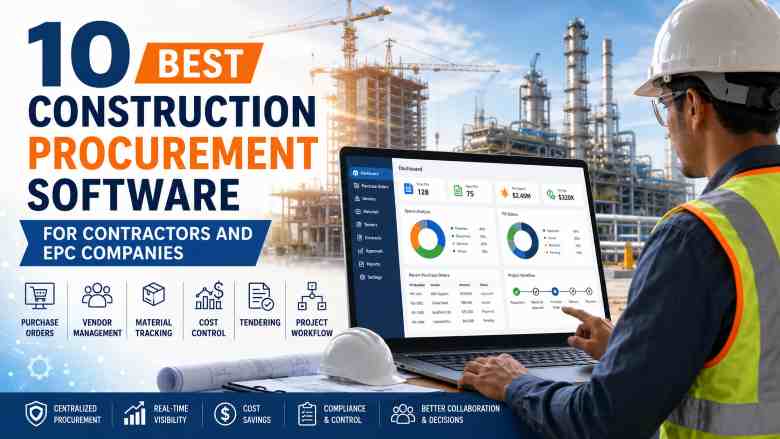
The best construction procurement software helps contractors and EPC companies manage RFQs, vendor comparison, purchase orders, material tracking, approvals, inventory, contracts, and project budgets from one centralised platform.
Table of Contents
What Is Construction Procurement Software?
Construction procurement software is a digital platform that manages the end-to-end purchasing lifecycle on construction projects. This covers everything from raising material requisitions and issuing requests for quotation (RFQs) to comparing vendor bids, generating purchase orders, tracking deliveries, managing inventory, handling contracts, and reconciling procurement spend against project budgets.
Unlike generic procurement tools built for manufacturing or retail, construction-specific procurement software is designed around project-based workflows. It understands that a single contractor may run dozens of active projects simultaneously, each with its own budget codes, bill of quantities (BOQ), approval hierarchies, and vendor panels. The best platforms integrate procurement data directly with construction ERP systems, accounting modules, and scheduling tools so that every purchase order is tied to a project cost centre in real time.
For EPC companies managing large infrastructure, oil and gas, or power projects, procurement software also handles subcontract management, long-lead item tracking, supplier prequalification, and compliance with client or government procurement regulations.
Why Contractors and EPC Companies Need Procurement Software in 2026
Several converging pressures make digital procurement essential for contractors today, not merely convenient.
Material price volatility remains a defining challenge. Steel, cement, copper, and lumber prices have fluctuated sharply over the past four years, and contractors without real-time visibility into committed costs versus budgeted costs are exposed to margin erosion on every project. Procurement software provides live dashboards that flag budget variances the moment a purchase order is approved, rather than weeks later when the accounts team reconciles invoices.
Supplier and delivery delays continue to disrupt project schedules globally. Integrated procurement platforms track order status, expected delivery dates, and supplier lead times, giving project managers early warning when a critical material is at risk of late arrival. This is especially important for EPC firms managing complex supply chains across multiple countries.
Approval bottlenecks are a silent schedule killer. On projects with manual approval workflows, a single purchase requisition can sit unsigned for days while the approving manager is on site or travelling. Digital approval workflows with mobile access and delegation rules eliminate this lag. The World Economic Forum’s construction framework identifies process automation as one of the key levers for improving construction productivity.
Multi-site and multi-project procurement is increasingly common as contractors grow. Without a centralised system, each project operates as its own procurement island, negotiating separately with the same vendors and missing volume discount opportunities. Centralised procurement software enables company-wide vendor management, rate contracts, and consolidated purchasing.
Compliance and audit requirements are tightening across markets. Government infrastructure projects, PPP contracts, and international EPC clients increasingly require auditable procurement trails, competitive bidding documentation, and anti-corruption compliance. Software-managed procurement provides this documentation automatically, which is virtually impossible to replicate with email-based systems.
For more on how digital transformation in construction is reshaping the industry, explore our detailed analysis of the latest technology trends for contractors and project managers.
Key Features to Look for in Construction Procurement Software
Not all procurement platforms are built equally for construction workflows. When evaluating software, contractors and EPC firms should prioritise the following capabilities:
RFQ and bid comparison: The ability to issue requests for quotation to multiple vendors, receive responses within the platform, and compare bids side by side on price, delivery terms, payment conditions, and compliance. The best tools auto-score bids against weighted criteria so that procurement teams can make defensible vendor selection decisions.
Vendor management: A centralised vendor database with prequalification tracking, performance ratings, insurance and compliance document management, and communication history. For EPC companies, this extends to supplier risk profiling and geographic coverage mapping.
Purchase order automation: One-click PO generation from approved requisitions, with automatic population of project codes, tax calculations, delivery addresses, and payment terms. Digital POs with electronic signatures reduce processing time from days to minutes.
Material requisition workflows: Site teams should be able to raise material requests from mobile devices, with automatic routing to the appropriate approver based on value thresholds, project, or material category.
Budget and BOQ integration: Procurement spend must map directly to project budgets and bills of quantities so that project managers can see committed costs versus approved budgets at any point. This is critical for avoiding cost overruns and is a standard requirement for quantity surveying software integration.
Inventory and warehouse tracking: For contractors operating stores and warehouses, the software should track stock levels, material receipts, issues to project, wastage, and reorder points. This is especially valuable for contractors with centralised material yards serving multiple sites.
Contract and compliance management: Management of rate contracts, subcontracts, framework agreements, and long-term supply agreements with milestone tracking, variation management, and compliance alerts.
Approval workflows: Configurable, multi-level approval chains based on value, project, department, or material type. Delegation and escalation rules ensure that approvals do not stall when a designated approver is unavailable.
ERP and accounting integration: Seamless data flow between procurement and finance systems, including accounts payable, general ledger postings, tax compliance, and construction accounting software. Two-way or three-way invoice matching (PO, receipt, invoice) prevents overpayments.
Mobile access: Field-ready mobile apps or responsive interfaces that allow site engineers, store managers, and project managers to raise requisitions, approve orders, and confirm deliveries from the job site without returning to the office.
Reporting and dashboards: Real-time procurement analytics covering spend by project, vendor performance, PO cycle times, budget utilisation, and procurement pipeline status. Executive dashboards give leadership portfolio-level visibility.
AI-based forecasting and supplier risk insights: Emerging capabilities include predictive demand forecasting based on project schedules, automated price benchmarking against market indices, and AI-driven supplier risk scoring that flags vendors with financial instability or delivery reliability issues.
Best Construction Procurement Software for Contractors and EPC Companies
The following comparison table provides a quick overview of the leading platforms. Detailed reviews of each software follow below.
| Software | Best For | Key Strength | Suitable For | Pricing Note |
|---|---|---|---|---|
| Procore | General contractors, large builders | End-to-end project and procurement integration | Mid to large contractors | Custom pricing based on annual construction volume |
| Oracle Primavera Unifier | EPC companies, large infrastructure | Enterprise procurement, contract, and cost control | Enterprise EPC and infrastructure | Enterprise pricing; contact Oracle |
| SAP S/4HANA | Multinational EPC and large contractors | Full ERP with integrated procurement and supply chain | Large enterprise | Enterprise pricing via RISE with SAP |
| Autodesk Construction Cloud | BIM-integrated procurement | Procurement tied to BIM models and project data | Mid to large contractors | Subscription-based; check Autodesk website |
| CMiC | Enterprise general contractors | Single-database construction ERP with procurement | Large contractors and ENR-ranked firms | Enterprise pricing; contact CMiC |
| Trimble Viewpoint Vista | Contractors needing ERP with procurement | Integrated job costing, procurement, and accounting | Mid to large contractors | Enterprise pricing; contact Trimble |
| Jonas Construction Software | Mid-sized contractors | Cloud ERP with procurement, PO, and inventory | Mid-sized general and specialty contractors | Subscription pricing; contact Jonas |
| Contractor Foreman | Small to mid-sized contractors | Affordable, all-in-one with purchasing module | Small and growing contractors | From approximately USD 49/month |
| Procurify | Procurement visibility and spend control | Real-time spend tracking and approval workflows | Mid-sized companies across industries | Custom pricing; check Procurify website |
| Knowify | Subcontractors and specialty trades | PO management with QuickBooks integration | Small to mid-sized subcontractors | From approximately USD 149/user/month |
1. Procore
Best for: General contractors and large construction firms needing end-to-end project and procurement management on a single platform.
Procore is one of the most widely used construction project management software platforms globally, and its procurement capabilities are deeply integrated into the broader project lifecycle. The platform covers bid management, purchase order creation, subcontractor commitments, invoice management, and budget tracking within a unified cloud environment.
Key procurement features: Bid management with invitation tracking and levelling tools. Automated purchase order creation tied to project budgets. Commitment tracking for subcontracts and purchase orders. Three-way invoice matching. Budget integration with real-time cost visibility. Vendor prequalification and compliance tracking.
Construction and EPC use cases: Large commercial and residential contractors managing multi-project portfolios. General contractors coordinating procurement across multiple subcontractors and suppliers. Firms that need procurement data integrated with daily logs, RFIs, submittals, and change orders within a single platform.
Strengths: Extensive integration marketplace with over 500 partner apps. Intuitive interface praised by field and office teams. Strong mobile app for on-site procurement tasks. AI-powered features through Procore AI (Datagrid platform) for task automation and predictive insights.
Limitations: Custom pricing based on annual construction volume can be expensive for smaller contractors. Steep learning curve for teams new to the full feature set. Reporting customisation requires additional effort.
Integration: QuickBooks, Sage, Xero, Microsoft Project, Smartsheet, Bluebeam, DocuSign, and 500+ apps via the Procore App Marketplace.
Suitable company size: Mid-sized to large contractors and construction firms.
Pricing: Custom pricing based on annual construction volume. Contact Procore for current pricing.
Why it matters for contractors: Procore’s strength is that procurement does not exist in a silo. Every PO, commitment, and invoice is connected to the project schedule, budget, and document management system, giving project managers a single source of truth for cost and procurement status.
2. Oracle Primavera Unifier
Best for: EPC companies, government infrastructure agencies, and enterprise-scale capital project organisations requiring robust procurement, contract, and cost control.
Oracle Primavera Unifier is a cloud-based enterprise platform designed for complex capital projects and construction programmes. Its procurement module handles the full cycle from supplier management and bidding through contract execution, requisitions, purchase orders, invoice approvals, and closeout. Unifier’s configurable Business Process Management (BPM) engine allows organisations to tailor procurement workflows to specific regulations, client requirements, and project types.
Key procurement features: Supplier management and prequalification. Competitive bidding and bid evaluation. Contract management including master service agreements, subcontracts, and purchase orders. Automated approval workflows with full audit trails. Budget-connected procurement with real-time cost reconciliation. AI-driven business process summarisation and workflow insights.
Construction and EPC use cases: Large EPC contractors managing multi-billion-dollar infrastructure, energy, and industrial projects. Government agencies and public sector organisations requiring auditable procurement compliance. Owners and developers managing capital project portfolios across multiple geographies.
Strengths: Extremely configurable for complex organisational and project structures. Deep integration with Oracle Primavera P6 for schedule-linked procurement. Enterprise-grade security and compliance. Supports NEC4 and FIDIC contract management workflows. Oracle Cloud Infrastructure with AI capabilities.
Limitations: Complex implementation requiring significant configuration and training. Enterprise pricing that is not suited for small or mid-sized contractors. Requires dedicated administration for ongoing BPM configuration.
Integration: Oracle Primavera P6, Oracle ERP Cloud, Oracle Fusion, and third-party systems via APIs. Part of the Oracle Construction and Engineering suite.
Suitable company size: Large enterprise, EPC companies, government agencies, and major infrastructure developers.
Pricing: Enterprise pricing available on request. Contact Oracle for details.
Why it matters for EPC firms: Unifier is purpose-built for the complexity that EPC companies face: multi-tier approval hierarchies, cross-border procurement compliance, integrated cost and schedule control, and the need to manage thousands of purchase orders, contracts, and change orders across a portfolio of capital projects. For professionals interested in building skills with this platform, our guide to PMP certification and project controls career development is a useful complement.
3. SAP S/4HANA
Best for: Multinational EPC companies and large construction conglomerates needing a full enterprise ERP with integrated procurement, supply chain, and financial management.
SAP S/4HANA is SAP’s flagship ERP suite, built on the in-memory HANA database platform. While not exclusively a construction tool, it is widely deployed by large EPC firms, construction conglomerates, and infrastructure companies for its comprehensive procurement and materials management (MM) capabilities. The platform manages the entire procure-to-pay cycle, subcontractor procurement, project-linked purchasing, and supply chain logistics at enterprise scale.
Key procurement features: Procure-to-pay automation across the enterprise. Material Requirements Planning (MRP) integrated with project schedules. Supplier evaluation and lifecycle management. Contract management for framework agreements and long-term supply contracts. Real-time analytics with SAP HANA in-memory processing. SAP Ariba integration for network-based procurement and supplier collaboration.
Construction and EPC use cases: Multinational EPC contractors managing procurement across multiple countries with complex tax, compliance, and logistics requirements. Large construction companies with diversified operations spanning real estate, infrastructure, and industrial projects. Organisations requiring tight integration between procurement, project accounting, HR, and asset management.
Strengths: Unmatched scalability for very large organisations. Deep integration across finance, project management, HR, and supply chain. SAP Fiori provides a modern user experience. SAP BTP (Business Technology Platform) enables custom extensions without modifying the core ERP. Strong compliance and regulatory support across jurisdictions.
Limitations: High implementation cost and long deployment timelines. Requires significant process standardisation and change management. Complexity may be excessive for mid-sized contractors. Clean master data is a prerequisite for successful implementation.
Integration: SAP Ariba, SAP Fieldglass, SAP Analytics Cloud, and extensive third-party integrations through SAP BTP and standard APIs.
Suitable company size: Large enterprise and multinational organisations.
Pricing: Enterprise pricing via RISE with SAP subscription model. Contact SAP for details.
Why it matters for EPC firms: For the largest EPC companies — the ones managing multi-billion-dollar portfolios across continents — SAP S/4HANA provides the enterprise backbone that connects procurement with every other business function. It is not a quick deployment, but for organisations at this scale, the integration depth is unmatched.
4. Autodesk Construction Cloud
Best for: Contractors who want procurement workflows connected to BIM models, design data, and preconstruction processes.
Autodesk Construction Cloud (ACC) brings together Autodesk Build, Autodesk Takeoff, and Autodesk BIM Collaborate into a unified platform. Its procurement features include bid boards, procurement workflows, and purchasing tools that tie directly into quantity takeoffs and BIM-derived data. This makes it particularly strong for contractors who want procurement decisions informed by model-based quantities.
Key procurement features: Bid board for managing invitations, submissions, and bid levelling. Procurement workflows linked to BIM takeoffs and cost estimates. RFI and submittal management connected to procurement timelines. Budget tracking integrated with project cost management. Document management with version control.
Construction and EPC use cases: Commercial and residential builders using BIM-based workflows. Contractors wanting to derive procurement quantities directly from 3D models. Firms seeking an integrated platform that connects design, preconstruction, and field operations with procurement.
Strengths: Seamless connection between BIM data and procurement quantities. Strong preconstruction tools including takeoff and estimating. Unified data environment across design and construction phases. Integration with the broader Autodesk ecosystem (Revit, Navisworks, Civil 3D). Good mobile apps for field use.
Limitations: Procurement capabilities are less deep than dedicated procurement or ERP platforms. Better suited for building construction than heavy civil or EPC-scale procurement. Integration with non-Autodesk accounting systems may require additional configuration.
Integration: Autodesk Revit, Navisworks, Civil 3D, Procore (via integration), QuickBooks, Sage, and other third-party tools.
Suitable company size: Mid-sized to large contractors, especially those already using Autodesk design tools.
Pricing: Subscription-based. Check the Autodesk Construction Cloud website for current plans.
Why it matters for contractors: If your firm already works in the Autodesk ecosystem for design and BIM, ACC provides a natural extension into procurement. The ability to pull quantities directly from models into procurement workflows reduces manual takeoff errors and speeds up the purchasing cycle. Explore our guide on future construction technologies to understand how BIM-integrated procurement is evolving.
5. CMiC
Best for: Enterprise-level general contractors and ENR-ranked firms that need a single-database construction ERP with deeply integrated procurement, accounting, and project management.
CMiC is a cloud-based construction ERP that connects accounting, payroll, procurement, equipment management, and project controls within a single database. Unlike platforms that bolt procurement onto a generic framework, CMiC is built from the ground up for construction companies. Its procurement module covers purchase requisitions, vendor management, purchase order workflows, commitment tracking, and inventory management, all integrated with job costing and financial reporting.
Key procurement features: Purchase requisition and PO management with multi-level approval workflows. Vendor portal for self-service communication and document exchange. Commitment tracking linked to job cost codes. AP automation with three-way matching. Inventory management integrated with procurement and job costing. Reporting and analytics across the procurement pipeline.
Construction and EPC use cases: Large general contractors, design-build firms, and specialty contractors managing high-volume procurement across multiple projects. Firms requiring SOC-certified cloud ERP with construction-specific procurement workflows. Contractors that have outgrown mid-market accounting software and need enterprise-grade cost control.
Strengths: True single-database architecture eliminates data silos between procurement, accounting, and project management. Strong compliance and audit readiness with SOC 3 certification. Offline capability for field teams. Deep construction-specific functionality developed over decades.
Limitations: Enterprise pricing positions it above the budget of most small and mid-sized contractors. Implementation requires significant planning and data migration effort. Learning curve for the full platform.
Integration: Microsoft Office, Bluebeam, Procore, and various third-party systems via APIs.
Suitable company size: Large enterprise contractors, ENR-ranked firms.
Pricing: Enterprise pricing. Contact CMiC for details.
6. Trimble Viewpoint Vista
Best for: Contractors seeking an integrated construction ERP that combines procurement with job costing, accounting, project management, and HR within the Trimble ecosystem.
Trimble Viewpoint Vista is a construction ERP platform used by thousands of contractors globally. Its procurement capabilities are integrated with the broader Vista environment, which includes financial management, job costing, project management, HR, and payroll. As part of Trimble Construction One, Vista connects with field management, estimating, and design tools across the Trimble portfolio.
Key procurement features: Purchase order management with approval workflows. Subcontract management and commitment tracking. Accounts payable automation and invoice processing. Job cost integration for real-time budget visibility. Vendor management with compliance tracking. Integration with Trimble field management tools for site-to-office procurement coordination.
Construction and EPC use cases: Mid-sized to large general contractors and specialty contractors who need procurement integrated with accounting and project management. Firms already using other Trimble construction tools. Contractors who want a connected ERP ecosystem spanning estimating, scheduling, field management, and finance.
Strengths: Mature, construction-specific ERP with strong job costing and financial reporting. Part of the larger Trimble Construction One ecosystem. Microsoft Azure-hosted cloud with SOC 2 certification. Strong reporting and analytics capabilities. Active user community and extensive documentation.
Limitations: Enterprise-level pricing not suited for small contractors. Some users report a learning curve with the extensive feature set. Reporting customisation can require additional effort.
Integration: Microsoft Project, Smartsheet, Bluebeam, DocuSign, Trimble ProjectSight, Trimble estimating tools, and various third-party applications.
Suitable company size: Mid-sized to large contractors.
Pricing: Enterprise pricing. Contact Trimble Viewpoint for details.
For a broader comparison of how to choose the right construction ERP, including procurement considerations, see our dedicated selection guide.
7. Jonas Construction Software
Best for: Mid-sized general contractors and specialty contractors who need a cloud-based construction ERP with dedicated procurement, PO management, and inventory tracking.
Jonas Construction Software is a cloud-based ERP designed specifically for construction firms. Its procurement module handles purchase requisitions, vendor management, purchase orders, and inventory tracking, all connected to the platform’s job costing, accounting, and project management functions. Jonas has a strong reputation among mid-market contractors who need construction-specific workflows without the complexity and cost of enterprise ERP systems.
Key procurement features: Purchase order creation and management. Material requisition workflows. Vendor database with performance tracking. Inventory management and stock control. Integration with job costing and accounts payable. Mobile access for field procurement tasks.
Strengths: Built specifically for construction, not adapted from a generic ERP. Cloud-based with modern interface. Good balance of capability and usability for mid-market firms. Strong customer support and implementation guidance.
Limitations: Less suitable for very large EPC-scale procurement complexity. Feature depth in procurement may not match enterprise platforms like CMiC or Oracle Unifier. Smaller integration ecosystem compared to Procore or SAP.
Suitable company size: Mid-sized contractors and specialty trade contractors.
Pricing: Subscription-based pricing. Contact Jonas Construction Software for current pricing.
8. Contractor Foreman
Best for: Small to mid-sized contractors who need affordable, all-in-one construction management with a practical purchasing module.
Contractor Foreman is a cloud-based construction management platform that includes project management, scheduling, estimating, and purchasing tools at a fraction of the cost of enterprise platforms. Its purchasing module covers purchase orders, vendor management, and basic procurement tracking, making it a solid entry point for small contractors transitioning from spreadsheets to digital procurement.
Key procurement features: Purchase order creation and tracking. Vendor contact management. Basic material cost tracking against project budgets. Document attachment to POs. Mobile access for site teams.
Strengths: Very affordable pricing starting around USD 49 per month. Easy to set up and use with minimal training. Covers a broad range of construction management functions beyond procurement. Good for small teams moving from manual to digital workflows.
Limitations: Procurement features are basic compared to mid-market and enterprise platforms. Limited advanced capabilities for RFQ management, bid comparison, or inventory control. Not suited for complex multi-project or EPC-scale procurement.
Suitable company size: Small and growing contractors with 5 to 50 employees.
Pricing: From approximately USD 49 per month. Check Contractor Foreman for current plans and pricing tiers.
9. Procurify
Best for: Organisations that need a dedicated cloud procurement platform focused on spend visibility, purchase request management, and approval workflows — including construction companies scaling their procurement operations.
Procurify is a cloud-based procurement platform that provides real-time visibility into the entire purchasing process, from purchase requisitions and expense approvals to vendor management and spend analytics. While not exclusively built for construction, its flexible workflow engine and strong approval management make it applicable to construction companies that need to standardise purchasing across multiple projects and departments.
Key procurement features: Purchase requisition and approval workflows. Real-time spend tracking and budget monitoring. Vendor management and communication. Three-way matching for POs, receipts, and invoices. Spend analytics dashboards. Mobile procurement for field teams.
Strengths: Strong spend visibility and control features. Intuitive, modern user interface. Good for companies with distributed procurement teams. Flexible workflows adaptable to construction purchasing processes.
Limitations: Not construction-specific; lacks native job costing, BOQ integration, or project-based budget structures. Requires integration with construction ERP or accounting software for full construction workflow coverage. May not replace a construction ERP procurement module for complex project-based purchasing.
Suitable company size: Mid-sized organisations, including construction companies scaling their procurement function.
Pricing: Custom pricing. Contact Procurify for details.
10. Knowify
Best for: Subcontractors and specialty trade contractors who need procurement and job costing tightly integrated with QuickBooks.
Knowify is a cloud-based construction management software tailored for subcontractors and specialty contractors. Its procurement features include purchase order management, vendor tracking, and three-way matching for POs, receipts, and invoices. Knowify’s deep integration with QuickBooks makes it particularly attractive for contractors who use QuickBooks as their accounting system and want to add construction-specific procurement and job costing without replacing their accounting platform.
Key procurement features: Purchase order creation and management. Three-way matching (PO, receipt, invoice). Vendor portal and communication tools. Commitment tracking linked to job cost codes. Mobile access for field teams. Deep QuickBooks integration for real-time financial syncing.
Strengths: Excellent QuickBooks integration. Strong job costing tied to procurement. Good for subcontractors who need to control costs at the trade level. Mobile-friendly interface.
Limitations: Designed primarily for subcontractors and smaller operations. Pricing can escalate for larger teams or advanced features. Limited native reporting customisation. Not suited for large GC or EPC-scale procurement.
Suitable company size: Small to mid-sized subcontractors and specialty trade contractors.
Pricing: Quote-based pricing starting at approximately USD 149 per user per month (billed annually). Free trial available.
Best Software by Use Case
Different types of construction businesses have different procurement needs. Here is a practical guide based on your company profile:
Best for EPC companies: Oracle Primavera Unifier or SAP S/4HANA. Both platforms handle the scale, complexity, and compliance requirements of large EPC operations, including multi-tier contract management, cross-border procurement, and integration with project scheduling tools like Primavera P6.
Best for civil contractors: Procore or Trimble Viewpoint Vista. These platforms combine strong procurement with field-to-office integration, making them practical for civil contractors managing material-intensive earthworks, bridge, road, and utility projects. Refer to our guide on construction scheduling software for complementary tools.
Best for infrastructure projects: Oracle Primavera Unifier. Its enterprise-grade BPM engine is specifically designed for public infrastructure, transportation, and utilities projects with complex procurement regulations and audit requirements.
Best for real estate developers: Procore or Autodesk Construction Cloud. Developers managing multiple building projects benefit from the BIM integration and portfolio-level visibility these platforms offer.
Best for small and mid-sized contractors: Contractor Foreman (small) or Jonas Construction Software (mid-sized). These platforms offer the right balance of functionality and affordability for growing firms.
Best for enterprise construction companies: CMiC or Trimble Viewpoint Vista. Both are proven at enterprise scale with thousands of contractors relying on them as their ERP of record.
Best for material and inventory control: Jonas Construction Software or CMiC. Both offer dedicated inventory management modules that integrate with procurement and job costing.
Best for procurement and finance integration: SAP S/4HANA or Trimble Viewpoint Vista. Both platforms provide deep integration between procurement, accounts payable, general ledger, and financial reporting. For related tools, see our review of construction accounting software.
Construction Procurement Software vs Construction ERP
A question that many contractors face is whether they need a standalone procurement tool or a complete construction ERP system that includes procurement as one module among many.
Standalone procurement software (like Procurify) focuses exclusively on the purchasing cycle: requisitions, approvals, POs, vendor management, and spend tracking. It does this well but requires integration with your existing accounting, project management, and scheduling tools. This approach works for companies that already have an accounting system they are happy with and want to add procurement-specific functionality without replacing their entire tech stack.
Construction ERP with procurement (like CMiC, Viewpoint Vista, Jonas, or SAP S/4HANA) provides procurement as part of an integrated suite that also handles accounting, job costing, payroll, HR, project management, and potentially equipment and field operations. The advantage is that procurement data flows seamlessly into financial reports and project cost tracking without integration middleware. The trade-off is higher cost, longer implementation, and the need to adopt a broader platform.
Construction project management platforms with procurement features (like Procore and Autodesk Construction Cloud) sit in between. They are not full ERPs, but they offer procurement tools integrated with project management, document control, and field operations. Many contractors use these alongside a separate accounting system, connecting the two through integrations.
The right choice depends on the maturity of your existing technology stack, the volume and complexity of your procurement, and your budget for technology investment. For contractors running 5 or fewer projects with a small vendor base, a standalone procurement tool or a project management platform with procurement features may be sufficient. For mid-sized to large firms managing dozens of projects with hundreds of vendors, a construction ERP with integrated procurement is typically the better long-term investment. Our guide to how to choose the right construction ERP covers this decision in detail.
How to Choose the Right Procurement Software
Selecting procurement software is a significant decision that affects project cost control, vendor relationships, and operational efficiency across your entire organisation. Here is a practical checklist to guide your evaluation:
Project size and complexity: Simple residential projects with a handful of material suppliers have very different procurement needs than multi-billion-dollar infrastructure or EPC contracts with hundreds of vendors and subcontractors. Match the software’s capabilities to your actual project complexity.
Number of vendors: If you regularly work with 20 or fewer suppliers, a basic procurement module may suffice. If you manage hundreds of vendors across multiple categories and geographies, you need robust vendor management, prequalification, and performance tracking features.
Material volume and diversity: High-volume, multi-material procurement requires strong requisition workflows, inventory management, and delivery tracking. Specialty contractors purchasing a narrow range of materials may need less complexity.
Approval hierarchy: Consider how many levels of approval your organisation requires and how those approvals vary by value threshold, project, or material category. Ensure the software supports your approval structure without rigid limitations.
Integration needs: Map the systems you already use for accounting, project management, scheduling, and document control. The procurement software must integrate smoothly with these, either natively or through well-supported APIs and connectors.
Reporting requirements: Identify the procurement KPIs and reports your leadership team needs: spend by project, vendor performance, PO cycle time, budget utilisation, and procurement pipeline status. Ensure the software delivers these out of the box or through configurable dashboards.
Mobile and site accessibility: If site engineers and store managers need to raise requisitions, confirm deliveries, and approve orders from the field, mobile capability is essential.
Budget: Be realistic about total cost of ownership, including licence or subscription fees, implementation costs, data migration, training, and ongoing support. Enterprise ERP systems cost significantly more than standalone procurement tools or project management platforms with procurement features.
Implementation support: Evaluate the vendor’s implementation methodology, typical timelines, and customer support model. Ask for references from construction companies of similar size and project type to yours.
Data migration: If you are moving from spreadsheets or an existing system, plan for the effort required to clean and migrate vendor data, material master data, rate contracts, and historical purchase order records.
Training requirements: The best software is only effective if your teams actually use it. Assess the training resources available: on-demand videos, live training, certifications, and documentation. Consider how you will train site teams who may have limited technology exposure.
Implementation Roadmap for Contractors
Implementing procurement software is not just a technology project — it is a change management initiative that affects how your procurement, site, QS, planning, and finance teams work every day. A phased approach reduces risk and builds internal confidence.
Step 1: Audit your current procurement process. Document how procurement works today, from requisition to payment. Identify pain points, bottlenecks, manual workarounds, and compliance gaps. This baseline informs your software requirements and success metrics.
Step 2: Map RFQ, PO, and approval workflows. Define your target-state workflows for material requisitions, RFQs, vendor selection, PO creation, delivery confirmation, invoice matching, and payment approval. Align these with your organisational approval matrix.
Step 3: Clean vendor and material master data. Review and standardise your vendor database, material codes, cost categories, and rate contracts. Poor master data is the most common cause of failed procurement software implementations.
Step 4: Select software based on project needs. Use the evaluation checklist above to shortlist and evaluate 2 to 3 platforms through demos, proof-of-concept trials, and reference checks with similar construction companies.
Step 5: Run a pilot on one project. Deploy the software on a single, representative project before rolling it out company-wide. Use the pilot to validate workflows, test integrations, and gather feedback from procurement, site, and finance teams.
Step 6: Train procurement, QS, planning, site, stores, and finance teams. Provide role-specific training that focuses on the tasks each team member will perform daily. Generic training sessions with every feature demonstrated are far less effective than targeted, role-based training. Professionals looking to build broader digital construction skills can explore construction management courses and project management online courses to complement software-specific training.
Step 7: Track KPIs and scale across projects. Measure procurement cycle time, PO processing time, budget variance, vendor delivery performance, and user adoption rates. Use these metrics to refine workflows and build the business case for company-wide rollout.
Common Mistakes to Avoid
Based on real-world contractor experiences, these are the most frequent pitfalls when selecting and implementing construction procurement software:
Choosing software based only on price. The cheapest option rarely delivers the best value. A low-cost tool that lacks critical features forces your team back to spreadsheets for the gaps, negating the investment. Focus on total cost of ownership and fit for your procurement complexity.
Ignoring site team usability. If site engineers and store managers find the software difficult to use on a mobile device in poor connectivity, they will revert to phone calls and paper forms. Always evaluate mobile UX from the perspective of field users, not just office-based procurement managers.
Not involving procurement and finance users in the selection process. Software selected by IT or management without input from the people who will use it daily faces adoption resistance. Include procurement officers, QS teams, site engineers, and finance staff in demos and evaluation.
Poor vendor master data. Migrating duplicate, incomplete, or outdated vendor records into a new system multiplies confusion. Invest the effort to clean and standardise vendor data before go-live.
No integration plan. Procurement software that does not connect to your accounting system, project management platform, or scheduling tools creates a new data silo rather than solving the old ones. Define integration requirements upfront and validate them during the pilot.
No training. Software without training is shelfware. Budget for comprehensive, role-based training and ongoing refresher sessions, especially when onboarding new employees.
Over-customisation. Excessive custom workflows and non-standard configurations increase implementation time, cost, and complexity. Start with the vendor’s recommended best-practice workflows and customise only where your business genuinely requires it.
Not tracking ROI. If you cannot measure the impact of procurement software on cost savings, cycle time reduction, and error rates, you cannot justify continued investment or expansion. Define success metrics before implementation and track them consistently.
Career Relevance for Construction Professionals
Understanding procurement software is increasingly relevant across a wide range of construction roles, not just for procurement specialists. Here is why professionals in adjacent roles benefit from procurement software knowledge:
Procurement engineers and officers are the primary users of these platforms. Digital procurement skills are becoming a baseline requirement for these roles, and professionals who can manage RFQs, vendor evaluation, PO automation, and spend analytics in software are significantly more employable than those limited to manual processes.
Quantity surveyors work directly with procurement data for cost estimation, BOQ management, and budget monitoring. Understanding how procurement software integrates with quantity surveying software and cost management tools is a valuable career differentiator. See our quantity surveyor career guide for more details.
Billing engineers reconcile procurement records with invoice processing, payment certifications, and contractor billing. Familiarity with three-way matching, commitment tracking, and PO-linked invoicing within procurement software streamlines this work significantly.
Planning engineers rely on procurement timelines for long-lead items, material delivery schedules, and resource loading. When procurement software integrates with scheduling tools like Primavera P6 or Microsoft Project, the planning engineer gains real-time visibility into procurement-driven schedule risks.
Contracts managers manage subcontracts, rate contracts, and framework agreements that are increasingly administered through procurement platforms. Digital contract management skills are essential for professionals in this role.
Project managers need portfolio-level visibility into procurement status, committed costs, and budget utilisation. The ability to read and act on procurement dashboards is a core competency for modern project management careers in construction.
Store and warehouse managers use procurement software for inventory tracking, material receipts, stock management, and reorder management. Digital inventory management replaces manual stock registers and reduces material wastage.
ERP coordinators and digital construction professionals are responsible for configuring, maintaining, and optimising procurement modules within broader ERP and project management platforms. These roles are among the fastest-growing hybrid construction roles in the industry.
If you are a construction professional looking to strengthen your digital procurement skills and advance your career, ConstructionCareerHub.com offers AI-powered career tools, including resume optimisation, interview preparation, salary benchmarking, and skills gap analysis, designed specifically for the construction industry.
For structured learning, consider these relevant courses:
- Construction Management Specialization — Columbia University
- Supply Chain Management Specialization — Rutgers University
- Procurement and Sourcing — Rutgers University
For digital career resources tailored to construction professionals, explore the Ultimate Guide to Launching Your Career in Digital Construction and the BIM Job Interview Preparation Guide — both available as affordable ebooks with practical, actionable career advice. Professionals exploring international or remote construction procurement roles may also find the Remote Construction Job Hunting System useful for navigating global opportunities.
Final Recommendation
There is no single “best” procurement software for every contractor. The right choice depends on your organisation’s size, project complexity, procurement volume, integration requirements, and technology budget.
For small contractors taking their first step from spreadsheets to digital procurement, Contractor Foreman offers an affordable, practical starting point. For subcontractors needing tight integration with QuickBooks, Knowify is purpose-built for that workflow.
For mid-sized contractors, Jonas Construction Software provides a well-balanced construction ERP with solid procurement capabilities. For large general contractors, Procore, CMiC, and Trimble Viewpoint Vista are proven at scale, each with different strengths in project management integration, ERP depth, and ecosystem connectivity.
For EPC companies and enterprise-scale infrastructure organisations, Oracle Primavera Unifier and SAP S/4HANA deliver the configurability, compliance, and integration depth that complex capital projects demand.
Whichever platform you evaluate, request a demo with your own procurement data, involve your procurement, site, QS, and finance teams in the assessment, and run a pilot on a real project before committing to a company-wide rollout. The investment in getting this decision right will pay dividends in project cost control, supplier performance, and operational efficiency for years to come.
For additional construction career development resources, explore the Construction Career Resources Bundle — a comprehensive collection of tools for job seekers and professionals looking to advance in the construction industry.
Build your construction career with the right digital skills. ConstructionCareerHub.com offers AI-powered Resume Lab, Interview Copilot, Salary Calculator, and Skills Gap Analyzer — purpose-built for construction professionals navigating the digital transformation of the industry.
Frequently Asked Questions
What is construction procurement software?
Construction procurement software is a digital platform that manages the entire purchasing lifecycle on construction projects, including material requisitions, RFQs, vendor comparison, purchase orders, delivery tracking, inventory management, contract administration, and budget reconciliation. It replaces spreadsheet-based and email-based procurement with automated, auditable workflows designed for project-based construction operations.
Which is the best procurement software for contractors?
The best procurement software for contractors depends on company size and project complexity. Procore is widely used by mid-to-large general contractors for its integrated project and procurement management. Contractor Foreman suits small contractors on a budget. Trimble Viewpoint Vista and CMiC are proven choices for large enterprise contractors requiring full ERP integration.
What is the best procurement software for EPC companies?
Oracle Primavera Unifier and SAP S/4HANA are the leading choices for EPC companies. Both platforms handle the scale, compliance, multi-contract complexity, and cross-border procurement requirements that characterise large EPC operations. Primavera Unifier integrates tightly with Primavera P6 for schedule-linked procurement, while SAP S/4HANA offers the broadest enterprise integration across finance, supply chain, and HR.
How does procurement software reduce project delays?
Procurement software reduces delays by automating approval workflows that eliminate manual bottlenecks, providing real-time delivery tracking that flags at-risk materials before they impact the schedule, enabling faster vendor comparison and PO generation, and connecting procurement timelines with project schedules so that long-lead items are ordered proactively rather than reactively.
Is construction procurement software different from ERP?
Yes. Construction procurement software focuses specifically on the purchasing and supply chain workflow. A construction ERP is a broader platform that includes procurement alongside accounting, job costing, payroll, HR, project management, and other functions. Some procurement tools operate standalone, while others exist as modules within a larger ERP. See our guide on construction ERP systems for a detailed comparison.
Can small contractors use procurement software?
Yes. Platforms like Contractor Foreman offer affordable procurement features starting around USD 49 per month, making digital procurement accessible to small contractors with limited budgets. Even basic digital PO management and vendor tracking deliver significant improvements over spreadsheet-based procurement for small teams.
What features should EPC companies look for in procurement software?
EPC companies should prioritise multi-tier approval workflows, supplier prequalification and risk management, contract management for subcontracts and framework agreements, integration with scheduling tools like Primavera P6, compliance and audit trail capabilities, multi-currency and multi-language support, and scalability to handle thousands of POs and vendor relationships across a project portfolio.
How much does construction procurement software cost?
Pricing varies widely. Entry-level platforms for small contractors start around USD 49 to 149 per month. Mid-market construction ERPs with procurement modules typically range from several hundred to several thousand dollars per month depending on user count and modules. Enterprise platforms like Oracle Primavera Unifier, SAP S/4HANA, and CMiC require custom enterprise pricing that can run into six figures annually for large organisations. Always request pricing directly from vendors based on your specific requirements.
Does procurement software help with material tracking?
Yes. Most construction procurement platforms track material orders from PO issuance through delivery confirmation, with features for delivery scheduling, goods receipt, quality inspection, and warehouse inventory management. Some platforms also provide supplier lead time analytics and automatic reorder alerts based on project consumption patterns.
Which professionals should learn procurement software?
Procurement engineers, quantity surveyors, billing engineers, planning engineers, contracts managers, project managers, store managers, ERP coordinators, and digital construction specialists all benefit from procurement software skills. As construction procurement becomes increasingly digital, these skills enhance employability across a wide range of construction job titles and career paths.
Can procurement software integrate with construction accounting systems?
Yes. Most construction procurement platforms offer integration with popular accounting systems including QuickBooks, Sage, Xero, and construction-specific ERPs. Integration typically covers accounts payable, general ledger postings, tax calculations, and three-way invoice matching. Some platforms like Knowify provide deep native integration with QuickBooks, while enterprise platforms like SAP S/4HANA include accounting as part of the same integrated system.
Is cloud-based procurement software better than on-premise for contractors?
For most contractors, cloud-based procurement software is the better choice in 2026. Cloud platforms offer lower upfront costs, automatic updates, mobile accessibility from job sites, multi-project access from any location, and reduced IT infrastructure requirements. On-premise deployment may still be preferred by some large enterprises with specific data sovereignty or security requirements, but the industry trend is strongly toward cloud-first adoption.
Ready to accelerate your construction career? Explore AI-powered career tools at ConstructionCareerHub.com — including Resume Lab, Interview Copilot, and Skills Gap Analyzer built specifically for construction professionals.
This article was last updated on June 11, 2026. Software features, pricing, and availability may change. Always verify current information on the official vendor websites linked in this guide. Course recommendations include affiliate links that help support ConstructionPlacements.com at no additional cost to you.
