

Last Updated on June 19, 2026 by Admin
Every investor eventually learns that a low price can be a distraction. A property may look cheap because the market has missed something. It may also look cheap because future demand is weak and the discount is deserved.
ConstructionCareerHub App is LIVE — built ONLY for construction careers. Don’t apply with a weak resume.
Get ATS-ready Resume Lab + Interview Copilot + Campus Placement Prep (resume screening, skill gaps, interview readiness) — in minutes & Other advanced features.
Explore Smarter Construction Career Tools →Quick check. Big impact. Start now.
Location is the part of the investment that the owner cannot repair after closing. Paint can change. Management can improve. A weak address is much harder to correct. Some locations are already sought after before a buyer studies a specific property. For instance, property in San Miguel de Allende is a dream for many because the city itself is a colonial-era masterpiece.
A place with proven appeal gives an investor something real to examine, while a cheaper area has to prove that demand will still exist when the buyer becomes the owner. The real question is how well the location can support value after the purchase.
Table of Contents
Start With Why People Stay
A good investment location has demand that does not depend on hype. People return because the place works for daily life. That is different from a market that gets attention for a season and then struggles once the excitement moves somewhere else.
A serious investor should spend time asking what holds people there. In some places, the answer is a stable renter base. Somewhere else, it may be long-term owner demand from retirees or remote workers who want a slower pace. The specific driver can change, but the demand should feel durable enough to survive a softer year.
Useful research often begins away from the listing page. Local vacancy patterns, rental absorption, permit activity, and resale history can reveal more than polished property photos. If the location has a real buyer or renter base, the numbers usually show it before the marketing copy does.
Access Is About Daily Friction
Access is not only about distance on a map. A building can be close to a business district and still feel inconvenient if the drive is awkward or parking is poor. Another property may be farther away but easier to use every day.
Investors should think like the future occupant. A tenant who commutes five days a week will judge the location differently from a buyer who values a walkable neighborhood. Small daily annoyances can weaken demand over time because people remember how a place feels on an ordinary morning.
This is why site visits should happen at more than one time of day. A street that feels calm at noon may be frustrating at 7:45 a.m. A neighborhood that looks appealing on a weekend may feel different after dark. Location research is stronger when it includes the hours people actually live and work there.
Supply Can Help or Hurt
Scarcity can protect value, but only when demand is real. A location with limited land, difficult approvals, or strong neighborhood character may hold pricing better because new competition is harder to create. That advantage can support both resale and rent.
Still, scarcity can be misleading. A market with little new construction may be protected, or simply unattractive to builders. Investors need to understand which version they are seeing.
Planning rules deserve careful attention. A property near an area marked for future density may gain value as the district changes. Another site may face limits that keep future upgrades difficult. Those rules are not background details. They shape the investment path.
A good location is not always the one with the least supply. Sometimes the better opportunity is a place where new supply is coming in a controlled way and public services are improving alongside it. Growth without basic support can weaken the appeal that attracted buyers in the first place.
Infrastructure Can Change the Ceiling
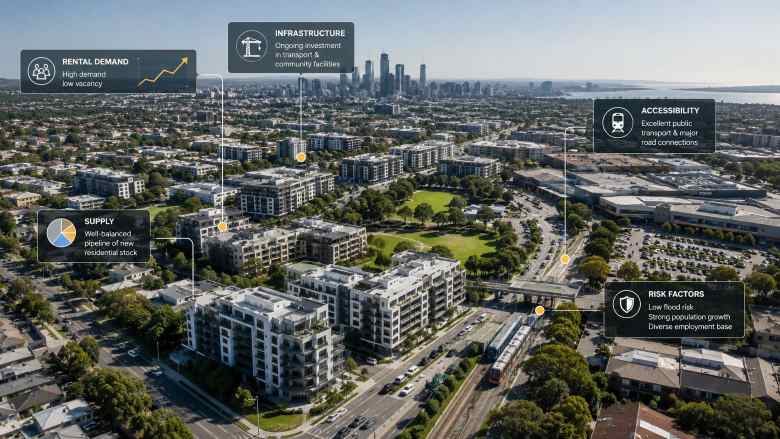
Infrastructure is one of the few forces that can change how a location feels over time. A better road connection can shorten a commute. A transit upgrade can make a neighborhood more useful to renters who do not want to rely on a car. Improved utilities can make development easier and maintenance less uncertain.
Investors should be careful with future promises. A planned project is not the same as a completed one. Many locations have been sold on a bridge, rail stop, or road widening that took years longer than expected.
Completed infrastructure is easier to price. The investor can see how people are already using the area. Leases, foot traffic, sale prices, and business activity show if the improvement has changed behavior.
Speculative infrastructure can still be valuable, but the purchase price should reflect the risk. If the deal only works after a public project is finished, the investor is carrying a timing bet. That may be acceptable for some buyers, but it should be named honestly before closing.
Risk Belongs in the Price
A location can look attractive until the risk side is priced properly. Flood exposure, wildfire history, insurance pressure, and heat can all affect long-term ownership. These conditions are no longer distant concerns for many property owners.
Risk is not only physical. Local taxes, short-term rental rules, permitting delays, and political pressure can change the return. A property that depends on one narrow operating strategy is more vulnerable when rules shift.
Due diligence should connect risk to the actual business plan. A long-term rental has different exposure from a vacation home. A warehouse has different site needs from a small apartment building. General market confidence is not enough.
The stronger investment location is the one where the buyer understands the trade-off. There may be risk, but the price, insurance, operating plan, and exit strategy have to account for it. When those pieces are honest, location becomes more than a slogan. It becomes the part of the investment that supports every other decision.
- Related Posts:
- Attractive, Secure, and Budget-Friendly Gate Designs for Long Driveways
- Can Smart Home Technology Make a Home More Attractive to Buyers?
- The Essential Guide to Daily Construction Reports: Tips and Best Practices
- 10 Best Essential Living Room Furniture items for your sweet home
- How Does Green Construction Add Value to Homes?
