
Last Updated on July 31, 2026 by Admin
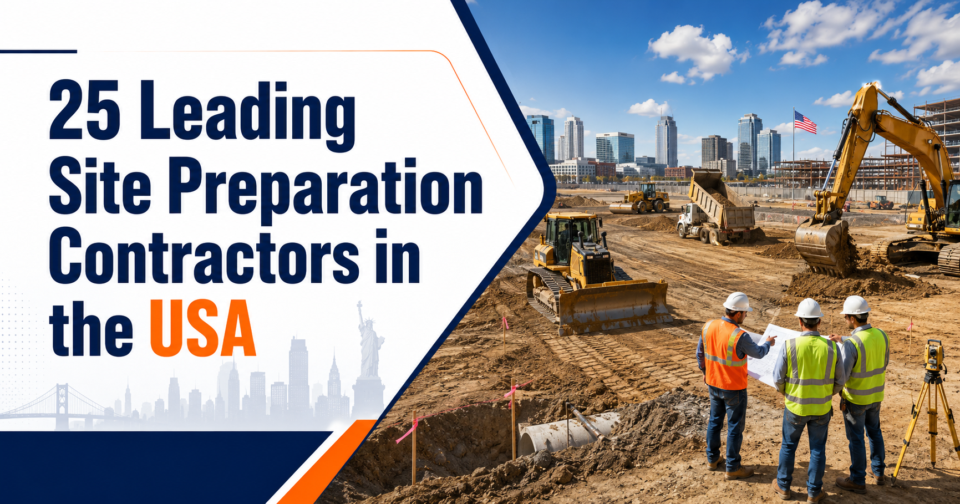
Site preparation contractors are specialty construction firms that make raw or previously developed land buildable. Their work combines land clearing, demolition, mass excavation, grading, earthmoving, soil stabilization, drainage, underground utility installation and erosion control. In U.S. federal statistics they fall under NAICS 238910, and they are typically the first trade on site and one of the last to finish. For a broader understanding of how these firms fit within the wider industry, see this overview of construction service types.
ConstructionCareerHub App is LIVE — built ONLY for construction careers. Don’t apply with a weak resume.
Get ATS-ready Resume Lab + Interview Copilot + Campus Placement Prep (resume screening, skill gaps, interview readiness) — in minutes & Other advanced features.
Explore Smarter Construction Career Tools →Quick check. Big impact. Start now.
Key takeaways
- Site preparation contractors handle clearing, demolition, excavation, grading, earthwork, dewatering, soil stabilization, underground utilities and stormwater controls — the scopes that determine whether a project starts on schedule.
- The 25 companies below were selected against published eligibility rules: U.S. operations, explicit sitework service lines on an official website, verifiable large-project experience, and at least two independent sources per company including one primary source.
- Capability varies sharply by region and ground conditions. A contractor that excels at Gulf Coast petrochemical earthwork is not automatically the right choice for a Boston deep-hole excavation or an Arizona basement shoring job.
- Trench safety, soil behavior, permitting and stormwater compliance drive real cost and schedule risk. OSHA’s trenching and excavation standards and EPA construction stormwater requirements apply to nearly every commercial site.
- This is an evidence-based editorial comparison, not a revenue league table. Most leading sitework firms are privately held and do not disclose comparable revenue, so no revenue estimates appear here.
- Inclusion is not an endorsement. Verify licensing, insurance, bonding, safety records and local availability before awarding any contract.
Table of Contents
What site preparation contractors do
The U.S. Census Bureau defines NAICS 238910, Site Preparation Contractors, as establishments primarily engaged in excavating and grading, earthmoving, land clearing, building and structural demolition, septic system installation, and renting construction equipment with an operator (excluding cranes). In practice the scope is broader than the classification suggests. For a full breakdown of contractor types in the construction industry, including how site preparation fits alongside general, specialty and trade contractors, see our separate guide.
A typical commercial sitework package includes several distinct operations, each with its own risk profile:
- Clearing and grubbing — removing trees, stumps, root mats and surface vegetation.
- Demolition — taking down existing structures, slabs, foundations and pavements, and managing the resulting debris.
- Mass excavation and embankment — moving bulk material to reach design elevations, balanced as cut and fill wherever possible.
- Rough and fine grading — shaping the site to tolerances a building pad, pavement or foundation can be built on.
- Soil stabilization — treating weak subgrade with lime, cement or mechanical methods so it can carry load.
- Earth retention and shoring — soldier piles and lagging, sheeting, secant or soil-mix walls that allow a deep excavation next to existing structures.
- Dewatering — lowering groundwater so excavation can proceed dry.
- Underground utilities — storm drainage, sanitary sewer, water services and duct banks.
- Erosion and sediment control — the physical measures required by a Stormwater Pollution Prevention Plan.
The terminology overlaps with excavation contractors, earthwork contractors, site development contractors, demolition contractors, underground utility contractors and heavy civil contractors. Many firms describe themselves using several of these labels. That overlap is genuine, but it has limits: a company that only locates utilities, only designs foundations, or only rents equipment is not a site preparation contractor in any meaningful procurement sense. For a wider view of the trade landscape, see this overview of the role civil contractors play in construction. Understanding related construction abbreviations like SWPPP, NPDES, and NAICS can also help when reviewing contractor scopes.
U.S. market context
Sitework demand tracks total construction activity. The U.S. Census Bureau’s monthly construction spending release dated July 1, 2026 estimated May 2026 total construction spending at a seasonally adjusted annual rate of $2,210.2 billion, with private nonresidential construction at $738.7 billion and public construction at $541.2 billion, including $150.6 billion for highways. Those three categories — private nonresidential, public infrastructure and highway work — account for most large sitework packages. For a full list of the largest construction companies in the United States driving this spending, see our rankings guide.
On the labor side, Bureau of Labor Statistics data extracted June 3, 2026 put employment across all specialty trade contractors (NAICS 238) at approximately 5.25 million in April 2026 on a preliminary seasonally adjusted basis, spread across roughly 599,000 private establishments as of the fourth quarter of 2025. The subsector is highly fragmented: even the largest sitework firms represent a small share of national capacity, which is why regional availability matters more than national rankings for most projects. The BLS also projects continued construction employment growth through 2033 in its Beyond the Numbers analysis, and the Associated General Contractors of America publishes state-level employment data useful for gauging local market tightness. For a deeper look at how hiring is evolving, see our analysis of U.S. construction employment trends.
Safety statistics explain why prequalification standards are strict. BLS recorded 608 fatal work injuries among specialty trade contractors in 2024 and a total recordable injury and illness rate of 2.3 cases per 100 full-time workers that year. Excavation and trenching carry disproportionate risk within that total, which is the reason 29 CFR 1926.651 imposes specific requirements for protective systems, access, and daily inspection by a competent person. Firms and workers looking to strengthen compliance should consider accredited OSHA training programs for construction.
Three demand drivers have reshaped the sitework market since 2020: hyperscale data centers, advanced manufacturing including semiconductor fabrication and battery plants, and logistics distribution. All three involve very large pads, compressed schedules and heavy earthmoving volumes, and several of the contractors below have restructured around them. For professionals looking to enter this high-growth segment, explore our guides to data center construction careers and hyperscale data center jobs in the USA.
Ranking methodology
Research was conducted and verified as of July 31, 2026.
Eligibility. A company was considered only if it operates in the United States, explicitly identifies site preparation, site development, sitework, excavation, grading, earthwork, clearing, demolition, underground utilities or soil stabilization on its official website, has verifiable commercial, industrial, infrastructure, institutional, energy or transportation experience, maintains an active official web presence, shows recent evidence of operations, and is supported by at least two credible sources — at least one of them primary.
Source hierarchy. Official company websites, project pages, press releases, SEC filings and federal registrations were treated as Tier 1. Engineering News-Record, AGC chapters, trade press and reputable regional business journals were treated as Tier 2. Contractor directories and subcontractor-billing listicles were used only to discover candidates, never as sole evidence for a claim.
Ranking criteria. Relevance and breadth of site preparation services (30%); verified project scale and track record (25%); geographic reach and service coverage (15%); ability to self-perform integrated scopes (15%); equipment, machine-control and operational capability (10%); publicly documented safety, environmental and source transparency (5%).
Why there are no scores. Comparable evidence does not exist for all 25 companies. Several are privately held and publish no safety statistics, equipment counts or financials. Publishing numerical scores would imply a precision the underlying data cannot support, so the list is presented as an editorial ordering of documented capability rather than a scored ranking.
Revenue. No private company revenue was estimated. Where a figure appears, it is attributed to a named source with its reporting year and its scope stated — total company, segment or parent group. Third-party contractor lists frequently mix reporting periods and attribute whole-corporation revenue to a single division; those figures were not reproduced.
Parent companies and subsidiaries. Corporate structures were checked before inclusion. Plateau Excavation and Petillo are both Sterling Infrastructure operating companies but are listed separately because they run distinct regional operations under their own brands, and that relationship is disclosed in each profile. Independence Demolition was excluded as a sister company of Independence Excavating within the DiGeronimo group to avoid double counting. Phillips & Jordan appears under its current name, Phillips Heavy, Inc.
What this list is not. It is an editorial comparison to support shortlisting and research. It is not a procurement recommendation, a licensing verification, or a substitute for bid-stage due diligence.
Comparison table: 25 leading site preparation contractors
| Rank | Company | Headquarters | Primary service region | Core site-preparation capabilities | Main project sectors | Best suited for | Official website |
|---|---|---|---|---|---|---|---|
| 1 | Plateau Excavation | Kennesaw, GA | Southeast | Mass earthwork, grading, clearing, storm drainage, site utilities | Data centers, advanced manufacturing, logistics, energy | Hyperscale campuses on compressed schedules | plateauexcavation.com |
| 2 | W.T. Byler Co., Inc. | Houston, TX | Texas and Gulf Coast | Clearing and grubbing, mass excavation and embankment, soil stabilization, site utilities, rail | Industrial, petrochemical, commercial, railroad | Large industrial and petrochemical site prep | wtbyler.com |
| 3 | Ames Construction | Burnsville, MN | Multi-region, U.S. | Site development, mass earthwork, utilities, environmental and reclamation | Mining, transportation, industrial, data centers, water | Very large multi-scope earthwork programs | amesconstruction.com |
| 4 | Allan Myers | Worcester, PA | Mid-Atlantic | Site development, mass excavation, utilities, paving, materials supply | Commercial, transportation, water, federal | Self-performed sitework with in-house materials | allanmyers.com |
| 5 | Independence Excavating | Independence, OH | Midwest and Mid-Atlantic | Site development, demolition, sheeting and shoring, dewatering, remediation, crushing | Industrial, energy, sports, environmental, highway | Brownfield redevelopment and complex urban excavation | indexc.com |
| 6 | Beaver Excavating Company | Canton, OH | Ohio Valley and Midwest | Mass earthmoving, site civil, underground utilities, demolition, concrete | Commercial, industrial, heavy highway, energy | High-volume earthwork on highway and industrial sites | beaverexcavating.com |
| 7 | Phillips Heavy, Inc. | Knoxville, TN | National | Land clearing, mass earthwork, soil stabilization, dewatering, erosion control, utilities | Water and reservoirs, mining, industrial, power, disaster recovery | Difficult terrain and very large earth volumes | phillipsinc.com |
| 8 | Emery Sapp & Sons | Columbia, MO | Midwest and South Central | Excavation, grading, underground utilities, paving, structures | Commercial, e-commerce, transportation, aviation, healthcare | Turnkey site packages across several states | emerysapp.com |
| 9 | Petillo Incorporated | New Jersey | Northeast and Mid-Atlantic | Site excavation, utilities, erosion control, retaining walls, environmental remediation | E-commerce, distribution, commercial, industrial | East Coast distribution and fulfillment sites | petillo.com |
| 10 | Veit & Company, Inc. | Rogers, MN | Upper Midwest and beyond | Earthwork, demolition, foundations, utilities, dredging, remediation | Commercial, industrial, energy, municipal | Combined demolition and sitework scopes | veitusa.com |
| 11 | H&K Group, Inc. | Skippack, PA | Eastern PA, NJ, DE | Clearing, bulk excavation, rock drilling, utilities, curbing and paving | Commercial, land development, transportation, water | Land development with integrated materials supply | hkgroup.com |
| 12 | D.H. Griffin Companies | Greensboro, NC | Southeast and national | Demolition, site development, environmental remediation, infrastructure | Industrial, power, manufacturing, commercial | Demolition-led site clearance and redevelopment | dhgriffin.com |
| 13 | Brandenburg Industrial Service Co. | Chicago, IL | National and Puerto Rico | Demolition, soil remediation, site preparation, utility relocation | Heavy industry, power generation, commercial real estate | Plant closure and contaminated-site preparation | brandenburg.com |
| 14 | Ryan Incorporated Central | Janesville, WI | Midwest and Mid-Atlantic | Mass excavation, site grading, landfill construction and capping | Industrial, power, solar, environmental, commercial | Large-volume grading and landfill work | ryancentral.com |
| 15 | J. Derenzo Company | Brockton, MA | New England | Site clearing, deep-hole excavation, earth retention, dewatering, utilities | Commercial, institutional, urban mixed-use | Tight urban excavation in Greater Boston | jderenzo.com |
| 16 | W. L. French Excavating Corp. | North Billerica, MA | New England | Mass excavation, soil and waste management, remediation, heavy utilities | Commercial, institutional, transportation, municipal | Sites with contaminated or regulated soils | wlfrench.com |
| 17 | Peterson Contractors, Inc. | Reinbeck, IA | Iowa and multi-state | Heavy earthwork, sitework, ground improvement, soil stabilization, retaining walls | Transportation, industrial, commercial, energy | Earthwork combined with ground improvement | pcius.com |
| 18 | Saiia Construction Company LLC | Birmingham, AL | Southeast and multi-state | Site preparation, mass grading, CCR management, stormwater, erosion control | Power generation, mining, pulp and paper | Industrial and coal-ash site work | saiia.com |
| 19 | Reliable Contracting Company | Millersville, MD | Maryland and Washington, D.C. area | Grading and excavation, utilities, sediment control, asphalt and aggregates | Commercial, government, aviation, residential development | Maryland commercial and federal site development | reliablecontracting.com |
| 20 | Buesing Corp. | Phoenix, AZ | Arizona and Southwest | Mass excavation, mass grading, shoring, micropiles, shotcrete, crushing | Data centers, semiconductor, commercial, mining, municipal | Basement excavation and desert site grading | buesingcorp.com |
| 21 | Keller North America | U.S. operations of Keller Group plc | United States and Canada | Ground improvement, earth retention, groundwater control and dewatering, deep foundations | Commercial, industrial, infrastructure, power | Sites with weak, liquefiable or variable soils | keller-na.com |
| 22 | Malcolm Drilling Company, Inc. | San Francisco, CA | National | Excavation support, dewatering, ground improvement, slope stabilization, cut-off walls | Commercial, transportation, aviation, institutional | Deep shored excavations below the water table | malcolmdrilling.com |
| 23 | ASRC Construction | Anchorage, AK | Alaska and selected Lower 48 | Site and infrastructure development, heavy civil, utilities, materials | Federal, aviation, healthcare, utilities, education | Remote and Arctic-condition site development | asrcconstruction.com |
| 24 | Ruttura & Sons Construction Co. | West Babylon, NY | Long Island and New York metro | Excavation, demolition, storm drainage, sanitary and water services, site concrete | Commercial, institutional, municipal | Multi-phase sitework in the New York metro area | ruttura.com |
| 25 | Joseph J. Albanese, Inc. | Santa Clara, CA | Northern California and Mountain West | Grading, paving and excavation, demolition, site and structural concrete | Commercial, data centers, public works, institutional | Bay Area projects needing sitework plus concrete | jjalbanese.com |
No revenue figures appear in this table. Comparable, same-year, sitework-specific revenue is not publicly available for most of these companies.
Leading site preparation contractors: company profiles
Each profile below covers headquarters, service area, parent structure, documented capabilities, verified project examples, distinguishing factors and independent corroboration. For context on how site preparation fits within the broader construction project life cycle, see our separate guide.
1. Plateau Excavation
Headquarters: Kennesaw, Georgia, with shop and logistics operations in Austell, Georgia and an office in Winter Garden, Florida.
Service area: Southeastern United States.
Parent company: Sterling Infrastructure, Inc. (Nasdaq: STRL), within its E-Infrastructure Solutions segment.
Plateau describes itself as a complete sitework provider for large-scale development, focused on hyperscale data centers, advanced manufacturing, logistics and distribution, and energy infrastructure. Its stated capabilities cover mass earthmoving, grading, clearing, storm drainage, erosion control and site utilities delivered from preconstruction through completion. According to Sterling Infrastructure, Plateau is the largest excavating contractor in the southeastern United States and serves blue-chip customers across the data center, e-commerce, distribution and warehousing sectors.
Sterling’s E-Infrastructure project descriptions include site development for a global social media company’s data center expansion involving duct bank excavation, storm drain installation and asphalt paving, and a 106-acre retail and entertainment development in Georgia requiring earthwork, rock blasting, storm drain and wet utility installation and retaining wall construction.
What distinguishes Plateau is fleet depth concentrated in one region. The company states it operates one of the largest earthmoving fleets in the Southeast and can sustain production across multiple megaprojects simultaneously. That makes it well suited to campus-scale developments where a single missed grading milestone delays vertical construction. Official website. Independent corroboration: Sterling Infrastructure E-Infrastructure Solutions.
2. W.T. Byler Co., Inc.
Headquarters: Houston, Texas, with a San Antonio location.
Founded: 1973, by Troy Byler.
Service area: Texas and the Gulf Coast, with railroad work over a wider footprint.
Byler is a full-service site development and railroad construction contractor. Company service pages list mass excavation and embankment, clearing and grubbing, soil stabilization, underground piping, industrial concrete, asphalt paving, and turnkey Class I mainline railroad construction and maintenance. The combination of earthwork and rail self-performance is unusual and directly relevant to industrial sites that require rail service.
Company project records describe civil site preparation and railserve track for the Golden Triangle Polymers facility in Orange, Texas, a project the company identifies as an $8.5 billion development. A company article states that Byler handles 60 to 80 projects annually with a workforce of up to 1,000.
Byler suits heavy industrial and petrochemical site preparation, particularly where expansive clay soils require chemical stabilization and where rail infrastructure forms part of the scope. Official website. Independent corroboration: company profile listing site development, mass excavation and soil stabilization specialties.
3. Ames Construction
Headquarters: Burnsville, Minnesota.
Founded: 1962, originally as a small family earthwork contractor.
Service area: Multiple U.S. regions, with a concentration in the West and Midwest.
Ames is an employee-owned heavy civil and industrial general contractor that self-performs the majority of its work. Its dedicated site development practice covers mass earthwork, utilities, environmental remediation and reclamation across mining, transportation, industrial, water resources and rail markets.
Ames’ site development project summaries include preparing a 1,000-acre pad and transportation network at a megasite, sitework for multiple data centers under strict schedules, a tailings storage facility completed in nine months for an Arizona mining operation, and sitework for the Minneapolis stadium project. ENR’s 2024 Top 400 Contractors list placed Ames at number 62, according to company materials. The company was also honored by AGC of America with 2025 Build America awards including the Federal and Heavy New category for the Fargo-Moorhead Area Diversion Inlet Structure.
Ames is well suited to very large multi-scope earthwork programs where a single contractor is expected to carry earthwork, structures and utilities together. Official site development page. Independent corroboration: AGC of America Build America award listings.
4. Allan Myers
Headquarters: Worcester, Pennsylvania.
Founded: 1939.
Service area: Mid-Atlantic, from the Philadelphia region to Richmond.
Allan Myers describes itself as the largest self-performing heavy civil contractor and construction materials supplier in the Mid-Atlantic. Site development is one of its five named markets alongside design-build, transportation, water, and asphalt and aggregate production. Company materials cite more than 2,800 employees, eight regional offices and 24 asphalt and aggregate plants.
Company project records describe the Atwater development as a quarry restoration and sitework project involving approximately one million cubic yards of excavation and rock work, and separately list site preparation and water pipeline scopes including mass excavation.
The distinguishing factor is vertical integration. Owning quarries and asphalt plants gives Allan Myers control over aggregate supply and haul distance, two of the largest variables in sitework pricing. It is a strong fit for Mid-Atlantic commercial and public projects where material supply risk is a concern. Official website. Independent corroboration: industry association member profile confirming founding year and regional footprint.
5. Independence Excavating, Inc.
Headquarters: Independence, Ohio.
Founded: 1956, by the DiGeronimo family.
Service area: Midwest and Mid-Atlantic, with project work in additional states.
Independence Excavating, known as IX, is a DiGeronimo company covering site development, demolition, heavy industrial work, environmental remediation, sheeting and shoring, dewatering, concrete paving and aggregate crushing and recycling. Company materials describe an average workforce of around 600 and four recycling yards producing over four million tons of material annually.
Company project records include phased demolition, excavation and site preparation for the Jacksonville stadium renovation; large-scale demolition and site preparation at the former Homer City Generating Station to advance redevelopment; and conversion of the former Weirton Steel Mill site into a battery manufacturing campus, which the company reports involved complex subsurface conditions.
IX is a strong candidate for brownfield redevelopment, where demolition, contaminated material handling and excavation must be sequenced by one contractor. Note that Independence Demolition operates as a related DiGeronimo company; it was not listed separately here. Official website. Independent corroboration: context on the heavy equipment used for this class of work and regional safety recognition reported by the Constructors Association of Western Pennsylvania.
6. The Beaver Excavating Company
Headquarters: Canton, Ohio.
Founded: 1953, by William “Don” Sterling.
Service area: Ohio, Pennsylvania, West Virginia and the wider Midwest.
Beaver is a third-generation family-owned mass earthmoving and site development contractor. Its stated services span earthwork, highway construction, cast-in-place concrete, underground utilities, demolition and site civil work for commercial, industrial and heavy highway clients. Its federal contractor registration lists NAICS 238910, Site Preparation Contractors, among its classifications.
Company history records describe an integrated joint venture award for the Portsmouth Bypass, Ohio’s first public-private partnership highway contract, described as a 16-mile four-lane limited-access highway with 27 bridges and nearly 20 million cubic yards of earthwork at a contract value over $450 million.
Beaver reports a first-place national finish in the AGC of America and Willis Towers Watson Construction Safety Excellence Awards, Federal and Heavy Division, in 2017 — its fifth national first-place award. That documented safety record, combined with very high earthwork volumes, makes it well suited to large highway and industrial grading packages. Official company history. Independent corroboration: federal contractor registration records listing NAICS 238910.
7. Phillips Heavy, Inc. (formerly Phillips & Jordan)
Headquarters: Knoxville, Tennessee.
Founded: 1952, as a land clearing firm.
Service area: National, with regional offices in California, Florida, South Carolina and Colorado.
Name change: Phillips & Jordan, Inc. rebranded its heavy civil operations as Phillips Heavy, Inc.; the rebrand was completed internally in June 2025 and announced publicly on October 9, 2025. The parent organization now operates as Phillips Infrastructure Corp.
Phillips Heavy’s stated capabilities map closely to site preparation: ground improvement for demanding soils, precision dewatering, soil stabilization, engineered erosion control, large-volume earthmoving and underground utility installation. Company project pages list complete site development for an Amazon distribution center and the Barney’s Canyon mine reclamation project.
The October 2025 announcement states the Phillips enterprise employs more than 1,800 people and operates 750 pieces of heavy equipment, and that the company has moved hundreds of millions of cubic yards of earth for reservoirs, industrial and commercial infrastructure, mines and renewable energy projects.
Phillips is worth considering where terrain is genuinely difficult — steep, wet, remote or geotechnically poor — and where a single contractor must carry earthmoving, water management and restoration. Buyers should note the name change when reviewing older references. Official company page. Independent corroboration: Business Wire rebrand announcement, October 9, 2025.
8. Emery Sapp & Sons, Inc.
Headquarters: Columbia, Missouri, with offices in Kansas City, Springfield and Joplin.
Founded: 1972.
Service area: Missouri, Kansas, Oklahoma, Arkansas and Texas.
Emery Sapp & Sons is a 100% employee-owned civil contractor offering turnkey site development. Company materials describe expertise in excavation, grading, underground utilities, bridge construction, and asphalt and concrete paving, and cite more than 1,500 employee-owners along with one of the larger heavy equipment fleets in the region.
Regional trade coverage reports that the company’s work spans airports, hospitals, apartment complexes and large e-commerce fulfillment sites, and that it positions itself as a complete site contractor able to assist developers at the budgeting and site selection stage. The company also identifies stringless paving, hydro excavation and chemical rock fracturing among its adopted techniques.
Employee ownership and early-stage preconstruction involvement are the differentiators. It is well suited to multi-state developers who want one civil contractor carrying earthwork through paving. Official website. Independent corroboration: Springfield Business Journal profile.
9. Petillo Incorporated
Headquarters: New Jersey.
Founded: 1994, by Michael Petillo.
Service area: Northeast and Mid-Atlantic.
Parent company: Sterling Infrastructure, Inc., which closed its acquisition of Petillo on December 30, 2021.
Petillo is a specialty site development contractor focused on e-infrastructure work. Sterling’s acquisition materials describe its service profile as utilities contracting, site excavation, environmental remediation, erosion control and retaining walls, water management and distribution, and concrete installation and repair, supported by more than 300 field employees at the time of acquisition.
Sterling’s investor announcement stated Petillo’s revenue at approximately $212 million with a 2017 to 2021 compound revenue growth rate of about 29%. That figure is a 2021 total-company estimate disclosed at acquisition and should not be read as current sitework revenue.
Petillo’s value is regional depth on East Coast distribution, fulfillment and commercial sites. Sterling’s project examples include a million-square-foot non-sortable fulfillment center in Montgomery, New York requiring significant grading, storm drain and underground utility installation, and a precast arch bridge at the entrance. Official website. Independent corroboration: Sterling acquisition announcement, January 2022.
10. Veit & Company, Inc.
Headquarters: Rogers, Minnesota.
Founded: 1928, by Frank Veit.
Service area: Upper Midwest, with specialty contracting work reported across a wider multi-state footprint.
Veit is a third-generation, privately held specialty contractor. Its stated services include earthwork, demolition, foundations, utilities, marine and diving services, hydraulic dredging, industrial cleaning, cured-in-place pipelining and environmental remediation, supported by an affiliated waste management operation.
Company project records describe commercial site preparation for a 750,000-square-foot distribution center in Lakeville, Minnesota under contract to Ryan Companies, and earthwork, utilities, demolition, driven piling and earth retention for an apartment and parking ramp development in Minneapolis. The company also has a documented history of large-scale explosive demolition.
Veit is a good fit where demolition, disposal and sitework are one continuous scope, since its own disposal and recycling network shortens haul chains. Official project listings. Independent corroboration: published company history documenting founding and subsidiary structure.
11. H&K Group, Inc.
Headquarters: Skippack, Pennsylvania.
Founded: 1968.
Service area: Eastern Pennsylvania, New Jersey and Delaware.
H&K Group delivers site and land development through ten affiliated contracting companies, supported by more than 80 operations including quarries, asphalt plants and concrete facilities. Its site and land development page states it handles every phase from initial clearing and bulk excavation through curbing, paving and retaining wall installation.
One capability worth noting for rocky sites: H&K’s Drilling Division operates mobile track drill rigs used for select and mass rock excavation as well as test borings and bedrock profiling. Few sitework contractors carry that in-house.
H&K is well suited to Mid-Atlantic land development where rock is likely and where aggregate and asphalt supply matters. The U.S. Geological Survey has ranked the company among the top 100 crushed stone producers in the United States, according to company materials citing trade coverage. Official site and land development page. Independent corroboration: industry directory listing confirming trade association membership and service scope.
12. D.H. Griffin Companies
Headquarters: Greensboro, North Carolina.
Founded: 1959; D.H. Griffin Wrecking Co., Inc. incorporated in 1967.
Service area: Southeast and nationally, with operations reported across roughly ten states.
D.H. Griffin is a vertically integrated group covering contract demolition, environmental remediation, infrastructure and site development, industrial contracting and scrap recycling. Company materials state a fleet of more than 1,200 pieces of equipment.
According to the company, D.H. Griffin Wrecking ranked fourth among demolition companies in the United States in Engineering News-Record’s 2024 rankings, and its affiliate DARI ranked thirteenth in asbestos abatement that year. The company also states that DHG Infrastructure was selected as site developer for what it describes as the world’s largest silicon carbide materials facility.
Where a project begins with an existing structure, D.H. Griffin’s combination of demolition scale, abatement capability and in-house site development is the relevant strength. Official website. Independent corroboration: Demolition & Recycling International coverage of the company’s founding and growth.
13. Brandenburg Industrial Service Company
Headquarters: Chicago, Illinois.
Founded: 1968.
Service area: Multiple U.S. regional offices and Puerto Rico.
Brandenburg self-performs demolition, environmental remediation, asbestos abatement, hazardous material removal, soil remediation, asset recovery and site preparation. Company materials cite more than 800 full-time permanent employees and a heavy equipment fleet valued in excess of $150 million.
According to the company, Brandenburg was the first demolition contractor to successfully complete OSHA’s Challenge Program and to be certified as a Star member of OSHA’s Voluntary Protection Programs — the highest level of recognition under that scheme. Independent industry directory listings repeat the same self-performance profile including site preparation and utility relocation.
Brandenburg is best suited to industrial plant closures and contaminated sites where demolition, remediation and site preparation must be delivered under one contract with strict operational constraints. Official services page. Independent corroboration: National Demolition Association industry buyers guide listing.
14. Ryan Incorporated Central
Headquarters: Janesville, Wisconsin, with offices in Elgin, Illinois and Hagerstown, Maryland.
Founded: 1884.
Service area: Midwest and Mid-Atlantic, with completed projects reported in 25 states.
Ryan Incorporated Central began building railroad embankments with mule teams and became a full-service grading contractor by the 1940s, including early work at what became O’Hare Airport. The company describes itself today as one of the nation’s premier mass excavation and sitework contractors, with experience in commercial, power and industrial sitework, municipal and industrial landfill construction and capping, solar development grading, and golf course construction.
Landfill construction and capping is a specialized subset of earthwork involving liner systems, precise slope control and long-term regulatory obligations, and relatively few sitework contractors carry that experience alongside general grading.
Ryan is worth considering for high-volume grading, landfill cells and utility-scale solar site preparation across the Midwest and Mid-Atlantic. Official company history. Independent corroboration: Forward Janesville chamber member listing.
15. J. Derenzo Company
Headquarters: Brockton, Massachusetts.
Founded: Post-World War II; the company states more than 75 years of operation.
Service area: New England, concentrated in Greater Boston.
J. Derenzo describes itself as first boots on the ground and last boots on the ground: clearing and grading, excavation, earth retention and foundation systems at the start, then curbing, landscaping and final utility connections at the end. Its excavation practice covers deep-hole excavation and earth support including up-down construction, slurry walls, soldier piles and lagging, soil mixing and sheeting, together with dewatering system design coordination.
Related companies — JDC Demo & Abatement, Allied Pile Driving and Boston Environmental — extend the group into surveying, pile driving, soil remediation, abatement and demolition. The company is a listed Division 2 Site Work member of the Associated General Contractors of Massachusetts.
Its clearest strength is congested urban excavation where adjacent structures, shallow groundwater and limited laydown space make earth support the controlling scope. Official website. Independent corroboration: AGC Massachusetts member listing.
16. W. L. French Excavating Corporation
Headquarters: North Billerica, Massachusetts.
Founded: 1972, by William L. French Sr.
Service area: New England, centered on Greater Boston.
W. L. French is a union site contractor and soil management firm whose services include mass excavation, site and environmental remediation, heavy utility construction, soil and waste management, asbestos abatement and municipal services. A Massachusetts recycling directory listing describes licensed site professionals and environmental staff coordinating loading, manifesting, permitting, characterization and transportation of over 100 trucks daily and more than one million tons of soil annually.
Published trade coverage describes a project where the company excavated a site hole up to 35 feet deep supported by internally braced steel sheeting, disposed of 75,000 tons of urban fill and natural soils, relocated an 18-inch sewer and 36-inch drain, installed new water, sewer, drain and electrical utilities, and reconstructed an access road and parking lot, working with general contractor Walsh Brothers.
W. L. French is a strong candidate wherever regulated, contaminated or reportable soils will be generated, since characterization and disposal logistics — not digging — usually control cost on those sites. Official website. Independent corroboration: RecyclingWorks Massachusetts database listing.
17. Peterson Contractors, Inc.
Headquarters: Reinbeck, Iowa.
Founded: Mid-1960s. Company materials cite 1965; a regional chamber listing cites 1964 with Iowa incorporation in 1966.
Service area: Iowa and multiple states; the company reports a presence in more than half of the continental United States.
Peterson Contractors, known as PCI, combines conventional heavy earthwork and sitework with ground improvement. Listed services include heavy earthwork, site work, bridges and box culverts, retaining walls, demolition, material processing, and specialty work covering intermediate and deep foundations, micropiles and soil stabilization. PCI is a certified Geopier installer. Professionals interested in the geotechnical side of this work may find our geotechnical engineering interview guide useful.
The company states a fleet of over 1,500 pieces of large construction equipment, use of GPS machine control, and prime or subcontractor roles on more than 15,000 projects, with over one million safe work hours annually and a safety modifier it describes as consistently below the industry standard.
PCI is well suited to sites where earthwork and ground improvement are interdependent — for example a fill pad over compressible soils where rigid inclusions or aggregate piers must be installed as part of the grading sequence. Contractor licensing records list NAICS 238910 among its classifications. Official website. Independent corroboration: Geopier licensee listing.
18. Saiia Construction Company LLC
Headquarters: Birmingham, Alabama.
Founded: 1946, as Birmingham Excavating Co., by Sam Saiia.
Service area: Southeastern United States, with experience reported in 11 states.
Parent company: MasTec, Inc. Saiia was acquired by Infrastructure and Energy Alternatives in 2018; MasTec acquired IEA and its affiliated companies in 2022, placing Saiia within MasTec’s Clean Energy and Infrastructure segment.
Saiia is an industrial heavy civil contractor serving power generation, mineral and aggregate mining, and pulp and paper markets. Its stated services include site preparation, coal combustion residuals management, landfill construction and management, mass grading and earthwork, stormwater management and erosion control. Company materials cite more than 630 pieces of construction machinery and over 500 employees.
Coal combustion residuals work — dewatering impoundments, dry-ash stacking, dust control, water treatment and closure turf systems — is a regulated niche that overlaps heavily with earthwork and stormwater compliance.
Saiia is worth considering for industrial site preparation at operating plants, where work must proceed alongside live production. Official about page. Independent corroboration: published company profile documenting the IEA and MasTec ownership sequence.
19. Reliable Contracting Company, Inc.
Headquarters: Millersville, Maryland.
Founded: 1928, by brothers Bill and Frank Baldwin; incorporated in 1942.
Service area: Central and southern Maryland and the Washington, D.C. area.
Reliable describes itself as one of Maryland’s largest sitework contractors, citing more than 400 employees, 100 trucks and 250 pieces of earthmoving equipment. Its Grading and Excavation Division performs earthmoving for commercial, residential and government development sites; the company also operates utility and concrete divisions and a NAPA-recognized asphalt plant in Gambrills, Maryland.
Two details stand out for procurement teams. The company states its office and field managers hold Maryland Department of the Environment sediment control certification, which is directly relevant to erosion and stormwater compliance. It also states a mass grading production capability of 10,000 cubic yards of earth per day — a company claim, not an independently verified figure.
Reliable is a practical shortlist candidate for Maryland commercial, federal and airport-adjacent site development where local permitting knowledge and in-house asphalt supply reduce schedule risk. Official grading and excavation page. Independent corroboration: industry directory listing confirming founding year and fleet scale.
20. Buesing Corp.
Headquarters: Phoenix, Arizona.
Founded: 1965 in Minnesota by Jerry Buesing and his brother; operations relocated to Phoenix by 1988.
Service area: Arizona and the Southwest.
Buesing is an employee-owned civil contractor whose listed services include clearing and grubbing, mass excavation, mass grading, backfill, shoring and earth retention, tie-backs and micropiles, shotcrete stabilization, foundation drilling, dewatering support, crushing and screening of native soil, concrete and asphalt recycling, and site concrete. Company materials cite more than 300 employees.
Company project records include work at a 1,200-acre North Phoenix development the company describes as a new tech corridor anchored by a microchip manufacturing facility, and a Phoenix Convention Center project where Buesing installed a permanent tieback retaining wall and excavated for a new underground basement addition.
The combination of mass excavation and self-performed shoring is the differentiator: on urban basement projects it removes the interface risk between two separate subcontractors. Buesing also lists mining support services including leach pads and reclamation. Official about page. Independent corroboration: Construction & Demolition Recycling trade profile.
21. Keller North America
Headquarters: U.S. operations of Keller Group plc, which is headquartered in London and listed on the London Stock Exchange.
Service area: United States and Canada.
Keller is included because ground conditions, not soil volume, are the binding constraint on many sites. Keller North America’s stated specialisms are ground improvement, deep foundations, earth retention and groundwater control and dewatering, with techniques including dynamic compaction, rigid inclusions, vibro replacement, wet and dry soil mixing, cutter soil mixing, wick drains and jet grouting.
Keller Group plc describes itself as the world’s largest geotechnical specialist contractor, with around 10,000 staff and annual revenue of approximately £3 billion. Reporting on the group’s 2024 annual results by Ground Engineering in April 2025 stated that Keller’s North America revenue increased 4.2% to £1.78 billion, with underlying operating profit in the region up 16.1% to £190 million. Those are regional segment figures for the whole North American business, not site preparation revenue.
Keller is well suited to projects where soft, liquefiable, variable or contaminated ground must be improved before a pad or foundation can be built, and where a design-build geotechnical solution can reduce excavation quantities. Official website. Independent corroboration: Keller Group plc preliminary results for the year ended 31 December 2025.
22. Malcolm Drilling Company, Inc.
Headquarters: San Francisco, California.
Founded: 1962.
Service area: National, with locations across the United States.
Malcolm’s core services relevant to site preparation are excavation support systems, dewatering, ground improvement, slope stabilization, underpinning and cut-off walls, alongside deep foundation work. The company offers design-build delivery, which allows shoring and dewatering to be engineered together rather than bid as separate scopes.
Company project records describe a downtown San Francisco development on a 275-by-170-foot site requiring a 40-foot shored excavation through fill, dune sand and marsh deposits, delivered as a design-build shoring system using deep soil mixing walls, slant-drilled underpinning piles with jet grout infills and tie-backs, with internal bracing on the street frontage where tie-backs would have conflicted with transit tunnels, and dewatering by ten wells inside the excavation plus five recharge wells. Another project involved sixteen deep dewatering well systems with localized drawdown tuned to municipal discharge limits.
Malcolm is a strong candidate for deep excavations below the water table in dense urban settings, particularly where discharge permitting constrains dewatering. Official website. Independent corroboration: published trade profile documenting founding year, service range and fleet investment.
23. ASRC Construction
Headquarters: Anchorage, Alaska.
Service area: Alaska, with selected work in the Lower 48 and international markets.
Parent company: Arctic Slope Regional Corporation, an Alaska Native regional corporation incorporated in 1972.
ASRC Construction provides general contracting, construction management, design-build, site and infrastructure development and materials procurement across four service areas: vertical buildings, heavy civil construction, utility and infrastructure systems, and building materials. Its civil division has decades of experience building runways, roads, highways and bridges for federal, state, municipal and private clients, including work at the northernmost airport in the United States.
The relevant capability here is logistics rather than volume. Remote Alaskan site development involves barge windows, seasonal shutdowns, permafrost considerations and self-supplied materials — constraints that rule out most contractors regardless of fleet size. Company project listings include a K-12 school replacement in Napakiak involving a sewage lagoon, airport realignment and resurfacing work, and a barge landing access road.
A caution on figures: third-party contractor lists sometimes attribute Arctic Slope Regional Corporation’s whole-company revenue to its construction unit. ASRC operates across government services, energy, industrial services and construction, and corporate revenue does not represent site preparation activity. Official civil services page. Independent corroboration: Arctic Slope Regional Corporation construction operations page.
24. Ruttura & Sons Construction Co., Inc.
Headquarters: West Babylon, New York, with a Farmingdale address in company records.
Founded: The company describes four generations of family ownership and roughly a century in business.
Service area: Long Island and the New York metropolitan area.
Ruttura & Sons performs demolition, excavation, storm drainage, sanitary systems, water services and all phases of cast-in-place concrete, and describes itself as a multi-phase site work contractor. The company’s stated rationale for combining excavation and concrete under one contract is to remove the coordination burden that arises when a client must referee between separate site excavators and concrete trades.
That single-source model is the main reason to consider the firm on New York metro projects, where site constraints, union coordination and municipal permitting can make interface management the largest schedule risk. Company materials note continued expansion of excavation and site work capabilities.
Documentation is thinner than for larger firms on this list. The official website is dated and does not publish a detailed project portfolio, so buyers should request current project references and license verification directly. Official website. Independent corroboration: Bloomberg company profile confirming service lines.
25. Joseph J. Albanese, Inc.
Headquarters: Santa Clara, California.
Founded: 1955, by Joseph “Joe” Albanese; now led by third-generation CEO Phillip Albanese.
Service area: Northern California, plus Mountain West operations serving Idaho, Utah, Montana, the Sacramento Valley and Nevada through affiliated companies.
Albanese is included with a stated caveat: structural and site concrete is its largest business line. It is listed here because grading, paving and excavation and demolition are named, self-performed service lines with documented project use, not incidental offerings. Company service listings cover grading, paving and excavation, demolition, structural and site concrete, shotcrete, concrete pumping, sawcutting and core drilling, and virtual construction.
Company project records include site concrete work at Levi’s Stadium in Santa Clara and a Santa Clara data center project delivered with grading and paving, structural concrete, site concrete, shotcrete, concrete pumping and sawcutting. Public works records list bridge, culvert, road and emergency construction with excavation, demolition and grading scopes.
Albanese is worth considering on Bay Area projects where a single subcontractor carrying grading, demolition and concrete reduces interface risk. Buyers seeking a pure earthwork specialist for a large greenfield pad should weigh that against contractors whose primary business is bulk excavation. Official website. Independent corroboration: AGC of California member listing.
Regional shortlist of site preparation companies
Geographic coverage below reflects what each company states on its own website. Where a firm reports project experience in multiple states without claiming nationwide coverage, it is grouped by its stated home region. For broader company lists by region, see our rankings of civil engineering companies in the US and top commercial construction companies in the USA.
Northeast
- J. Derenzo Company — Greater Boston deep excavation and earth retention.
- W. L. French Excavating — New England mass excavation and regulated soil management.
- Petillo Incorporated — Northeast and Mid-Atlantic e-infrastructure site development.
- Ruttura & Sons Construction — Long Island and New York metro multi-phase sitework.
Mid-Atlantic
- Allan Myers — Philadelphia to Richmond, self-performed civil with in-house materials.
- H&K Group — Eastern Pennsylvania, New Jersey and Delaware land development.
- Reliable Contracting — Central and southern Maryland and the D.C. area.
- Ryan Incorporated Central — Mid-Atlantic operations from its Hagerstown, Maryland office.
Southeast and Gulf Coast
- Plateau Excavation — Southeast data center, manufacturing and logistics sitework.
- D.H. Griffin Companies — demolition-led site clearance and redevelopment.
- Saiia Construction — industrial and power-sector site preparation.
- Phillips Heavy — Knoxville-based with national reach and Southeast concentration.
Midwest
- Independence Excavating — brownfield and heavy industrial sitework.
- Beaver Excavating Company — high-volume earthwork across the Ohio Valley.
- Veit & Company — Upper Midwest demolition and earthwork.
- Ryan Incorporated Central — mass excavation, landfills and solar site grading.
- Emery Sapp & Sons — Missouri-based turnkey civil across five states.
- Peterson Contractors — earthwork with ground improvement.
- Brandenburg Industrial Service — Chicago-based industrial demolition and site preparation.
Texas and Southwest
- W.T. Byler Co. — Gulf Coast industrial and petrochemical site development plus rail.
- Buesing Corp. — Arizona mass excavation, grading and shoring.
Western United States
- Joseph J. Albanese — Northern California and Mountain West grading, demolition and concrete.
- Malcolm Drilling — San Francisco headquarters, excavation support and dewatering nationally.
- ASRC Construction — Alaska site and infrastructure development.
Multi-region and national
- Ames Construction — self-performing heavy civil and industrial contractor across multiple U.S. regions.
- Phillips Heavy — registered in all 50 states, with work performed in more than 40 states over the past decade.
- Keller North America — geotechnical specialist across the United States and Canada.
- Brandenburg Industrial Service — regional offices across the U.S. and Puerto Rico.
- D.H. Griffin Companies — operations reported across roughly ten states.
Best suited by project type
Each suggestion below is tied to a documented capability, not to a general reputation. Understanding how these specialties map to construction job titles and roles can help procurement teams identify the right personnel within each firm.
- Mass excavation: Beaver Excavating, Ryan Incorporated Central, W.T. Byler and Buesing Corp. all document very high earthmoving volumes and dedicated mass excavation service lines.
- Industrial site development: W.T. Byler, Saiia Construction, Independence Excavating and Ames Construction each publish industrial project records at operating plants and heavy manufacturing sites. For a wider list of firms in this space, see the top EPC companies in the USA.
- Commercial developments: Emery Sapp & Sons, H&K Group, Reliable Contracting and Allan Myers offer turnkey commercial packages from clearing through paving.
- Highways and infrastructure: Ames Construction, Allan Myers, Beaver Excavating and Emery Sapp & Sons all hold documented DOT and federal transportation experience.
- Underground utilities: Petillo, Reliable Contracting, Veit & Company and Ruttura & Sons list storm drainage, sanitary and water services as self-performed scopes.
- Demolition and brownfield preparation: D.H. Griffin, Brandenburg Industrial Service, Independence Excavating and W. L. French combine demolition or remediation with sitework.
- Deep foundations and difficult ground: Keller North America, Malcolm Drilling and Peterson Contractors are notable for ground improvement, earth retention and dewatering.
- Data centers and advanced manufacturing sites: Plateau Excavation, Petillo, Ames Construction and Buesing Corp. each publish data center, semiconductor or large distribution project records.
- Remote and extreme-condition sites: ASRC Construction and Phillips Heavy document work in Arctic, mountainous or disaster-affected conditions.
How to choose a site preparation contractor
Sitework is bid earlier and with less information than almost any other trade package, which is why scope definition matters more than headline price. The checklist below is organized the way a prequalification and bid review usually runs. It is general guidance, not legal advice. For additional perspective, see our detailed guide on choosing the best excavating contractor.
Qualification and compliance
- Relevant project experience — comparable size, soil type, sector and delivery method, not just a long client list.
- Contractor licensing — requirements vary by state and by municipality. Some states license excavation contractors directly; others regulate at city or county level, or through utility damage-prevention programs. Verify with the issuing authority.
- General liability and workers’ compensation insurance — request current certificates naming the correct entities, and confirm limits against contract requirements.
- Bonding capacity — single-project and aggregate capacity, plus current backlog against that capacity.
- OSHA safety program — written program, experience modification rate, recordable and lost-time rates, and any citation history. Refer to our overview of construction safety training courses for upskilling options.
- Trenching and excavation standards — familiarity with 29 CFR 1926.651 and the protective system requirements described in OSHA’s trenching and excavation safety publication.
- Competent-person procedures — who is designated, how daily inspections are recorded, and what triggers a stop-work.
- Utility location and damage prevention — 811 ticket management, private locating, potholing and vacuum excavation practice.
Technical capability
- Geotechnical coordination — how the contractor reviews the geotechnical report and who owns unsuitable-material determinations.
- Earthwork balancing — whether cut and fill quantities were independently taken off, and what shrink and swell factors were assumed.
- GPS machine control — model-based grading capability, in-house surveying and how as-built verification is handled. Compare quantities using takeoff software before award.
- Equipment fleet — owned versus rented, age, and whether the fleet suits the site’s haul geometry.
- Soil stabilization — lime, cement or mechanical treatment experience and mix design coordination.
- Rock excavation or blasting — in-house drilling, licensed blasting, and how rock is defined and measured in the contract.
- Dewatering — system design responsibility, discharge permitting and monitoring.
- Erosion and sediment control — installation, inspection and maintenance responsibilities.
- Stormwater Pollution Prevention Plan — who prepares it, who signs inspection reports, and who holds permit responsibility under the EPA Construction General Permit or the applicable state permit.
Commercial and logistical terms
- Hauling and disposal — named disposal sites, distances, tipping fees and who bears the risk if a site closes.
- Environmental remediation — capability and licensing if impacted material is encountered.
- Subcontractor management — which scopes are self-performed and which are passed down.
- Schedule and manpower — committed crew counts, weather assumptions and working-day definitions.
- Change-order procedures — notice periods, pricing method and unit rates for common overruns.
- References — recent, comparable, and contactable, including at least one project that went badly.
- Detailed scope exclusions — the single most useful page in any sitework bid. Read it before the price.
- Local permitting knowledge — grading permits, haul routes, hours of operation and municipal inspection practice.
Owners assembling a broader project team may also want to review guidance on why site preparation matters on industrial construction projects and on key players involved in construction projects. For staffing questions, explore top construction recruiters and staffing agencies in the USA.
Site preparation cost factors
No national average price is published here, because sitework unit costs vary by an order of magnitude between sites and no credible source supports a single national figure. What can be stated is which variables actually drive the number.
- Acreage and site geometry — long, narrow or steep sites reduce equipment productivity regardless of total area.
- Cut-and-fill quantities — and whether the site balances or requires import or export.
- Soil conditions — bearing capacity, moisture content, plasticity and the volume of unsuitable material.
- Rock excavation — presence, depth, hardness and whether blasting is permitted locally.
- Clearing density — tree size and count, stump disposal and any protected species or wetland constraints.
- Demolition — existing structures, slabs, foundations, tanks and buried obstructions.
- Contaminated materials — characterization, manifesting and licensed disposal add cost that has nothing to do with excavation productivity.
- Haul distances and disposal fees — often the largest single line item on urban projects.
- Utility relocation — existing services in conflict, and coordination with utility owners.
- Dewatering — groundwater depth, aquifer behavior and discharge permit conditions.
- Temporary access — construction entrances, haul roads, matting and traffic control.
- Erosion-control requirements — the extent of measures required by the approved plan and inspection frequency.
- Labor and equipment availability — regional market tightness, which state-level AGC employment data can help gauge.
- Fuel costs — material on high-volume earthmoving projects.
- Local permits — grading permits, right-of-way permits and review timelines.
- Weather and season — frost, rainfall and the number of workable days assumed.
- Project schedule — acceleration, multiple shifts and phased handovers.
- Prevailing-wage requirements — applicable on many public and federally funded projects.
The practical recommendation is to obtain detailed, scope-aligned bids from several qualified local contractors on a common quantity basis, with exclusions listed line by line. Comparing lump sums against different assumed quantities produces a meaningless comparison. Teams can standardize that process using construction estimating software and track project delivery with construction project management software.
Red flags in a sitework bid
- Vague scope language that does not name specific operations or areas.
- Missing quantities, or quantities that differ materially from the engineer’s takeoff without explanation.
- Unclear or absent exclusions.
- No current proof of general liability and workers’ compensation insurance.
- No relevant project references, or references only from unrelated project types.
- Licensing that cannot be verified with the issuing authority.
- Inadequate trench-safety procedures, or no named competent person.
- No erosion-control plan or unclear responsibility for stormwater inspections.
- An unrealistically low bid, which usually signals a missing scope rather than efficiency.
- Unclear disposal locations or unnamed haul destinations.
- Excessive upfront payment demands.
- No defined change-order process or pricing mechanism.
- No coordination plan for locating and protecting underground utilities.
Frequently asked questions
What does a site preparation contractor do?
A site preparation contractor makes land ready for construction. The work typically includes clearing vegetation, demolishing existing structures, excavating and grading to design elevations, stabilizing weak soils, installing storm drainage and underground utilities, controlling groundwater, and installing erosion and sediment measures. On many projects the same contractor returns at the end for final grading, curbing and paving.
What is included in construction site preparation?
A standard commercial sitework package includes surveying and layout, clearing and grubbing, demolition and debris removal, stripping topsoil, mass excavation and embankment, rough and fine grading, subgrade preparation and stabilization, storm and sanitary utility installation, dewatering if required, erosion and sediment control, and haul-off or import of material. Earth retention and shoring are added when excavation depth or adjacent structures require them.
What is the difference between a site preparation contractor and an excavation contractor?
The terms overlap and are often used interchangeably. In practice, excavation contractor usually describes a firm focused on digging, hauling and grading. Site preparation contractor is broader and often includes clearing, demolition, utilities, stabilization and erosion control as well. Under NAICS 238910 both are classified together. What matters commercially is the specific list of self-performed scopes in the contract, not the label. See our separate guide on choosing the best excavating contractor for more detail.
How should a developer choose a sitework contractor?
Match the contractor to the site’s controlling risk. If the risk is volume, prioritize fleet capacity and production history. If it is groundwater or weak soils, prioritize dewatering and ground improvement capability. If it is an existing structure or contamination, prioritize demolition and remediation experience. Then verify licensing, insurance, bonding and safety performance, and compare bids on a common quantity basis with exclusions read in full.
Do site preparation contractors install underground utilities?
Many do. Storm drainage, sanitary sewer and water service installation are commonly self-performed by sitework contractors, since the trenching equipment and crews are already on site. Dry utilities such as electrical duct banks are sometimes included and sometimes carried by a separate contractor. This should be confirmed explicitly, because utility scope is one of the most frequent sources of gaps between trade packages.
Are site preparation contractors required to be licensed?
Requirements vary by state and municipality. Some states license contractors performing excavation or earthwork; others regulate through local building departments, grading permits or utility damage-prevention programs, and some impose separate licensing for blasting, demolition or asbestos work. Verify current status directly with the relevant state or local authority rather than relying on a company’s own statement.
How long does commercial site preparation take?
Duration depends on earthwork volume, soil and weather, permitting, and whether demolition or remediation is involved. A small commercial pad may take a few weeks; a large distribution center or data center campus involving millions of cubic yards can run many months and is often phased so that vertical construction begins on completed areas. Realistic durations come from the contractor’s production rates applied to verified quantities, not from rules of thumb.
What information is needed to obtain a sitework bid?
At minimum: a current civil site plan set with grading, drainage and utility sheets; the geotechnical report; a boundary and topographic survey; the erosion and sediment control plan; known permit conditions; any environmental reports; the project schedule and required phasing; and a clear statement of which scopes are in the package. Bids issued without a geotechnical report will carry heavy qualifications.
Who are the largest site preparation contractors in the United States?
No single public ranking captures every company. Most leading sitework firms are privately held and do not publish revenue, and the rankings that do exist measure different things — total company revenue, specialty-contracting revenue, excavation and foundation revenue, or demolition revenue — over different reporting years. Engineering News-Record’s specialty contractor lists are the most widely used reference point, but they cover only firms that submit data. Any claim that one company is definitively the largest should be treated as unsupported unless the category, year and ranking method are stated.
How can someone find site preparation contractors near their project?
Start with state and local AGC chapters, state contractor licensing databases, and the project’s civil engineer, who will know which firms bid successfully in that jurisdiction. Public procurement records show which contractors have recently completed comparable local work. General contractors active in the market are also a reliable source of referrals, since they carry the risk of a sitework subcontractor’s performance.
Conclusion
Site preparation contractors set the conditions every later trade inherits. Grading tolerances, subgrade quality, drainage performance and utility placement are difficult and expensive to correct once foundations are in, which is why the selection decision deserves more scrutiny than its share of project cost suggests.
The right contractor depends on the specific project rather than on any national ranking. A firm with an exceptional record moving twenty million cubic yards on a highway alignment may be the wrong choice for a forty-foot shored basement in a downtown core, and a specialist in contaminated soil logistics may not be competitive on a greenfield industrial pad. Region, soil conditions, sector experience and the exact list of self-performed scopes matter more than size.
Before awarding work, verify licensing with the issuing authority, confirm current insurance and bonding, request safety records and recent comparable references, and read the scope exclusions closely. Comparing several qualified local bids on a common set of quantities will reveal more about pricing than any published list can.
Related reading on ConstructionPlacements: U.S. construction companies, civil engineering companies in the US, commercial construction companies in the USA, types of construction companies, and construction site essentials.
Editorial disclaimer
This list is based on publicly available information reviewed as of July 31, 2026, and is intended for informational and preliminary research purposes only. It is not a substitute for contractor due diligence. Contractor availability, licensing, services, ownership and geographic coverage can change without notice. Readers should independently verify insurance, bonding, references, safety information, licensing and project suitability before entering into any agreement. Inclusion does not constitute an endorsement, and rankings are not paid placements; no company paid or was invited to pay for inclusion, and any sponsorship on ConstructionPlacements is disclosed separately where it applies. Statements attributed to a company reflect that company’s own published claims and have not been independently audited.
