

Last Updated on May 27, 2026 by Admin
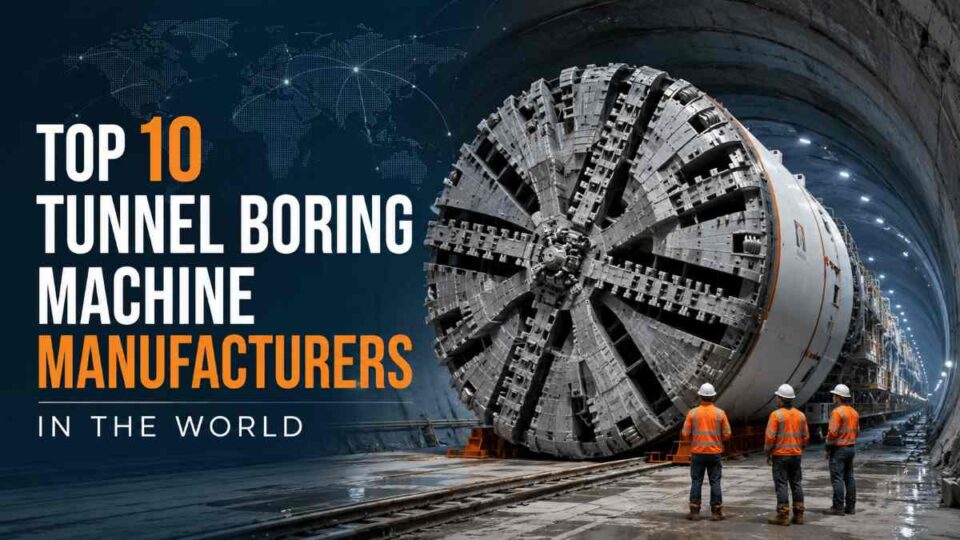
Tunnel boring machines (TBMs) are among the most complex and critical pieces of equipment in modern infrastructure construction. Every major metro system, high-speed railway tunnel, hydropower project, road tunnel, and urban utility network built today depends on these massive underground machines to excavate safely, efficiently, and at scale. The global TBM market was valued at approximately USD 6.0 billion in 2024 (IMARC Group), with other estimates placing it at USD 6.69 billion (Straits Research). The market is projected to grow steadily through 2033, driven by rapid urbanisation, government infrastructure spending, and the need for sustainable underground transportation networks across Asia, Europe, the Americas, and the Middle East.
ConstructionCareerHub App is LIVE — built ONLY for construction careers. Don’t apply with a weak resume.
Get ATS-ready Resume Lab + Interview Copilot + Campus Placement Prep (resume screening, skill gaps, interview readiness) — in minutes & Other advanced features.
Explore Smarter Construction Career Tools →Quick check. Big impact. Start now.
Whether you are a civil engineer, a tunnelling contractor, a procurement professional evaluating equipment suppliers, or a student exploring career opportunities in underground construction, understanding which companies manufacture TBMs — and what sets each apart — is essential. This article presents a research-backed list of the top 10 tunnel boring machine manufacturers in the world, based on factors such as global project experience, TBM technology range, innovation, production volume, and industry reputation.
Note: Rankings in this list are not strictly hierarchical. They are based on a combination of global presence, TBM technology portfolio, project experience, production volume, innovation, and industry recognition. Where data is sourced from official company publications, industry reports, or verified project case studies, references are provided.
Table of Contents
What Is a Tunnel Boring Machine (TBM)?
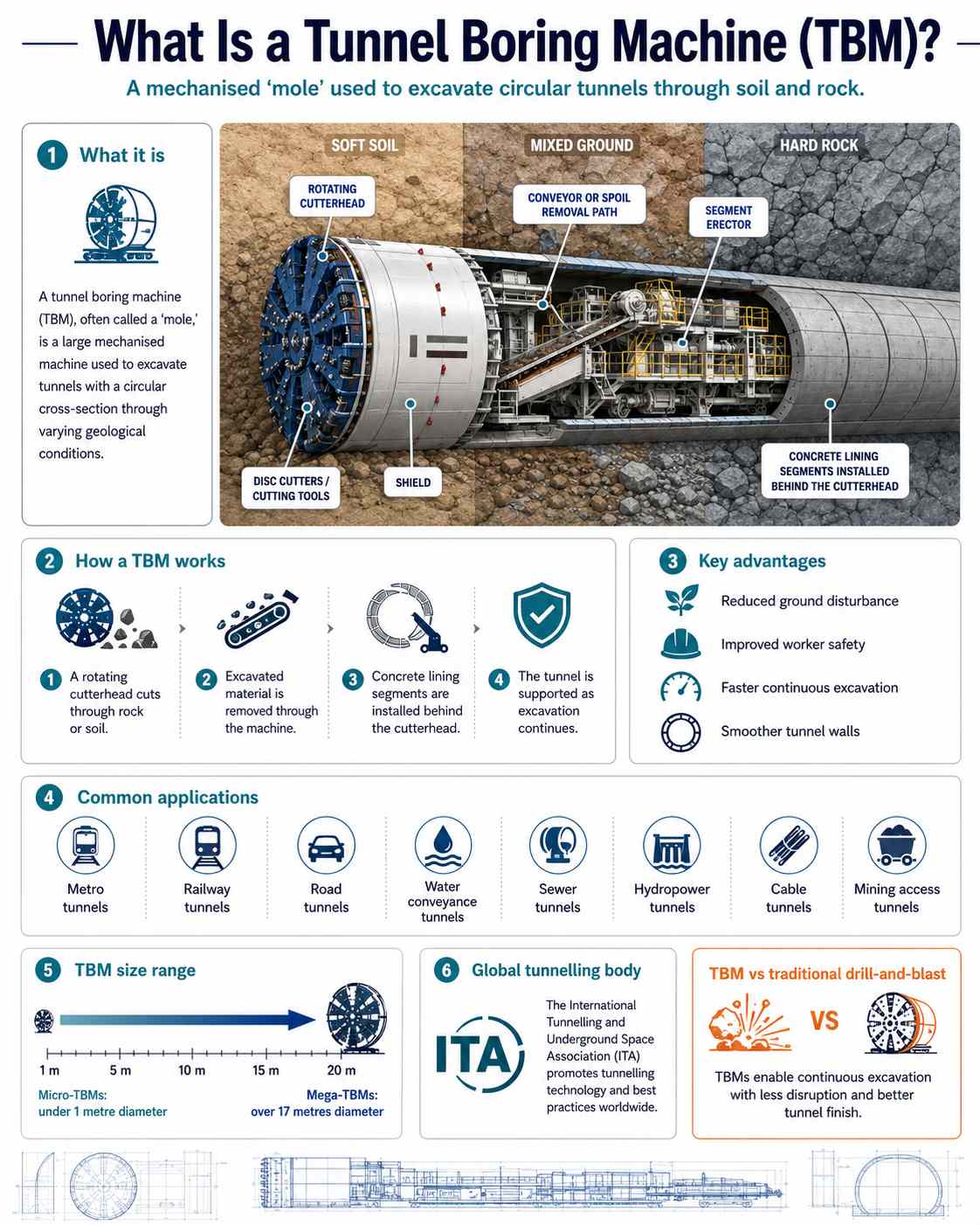
A tunnel boring machine (TBM), often called a “mole,” is a large mechanised machine used to excavate tunnels with a circular cross-section through varying geological conditions — from soft soil and mixed ground to hard rock. TBMs are designed to bore through rock and soil using a rotating cutterhead fitted with disc cutters or cutting tools, while simultaneously installing concrete lining segments to support the tunnel behind the cutterhead. The International Tunnelling and Underground Space Association (ITA) is the global body that promotes the advancement of tunnelling technology and best practices.
TBMs offer significant advantages over traditional drill-and-blast methods, including reduced ground disturbance, improved worker safety, faster continuous excavation, and smoother tunnel walls. They are essential for constructing metro tunnels, railway tunnels, road tunnels, water conveyance tunnels, sewer tunnels, hydropower tunnels, cable tunnels, and mining access tunnels. Modern TBMs range from micro-TBMs with diameters under one metre to mega-TBMs exceeding 17 metres in diameter.
For a broader overview of tunnelling hardware, see this guide on equipment required for tunnel construction projects.
Types of TBMs Used in Construction
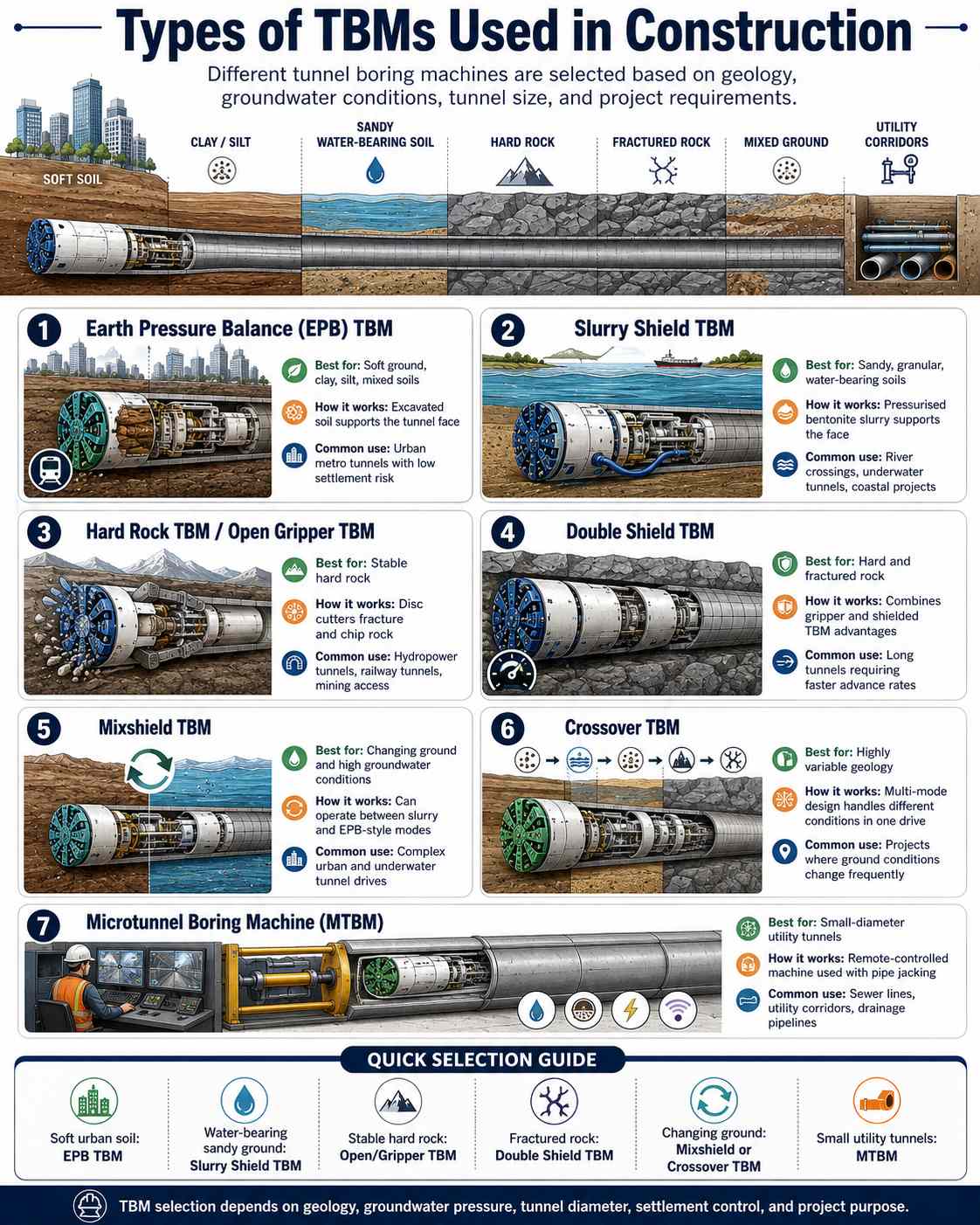
Understanding TBM types is important when evaluating manufacturers, as each company specialises in specific machine categories suited to different geological conditions and project requirements.
Earth Pressure Balance (EPB) TBMs are primarily used in soft ground, clay, silt, and mixed soils. The excavated material itself acts as face support, making EPB machines ideal for urban metro tunnels where surface settlement must be minimised.
Slurry Shield TBMs use a pressurised slurry (bentonite suspension) to support the tunnel face. These are suited for water-bearing granular soils, sandy ground, and underwater tunnel crossings. Slurry TBMs are widely used for river crossings and coastal tunnel projects.
Hard Rock TBMs (Open/Gripper TBMs) use disc cutters to fracture and chip away rock. Gripper-type TBMs push against the tunnel walls using hydraulic grippers. These machines are used for hydropower tunnels, railway tunnels through mountain ranges, and mining applications.
Double Shield TBMs combine the advantages of gripper TBMs and shielded TBMs. They are suitable for variable rock conditions and can operate in both hard and fractured rock, offering faster advance rates.
Mixshield TBMs are versatile machines that can switch between slurry and EPB modes, making them suitable for projects where geological conditions change along the alignment.
Crossover TBMs are multi-mode machines designed to handle the widest possible range of ground conditions within a single tunnel drive, reducing the need for machine modifications mid-project.
Microtunnel Boring Machines (MTBMs) are smaller, remotely operated machines used for utility tunnels, sewer lines, and pipe-jacking applications.
Top 10 Tunnel Boring Machine Manufacturers in the World
1. Herrenknecht AG — Germany
Headquarters: Schwanau, Baden-Württemberg, Germany
Founded: 1975
Key TBM Types: Mixshield, EPB Shield, Slurry Shield, Hard Rock TBM, Micro TBM, Pipe Jacking, Vertical Shaft Sinking Machines (VSM)
Official Website: herrenknecht.com
Herrenknecht AG is widely regarded as the global market leader in tunnel boring machines. Founded by Martin Herrenknecht, the company has been operating in the tunnelling industry for nearly 50 years and has delivered TBMs to projects across every continent and in virtually every geological condition imaginable. Herrenknecht’s product range covers the full spectrum of mechanised tunnelling — from micro-TBMs for utility installations to mega-diameter Mixshields exceeding 17 metres. The company reported revenue of approximately €1.29 billion in 2024.
Herrenknecht TBMs have been used on many of the world’s most iconic tunnel projects, including the Gotthard Base Tunnel (Switzerland), the Crossrail/Elizabeth Line (London), HS2 (UK), the Silvertown Tunnel and the Thames cable tunnel (London), the Brenner Base Tunnel (Austria–Italy), and Hong Kong’s Tuen Mun–Chek Lap Kok Link. Since September 2024, a giant Herrenknecht TBM has been excavating a metro tunnel under the Panama Canal. In India, Herrenknecht is supplying two 15.62-metre diameter Mixshields for Mumbai’s Versova-Dahisar Link Road — the largest TBMs in the country. Most recently, in April 2026, a Herrenknecht TBM achieved breakthrough on the second tube of the Gotthard Road Tunnel in Switzerland, advancing approximately 3.8 km through extremely hard rock at up to 32 metres per day.
The company is also advancing digitalisation through its Herrenknecht.Connected platform for real-time tunnelling project monitoring, and won the bauma Innovation Award 2022 for its Tunnel Enlargement System (TES).
Why Herrenknecht Matters: Unmatched global project portfolio, the widest TBM product range in the industry, nearly 50 years of engineering expertise, and consistent leadership in TBM innovation and diameter records. A Herrenknecht TBM at the Brenner Base Tunnel reportedly set a new hard rock tunnelling record of 61 metres in 24 hours. The company is also supplying three TBMs for Adelaide’s T2D project in South Australia.
2. CREG — China Railway Engineering Equipment Group — China
Headquarters: Zhengzhou, Henan Province, China
Founded: 2009 (as a subsidiary of China Railway Group Limited)
Key TBM Types: EPB TBM, Slurry Shield, Gripper TBM, Shield TBM, Pipe Jacking, Non-circular (Horseshoe-shaped) TBM, Shaft Boring Machine
Official Website: crecg.com
CREG is the largest tunnel boring machine manufacturer in China by production and sales volume, having ranked first globally for eight consecutive years as of 2025 (Xinhua). A subsidiary of China Railway Group Limited (CREC), CREG has received over 1,800 orders for shield machines and TBMs, with its products having excavated more than 5,000 kilometres of tunnels. The company has exported TBMs to over 34 countries and regions, including Denmark, France, Italy, Canada, Singapore, Malaysia, Thailand, and the UAE.
CREG has developed several pioneering products, including the world’s first horseshoe-shaped TBM and the globally largest sectional rectangular TBM. The company maintains R&D spending at approximately 9% of revenue and has achieved independent development of core components including main bearings, high-capacity hydraulic pumps, and frequency converters. In Singapore alone, CREG has captured about one-third of the Land Transport Authority’s TBM market share. Four CREG TBMs are currently being built in Zhengzhou, China, for Victoria’s Suburban Rail Loop project in Australia.
Why CREG Matters: Highest global production and sales volume for eight consecutive years, extensive domestic and international project experience, pioneering non-circular TBM technology, and strong R&D investment in core component independence.
3. CRCHI — China Railway Construction Heavy Industry — China
Headquarters: Changsha, Hunan Province, China
Founded: 2007 (a member of Fortune Global 500 company CRCC)
Key TBM Types: EPB TBM, Slurry Shield, Hard Rock TBM, Double Shield TBM, NATM Equipment, Drilling and Blasting Equipment
Official Website: en.crchi.com
Industry Profile: The Tunnelling Journal — CRCHI
CRCHI is another major Chinese TBM powerhouse and a subsidiary of China Railway Construction Corporation (CRCC). The company has been consistently ranked among the top 5 construction machinery manufacturers in China and the top 50 globally. CRCHI manufactures TBMs with diameters ranging from 0.5 metres to 23 metres, making it one of the most versatile producers in terms of size range.
CRCHI has established 16 subsidiaries and manufacturing bases across China (including Changsha, Zhuzhou, Kunming, and Urumqi) and maintains 13 overseas branches in countries including Singapore, Russia, Australia, Turkey, and India. The company claims approximately 80% market share in hard rock TBMs within China. Notable international projects include TBMs supplied for the Moscow Metro and the Upper Elahera–Hela Canal Water Transfer Tunnel in Sri Lanka.
Why CRCHI Matters: Extremely wide TBM diameter range (0.5m to 23m), dominant position in China’s hard rock TBM segment, strong international expansion with branches across multiple continents, and full lifecycle service capabilities.
4. The Robbins Company — United States
Headquarters: Solon, Ohio, USA
Founded: 1952
Key TBM Types: Main Beam TBM, Double Shield TBM, Single Shield TBM, Crossover XRE TBM, Earth Pressure Balance Machine
Official Website: robbinstbm.com
The Robbins Company is a pioneering American TBM manufacturer with over seven decades of tunnelling expertise. Robbins is credited with designing the first hard rock TBM and has been at the forefront of tunnelling innovation ever since. The company’s TBM designs have been proven on hundreds of projects across more than five decades, and Robbins TBM owners hold world excavation records for virtually every tunnel diameter.
Robbins is known for its Crossover XRE machines, which are designed to handle the widest range of ground conditions in a single tunnel drive. The company provides comprehensive lifecycle support, from tender through final breakthrough, including experienced operators, mechanics, and TBM managers. Robbins TBMs meet international safety standards including CE, OSHA, and CSA. In May 2026, Ivanhoe Electric announced the acquisition of a Robbins Crossover XRE TBM for mine access development at the Santa Cruz Copper Project in Arizona, highlighting the company’s growing presence in the mining tunnelling segment.
Why Robbins Matters: Inventor of the hard rock TBM, seven decades of proven designs, world record holder in multiple tunnel diameters, innovative Crossover multi-mode technology, and strong lifecycle support services.
5. TERRATEC — Australia
Headquarters: Sydney, Australia (with a majority stake owned by Japan’s JIMT)
Key TBM Types: EPB TBM, Slurry TBM, Hard Rock TBM, Rock Slurry TBM, Microtunnelling Systems, Raise Boring Machines
Official Website: terratec.co
TERRATEC is an internationally recognised TBM manufacturer known for delivering robust, durable, and versatile tunnelling machines with strong customer support. The company has subsidiaries strategically located around the world and has built a strong reputation particularly in Asia, Europe, and the Americas.
TERRATEC has a dominant presence in India’s tunnelling sector, having supplied TBMs for major metro projects across Delhi (Phase III and IV), Lucknow, Pune, Kanpur, Ahmedabad, Surat, Mumbai, and Chennai (Phase II). In March 2026, the company commenced assembly on two massive 14.42-metre diameter Rock EPB TBMs for Mumbai’s Goregaon-Mulund Link Road (GMLR) project — twin road tunnels of approximately 5.3 km each passing beneath Sanjay Gandhi National Park. Internationally, TERRATEC TBMs are advancing on Bucharest’s Metro Line 6 and Bangkok’s 9th Water Supply Improvement Project. On the CIDCO water tunnel project in Mumbai, TERRATEC’s T83B Open TBM achieved an exceptional 752 metres excavated in a single month in July 2025 — acknowledged as a national record for a water tunnel drive using a single rail track.
Why TERRATEC Matters: Dominant market position in India’s metro tunnelling sector, strong international presence across multiple continents, reputation for tailor-made robust TBM designs, and excellent on-site technical support and spare parts availability.
6. UGITEC (Underground Infrastructure Technologies Corporation) — Japan
Headquarters: Osaka, Japan
Established: October 2021 (joint venture combining TBM businesses of Hitachi Zosen Corporation and Kawasaki Heavy Industries)
Key TBM Types: EPB Shield, Slurry Shield, Hard Rock TBM, Multi-face TBM, Rectangular TBM
Official Website: ugitec.co.jp
UGITEC was formed in October 2021 through the integration of the TBM businesses of two Japanese heavy industry giants: Kawasaki Heavy Industries (active in TBMs since 1957) and Hitachi Zosen Corporation (active since 1967). The joint venture combines decades of accumulated engineering excellence from both companies.
Hitachi Zosen was previously known for producing the world’s largest EPB TBM — “Bertha” (17.45-metre diameter, used for Seattle’s SR 99 tunnel) — and the world’s largest-diameter TBM at the time for the Tokyo Bay Aqua Line Highway. Kawasaki has a strong track record particularly in Singapore, where over 35 of its TBMs have been procured for various metro and infrastructure projects. UGITEC was also responsible for the world’s first multi-face TBM, equipped with two circular cutterheads and an independent pressure chamber, delivered for the JR East Keiyo Line Kyobashi tunnel.
Why UGITEC Matters: Combines the engineering legacy of two of Japan’s most experienced TBM manufacturers, proven track record on landmark projects globally, specialised expertise in large-diameter and innovative TBM configurations.
7. Komatsu Ltd. — Japan
Headquarters: Tokyo, Japan (Komatsu; TBM division operates from specific manufacturing facilities)
Founded: 1921 (Komatsu Ltd.)
Key TBM Types: Shield TBM, EPB TBM, Slurry TBM
Official Website: komatsu.jp
Komatsu is one of the world’s largest construction and mining equipment manufacturers, and its TBM division produces shield machines and tunnel boring equipment for various infrastructure applications. Komatsu brings the engineering precision and manufacturing quality standards of a global heavy equipment leader to its tunnelling products.
While Komatsu’s TBM market share is smaller compared to dedicated tunnelling manufacturers like Herrenknecht, the company’s machines have been deployed on metro, railway, and utility tunnel projects primarily in Asia. Komatsu’s broader construction equipment expertise — including excavators, bulldozers, and mining equipment — provides synergies in underground construction where multiple equipment types are required on the same project. The company is consistently identified in industry market reports as a leading TBM manufacturer.
For more on major equipment manufacturers, see our guides on top construction equipment manufacturers in India and top construction equipment brands in the USA.
Why Komatsu Matters: Global heavy equipment manufacturing scale and quality standards, reliable TBM products for Asian infrastructure markets, and synergy with broader construction and mining equipment ecosystems.
8. NFM Technologies — France
Headquarters: Grenoble, France
Key TBM Types: EPB Shield, Slurry Shield, Hard Rock TBM, Microtunnelling Equipment
Official Website: nfm-technologies.com
NFM Technologies (Neyrpic Framatome Mécanique) is a French engineering company that manufactures tunnel boring machines alongside other specialised heavy engineering equipment. NFM has a long history of participation in European and international tunnelling projects and brings deep expertise in precision engineering derived from its broader industrial portfolio, which includes components for nuclear, aerospace, and defence sectors.
NFM’s TBMs have been used in multiple metro and infrastructure projects globally, including in Singapore, where the company has supplied machines for various rail tunnel contracts. The company offers comprehensive technical support, operator training, and project management services alongside its machines. NFM’s European engineering heritage and experience in complex project environments make it a trusted choice for technically demanding tunnel projects.
Why NFM Technologies Matters: Deep European tunnelling project experience, precision engineering heritage from nuclear and aerospace sectors, comprehensive technical support and training services.
9. Akkerman Inc. — United States
Headquarters: Brownsdale, Minnesota, USA
Founded: 1973
Key TBM Types: Microtunnel Boring Machines, Pipe Jacking Systems, Earth Pressure Balance Microtunnelling, Guided Boring Systems
Official Website: akkerman.com
Akkerman is a specialised American manufacturer focused on microtunnelling and pipe jacking equipment. While the company operates in a different size segment compared to large-diameter TBM manufacturers, Akkerman occupies an important niche in the global tunnelling equipment market. The company’s machines are used extensively for sewer construction, water main installation, utility tunnels, and trenchless construction projects across North America and internationally.
Akkerman’s focus on smaller-diameter tunnelling solutions addresses a critical segment of the underground construction market, particularly for urban utility infrastructure where minimising surface disruption is essential. The company is consistently identified in market research reports as a notable player in the global TBM and microtunnelling market.
Why Akkerman Matters: Specialised leadership in microtunnelling and pipe jacking equipment, strong position in the North American trenchless construction market, and solutions for critical urban utility infrastructure.
10. Mitsubishi Heavy Industries (MHI) — Japan
Headquarters: Tokyo, Japan
Founded: 1884 (Mitsubishi Heavy Industries)
Key TBM Types: Shield TBM, Slurry Shield, EPB Shield
Official Website: mhi.com
Mitsubishi Heavy Industries is one of Japan’s largest industrial conglomerates with operations spanning aerospace, energy, defence, and industrial machinery. MHI’s tunnelling equipment division produces shield machines and TBMs that have been used on infrastructure projects in Japan and internationally. The company brings vast engineering resources and manufacturing capabilities to the TBM sector, backed by MHI’s renowned quality control and precision engineering standards.
MHI TBMs have been used in Japanese metro, railway, and utility tunnel construction, and the company leverages its broader expertise in heavy industrial machinery to deliver robust tunnelling solutions. MHI is identified as a notable manufacturer in multiple industry market reports on the global TBM market, including by Coherent Market Insights and ResearchAndMarkets.
Why MHI Matters: Backed by one of the world’s largest and most respected industrial conglomerates, deep Japanese engineering excellence, and broad industrial synergies from aerospace and energy sectors.
Comparison Table: Top 10 TBM Manufacturers in the World
| Rank | Manufacturer | Country | Key TBM Types | Known Strengths | Best Suited For |
|---|---|---|---|---|---|
| 1 | Herrenknecht AG | Germany | Mixshield, EPB, Slurry, Hard Rock, Micro TBM, VSM | Global market leader, widest product range, nearly 50 years of experience | All tunnel types — metro, railway, road, hydropower, utility |
| 2 | CREG | China | EPB, Slurry, Gripper, Non-circular, Shaft Boring | Highest global production volume (8 consecutive years), 1,800+ orders | Metro, railway, highway, mining, water conservancy |
| 3 | CRCHI | China | EPB, Slurry, Hard Rock, Double Shield, NATM | 0.5m–23m diameter range, 80% China hard rock market share | Metro, railway, expressway, coal mines, hydraulic projects |
| 4 | The Robbins Company | USA | Main Beam, Double Shield, Single Shield, Crossover XRE, EPB | Inventor of hard rock TBM, world record excavation rates, 70+ years | Hard rock tunnels, mining, water conveyance, multi-mode projects |
| 5 | TERRATEC | Australia | EPB, Slurry, Hard Rock, Rock Slurry, Raise Boring, Microtunnelling | Dominant in India’s metro tunnelling, strong Asia-Europe presence | Metro, sewer, water, road tunnels — especially in South and Southeast Asia |
| 6 | UGITEC | Japan | EPB Shield, Slurry Shield, Hard Rock, Multi-face, Rectangular | Combined legacy of Hitachi Zosen + Kawasaki, innovative TBM designs | Metro, railway, utility tunnels — strong in Japan and Singapore |
| 7 | Komatsu | Japan | Shield TBM, EPB, Slurry | Global heavy equipment scale, manufacturing precision | Metro and utility tunnels, primarily Asian markets |
| 8 | NFM Technologies | France | EPB, Slurry, Hard Rock, Microtunnelling | European engineering heritage, nuclear/aerospace precision | Complex metro and infrastructure tunnels in Europe and Asia |
| 9 | Akkerman Inc. | USA | Microtunnel Boring Machines, Pipe Jacking | Specialised microtunnelling leader, trenchless solutions | Sewer, water, utility tunnels — trenchless construction |
| 10 | Mitsubishi Heavy Industries | Japan | Shield TBM, Slurry Shield, EPB Shield | Backed by major industrial conglomerate, precision engineering | Metro, railway, utility tunnels — primarily Japan and Asia |
How to Choose a TBM Manufacturer
Selecting the right TBM manufacturer is a critical decision that can determine the success or failure of a tunnel project. Procurement teams, project managers, and tunnelling contractors should consider several key factors.
Geological Compatibility: The manufacturer must have proven experience with TBMs designed for the specific geological conditions of the project — soft ground, mixed face, hard rock, high water pressure, or variable geology. Manufacturers like Herrenknecht and Robbins offer multi-mode Crossover machines for variable conditions.
Project References: Evaluate the manufacturer’s track record on projects of similar scale, diameter, and geological complexity. Request case studies and performance data from comparable completed projects.
Lifecycle Support: A TBM is only as good as the support behind it. Leading manufacturers provide comprehensive services including design consultation, operator training, on-site engineering support, spare parts supply, and machine refurbishment or buyback options.
Customisation Capability: Every tunnel project has unique parameters. The best manufacturers — Herrenknecht, TERRATEC, CREG, and Robbins — can customise TBM designs to specific project requirements, including cutterhead configuration, thrust capacity, and segment erection systems.
Lead Time and Logistics: TBM manufacturing and delivery timelines can be 12–18 months or more. Consider the manufacturer’s production capacity, delivery logistics, and ability to assemble and commission the machine at the project site.
Total Cost of Ownership: Beyond the initial purchase price, evaluate maintenance costs, energy consumption, cutter wear rates, machine availability, and resale or refurbishment value.
For broader insights on construction equipment selection, explore our guide on construction equipment types and heavy equipment used on construction sites.
TBM Market Trends in 2026
The global tunnel boring machine market continues to evolve rapidly, driven by several important trends that are shaping how TBMs are designed, manufactured, and deployed worldwide.
Asia-Pacific Dominance: The Asia-Pacific region remains the dominant TBM market, supported by massive metro and infrastructure projects in China, India, Indonesia, Thailand, Vietnam, and Australia. India alone has emerged as one of the most active tunnelling markets globally, with multiple metro systems, highway tunnels, and water infrastructure projects under construction simultaneously.
Chinese Manufacturers’ Global Expansion: Chinese TBM manufacturers — particularly CREG and CRCHI — have dramatically expanded their global footprint. China now produces over 4,000 TBMs, accounting for approximately 70% of the global market share by volume. Chinese-made machines are exported to over 30 countries across Europe, Asia, the Americas, and the Middle East.
Digitalisation and Automation: Leading manufacturers are integrating real-time monitoring platforms, predictive maintenance systems, and automated tunnelling controls into their TBMs. Herrenknecht’s Connected platform and CREG’s intelligent stone handling systems are examples of this trend.
Multi-Mode and Adaptive TBMs: The development of Crossover TBMs (Robbins) and Mixshield machines (Herrenknecht) that can operate in multiple geological modes within a single drive is a major technological trend, reducing project risk and the need for mid-drive machine modifications.
Sustainable Tunnelling: CREG has introduced what it describes as the world’s first “green TBMs”, and the broader industry is focusing on energy-efficient machines, reduced material waste, and machine refurbishment and reuse to lower the carbon footprint of tunnelling projects.
Market Growth Projections: Industry reports project the global TBM market to reach USD 8.1 billion by 2033 at a CAGR of 3.48% (IMARC Group) or USD 11.5 billion by 2033 at a CAGR of 6.2% (Straits Research), depending on the source and methodology.
Career Opportunities in Tunnelling and Underground Construction
The global expansion of metro networks, high-speed rail projects, highway tunnels, and utility infrastructure is creating significant career opportunities for civil engineers, mechanical engineers, geotechnical specialists, and construction professionals in the tunnelling sector.
Key job roles in TBM and tunnelling projects include:
TBM Operator and Shift Engineer — responsible for operating the machine and managing the tunnelling process during each shift. TBM Maintenance Engineer — ensures the machine operates at peak performance through preventive and corrective maintenance. Tunnel Engineer — manages the overall tunnel construction process, including alignment control, ground monitoring, and segment installation. Geotechnical Engineer — analyses geological conditions along the tunnel alignment and provides recommendations for TBM operation parameters. Project Manager (Tunnelling) — oversees the entire tunnel construction project, managing schedules, budgets, safety, and stakeholder coordination. Survey Engineer — maintains precise tunnel alignment using advanced surveying instruments and guidance systems. Safety Engineer — implements and monitors safety protocols for underground construction, a high-risk environment.
Skills required for TBM and tunnelling jobs: Understanding of soil mechanics and rock mechanics, familiarity with TBM types and operating principles, tunnel design and construction methodology, ground monitoring and instrumentation, construction safety management (especially confined space and underground hazards), and proficiency with construction project management software.
For detailed guidance on building a career in civil engineering and construction, explore these resources on ConstructionPlacements: types of civil engineering jobs, career options after civil engineering, civil engineering salary guide, and the comprehensive list of 110 civil engineering career pathways.
Build Your Construction Career with AI-Powered Tools
Planning a career in tunnelling, infrastructure, or construction management? ConstructionCareerHub.com offers AI-powered career tools built exclusively for the construction industry — including an ATS-optimised Resume Lab, Interview Copilot for technical and HR interview preparation, Career Planner, and Salary Calculator. Whether you are a fresh graduate or an experienced tunnelling professional, these tools can help you stand out in a competitive job market.
Future of TBM Technology
The tunnel boring machine industry is entering a new phase of technological evolution. Autonomous and semi-autonomous tunnelling operations are being developed, with manufacturers working on systems that reduce the need for human intervention in the most hazardous underground environments. Artificial intelligence and machine learning are being applied to predict geological conditions ahead of the cutterhead, optimise tunnelling parameters in real time, and reduce cutter wear and downtime.
Digital twin technology — creating real-time virtual replicas of TBM operations — is enabling project teams to monitor machine performance remotely, predict maintenance needs before failures occur, and optimise logistics across the entire tunnel construction process. The integration of IoT sensors throughout the TBM and tunnel lining allows for continuous structural health monitoring.
On the materials and engineering front, larger TBM diameters continue to push boundaries, with machines exceeding 17 metres now operational and larger designs in development. Sustainable tunnelling practices, including machine refurbishment for reuse on multiple projects, energy-efficient drive systems, and the recycling of excavated material, are becoming standard requirements for major infrastructure clients worldwide.
Final Thoughts
Tunnel boring machines are the backbone of modern underground infrastructure development. From metro systems that move millions of commuters daily to hydropower tunnels that generate clean energy, the machines produced by these top manufacturers are shaping the built environment across every continent.
Herrenknecht continues to lead as the global benchmark, while Chinese manufacturers CREG and CRCHI have transformed the competitive landscape with scale, innovation, and aggressive international expansion. American pioneer Robbins continues to push boundaries in hard rock tunnelling and multi-mode technology. TERRATEC has become the go-to TBM supplier for India’s rapidly expanding metro network. Japanese manufacturers — through UGITEC, Komatsu, and MHI — bring precision engineering excellence to the global tunnelling industry. And European firms like NFM Technologies contribute deep technical expertise for complex projects.
For civil engineers, construction professionals, and students, the tunnelling industry offers exciting and rewarding career opportunities that are growing rapidly alongside global infrastructure investment. Understanding the companies that manufacture TBMs — and the technology behind them — is a valuable step toward building a successful career in this specialised and high-impact sector of the construction industry.
For more insights on construction careers, equipment, and industry trends, continue exploring ConstructionPlacements.com.
Frequently Asked Questions (FAQ)
Who is the largest TBM manufacturer in the world?
Herrenknecht AG of Germany is widely regarded as the global market leader in tunnel boring machines by technology range, global project portfolio, and revenue (approximately €1.29 billion in 2024). However, by production and sales volume, China Railway Engineering Equipment Group (CREG) has ranked first globally for eight consecutive years as of 2025.
Which country makes the best tunnel boring machines?
Germany, China, Japan, the United States, Australia, and France are the leading TBM manufacturing countries. Germany (Herrenknecht) leads in technology and global reach; China (CREG, CRCHI) dominates by volume and cost-competitiveness; the USA (Robbins) pioneered hard rock TBMs; and Japan (UGITEC, Komatsu, MHI) excels in precision engineering. Australia (TERRATEC) is a major player in Asian metro tunnelling.
What are the top TBM companies in the world?
Based on global presence, technology, and project experience, the top TBM companies include Herrenknecht AG (Germany), CREG (China), CRCHI (China), The Robbins Company (USA), TERRATEC (Australia), UGITEC (Japan), Komatsu (Japan), NFM Technologies (France), Akkerman Inc. (USA), and Mitsubishi Heavy Industries (Japan).
What is the cost of a tunnel boring machine?
TBM costs vary widely depending on diameter, type, geological specification, and customisation. A small-diameter microtunnel machine may cost a few million dollars, while large-diameter metro or highway TBMs can cost USD 30–80 million or more. The world’s largest TBMs have reportedly cost over USD 100 million including delivery and commissioning. Total project tunnelling costs include not just the machine but also operation, maintenance, segment production, and logistics.
Which TBM is used in metro tunnel construction?
Earth Pressure Balance (EPB) TBMs and Slurry Shield TBMs are the most commonly used machine types for metro tunnel construction. EPB TBMs are preferred in urban soft ground conditions (clay, silt, mixed soils) because they use the excavated material to support the tunnel face and minimise surface settlement — critical in densely populated city environments. Manufacturers like Herrenknecht, TERRATEC, CREG, and CRCHI supply the majority of TBMs used in global metro projects.
What skills are required to work in TBM tunnelling projects?
Key skills include knowledge of soil mechanics and rock mechanics, understanding of TBM types and operating principles, tunnel design and construction methodology, geotechnical instrumentation and monitoring, construction safety management (confined space, underground hazards), and proficiency with project scheduling and management tools. Relevant educational backgrounds include civil engineering, geotechnical engineering, mechanical engineering, and mining engineering.
Are TBM jobs good for civil engineers?
Yes. Tunnelling is one of the most specialised and well-compensated areas of civil engineering. TBM projects offer opportunities for rapid career growth, international assignments, and exposure to cutting-edge construction technology. With metro systems, high-speed rail, and water infrastructure projects expanding globally, demand for skilled tunnelling professionals is strong and growing. Check our civil engineering salary guide for compensation benchmarks.
How do companies choose a TBM manufacturer?
Companies typically evaluate TBM manufacturers based on geological compatibility (experience with specific ground conditions), project references and track record, TBM customisation capability, lifecycle support services (training, spare parts, on-site engineers), lead time and delivery logistics, total cost of ownership (purchase price plus maintenance, energy, and cutter costs), and the manufacturer’s financial stability and global support network.
