

Last Updated on May 27, 2026 by Admin
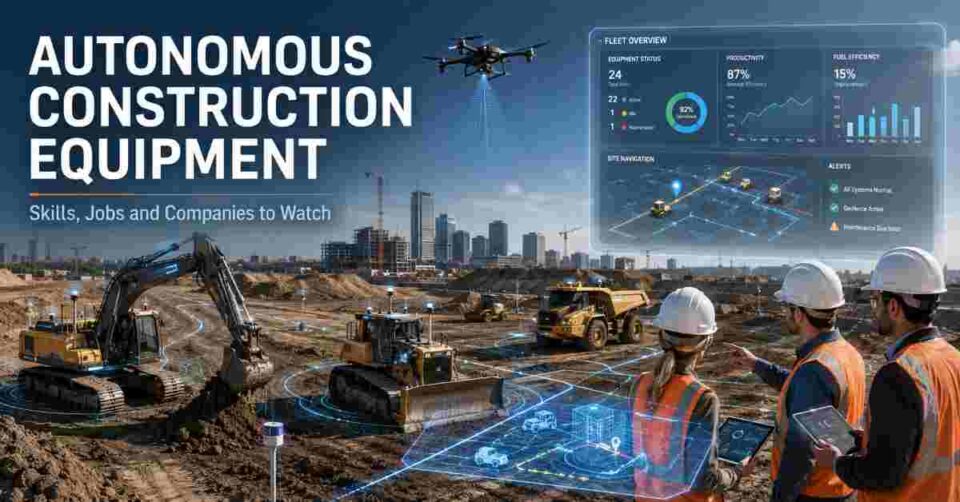
The construction industry is in the middle of a generational shift. Autonomous construction equipment — self-operating excavators, GPS-guided dozers, LiDAR-enabled loaders, and AI-driven haul trucks — is moving from prototype to production at a pace that is reshaping how projects get built, who builds them, and which skills matter most. The autonomous construction equipment market was valued at approximately $18.16 billion in 2026 and is forecast to reach $25.86 billion by 2030, growing at a compound annual rate of roughly 9.2% (The Business Research Company).
ConstructionCareerHub App is LIVE — built ONLY for construction careers. Don’t apply with a weak resume.
Get ATS-ready Resume Lab + Interview Copilot + Campus Placement Prep (resume screening, skill gaps, interview readiness) — in minutes & Other advanced features.
Explore Smarter Construction Career Tools →Quick check. Big impact. Start now.
For construction professionals, students, and career changers, that growth curve translates directly into new job roles, higher salaries, and an urgent demand for skills that barely existed five years ago. Whether you are an experienced heavy-equipment operator looking to future-proof your career, a civil engineering graduate exploring emerging specialisations, or a technology professional curious about crossing into construction, this guide covers everything you need to know — the skills employers want, the jobs being created, the companies leading the charge, and the practical steps to break in.
For a broader look at how technology is transforming jobsite roles, see our detailed guide on AI in Construction: 2026 Skills & Tools That Get You Hired.
Table of Contents
What Is Autonomous Construction Equipment?
Autonomous construction equipment refers to heavy machinery — excavators, bulldozers, wheel loaders, haul trucks, compactors, and graders — that can perform tasks with reduced or zero direct human control. These machines rely on a technology stack that typically includes GPS/GNSS positioning, LiDAR and radar sensors, computer vision cameras, inertial measurement units (IMUs), and onboard AI that processes sensor data in real time to make navigation and task-execution decisions.
The level of autonomy varies. The industry generally recognises three tiers:
- Remote-Controlled: An operator controls the machine from a distance using a joystick console or tablet. The operator still makes every decision; the machine simply follows commands wirelessly. Companies like Teleo specialise in this tier.
- Semi-Autonomous: The machine handles routine, repetitive motions — truck loading cycles, compaction passes, trenching to grade — while a human supervisor monitors and intervenes as needed. Caterpillar’s Cat Command system and Komatsu’s IMC 3.0 excavators sit at this level.
- Fully Autonomous: The equipment operates independently for defined tasks within a geofenced area. Caterpillar’s autonomous haul trucks in mining have logged over 4.5 billion tonnes of material moved autonomously since their introduction — the most proven deployment of full autonomy in heavy equipment (Caterpillar Newsroom).
Understanding these tiers is critical for career planning because each level demands a different mix of skills, from hands-on joystick dexterity to data-science fluency.
For more on the robotics side of this evolution, read our feature on What Is Construction Robotics and Its Applications.
Why Autonomous Equipment Is Growing So Fast in 2026
Several converging forces explain the rapid adoption:
Chronic Labour Shortages
The global construction workforce deficit is now structural, not cyclical. In the United States alone, the industry needs an estimated 500,000+ additional workers per year to meet infrastructure demand, according to Associated Builders and Contractors (ABC). Autonomous and semi-autonomous machines allow contractors to maintain output with fewer operators on site.
Safety Imperatives
Construction remains one of the most hazardous industries worldwide. Removing operators from cabs in demolition zones, unstable slopes, and high-dust environments directly reduces injury and fatality risk. OSHA-aligned construction robotics initiatives cite safety as a primary driver of adoption.
Precision and Productivity
Autonomous grading and trenching systems routinely achieve centimetre-level accuracy on the first pass — far exceeding what even experienced operators typically deliver. That precision cuts rework, reduces material waste, and compresses schedules. Caterpillar reported at CONEXPO-CON/AGG 2026 that its autonomous construction systems can improve earthwork productivity by up to 30% on repetitive tasks.
Falling Sensor and Compute Costs
LiDAR units that cost $75,000 a decade ago are now available for under $1,000. GPU compute power for onboard AI has followed a similar trajectory. Regional manufacturers in China and India are already launching lower-cost autonomous loaders, intensifying competition and accelerating price declines across the market.
Regulatory and Standards Maturation
Compliance with evolving standards like ISO 3691-4 (safety of industrial trucks — driverless) is becoming a prerequisite in tenders, particularly in Europe and Australia. This regulatory clarity is giving fleet buyers the confidence to invest, knowing validated safety processes exist.
For a detailed exploration of the broader technology landscape, see our guide on Future Building Construction Technologies 2026.
Top Skills Needed for Autonomous Construction Equipment Careers
The talent gap in autonomous construction is widening. Employers are hunting for professionals who can bridge the divide between traditional heavy-equipment operations and modern technology systems. Here are the core skill domains:
1. Robotics and Automation Fundamentals
Understanding how robotic systems perceive, decide, and act is foundational. This includes sensor fusion (combining data from LiDAR, cameras, radar, and GPS into a coherent world model), path planning algorithms, and real-time control loops. Even non-engineers benefit from grasping these concepts at a practical level.
2. Machine Learning and AI for Perception
Autonomous machines rely on AI models — particularly deep-learning-based computer vision — to classify terrain, detect obstacles, identify workers, and interpret site conditions. Skills in Python, TensorFlow/PyTorch, and point-cloud processing tools are highly valued by OEMs and technology start-ups alike.
3. GPS/GNSS and Geospatial Technology
Precision positioning is the backbone of autonomous grading, trenching, and material placement. Proficiency with RTK-GPS receivers, machine control systems (Trimble, Topcon, Leica), geofencing logic, and coordinate reference systems separates qualified candidates from generalists.
4. Heavy-Equipment Operations and Mechanical Knowledge
Technology does not replace domain expertise — it augments it. Companies consistently report that the best autonomous-system supervisors are experienced operators who understand load dynamics, soil behaviour, and equipment limitations at an intuitive level. If you are already a licensed equipment operator, you have a significant advantage. See our Heavy Equipment Operator License & Certifications Guide for background.
5. Telematics, Fleet Management, and IoT
Remote monitoring and fleet orchestration platforms — Cat Product Link, Komatsu KOMTRAX, Hitachi LANDCROS Connect, John Deere JDLink — generate vast amounts of operational data. Professionals who can interpret telematics dashboards, configure alert thresholds, and optimise fleet utilisation are in high demand.
6. ROS (Robot Operating System) and Simulation
ROS and ROS 2 are the de facto middleware for prototyping and deploying robotic systems. Simulation environments like Gazebo, NVIDIA Isaac Sim, and MATLAB/Simulink allow engineers to test autonomous algorithms before field deployment. Competence here is a differentiator for R&D and integration roles.
7. Safety, Compliance, and Risk Assessment
Operating autonomous machinery on active construction sites involves regulatory compliance (OSHA, ISO 3691-4, ANSI/RIA standards), risk-assessment documentation, safety-case development, and geofence boundary management. These skills are essential for site supervisors, safety officers, and project managers transitioning into autonomy-enabled projects.
8. Data Analytics and Predictive Maintenance
Autonomous equipment generates terabytes of sensor data. Skills in SQL, Python data-analysis libraries (Pandas, NumPy), and visualisation tools (Power BI, Tableau) enable professionals to extract insights — optimising routes, predicting component failures, and reducing downtime.
For a deep dive into the broader AI skill set construction professionals need, explore our article on AI Skills Every Construction Professional Should Learn.
High-Growth Jobs in Autonomous Construction Equipment
Autonomous technology is not eliminating construction jobs — it is creating new ones while transforming existing roles. Here are the key positions emerging in 2026:
1. Autonomous Equipment Operator / Remote Fleet Supervisor
This is the evolution of the traditional heavy-equipment operator. Instead of sitting in one cab, these professionals supervise three to five machines simultaneously from a remote control station — often in an air-conditioned office. They intervene when the AI encounters edge cases and optimise task sequences in real time.
Salary range (USA): $50,000 – $85,000/year, depending on fleet size and employer. Experienced supervisors at major contractors earn at the upper end.
2. Robotics Engineer — Construction Focus
These engineers design, build, test, and deploy the autonomous systems that go into construction machinery. They work on perception stacks, motion-planning algorithms, sensor calibration, and safety-critical software. Employers include OEMs like Caterpillar and Komatsu, as well as start-ups like Built Robotics, Teleo, and SafeAI.
Salary range (USA): $100,000 – $180,000/year. Senior engineers at well-funded start-ups or NVIDIA-tier companies can exceed $200,000 in total compensation (Salary.com).
3. Autonomous Systems Integration Technician
When a contractor buys or leases an autonomous kit — like Built Robotics’ Exosystem or Teleo’s retrofit package — someone has to install it, calibrate the sensors, integrate it with the machine’s hydraulic and CAN-bus systems, and commission it. These technicians are the field-level bridge between hardware and software.
Salary range (USA): $55,000 – $95,000/year.
4. Construction Telematics / Data Analyst
Analysing machine-health data, fuel consumption, cycle times, idle rates, and sensor logs to improve fleet performance. This role is especially valuable for large earthmoving contractors running mixed autonomous and manually-operated fleets.
Salary range (USA): $60,000 – $100,000/year.
5. Machine-Learning Engineer — Off-Highway Vehicles
A specialised ML role focused on perception (obstacle detection, terrain classification) and decision-making algorithms for unstructured environments. Unlike on-highway autonomous driving, off-highway construction sites are far more variable — mud, dust, steep grades, dynamic obstacles — making this a technically demanding niche.
Salary range (USA): $120,000 – $200,000+/year.
6. Safety and Compliance Officer — Autonomous Operations
Developing and enforcing safety protocols for sites with autonomous machines, conducting risk assessments, managing geofence zones, and ensuring regulatory compliance. This role is critical as insurers begin requiring formal autonomous-equipment safety plans.
Salary range (USA): $70,000 – $110,000/year.
7. Simulation and Digital-Twin Engineer
Building virtual replicas of construction sites where autonomous algorithms can be tested, validated, and optimised before field deployment. These engineers work with tools like NVIDIA Omniverse, Unity, Unreal Engine, and Gazebo.
Salary range (USA): $100,000 – $160,000/year.
8. Autonomous Equipment Sales and Applications Engineer
Translating technical capabilities into customer value. This role requires deep product knowledge, construction-site experience, and the ability to demonstrate ROI to contractors and fleet managers.
Salary range (USA): $75,000 – $130,000/year (base + commission).
For career planning tools that help you map a path into these roles, visit ConstructionCareerHub.com — it offers an AI-powered Career Planner, Resume Lab, and Interview Copilot specifically built for construction professionals.
Also explore our list of Top 10 Construction Jobs That Will Be Automated by 2030 for related insights on how roles are evolving.
15 Companies Leading Autonomous Construction Equipment in 2026
The competitive landscape spans century-old OEMs and venture-backed start-ups. Here are the companies driving the most significant developments:
1. Caterpillar
The world’s largest construction-equipment manufacturer (2024 revenue: $64.8 billion) announced a major expansion of its autonomy programme at CES and CONEXPO-CON/AGG 2026. Cat is embedding autonomy into excavators (autonomous trenching, loading, grading), wheel loaders, and haul trucks, building on three decades of autonomous mining-truck deployment. The Cat Command platform serves as the control hub.
2. Komatsu
Komatsu’s Intelligent Machine Control (IMC 3.0) excavators incorporate 3D boundary control and semi-autonomous grading. The company has partnered with Pronto AI for autonomous quarry trucks and launched Smart Quarry autonomy features. Komatsu’s global dealer network exceeds 1,000 locations, giving it unmatched service coverage.
3. John Deere
Deere has invested heavily in autonomy across both agriculture and construction. Its autonomous track-type tractor and precision grading systems were showcased at CONEXPO 2026. Deere’s acquisition of Blue River Technology and its partnership ecosystem give it a strong AI bench.
4. Volvo Construction Equipment
Volvo CE has been piloting autonomous haulers and wheel loaders at quarries in Scandinavia. The company’s electric autonomous concept machines combine zero-emission propulsion with full autonomy — a dual trend gaining momentum in 2026.
5. Hitachi Construction Machinery
Hitachi introduced LANDCROS Connect in 2025, a platform designed to integrate mixed-brand fleet data for autonomous and semi-autonomous operations. This brand-agnostic approach positions Hitachi as a fleet-management play rather than a single-machine solution.
6. Built Robotics
San Francisco-based Built Robotics developed the Exosystem — an autonomous retrofit kit for excavators — and the RPD-35 autonomous pile driver. The company focuses on utility-scale solar and renewable-energy projects, where it claims 5x productivity improvements across more than 2 GW of installed solar capacity.
7. Teleo
Palo Alto-based Teleo offers supervised-autonomy retrofit technology that works across multiple OEM brands (Cat, Komatsu, Deere, Volvo). A single remote operator can supervise multiple machines. Teleo has been actively deploying across US and European job sites, with 42 machines ordered and expansion into global dealer partnerships.
8. SafeAI
SafeAI provides autonomous retrofit solutions for heavy earthmoving equipment. The company targets mining and large-scale civil-construction applications, converting existing fleets to autonomous operation without requiring new-machine purchases.
9. Bedrock Robotics
Formerly Scaled Robotics, Bedrock Robotics has developed autonomous systems for excavators with a focus on quality-controlled earthmoving. The company uses real-time 3D mapping and digital-twin integration to ensure as-built conditions match design specifications within millimetre tolerances.
10. Autonomous Solutions Inc. (ASI) / ASI Construction
In May 2025, ASI launched ASI Construction with SoftBank, focusing on automating earth-moving fleets. ASI has one of the longest track records in vehicle autonomy (founded in 2000) and holds the intellectual-property base for multi-vehicle fleet orchestration.
11. Trimble
While Trimble is primarily known for positioning and machine-control systems, its hardware and software are the enabling infrastructure for much of the autonomous-equipment ecosystem. Trimble’s Earthworks platform, which integrates with OEM autonomy systems, makes it a critical enabler rather than a direct competitor.
12. CASE Construction Equipment (CNH Industrial)
CASE showcased joystick and advanced control improvements at CONEXPO 2026, laying the control-interface groundwork for semi-autonomous and remote operation of its excavators and dozers.
13. Husco (GenSteer)
Husco’s GenSteer steer-by-wire system won a 2026 CONEXPO Next Level Award. Steer-by-wire is a prerequisite technology for full machine autonomy — replacing mechanical linkages with electronic control.
14. Gravis Robotics
Swiss-based Gravis Robotics develops autonomous excavation software. The Gravis Rack, which also won a 2026 CONEXPO award, is designed to bolt onto existing machines and enable autonomous digging tasks with minimal infrastructure modifications.
15. DEVELON (formerly Doosan Infracore)
DEVELON is investing in intelligent machine interfaces and autonomous-ready control architectures. Its 2026 product line features advanced joystick systems and telematics designed for progressive automation upgrades.
For a broader look at the robotics companies reshaping construction, see our article on 15 Construction Robotics Companies Disrupting Building.
How to Break Into Autonomous Construction Careers: Step-by-Step
Whether you are starting fresh or transitioning from a related field, here is a practical pathway:
Step 1: Assess Your Starting Point
If you already hold a heavy-equipment operator licence or have field experience, you are closer than you think. The reskilling path from operator to remote-fleet supervisor can be as short as 6–12 months with the right training. If you come from a software or data-science background, your gap is industry domain knowledge, not technical skills.
Step 2: Build Foundational Knowledge
Enrol in targeted online courses that cover robotics fundamentals, sensor technology, and autonomous systems. Recommended courses include:
- Modern Robotics Specialisation — Northwestern University
- Robotics MicroMasters — University of Pennsylvania
- Autonomous Robotics and ROS Courses
- Self-Driving Cars Specialisation — University of Toronto
Step 3: Get Hands-On with Equipment and Simulators
Seek out operator training programmes that include GPS machine-control systems. Many International Union of Operating Engineers (IUOE) apprenticeship programmes now include technology modules. For software professionals, download ROS 2 and Gazebo, build a simple simulated autonomous vehicle, and document your project on GitHub. For structured training pathways, see our Construction Equipment Operator Training Guide.
Step 4: Earn Relevant Certifications
Consider industry-recognised credentials such as OSHA 30-Hour Construction, FAA Part 107 (for drone operations, which share sensor and autonomy overlaps), Trimble or Topcon machine-control certifications, and emerging autonomous-equipment safety certifications from organisations like the Association of Equipment Manufacturers (AEM). See our guide on Drone Operator in Construction: Salary & Certification 2026 for adjacent credentialing pathways.
Step 5: Target the Right Employers
Apply to the companies listed in this article — both OEMs and start-ups. Start-ups like Built Robotics, Teleo, and SafeAI tend to hire faster and value non-traditional backgrounds. OEMs offer larger scale and more structured career paths. Construction technology recruiters and niche job boards are excellent resources.
Step 6: Build a Professional Portfolio
Document your projects, certifications, and field experience. Use the ConstructionCareerHub Resume Lab to build an ATS-optimised resume that highlights both your traditional construction experience and your technology upskilling.
Salary Comparison: Traditional vs. Autonomous Equipment Roles
One of the strongest career motivators for entering autonomous construction is the salary uplift. Here is how traditional and autonomous-focused roles compare in the United States (2026 data):
| Role | Traditional Salary | Autonomous / Tech-Enhanced Salary |
|---|---|---|
| Heavy Equipment Operator | $45,000 – $65,000 | $55,000 – $85,000 (remote fleet supervisor) |
| Field Technician | $40,000 – $60,000 | $55,000 – $95,000 (systems integration tech) |
| Site Safety Officer | $55,000 – $85,000 | $70,000 – $110,000 (autonomous ops safety) |
| Mechanical Engineer | $70,000 – $100,000 | $100,000 – $180,000 (robotics engineer) |
| Data Analyst (General) | $55,000 – $80,000 | $60,000 – $100,000 (construction telematics) |
Sources: Salary.com, Glassdoor, ZipRecruiter, and U.S. Bureau of Labor Statistics.
The message is clear: adding autonomy and technology skills to a construction career profile significantly increases earning potential at every level.
Challenges and Risks to Consider
It would be irresponsible to discuss this space without acknowledging the hurdles:
High Capital Costs
A fully autonomous excavator or a retrofit kit can cost $100,000 – $500,000 or more. Small and mid-size contractors often cannot absorb this upfront investment, though the emergence of Robotics-as-a-Service (RaaS) subscription models is beginning to democratise access.
Skills Gap and Training Infrastructure
The reskilling pipeline is still immature. University curricula have not fully adapted, and industry training programmes are only beginning to incorporate autonomy modules. This gap creates both a challenge and an opportunity for early movers.
Cybersecurity Concerns
Connected autonomous machines are potential cyberattack vectors. Securing CAN-bus communications, firmware updates, and telematics data transmission is an area where the industry needs to build deeper expertise.
Regulatory Uncertainty
While ISO 3691-4 provides a framework, many jurisdictions have not yet codified specific regulations for autonomous construction equipment operating on public-adjacent sites. This ambiguity can slow adoption, especially for public-works projects.
Job Displacement Anxiety
Research suggests the net employment effect of construction autonomy is modestly positive — traditional roles shift toward higher-skilled, better-compensated positions rather than disappearing. However, the transition period is real, and workers without access to reskilling risk being left behind.
For a balanced perspective on the automation-jobs question, read How Civil Engineers Can Thrive in the Age of AI and AGI.
Future Outlook: What to Expect by 2030
Several trends are likely to define the next five years:
- Electrification + Autonomy convergence: CONEXPO 2026 confirmed that electric and autonomous equipment are increasingly sold as a package. Expect autonomous electric dozers and excavators to become standard offerings by 2028–2029.
- Multi-machine fleet orchestration: Instead of automating one machine at a time, the industry is moving toward orchestrating entire fleets — five autonomous haul trucks coordinated with two autonomous excavators and a semi-autonomous grader, all managed from a single control room.
- Humanoid construction robots: Companies like Figure AI and Boston Dynamics are trialling bipedal machines for unstructured environments. While still early-stage, these platforms could complement autonomous heavy equipment for tasks requiring human-like dexterity.
- AI-driven site planning: Agentic AI systems will increasingly handle scheduling, material logistics, and equipment routing autonomously, making the “autonomous site” concept — not just autonomous machines — a near-term reality.
- Expanded global deployment: Markets in the Middle East, India, Southeast Asia, and Australia are accelerating adoption, driven by mega-infrastructure programmes and acute labour shortages.
For career-level forecasting, explore Careers in Construction Technology Integration and the High-Demand Careers: BIM, Tech Managers & Drone Operators guide.
Recommended Resources for Further Learning
Build your knowledge and credentials with these resources:
Online Courses
- Modern Robotics Specialisation — Coursera (Northwestern)
- Self-Driving Cars Specialisation — Coursera (U of T)
- Robotics MicroMasters — edX (UPenn)
- Autonomous Systems and ROS Courses — Udemy
Industry Bodies and Standards
- Association of Equipment Manufacturers (AEM)
- OSHA (Occupational Safety and Health Administration)
- ISO 3691-4 — Safety of Industrial Trucks — Driverless Systems
Career Ebooks
These downloadable guides from our resource library cover related career-building strategies:
- The Civil Engineering Career Guide eBook
- The Construction Interview Preparation Guide
- Construction Career eBook Bundle (Best Value)
- Remote Construction Jobs Guide
Frequently Asked Questions (FAQ)
What is autonomous construction equipment?
Autonomous construction equipment includes heavy machines like excavators, dozers, loaders, and haul trucks that can operate with reduced or zero direct human control using technologies such as GPS, LiDAR, computer vision, and artificial intelligence. These machines range from remote-controlled and semi-autonomous to fully autonomous systems.
What skills do I need to work with autonomous construction equipment?
Key skills include robotics and automation fundamentals, GPS/GNSS and geospatial technology, machine learning and computer vision, telematics and fleet management, heavy-equipment operational knowledge, ROS and simulation tools, data analytics, and safety compliance. The ideal candidate combines traditional construction experience with technology proficiency.
Are autonomous construction machines replacing human workers?
No. Research and industry data suggest that autonomous construction equipment is transforming roles rather than eliminating them. Traditional operator positions are evolving into higher-skilled, better-compensated roles such as remote fleet supervisors, robotics technicians, and data analysts. The net employment effect is expected to be modestly positive.
How much do autonomous equipment operators earn?
In the United States, autonomous equipment operators and remote fleet supervisors earn approximately $50,000 – $85,000 per year, which is $10,000 – $20,000 higher than traditional heavy-equipment operator salaries. Robotics engineers in this space earn $100,000 – $180,000 or more.
Which companies are leading in autonomous construction equipment?
Major players include Caterpillar, Komatsu, John Deere, Volvo CE, and Hitachi Construction Machinery among OEMs, and Built Robotics, Teleo, SafeAI, Bedrock Robotics, and ASI Construction (with SoftBank) among technology start-ups. Enablers like Trimble and Husco also play critical roles.
What certifications help in getting autonomous construction jobs?
Helpful certifications include OSHA 30-Hour Construction, FAA Part 107 (drone pilot), Trimble or Topcon machine-control certifications, IUOE apprenticeship completion, and emerging autonomy-specific credentials from AEM and equipment manufacturers. Robotics-focused courses from Coursera or edX add credential weight.
How big is the autonomous construction equipment market?
The market was valued at approximately $18.16 billion in 2026 and is projected to reach $25.86 billion by 2030, growing at a CAGR of 9.2%, according to The Business Research Company. Some analyst firms using different methodologies estimate the 2030 market at up to $27 billion.
Can existing construction equipment be converted to autonomous?
Yes. Companies like Built Robotics, Teleo, and SafeAI specialise in retrofit kits that add autonomous or semi-autonomous capabilities to existing machines from brands like Caterpillar, Komatsu, John Deere, and Volvo. This approach is often more cost-effective than purchasing new autonomous-native equipment.
If you are actively planning a career in construction technology, use the free tools at ConstructionCareerHub.com — including the AI-powered Resume Lab, Interview Copilot, Career Planner, and Salary Calculator — to map your next move.
