

Last Updated on June 28, 2026 by Admin
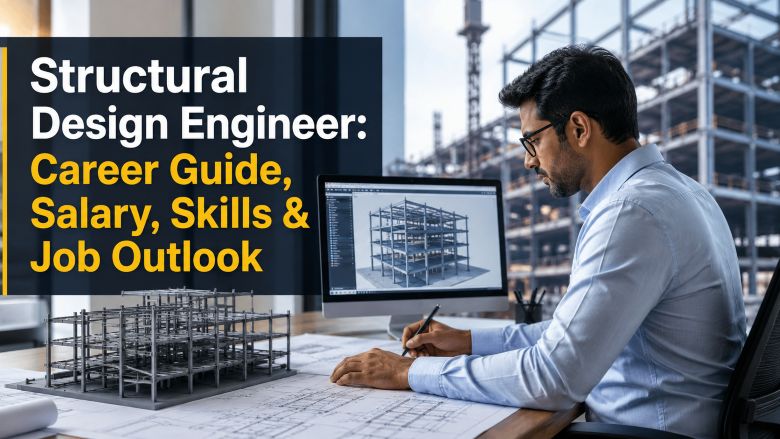
A structural design engineer is the professional who stands between an architect’s vision and a building that actually stays standing. They analyse forces, design load-bearing systems, and translate physics into steel, concrete, and timber that millions of people trust with their lives every single day. Whether it is a 60-storey high-rise resisting seismic loads in Tokyo, a cable-stayed bridge spanning a river gorge, or a hyperscale data centre housing AI infrastructure worth billions, the structural design engineer is the person who makes sure the maths works — and that the structure does not fail.
ConstructionCareerHub App is LIVE — built ONLY for construction careers. Don’t apply with a weak resume.
Get ATS-ready Resume Lab + Interview Copilot + Campus Placement Prep (resume screening, skill gaps, interview readiness) — in minutes & Other advanced features.
Explore Smarter Construction Career Tools →Quick check. Big impact. Start now.
In 2026, demand for structural design engineers is at a historic peak. The U.S. Bureau of Labor Statistics projects 5% employment growth for civil engineers (including structural specialisations) through 2034, with roughly 23,600 annual job openings. Global infrastructure spending is forecast to reach $9.2 trillion per year by 2030, and the data centre construction market in Asia-Pacific alone is projected to hit $177.5 billion by 2032. Add climate-resilient infrastructure mandates, renewable energy expansion, and accelerating BIM adoption, and the result is a profession that is both intellectually demanding and exceptionally well compensated.
This comprehensive guide covers everything you need to know about building a career as a structural design engineer in 2026 — from job responsibilities and essential skills to salary benchmarks, software proficiency requirements, certification pathways, and global career opportunities. Whether you are a civil engineering student exploring specialisation options, a fresh graduate preparing for your first design role, or an experienced site engineer considering a transition into structural design, this article provides the data-backed clarity you need.
🚀 ConstructionCareerHub App is LIVE — built ONLY for construction careers. Don’t apply with a weak resume. Get ATS-ready Resume Lab + Interview Copilot + Campus Placement Prep (resume screening, skill gaps, interview readiness) — in minutes & other advanced features.
Explore Smarter Construction Career Tools →
Table of Contents
What Is a Structural Design Engineer?
A structural design engineer is a specialised civil engineer responsible for designing the structural framework of buildings, bridges, towers, industrial facilities, and other infrastructure. The word “design” in the title distinguishes this role from site-based structural engineering — structural design engineers work primarily in office environments, creating the calculations, models, and construction drawings that contractors execute on site.
Their core objective is ensuring that every structure can safely resist all anticipated loads — including dead loads (the weight of the structure itself), live loads (occupants, furniture, equipment), wind loads, seismic loads, snow loads, and thermal effects — throughout its entire service life. This requires deep knowledge of structural mechanics, material science, building codes, and advanced analysis software. For a broader understanding of how structural design fits within civil engineering as a discipline, our detailed guide covers the foundational principles.
The role sits at the intersection of engineering science and practical construction. A structural design engineer must balance safety factors with cost efficiency, architectural aesthetics with constructability, and code compliance with innovation. It is a profession where a single decimal-point error in a load calculation can have catastrophic consequences — and where getting the design right can define skylines for generations.
Structural Design Engineer Job Description and Key Responsibilities
The day-to-day work of a structural design engineer varies by project type, firm size, and seniority level, but the core responsibilities remain consistent across the profession. Here is a detailed breakdown of what the role involves.
Structural Analysis and Design
The primary responsibility is performing structural analysis — calculating how forces flow through a building’s frame and ensuring every member (beam, column, slab, wall, foundation) is sized adequately. This involves applying engineering principles from statics, dynamics, mechanics of materials, and soil mechanics. For buildings, this means designing the gravity load system (how vertical loads travel from roof to foundation) and the lateral load resisting system (how the structure withstands wind and earthquake forces). Engineers select from structural systems such as moment-resisting frames, braced frames, shear wall systems, or combinations, depending on the building height, occupancy category, and seismic zone. Our guide on structural engineering as a field provides a comprehensive context on these design approaches.
Computer-Aided Modelling and Simulation
Modern structural design is inseparable from software. Structural design engineers build three-dimensional analytical models using tools like ETABS, STAAD Pro, SAP2000, and Autodesk Revit to simulate how structures behave under various loading scenarios. They run response spectrum analysis for seismic design, perform wind load analysis per applicable codes (ASCE 7, IS 875, Eurocode 1), and check member capacities against strength and serviceability limit states. A strong understanding of these tools is non-negotiable — our curated list of the 10 best structural design software courses in 2026 covers the training pathways in detail.
Construction Drawing Preparation
Structural design engineers produce detailed construction drawings — general arrangement plans, reinforcement detailing sheets, steel connection details, foundation layouts, and structural specifications. These documents serve as the legal and technical instructions for contractors. Accuracy is paramount; a misplaced rebar callout or incorrect concrete grade specification can compromise an entire structure. AutoCAD remains the workhorse for 2D documentation, while BIM software like Revit is rapidly becoming mandatory for coordinated 3D documentation.
Code Compliance and Regulatory Coordination
Every structural design must comply with applicable building codes and standards — ACI 318 and ASCE 7 in the United States, IS 456 and IS 1893 in India, Eurocodes in Europe, and BS/EN standards in the UK and the Gulf. Structural design engineers prepare design calculations, submit them for peer review or third-party checking, and coordinate with building control authorities for approvals. Understanding how codes evolve (particularly seismic design provisions) is a career-long requirement.
Multi-Disciplinary Coordination
Structural design engineers collaborate daily with architects, MEP engineers, quantity surveyors, and construction managers. They resolve spatial conflicts between structural members and building services (HVAC ducts, electrical conduits, plumbing risers) through BIM coordination and clash detection processes. Communication skills are as important as technical proficiency — the ability to explain structural constraints to non-technical stakeholders is what separates competent engineers from exceptional ones.
Site Support and Construction Supervision
While structural design engineers are primarily office-based, they regularly visit construction sites to verify that work matches the design intent. They review shop drawings, respond to Requests for Information (RFIs) from contractors, approve material substitutions, and inspect critical structural elements before concrete pours or steel erection. For more context on the site-side of structural engineering, our day-in-the-life of a site engineer guide provides a useful comparison.
Structural Design Engineer Salary: Global Benchmarks for 2026
Compensation for structural design engineers varies significantly by geography, experience level, licensure status, and specialisation. Here is the latest salary data from multiple authoritative sources.
United States
According to Salary.com (February 2026 data), the average annual salary for a structural design engineer in the United States is $78,550, with the full range spanning approximately $66,000 to $93,000 depending on experience and location. ZipRecruiter reports a higher average of $102,774 per year, with the 75th percentile at $132,000 and top earners reaching $151,000–$160,000 annually. The highest-paying states include California ($86,641), Massachusetts ($85,486), and Washington ($85,172). PE-licensed structural engineers command a significant premium — the 2025 ASCE Salary Report found that PE-licensed civil engineers earn approximately $40,000 more annually than unlicensed counterparts. For state-by-state salary analysis, see our detailed best-paying US states for civil engineers guide.
India
In India, structural design engineers earn an average of ₹4,16,000 per year (approximately ₹34,667 per month) according to Indeed India (March 2026). Glassdoor reports a higher average of ₹7,50,000 per year, with the 75th percentile at ₹10,70,000 and top earners reaching ₹15,00,000 annually. PayScale India places the average at ₹6,60,830. Engineers proficient in ETABS and STAAD Pro earn ₹4–12 LPA at the mid-level, while senior design engineers at major firms like L&T, Tata Projects, and AECOM can command ₹15–25+ LPA. Our comprehensive civil engineering salary guide covers India-specific trends in depth.
Gulf Region (UAE, Saudi Arabia, Qatar)
Structural design engineers in the Gulf typically earn AED 8,000–20,000 per month (approximately $26,000–$65,000 annually), with senior engineers and team leads commanding AED 25,000–35,000+ per month. Tax-free status, housing allowances, and end-of-service gratuities significantly enhance total compensation. The current infrastructure expansion across Saudi Arabia (NEOM, The Line, Red Sea developments) and Qatar’s post-World Cup legacy projects are creating sustained demand. For professionals exploring international construction career opportunities, the Gulf remains one of the most lucrative markets.
Key Salary Influencers
Several factors can substantially shift your earning potential as a structural design engineer. PE or SE licensure is the single biggest salary accelerator in the United States. Software proficiency in ETABS, SAP2000, and Revit can increase earnings by 20–40% compared to engineers relying solely on manual methods. Specialisation in high-demand areas such as seismic design, data centre structural engineering, or performance-based design commands significant premiums. Project type matters too — engineers working on high-rise buildings, bridges, and critical infrastructure generally earn more than those working on low-rise residential projects. For a detailed view of salary expectations across different roles, explore our highest-paying civil engineering jobs guide.
Essential Skills for Structural Design Engineers
Succeeding as a structural design engineer requires a combination of deep technical knowledge, software proficiency, and professional soft skills. Here are the competencies that hiring managers prioritise in 2026.
Technical and Analytical Skills
The foundation is a thorough understanding of structural mechanics — statics, dynamics, strength of materials, theory of structures, and soil mechanics. You must be able to trace load paths through a structure intuitively, understand when a member is governed by strength versus serviceability, and recognise when software results do not make physical sense. Competence in reinforced concrete design (ACI 318, IS 456, Eurocode 2), structural steel design (AISC 360, IS 800, Eurocode 3), and foundation engineering is essential. Our collection of 100+ structural analysis interview questions provides an excellent self-assessment benchmark for these fundamentals.
Software Proficiency
Software proficiency is the single most measurable differentiator in the structural design job market. The must-know tools in 2026 include ETABS for multi-storey building analysis and seismic design, STAAD Pro for general-purpose structural analysis (particularly popular in India and the Gulf), SAP2000 for complex structures and bridge analysis, Autodesk Revit for BIM-integrated structural modelling, SAFE for foundation and slab design, Tekla Structures for steel and precast detailing, and AutoCAD for 2D drafting and documentation. Engineers who demonstrate proficiency across multiple platforms — for example, ETABS for buildings and SAP2000 for bridges — become deployable across diverse project types. For targeted interview preparation on these platforms, our ETABS interview questions guide and STAAD Pro interview questions guide are essential reading.
BIM and Digital Construction Skills
Building Information Modelling has transformed structural design workflows. Over 60% of US construction firms now use BIM tools, and government BIM mandates exist in the UK, Singapore, and several Gulf states. Structural design engineers must be proficient in creating and managing structural BIM models, conducting clash detection with architectural and MEP models, and generating automated schedules and quantity takeoffs. Understanding the BIM ecosystem — what BIM means for civil engineering — is no longer optional; it is a core hiring requirement. For a comprehensive view of BIM software options, certifications, and career paths, explore our guides on top BIM certifications in 2026 and BIM careers, salaries, and global demand.
Communication and Teamwork
Structural design is a collaborative discipline. You will present design concepts to architects who may not understand load paths, explain cost implications to clients, defend design decisions to peer reviewers, and coordinate with contractors who need practical, buildable solutions. Written communication matters equally — your design reports, calculation sheets, and specifications become legal documents. Our guide on civil engineer vs. structural engineer highlights how communication skills differentiate these overlapping career paths.
How to Become a Structural Design Engineer: Step-by-Step Career Path
The path to becoming a structural design engineer follows a structured progression that combines formal education, practical experience, and professional licensure.
Step 1: Earn a Bachelor’s Degree in Civil or Structural Engineering
A bachelor’s degree in civil engineering (with structural electives) or a dedicated structural engineering programme from an ABET-accredited institution (or equivalent national accreditation) is the standard entry requirement. Core coursework should include structural analysis, reinforced concrete design, steel design, foundation engineering, fluid mechanics, and construction materials. If you are still evaluating whether civil engineering is the right path, our guide on how hard civil engineering is to study provides an honest assessment, and our civil engineering career guide 2026 maps out the full landscape of career options.
Step 2: Gain Entry-Level Design Experience (0–3 Years)
Fresh graduates typically enter as junior structural design engineers or graduate engineers at design consultancies, EPC firms, or government engineering departments. During this phase, you assist senior engineers with calculations, learn to operate analysis software under supervision, produce reinforcement detailing drawings, and develop an understanding of construction processes by visiting sites. Companies like Arup, WSP, Jacobs, AECOM, L&T, and Tata Projects actively recruit graduates for structural design roles — our interview preparation guide for L&T, Tata Projects, and Shapoorji Pallonji covers what these employers look for.
Step 3: Pass the FE Exam and Build Your Software Portfolio
In the United States, passing the Fundamentals of Engineering (FE) exam — ideally during or immediately after your undergraduate programme — is the first formal step toward licensure. Concurrently, invest in building demonstrable software proficiency. Complete structured online courses in ETABS, STAAD Pro, and Revit. Create a portfolio of practice models (a multi-storey building, a small bridge, a foundation system) that you can present during interviews. Our guides on structural design software courses and becoming a BIM designer offer curated training recommendations.
Step 4: Obtain Your PE License (4+ Years Experience)
After accumulating four years of progressive engineering experience under a licensed PE, you become eligible to sit for the PE (Professional Engineer) examination. In the structural engineering discipline, this is the Structural Engineering (SE) exam in jurisdictions that require it. PE licensure is a career-defining milestone — it authorises you to sign and seal engineering drawings, take legal responsibility for designs, and practise independently. Our step-by-step guide to becoming a certified structural engineer walks through the entire certification journey.
Step 5: Specialise and Advance (5–15+ Years)
With a PE license and substantial project experience, structural design engineers advance into specialised roles — seismic design specialist, bridge engineer, high-rise structural lead, forensic structural engineer, or structural team lead. At the senior level, roles expand to include project management, client relationship management, business development, and mentoring junior engineers. The career trajectory can lead to principal engineer, associate director, or partner-level positions at design consultancies. For a comprehensive view of all possible career trajectories, our 15 best career options after civil engineering maps the landscape.
🛠️ Build Your Structural Engineering Career with the Right Tools
The ConstructionCareerHub platform provides AI-powered Resume Lab (ATS-optimised resume builder), Interview Copilot (AI-driven mock interviews), Career Planner, and Salary Calculator — built exclusively for construction professionals.
Try the Free Career Tools →
Top Industry Sectors Hiring Structural Design Engineers in 2026
Structural design engineers are needed across virtually every construction sector, but several industries are driving disproportionate demand in 2026.
Data Centre Construction
The explosive growth of AI and cloud computing is driving a global data centre construction boom. APAC data centre construction is projected to reach $177.5 billion by 2032, with each major project generating 1,700+ specialised construction jobs. Structural design engineers are essential for designing the heavy floor loading systems (server rooms can exceed 250 kPa), seismic-resilient foundations, and modular structural frameworks these facilities demand. Explore our comprehensive data centre construction contractors guide for market insights.
High-Rise and Commercial Buildings
Urbanisation continues to drive demand for tall buildings globally. Structural design engineers specialising in high-rise design must understand lateral load systems, progressive collapse prevention, construction sequencing effects, and performance-based seismic design. This is one of the most intellectually challenging and financially rewarding niches within the profession. The top 50 civil engineering firms in the USA are consistently hiring for these roles.
Renewable Energy Infrastructure
Wind turbine foundations, solar farm structural supports, battery energy storage system (BESS) enclosures, and green hydrogen plant structures all require structural design expertise. Over $300 billion is allocated globally to sustainable infrastructure projects, creating a new frontier for structural design engineers with sustainability awareness.
Infrastructure Rehabilitation
Ageing infrastructure across the United States, Europe, and other developed economies requires structural assessment, retrofit design, and rehabilitation engineering. The American Society of Civil Engineers consistently grades US infrastructure below standard, creating sustained demand for structural engineers who can evaluate existing structures and design strengthening solutions.
Industrial and EPC Projects
Oil and gas facilities, petrochemical plants, pharmaceutical manufacturing, and mining infrastructure demand structural design engineers who understand dynamic equipment loads, blast-resistant design, and elevated temperature effects. Gulf countries and Australia remain particularly strong markets. Our commissioning engineer career guide covers the EPC sector in detail for related roles.
Structural Design Engineer vs. Related Roles: Understanding the Differences
Job titles in structural engineering can be confusing. Here is how the structural design engineer role compares to closely related positions.
A structural engineer is the broadest title, encompassing design, analysis, site inspection, and project management across a structure’s lifecycle. A structural design engineer specifically focuses on the design and analysis phase — creating the structural systems, performing calculations, and producing construction documents. While all structural design engineers are structural engineers, not all structural engineers focus primarily on design.
A civil design engineer covers a wider scope — roads, drainage, earthworks, and site infrastructure — in addition to (or instead of) building structures. Our civil design engineer job description clarifies this distinction. A site engineer works predominantly on construction sites, translating design drawings into physical structures — the execution side rather than the design side. For a detailed comparison of these overlapping career paths, read our civil engineer vs. structural engineer guide and our comprehensive list of 150+ construction job titles.
Best Courses and Certifications for Structural Design Engineers
Continuous learning is non-negotiable in structural engineering. Design codes update, software platforms evolve, and new construction methods emerge regularly. Here are the most impactful courses and certifications for structural design engineers in 2026.
Recommended Online Courses
The following courses are available on major learning platforms and have been evaluated for curriculum depth, instructor credentials, and career relevance.
Structural Scheme Setting and ETABS Analysis of RCC Building (L&T EduTech on Coursera) — A hands-on course covering ETABS modelling from scratch using real-world project parameters. Ideal for engineers working with Indian Standard codes.
Enrol on Coursera →
Structural Engineering: Fundamentals of Structural Design (edX) — Six graduate-level modules covering structural design theory, analysis methods, and material behaviour from a top university perspective.
Explore on edX →
ETABS – Complete Structural Design of a Building (Udemy) — Covers gravity and lateral load analysis, design, and detailing for reinforced concrete structures. Bestseller with thousands of students.
Enrol on Udemy →
BIM: From Sketch to Digital Twin (Coursera) — Covers the complete BIM lifecycle from initial design through digital twin creation. Excellent for structural engineers transitioning to BIM-integrated workflows.
Enrol on Coursera →
Construction Management Professional Certificate (University of Maryland on edX) — Comprehensive construction management with BIM integration, scheduling, and cost estimation. Ideal for structural engineers moving toward project leadership.
Explore on edX →
For a complete breakdown of the best training investments, read our 10 best structural design software courses in 2026.
Professional Certifications
Beyond the PE/SE license, certifications that enhance a structural design engineer’s career include the Autodesk Certified Professional (ACP) for Revit Structure, the buildingSMART Professional Certification for openBIM workflows, and the PMP (Project Management Professional) for engineers transitioning into design team leadership. For a comprehensive analysis of which certifications deliver the best career ROI, our top BIM certifications guide provides detailed comparisons.
How to Prepare for Structural Design Engineer Interviews
Landing a structural design engineer position requires demonstrating both theoretical depth and practical software proficiency. Interviewers at design consultancies and EPC firms typically assess candidates across several dimensions: fundamental structural concepts (load paths, moment distribution, section design), software application skills (building an ETABS model from scratch, interpreting STAAD Pro output), code knowledge (design load combinations, seismic detailing requirements), and project experience (describing real design challenges and how you resolved them).
To prepare systematically, work through our 55+ structural engineer interview questions with detailed answers, the top 50 ETABS interview questions, and the 100+ structural analysis interview questions. For resume optimisation, our top 25 resume and portfolio interview questions guide covers how to present your design experience effectively.
Before any interview, ensure your resume highlights your software certifications, project experience with specific structural systems, and quantifiable contributions (e.g., “Designed the structural system for a 12-storey RC building with ETABS, resulting in 8% material optimisation compared to preliminary sizing”). The AI-powered Resume Lab on ConstructionCareerHub.com is purpose-built to optimise construction resumes for ATS filters at top engineering firms.
Structural Design Engineer Job Outlook: Why 2026 Is a Peak Year
The job outlook for structural design engineers in 2026 is exceptionally strong, driven by the convergence of several macro trends.
The U.S. Bureau of Labor Statistics projects 5% employment growth for civil engineers from 2024 to 2034, with approximately 23,600 annual job openings driven by both growth and replacement demand. The 2025 ASCE Salary Report found that average base salaries for civil engineers reached $148,000 — a 6.4% increase from 2024 — with entry-level salaries rising to $77,100 and job satisfaction at 86.2%. These numbers confirm that the profession is growing in both volume and value.
At the global level, infrastructure spending is projected to reach $9.2 trillion annually by 2030. Data centre construction is tripling installed capacity to 80 GW by 2030, with each major project generating 1,700+ specialised construction jobs. Climate-resilient infrastructure mandates, renewable energy expansion, and urbanisation in developing economies are layering additional demand on top of baseline infrastructure needs. Deloitte’s Engineering & Construction Industry Outlook identifies data centre expansion, semiconductor manufacturing, energy transition, and grid modernisation as the key growth sectors for 2026 and beyond.
For engineers considering their career options within this expanding market, our structural engineering career guide provides a comprehensive view of the profession’s trajectory, and our guide on what civil engineers do covers the broader discipline.
Career Resources and eBooks for Structural Design Engineers
To accelerate your structural design engineering career, we have curated these resources specifically for construction professionals at every career stage.
📘 Civil Engineer’s Career eBook — A complete blueprint for building a successful civil and structural engineering career, covering industry dynamics, career strategies, and professional growth frameworks.
📘 Construction Interview Preparation Guide — 300+ interview questions and answers covering structural engineering, geotechnical, construction management, and technical software rounds. Essential for design engineer interviews.
📘 Construction Career Bundle — Combined kit for resume optimisation, interview preparation, and salary negotiation — everything you need in one package.
📘 Remote & Global Construction Jobs Kit — For structural design engineers targeting international opportunities in the Gulf, Australia, Europe, or remote design consultancy roles.
Frequently Asked Questions About Structural Design Engineers
What does a structural design engineer do?
A structural design engineer analyses loads, designs structural systems (beams, columns, foundations, slabs), creates detailed engineering drawings, performs computer-aided analysis using software like ETABS, STAAD Pro, and SAP2000, and ensures structures meet building codes and safety standards. They work on buildings, bridges, industrial facilities, and infrastructure projects. For a detailed job description, see our structural engineer job description and salary guide.
What is the salary of a structural design engineer in the USA?
In the USA, structural design engineers earn an average annual salary of $78,550–$102,774 depending on the data source. Entry-level engineers earn $55,000–$74,000, mid-level professionals earn $87,000–$106,000, and senior structural design engineers can earn $123,000–$160,000+. PE licensure, software proficiency, and specialisation in areas like seismic design or high-rise structures significantly increase compensation.
What qualifications are needed to become a structural design engineer?
A bachelor’s degree in civil or structural engineering from an accredited programme is the minimum requirement. Passing the FE (Fundamentals of Engineering) exam, gaining 4+ years of supervised experience, and obtaining a PE (Professional Engineer) license are the standard career milestones. Some states also require a separate SE (Structural Engineer) license for critical structures. Our certification guide covers the complete process.
What software should a structural design engineer learn?
Essential software includes ETABS and SAP2000 for building and structural analysis, STAAD Pro for general-purpose analysis, Autodesk Revit for BIM-integrated structural modelling, AutoCAD for 2D drafting, SAFE for foundation design, and Tekla Structures for steel and precast detailing. Proficiency in these tools can increase earning potential by 20–40%. For training recommendations, see our structural design software courses guide.
Is structural design engineering a good career in 2026?
Yes. The BLS projects 5% employment growth through 2034, with approximately 23,600 annual openings. Global infrastructure spending projected to reach $9.2 trillion annually by 2030, data centre construction booms, and climate-resilient infrastructure mandates are driving strong demand. Average salaries are rising — the 2025 ASCE report showed a 6.4% year-over-year increase — and PE-licensed structural engineers earn among the highest salaries in the broader civil engineering field.
What is the difference between a structural engineer and a structural design engineer?
A structural engineer is a broad title covering analysis, design, inspection, and project management across a structure’s lifecycle. A structural design engineer is a more specific role focused primarily on the design and analysis phase — creating structural systems, performing calculations, developing construction drawings, and specifying materials. Many organisations use these titles interchangeably, though “structural design engineer” emphasises office-based design work over site supervision. Read our detailed comparison guide for more clarity.
🚀 Ready to Launch Your Structural Design Engineering Career?
Visit ConstructionCareerHub.com for AI-powered Resume Lab, Interview Copilot, Career Planner, and Salary Calculator — built exclusively for construction professionals. Your next career move starts with the right preparation.
Get Started Free →
Related Articles on ConstructionPlacements
- Structural Engineering: An Extensive Field of Innovation and Ingenuity
- 55+ Structural Engineer Interview Questions and Answers [2026]
- Exploring BIM Careers: Top Opportunities for Engineers and Architects
- Career Shift: Site Engineer to BIM Specialist
- 250+ Civil Engineering Seminar Topics 2026
- 150+ Civil Engineering Final Year Project Ideas
- MS Excel in the Construction Industry: Complete Guide
- Construction Data: How It’s Revolutionising the Industry in 2026
