
Last Updated on June 3, 2026 by Admin
Structural design software proficiency is no longer a nice-to-have skill for civil and structural engineers — it is a core hiring requirement. Whether you are a fresh graduate preparing for campus placements, a mid-career engineer transitioning into design consultancy, or a senior professional upgrading to BIM-integrated workflows, the right online course can dramatically accelerate your career trajectory and earning potential.
ConstructionCareerHub App is LIVE — built ONLY for construction careers. Don’t apply with a weak resume.
Get ATS-ready Resume Lab + Interview Copilot + Campus Placement Prep (resume screening, skill gaps, interview readiness) — in minutes & Other advanced features.
Explore Smarter Construction Career Tools →Quick check. Big impact. Start now.
According to the U.S. Bureau of Labor Statistics, employment for civil engineers is projected to grow 5% through 2032, with structural specialisations commanding premium salaries. In India, engineers proficient in ETABS and STAAD Pro earn ₹4–12 LPA at the mid-level, while their US counterparts command $70,000–$130,000 or more annually.
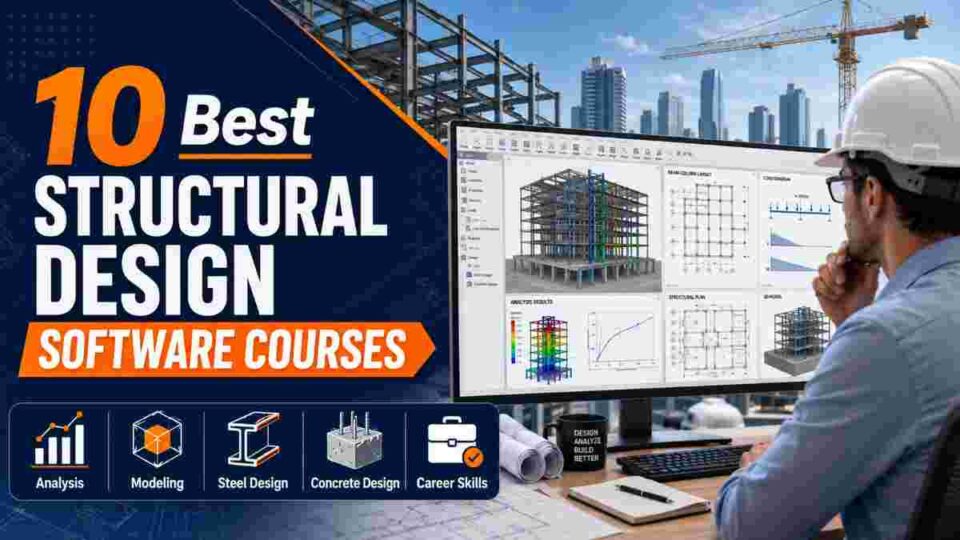
This guide curates the 10 best structural design software courses available online in 2026 — spanning industry-standard tools like ETABS, SAP2000, STAAD Pro, Revit Structure, and Tekla. Each course has been evaluated on curriculum depth, instructor credentials, real-world project coverage, student reviews, and career relevance.
Try the Resume Lab →
Table of Contents
Why Structural Design Software Skills Matter in 2026
The construction industry’s digital transformation has fundamentally changed how structural engineers work. Manual calculations that once took days are now completed in hours using finite element analysis (FEA) software. BIM mandates from government bodies and major clients across the UK, US, Singapore, and the Gulf region mean that structural engineers must deliver their designs within coordinated digital models — not just standalone calculations.
Here is why investing in structural design software training delivers measurable career returns:
Higher salaries: Structural engineers with software proficiency earn 20–40% more than peers relying solely on manual methods or basic spreadsheet tools. BIM-certified engineers command an even higher premium — up to 30–50% more in markets like India and the Gulf.
Broader job eligibility: Major consultancies such as Arup, WSP, Jacobs, and AECOM list ETABS, SAP2000, or Revit proficiency as mandatory requirements in virtually all structural engineering job postings. Without these skills, candidates are filtered out before interviews begin.
Project versatility: Proficiency across multiple tools — for example, ETABS for buildings, SAP2000 for bridges, and STAAD Pro for industrial structures — makes engineers deployable across diverse project types, increasing job security and advancement opportunities.
AI-readiness: As AI transforms construction, structural software platforms are integrating generative design, automated code-checking, and optimisation algorithms. Engineers who understand the software foundations will adapt faster to these AI-enhanced workflows.
For a comprehensive overview of digital tools shaping the industry, explore our guide on the best construction software to learn in 2026.
How We Selected These Courses
Each course on this list was evaluated against five criteria designed to ensure practical career value:
Curriculum relevance: Does the course teach current software versions and design codes (ACI 318-19, Eurocode, IS 456:2000, IS 1893:2016) that employers actually require?
Instructor credibility: Is the instructor a practising structural engineer or university faculty with verifiable project experience?
Hands-on projects: Does the course include real-world modelling exercises — not just interface walkthroughs?
Student outcomes: What do learner reviews and ratings indicate about practical skill development?
Accessibility and value: Is the course reasonably priced, self-paced, and accessible globally?
10 Best Structural Design Software Courses in 2026
1. ETABS Professional Training for Structural Engineers (Udemy)
Software covered: CSI ETABS
Design code: ACI 318-19
Level: Beginner to Intermediate
Best for: Civil engineering students and junior structural engineers entering building design
This course provides a structured pathway from ETABS fundamentals to complete RC building design per ACI standards. The curriculum covers interface navigation, structural scheme conceptualisation, model creation, load definition, analysis execution, and design interpretation — following the exact workflow practised in professional consultancies.
What makes this course stand out is its emphasis on the thinking process behind structural modelling, not just button-clicking. The instructor, a practising structural engineer, walks through conceptual design decisions (slab system selection, column layout, lateral load paths) before opening the software — mirroring how experienced engineers actually approach projects.
Key modules include: Structural model creation, gravity and lateral load application, analysis per ACI code, design report generation, and reinforcement detailing interpretation. Students work through a complete office building project from concept to final design output.
🔗 Enroll in ETABS Professional Training on Udemy →
2. Structural Scheme Setting and ETABS Analysis of RCC Building (Coursera)
Software covered: CSI ETABS, CSI SAFE
Design code: Multiple (ACI-focused)
Level: Intermediate
Best for: Engineers who want university-structured learning with ETABS
Offered as part of a broader structural engineering specialisation on Coursera, this course bridges the gap between theoretical structural design knowledge and practical software application. It covers architectural drawing interpretation, structural scheme setting, floor system selection (continuous two-way slabs, flat slabs, drop panels), edge beam design, and column sizing — all modelled and verified in ETABS.
The university-structured approach distinguishes this from typical tutorial courses. Learners develop a conceptual understanding of structural behaviour before applying it in software, which builds the engineering judgement that employers value alongside raw software proficiency.
This course can be audited for free on Coursera, with a paid option for verified certificates. For more free learning options, see our guide to free construction courses on Coursera.
3. Structural Engineering Course: ETABS, STAAD & SAP2000 (Udemy)
Software covered: ETABS, STAAD Pro, SAP2000, SAFE
Design codes: IS 800:2007, IS 456:2000, IS 1893:2016
Level: Beginner to Advanced
Best for: Indian engineers and anyone working with Indian Standard codes
This is one of the most comprehensive structural design software courses available in 2026. It covers three major analysis platforms — STAAD Pro, ETABS, and SAP2000 — all aligned with Indian Standard codes. The curriculum includes steel and RCC structure design, truss analysis, silo support structures with FEM analysis, and earthquake-resistant design per IS 1893:2016.
For engineers working in the Indian construction market or preparing for roles with Indian consultancies, this course delivers exceptional value by combining multi-software proficiency with IS code compliance — exactly what employers like L&T, Tata Projects, and Shapoorji Pallonji expect.
The course features real-world project-based modules including steel truss design in STAAD Pro, multi-storey building analysis in ETABS, and bridge component analysis in SAP2000. Each module follows a concept-to-completion workflow with hands-on parallel exercises.
For a deeper dive into STAAD Pro fundamentals, also check our free STAAD Pro tutorial guide.
🔗 Enroll in the Structural Engineering Course on Udemy →
4. SAP2000 Professional Course for Structural Engineers (Udemy)
Software covered: CSI SAP2000
Design code: AISC/ANSI, ASCE
Level: Beginner to Advanced
Best for: Engineers working on bridges, stadiums, industrial structures, and non-building projects
SAP2000 is a general-purpose structural analysis and design tool that handles diverse structure types — bridges, stadiums, towers, industrial facilities — that ETABS cannot efficiently address. This course covers everything from basic modelling techniques to advanced steel, cold-formed steel, and aluminium design with AISC/ANSI code references.
The instructor focuses on professional-level design practice, covering load pattern definition, seismic and wind load application, mass source configuration, diaphragm assignment, Tekla/Revit/AutoCAD model import, and comprehensive analysis and design interpretation. The systematic topic sequencing makes complex concepts accessible even for learners without prior SAP2000 experience.
SAP2000 proficiency is particularly valuable for engineers targeting bridge design, infrastructure consulting, or international project roles where the software’s versatility across structure types and design codes provides a significant advantage. Learn more about essential software skills for civil engineers.
🔗 Enroll in the SAP2000 Professional Course on Udemy →
5. Learn ETABS & SAFE in the Structural Design of 15 Stories RC (Udemy)
Software covered: CSI ETABS, CSI SAFE, CSI SAP2000
Design code: Multiple
Duration: 20+ hours
Level: Intermediate to Advanced
Best for: Engineers ready to tackle high-rise building design with real-project complexity
This is not a typical software tutorial — it is a complete structural design project course. The instructor walks through the full design of a 15-storey reinforced concrete building with a basement, covering everything from initial member sizing and conceptual thinking through to final ETABS modelling, SAFE foundation design, earthquake analysis, and design report generation.
Advanced topics include fluid viscous damper (FVD) modelling in ETABS, response spectrum analysis, mosque dome modelling in ETABS and SAP2000, and minaret pile foundation design. The 20-plus hours of content provide the depth needed to transition from academic knowledge to professional practice.
This course is particularly recommended for engineers who have completed a basic ETABS course and want to progress to real-world high-rise project complexity. The instructor’s emphasis on “how a civil engineer must think before modelling” builds the design judgement that distinguishes competent engineers from mere software operators.
Start a Free Interview Session →
6. The Art of Structural Engineering: Bridges (edX — Princeton University)
Focus: Structural engineering design philosophy and bridge engineering
Institution: Princeton University
Instructor: Prof. Maria Garlock, Department of Civil and Environmental Engineering
Duration: 8 weeks (2–3 hours per week)
Level: Introductory
Best for: Engineers seeking design thinking foundations and bridge engineering context
While not a software-specific course, this Princeton University offering on edX provides something that most software tutorials lack — an understanding of the creative and structural philosophy behind engineering design. The course examines significant bridges from the industrial revolution onwards, exploring the interplay between forces, form, economics, and aesthetics in structural design.
The course covers structural art principles through iconic bridges: Thomas Telford’s metal forms, John Roebling and the Brooklyn Bridge, the Golden Gate Bridge, Robert Maillart’s reinforced concrete innovations, and Christian Menn’s modern bridge forms. This conceptual foundation makes software tools more meaningful, as engineers understand the “why” behind the models they create.
This course is free to audit on edX and requires only basic algebra — making it accessible to students at any stage. It pairs exceptionally well with the practical software courses in this list, creating a well-rounded structural engineering education.
7. Bentley STAAD.Pro Tutorial (Udemy)
Software covered: Bentley STAAD.Pro v8i
Level: Beginner
Cost: Free
Best for: Beginners who want a zero-cost entry into structural analysis software
STAAD.Pro is a 3D structural analysis and design application supporting over 90 international steel, concrete, timber, and aluminium design codes. This free Udemy course starts from absolute basics and progressively builds towards modelling complete building structures. The course is structured so learners can achieve basic proficiency within a month, with three to four months of practice needed for mastery.
While the free course covers the foundational STAAD.Pro workflow — geometry creation, member property assignment, support conditions, load application, analysis, and design — it provides sufficient grounding for learners to determine whether structural analysis is their career direction before investing in premium courses. Read more about learning STAAD Pro and how it compares with other structural design tools.
STAAD.Pro proficiency is particularly valuable for engineers targeting roles in India, the Middle East, and Southeast Asia, where it remains the dominant structural analysis tool for industrial and infrastructure projects.
8. Engineering of Structures Around Us Specialization (Coursera — Dartmouth College)
Focus: Structural engineering fundamentals — tension, compression, trusses, and building response
Institution: Dartmouth College
Platform: Coursera
Level: Introductory to Intermediate
Best for: Students and early-career engineers building strong conceptual foundations
This multi-course specialisation from Dartmouth College covers the fundamental forces and behaviours that every structural design software model relies on — tension, compression, trusses, determinacy, and the response of structures to various force types. Understanding these concepts is what separates engineers who use software intelligently from those who merely input data and accept outputs uncritically.
The specialisation includes courses on tension and compression in structural systems, the response of structures to dynamic forces, and the engineering principles behind tensegrity structures and building systems. Each course includes knowledge checks, calculation assignments, and creative challenges that reinforce conceptual understanding.
This specialisation is strongly recommended as a prerequisite or companion to the practical software courses listed above. Coursera offers financial aid for eligible learners and free audit access to all course materials. Browse our complete list of 30 best online construction courses for additional options.
9. Autodesk Revit Structure Online Courses
Software covered: Autodesk Revit (Structural module)
Available on: Autodesk Education, Udemy, Coursera
Level: Beginner to Intermediate
Best for: Structural engineers transitioning to BIM-integrated design workflows
Revit Structure is Autodesk’s BIM platform for structural engineering, providing parametric modelling, structural analysis integration, construction documentation, and multi-discipline coordination capabilities. In 2026, BIM proficiency through Revit is increasingly a baseline requirement for structural engineering roles — especially in markets with BIM mandates like the UK, Singapore, and the Gulf.
Autodesk offers free Revit access to students through its Education Community, and multiple free and paid courses are available across platforms. Recommended learning paths include Revit Structure fundamentals (interface, modelling, documentation), advanced structural modelling (analytical model, Dynamo for automation), and interoperability with analysis tools (ETABS, Robot Structural Analysis).
The combination of Revit Structure with a dedicated analysis tool like ETABS or SAP2000 represents the standard structural engineering workflow in modern consultancies. Explore our detailed guide on Autodesk Revit tutorials and courses and understand Revit’s capabilities and system requirements.
10. Structural Materials: Selection and Economics (edX — MIT)
Focus: Structural material properties, selection criteria, and economic analysis
Institution: Massachusetts Institute of Technology (MIT)
Platform: edX
Level: Intermediate
Best for: Engineers who want to make better material selection decisions in structural design
This MIT course addresses a critical knowledge gap that most software courses overlook — understanding the properties, behaviours, and economics of structural materials including steel, aluminium, titanium, concrete, and composites. When engineers model structures in ETABS or SAP2000, the material properties they assign directly affect analysis accuracy and design efficiency.
The course covers why billions of tons of structural materials are used annually, how material selection affects structural performance, cost, and sustainability, and the engineering principles governing material behaviour under various loading conditions. This knowledge elevates software-based design from mechanical modelling to informed engineering decision-making.
Paired with hands-on software courses, this MIT offering creates a comprehensive structural engineering skill set that combines theoretical depth with practical application — exactly what senior-level roles require.
Quick Comparison: Top 10 Structural Design Software Courses at a Glance
| Course | Platform | Software | Level | Free? |
|---|---|---|---|---|
| ETABS Professional Training | Udemy | ETABS | Beginner–Intermediate | Paid |
| ETABS Analysis of RCC Building | Coursera | ETABS, SAFE | Intermediate | Free Audit |
| Indian Structural Engineering | Udemy | ETABS, STAAD, SAP2000 | Beginner–Advanced | Paid |
| SAP2000 Professional Course | Udemy | SAP2000 | Beginner–Advanced | Paid |
| ETABS & SAFE — 15 Stories RC | Udemy | ETABS, SAFE, SAP2000 | Intermediate–Advanced | Paid |
| Art of Structural Engineering: Bridges | edX | Conceptual / Design Theory | Introductory | Free Audit |
| Bentley STAAD.Pro Tutorial | Udemy | STAAD.Pro | Beginner | Free |
| Engineering of Structures Specialization | Coursera | Conceptual / Theory | Introductory–Intermediate | Free Audit |
| Autodesk Revit Structure Courses | Multiple | Revit Structure | Beginner–Intermediate | Free/Paid |
| Structural Materials (MIT) | edX | Materials Science | Intermediate | Free Audit |
How to Choose the Right Structural Design Software Course
Selecting the best course depends on your career stage, target market, and the type of structural work you want to pursue. Here is a practical decision framework:
If you are a student or fresh graduate: Start with the free STAAD.Pro tutorial (Course 7) or the Dartmouth Specialization (Course 8) to build conceptual foundations. Then move to ETABS Professional Training (Course 1) for practical building design skills that directly translate to entry-level job requirements.
If you are targeting Indian market roles: The Indian Structural Engineering Course (Course 3) is the single best investment. It covers three software platforms aligned with Indian Standard codes — exactly what employers like L&T, Tata Projects, and mid-tier consultancies require. Supplement with our guide on steps to becoming a certified structural engineer.
If you want to specialise in high-rise building design: Complete ETABS Professional Training (Course 1) first, then progress to the 15-storey RC building course (Course 5) for advanced practice with earthquake design and damper modelling.
If you work on bridges or industrial structures: The SAP2000 Professional Course (Course 4) is your primary choice, complemented by the Princeton bridges course (Course 6) for design philosophy context.
If you are transitioning to BIM-integrated roles: Revit Structure courses (Course 9) are essential. Pair them with BIM certifications for maximum career impact. Explore our complete BIM software guide to understand the broader ecosystem.
Structural Design Software Career Pathways and Salary Data
Investing in structural design software training opens specific career pathways with quantifiable salary outcomes. Understanding these pathways helps you choose courses strategically rather than randomly.
Entry-Level Structural Design Engineer (0–3 years): Proficiency in ETABS or STAAD Pro is the minimum requirement. Typical roles include junior structural engineer, design engineer, and structural drafter. Salary ranges: India ₹3–6 LPA, Gulf $30,000–$50,000, US $55,000–$75,000, UK £28,000–£40,000.
Mid-Level Structural Engineer (3–8 years): Multi-software proficiency (ETABS + SAP2000 + Revit) combined with project experience qualifies engineers for senior design engineer, project engineer, and team lead roles. Salary ranges: India ₹6–15 LPA, Gulf $50,000–$90,000, US $75,000–$110,000, UK £40,000–£65,000.
Senior / Principal Structural Engineer (8+ years): At this level, engineers need advanced analysis capabilities (nonlinear, performance-based design) plus BIM coordination and project management skills. Roles include principal engineer, associate, technical director, and design manager. Salary ranges: India ₹15–30+ LPA, Gulf $90,000–$150,000, US $110,000–$160,000+, UK £60,000–£90,000+.
For detailed salary data across construction roles, see our comprehensive civil engineering salary guide and the structural engineer salary details page.
Plan Your Structural Engineering Career →
Essential Complementary Skills for Structural Design Engineers
Software proficiency alone is necessary but not sufficient. The most successful structural engineers in 2026 combine software skills with these complementary competencies:
BIM coordination: Understanding how structural models integrate with architectural and MEP models through BIM platforms like Revit, Tekla, and Navisworks is essential for design coordination and clash detection. Learn more about Tekla Structures and its role in structural BIM workflows.
Design code knowledge: Software produces results; engineers interpret them. Thorough knowledge of relevant design codes (ACI 318, Eurocode 2/3, IS 456, IS 800, BS EN 1992) is what transforms software output into validated engineering decisions.
Computational tools: Python scripting, Excel VBA, and parametric design tools like Grasshopper and Dynamo are increasingly used for automating repetitive analysis tasks, generating design alternatives, and processing results. See our guide on essential computer skills for civil engineers.
Communication and documentation: Structural engineers must communicate their designs effectively through calculation reports, technical memos, and presentations. Strong technical writing skills differentiate senior engineers from junior peers.
For further reading on the intersection of structural design and emerging technologies, explore our article on the role of structural design in civil engineering and how AI is transforming BIM by 2030.
Where to Go After Completing These Courses
Completing online courses is the beginning, not the end, of building structural design expertise. Here is how to convert course completion into career outcomes:
Build a portfolio: Create two to three practice projects beyond course assignments — a residential building in ETABS, an industrial structure in STAAD Pro, and a bridge component in SAP2000. Document your design process, assumptions, analysis results, and design decisions in a professional format.
Earn certifications: Pursue vendor certifications from Autodesk (Revit Professional), Bentley (STAAD.Pro), or CSI (ETABS) to validate your skills. Explore our guide on free construction certifications you can get online.
Prepare for interviews: Structural design interviews test both theoretical understanding and software application skills. Review our 55+ structural engineer interview questions and answers and the top 50 ETABS interview questions to prepare comprehensively.
Understand career pathways: Read our structural engineering career guide and the civil engineer vs structural engineer comparison to clarify your career direction.
Explore advanced learning: For engineers ready to expand beyond structural design, our curated list of top 10 civil engineering courses on Udemy covers adjacent skills including quantity surveying, project management, and AutoCAD.
Recommended Career Resources
Complement your structural design software training with these career-focused resources:
📘 Civil Engineering Interview Questions & Answers PDF eBook — 102 technical Q&As covering all key civil engineering domains, ideal for freshers and lateral movers preparing for structural design interviews.
📘 Construction Interview Guide — Comprehensive preparation for technical and HR interview rounds across construction roles, including structural engineering positions.
📘 Construction Career eBook Bundle — All-in-one career resource covering resumes, interviews, salary negotiation, and career planning for construction professionals.
📘 Remote Construction Jobs Guide — For structural engineers exploring remote design and BIM coordination roles that are growing rapidly in 2026.
For broader career planning, use our interactive construction career path planner and browse the complete guide to 150+ construction job titles.
Frequently Asked Questions (FAQ)
Which structural design software should I learn first in 2026?
ETABS is the best starting point for most aspiring structural engineers. It is purpose-built for multi-storey building analysis and design, widely used across consulting firms globally, and offers the most direct career return on investment. If you work primarily with Indian design codes, STAAD Pro is equally important. Pair either with Revit Structure for BIM workflows to maximise employability.
Are free structural design software courses worth it?
Yes, free courses on platforms like Coursera (audit mode), edX, YouTube, and vendor academies like Bentley Education and Autodesk Education provide genuine foundational knowledge. However, paid courses typically offer structured project-based learning, instructor support, and verifiable certificates that carry weight on resumes and LinkedIn profiles.
How long does it take to learn structural design software?
Basic proficiency in a single structural design tool like ETABS or STAAD Pro typically takes four to eight weeks of consistent study at one to two hours daily. Mastering advanced features such as seismic analysis, nonlinear modelling, or performance-based design takes three to six months of practice with real-world projects.
Can I get a job with only an online structural design software course?
Online courses alone are unlikely to land a structural engineering job without a relevant degree in civil or structural engineering. However, software proficiency demonstrated through course certificates, a portfolio of practice projects, and strong interview performance significantly improves hiring chances. Refer to our construction job interview guide for comprehensive preparation strategies.
What is the salary impact of learning structural design software?
Structural engineers proficient in ETABS, SAP2000, or Tekla Structures earn 20–40% more than peers without software skills. In India, ETABS-proficient mid-level engineers earn ₹4–12 LPA. In the US, structural engineers command $70,000–$130,000 or more annually depending on licensure and project complexity.
Is ETABS or STAAD Pro better for structural design?
ETABS is purpose-built for multi-storey building analysis with an optimised workflow for storey-based modelling and lateral system design. STAAD Pro is a general-purpose analysis tool popular for industrial structures, non-building structures, and Indian code-based design. For high-rise building projects, ETABS is preferred. For diverse structure types and Indian market roles, STAAD Pro is equally valuable. Learning both is ideal.
Do I need to learn BIM software along with structural design software?
Yes, in 2026, BIM proficiency is increasingly non-negotiable for structural engineers. Revit Structure and Tekla Structures are the dominant BIM platforms for structural work. Employers expect engineers to create analysis models in tools like ETABS or SAP2000 and integrate those designs into BIM workflows for coordination, clash detection, and documentation.
What are the prerequisites for learning structural design software?
A foundational understanding of structural analysis concepts — load paths, moment diagrams, shear force diagrams, and material properties — is essential. A bachelor’s degree or ongoing studies in civil or structural engineering provides this foundation. Basic familiarity with AutoCAD and computer-aided design concepts is also helpful. Review our civil engineering subjects guide for the complete academic foundation.
Which platform is best for structural design software courses — Coursera, edX, or Udemy?
Each platform serves different needs. Coursera and edX offer university-backed courses with strong theoretical foundations from institutions like Dartmouth and Princeton. Udemy excels at practical, project-based software training with lifetime access and frequent discounts. For comprehensive learning, combine a theoretical foundation course from Coursera or edX with a hands-on software course from Udemy.
What structural design software courses help with seismic and earthquake engineering?
Courses covering ETABS and SAP2000 with earthquake analysis modules are most relevant. Look for courses that teach response spectrum analysis, time-history analysis, and performance-based design. The Udemy course on ETABS and SAFE for 15-storey RC building design (Course 5 in this guide) specifically covers earthquake design and is highly rated for this purpose.
Last Updated: June 2026 | ConstructionPlacements.com — Helping construction professionals build stronger careers.
