

Last Updated on May 12, 2026 by Admin
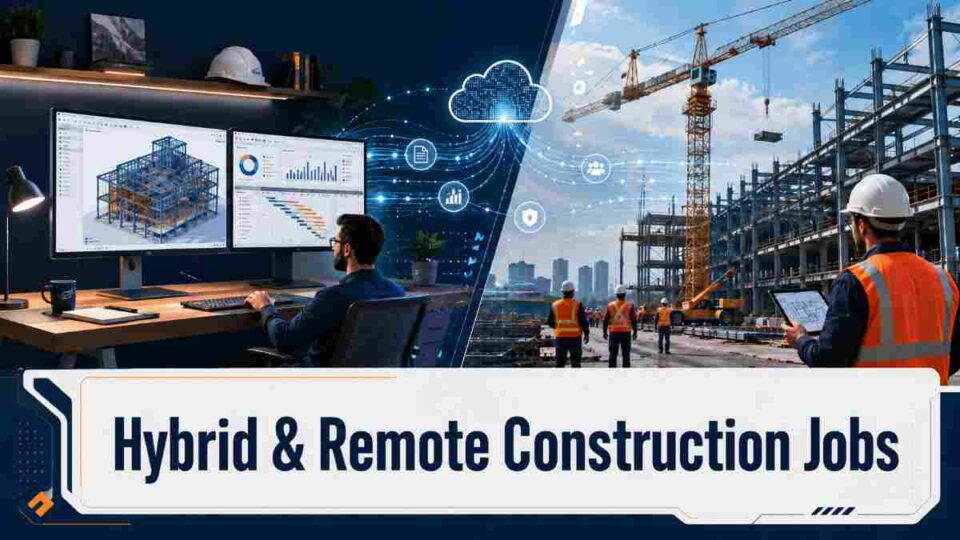
Construction has always been synonymous with hard hats, heavy equipment, and boots on muddy ground. But in 2026, that picture is shifting — fast. While on-site work remains essential for physical execution, a growing segment of the construction workforce now operates from home offices, co-working spaces, and hybrid setups that blend remote collaboration with periodic site visits.
ConstructionCareerHub App is LIVE — built ONLY for construction careers. Don’t apply with a weak resume.
Get ATS-ready Resume Lab + Interview Copilot + Campus Placement Prep (resume screening, skill gaps, interview readiness) — in minutes & Other advanced features.
Explore Smarter Construction Career Tools →Quick check. Big impact. Start now.
According to the U.S. Bureau of Labor Statistics (BLS), construction occupations have historically had a remote work rate of just 2.7%. But that figure masks a critical nuance: the management, design, estimation, and technology functions supporting construction projects are increasingly digital — and increasingly remote-friendly. A Robert Half Q1 2026 analysis found that 19% of new professional job postings across industries are now hybrid, with senior-level roles (5+ years’ experience) seeing 20% hybrid and 8% fully remote rates.
In parallel, the construction industry itself needs roughly 499,000 additional workers in 2026 to meet project demands, and 94% of contractors report difficulty filling positions, according to The Birmingham Group’s 2026 salary guide. This talent crunch is forcing firms to rethink where — and how — construction professionals work.
If you’re a construction professional who wants location flexibility without abandoning the industry you know, this guide is for you. Below, we break down 12 construction roles that can be performed partially or fully without going to site — with real salary data, tools required, career paths, and practical advice on landing these positions in 2026.
Not sure which construction career direction suits you best? Try our free Construction Career Direction Tool — an AI-powered assessment that delivers personalized recommendations in 5 minutes.
Table of Contents
1. BIM Coordinator / BIM Manager (Remote or Hybrid)
What Does a BIM Coordinator Do Remotely?
A BIM Coordinator manages the creation, coordination, and quality assurance of Building Information Models — the 3D digital representations that underpin modern construction projects. This role involves clash detection, federated model management, BIM execution planning, and maintaining project standards across disciplines.
Because all work happens inside software platforms like Autodesk Revit, Navisworks, BIM 360, and Autodesk Construction Cloud, BIM coordination is one of the most naturally remote-compatible roles in construction. Coordination meetings, RFI reviews, and clash detection sessions happen via screen-share, making physical presence optional for most deliverables.
Salary Range (2026)
- U.S. Average: $74,861–$78,490/year (Glassdoor, Salary.com)
- Top Earners (90th Percentile): $99,330–$120,156/year
- Remote BIM Hourly: $30.77–$34.62/hour (ZipRecruiter, May 2026)
- BIM Manager (senior): $95,000–$130,000+/year
Key Tools
Autodesk Revit, Navisworks, BIM 360/ACC, Bluebeam Revu, Solibri, Synchro 4D Pro, Dynamo for Revit.
How to Get Started
Build proficiency in Revit and Navisworks through hands-on project work or online certifications. The Autodesk Revit User Certification and the AGC Certificate of Management in BIM are widely recognized. Explore our detailed guide on BIM Careers in 2026 for a full breakdown of roles, salaries, and global demand.
Recommended Course: BIM Fundamentals for Infrastructure – Coursera
2. Construction Estimator / Quantity Surveyor (Remote)
What Does a Remote Construction Estimator Do?
Construction estimators prepare cost estimates for projects by analyzing blueprints, specifications, material prices, and labor requirements. With digital takeoff tools, cloud-based estimating platforms, and access to real-time pricing databases, this role has become highly remote-capable. Many estimators already work remotely for multiple contractors simultaneously.
Salary Range (2026)
- U.S. Average (Remote): $83,002/year (ZipRecruiter)
- Mid-Range: $67,000–$110,630/year (Glassdoor, 2026)
- Senior Estimator: $107,000–$155,000/year depending on region and specialization
- Chief Estimator / Director of Preconstruction: $162,500–$307,721/year
Key Tools
PlanSwift, Bluebeam Revu, ProEst, STACK, RSMeans, Sage Estimating, On-Screen Takeoff, Excel/Google Sheets.
How to Get Started
A background in civil engineering, construction management, or quantity surveying is typical. Certification through the American Society of Professional Estimators (ASPE) or RICS adds credibility. For a complete career roadmap, read our Construction Estimator Career Guide.
Also, check out the growing freelance opportunity in this space: Freelance Career in Construction Estimation and Planning 2026.
3. Construction Project Manager (Hybrid)
What Does a Hybrid Construction PM Do?
Construction project managers oversee scheduling, budgeting, procurement, team coordination, and client communication across a project’s lifecycle. While PMs traditionally spent most of their time on-site, the 2026 reality is different. Cloud-based project management platforms now allow PMs to monitor progress dashboards, review submittals, approve RFIs, and manage budgets from anywhere — visiting the site only for critical milestones, inspections, or stakeholder meetings.
According to industry forecasts from Davron, remote collaboration tools now allow construction teams to work efficiently across locations, with firms investing heavily in cloud-based platforms for distributed project delivery.
Salary Range (2026)
- U.S. Average: $95,000–$130,000/year
- With Data Analytics / BIM Experience: 15–20% premium over baseline
- Senior / Director Level: $140,000–$200,000+/year
Key Tools
Procore, Autodesk Construction Cloud, Buildertrend, Monday.com, Microsoft Project, Primavera P6, Smartsheet.
How to Get Started
PMP certification from the Project Management Institute (PMI) remains the gold standard. Pairing it with construction-specific credentials like the CCM (Certified Construction Manager) from CMAA significantly boosts hybrid PM opportunities. Read our full Construction Management Career Guide.
Recommended Course: Construction Management Specialization – Coursera (Columbia University)
4. CAD Drafter / Structural Detailer (Fully Remote)
What Does a Remote CAD Drafter Do?
CAD drafters create technical drawings and construction documents from redlines, sketches, and design specifications provided by engineers and architects. Structural detailers specialize in steel, concrete, or timber detailing for fabrication and erection. Both roles are entirely computer-based, making them ideal for fully remote work. Many firms — especially in MEP (mechanical, electrical, plumbing) and structural steel — have built fully distributed drafting teams.
Salary Range (2026)
- CAD Drafter (U.S.): $45,000–$70,000/year
- Structural/MEP Detailer: $55,000–$85,000/year
- Senior Detailer / Lead Drafter: $75,000–$95,000/year
Key Tools
AutoCAD, Revit, Tekla Structures, MicroStation, SDS/2, Bluebeam Revu.
How to Get Started
An associate degree or diploma in drafting technology, architectural drafting, or mechanical design is common. Autodesk Certified Professional (AutoCAD or Revit) credentials accelerate remote job placement. Learn more about the role landscape in our 150+ Construction Job Titles & Descriptions Guide.
5. Construction Safety Consultant (Remote / Hybrid)
What Does a Remote Safety Consultant Do?
Safety consultants develop site-specific safety plans, conduct risk assessments, write Job Hazard Analyses (JHAs), prepare OSHA compliance documentation, deliver virtual safety training, and review incident reports — all of which can be done remotely. While field audits and on-site inspections require physical presence, a significant portion of safety management work happens digitally, especially for consultants serving multiple projects simultaneously.
Salary Range (2026)
- Construction Safety Specialist: $60,000–$85,000/year
- Safety Manager / Consultant: $80,000–$120,000/year
- Director of Safety / CSP-Certified: $110,000–$160,000+/year
Key Tools
iAuditor (SafetyCulture), Procore Safety, SiteDocs, Microsoft Teams/Zoom for virtual training, OSHA standards libraries.
How to Get Started
The Certified Safety Professional (CSP) credential from BCSP and OSHA 30-hour/500-hour certifications are essential. Many safety professionals build hybrid consulting practices after gaining field experience. Learn more about high-demand construction careers including safety leadership roles.
6. Construction Scheduler / Planner (Remote)
What Does a Remote Scheduler Do?
Construction schedulers build and maintain CPM (Critical Path Method) schedules, perform delay analyses, track earned value, and update project timelines using scheduling software. This work is inherently digital and is one of the most reliably remote roles in construction management. Megaproject programs — data centers, renewable energy plants, infrastructure — frequently hire remote schedulers to coordinate multi-JV teams across geographies.
Salary Range (2026)
- Junior Scheduler: $60,000–$80,000/year
- Mid-Level Scheduler / Planner: $80,000–$110,000/year
- Senior Scheduler / Delay Analyst: $110,000–$150,000/year
Key Tools
Oracle Primavera P6, Microsoft Project, Asta Powerproject, Synchro 4D, Tilos (linear scheduling).
How to Get Started
Certification in Oracle Primavera P6 and PMI’s Scheduling Professional (PMI-SP) credential are strong differentiators. Our guide on mastering construction software for a digital career covers the critical tools to learn.
Recommended Course: Primavera P6 Professional – Udemy
7. Sustainability Consultant / Green Building Advisor (Remote)
What Does a Remote Sustainability Consultant Do?
Sustainability consultants advise construction projects on environmental compliance, energy modelling, carbon footprint analysis, and green building certifications such as LEED, BREEAM, WELL, and IGBC. They review design documents, run energy simulations, prepare certification documentation, and conduct lifecycle assessments — almost all of which is screen-based work. With ESG documentation now required in many project bids, demand for this role is accelerating.
Salary Range (2026)
- Junior Sustainability Analyst: $55,000–$75,000/year
- LEED AP / Sustainability Consultant: $80,000–$115,000/year
- Senior Consultant / ESG Advisor: $115,000–$160,000/year
- Pay Growth: BIM specialists and sustainability consultants have seen 25–30% salary increases in 2026 due to ESG-driven demand
Key Tools
Energy modelling (eQUEST, EnergyPlus, IES VE), LEED Online, One Click LCA (lifecycle assessment), Green Building Studio, Tally (embodied carbon).
How to Get Started
Pursue the LEED AP BD+C credential from USGBC or BREEAM Assessor certification. Engineers and architects with sustainability specializations are especially well-positioned.
Recommended Course: Sustainability and Green Building – edX
8. Construction Accountant / Financial Analyst (Fully Remote)
What Does a Remote Construction Accountant Do?
Construction accounting is a specialized niche that handles job costing, AIA billing, work-in-progress (WIP) reporting, percentage-of-completion accounting, change order tracking, and lien waiver management. These functions are entirely computer-based and well-suited to remote work. Firms like Apparatus Contractor Services, which specializes in outsourced construction accounting, hire remote accounting professionals across the U.S.
Salary Range (2026)
- Construction Accountant: $60,000–$85,000/year
- Senior Construction Accountant / Controller: $90,000–$130,000/year
- Construction CFO / VP of Finance: $150,000–$250,000/year
Key Tools
Sage 300 CRE, Viewpoint Vista, Foundation Software, QuickBooks (with construction add-ons), Procore financials, CMiC.
How to Get Started
A CPA or CMA with construction industry experience is the strongest credential combination. CFMA (Construction Financial Management Association) membership and CCIFP certification demonstrate industry specialization.
9. Preconstruction Manager / Virtual Design Coordinator (Hybrid)
What Does a Remote Preconstruction Manager Do?
Preconstruction managers lead the planning phase — preparing estimates, managing design-assist collaboration, conducting constructability reviews, and developing project budgets and logistics plans. VDC (Virtual Design and Construction) Coordinators operate in a similar space, using 3D/4D/5D models to plan construction sequencing, detect conflicts, and optimize project delivery before breaking ground. Both roles are heavily software-driven, with site visits needed mainly during design validation and project kickoff.
Salary Range (2026)
- VDC Coordinator: $70,000–$100,000/year
- Preconstruction Manager: $110,000–$160,000/year
- Director of Preconstruction: $162,500–$307,721/year (varies by market)
Key Tools
Revit, Navisworks, Synchro 4D Pro, Assemble Systems, Autodesk Construction Cloud, On-Screen Takeoff.
How to Get Started
Experience in estimating or BIM coordination provides the strongest foundation. The career path typically progresses from estimator → senior estimator → preconstruction manager. Explore our guide to top estimating software to build your digital toolkit.
10. Construction Technology Specialist / Digital Construction Manager (Remote)
What Does a Remote Construction Tech Specialist Do?
This emerging role bridges traditional construction management with technology implementation. Digital construction managers deploy and manage project management platforms, IoT sensor networks, drone data pipelines, AI-driven scheduling tools, and digital twin ecosystems. They train teams, customize workflows, and ensure technology adoption across projects — work that is largely remote.
According to iRecruit’s 2026 remote civil engineering analysis, 84% of AEC firms are prioritizing investments in cloud-based design tools, VR, digital twins, and AI-driven project management platforms — creating massive demand for professionals who can implement and manage these systems.
Salary Range (2026)
- Construction Technology Specialist: $80,000–$120,000/year
- Digital Construction Manager: $100,000–$150,000/year
- VP of Construction Technology: $160,000–$220,000+/year
Key Tools
Procore, Autodesk Construction Cloud, OpenSpace (photo documentation AI), Spot.AI, Power BI, Tableau, Python/SQL for data analytics.
How to Get Started
Professionals with a hybrid background — construction management experience plus data analytics or IT skills — are in highest demand. Read our deep dive on BIM, Tech Managers & Drone Operators as high-demand construction careers.
11. Construction Marketing Manager / Content Strategist (Fully Remote)
What Does a Remote Construction Marketer Do?
Construction companies — from general contractors to material suppliers and SaaS vendors — increasingly invest in digital marketing, brand building, proposal writing, and business development content. Marketing managers in this space create case studies, manage social media accounts, develop bid/proposal narratives, produce project showcase videos, write blog content, and run lead-generation campaigns. This role is inherently remote and growing rapidly as construction firms realize the value of professional marketing.
Salary Range (2026)
- Construction Marketing Coordinator: $50,000–$70,000/year
- Marketing Manager (AEC): $75,000–$110,000/year
- Director of Marketing / BD: $110,000–$160,000/year
Key Tools
HubSpot, Canva, Adobe Creative Suite, WordPress, LinkedIn Campaign Manager, SEMrush/Ahrefs (SEO), Mailchimp.
How to Get Started
Digital marketing skills paired with construction industry knowledge create a unique value proposition. SMPS (Society for Marketing Professional Services) membership and CPSM certification are industry-specific credentials.
12. Construction Claims Analyst / Contract Specialist (Remote)
What Does a Remote Claims Analyst Do?
Claims analysts and contract specialists review project documentation, prepare delay claims, analyze change orders, evaluate contractual entitlements, and support dispute resolution proceedings. This document-intensive, analytical work is highly suited to remote execution. Many construction law firms, claims consultancies, and large contractors hire remote claims professionals for cross-project support.
Salary Range (2026)
- Junior Claims Analyst: $65,000–$85,000/year
- Senior Claims Analyst / Contract Specialist: $90,000–$130,000/year
- Claims Manager / Director: $130,000–$180,000+/year
Key Tools
Primavera P6 (for delay analysis), Microsoft Excel (quantum calculations), Bluebeam Revu (document markup), Aconex/Procore (document management), contract management platforms.
How to Get Started
A background in construction management, quantity surveying, or construction law provides the best foundation. The AACE Certified Claims Professional (CCP) and Planning & Scheduling Professional (PSP) certifications from AACE International are highly valued.
Recommended Course: Construction Claims Management – Udemy
Quick Comparison: 12 Remote & Hybrid Construction Roles at a Glance
| Role | Work Mode | U.S. Salary Range (2026) | Top Tools |
|---|---|---|---|
| BIM Coordinator / Manager | Remote / Hybrid | $74,000–$130,000+ | Revit, Navisworks, ACC |
| Construction Estimator / QS | Remote | $67,000–$155,000 | PlanSwift, Bluebeam, ProEst |
| Construction Project Manager | Hybrid | $95,000–$200,000+ | Procore, P6, Smartsheet |
| CAD Drafter / Structural Detailer | Fully Remote | $45,000–$95,000 | AutoCAD, Revit, Tekla |
| Construction Safety Consultant | Remote / Hybrid | $60,000–$160,000+ | iAuditor, Procore Safety |
| Construction Scheduler / Planner | Remote | $60,000–$150,000 | Primavera P6, MS Project |
| Sustainability Consultant | Remote | $55,000–$160,000 | eQUEST, One Click LCA |
| Construction Accountant | Fully Remote | $60,000–$250,000 | Sage 300 CRE, Viewpoint |
| Preconstruction / VDC Coordinator | Hybrid | $70,000–$307,000 | Synchro 4D, Assemble |
| Digital Construction Manager | Remote | $80,000–$220,000+ | Power BI, Procore, AI tools |
| Construction Marketing Manager | Fully Remote | $50,000–$160,000 | HubSpot, WordPress, Canva |
| Claims Analyst / Contract Specialist | Remote | $65,000–$180,000+ | P6, Bluebeam, Excel |
Essential Skills for Landing Remote Construction Jobs in 2026
Regardless of which role you target, employers hiring for remote or hybrid construction positions consistently look for a specific skill set that goes beyond technical construction knowledge.
Digital Fluency
Mastery of cloud-based construction platforms (Procore, BIM 360/ACC, PlanGrid) is table stakes. But in 2026, employers also value proficiency in data visualization tools (Power BI, Tableau), basic scripting (Python for automation), and AI-assisted workflows. An industry analysis by iRecruit found that 84% of AEC firms are prioritizing investment in cloud-based and AI-driven platforms, meaning the demand for digitally fluent construction professionals will only accelerate.
Asynchronous Communication
Remote construction work requires clear written communication — documenting decisions, writing detailed RFIs, creating structured reports, and maintaining transparent project records. Teams spread across time zones rely on async tools like Slack, Loom (video walk-throughs), and shared Notion/Confluence workspaces.
Self-Management and Accountability
Without direct supervision, remote construction professionals need strong time management, goal-tracking, and self-discipline. Demonstrating a track record of independent project delivery during interviews is critical.
Construction Domain Expertise
Remote roles don’t eliminate the need for deep construction knowledge — they amplify it. Understanding construction sequencing, means-and-methods, contract administration, and building codes gives you the judgment that digital tools alone can’t replace. Explore our comprehensive guide on shifting from site engineering to digital construction roles for practical transition advice.
Where to Find Remote & Hybrid Construction Jobs in 2026
Finding remote construction positions requires a targeted approach since general job boards often bury construction roles under broad categories. Here are the most effective channels:
- LinkedIn Jobs — Use filters: “Remote” + construction-specific keywords (BIM, estimating, scheduling). Set job alerts for immediate notifications.
- Indeed / ZipRecruiter / Glassdoor — Search “remote construction estimator,” “remote BIM coordinator,” or “hybrid project manager construction.” As of May 2026, ZipRecruiter lists thousands of remote construction positions with average pay of $95,168/year.
- Industry-Specific Boards — ConstructionJobs.com, iHireConstruction, and Engineering.com focus on AEC roles and often have better remote filters.
- Specialized Staffing Firms — The Birmingham Group, Davron, and Michael Page Construction place professionals in remote and hybrid roles across the U.S.
- Upwork / Toptal — Freelance construction estimators, schedulers, and BIM modelers find consistent project work on these platforms. Upwork reports a 22% premium for deep technical skills like cost estimating.
- ConstructionPlacements.com — Our job listings section regularly features remote-friendly construction positions globally.
Ready to optimize your resume for remote construction roles? Use the Resume Lab on ConstructionCareerHub — our AI-powered tool that creates ATS-ready resumes tailored for construction positions in minutes.
Challenges of Remote Construction Work (and How to Overcome Them)
Staying Connected to the Field
Remote construction professionals risk losing touch with on-site realities. Regular site visits (even monthly), drone footage reviews, and 360° photo documentation tools like OpenSpace help maintain field awareness without requiring daily presence.
Time Zone Coordination
Working across multiple project time zones — common for BIM coordinators and estimators serving national clients — requires disciplined scheduling. Establish core overlap hours and use asynchronous documentation to minimize real-time dependency.
Proving Value Without Physical Visibility
In an industry that has traditionally valued presence, remote workers must be intentional about demonstrating output. Weekly status reports, shared dashboards, and proactive communication with project teams build trust and visibility.
Technology and Cybersecurity
Remote work in construction involves handling sensitive bid documents, proprietary designs, and financial data. Secure VPN connections, two-factor authentication, and compliance with company IT policies are non-negotiable.
The Future of Remote Work in Construction: What’s Next?
The trajectory is clear. By 2030, industry analysts project that nearly half of all infrastructure jobs will demand remote-first, digitally enabled skills. Several converging trends are driving this shift:
- AI and Automation: AI-driven scheduling, generative design, and automated quantity takeoffs are creating new remote-native roles that didn’t exist two years ago.
- Digital Twins: As digital twin adoption scales, construction professionals will monitor, manage, and optimize buildings remotely throughout their entire lifecycle — not just during construction.
- Nearshore and Global Teams: Firms are increasingly hiring BIM coordinators, estimators, and schedulers from Latin America, India, and Southeast Asia to work in U.S.-compatible time zones at competitive rates. The annual cost difference between onshore and nearshore BIM coordinators ranges from $47,000 to $75,000.
- Data Center Boom: Data center construction spending is projected to grow by 24.9% in 2026, with data centers now accounting for 50% of all office-category construction activity — much of this work is coordinated by remote engineering teams.
For construction professionals willing to invest in digital skills, the remote work opportunity is significant and growing. The key is positioning yourself at the intersection of construction domain expertise and technology fluency.
Tools to Accelerate Your Remote Construction Career
At ConstructionCareerHub.com, we’ve built AI-powered career tools designed specifically for construction professionals:
- Resume Lab — Build an ATS-optimized construction resume in minutes. Tailored for remote and hybrid role applications.
- Interview Copilot — Practice 15+ AI-generated technical and HR interview questions for BIM, QS, Planning, HSE, and project management roles.
- Career Planner — Get a personalized career roadmap with salary projections, skill gap analysis, and role recommendations.
Also, explore these downloadable resources for career acceleration:
- Remote Construction Jobs Toolkit — Gumroad eBook
- The Construction Interview Guide — 300+ Questions & Answers
- The Civil Engineering Career Blueprint eBook
- Complete Construction Career Bundle
Frequently Asked Questions (FAQ)
Can you really work in construction remotely?
Yes. While physical site work (pouring concrete, welding steel, operating cranes) requires on-site presence, many construction roles — BIM coordination, estimating, scheduling, design, safety planning, preconstruction, accounting, and claims analysis — are performed entirely on computers using cloud-based software. These roles can be done remotely or in hybrid arrangements where professionals visit sites periodically.
What are the highest-paying remote construction jobs in 2026?
The highest-paying remote construction roles in 2026 include Director of Preconstruction ($162,500–$307,721/year), Digital Construction Manager ($100,000–$220,000+/year), Senior Construction Project Manager ($140,000–$200,000+/year), and Senior Claims Analyst ($90,000–$180,000+/year). Roles combining construction expertise with data analytics or AI skills command the highest premiums.
What qualifications do I need for a remote construction job?
Most remote construction positions require a degree in civil engineering, construction management, architecture, or a related field, plus 3–5 years of industry experience. Key certifications include PMP, LEED AP, Autodesk Revit Professional, ASPE CPE, AACE CCP, and PMI-SP. Proficiency in cloud-based construction software (Procore, BIM 360, Primavera P6) is increasingly essential.
Is remote work in construction growing or declining in 2026?
Remote and hybrid work in construction’s professional roles is growing, driven by talent shortages, cloud-based software adoption, and the boom in distributed megaprojects (data centers, renewable energy). However, the overall share of fully remote positions across all industries has slightly declined from post-pandemic peaks, with hybrid arrangements becoming the dominant flexible model. The construction industry specifically is seeing growth in hybrid roles for management, design, and technology functions.
How can I transition from an on-site construction role to a remote position?
Start by building digital skills — learn BIM software (Revit, Navisworks), scheduling tools (Primavera P6), or estimating platforms (PlanSwift, ProEst). Pursue relevant certifications, contribute to digital construction projects at your current company, and gradually build a portfolio demonstrating remote-capable work. Our guide on shifting from site engineer to BIM specialist provides a step-by-step transition roadmap.
Are remote construction jobs available internationally or only in the U.S.?
Remote construction jobs are available globally. BIM coordination, estimation, and scheduling work is regularly outsourced from U.S., UK, and Australian firms to professionals in India, the Philippines, Colombia, Mexico, and other markets. Countries with strong engineering education systems and U.S.-compatible time zones are particularly well-positioned for remote construction careers.
What is the average salary for remote construction jobs in 2026?
According to ZipRecruiter (April 2026), the average annual salary for remote construction roles in the U.S. is $95,168, with most workers earning between $71,000 and $115,500 depending on experience, specialization, and location. Senior and director-level positions frequently exceed $150,000.
Final Takeaway
The construction industry in 2026 is not abandoning the job site — it’s augmenting it with a remote-capable workforce that handles design, coordination, estimation, scheduling, technology, compliance, and business operations from wherever they work best. The 12 roles covered in this guide represent real, well-paying career paths that offer the flexibility of remote or hybrid work without requiring you to leave the construction industry.
The professionals who thrive in this evolving landscape will be those who combine deep construction domain expertise with digital fluency — and who proactively invest in the certifications, tools, and career planning that set them apart. Whether you’re a site engineer looking to pivot, a BIM modeler ready to go freelance, or a project manager seeking a hybrid arrangement, the opportunities are here and growing.
Start your transition today. Explore our Construction Career Path Planner, build your resume with the ConstructionCareerHub Resume Lab, and invest in the digital skills that will define the next decade of construction careers.
Disclaimer: Salary figures cited in this article are based on publicly available data from ZipRecruiter, Glassdoor, Salary.com, PayScale, and The Birmingham Group as of Q1/Q2 2026. Actual compensation varies by experience, location, employer, and specialization.
Related posts:
- Hybrid Construction Roles: Site to Screen Career Guide 2026
- The Future of the Real Estate Industry: Top 10 Trends to Watch in 2026
- The Impact of Remote Work on the Construction Industry
- Construction and Management Jobs in USA (2026): Salary & Hiring Trends
