

Last Updated on May 12, 2026 by Admin
Industrial equipment depends on controlled motion. Whether the application involves bulk material handling, automated packaging, precision robotics, or heavy process manufacturing, the relationship between gear ratios and torque directly affects machine reliability, efficiency, and output consistency.
ConstructionCareerHub App is LIVE — built ONLY for construction careers. Don’t apply with a weak resume.
Get ATS-ready Resume Lab + Interview Copilot + Campus Placement Prep (resume screening, skill gaps, interview readiness) — in minutes & Other advanced features.
Explore Smarter Construction Career Tools →Quick check. Big impact. Start now.
These concepts are foundational in mechanical power transmission, yet they are often oversimplified. In practice, gear ratio selection influences far more than rotational speed. It affects motor loading, thermal performance, bearing life, startup behavior, energy consumption, and long-term maintenance intervals.
For engineers and plant operators, understanding how torque and gearing interact is essential for designing systems that remain stable under real operating conditions rather than ideal laboratory assumptions.
Table of Contents
Gear ratios: balancing rotational speed and mechanical force
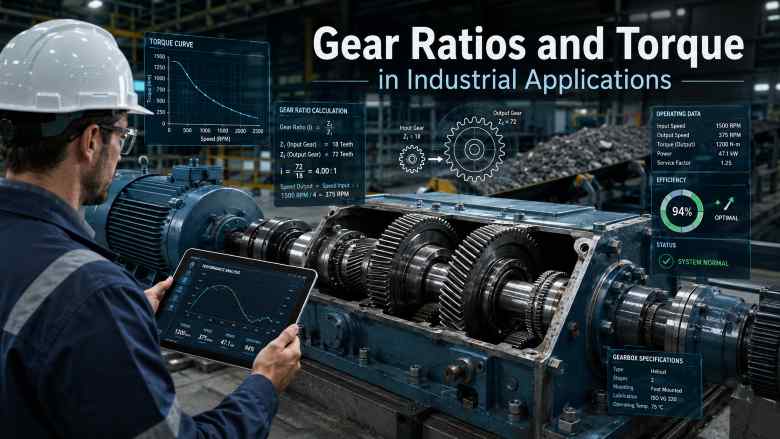
At its core, a gear ratio defines the relationship between the input and output rotational speeds within a drivetrain.
A reduction ratio decreases output speed while increasing output torque. Conversely, a speed-increasing ratio raises rotational speed while reducing available torque. The relationship follows the principle of conservation of power, accounting for mechanical losses within the transmission system.
The simplified relationship is commonly expressed as:
Torqueout≈Torquein×Gear Ratio×EfficiencyTorque_{out} \approx Torque_{in} \times Gear\ Ratio \times EfficiencyTorqueout≈Torquein×Gear Ratio×Efficiency
For example, a gearbox with a 20:1 reduction ratio theoretically multiplies torque by a factor of twenty while reducing output shaft speed proportionally. Actual performance depends on drivetrain efficiency, which varies according to gearbox type, lubrication quality, operating temperature, and load characteristics.
This tradeoff between speed and force forms the basis of nearly every industrial motion-control system.
Why torque matters beyond specification sheets
Torque is rotational force applied at a shaft. In industrial environments, torque demand rarely remains constant.
Conveyors experience varying material loads. Crushers encounter intermittent shock loading. Mixers operate under changing viscosity conditions. Even automated assembly systems see fluctuating acceleration and deceleration demands throughout production cycles.
As a result, engineers evaluate more than nominal torque ratings. They also assess:
- Starting torque
- Peak transient torque
- Continuous operating torque
- Service factor requirements
- Shock-load tolerance
- Thermal loading capacity
This distinction is critical because drivetrain failures often occur during transient events rather than steady-state operation.
A motor that performs adequately under normal running conditions may still fail during startup if the gearbox cannot manage high inrush torque or reflected inertia. Similarly, undersized gear reducers frequently experience accelerated tooth wear, bearing fatigue, or lubricant degradation long before catastrophic failure becomes visible.
Gear ratios across industrial applications
Different industries prioritize different torque-speed relationships.
In bulk material handling systems such as mining conveyors or aggregate processing plants, high reduction ratios provide the torque necessary to move heavy loads at controlled speeds. These systems typically rely on helical or planetary gearboxes designed for continuous-duty operation under substantial radial and axial loading.
By contrast, high-speed packaging lines often require moderate torque with extremely precise motion control. Servo-driven systems paired with low-backlash gear reducers help maintain positional accuracy while minimizing oscillation and vibration.
Industrial robotics introduces another layer of complexity. Robotic joints demand compact gear arrangements capable of producing high torque density without sacrificing precision. Harmonic drives and cycloidal gear systems are commonly selected because they provide high reduction ratios with minimal backlash.
Meanwhile, process industries such as pulp and paper, steel manufacturing, and chemical processing frequently operate under severe duty cycles where torque stability becomes more important than maximum speed.
The gearbox selection process therefore depends heavily on application-specific operating profiles rather than isolated performance values.
Efficiency losses and thermal realities
Idealized drivetrain calculations rarely reflect real operating conditions.
Every gearbox experiences mechanical losses due to friction between meshing gear teeth, bearing resistance, lubricant shear, and seal drag. These losses generate heat, which directly influences gearbox efficiency and service life.
Gearbox efficiency varies by configuration:
- Spur gearboxes generally operate at high efficiency under moderate loads
- Helical gears provide smoother operation with slightly higher axial loading
- Worm gear reducers offer large reduction ratios but typically produce greater thermal losses
- Planetary gear systems achieve high torque density with strong load distribution characteristics
Thermal management becomes increasingly important in continuous-duty industrial environments. Excessive operating temperatures accelerate lubricant oxidation, reduce viscosity stability, and increase wear rates across bearings and gear surfaces.
This is why many modern industrial systems incorporate thermal sensors, oil condition monitoring, and vibration analysis directly into predictive maintenance programs.
A gearbox rarely fails without warning. In most cases, elevated vibration signatures, abnormal heat generation, or lubricant contamination appear well before severe mechanical damage develops.
Dynamic loading changes everything
Static calculations provide a baseline, but industrial systems operate dynamically.
Acceleration profiles, cyclic loading, shock events, and reversing motion introduce stresses that significantly exceed nominal operating conditions. Engineers therefore calculate reflected inertia, torsional stiffness, and load distribution when sizing drivetrains.
Consider a high-inertia conveyor startup. The motor must overcome not only the load itself but also the inertia of rotating shafts, pulleys, couplings, and transported material. Improper ratio selection can result in excessive current draw, unstable acceleration, or mechanical shock transmitted through the drivetrain.
Variable Frequency Drives (VFDs) have become central to addressing these challenges. Manufacturers such as Siemens, Rockwell Automation, and ABB integrate advanced motor control algorithms that regulate acceleration curves and torque delivery with far greater precision than traditional fixed-speed systems.
The result is smoother startup behavior, reduced mechanical stress, and lower energy consumption across variable-load applications.
Gearbox selection is a system-level decision
One of the most common engineering mistakes involves selecting a gearbox based solely on output torque requirements.
In reality, gearbox sizing requires consideration of the complete drivetrain ecosystem, including:
- Motor characteristics
- Duty cycle classification
- Ambient operating temperature
- Mounting orientation
- Load direction
- Shaft overhung loads
- Lubrication method
- Environmental contamination
- Maintenance accessibility
A gearbox operating in a cement plant faces vastly different contamination risks than one installed in a pharmaceutical cleanroom.
Many industrial operators work with specialized drivetrain manufacturers when configuring gear reducers for demanding environments. Companies such as United Gear & Assembly provide custom gearbox and power transmission solutions for applications where torque consistency, durability, and serviceability directly affect uptime. In sectors like material handling, aggregate processing, and heavy manufacturing, that engineering support often becomes just as important as the gearbox specifications themselves.
Similarly, applications exposed to washdown conditions require sealing arrangements and corrosion-resistant materials that standard industrial reducers may not provide.
Service factor calculations help compensate for these operational variables. However, experienced engineers recognize that field conditions often exceed modeled assumptions. Conservative sizing remains common in heavy industry because marginal overcapacity typically improves operational reliability and extends maintenance intervals.
Automation and predictive diagnostics
Industrial automation has significantly changed how facilities manage torque transmission systems.
Modern condition-monitoring platforms continuously evaluate gearbox vibration, bearing temperature, lubricant condition, and motor current signatures. These systems support predictive maintenance strategies that identify abnormal drivetrain behavior before unplanned shutdowns occur.
This capability is particularly valuable in industries where downtime carries substantial financial consequences. A failed gearbox in a steel mill, refinery, or mining operation can halt production for hours or even days.
As Industry 4.0 adoption expands, torque monitoring is increasingly integrated into centralized plant analytics systems. Engineers can now correlate drivetrain performance with production throughput, energy efficiency, and maintenance history in near real time.
The mechanical principles remain unchanged, but the visibility into system behavior has improved dramatically.
Final perspective
Gear ratios and torque are not isolated mechanical concepts. They are central variables that influence equipment performance, reliability, and operational cost across virtually every industrial sector.
Well-designed drivetrain systems balance torque multiplication, speed control, efficiency, and thermal stability according to the realities of the application. Poorly matched systems, by contrast, create recurring maintenance issues, excessive energy consumption, and premature component failure.
As industrial facilities continue pursuing higher efficiency and greater automation, drivetrain optimization will remain a critical engineering priority. The fundamentals are straightforward, but successful implementation requires careful consideration of load behavior, environmental conditions, control strategy, and long-term operating demands.
In industrial applications, the difference between stable performance and chronic mechanical failure often comes down to how effectively torque and gear ratios are managed throughout the system lifecycle.
Related Posts:
- How Often Should You Service an Industrial Gearbox?
- 75 Construction Ratios Everyone Should Know for Effective Project Management
- 115+ Diploma Mechanical Engineering Interview Questions and Answers [2026 Guide]
- Avoiding Downtime: The Right Lifting Gear For Urban Infrastructure Projects
