
Last Updated on October 14, 2024 by Admin
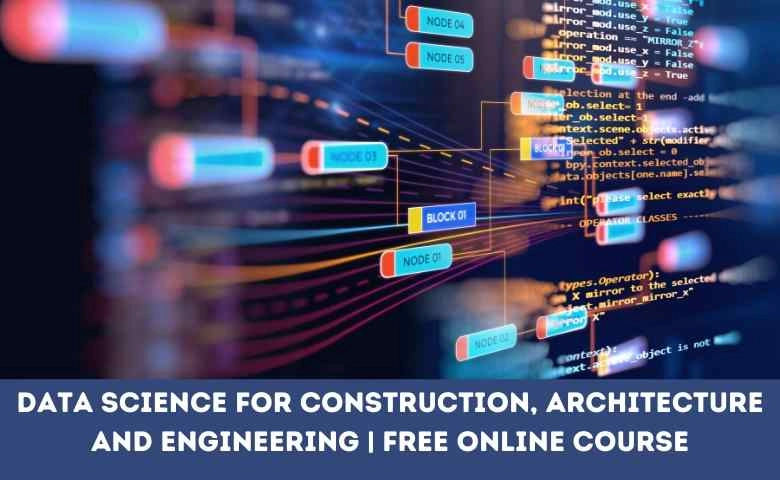
This FREE course on Data Science for Architecture, Engineering, and Construction (AEC) industry introduces data science skills targeting applications in building design, construction, and operations. You will learn practical coding within this context, emphasizing basic Python programming and the Pandas library. This course is offered by the National University of Singapore (NUS).
ConstructionCareerHub App is LIVE — built ONLY for construction careers. Don’t apply with a weak resume.
Get ATS-ready Resume Lab + Interview Copilot + Campus Placement Prep (resume screening, skill gaps, interview readiness) — in minutes & Other advanced features.
Explore Smarter Construction Career Tools →Quick check. Big impact. Start now.
About this course
-
Course Length: 6 Weeks
-
Effort: 3–5 hours per week
-
Price: FREE
-
Course Type: Instructor-led on a course schedule
- Course Offered By National University of Singapore (NUS)
The building industry is exploding with data sources that impact the energy performance of the built environment and the health and well-being of occupants. Spreadsheets just don’t cut it anymore as the sole construction analytics tool for professionals in this field.
Participating in mainstream data science courses might provide skills such as programming and statistics; however, the applied context to buildings is missing, which is essential for beginners.
Related Posts:
- MS Excel Usage In The Construction Industry [2023 Updated]
- 11 Best Project Management Online Courses For 2023 Updated
- Top Free Online Courses Websites For Engineering Courses In 2023
- Top 10 Free Data Science Online Courses To Learn In 2023
- What is Power BI? How is it Useful to Harness Construction Data?
- Top 10 Free Data Science Online Courses To Learn In 2023
- Building Information Modelling (BIM) Free Online Course
This course focuses on developing data science skills for professionals, specifically in the built environment sector. It targets architects, engineers, and construction and facilities managers with little programming experience.
Data science skills are introduced in the context of the building life cycle phases. Participants will use large, open data sets from buildings’ design, construction, and operations to learn and practice data science techniques.
Essentially, this course adds new tools and skills to supplement spreadsheets. Major technical topics include data loading, processing, visualization, and essential machine learning using Python, Pandas data analytics, construction analytics, sci-kit learn machine learning libraries and the web-based Colaboratory environment.
Microsoft Excel & Data Science For 2023 Premium Certification Bundle
In addition, the course will provide numerous learning paths for various built environment-related tasks to facilitate further growth.
enroll for freeWhat you’ll learn
- Why data science is essential for the built environment
- Why building industry professionals should learn how to code
- A jump start in the Python Programming Language
- Overview of the Pandas data analysis library
- Guidance in the loading, processing, and merging of data
- Visualization of data from buildings
- Basic machine learning concepts applied to build data
- Examples of parametric analysis for the integrated design process
- Examples of how to process time-series data from IoT sensors
- Examples of analysis of thermal comfort data from occupants
- Numerous starting points for using data science in other building-related tasks
Related Posts:
- Top Construction Management Online Courses To Study In 2023
- Top Construction Management Courses and Construction Institutes In India
- What are the Various Types of Construction Companies?
- Top 10 MS Excel Online Courses For Engineers In 2023
- Construction Management In Australia – Courses and Universities
- What Is The Difference Between Civil Engineering and Architecture?
Syllabus
Section 1: Introduction to Course and Python Fundamentals
This introduction covers an overview of crucial Python concepts and the motivating factors for building-industry professionals to learn to code. The NZEB at the NUS School of Design and Environment is introduced as an example of a building that uses various data science-related technologies in its design, construction, and operations.
Section 2: Introduction to the Pandas Data Analytics Library and Design Phase Application Example
The foundational functions of Pandas are demonstrated in the context of the integrated design process through the processing of data from parametric EnergyPlus models.
Further future learning path examples are introduced for the Design Phase, including building information modeling (BIM) using Revit or Rhino, spatial analytics, and building performance modeling Python libraries.
Section 3: Pandas Analysis of Time-Series Data from IoT and Construction Phase Application Example
Time-series analysis Pandas functions are demonstrated in the Construction Phase by analyzing hourly IoT data from electrical energy meters.
Further future learning path examples are introduced for the Construction Phase, including project management, building management system (BMS) data analysis, and digital construction such as robotic fabrication.
Related Posts:
- What is Python, and why is it important to Learn in 2023?
- Top 10 Free Data Science Online Courses To Learn In 20212
- Data Science Career and Jobs in 2023: A Complete Guide
- All you want to know about the Construction Project Management
Section 4: Statistics and Visualization Basics and Operations Phase Application Example
Using Pandas and the Seaborn library, various statistical aggregations and visualization techniques are demonstrated on Operations Phase occupant comfort data from the ASHRAE Thermal Comfort Database II.
Further future learning path examples are introduced for the Operations Phase, including energy auditing, IoT analysis, occupant detection, and reinforcement learning.
Section 5: Introduction to Machine Learning for the Built Environment
This concluding section overviews the motivations and opportunities for predicting the built environment.
Prediction, classification, and clustering using the sci-kit learn library are demonstrated on the electrical meter and occupant comfort data. The course is concluded with suggestions on more in-depth Python, Data Science, and Statistics courses on EDx.
Dr. Clayton Miller led the development of this curriculum with support from NUS students Ananya Joshi, Charlene Tan, Chun Fu, James Zhan, Mahmoud Abdelrahman, Matias Quintana, and Vanessa Neo.
- Top 50 Primavera P6 Interview Questions & Answers [2026]
- Active vs. Passive Fall Protection: Which System Best Fits Your Site Profile?
- Top 50 Tekla Structures Interview Questions & Answers for Steel Detailers [2026]
- How to Crack L&T / Tata Projects / Shapoorji Interview (2026 Guide)
- 100+ BIM Interview Questions & Answers: Revit, Navisworks & BIM Coordination [2026]
- Construction Campus Placements Playbook 2026: The Complete Guide to Landing Your First Construction Job
- Gulf Construction Jobs for Indians 2026: Career Kit
- The Construction Job Blueprint 2026: How Civil, BIM & Construction Engineers Actually Get Hired (Not Just Apply)
- Free Construction Estimate Templates (Excel & PDF) – Download from usepe.in
- India’s 2047 Data Centre Tax Holiday: The New Hiring Wave for Civil/MEP/BIM Engineers
- Modern Techniques in Non-Destructive Testing for Large-Scale Projects
- Hybrid Construction Roles: Site to Screen Career Guide 2026
- India Union Budget 2026-27: A Game-Changer for Construction, Infrastructure, Real Estate & Employment
- Top 20 BIM Companies in India 2026: The Ultimate Guide for Engineers & Developers
- If I Had to Restart My Construction Career in 2026, Here’s What I’d Do Differently
