

Last Updated on February 4, 2026 by Admin
Construction careers thrive on two currencies: trust and timing. Modern techniques in non-destructive testing step straight into that exchange and raise the value of both. This carries real weight on mega-projects where schedules apply constant pressure. Testing methods let teams see inside concrete, steel, and composites while the structure stays exactly where it stands. That changes how professionals plan, communicate, and advance. Three points matter here: first, modern NDT sharpens decision-making on vast sites where mistakes echo for years. Second, these tools turn everyday workers into high-value specialists who speak the language of risk and assurance. Third, understanding these methods builds career resilience as projects scale up and scrutiny tightens.
ConstructionCareerHub App is LIVE — built ONLY for construction careers. Don’t apply with a weak resume.
Get ATS-ready Resume Lab + Interview Copilot + Campus Placement Prep (resume screening, skill gaps, interview readiness) — in minutes & Other advanced features.
Explore Smarter Construction Career Tools →Quick check. Big impact. Start now.
Seeing Inside Giants Without Breaking Them
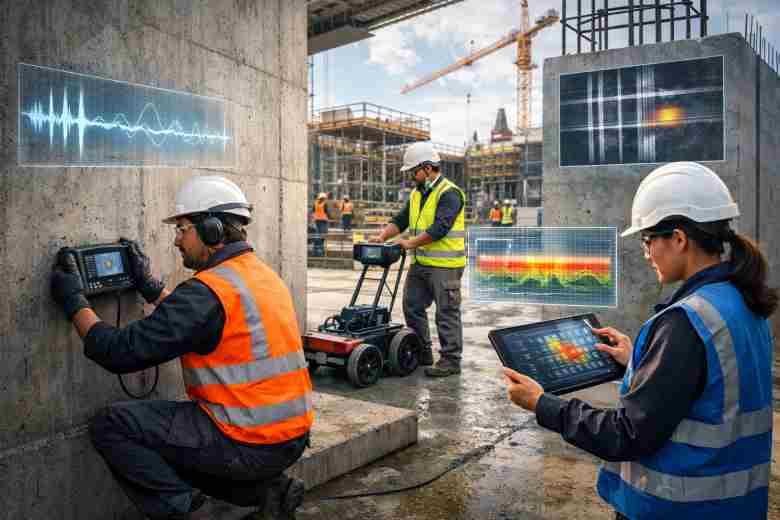
Large projects behave like living systems. Stress travels, materials age, and tiny flaws grow ambitions of their own. Modern non-destructive testing techniques allow teams to read those signals early. Ultrasonic testing sends sound waves through steel to reveal hidden cracks. Ground-penetrating radar maps rebar layouts inside concrete slabs with clarity that feels almost unfair. Infrared thermography highlights moisture intrusion and insulation gaps by reading temperature patterns like a weather map. The reason why these tools matter is because they compress learning time on site. A supervisor gains answers during a morning walk-through instead of waiting for invasive sampling. A project engineer explains findings with images that speak faster than spreadsheets. For workers, this knowledge elevates daily tasks. You move from following instructions to interpreting evidence, and that shift builds authority. On large-scale projects, authority opens doors to leadership roles and specialist pathways. Understanding how these techniques work also strengthens collaboration with inspection teams as well as experienced materials testing consultants, who help translate raw data into decisions that protect structures, schedules, and compliance. Working alongside them sharpens judgment, accelerates learning, and exposes professionals to higher-level quality conversations that shape careers.
Speed, Safety, and the Currency of Trust
Time shapes every construction story. Modern NDT techniques respect that reality by delivering rapid insights without halting progress. Phased array ultrasonics scan welds in record time. Digital radiography produces immediate images without film delays. Acoustic emission monitoring listens for active cracking while structures carry load. These methods serve safety while schedules keep breathing. For professionals on large projects, this blend changes how trust forms. Clients appreciate evidence gathered without disruption, and regulators respond to clear data trails. Site teams gain reassurance that quality checks align with real-world pressures. Career development follows trust closely. When you understand these tools, you contribute to conversations that shape sequencing and risk management. You explain why a pour proceeds or pauses using measured data, and that voice carries weight. Knowledge of modern NDT also supports cross-disciplinary respect. Environmental teams, structural engineers, and quality managers share a common language through these techniques. The benefit here is that this shared understanding reduces friction and builds better workflows without slowing ambition. The professional who grasps speed and safety together becomes indispensable.
Future-Proof Skills on Expanding Projects
Large-scale construction keeps stretching its ambitions. Projects reach higher, spread wider, and grow more complex with every cycle. Modern non-destructive testing moves right alongside that growth. Drones now sweep across façades and bridges with high-resolution cameras and thermal sensors, covering ground that once demanded weeks of scaffolding. At the same time, artificial intelligence steps in to spot patterns and flag anomalies that tired eyes might miss after a long shift. Meanwhile, wireless sensors stream real-time data from critical structural elements, building living records of structural health that evolve day by day.
For workers on site and in offices, these advances open practical doors. Skills gained here travel well. Learning how data moves from sensor to screen to decision builds digital confidence fast. Understanding where the data helps, and where human judgment still leads, sharpens professional instincts. As a result, career mobility expands across infrastructure, energy, and high-rise development. These tools also strengthen conversations around sustainability and lifecycle performance, subjects that increasingly influence funding, approvals, and long-term asset value. Modern NDT knowledge positions professionals as caretakers of structures that must perform for decades. Employers notice that mindset quickly, because long-term thinkers remain rare and valuable in an industry built to last.
NDT knowledge stays useful long after a project wraps. It strengthens trust across disciplines, supports calm decision-making under pressure, and signals readiness for greater responsibility. Leadership grows from understanding risk, quality, and performance over time. Learn how the tools work, interpret what they reveal, and explain it simply. Structures stand tall. Careers stand stronger when professionals understand what keeps them standing.
Related Posts:
- Concrete Scanning: Ensuring Safety and Precision in Construction Projects
- Top Ways to Secure Your Large-Scale Construction Projects
- How to Approach Power BI When Dealing with Large-Scale Construction
- The Complete Guide to Sourcing Quality Material Inspection Services
