
Last Updated on January 28, 2026 by Admin
The Brutally Honest Career Reset Blueprint Every Construction Professional Needs to Read
ConstructionCareerHub App is LIVE — built ONLY for construction careers. Don’t apply with a weak resume.
Get ATS-ready Resume Lab + Interview Copilot + Campus Placement Prep (resume screening, skill gaps, interview readiness) — in minutes & Other advanced features.
Explore Smarter Construction Career Tools →Quick check. Big impact. Start now.
Every year, I speak with hundreds of construction professionals—fresh graduates eager to land their first site engineer role, mid-career engineers stuck in stagnant positions, seasoned project managers eyeing Gulf opportunities, BIM modelers wondering if their skills are still relevant, and quantity surveyors questioning their next move.
Different backgrounds. Different experience levels. Different geographies.
But the same frustration echoes in almost every conversation:
👉 “I’m qualified. I have the degree.”
👉 “I’m experienced. I’ve worked on real projects.”
👉 “But I’m still not getting the right opportunities.”
Here’s the uncomfortable truth I’ve learned after years in construction recruitment and career guidance: The problem isn’t the job market. The problem is how most professionals approach their careers.
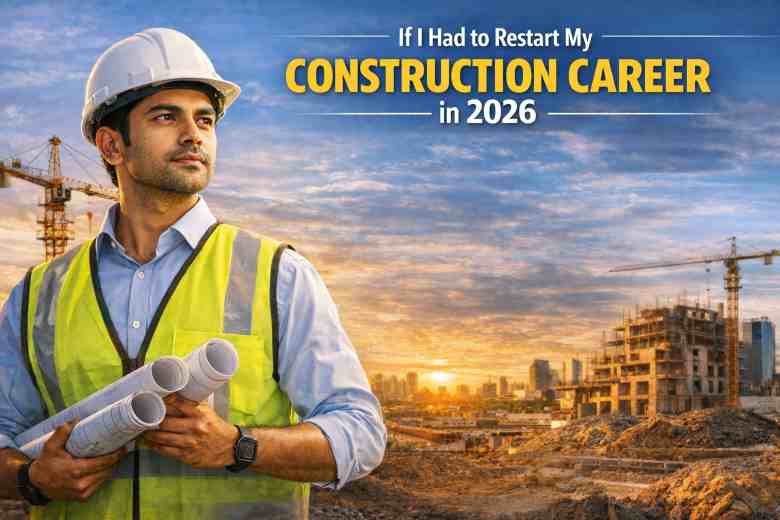
If I were starting my construction career again in 2026—knowing everything I know now about what actually gets people hired, promoted, and paid well—this is exactly what I would do differently.
And I’m sharing this not as theory, but as a practical roadmap you can implement starting today.
1. I Would Choose a Role Before Chasing a Job
This is the single biggest mistake I see construction professionals make—and it costs them years of career progress.
In 2026, introducing yourself as a “Civil Engineer” or “Construction Professional” is far too vague. The industry has evolved. Specialization isn’t optional anymore—it’s the entry ticket to meaningful opportunities.
Think about it from a recruiter’s perspective. When a contractor in Dubai needs someone to manage project schedules for a $200 million infrastructure project, they’re not looking for a “civil engineer.” They’re looking for a Planning Engineer with Primavera P6 expertise and GCC experience.
If I were starting over, I’d clearly choose one path early and build everything around it:
Execution & Site Engineering — For those who thrive in the controlled chaos of construction sites, managing daily operations, coordinating subcontractors, and solving problems in real-time. This path demands strong technical knowledge, leadership under pressure, and the ability to read situations as quickly as you read drawings. Learn more about site engineer careers and salary expectations.
Planning & Project Controls — For the analytically minded who love schedules, baselines, earned value analysis, and keeping mega-projects on track. Planning engineers are the backbone of project delivery, and demand for skilled planners continues to outpace supply globally. Prepare with our 55 Planning Engineer Interview Questions guide.
BIM & Digital Construction — For the tech-forward professionals who see construction’s future in data, 3D models, clash detection, and digital twins. BIM isn’t just a skill anymore—it’s becoming the operating system of modern construction. Discover how to become a BIM specialist.
Quantity Surveying & Commercials — For those who understand that every construction project is ultimately a financial endeavor. QS professionals who can manage costs, prepare BOQs, handle variations, and protect margins are invaluable. Explore quantity surveying career paths and interview preparation.
Safety & Quality — For professionals committed to ensuring projects don’t just get built, but get built right and safely. With regulatory requirements tightening globally, HSE and QA/QC specialists are increasingly critical. Learn about construction safety management careers.
Clarity beats confusion—every single time.
When you’re clear about your role, everything else becomes easier: which skills to develop, which certifications to pursue, which jobs to apply for, and how to position yourself in interviews. If you’re exploring different construction career paths, start with understanding the full landscape of job titles in the construction industry.
2. I Would Build Proof, Not Just Collect Certificates
Let me be direct: Degrees and certifications open doors. Proof gets you hired.
I’ve reviewed thousands of CVs over the years. The pattern is unmistakable. Candidates with impressive certificate collections but no demonstrable work get filtered out. Candidates with modest credentials but strong proof of capability get shortlisted.
What does “proof” actually mean in construction?
It means tangible evidence that you can do the job, not just that you’ve studied the theory.
If I were rebuilding my career, I’d focus obsessively on creating proof:
Real site exposure — Even unpaid internships, site visits, or shadowing experienced professionals count. The goal is to understand how construction actually works beyond textbooks. The smell of concrete, the sound of pile driving, the coordination chaos of a busy site—these experiences shape your professional instincts in ways classrooms never can.
Actual project artifacts — Drawings you’ve contributed to, schedules you’ve developed, quantity takeoffs you’ve prepared, safety reports you’ve written, BIM models you’ve coordinated. These are your professional currency.
Software outputs that demonstrate capability — A Primavera P6 schedule you’ve built from scratch. A Revit model with proper families and parameters. A cost estimate in CostX or Bluebeam. An S-curve analysis in Excel. These outputs tell recruiters more about your abilities than any certificate ever could.
Before-and-after improvements — Did you help reduce material wastage on a project? Improve schedule adherence? Identify cost savings? Resolve a complex clash detection issue? Document these stories with specifics.
The professionals who advance fastest aren’t necessarily the most certified—they’re the ones who can demonstrate results.
Recommended Courses to Build Proof:
For Planning & Scheduling:
- Primavera P6: Project Planning and Scheduling Masterclass on Udemy — Master Primavera P6 from basics to advanced scheduling
- Advanced Primavera P6 Professional Construction Scheduling on Udemy — Learn bridge construction scheduling from A to Z
- Primavera P6 for Civil Engineers – Masterclass in Planning on Udemy — Real civil project-based learning with BOQ integration
For BIM & Digital Construction:
- Building Smarter: BIM in Practice Specialization on Coursera — Comprehensive BIM implementation from L&T EduTech
- BIM Fundamentals for Engineers on Coursera — Master 3D modeling, clash detection, and collaboration
For Construction Management:
- Construction Project Management by Columbia University on Coursera — Industry-leading specialization covering project initiation, BIM, and scheduling
- Construction Management Professional Certificate on edX — Comprehensive program from University of Maryland covering cost estimation, scheduling, and sustainable practices
- Project Management in Construction Specialization on Coursera — From planning to execution with L&T expertise
3. I Would Redesign My CV for Recruiters, Not Colleges
Here’s a statistic that should change how you think about your resume: Recruiters spend an average of 6–8 seconds on initial CV screening.
Six to eight seconds. That’s all you get to make an impression.
Yet most construction CVs I see are designed as if someone will read them cover-to-cover like a novel. They’re filled with generic responsibilities, vague descriptions, and formatting that buries the most important information.
If I were starting over, I’d approach my CV like a marketing document—because that’s exactly what it is. You’re marketing your professional value to potential employers.
I’d make my resume role-specific. A CV for a Planning Engineer position should emphasize scheduling experience, software proficiency, and project controls achievements. A CV for a Site Engineer role should highlight execution experience, team coordination, and problem-solving examples. One-size-fits-all CVs get one-size-fits-all results: rejection. Learn how to write a construction resume that stands out.
I’d use industry keywords strategically. Applicant Tracking Systems (ATS) scan for specific terms before human eyes ever see your CV. If you’re applying for planning roles, terms like “baseline schedule,” “critical path,” “earned value,” “P6,” “delay analysis,” and “progress monitoring” should appear naturally in your experience descriptions.
I’d show results, not just responsibilities. There’s a world of difference between “Responsible for project scheduling” and “Developed and maintained master schedule for $45M commercial project, achieving 94% schedule adherence through proactive delay mitigation.”
I’d quantify everything possible. Project values. Team sizes. Cost savings achieved. Schedule improvements delivered. Safety records maintained. Numbers create credibility and context.
A strong CV doesn’t describe work. It positions value.
For comprehensive guidance on building a winning construction management resume, and free resume formats for engineering freshers, check our detailed resources.
4. I Would Practice Interviews Before Applying
This might be the most underrated career advice I can offer: Most candidates fail interviews not because they lack knowledge—but because they lack practice.
I’ve seen brilliant engineers with deep technical expertise stumble through interviews because they couldn’t articulate their experience clearly. I’ve watched experienced professionals with impressive track records lose opportunities because they couldn’t handle behavioral questions confidently.
The knowledge was there. The communication wasn’t.
Interviews are a performance. And performances require rehearsal.
If I were starting my career again, I would treat interview preparation as seriously as I treat technical skill development:
I’d do mock interviews regularly. Not mental rehearsals—actual spoken practice. Recording yourself answering common questions reveals gaps you never knew existed. Hearing yourself explain your project experience out loud is completely different from thinking about it.
I’d get honest feedback. Friends and family are usually too kind. What you need is constructive criticism that identifies your weak points: Do you ramble? Do you undersell your achievements? Do you get defensive about gaps in your experience? Do you fail to provide specific examples?
I’d fix gaps before the real interview. If you struggle with behavioral questions, learn the STAR method (Situation, Task, Action, Result) and practice structuring your answers. If technical questions trip you up, identify the common questions for your role and prepare thorough responses.
I’d research each company specifically. Generic interview preparation only takes you so far. Understanding the company’s current projects, their challenges, their culture, and their competitive position allows you to tailor your responses and ask intelligent questions.
The construction professionals who consistently land the best offers aren’t necessarily the most qualified on paper—they’re the ones who interview best.
Interview Preparation Resources:
- How to Face Civil Engineering Interviews — Comprehensive guide for 2025 interviews
- Top 50 BIM Interview Questions and Answers — Essential preparation for BIM roles
- 100 Quantity Surveying Interview Questions — Complete QS interview preparation
- BIM Engineer Interview Practice Test — Test your knowledge before the real interview
Want AI-powered interview practice with instant feedback? ConstructionCareerHub.com offers role-based interview simulations designed specifically for construction professionals—from site engineer positions to senior project management roles. The platform analyzes your responses and provides actionable improvement suggestions, helping you identify blind spots before they cost you real opportunities.
5. I Would Master One High-Leverage Tool
There’s a seductive trap in professional development: the illusion that more tools mean more value.
I’ve met candidates who list fifteen software programs on their CV but can’t demonstrate proficiency in any of them. Surface-level familiarity with many tools is worth less than deep expertise in one.
Not 10 tools. One, properly.
If I were starting over, I’d identify the single most high-leverage tool for my chosen role and pursue genuine mastery:
For Planning & Project Controls: Primavera P6 remains the industry standard for large-scale project scheduling, particularly in GCC markets. True P6 proficiency—understanding resource loading, cost loading, baseline management, progress updating, delay analysis, and reporting—separates planning professionals from scheduling clerks.
Recommended: Primavera P6 Professional Masterclass: Project Planning on Udemy offers complete training with live projects, from WBS creation to Earned Value Management.
For BIM & Digital Construction: Revit is foundational, but the real value comes from understanding BIM workflows, coordination processes, and how models translate to construction execution. Master the essential skills every BIM professional needs.
Recommended: Construction Management Specialization by Columbia University on Coursera includes comprehensive BIM modules alongside project management fundamentals.
For Quantity Surveying: Mastering measurement software like CostX, Bluebeam, or even advanced Excel for cost management creates immediate professional value. Understanding how to move from 2D drawings to accurate quantities—and how to handle variations and claims—is where QS careers are made. Explore the best quantity surveying courses.
For Site Engineering: While software matters less than field judgment, proficiency in AutoCAD for site layouts, MS Project for short-term scheduling, and mobile documentation tools increasingly separates effective site engineers from those struggling to keep up.
For Safety & Quality: Understanding safety management systems, audit protocols, and reporting tools is essential. Many HSE roles now require familiarity with digital inspection platforms and incident tracking systems. Learn about construction safety careers.
Depth beats surface-level learning. Every time.
6. I Would Become Visible, Not Invisible
Here’s a reality of the 2026 job market that many construction professionals still haven’t internalized: Silent job applications rarely work anymore.
The traditional approach—browse job boards, submit applications, wait for responses—yields diminishing returns in an increasingly connected industry.
The professionals who consistently attract the best opportunities aren’t just qualified. They’re visible.
If I were rebuilding my career, I’d make professional visibility a non-negotiable priority:
I’d stay genuinely active on LinkedIn. Not just having a profile—actively engaging. Sharing insights from projects (while respecting confidentiality). Commenting thoughtfully on industry discussions. Connecting with professionals in my target companies and geographies. Our comprehensive LinkedIn Jobs Search Guide shows you exactly how to optimize your profile for recruiter visibility.
I’d share learnings and site insights. Every construction professional accumulates valuable knowledge through their work. The ones who share that knowledge—a lesson learned from a challenging pour, an observation about effective safety practices, a tip for better schedule management—build professional reputations that attract opportunities.
I’d engage with industry conversations. Following and interacting with construction thought leaders, companies, and organizations in my target market. Demonstrating genuine interest in industry trends and challenges.
I’d build relationships before I need them. The worst time to network is when you’re desperately job hunting. The best time is when you’re employed and can engage from a position of strength.
Opportunities follow visibility. Recruiters search LinkedIn for candidates with specific skills and experience. Hiring managers notice professionals who contribute valuable insights. Industry connections remember people who engage meaningfully.
For a complete playbook, read our guide on How to Get Your First Construction Job Through LinkedIn in 2025.
7. I Would Plan My Career Like a Project
This is perhaps the most important mindset shift of all.
Construction professionals are trained to plan projects meticulously. We understand that complex endeavors require:
- A clear roadmap — Where are we going? What’s the end state?
- Defined milestones — What are the key achievements along the way?
- Realistic timelines — When should each milestone be reached?
- Risk buffers — What could go wrong, and how do we prepare?
- Resource allocation — What investments of time, money, and effort are required?
- Progress monitoring — Are we on track? What adjustments are needed?
Yet most construction professionals approach their careers with none of this discipline.
They drift from job to job without clear direction. They react to opportunities rather than creating them. They hope for advancement without systematically building toward it.
Careers are projects. They deserve project management.
If I were starting over, I’d create an actual career plan:
Where do I want to be in 5 years? 10 years? Not vague aspirations—specific positions, responsibilities, and compensation targets. A Principal Planning Manager in a Tier-1 contractor. A BIM Director leading digital transformation. A Commercial Director managing major project portfolios. Clarity of destination enables clarity of path.
What milestones mark progress toward that goal? Promotions. Certifications. Project types. Geographic experience. Salary thresholds. Skills acquired. Each milestone should be specific and measurable.
What’s my timeline? Ambitious but realistic. When should I achieve each milestone? What’s my critical path?
What are the risks to my career plan? Market downturns. Technology disruption. Geographic constraints. Skill obsolescence. How do I mitigate these risks?
What investments are required? Courses. Certifications. Relocations. Sometimes short-term salary sacrifices for long-term positioning. Career advancement isn’t free—it requires strategic investment.
Professionals who plan their careers systematically consistently outperform those who leave career progression to chance.
ConstructionCareerHub.com provides role-based career roadmaps specifically designed for construction professionals—helping you map the exact skills, experiences, and milestones needed for your target position, whether that’s senior site management, planning leadership, or commercial director roles.
What This Means for Different Professionals
The principles above apply universally, but implementation varies based on where you are in your career:
🎓 For Fresh Graduates and Entry-Level Professionals
Stop waiting for campus placements to “figure it out.”
The graduates who accelerate fastest are those who arrive at their job search with role clarity, demonstrable skills, and interview readiness—not those who wait passively for opportunities to appear.
Start building now:
- Choose your specialization path based on genuine interest and market demand
- Create proof through internships, personal projects, and software practice
- Optimize your CV for your target role before applications begin
- Practice interviews until confident articulation becomes second nature
The gap between prepared graduates and unprepared graduates has never been wider. Companies have too many choices to take chances on candidates who can’t demonstrate readiness.
Foundational courses for freshers:
- Construction Project Management by Columbia University on Coursera
- The Industry and Profession in Construction Management on edX
- Primavera P6 for Beginners – Learn Scheduling Fast on Udemy
Explore the complete landscape of construction career opportunities.
🧑💼 For Experienced Professionals Seeking Advancement
Experience alone doesn’t guarantee growth. Positioning, specialization, and visibility decide your next level.
I’ve seen professionals with 15 years of experience passed over for roles in favor of candidates with 8 years—because the less experienced candidate was better positioned, more specialized, and more visible.
Time served is not the same as value created.
For mid-career advancement:
- Audit whether your experience demonstrates clear specialization or scattered generalization
- Identify the specific gap between your current position and your target role
- Build visibility through thought leadership and industry engagement
- Ensure your CV and interview approach reflect your seniority level
Career stagnation at the mid-level often stems from one of three issues: unclear specialization, insufficient visibility, or outdated positioning. Identifying which challenge applies to you is the first step toward breakthrough.
Advanced courses for experienced professionals:
- Advanced Planning & Scheduling with Primavera P6 on Udemy — 11.5 PDUs included
- Project Delivery Methods and Contracts in Construction Management on edX
- Construction Management Specialization by Columbia University on Coursera
🌍 For GCC and International Opportunity Seekers
Gulf hiring is outcome-driven. Your CV, interview readiness, and role-fit matter more than years worked.
The GCC construction market—UAE, Saudi Arabia, Qatar, Kuwait, Oman, Bahrain—operates differently than domestic markets. Competition is fierce. Expectations are high. Cultural fit matters.
Contractors and consultants hiring for Gulf projects prioritize:
- Role-specific experience — Generic construction experience is insufficient. They want precise matches for their requirements.
- Demonstrated software proficiency — Particularly Primavera for planning roles, relevant BIM tools for digital construction, and commercial software for QS positions.
- Clear communication skills — Interview performance weighs heavily. Can you explain your experience clearly? Can you handle technical questions confidently?
- Professional presentation — CV quality, interview polish, and overall professional presence matter more in competitive international markets.
If your goal is GCC placement, every aspect of your professional presentation needs to be optimized for that specific market.
Essential resources for Gulf job seekers:
- The Gulf Construction Boom: Jobs Indians Should Target in 2026
- Site Engineer Jobs in Dubai 2026: Complete Career Roadmap
- Top 10 In-Demand Construction Jobs in UAE
- Top Construction Companies in Dubai UAE
Resources That Can Accelerate Your Journey
Throughout this article, I’ve emphasized actionable steps you can take independently. But I also recognize that structured guidance can dramatically accelerate progress.
📚 Essential eBooks for Deep-Dive Learning
For comprehensive self-study resources, we’ve developed detailed ebooks covering specific aspects of construction career development:
Career Planning & Strategy:
- Construction Career Mastery: The Essential eBook Collection (15 eBooks) — Complete bundle covering resumes, interviews, salary negotiation, and career planning for aspiring engineers
- Construction Career Launchpad: A Comprehensive eBook to Construction Job Preparedness — Everything you need to prepare for your construction career
- Hidden Construction Careers That Pay More Than Engineering — Discover lucrative career paths most professionals overlook
Interview Preparation:
- A Comprehensive Civil Engineering Job Interview Guide with 300 Interview Questions and Answers — The most complete interview preparation resource
- Civil Site Engineer Interview Preparation Guide + 225 Interview Q&A — Role-specific preparation for site engineering positions
- Construction Jobs Interview: An Ultimate Interview Preparation Guide — Comprehensive interview strategies and techniques
Specialized Career Guides:
- An Ultimate Guide to Launch Your Career in Digital Construction — Navigate the digital transformation in construction
- Passive Income for Construction Professionals: 15 Proven Strategies for 2026 — Build multiple income streams beyond your day job
- Civil Engineering Interview Questions and Answers PDF eBook — Technical interview preparation
Assessment & Self-Evaluation:
- Construction Project Manager Readiness Test (CPMRT) — Evaluate your readiness for project management roles
- Construction Job Readiness Assessment Test — Identify gaps in your job-search preparation
🎯 For AI-Powered Career Acceleration
This exact gap—career clarity, skill readiness, interview preparation, and strategic positioning—is precisely why we built ConstructionCareerHub.com.
The platform is designed specifically for construction professionals who are serious about career advancement:
✅ Practice interviews with AI-powered feedback — Role-specific simulations for site engineers, planners, QS professionals, BIM specialists, and management positions, with instant analysis of your responses and targeted improvement suggestions
✅ Plan role-based career roadmaps — Structured pathways showing exactly what skills, experiences, and milestones lead to your target position
✅ Understand market-aligned salary expectations — Data-driven benchmarks for construction roles across different markets and experience levels
✅ Improve CVs and job readiness step-by-step — Systematic guidance for positioning your experience effectively
ConstructionCareerHub.com isn’t designed to replace your effort—it’s designed to ensure your effort moves you in the right direction, faster.
🔗 Additional Reading on ConstructionPlacements.com
- Construction Management Career Guide — Comprehensive overview of the CM profession
- Estimation Engineer Career Guide — Complete guide for cost estimation careers
- Facility Management Career Paths — Explore FM career opportunities
- Construction Technologist Career Guide — Navigate the tech-construction intersection
- VDC Engineer Job Description and Salary — Virtual Design and Construction careers
- Contracts Engineer Career Guide — Commercial and legal career paths
- Civil Engineering Technology Career Guide — Technology applications in civil engineering
Final Question: Let’s Learn From Each Other
If you had to restart your construction career in 2026, what would you do differently?
- Would you specialize earlier?
- Choose a different path entirely?
- Invest more in certain skills?
- Build visibility sooner?
- Approach job searching differently?
Drop your answer in the comments.
Your insight might be exactly the clarity someone else needs today. The construction community grows stronger when we share lessons learned—especially the hard-won ones.
The Bottom Line
Construction careers don’t fail because of lack of jobs.
They fail because of poor planning.
The industry is building more than ever. Mega-projects are launching across the GCC, infrastructure investments are surging globally, and the demand for skilled construction professionals continues to grow.
But the professionals who capture these opportunities aren’t the ones with the most impressive credentials on paper. They’re the ones who:
- Chose a clear role and built everything around it
- Created proof of capability, not just collections of certificates
- Positioned their experience as value, not just history
- Practiced until their interview performance matched their actual ability
- Mastered high-leverage tools deeply rather than many tools superficially
- Built visibility that attracted opportunities
- Planned their careers with the same discipline they’d apply to any major project
These aren’t secrets. They’re disciplines.
The question is whether you’ll implement them.
What’s one change you’re going to make in your career approach after reading this?
Found this valuable? Share it with a construction professional who needs to hear it.
For more construction career insights, job opportunities, and professional development resources, visit ConstructionPlacements.com or explore our career acceleration tools at ConstructionCareerHub.com.
Written by the Founder of ConstructionPlacements.com and ConstructionCareerHub.com, platforms dedicated to helping construction professionals navigate their careers across India, the Middle East, the USA, and global markets. With years of experience in construction recruitment and career guidance, he has helped thousands of engineers, planners, and project managers land their dream roles.
Related Posts:
- How to Succeed in your Job Search for Fresh Graduates
- The Best Free Resume Builder for the Construction Industry in 2026
- The Do’s and Don’ts of Writing an Entry-Level Construction Resume
- Top 15 Digital Construction Careers Without Coding Skills [2026 Guide]
