

Last Updated on January 4, 2026 by Admin
The 7/12 extract (also known as Satbara Utara or सातबारा उतारा) is the most important land record document in Maharashtra, India. Whether you’re a farmer applying for agricultural loans, a property buyer conducting due diligence, or a legal professional handling land disputes, understanding how to access and interpret your 7/12 extract is essential.
Thanks to the Maharashtra government’s digital initiatives, you can now download your 7/12 extract online through the official Mahabhulekh portal (bhulekh.mahabhumi.gov.in) in just minutes. This comprehensive 2026 guide covers everything from basic concepts to advanced features, ensuring you have complete knowledge of Maharashtra’s digital land record system.
If you’re planning to invest in property, also read our detailed guide on Types of Plots and Housing in India to understand different property categories before making your purchase decision.
Table of Contents
What is a 7/12 Extract (Satbara Utara)?
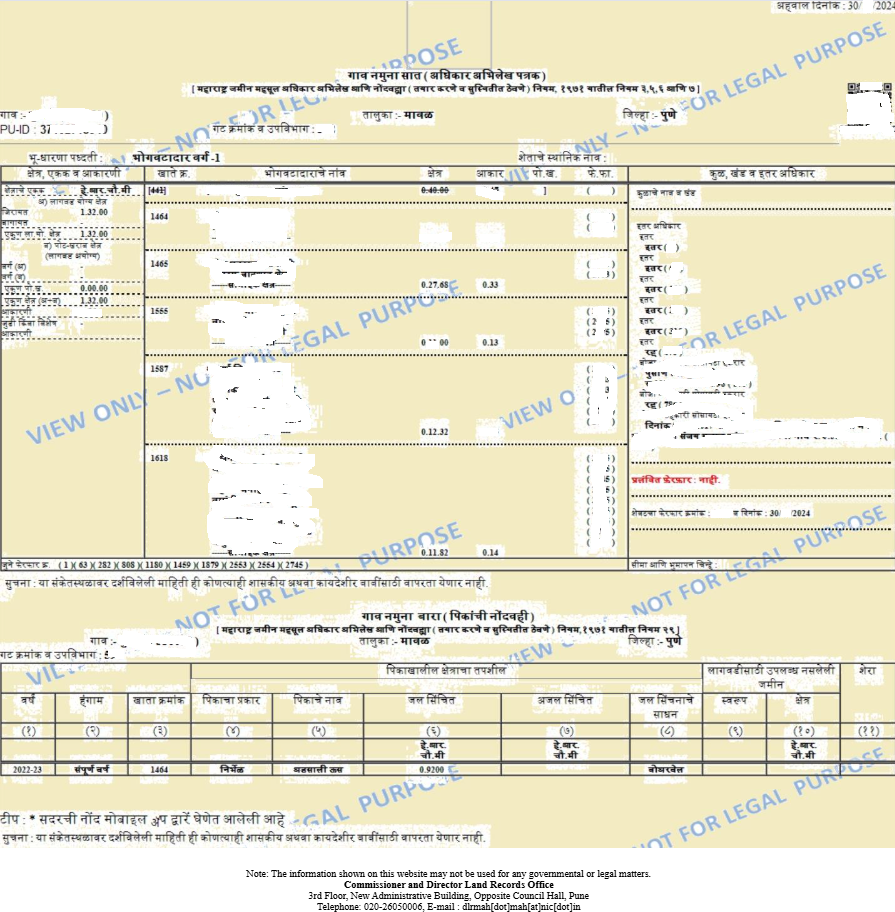
A 7/12 extract is an official land record document maintained by the Revenue Department of Maharashtra under the Maharashtra Land Revenue Code, 1966. The name “7/12” refers to the two forms (Form VII and Form XII) that together constitute this comprehensive land record.
The document serves as legal proof of land ownership and contains critical information including:
- Owner Details: Names of all current landowners with their respective shares
- Survey Information: Survey number, Gat number, and village/taluka/district details
- Land Measurements: Total area in hectares, ares, and square meters
- Cultivation Details: Type of crops, irrigation status, and seasonal cultivation patterns
- Encumbrances: Any mortgages, loans, court orders, or legal disputes attached to the land
- Mutation History: Record of ownership changes (Ferfar) over time
Understanding Form VII and Form XII
Form VII (Register of Rights) contains:
- Names of all owners and their legal heirs
- Share of each owner in the property
- Survey and settlement number
- Boundaries and geographical identifiers
Form XII (Register of Crops) contains:
- Types of crops cultivated (Kharif, Rabi, Summer)
- Irrigation source and method
- Land classification (irrigated/non-irrigated)
- Outstanding dues and liabilities
Why is the 7/12 Extract Important?
The 7/12 extract serves as the foundation document for numerous legal, financial, and administrative purposes in Maharashtra:
Property Transactions
Before purchasing any agricultural land in Maharashtra, buyers must verify the 7/12 extract to confirm the seller’s ownership rights and check for any encumbrances. This prevents fraud and ensures a clear title transfer. For more insights on buying land safely, explore our Comprehensive Guide to Buying Land.
Bank Loans and Credit
All banks and financial institutions require the 7/12 extract when processing agricultural loans, home loans on converted land, or using land as collateral. The document validates ownership and helps banks assess the property’s value.
Government Schemes and Subsidies
Farmers need the 7/12 extract to apply for various government benefits including PM Kisan Samman Nidhi, crop insurance, agricultural subsidies, and drought relief funds. The document proves land ownership and farming status.
Legal Proceedings
In property disputes, inheritance claims, or partition suits, the 7/12 extract serves as primary evidence of ownership. Courts rely on this document to establish rights and resolve conflicts.
The Evolution to Digital: From Guntha to Metric Units
Historically, traditional units like Guntha were used in Maharashtra’s land records. However, since the early 1970s—when India adopted the metric system—land measurements in the 7/12 extract have been standardized into:
- Hectares (हे): 1 hectare = 10,000 sq. meters.
- Ares (आर): 1 are = 100 sq. meters (or 1076.4 sq. ft).
- Square Meters (चौरस मीटर): The base unit of area.
It is important to note that while Guntha (1089 sq. ft) was once common, the 7/12 extract now exclusively uses metric units. This shift has reduced confusion and brought precision to property measurements.

Breaking Down the 7/12 Extract
The document consists mainly of two forms:
Form VII:
- Owner Details: Name(s) of the owner(s), rights, and share in the property.
- Survey and Boundaries: Survey number, village, and other geographical identifiers.
Form XII:
- Agricultural Information: Types of crops, irrigation details, and land suitability.
- Land Use and Liabilities: Information regarding taxes, loans, or any legal disputes.
Understanding these sections ensures that you can verify the authenticity of the land record and identify any potential issues before a transaction.
For a detailed explanation on reading the 7/12 extract, visit HomeBazar’s simple guide
How to Download 7/12 Extract Online in Maharashtra (2026)
Maharashtra offers multiple official portals to access land records. Here’s how to use each platform:
Method 1: Mahabhulekh Portal (Free Unsigned Copy)
The Mahabhulekh portal (bhulekh.mahabhumi.gov.in) is the official Maharashtra land records website where you can view and download unsigned 7/12 extracts for free.
- Visit the Official Website: Go to mahabhumi.gov.in
- Select Your Division: Choose from the six revenue divisions – Pune, Konkan, Nashik, Aurangabad (Chhatrapati Sambhajinagar), Amravati, or Nagpur
- Choose District, Taluka, Village: Select your location from the dropdown menus
- Enter Property Details: Input the Survey/Gat number, or search by owner’s name
- View and Download: Your 7/12 extract will be displayed. You can view it online or download as PDF
Method 2: Digital Satbara Portal (Digitally Signed Copy)
For legally valid, digitally signed copies of your 7/12 extract, use the Digital Satbara portal (digitalsatbara.mahabhumi.gov.in).
- Visit Digital Satbara Portal: Go to digitalsatbara.mahabhumi.gov.in
- Register/Login: New users must create an account; existing users can log in with credentials
- Recharge Wallet: Add funds to your account (minimum ₹15 per download)
- Select Document Type: Choose “Digital 7/12” from available options
- Enter Details: Fill in District, Taluka, Village, and Survey/Gat Number
- Download: Your digitally signed 7/12 extract will be available for download
Method 3: Aaple Sarkar Portal (For Mutations)
Use the Aaple Sarkar portal (aaplesarkar.mahaonline.gov.in) specifically for applying mutations (Ferfar) to update ownership records, such as adding a new owner’s name after purchase or inheritance.
Sample 7/12 Extract
Here is the sample 7/12 extract downloaded from the Mahabhulekh website.
7/12 Extract Fee Structure in Maharashtra (2026)
| Document Type | Fee (2026) | Legal Validity |
| Unsigned 7/12 (Mahabhulekh) | FREE | For reference only |
| Digital Signed 7/12 | ₹15 per copy | Legally valid |
| Digital Signed 8A Extract | ₹15 per copy | Legally valid |
| Digital Property Card | ₹15 per copy | Legally valid |
| Ferfar (Mutation Record) | ₹15 per copy | Legally valid |
Understanding Land Measurements in 7/12 Extract
Since India’s adoption of the metric system in the 1970s, Maharashtra’s land records use standardized metric units. Here’s what each measurement means:
| Unit | Marathi Name | Equivalent |
| Hectare (हे) | हेक्टर | 10,000 sq. meters / 2.47 acres |
| Are (आर) | आर | 100 sq. meters / 1,076 sq. ft |
| Square Meter | चौरस मीटर | 10.76 sq. ft |
| Guntha (Traditional) | गुंठा | 1,089 sq. ft (not used in 7/12) |
Note: While Guntha is still commonly used in local transactions, official 7/12 extracts exclusively use metric units.
7/12 Extract vs Property Card vs 8A Extract: Key Differences
| Feature | 7/12 Extract | Property Card | 8A Extract |
| Applicable For | Rural/Agricultural land | Urban properties | Rural land (accounts) |
| Also Known As | Satbara Utara | Malmatta Patrak | Khata Extract |
| Key Information | Ownership + Crops | CTS No., Building info | Account holder details |
| Issuing Authority | Talathi Office | City Survey Office | Talathi Office
|
Land Record Portals Across Major Indian States (2026)
If you own land in other states or are considering purchasing property outside Maharashtra, here are the official land record portals developed under the Digital India Land Records Modernization Programme (DILRMP):
| State | Portal Name | Website |
| Andhra Pradesh | Meebhoomi | meebhoomi.ap.gov.in |
| Gujarat | AnyRoR | anyror.gujarat.gov.in |
| Karnataka | Bhoomi | landrecords.karnataka.gov.in |
| Maharashtra | Mahabhulekh | bhulekh.mahabhumi.gov.in |
| Rajasthan | Apna Khata | apnakhata.rajasthan.gov.in |
| Tamil Nadu | Patta Chitta | eservices.tn.gov.in |
| Uttar Pradesh | Bhulekh UP | upbhulekh.gov.in |
| Haryana | Jamabandi | jamabandi.nic.in |
| Punjab | PLRS | plrs.org.in |
| Jharkhand | Jharbhoomi | jharbhoomi.nic.in |
Common Issues and Troubleshooting
Portal Not Loading or Slow Response
- Try accessing during off-peak hours (early morning or late evening)
- Clear browser cache and cookies
- Use desktop mode if accessing from mobile
- Try a different browser (Chrome recommended)
Record Not Found
- Verify the survey/gat number is correct
- Try searching by owner’s name instead
- Check if the land is urban (use Property Card search)
- Contact local Talathi office for assistance
Incorrect Information in 7/12
- Apply for mutation (Ferfar) through Aaple Sarkar portal
- Submit supporting documents to Talathi office
- Track application status online
Embracing Digital Transformation in Land Records
Maharashtra’s digitization of land records represents a significant step toward transparent and efficient governance. The shift from paper-based records to digital platforms has reduced corruption, eliminated middlemen, and empowered citizens with direct access to their property information.
This transformation is part of the larger Construction 4.0 digital revolution that is reshaping how we manage, verify, and transact property in India. For professionals in land surveying, understanding these digital tools is increasingly essential. Learn more about career opportunities in our Land Surveyor Job Description and Salary Guide.
Proper documentation is crucial in all property-related matters. Explore our guide on Effective Documentation in Construction Management to understand best practices for maintaining comprehensive records.
Conclusion
The 7/12 extract (Satbara Utara) remains the most critical land record document in Maharashtra, serving as definitive proof of ownership for agricultural and rural properties. With the Mahabhulekh portal and Digital Satbara services, accessing these records has never been easier or more convenient.
Whether you’re a farmer, property buyer, legal professional, or NRI with land holdings in Maharashtra, understanding how to access, read, and utilize your 7/12 extract is essential for protecting your property rights and enabling smooth transactions.
Key Takeaways:
- Use Mahabhulekh (bhulekh.mahabhumi.gov.in) for free viewing and unsigned copies
- Use Digital Satbara portal for legally valid, digitally signed copies (₹15 per copy)
- Always verify 7/12 before any property transaction
- Apply for mutations through Aaple Sarkar portal to update ownership
- Keep your land records updated to avoid future disputes
Disclaimer: This guide is for informational purposes only and updated as of January 2026. Always verify information with official government portals and consult legal professionals for specific property matters.
Related Posts:
- How to Enhance Documentation in Construction Management
- Unlocking the Real Estate Puzzle: A Comprehensive Guide to Types of Plots and Housing in India
- Finding Your Piece of the Earth: A Comprehensive Guide to Buying Land
- Land Surveyor Job Description and Salary Details
Frequently Asked Questions
The 7/12 Extract is an essential land record document in Maharashtra, India. It provides detailed information about a land parcel’s ownership, agricultural details, and history. This document is crucial for verifying property ownership, ensuring legal transactions, and performing agricultural assessments.
The measurement system in the 7/12 Extract has transitioned from traditional units such as Guntha to metric units including hectares, ares, and square meters. This change ensures greater accuracy and standardization in land measurement and record-keeping.
The 7/12 extract is called “सातबारा उतारा” (Satbara Utara) in Marathi. It combines Form 7 (rights register) and Form 12 (crop/cultivation register) maintained by the Revenue Department.
The digitally signed 7/12 extract downloaded from the Digital Satbara portal (digitalsatbara.mahabhumi.gov.in) is legally valid for all official purposes including court proceedings, bank loans, and property transactions. Unsigned copies from Mahabhulekh are for reference only.
Yes, NRIs can access Maharashtra land records through the Mahabhulekh portal from anywhere in the world. No Aadhaar or local mobile verification is required for viewing records. Third-party platforms like Landeed also offer convenient access for NRIs.
The 7/12 extract is used for rural and agricultural land, while the Property Card (Malmatta Patrak) is issued for urban properties that have been converted from agricultural use. Both serve as proof of ownership but apply to different land categories.
Viewing unsigned 7/12 extracts on Mahabhulekh is completely free. For digitally signed copies with legal validity, the fee is ₹15 per document through the Digital Satbara portal.
