
Last Updated on May 19, 2026 by Admin
The construction industry is grappling with a significant labor shortage in 2026, leading to project delays, budget overruns and increasingly compromised quality control. These persistent challenges underscore the urgent need for innovative strategies. Enter the self-performance model, a proactive approach that counters these issues with the assurance of greater stability and predictability in project execution. It can enhance resource management and establish a framework for transforming the greater construction landscape.
ConstructionCareerHub App is LIVE — built ONLY for construction careers. Don’t apply with a weak resume.
Get ATS-ready Resume Lab + Interview Copilot + Campus Placement Prep (resume screening, skill gaps, interview readiness) — in minutes & Other advanced features.
Explore Smarter Construction Career Tools →Quick check. Big impact. Start now.
Table of Contents
The Fragility of the Subcontractor Model in a High-Demand Market
Continued reliance on subcontractor networks poses significant risks in a demanding market, especially amid a skilled labor shortage. Key challenges include:
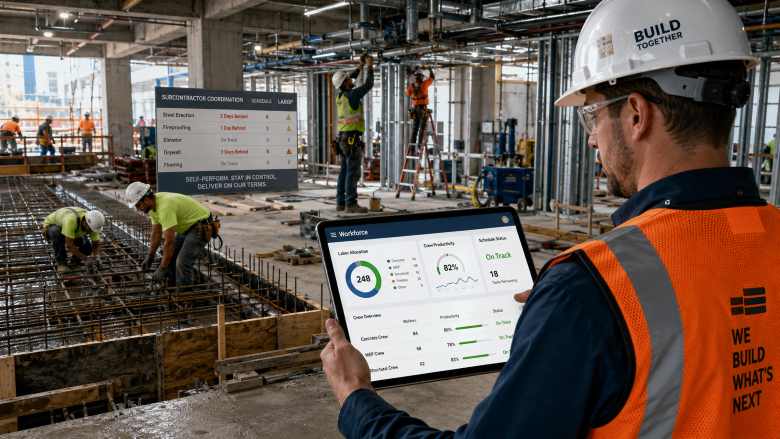
- Breakdowns in communication and scheduling: Coordination among multiple subcontractors can lead to miscommunication and scheduling conflicts, resulting in costly delays. Each third-party crew operates on a specific timeline, increasing the likelihood of bottlenecks.
- Inconsistent quality control and safety protocols: Subcontractors may adhere to different safety standards and quality benchmarks. These inconsistencies can compromise a project’s overall integrity, raising risks for both the contractor and clients.
- Increased project management overhead: A fragmented team of subcontractors requires greater oversight and administrative effort. This imbalance can inflate project management costs, further straining budgets and timelines in an already competitive market.
Escalating subcontracting model complexities underscore the need for a more integrated approach, driven by the self-performance model. Taking control of key aspects of construction enables companies to facilitate better communication, ensure consistent quality and reduce various management burdens. This approach can contribute to more successful project outcomes, even in challenging labor conditions.
The Self-Performance Advantage
The self-performance model offers a resilient alternative to traditional subcontracting by focusing on efficiency and control. Keeping critical trades in-house means companies can effectively manage the three pillars of successful project execution:
- Streamlined project management and communication: Centralizing operations enhances coordination and reduces the risk of miscommunication. A single team will better align on timelines and goals, significantly reducing delays and improving workflow.
- Unified safety and quality culture: Continued control over skilled labor promotes a consistent safety and quality culture. When everyone involved adheres to the same standards, projects can achieve greater compliance and reduce the risks associated with varying subcontractor protocols.
- Schedule and cost predictability: A self-performing assignee can closely monitor project timelines and budgets, with greater predictability that enables better financial planning and resource allocation. This greater control alleviates hidden costs often associated with managing fragmented subcontractor teams.
By directly addressing the risks associated with subcontractor reliance, the self-performance model offers a more stable approach amid a challenging labor landscape. This strategic shift enhances operational efficiency and results in superior outcomes across all project dimensions, reinforcing the stakeholder’s reputation for excellence.
How Morgan Corp. Redefines Project Success
Morgan Corp. stands as a premier example of the self-performance model’s success within the construction industry. By strategically integrating advanced technologies and fostering a culture of safety and trust, it demonstrates the profound impact of a unified approach. Its work on significant projects like the BMW plant, Microsoft, Wal-Mart and various major reservoirs serves as testimony to the company’s leadership and innovative techniques.
A ‘Field First’ Mentality in Action
Owning and operating one of the largest, late-model GPS-controlled fleets in the Southeast gives Morgan Corp. a strategic advantage. Enhancing jobsite precision, speed and efficiency, this technology allows for real-time adjustments and optimizations.
By leveraging this cutting-edge technology, Morgan Corp. can monitor equipment performance and workflow dynamics, ensuring that scheduled tasks are completed. This results in quicker turnarounds and reduced operational costs, bolstering its competitive edge in a high-demand market.
A Culture of Safety and Trust
An exceptional 0.55 Experience Modification Rate (EMR) indicates a strong Morgan Corp. safety record and showcases its commitment to maintaining high safety standards. This EMR metric also reflects the company’s incident rates, which are well below the civil construction average and are of significant importance in the construction industry.
Central to the Morgan Corp. operations is the “Social Contract,” a philosophy that emphasizes trust-based relationships. The approach promotes reliability and project integrity, ensuring that workers and clients alike can depend on Morgan Corp. to deliver quality work on every project.
Building a Sustainable Workforce
Morgan Corp.’s “Built on Leadership” program is a proactive answer to the ongoing labor shortage. By investing in on-the-job training, professional development and clear career pathways, the company cultivates a loyal and highly skilled workforce at all career stages, empowering a sustainable talent pool that subcontractor-dependent firms struggle to replicate.
Specializing Expertise On Demand
One way that Morgan Corp. demonstrates its technical mastery is through its leadership in Roller-Compacted Concrete (RCC) for industrial applications. With over 26 million square feet of RCC pavements complete, this specialized expertise adds significant value to clients with distinctive needs, solidifying a reputation for quality and innovation.
Additionally, Morgan Corp.’s sister company, Palmetto Rock, exemplifies its comprehensive in-house capabilities, enabling it to address various project requirements within a single organizational framework. By maintaining control over critical trades, Morgan Corp. ensures superior outcomes and reinforces its standing as a market leader.
Frequently Asked Questions
Learn more about how self-performance can help the construction industry amid labor shortages.
What is the self-performance model in construction?
The self-performance model involves a provider managing key aspects of a project, such as in-house skilled labor, equipment and materials. This approach eliminates reliance on subcontractors, enhancing control over quality, scheduling and costs.
How does self-performing work help mitigate labor shortages?
By keeping critical trades in-house, companies like Morgan Corp. can directly manage skilled labor resources. This self-management reduces reliance on an already strained labor market and enables better training and talent retention, which are vital during workforce shortages.
What are the key benefits of working with a heavy civil contractor like Morgan Corp.?
Working with Morgan Corp. offers numerous advantages, including a proven safety record, state-of-the-art technology and a commitment to quality. Its extensive experience and comprehensive services allow for streamlined project management, consistent quality control and reliable delivery on complex projects.
The Future of Construction Has a Strong Foundation
In an era marked by uncertainty, the self-performance model emerges as the most reliable path to success in construction. Morgan Corp.’s impressive over 75-year legacy underscores its stability and expertise, while its forward-thinking investments in people and technology position it as an ideal partner for today’s challenges. Its commitment to innovation keeps it at the forefront of the construction landscape, paving the way for a more resilient industry.
Related Posts:
- How the US Construction Industry is Tackling the Skilled Labor Shortage
- Construction Data: How It’s Revolutionizing the Construction Industry in 2026
- 31 Challenging Interview Questions Specific to the Construction Industry
- An Expert’s Guide to Workplace Survival in the Construction Industry
