

Last Updated on May 19, 2026 by Admin
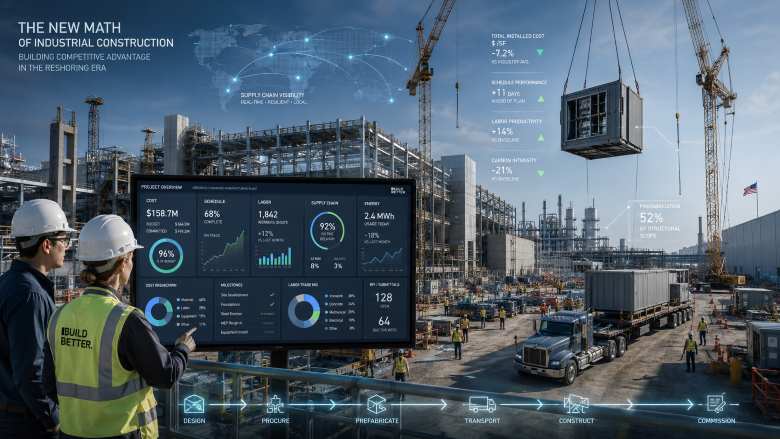
The unpredictability of global supply chains is driving the reshoring trend among industrial facilities. With production returning to United States soil, the selection of a construction partner becomes a strategic decision with lasting consequences. It requires a new mathematical framework that has outgrown the old-fashioned model focused solely on securing the lowest bid.
ConstructionCareerHub App is LIVE — built ONLY for construction careers. Don’t apply with a weak resume.
Get ATS-ready Resume Lab + Interview Copilot + Campus Placement Prep (resume screening, skill gaps, interview readiness) — in minutes & Other advanced features.
Explore Smarter Construction Career Tools →Quick check. Big impact. Start now.
Table of Contents
The Reality of the U.S. Reshoring Boom
Geopolitical disruptions, volatile tariffs and soaring transportation costs are decreasing or even eliminating the advantages of production in low-cost countries. For facility directors seeking stability and predictability, reshoring has become an increasingly attractive option. While rising international transportation costs play a role, they represent only part of the equation.
The true drivers extend beyond simple cost comparisons. Rather than focusing solely on labor arbitrage, plant managers must weigh qualitative factors. Labor quality, supply chain stability and political stability offer tangible value that spreadsheets often overlook.
Rising U.S. manufacturing productivity has narrowed the gap between domestic and offshore production expenses. When combined with reduced geopolitical risk, these elements create operational advantages that low-cost offshore production cannot match, making domestic facilities increasingly competitive.
Why the Lowest Bid Is Now the Highest Risk
The “lowest bid” model has become dangerously inadequate for critical industrial construction projects. It accounts only for the initial price tag while ignoring long-term risks and costs that can exceed up-front savings. In an era where facilities represent strategic assets for reshoring success, the cheapest option rarely delivers the best value.
Uncovering the Hidden Costs of Project Quality
Decision-makers evaluating construction partners must consider the total cost of ownership rather than focusing narrowly on bid prices. The hidden costs of poor-value industrial construction prove significant when examined closely. Choosing a partner based on price alone often leads to quality issues that trigger costly rework, schedule delays and persistent maintenance problems that erode profitability.
Traditional accounting systems struggle to capture these downstream costs. Research quantifying construction project quality has found that organizations that fail to prioritize quality incur higher failure costs. The financial impact exceeds 12% of the project cost, with most of it hidden from standard financial reporting. These expenses emerge over time through operational inefficiencies, unplanned repairs and lost plant production capacity.
Selecting a Contractor for Long-Term Value
For facility managers, the new cost calculus centers on the total cost of ownership. Projects face common challenges that can derail timelines and budgets, such as subcontractor coordination issues, communication breakdowns, infrastructure constraints, scope confusion and budget overruns. Decision-makers must recognize that up-front savings can disappear quickly when projects require extensive corrections.
Evaluating a contractor’s ability to deliver long-term value, minimize operational downtime and ensure reliability throughout the project life cycle offers a better path forward. This evaluation considers what a project costs to build, operate and maintain over its functional lifespan.
Key Traits of Best-Value Contractors
Reliable contractors share key characteristics that distinguish them from low-bid competitors. Industry-specific experience ensures familiarity with the unique demands of industrial facilities, and workers can benefit from a documented safety culture that reduces liability exposure.
Even when inevitable challenges arise, effective project management can keep complex builds on schedule. Organizational discipline and planning capability become evident through consistent on-time completion.
As a leading provider of industrial construction services, Foss General Contractors serves as a real-world example of a general contractor that embodies these traits. The company’s approach reflects the principles that define best-value partnerships:
- Fast project execution: Streamlined processes and experienced teams work to reduce construction timelines without sacrificing quality.
- Reliable performance: Consistent delivery builds confidence that projects will meet specifications and deadlines.
- Efficient operations: Smart planning and resource management aim to minimize operational downtime during construction and transitions.
Foss General Contractors offers complete, end-to-end solutions spanning design and planning through fabrication and installation. Such integration is key to minimizing risks and long-term costs. Rather than coordinating multiple disconnected vendors, manufacturers benefit from unified accountability and seamless execution.
Frequently Asked Questions About Industrial Construction
Understanding the scope and process of industrial construction helps manufacturers make informed decisions when selecting a general contractor for their projects.
What projects can Foss General Contractors handle?
Foss General Contractors can handle a broad range of industrial projects, including site preparation, new construction, expansions, renovations, retrofits, mechanical and electrical systems installation and finishing work. It focuses exclusively on industrial facilities.
How quickly can new construction be completed?
Project timelines vary depending on scope and technical requirements. A renovation may take six to 12 months, while new construction can range from 12 to 24 months. Every project progresses at a pace determined by its unique specifications. However, firms like Foss General Contractors maintain efficiency while upholding quality standards.
What is included in the initial estimate?
Initial estimates are comprehensive, covering labor, permit, material and subcontractor costs. A tentative timeline based on the project scope is also included in the estimate. The detailed breakdown helps facilities directors understand the full investment required and plan accordingly.
Building a Resilient and Competitive Future
In the modern industrial landscape, choosing a construction partner represents a strategic investment in a facility’s future rather than a simple line-item expense. The reshoring boom demands facilities that support efficient, reliable production over decades of operation. Embracing the new math of total cost of ownership proves essential for building a resilient, efficient and competitive operation capable of thriving in an uncertain global environment.
Related Posts:
- The Ultimate Construction Bids Guide for 2026
- 5 Types of Construction: A Comprehensive Guide
- Decoding the Construction Bidding Process: A Comprehensive Guide
- Is Oil & Gas Production a Good Career Path? A Comprehensive Analysis for 2026
