
Last Updated on January 16, 2026 by Admin
Understanding construction abbreviations and civil engineering acronyms is fundamental to success in the building industry. Whether you’re reviewing construction drawings, communicating with project managers, or preparing for job interviews, knowing these terms gives you a significant professional advantage.
ConstructionCareerHub App is LIVE — built ONLY for construction careers. Don’t apply with a weak resume.
Get ATS-ready Resume Lab + Interview Copilot + Campus Placement Prep (resume screening, skill gaps, interview readiness) — in minutes & Other advanced features.
Explore Smarter Construction Career Tools →Quick check. Big impact. Start now.
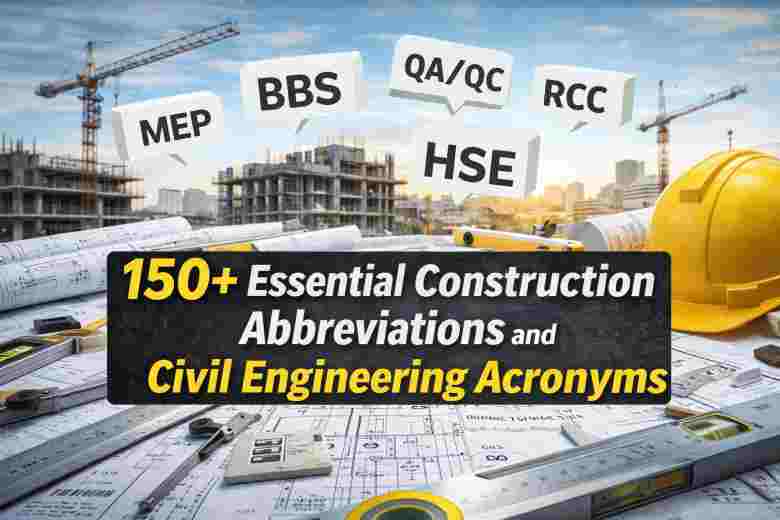
This comprehensive guide covers 165+ construction abbreviations and acronyms used across the construction industry globally. We’ve organized them by category and numbered each entry for easy reference.
Why Construction Professionals Must Know Industry Abbreviations
The construction management field relies heavily on standardized terminology to streamline communication across diverse teams. Mastering these abbreviations helps you read technical documents accurately, communicate efficiently with architects and contractors, and succeed in construction job interviews.
Pro Tip: To deepen your construction management knowledge, consider the Construction Project Management Specialization on Coursera from Columbia University.
Project Management Abbreviations (1-20)
Effective construction project management requires fluency in these essential abbreviations:
1. PM (Project Manager) – The professional responsible for planning, executing, and closing construction projects within budget and timeline constraints.
2. CM (Construction Manager) – A construction manager oversees the entire construction process and ensures quality requirements are met.
3. GC (General Contractor) – The primary contractor responsible for day-to-day oversight of a construction site and management of subcontractors.
4. CPM (Critical Path Method) – A project scheduling technique that identifies the longest sequence of dependent activities.
5. WBS (Work Breakdown Structure) – A hierarchical decomposition of project deliverables into smaller, manageable components. Learn more about key project management concepts.
6. EV (Earned Value) – The budgeted cost of work performed at any point during a project.
7. PV (Planned Value) – The budgeted cost for work scheduled to be completed by a specific date.
8. ETC (Estimate to Complete) – The projected cost to finish remaining project work.
9. EAC (Estimate at Completion) – The total expected cost of a project at completion.
10. IPD (Integrated Project Delivery) – A collaborative project delivery approach involving all stakeholders from early design through construction.
11. DBB (Design-Bid-Build) – The traditional project delivery method where design is completed before bidding.
12. DB (Design-Build) – A project delivery system combining design and construction services under one contract.
13. CMAR (Construction Manager at Risk) – A delivery method where the CM provides a guaranteed maximum price.
14. ECI (Early Contractor Involvement) – A procurement approach involving the contractor before design completion for feasibility input.
15. Float – The amount of time a task can be delayed without affecting the project completion date.
16. PERT (Program Evaluation Review Technique) – A statistical scheduling method for analyzing project tasks.
17. LOE (Level of Effort) – Support activities that don’t produce definitive deliverables.
18. OBS (Organizational Breakdown Structure) – Hierarchical model describing project team organization.
19. RAM (Responsibility Assignment Matrix) – Chart mapping project deliverables to team members.
20. SPI (Schedule Performance Index) – Measure of schedule efficiency on a project.
Related Resources
- Construction Contracting: Understanding Types of Construction Contracts
- Essential Steps for Constructing a Building
- Construction Cost Management Guide
BIM and Construction Technology Abbreviations (21-40)
Digital transformation has introduced numerous technology-related abbreviations. Understanding Building Information Modeling (BIM) terminology is essential for modern construction professionals.
21. BIM (Building Information Modeling) – A digital representation of physical and functional characteristics of a building. Explore BIM career opportunities.
22. CAD (Computer-Aided Design) – Software used to create 2D and 3D design drawings. Review the best CAD software options.
23. LOD (Level of Development/Detail) – Specifies the degree of detail and accuracy in a BIM model at various project stages.
24. CDE (Common Data Environment) – A shared digital space for collecting, managing, and disseminating project information per ISO 19650 standards.
25. IFC (Industry Foundation Classes) – An open file format for BIM data exchange between different software platforms.
26. AR (Augmented Reality) – Technology overlaying digital information onto the physical environment. Learn about AR in construction.
27. VR (Virtual Reality) – Immersive computer-generated environments for design visualization. Discover VR applications in construction.
28. IoT (Internet of Things) – Connected devices collecting and exchanging data on construction sites. Read about IoT in construction.
29. 3D Printing – Additive manufacturing technology for creating physical objects from digital models. Explore 3D printing in construction.
30. AI (Artificial Intelligence) – Machine learning systems for predictive analytics, quality control, and project optimization.
31. GPS (Global Positioning System) – Satellite-based navigation for surveying and equipment tracking.
32. GIS (Geographic Information System) – System for capturing, storing, and analyzing spatial and geographic data.
33. GPR (Ground Penetrating Radar) – Technology for subsurface imaging to detect utilities and voids.
34. UAV (Unmanned Aerial Vehicle) – Drones used for site surveys, inspections, and progress monitoring.
35. 4D BIM – BIM model integrated with project scheduling for time-based visualization.
36. 5D BIM – BIM model integrating cost data for real-time budget tracking.
37. 6D BIM – BIM model including sustainability and energy analysis data.
38. 7D BIM – BIM model for facility management and operations.
39. LiDAR (Light Detection and Ranging) – Remote sensing technology for precise 3D mapping.
40. ML (Machine Learning) – AI subset enabling systems to learn and improve from experience.
Enhance Your BIM Skills: The BIM Fundamentals for Engineers course on Coursera provides hands-on training with Autodesk Revit and ISO 19650 standards. For advanced applications, explore the BIM for Construction course on edX from Purdue University.
Related Resources
- Top 50 BIM Interview Questions and Answers
- 51 Top AutoCAD Interview Questions and Answers
- 50 Top Design Engineer Interview Questions and Answers
MEP and Building Systems Abbreviations (41-60)
MEP engineering encompasses the mechanical, electrical, and plumbing systems that make buildings functional.
41. MEP (Mechanical, Electrical, Plumbing) – The essential building systems providing heating, cooling, power, and water services.
42. HVAC (Heating, Ventilation, Air Conditioning) – Systems controlling indoor climate and air quality.
43. BMS (Building Management System) – Automated system for monitoring and controlling building operations.
44. GFCI (Ground Fault Circuit Interrupter) – Electrical safety device protecting against shock hazards.
45. ACH (Air Changes per Hour) – Measurement of ventilation rate in a space.
46. BTU (British Thermal Unit) – Unit measuring heating or cooling capacity.
47. CFM (Cubic Feet per Minute) – Measurement of air flow rate.
48. ERV (Energy Recovery Ventilator) – Equipment recovering energy from exhaust air.
49. VAV (Variable Air Volume) – HVAC system varying air flow to control temperature.
50. VRF (Variable Refrigerant Flow) – Advanced HVAC technology for precise climate control.
51. UPS (Uninterruptible Power Supply) – Backup power system for critical equipment.
52. AHU (Air Handling Unit) – Equipment conditioning and circulating air.
53. RTU (Rooftop Unit) – Self-contained HVAC unit installed on building roofs.
54. DX (Direct Expansion) – Cooling system where refrigerant directly cools air.
55. FLS (Fire Life Safety) – Systems protecting occupants including alarms, sprinklers, and smoke control.
56. MCC (Motor Control Center) – Assembly of motor starters and controls.
57. VFD (Variable Frequency Drive) – Device controlling motor speed by varying frequency.
58. FCU (Fan Coil Unit) – Simple HVAC device with fan and heating/cooling coil.
59. CHW (Chilled Water) – Water cooled by a chiller for air conditioning.
60. HW (Hot Water) – Heated water for space heating systems.
For comprehensive plumbing services knowledge, review our complete guide.
Contract and Documentation Abbreviations (61-80)
Construction contracts and procurement involve specialized terminology for legal and financial clarity.
61. RFI (Request for Information) – Document requesting clarification on drawings or specifications.
62. RFP (Request for Proposal) – Solicitation for detailed proposals from contractors.
63. RFQ (Request for Quotation) – Request for price quotes on materials or services.
64. BOQ (Bill of Quantities) – Itemized list of materials, quantities, and prices. Learn about quantity takeoff.
65. BOM (Bill of Materials) – Complete list of materials required for a project.
66. SOW (Statement of Work) – Document defining project scope, deliverables, and timeline.
67. CO (Change Order) – Formal document modifying the original contract scope.
68. COO (Certificate of Occupancy) – Official certification that a building is safe for occupancy.
69. NTP (Notice to Proceed) – Formal authorization to begin work.
70. LD (Liquidated Damages) – Pre-determined compensation for contract breaches.
71. GMP (Guaranteed Maximum Price) – Contract ceiling price for project completion.
72. T&M (Time and Materials) – Contract type based on actual labor hours and materials.
73. FF&E (Furniture, Fixtures & Equipment) – Movable items not permanently attached to a building.
74. IFC (Issued for Construction) – Final approved drawings ready for construction.
75. ASI (Architect’s Supplemental Instructions) – Clarifications or minor changes issued by the architect.
76. PCO (Potential Change Order) – Preliminary notice of a possible scope change.
77. Submittal – Documentation or samples submitted for approval. Read about submittals in construction.
78. PS&E (Plans, Specifications & Estimates) – Complete design documentation package.
79. AIA (American Institute of Architects) – Professional organization and standard contract forms.
80. FIDIC – International Federation of Consulting Engineers standard contracts.
Safety and Compliance Abbreviations (81-95)
Safety is paramount in construction. These abbreviations relate to construction safety standards and regulatory compliance.
81. OSHA (Occupational Safety and Health Administration) – U.S. federal agency establishing workplace safety standards.
82. PPE (Personal Protective Equipment) – Safety gear including hard hats, safety glasses, gloves, and high-visibility clothing.
83. SDS/MSDS (Safety/Material Safety Data Sheet) – Documentation detailing chemical hazards and handling procedures.
84. JSA (Job Safety Analysis) – Assessment identifying hazards associated with specific tasks.
85. JHA (Job Hazard Analysis) – Technique focusing on job tasks to identify hazards before they occur.
86. SWPPP (Stormwater Pollution Prevention Plan) – Plan to prevent construction site runoff pollution.
87. EHS (Environmental Health & Safety) – Department managing environmental and safety compliance.
88. TBT (Toolbox Talk) – Short safety meeting addressing specific hazards.
89. SOP (Standard Operating Procedure) – Documented procedure for routine construction tasks.
90. LOTO (Lockout/Tagout) – Safety procedure preventing unexpected equipment startup.
91. ADA (Americans with Disabilities Act) – U.S. law requiring accessible building design.
92. EIR (Environmental Impact Report) – Assessment of project environmental effects.
93. HSE (Health, Safety & Environment) – Integrated approach to workplace safety and environmental protection.
94. TRIR (Total Recordable Incident Rate) – Safety metric measuring workplace injuries.
95. EMR (Experience Modification Rate) – Insurance rating based on company safety record.
Sustainability and Green Building Abbreviations (96-110)
Sustainability is increasingly important in modern construction:
96. LEED (Leadership in Energy and Environmental Design) – Green building certification system. Explore LEED certification importance.
97. BREEAM – Building Research Establishment Environmental Assessment Method (UK standard).
98. WELL – Building certification focusing on occupant health and wellness.
99. NZE (Net Zero Energy) – Buildings producing as much energy as they consume annually.
100. LCA (Life Cycle Assessment) – Analysis of environmental impacts throughout a building’s life.
101. VOC (Volatile Organic Compounds) – Chemicals in materials affecting indoor air quality.
102. EIFS (Exterior Insulation and Finish System) – Energy-efficient wall cladding system.
103. EPD (Environmental Product Declaration) – Standardized disclosure of product environmental impact.
104. GHG (Greenhouse Gas) – Emissions contributing to climate change.
105. EC (Embodied Carbon) – Carbon emissions from material production and construction.
106. ASHRAE – American Society of Heating, Refrigerating and Air-Conditioning Engineers.
107. USGBC (U.S. Green Building Council) – Organization administering LEED certification.
108. IAQ (Indoor Air Quality) – Quality of air inside buildings.
109. ENERGY STAR – U.S. EPA program for energy efficiency.
110. PV (Photovoltaic) – Solar panels converting sunlight to electricity.
Construction Methods and Materials Abbreviations (111-130)
Understanding construction materials and methods terminology is essential for site work:
111. REBAR (Reinforcing Bar) – Steel reinforcement embedded in concrete for tensile strength.
112. PSI (Pounds per Square Inch) – Unit measuring material strength, commonly for concrete.
113. CMU (Concrete Masonry Unit) – Standard concrete blocks for wall construction.
114. OSB (Oriented Strand Board) – Engineered wood panel used for sheathing.
115. LVL (Laminated Veneer Lumber) – Engineered wood for structural applications.
116. CLT (Cross-Laminated Timber) – Mass timber panel system for structural construction.
117. SIP (Structural Insulated Panel) – Prefabricated insulated building panels.
118. ICF (Insulated Concrete Form) – Permanent formwork providing insulation.
119. DPC (Damp Proof Course) – Barrier preventing moisture migration through walls.
120. ROO (Roof Overhang) – Roof extension beyond exterior walls.
121. SOG (Slab on Grade) – Concrete slab poured directly on ground.
122. FRP (Fiber Reinforced Polymer) – Composite material for corrosion-resistant applications.
123. GWB (Gypsum Wall Board) – Drywall or plasterboard for interior walls.
124. HSS (Hollow Structural Section) – Steel tubing for structural framing.
125. WF (Wide Flange) – Common structural steel beam shape.
126. PT (Post-Tensioned) – Concrete reinforcement method using tensioned cables.
127. PC (Precast Concrete) – Concrete elements cast off-site.
128. CIP (Cast-in-Place) – Concrete poured and cured on-site.
129. DfMA (Design for Manufacture and Assembly) – Approach optimizing construction efficiency.
130. MMC (Modern Methods of Construction) – Innovative construction techniques including modular and prefab.
Learn about average costs to build a house and construction equipment and tools.
Professional Title and Certification Abbreviations (131-145)
Understanding civil engineer title abbreviations helps navigate the industry hierarchy:
131. PE (Professional Engineer) – Licensed engineer authorized to sign and seal engineering documents.
132. SE (Structural Engineer) – Specialized engineer focusing on structural design and analysis.
133. RA (Registered Architect) – Licensed architect authorized to stamp drawings.
134. EOR (Engineer of Record) – Licensed engineer legally responsible for the design.
135. RE (Resident Engineer) – Engineer supervising fieldwork on behalf of the owner.
136. PMP (Project Management Professional) – PMI certification for project managers. Learn about PMP certification.
137. CCM (Certified Construction Manager) – CMAA professional certification.
138. LEED AP (LEED Accredited Professional) – Green building certification credential.
139. CPC (Certified Professional Constructor) – AIC professional designation.
140. DBIA (Design-Build Institute of America) – Professional organization for design-build practitioners.
141. ASCE (American Society of Civil Engineers) – Professional civil engineering organization.
142. PMI (Project Management Institute) – Organization offering PMP certification.
143. CMAA (Construction Management Association of America) – CM professional organization.
144. AIC (American Institute of Constructors) – A constructor certification body.
145. RICS (Royal Institution of Chartered Surveyors) – Global professional body for surveying.
Advance Your Career: The Master in Construction Management course on Udemy covers comprehensive project management skills, including AI, IoT, and BIM applications. For hands-on site skills, check out the Site Engineer Masterclass on Udemy.
Quality Assurance, Control and Risk Management Abbreviations (146-155)
Quality control and risk management ensure construction projects meet specifications:
146. QA (Quality Assurance) – Systematic processes ensuring quality standards are met.
147. QC (Quality Control) – Inspection and testing activities verifying quality. Learn about the QA/QC engineer role.
148. ITP (Inspection and Test Plan) – Document outlining quality inspection requirements.
149. NCR (Non-Conformance Report) – Documentation of work not meeting specifications.
150. VE (Value Engineering) – Process improving value while reducing costs. Explore value engineering in construction.
151. Punch List – List of items requiring completion or correction before project closeout.
152. E&O (Errors and Omissions) – Insurance covering design professional mistakes.
153. CGL (Commercial General Liability) – Insurance protecting against third-party claims.
154. ADR (Alternative Dispute Resolution) – Methods resolving disputes outside court. Learn about effective dispute resolution.
155. Contingency – Budget reserve for unexpected costs.
Bonus: Drawing and Site Abbreviations (156-165)
156. A/E/C (Architecture/Engineering/Construction) – The combined AEC industry.
157. OAC (Owner/Architect/Contractor) – Primary project stakeholders.
158. TOS (Top of Steel) – Elevation reference point.
159. TOC (Top of Concrete) – Elevation at concrete surface.
160. BOP (Bottom of Pipe) – Invert elevation for piping.
161. NIC (Not in Contract) – Items excluded from scope.
162. NTS (Not to Scale) – Drawing notation indicating approximate dimensions.
163. TYP (Typical) – Indicates standard repetitive condition.
164. OFE (Owner Furnished Equipment) – Equipment provided by the owner.
165. SIM (Similar) – Drawing notation indicating like conditions.
Conclusion
Mastering construction abbreviations and acronyms is essential for career success in the building industry. Whether you’re a civil engineer, project manager, or aspiring professional, understanding these 165+ terms improves your communication, documentation skills, and professional credibility.
This comprehensive guide covers all essential abbreviations organized by category and numbered for easy reference. Bookmark this page for quick access, and explore our related resources to continue building your construction knowledge.
Next Steps: Test your knowledge with our 31 Essential Civil Engineering Basic Questions, prepare for interviews with our Construction Job Interview Guide, or explore why studying construction management is beneficial.
Related Posts:
- Essential Management Strategies for the Evolving Construction Landscape
- How to stay up-to-date on Building Information Modelling (BIM) Trends in Construction?
- What is Building Information Modeling (BIM) and Why You Need to Know About It
- BIM Careers in 2026: Your Complete Guide to Roles, Salaries, Software, and Global Demand
Frequently Asked Questions About Construction Abbreviations
The most essential abbreviations include BIM (Building Information Modeling), RFI (Request for Information), MEP (Mechanical, Electrical, Plumbing), OSHA (Occupational Safety and Health Administration), and CPM (Critical Path Method). These terms appear frequently in construction management and are fundamental for effective project communication.
You can bookmark this page for quick reference, or check our construction terms guide for additional terminology. We also recommend our civil engineering full forms resource for comprehensive abbreviation lists.
Abbreviations are shortened forms of words (e.g., “constr.” for construction), while acronyms are abbreviations formed from initial letters that create a pronounceable word (e.g., “OSHA” or “LEED”). In construction, both are used interchangeably to streamline communication on construction sites.
Start with this comprehensive guide and complement it with structured learning. The Construction Management Fundamentals Specialization on Coursera from the University of Maryland covers essential terminology within a practical context. For hands-on practice, consider the Complete Guide to Construction Management on Udemy.
While many abbreviations are internationally recognized (especially technical terms like BIM, CAD, and MEP), some vary by region. U.S. projects reference OSHA standards, while UK projects may use HSE (Health and Safety Executive). International projects often follow ISO standards for consistency.
Common drawing abbreviations include NTS (Not to Scale), TYP (Typical), EQ (Equal), SIM (Similar), and dimensional notations. For design software proficiency, explore our best CAD software guide.
