

Last Updated on July 23, 2026 by Admin
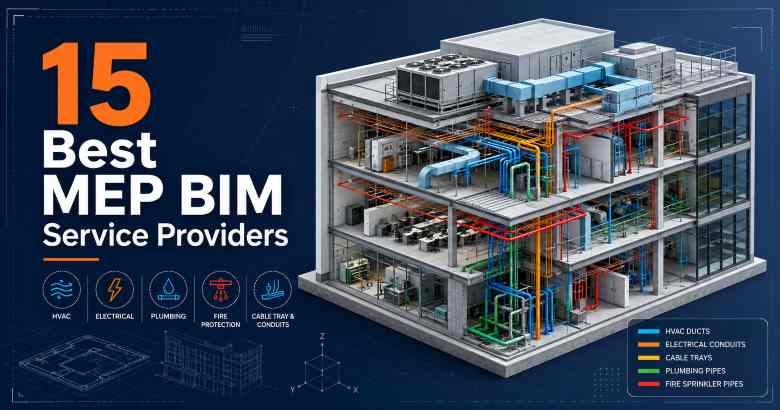
Choosing the right MEP BIM service provider can determine whether a construction project stays on schedule, within budget, and free of costly coordination errors. As mechanical, electrical, and plumbing systems grow increasingly complex across commercial buildings, data centers, hospitals, and mixed-use developments, AEC firms need partners who deliver more than just 3D models. The best providers combine technical precision with field-aware coordination, clash-free deliverables, and prefabrication-ready outputs.
ConstructionCareerHub App is LIVE — built ONLY for construction careers. Don’t apply with a weak resume.
Get ATS-ready Resume Lab + Interview Copilot + Campus Placement Prep (resume screening, skill gaps, interview readiness) — in minutes & Other advanced features.
Explore Smarter Construction Career Tools →Quick check. Big impact. Start now.
This guide evaluates the best MEP BIM service providers for 2026. It covers what these companies do, how they differ, which project types each serves best, and what to look for before signing a contract. Whether you are a general contractor evaluating BIM outsourcing for the first time or an MEP subcontractor upgrading your coordination workflows, this resource helps you make an informed decision.
For a broader understanding of BIM technology and its role in AEC workflows, start with our complete guide to BIM in civil engineering.
🚀 Working in MEP BIM or digital construction? Get your resume ATS-ready with ConstructionCareerHub.com — use Resume Lab, Interview Copilot, and Career Planner tools built exclusively for construction professionals.
Table of Contents
Quick Answer: Best MEP BIM Service Providers in 2026
MEP BIM service providers are specialized firms that create, coordinate, and manage 3D digital models of mechanical, electrical, plumbing, and fire protection systems for construction projects. They use tools like Autodesk Revit, Navisworks, and AutoCAD MEP to deliver clash-free coordination, shop drawings, fabrication-ready models, and quantity takeoffs.
Best overall MEP BIM provider: Pinnacle Infotech — with 5,200+ employees, 18,000+ projects across 47 countries, and 30+ years of MEP BIM experience across six continents.
Best for enterprise contractors: AECOM — a global infrastructure powerhouse with integrated MEP BIM capabilities across aviation, transportation, healthcare, and commercial sectors.
Best for outsourced MEP modeling: Hitech CADD Services — 1,200+ employees with 30+ dedicated MEP BIM experts and 300+ completed BIM projects serving clients in 51+ countries.
Best for MEP-heavy coordination: Eracore — execution-focused BIM partner specializing in electrical-heavy and mission-critical environments like data centers, healthcare, and airports.
Best for scan-to-BIM and retrofit projects: TrueCADD — with 200+ professionals, 5,000+ clients in 50+ countries, and deep expertise in point cloud to BIM conversion.
What Are MEP BIM Services?
MEP BIM services involve creating intelligent 3D models of a building’s mechanical (HVAC, ventilation), electrical (power distribution, lighting), and plumbing (water supply, drainage, fire protection) systems using BIM software platforms. Unlike traditional 2D drafting, MEP BIM modeling produces data-rich models where every component — from ductwork and conduits to piping routes — carries parametric information including dimensions, materials, performance specifications, and installation sequences.
The core services offered by MEP BIM providers include:
- 3D MEP Modeling: Creating detailed Revit models for HVAC, electrical, plumbing, and fire protection systems at LOD 100 through LOD 500
- MEP Coordination and Clash Detection: Integrating MEP models with architectural and structural models using Navisworks to identify and resolve spatial conflicts before construction
- Shop Drawing Production: Generating fabrication-ready drawings, spool drawings, and sleeve/penetration layouts from coordinated BIM models
- Quantity Takeoff and Cost Estimation: Extracting material quantities, component schedules, and cost data directly from the BIM model for procurement planning
- Prefabrication Modeling: Developing models optimized for off-site fabrication, reducing field installation time and waste
- 4D Scheduling and 5D Cost Integration: Linking MEP models to construction schedules and cost databases for time- and budget-linked project visualization
- As-Built Documentation: Creating accurate post-construction models for facility management, operations, and digital twin applications
- Scan-to-BIM: Converting 3D laser scan or point cloud data into accurate Revit models for renovation and retrofit projects
According to industry data, BIM-based clash detection reduces design errors by over 70% and saves an estimated 30% of project time. One documented case study showed that for a $200,000 VDC labor investment, a project achieved $2.22 million in rework savings and $542,000 in schedule savings, delivering a 10x return on investment. Read more about these outcomes in our detailed analysis of MEP coordination challenges and solutions.
Why MEP BIM Services Matter in 2026
Several factors make MEP BIM services more critical in 2026 than at any previous point in the industry’s history.
Government BIM mandates are expanding globally. Countries including the UK, Singapore, Malaysia, Germany, and several EU nations now require BIM for public construction projects. In the Middle East, the UAE, Saudi Arabia, and Qatar have mandated BIM for major public works, creating sustained demand that far exceeds local supply. These mandates apply directly to MEP systems, which represent 40–60% of a commercial building’s total construction cost.
Project complexity is increasing. Data centers, hospitals, semiconductor fabrication plants, and smart buildings require MEP systems that are exponentially more complex than traditional office buildings. A single data center floor can have more MEP routing per square meter than an entire mid-rise office building. Without BIM coordination, the risk of field clashes, rework, and schedule overruns multiplies.
Prefabrication is becoming standard. Approximately 35% of construction projects now use modular or prefabricated MEP systems. BIM-based prefabrication modeling reduces field installation time, improves build precision, and requires fabrication-ready LOD 400 models — a deliverable that most in-house teams cannot produce without specialized expertise.
The global BIM market is growing rapidly. The BIM market is projected to reach $15.42 billion by 2030, growing at 11.3% CAGR. This growth directly increases demand for specialized MEP BIM services. For a deeper exploration of this market trajectory and the software tools driving it, see our guide to the 20 best BIM software platforms in 2026.
For professionals building careers in this space, understanding MEP BIM is no longer optional. Our MEP engineer career guide covers the skills, certifications, and career progression paths that align with these industry shifts.
MEP BIM Service Providers: Comparison Table
| Provider | Best For | Team Size | Key MEP Services | Global Reach | Pricing Model |
|---|---|---|---|---|---|
| Pinnacle Infotech | Large-scale MEP outsourcing | 5,200+ | Full MEP BIM, coordination, prefab modeling | 47+ countries | Project-based / quote |
| AECOM | Enterprise infrastructure projects | 50,000+ (firm-wide) | MEP design, BIM coordination, 4D scheduling | 150+ countries | Contract / retainer |
| Hitech CADD Services | Cost-effective MEP modeling | 1,200+ | MEP modeling, clash detection, spatial coordination | 51+ countries | Project-based / hourly |
| Eracore | Electrical-heavy MEP coordination | Specialist team | MEP coordination, prefab-ready models, redline-free workflows | USA, global | Project-based / quote |
| TrueCADD | Scan-to-BIM and retrofits | 200+ | Point cloud to BIM, MEP modeling, 3D coordination | 50+ countries | Project-based / hourly |
| Tesla Outsourcing Services | MEP coordination with BIM compliance | Large team | MEP coordination, BIM consulting, Revit modeling | USA, UK, Europe, Australia, Canada | Project-based / quote |
| Diasphere | Mid-size MEP BIM projects | Growing (50%+ growth) | BIM modeling, coordination, HVAC, plumbing | USA, Middle East | Project-based |
| UniquesCADD | MEP + CAD combined services | Specialist team | MEP BIM, CAD drafting, shop drawings, scan-to-BIM | USA, Europe, global | Project-based / hourly |
| WSP Global | Multidisciplinary engineering with MEP | 70,000+ (firm-wide) | MEP engineering, digital twin, BIM coordination | 40+ countries | Contract / retainer |
| Turner Construction (VDC/BIM) | Large-scale commercial projects | 10,000+ (firm-wide) | BIM coordination, digital twin integration, VDC | North America, global | Integrated with GC services |
| Stantec | BIM consulting and implementation | 30,000+ (firm-wide) | BIM standards, CDE, training, MEP design | North America, Europe, Middle East | Consulting / project-based |
| Gensler | Design-led MEP BIM integration | 6,000+ (firm-wide) | MEP BIM modeling, energy optimization, sustainability | 50+ offices globally | Project-based |
| BuiltInBIM | USA MEP coordination specialist | Specialist team | MEP coordination, clash detection, Revit modeling | USA | Project-based |
| MEPBIM | Dedicated MEPF BIM services | Specialist team | Revit MEP, clash detection, shop drawings, LOD-based models | Global | Project-based / quote |
| Optimar Precon | BIM modeling for US/UK contractors | Specialist team | BIM modeling, MEP coordination, takeoff and estimation | India, USA, UK | Project-based / hourly |
Detailed Review: Best MEP BIM Service Providers
1. Pinnacle Infotech
Best for: Large-scale MEP BIM outsourcing across commercial, healthcare, hospitality, and industrial projects
Pinnacle Infotech is one of the largest dedicated BIM service providers globally, with over 5,200 employees across 15 global delivery centers. The company has executed more than 18,000 projects across 47 countries over 30+ years, making it one of the most experienced firms in the MEP BIM outsourcing space. Pinnacle’s MEP division has delivered 1,700+ MEP BIM design projects across six continents.
Pinnacle integrates advanced design tools such as Dialux, Elite, Pipenet, and ETAP alongside standard platforms like Revit and Navisworks. This enables faster design iterations and cost savings for clients. Their services span the full MEP BIM spectrum from 3D modeling to 7D (facility management), covering HVAC design, electrical systems, plumbing, and fire protection.
Key MEP services: MEP BIM modeling (LOD 100–500), 3D MEP coordination, clash detection, shop drawings, spool drawings, prefabrication modeling, 4D/5D BIM, energy modeling, as-built documentation
Pros: Massive scale and resource depth; proven track record on complex projects including Dubai Airport Terminal 3, Delhi Metro, and Msheireb Downtown Doha; cost-effective offshore delivery; quick team ramp-up capability
Considerations: Best suited for medium to large projects; smaller firms may find the engagement process tailored toward enterprise-level workflows
Pricing: Quote-based, typically project-specific after scope analysis
Ideal for: General contractors, MEP contractors, engineering consultancies, and developers with large or complex project pipelines
Website: pinnacleinfotech.com
2. AECOM
Best for: Enterprise-level infrastructure and building projects requiring integrated MEP BIM capabilities
AECOM is a global infrastructure consulting firm with deep MEP BIM capabilities integrated into its design and engineering services. Their teams use BIM 360, Navisworks, and advanced 4D scheduling to coordinate every building system from HVAC to electrical, plumbing, and fire protection. AECOM’s MEP BIM work is embedded within its broader project delivery, giving clients a single-source solution for design, coordination, and construction management.
Key MEP services: MEP design with BIM, multidisciplinary coordination, 4D construction simulation, clash detection, sustainability modeling, energy analysis
Pros: Global presence with local expertise; breadth across aviation, transport, healthcare, commercial, and public buildings; strong integration with US codes and international standards
Considerations: Premium pricing compared to specialist outsourcing firms; MEP BIM is part of their broader service offering rather than a standalone product
Pricing: Contract-based, typically as part of larger design or engineering engagements
Ideal for: Government agencies, large developers, and institutional clients requiring integrated A/E services with MEP BIM
Website: aecom.com
3. Hitech CADD Services
Best for: Cost-effective MEP BIM modeling and coordination for global AEC firms
Hitech CADD Services is an Ahmedabad-based BIM and CAD outsourcing provider operational since 1992. With a team of 1,200+ employees and 30+ dedicated MEP BIM experts, the company has completed 300+ BIM projects for clients in 51+ countries. Their offices in New York, Santa Clara, and London support global client engagement while maintaining competitive pricing through Indian delivery operations.
Hitech CADD specializes in converting 2D drawings to error-free 3D models, clash detection, and spatial MEP coordination. Their client base includes Fortune 500 companies and SMEs across the engineering and manufacturing sectors. For AEC firms evaluating BIM companies in India, Hitech CADD consistently ranks among the top providers.
Key MEP services: MEP BIM modeling, clash detection, spatial coordination, 2D to 3D conversion, HVAC modeling, plumbing design, fire protection
Pros: Established track record since 1992; competitive pricing; broad service range covering architectural, structural, and MEP BIM; global client presence
Considerations: Primarily an outsourcing model; firms requiring dedicated on-site BIM coordinators may need supplementary arrangements
Pricing: Project-based and hourly rates available; competitive offshore pricing
Ideal for: Mid-size contractors, MEP subcontractors, and engineering firms looking for reliable offshore MEP BIM partners
Website: hitechcaddservices.com
4. Eracore
Best for: Electrical-heavy and mission-critical MEP BIM coordination
Eracore is a specialist BIM partner focusing on electrical and MEP coordination. Their team of electrical engineers brings field-first expertise to projects, delivering clash detection services, MEP BIM (electrical, mechanical, and plumbing), and BIM implementation services. They are recognized for redline-free workflows, real-time support during coordination meetings, and constructible models that are prefabrication-ready.
What distinguishes Eracore from broader BIM firms is their specialization in electrical-heavy and mission-critical environments, including data centers, healthcare facilities, airports, and manufacturing plants. Their models are developed with field sequencing in mind, not just geometry alignment — a critical factor for trades that must install systems in specific sequences. To understand the growing demand for this specialization, see our guide on data center construction jobs.
Key MEP services: MEP BIM coordination, electrical BIM, mechanical BIM, plumbing BIM, clash detection, prefab-ready deliverables, BIM implementation
Pros: Deep electrical engineering expertise; constructability-focused models; supports real-time coordination meetings; strong in data centers and healthcare
Considerations: Focused primarily on coordination and execution rather than full-spectrum design services
Pricing: Quote-based per project
Ideal for: Electrical contractors, MEP subcontractors, and general contractors handling complex, high-density MEP projects
Website: eracore.com
5. TrueCADD
Best for: Scan-to-BIM and point cloud to BIM for renovation and retrofit projects
TrueCADD has built a strong reputation in scan-to-BIM and point cloud to BIM conversion. The company operates from Ahmedabad, India, with a global presence through offices in the US and UK. With 200+ professionals including 30+ Revit MEP Certified Professionals, TrueCADD has served more than 5,000 clients across 50+ countries and completed 3,000+ projects.
Their scan-to-BIM capability makes them a practical choice for renovation and retrofit contractors who need to work from existing conditions documentation rather than new-build design intent. They specialize in converting 3D laser scan data into accurate Revit models covering architectural, structural, and MEP components.
Key MEP services: Scan-to-BIM, point cloud to Revit, MEP BIM modeling, LIDAR processing, 2D floor plan extraction from scanned data, as-built documentation
Pros: Industry-leading scan-to-BIM expertise; large team of certified Revit professionals; broad global client base; strong portfolio in retrofit projects
Considerations: Primary strength is in scan-to-BIM and modeling rather than real-time coordination or on-site support
Pricing: Project-based and hourly rates available
Ideal for: Renovation contractors, facility managers, and AEC firms working on retrofit, adaptive reuse, or existing conditions documentation
Website: truecadd.com
6. Tesla Outsourcing Services
Best for: Comprehensive MEP coordination services aligned with BIM compliance standards
Tesla Outsourcing Services has 17+ years of global experience delivering MEP coordination services. They are trusted by 600+ leading architectural and engineering companies in the USA, UK, Europe, Australia, and Canada. Their services are fully aligned with international BIM compliance standards, including ISO 19650, the international benchmark for digital construction and asset information management.
Key MEP services: MEP BIM coordination, Revit modeling, Navisworks clash detection, BIM coordination consultation, multidisciplinary coordination
Pros: Strong ISO 19650 alignment; trusted by 600+ companies; comprehensive multi-discipline coordination experience; strong US market presence
Considerations: Primarily a coordination services provider; design engineering is not a core offering
Pricing: Quote-based per project
Ideal for: Engineering firms and contractors requiring standards-compliant MEP coordination
Website: teslaoutsourcingservices.com
7. Diasphere
Best for: Mid-size MEP BIM projects with HVAC and plumbing specialization
Diasphere is a growing MEP BIM service provider that has achieved 28+ satisfied clients and 100+ successful projects covering 100 million sq. ft of space. The company registered a 50% increase in employee count within two years, reflecting strong demand for their services. Their services span BIM modeling, BIM coordination, HVAC, and plumbing, with a comprehensive approach to MEP engineering solutions.
Key MEP services: BIM modeling, BIM coordination, HVAC design, plumbing BIM, MEP coordination
Pros: Rapid growth trajectory; strong HVAC and plumbing specialization; project scale of 100M+ sq. ft demonstrates proven capacity
Considerations: Smaller team compared to industry leaders; best suited for mid-size projects
Pricing: Project-based, contact for quote
Ideal for: Mid-size contractors and MEP subcontractors focused on commercial and residential projects
Website: diasphere.com
8. UniquesCADD
Best for: Combined MEP BIM modeling and CAD drafting services
UniquesCADD is an MEP BIM modeling and CAD outsourcing company with dual expertise in BIM and CAD disciplines. Their shop drawing services are particularly useful for MEP subcontractors who require fabrication-related drawings alongside coordination models. This dual skill set makes UniquesCADD suitable for contractors seeking consistent services across both BIM and CAD workflows.
Key MEP services: MEP BIM modeling, CAD drafting, clash detection, shop drawings, scan-to-BIM, coordination services
Pros: Dual BIM and CAD capability under one roof; strong shop drawing services for fabrication; competitive offshore pricing
Considerations: Smaller scale compared to firms like Pinnacle or Hitech CADD; may need to assess capacity for very large projects
Pricing: Project-based and hourly
Ideal for: MEP subcontractors needing both BIM models and CAD-based fabrication drawings
Website: uniquescadd.com
9. WSP Global
Best for: Multidisciplinary engineering with integrated MEP BIM and digital twin capabilities
WSP Global is one of the world’s largest engineering consultancies with 70,000+ employees across 40+ countries. Their MEP BIM capabilities are integrated within their broader engineering services, with particular strength in digital twin development and smart building systems. WSP’s seven-year strategic alliance with Microsoft, valued at over $1 billion, specifically targets data center and mission-critical facility engineering using digital twin technology.
For a broader view of how multidisciplinary firms like WSP are shaping the construction industry, explore our top construction companies in the world guide.
Key MEP services: MEP engineering design, BIM coordination, digital twin development, energy modeling, sustainability consulting, smart building integration
Pros: Massive global footprint; Microsoft digital twin alliance; deep engineering expertise across all MEP disciplines; strong in sustainability and smart buildings
Considerations: Premium pricing; MEP BIM is part of broader engineering engagements; may not be cost-effective for standalone BIM modeling needs
Pricing: Contract and retainer-based
Ideal for: Large owners, developers, and institutional clients requiring comprehensive engineering services with embedded BIM
Website: wsp.com
10. Turner Construction (VDC/BIM Division)
Best for: In-house BIM coordination for large-scale commercial and mission-critical projects
Turner Construction is one of the largest construction companies in the world, with an in-house VDC/BIM division that serves large-scale commercial and mission-critical projects. They are recognized for their BIM coordination services and integration of digital twins, assisting owners in smooth conversion from design to operations.
Key MEP services: BIM coordination, digital twin integration, VDC, trade-by-trade MEP coordination, 4D scheduling
Pros: Field-tested BIM workflows; direct connection between BIM models and field execution; strong on commercial and healthcare projects
Considerations: BIM services are typically integrated with Turner’s construction management services rather than offered as standalone outsourcing
Pricing: Integrated with GC contract
Ideal for: Project owners and developers engaging Turner as general contractor who want integrated VDC/BIM capabilities
Website: turnerconstruction.com
11. Stantec
Best for: BIM consulting, standards development, and Common Data Environment implementation
Stantec’s BIM consulting group provides BIM implementation services including project-specific standards creation, Common Data Environment (CDE) establishment, and project team training. They are an effective option for organizations that need a structured set of rules for managing digital assets across project lifecycles.
Key MEP services: BIM implementation consulting, MEP design, CDE setup, BIM standards development, project team training, digital asset management
Pros: Strong consulting and standards capability; effective for firms implementing BIM for the first time; long-term digital asset management perspective
Considerations: Primarily a consulting and engineering firm; not positioned as a high-volume modeling outsourcing provider
Pricing: Consulting engagement-based
Ideal for: Organizations implementing BIM standards, setting up CDEs, or training teams on MEP BIM workflows
Website: stantec.com
12. Gensler
Best for: Design-led MEP BIM integration with emphasis on sustainability and occupant comfort
Gensler is a global design and architecture leader that uses BIM not just for modeling, but to enhance aesthetics, occupant comfort, and overall building functionality. Their MEP BIM modeling prioritizes energy efficiency, indoor air quality, and adaptability. Their portfolio spans airports, offices, healthcare, and retail spaces, with LEED Platinum and WELL Building certified projects demonstrating their commitment to sustainable, high-performance MEP systems.
Key MEP services: MEP BIM modeling, energy efficiency optimization, indoor air quality modeling, sustainable building design, Revit MEP integration
Pros: World-class design integration; strong sustainability credentials; excellent for projects where MEP performance directly affects occupant experience
Considerations: Design-focused rather than construction-focused; not a traditional outsourcing provider for standalone MEP modeling
Pricing: Project-based, as part of design engagement
Ideal for: Developers and owners seeking design-led MEP BIM that prioritizes building performance and sustainability
Website: gensler.com
13. BuiltInBIM
Best for: USA-focused MEP coordination with advanced clash detection
BuiltInBIM is a specialist BIM service provider focused on detailed MEP coordination for the US market. Using tools like Revit, Navisworks, and AutoCAD, they deliver precise, clash-free models that facilitate seamless construction collaboration. Their advanced tools detect and resolve potential conflicts early, preventing costly on-site rework.
Key MEP services: MEP coordination, clash detection, high-fidelity 3D modeling, integration of ducts, pipes, conduits, and structural elements
Pros: Specialist focus on MEP coordination; advanced clash detection capabilities; strong client support and coordination meeting involvement
Considerations: Primarily US-focused; may have limited availability for international projects
Pricing: Project-based, contact for quote
Ideal for: US-based general contractors and MEP subcontractors needing dedicated coordination support
Website: builtinbim.com
14. MEPBIM
Best for: Dedicated MEPF BIM services across building sectors
MEPBIM (mepbim.com) operates as a dedicated MEP BIM services firm delivering Revit MEP modeling, clash detection, coordination, and shop drawings with LOD-based accuracy. They serve diverse sectors including residential, commercial, offices, healthcare, education, and industrial projects. Their models are compatible with Revit, Navisworks, and other BIM platforms for smooth cross-discipline collaboration.
Key MEP services: Revit MEP modeling, clash detection, coordination, shop drawings, LOD-based deliverables, multi-sector coverage
Pros: Pure-play MEPF BIM focus; multi-sector experience; LOD-specific deliverables; platform compatibility across major BIM tools
Considerations: Verify team capacity and delivery timelines for large-scale projects before engagement
Pricing: Quote-based per project
Ideal for: MEP contractors and engineering firms seeking a dedicated MEPF BIM partner
Website: mepbim.com
15. Optimar Precon
Best for: BIM modeling and MEP coordination for US and UK contractors
Optimar Precon is a BIM services company serving contractors in India, the USA, and the UK. Their full suite includes BIM modeling, MEP coordination, clash detection, CAD services, and takeoff/estimation. They are particularly suited for US and European contractors with MEP-heavy commercial projects requiring coordination-intensive BIM modeling.
Key MEP services: BIM modeling, MEP coordination, clash detection, CAD services, takeoff and estimation, HVAC BIM, electrical BIM
Pros: Full BIM service suite including takeoff and estimation; serves both US and UK markets from Indian delivery center; experienced with commercial projects
Considerations: Best suited for commercial building projects; verify experience in specialized sectors like healthcare or data centers
Pricing: Project-based and hourly rates
Ideal for: US and UK contractors seeking a cost-effective MEP BIM and estimation partner
Website: optimarprecon.com
Key Features to Look for in an MEP BIM Service Provider
Not all MEP BIM providers deliver the same value. When evaluating potential partners, AEC firms should assess these critical capabilities:
Software proficiency and tool stack: Confirm that the provider is proficient in Autodesk Revit MEP, Navisworks, AutoCAD, and relevant fabrication tools like Trimble SysQue or Fabrication CADmep. Providers using only outdated tools or a narrow software stack may struggle with interoperability. For a comprehensive view of the software landscape, see our list of top civil engineering software tools.
LOD capabilities: Verify the provider can deliver at the LOD level your project requires. LOD 300 suffices for design coordination, but fabrication-ready deliverables require LOD 400 and as-built models need LOD 500. Ask for sample deliverables at each level.
Standards compliance: In 2026, adherence to ISO 19650 is a baseline expectation for BIM service providers working on international projects. Additionally, providers should demonstrate familiarity with regional BIM mandates and building codes relevant to your project location.
Clash detection and coordination workflow: Ask how the provider manages clash detection — what tools they use, how they categorize clashes (hard, soft, workflow), and how they report and resolve findings. A mature provider will have documented clash resolution workflows and provide structured clash reports with severity rankings.
Sector-specific experience: An MEP BIM provider experienced in data centers will deliver different models than one experienced in residential construction. Verify that the provider has completed projects in your sector. Healthcare, industrial, and mission-critical facilities each have unique MEP coordination challenges.
Communication and time zone alignment: For outsourcing engagements, assess the provider’s communication protocols, response times, and overlap hours. Some providers maintain offices in multiple time zones specifically to support real-time coordination with US, European, or Middle Eastern clients.
Scalability: Can the provider scale their team to meet your project timeline? Large providers like Pinnacle Infotech can rapidly deploy additional resources; smaller specialists may face capacity constraints during peak demand periods.
📘 Want to build BIM skills that employers actually demand? Use the Construction Career Growth Audit on ConstructionCareerHub.com to identify skill gaps, benchmark your BIM competencies, and build a focused career development plan.
How to Choose the Right MEP BIM Service Provider: Step-by-Step
Selecting the right MEP BIM partner is a business decision with direct impact on project delivery, cost control, and field productivity. Follow this structured approach:
Step 1 — Define your BIM requirements clearly. Document the scope: which disciplines (mechanical, electrical, plumbing, fire protection), what LOD, what deliverables (models, clash reports, shop drawings, quantity takeoffs), and what standards apply. A clear scope document prevents misaligned expectations.
Step 2 — Shortlist providers based on sector experience. Match providers to your project type. A hospital project needs a provider experienced with healthcare MEP codes; a data center project needs one familiar with high-density electrical routing. Use this article’s comparison table as a starting point.
Step 3 — Request and evaluate sample deliverables. Ask shortlisted providers for sample Revit models, clash reports, and shop drawings from completed projects. Evaluate model quality, naming conventions, family usage, and coordination maturity.
Step 4 — Assess team qualifications. Verify that the provider’s team includes certified Revit MEP professionals, BIM coordinators, and engineers with relevant construction experience. Ask about certifications, training programs, and quality assurance processes. Our guide on essential skills for BIM professionals outlines the competencies you should expect.
Step 5 — Conduct a pilot project. Before committing to a full engagement, run a small pilot project to test communication, quality, turnaround time, and coordination workflow. This is especially important for outsourcing engagements where time zones and cultural differences can affect collaboration.
Step 6 — Negotiate terms with clear milestones. Define payment terms, milestone deliverables, quality benchmarks, revision limits, and intellectual property ownership in the contract. Establish a clear escalation path for quality issues.
Step 7 — Set up collaboration infrastructure. Establish a Common Data Environment (CDE), model sharing protocols, and communication channels before work begins. Whether using BIM 360, Autodesk Construction Cloud, or another platform, ensure all parties have access and understand the workflow.
If you are evaluating project management platforms to complement your BIM workflows, our best construction management software guide provides an up-to-date comparison.
In-House vs. Outsourced MEP BIM: Which Is Right for You?
The decision between building an in-house MEP BIM team and outsourcing to a service provider depends on your firm’s project volume, budget, and strategic goals.
In-house MEP BIM teams offer direct control over quality, real-time coordination with field teams, and deep project-specific knowledge. However, they require significant investment in hiring, training, software licenses, and hardware. Companies like Turner Construction and DPR Construction have successfully built in-house VDC/BIM divisions that serve as competitive advantages, but this model requires a consistent pipeline of BIM-intensive projects to justify the overhead.
Outsourced MEP BIM offers access to experienced professionals and advanced tools without heavy upfront investment. Offshore providers in India can deliver quality modeling at 40–60% lower cost compared to US rates. This model works well for firms entering BIM for the first time, those with variable project loads, or companies needing specialized expertise (like scan-to-BIM) for specific projects.
The hybrid model is increasingly common among mid-size and large contractors. Keep core BIM coordinators in-house to manage standards, attend coordination meetings, and maintain client relationships, while outsourcing modeling, detailing, and quantity takeoff work to offshore partners. This combines cost efficiency with quality control.
Professionals evaluating how to position themselves within these models should review our guide to becoming a BIM designer and BIM career opportunities for engineers and architects.
MEP BIM Implementation Checklist for Construction Firms
Whether you are implementing MEP BIM in-house or through an outsourcing partner, use this checklist to ensure a successful rollout:
- Define BIM Execution Plan (BEP) covering scope, responsibilities, standards, and deliverables
- Establish LOD requirements for each project phase (design, coordination, fabrication, as-built)
- Select and configure software stack (Revit MEP, Navisworks, CDE platform)
- Set up Common Data Environment with folder structure, naming conventions, and access controls
- Define clash detection rules, severity categories, and resolution workflows
- Assign roles: BIM Manager, BIM Coordinator, MEP Modelers, QA/QC reviewer
- Create model templates with standard families, view templates, and sheet layouts
- Establish coordination meeting schedule (typically weekly or bi-weekly)
- Define model exchange protocols and file naming standards
- Set quality benchmarks for model accuracy, completeness, and coordination status
- Plan training for team members on BIM tools and coordination workflows
- Document handover requirements for facility management and operations
For professionals preparing for BIM roles, our 100+ BIM interview questions and answers resource covers exactly the technical and workflow knowledge that employers expect.
Common Mistakes When Selecting MEP BIM Service Providers
Construction firms frequently make these errors when choosing MEP BIM partners:
Choosing on price alone. The lowest quote often delivers the lowest quality. A BIM model that requires extensive rework or creates field coordination problems costs far more than the savings on the modeling fee. Evaluate providers on quality, experience, and reliability first.
Not verifying sector experience. A provider excellent at residential MEP modeling may struggle with healthcare or data center projects. Always verify that the provider has completed projects in your specific sector.
Ignoring communication and time zone factors. A provider with a 12-hour time zone difference and poor communication protocols can create bottlenecks that delay coordination milestones. Confirm overlap hours, response time expectations, and escalation procedures before engagement.
Skipping the pilot project. Jumping directly into a full engagement without testing the provider’s capabilities through a small pilot project is a common and costly mistake. A pilot reveals quality standards, turnaround times, and communication patterns that portfolio reviews alone cannot.
Not defining deliverables clearly. Vague scope definitions lead to mismatched expectations. Specify exactly what LOD, what file formats, what coordination reports, and what shop drawing standards you require. Include sample deliverables from previous projects as benchmarks.
Overlooking quality assurance processes. Ask providers about their internal QA/QC procedures. Mature providers run models through systematic checks before delivery, including clash audits, model health checks, and parameter validation.
Best MEP BIM Providers by Company Size
Best for Small Contractors
Small contractors entering BIM should prioritize providers with flexible pricing, small-project capability, and willingness to scale. Optimar Precon and UniquesCADD are strong choices — both offer hourly and project-based pricing that accommodates smaller scopes without requiring enterprise-level commitments. For a full list of BIM companies suited to different firm sizes, see our best BIM companies in the USA.
Best for Mid-Size Contractors
Mid-size contractors typically need reliable outsourcing with some customization. Hitech CADD Services, TrueCADD, and Diasphere offer the right balance of scale, specialization, and pricing. These providers can handle multiple simultaneous projects without the premium pricing of large engineering firms.
Best for Enterprise General Contractors
Enterprise firms with large portfolios should consider Pinnacle Infotech for high-volume outsourcing, AECOM or WSP Global for integrated engineering+BIM services, or build in-house teams modeled after Turner Construction’s VDC/BIM division. At this scale, hybrid models combining in-house coordinators with outsourced modeling deliver the best results.
Future of MEP BIM Services: 2026 and Beyond
Several technology and market trends are reshaping MEP BIM services:
AI-powered clash detection and model generation. AI tools are beginning to automate routine modeling tasks and improve clash detection accuracy. Providers that integrate AI into their workflows — for automated routing, rule-based clash resolution, and predictive design suggestions — will deliver faster, higher-quality results. To explore how AI is impacting construction workflows broadly, see our resource on technology trends in construction management.
Digital twins and facility management integration. MEP BIM models are increasingly becoming the foundation for digital twins — virtual replicas of buildings used for ongoing performance monitoring, predictive maintenance, and lifecycle management. Providers that deliver LOD 500 as-built models with COBie data are positioning themselves at the center of this trend.
Prefabrication-first modeling. As modular and off-site construction accelerates, MEP BIM providers are shifting toward fabrication-optimized models. This means designing spool drawings, sleeve layouts, and prefab-ready assemblies directly from the coordination model, reducing field installation time.
Cloud-native collaboration. The shift to cloud-based BIM platforms (Autodesk Construction Cloud, Trimble Connect, Bentley iTwin) is enabling real-time collaboration between distributed teams. Providers that operate natively on cloud platforms can support concurrent work streams across time zones without file-exchange bottlenecks.
Sustainability-focused MEP design. With growing emphasis on net-zero buildings and green building certifications (LEED, BREEAM, WELL), MEP BIM providers are incorporating energy analysis, daylight simulation, and carbon footprint assessment into their modeling workflows. This aligns MEP BIM with the broader sustainability mandates in construction.
Building competency in construction technology skills is critical for staying relevant in this landscape. Learn more about high-growth roles through our guides on digital construction careers without coding and how BIM is becoming a career multiplier.
Career Relevance: MEP BIM for Construction Professionals
The growth of MEP BIM services creates direct career opportunities for MEP engineers, BIM coordinators, BIM managers, VDC engineers, construction technologists, and project managers. Understanding the MEP BIM services landscape helps professionals position themselves strategically whether they work for providers, contractors, or consultancies.
To master the construction software skills that employers actually demand, professionals should build proficiency in Revit MEP, Navisworks, and at least one CDE platform. Certifications like Autodesk Certified Professional in Revit MEP and BIM Management certifications strengthen candidacy.
If you are exploring construction technology career paths, our comprehensive guide on careers in construction technology integration maps the full spectrum of opportunities. For deeper understanding of MEP roles, see our MEP engineer roles and responsibilities overview and the complete MEP engineering guide.
If you are looking to build structured knowledge in BIM and construction management, consider the Construction Project Management course on Coursera for foundational project delivery skills, the Construction Management program on edX for university-backed professional development, or the BIM Revit MEP course on Udemy for hands-on MEP BIM modeling skills. For those focused on project controls, the Construction Management Specialization on Coursera covers scheduling, cost control, and procurement — all foundational for managing MEP BIM workflows effectively.
For targeted career development resources, explore the Construction Job Blueprint ebook for step-by-step career planning, the Construction Interview Guide for technical and HR interview preparation, the Complete Career Bundle for comprehensive support, and the Remote Construction Jobs Guide for professionals exploring location-independent roles in BIM, VDC, and digital construction.
🎯 Ready to advance your MEP BIM career? ConstructionCareerHub.com gives you ATS-ready Resume Lab, Interview Copilot, and Campus Placement Prep — all designed exclusively for construction professionals. Start your free career assessment today.
Final Recommendation
The best MEP BIM service provider for your firm depends on your project type, budget, and strategic goals. For high-volume outsourcing with proven global delivery, Pinnacle Infotech leads the field. For enterprise-level integrated engineering and BIM, AECOM and WSP Global offer comprehensive capabilities. For cost-effective offshore modeling, Hitech CADD Services and TrueCADD deliver strong value. For mission-critical MEP coordination, Eracore brings field-first expertise that standalone modeling providers cannot match.
Before selecting a provider, invest time in defining your BIM requirements, evaluating sample deliverables, and running a pilot project. The right MEP BIM partner does not just produce models — they reduce rework, accelerate construction, and improve long-term building performance. Explore our related guides on top MEP consultants in India and the best BIM companies in Bangalore for additional options.
For professionals navigating this landscape — whether you are hiring MEP BIM talent or building your own skills — staying current with BIM technology, industry mandates, and software tools is essential. The construction industry’s digital transformation makes MEP BIM competency a competitive requirement, not an optional advantage. As our construction project management software overview demonstrates, the entire ecosystem is moving toward integrated, model-based workflows.
Frequently Asked Questions (FAQ)
What is an MEP BIM service provider?
An MEP BIM service provider is a company that creates detailed 3D digital models of mechanical, electrical, and plumbing systems using Building Information Modeling software like Autodesk Revit and Navisworks. These providers handle MEP coordination, clash detection, shop drawing production, quantity takeoffs, and prefabrication modeling for construction projects.
How much do MEP BIM services cost?
MEP BIM service pricing varies by project scope, LOD, and provider location. Offshore providers in India typically charge $15–$45 per hour, while US and UK-based firms charge $75–$200 per hour. Most providers offer project-based quotes after evaluating scope and complexity. Complex projects requiring LOD 400–500 and prefabrication-ready deliverables cost more than basic modeling.
What is the difference between MEP BIM modeling and MEP coordination?
MEP BIM modeling is the process of creating 3D digital models of HVAC, electrical, plumbing, and fire protection systems. MEP coordination goes further by integrating these models with architectural and structural models, running clash detection to identify spatial conflicts, and resolving those clashes before construction begins. Coordination is a collaborative, multi-discipline activity that requires both technical skill and construction knowledge.
Which software do MEP BIM service providers use?
The most commonly used software includes Autodesk Revit MEP for 3D modeling, Navisworks for clash detection, AutoCAD MEP for drafting, BIM 360 or Autodesk Construction Cloud for collaboration, Trimble SysQue for fabrication, and MagiCAD for MEP design automation. Some providers also use Bentley OpenBuildings Designer. For a comprehensive overview, read our BIM software comparison guide.
Should I outsource MEP BIM services or build an in-house team?
Outsourcing is cost-effective for firms without large project pipelines or those new to BIM. In-house teams suit large contractors with consistent BIM workloads. Many firms use a hybrid model — keeping core BIM coordinators in-house while outsourcing modeling and detailing to offshore partners. The right model depends on your project volume, budget, and coordination needs.
What LOD levels do MEP BIM providers typically deliver?
Providers deliver models at LOD 100–200 (conceptual), LOD 300 (design development), LOD 350 (coordination), LOD 400 (fabrication-ready), and LOD 500 (as-built). The required LOD depends on your project phase and deliverable needs. Fabrication-ready models at LOD 400 require more effort and cost than design-phase models at LOD 300.
What should I look for when selecting an MEP BIM service provider?
Key factors include software proficiency (Revit, Navisworks), sector-specific experience, LOD capabilities, standards compliance (ISO 19650), team qualifications and certifications, clash detection workflows, communication protocols, scalability, and transparent pricing. Always request sample deliverables and run a pilot project before full engagement.
Can MEP BIM service providers help with prefabrication?
Yes. Many MEP BIM providers offer prefabrication-ready modeling including spool drawings, sleeve and penetration layouts, and fabrication-optimized assemblies. Providers like Pinnacle Infotech and Eracore specialize in constructability-focused models developed with field sequencing in mind. Prefabrication modeling typically requires LOD 400 deliverables.
