

Last Updated on June 23, 2026 by Admin
Digital twin technology has shifted from experimental pilot projects into enterprise procurement requirements across construction and facility management. The global digital twin market is projected to grow from approximately $29–36 billion in 2025 to between $150–170 billion by 2030, with construction and infrastructure ranking among the fastest-growing adoption sectors. For AEC teams, choosing the right digital twin platform in 2026 means matching software capabilities to the specific project phase — design, construction, or operations — and the asset type — vertical buildings or horizontal infrastructure.
ConstructionCareerHub App is LIVE — built ONLY for construction careers. Don’t apply with a weak resume.
Get ATS-ready Resume Lab + Interview Copilot + Campus Placement Prep (resume screening, skill gaps, interview readiness) — in minutes & Other advanced features.
Explore Smarter Construction Career Tools →Quick check. Big impact. Start now.
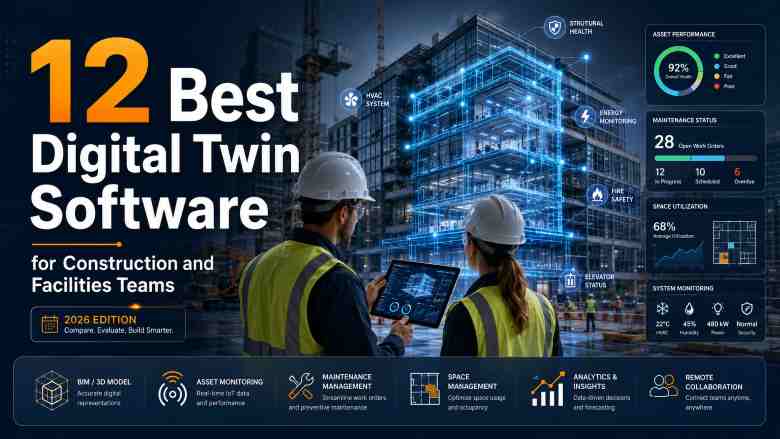
This buyer’s guide compares the 12 best digital twin software platforms for construction and facilities teams, organised by use case and project lifecycle stage. Whether you are a BIM manager evaluating handover workflows, a facility owner seeking operational intelligence, or an infrastructure engineer managing a transport or utility network, this comparison will help you identify the platform that fits your asset type, integration requirements, and budget.
If you are new to digital twin concepts in construction, start with our comprehensive guide on digital twins in construction project management before evaluating specific platforms.
Table of Contents
What Is Digital Twin Software in Construction?
Digital twin software creates a real-time, data-rich virtual replica of a physical building, infrastructure asset, or construction site. Unlike a static BIM model that represents design intent, a digital twin continuously ingests IoT sensor feeds, building management system (BMS) data, and environmental information to mirror the asset’s actual current state.
The distinction is straightforward: a BIM model answers “what does the building look like and how is it designed?” while a digital twin answers “how is the building performing right now, and what is likely to happen next?” This difference becomes commercially significant during the operations phase, where buildings spend 80% of their total lifecycle cost. According to a 2026 market analysis, property owners using digital twins are reducing energy consumption by up to 50% and operating costs by up to 35%.
In the context of construction data analytics, digital twins represent the convergence of BIM, IoT, cloud computing, and artificial intelligence — creating a single platform where design data, sensor data, and operational data are unified for decision-making across the entire asset lifecycle.
How Digital Twins Map to the Construction Lifecycle
Understanding which project phase your team operates in is the single most important factor when selecting a digital twin platform. Each phase has different data requirements, integration needs, and user profiles.
Design Stage: Simulation and Clash-Free Coordination
During design, digital twin capabilities focus on energy simulation, generative design exploration, and multi-disciplinary coordination. Platforms like Autodesk Tandem and Siemens Xcelerator integrate with BIM authoring tools to create data-rich models that carry forward into construction and operations. At this stage, the twin is largely a “descriptive twin” — it mirrors the designed state and enables what-if scenario testing before construction begins. BIM dimensions beyond 3D geometry — including 4D scheduling, 5D cost management, sustainability analysis (6D), and facility management data (7D) — form the foundation of the eventual digital twin.
Construction Stage: Progress Monitoring and Site Intelligence
During construction, the digital twin shifts to reality capture and as-built comparison. Platforms like OpenSpace (360° interior imagery), DroneDeploy (aerial photogrammetry), and Bentley iTwin Capture (point cloud processing) enable teams to compare actual site conditions against design models at regular intervals. This catches deviations early, reduces rework costs, and creates a documented record of every project phase. Construction-stage twins also integrate with construction management platforms and common data environments (CDEs) to ensure that data flows seamlessly from the field into the central project model.
Operations Stage: Performance Optimisation and Predictive Maintenance
The operations phase is where the digital twin delivers its greatest long-term value. Once IoT sensors, BMS feeds, and CMMS data are connected, the twin becomes a living model that tracks energy performance, predicts equipment failures, optimises space utilisation, and supports maintenance planning. Autodesk Tandem, Willow, and AVEVA are the leading platforms for this stage. Facility handover — the moment the construction team transfers the digital twin to the owner/operator — is a critical transition point. Platforms that create a seamless digital thread from design through handover to operations eliminate the data loss that traditionally occurs at project completion. For professionals involved in this transition, our guide on commissioning engineer careers covers the expanding role of digital handover in modern project delivery.
Best Digital Twin Software Platforms Compared: 2026
The platforms below are evaluated on construction and infrastructure relevance, BIM integration depth, IoT connectivity, lifecycle coverage, deployment model, and pricing transparency. Each entry identifies the primary use case, ideal buyer profile, and key limitations.
1. Autodesk Tandem — Best for Building Digital Twins and Facility Handover
Primary use case: Vertical buildings — commercial offices, hospitals, data centres, educational campuses, airports.
Autodesk Tandem has emerged as the leading building-focused digital twin platform for the AEC industry. It leverages Autodesk’s dominance in BIM through Revit to create a digital thread that starts at design and continues through facility operations. In April 2026, Autodesk named Globant as its official Tandem Digital Twin Solution Provider for airports, smart buildings, and logistics facilities — signalling the platform’s maturity for enterprise deployment.
Tandem focuses on “descriptive twins,” giving facility managers deep access to asset data — HVAC maintenance schedules, energy usage history, warranty records, product data sheets — embedded directly in the 3D model. The platform includes AI-driven operational insights for automatic energy efficiency optimisation, bridging the historical disconnect between the construction phase and decades-long operational lifecycle.
Key strengths: Included as an entitlement with BIM Collaborate Pro subscriptions (no separate licence cost); unlimited facilities, tagged assets, and streams; seamless Revit-to-operations handover; template-driven data structuring for repeatable deployments across portfolios; audit trail for all twin modifications.
Limitations: Strongest within the Autodesk ecosystem — teams using non-Autodesk BIM tools face additional data translation steps; time series history limited to 14 days on the base AEC entitlement; currently supports EU and US regional data hosting only (Australia, Canada, UK data residency not yet available). For teams already invested in Autodesk Construction Cloud, Tandem is the natural digital twin extension.
Pricing: Included with BIM Collaborate Pro subscriptions (starting approximately $480/year per user). Enterprise volume discounts available.
2. Bentley Systems iTwin — Best for Infrastructure Digital Twins
Primary use case: Horizontal infrastructure — bridges, highways, rail, water networks, utilities, smart cities, transport systems.
Bentley Systems iTwin is purpose-built for the built environment at infrastructure scale. Unlike building-focused platforms, iTwin bridges CAD, BIM, and GIS data to create a live 4D model that tracks changes over time across geographically distributed assets. In January 2026, Bentley upgraded iTwin to support large-scale smart city and transportation network digital twins with real-time data integration and asset performance monitoring.
The platform’s open-source iTwin.js libraries allow custom development, and its developer API enables deep integration with existing enterprise systems. iTwin Capture creates digital twins from drone imagery and point cloud scans, iTwin IoT connects sensor data from infrastructure assets, and iTwin Experience provides a unified interface for owners and operators to view all data layers — engineering, operations, and IT — through a single pane of glass.
Key strengths: Native IFC support; direct connections to MicroStation, OpenRoads, and OpenBuildings; strongest geospatial context of any AEC twin platform; open-source developer tools; consumption-based pricing scales with portfolio size.
Limitations: Technical setup and learning curve are steeper than building-focused platforms; smaller teams or single-building projects may not need this level of depth; ecosystem is strongest when paired with other Bentley products. For infrastructure career opportunities, see our guide on data centre and infrastructure construction jobs.
Pricing: Consumption-based model tied to data volume, users, and feature modules. Custom enterprise quotes required.
3. Azure Digital Twins (Microsoft) — Best for Scalable Cloud-Native IoT Integration
Primary use case: Large-scale IoT deployments, smart building portfolios, custom-built twin applications for owners and developers.
Microsoft Azure Digital Twins is a platform-as-a-service (PaaS) offering that provides the underlying graph database and modelling layer for custom digital twin applications. In March 2026, Microsoft enhanced the platform with advanced AI-driven simulation capabilities for industrial and infrastructure assets, focusing on real-time predictive modelling and system optimisation.
Unlike turnkey AEC platforms, Azure Digital Twins is a developer-oriented toolkit that enterprises use to build bespoke twin applications tailored to their specific portfolio and operational requirements. It uses the open Digital Twins Definition Language (DTDL) for model schemas and integrates natively with the broader Azure ecosystem (IoT Hub, Stream Analytics, Synapse, Power BI).
Key strengths: Virtually unlimited scalability; enterprise-grade security and compliance; flexible DTDL modelling supports any asset type; pay-per-use pricing keeps pilot costs low; strongest option for organisations with in-house development teams.
Limitations: Not a turnkey solution — requires significant development effort; no native BIM viewer or construction-specific workflows; dependent on system integrators for AEC-specific implementations.
Pricing: Pay-per-operation model: messaging, queries, and model operations each have unit costs. Pilot-scale projects can start under $500/month; enterprise portfolios scale to $10,000+/month.
4. Siemens Xcelerator — Best for Full Product and Asset Lifecycle Management
Primary use case: Manufacturing facilities, complex industrial plants, data centres, and projects requiring closed-loop simulation and operations.
Siemens Xcelerator offers one of the most comprehensive industrial digital twin portfolios available, covering product design, production simulation, and operational performance. Its “Executable Digital Twin” (xDT) technology embeds simulation models directly into edge devices and controllers for real-time, closed-loop optimisation. In March 2025, Siemens acquired Altair Engineering for $10 billion to strengthen its simulation and AI capabilities — the largest acquisition in the digital twin space to date.
Key strengths: End-to-end lifecycle coverage from design simulation to operations; Teamcenter backbone unifies all data; strongest physics-based simulation depth; Siemens Industrial Metaverse partnerships enable immersive collaboration.
Limitations: Primarily optimised for manufacturing and industrial assets rather than traditional construction; significant investment in deployment and training; overkill for simple building FM use cases.
Pricing: Enterprise licensing. Custom quotes based on modules, users, and deployment scale. Expect $100,000+ annually for meaningful deployments.
5. AVEVA Unified Operations — Best for Industrial and Process Facility Assets
Primary use case: Process plants, oil and gas facilities, power generation, water treatment, and heavy industrial construction.
AVEVA (now part of Schneider Electric) provides the strongest digital twin platform for asset-intensive industrial facilities. Its real-time asset performance monitoring and maintenance planning tools are used by teams overseeing complex plants and process infrastructure. The platform tracks the full health, operations, and maintenance history of equipment throughout the asset lifecycle.
Key strengths: Deep industrial process expertise; real-time operational data integration; strong maintenance and reliability engineering workflows; integration with Schneider Electric’s energy management ecosystem.
Limitations: Less suited for traditional building FM or residential/commercial construction; steep learning curve for non-industrial teams.
Pricing: Enterprise licensing with custom pricing. Typically deployed as part of larger Schneider Electric digital transformation engagements.
6. Willow — Best for Real-Estate Portfolio Operations Intelligence
Primary use case: Multi-building real-estate portfolios, commercial property management, campus-level operations.
Willow provides a vendor-neutral digital twin platform focused on connecting BIM data with live building operations data across large real-estate portfolios. Unlike Autodesk Tandem, which is strongest within the Autodesk ecosystem, Willow works across multiple BIM authoring environments and integrates with a wide range of BMS, CMMS, and IoT platforms.
Key strengths: Vendor-neutral BIM ingestion; portfolio-level dashboards; built for commercial real-estate operations; strong occupancy analytics and energy optimisation.
Limitations: Less depth in construction-phase capabilities; best suited for owners/operators rather than contractors; requires robust data from existing building systems.
Pricing: Portfolio-based licensing. Custom quotes based on number of buildings and integrations.
7. OpenSpace — Best for Construction-Phase Visual Progress Tracking
Primary use case: Interior construction progress documentation, as-built verification, quality assurance.
OpenSpace uses 360° site imagery captured by project teams during regular site walks to create visual digital twins of building interiors under construction. Its AI algorithms automatically compare captured conditions against BIM models, generating progress reports and identifying deviations without manual measurement.
Key strengths: Extremely low capture friction (hardhat-mounted cameras during normal site walks); AI-powered progress tracking; integrates with Autodesk Construction Cloud and Procore; visual record of every project phase.
Limitations: Focused on interior visual documentation rather than engineering-grade digital twins; does not provide IoT connectivity or operational-phase capabilities; exports panoramic formats rather than engineering deliverables. For construction technology career context, see top construction technology jobs in 2026.
Pricing: Per-project subscription. Contact for enterprise pricing.
8. Hexagon Smart Digital Reality — Best for Spatial Data and Geospatial Twins
Primary use case: Reality capture, plant lifecycle management, geospatial-heavy infrastructure projects.
Hexagon’s Smart Digital Reality platform converts laser scans, drone imagery, and survey data into intelligent digital twins for industrial plants and infrastructure assets. It excels at creating high-fidelity spatial models that serve as the geometric backbone for asset management.
Key strengths: Industry-leading reality capture processing (Leica scanners); strong plant lifecycle management (Intergraph heritage); excellent spatial data visualisation; integrates with major BIM and GIS platforms.
Limitations: Strongest in industrial and plant environments; spatial/geometric focus may lack operational depth for building FM use cases.
Pricing: Enterprise licensing based on modules and deployment scale. Custom quotes.
9. DroneDeploy — Best for Aerial Site Capture and Earthwork Monitoring
Primary use case: Exterior construction site monitoring, earthwork measurement, aerial progress documentation.
DroneDeploy creates digital twins from drone-captured aerial imagery, producing orthomosaic maps, 3D meshes, and point clouds for construction site monitoring. It is the strongest platform for exterior site twins focused on earthwork tracking, stockpile measurement, and aerial progress comparison.
Key strengths: Pre-built integrations with Autodesk Construction Cloud and Procore; GeoTIFF and LAS export formats; volumetric measurement tools; field-team-friendly mobile app. For teams using AI-powered construction workflows, DroneDeploy’s automated analytics reduce manual survey effort significantly.
Limitations: Exterior/aerial focus — not suited for interior building twins or operational-phase FM; point cloud accuracy varies with flight conditions and processing settings.
Pricing: Subscription-based. Business and Enterprise plans available.
10. NVIDIA Omniverse — Best for Photorealistic Simulation and Cross-Platform Interoperability
Primary use case: Large-scale construction simulation, multi-platform data unification, “Industrial Metaverse” visualisation.
NVIDIA Omniverse acts as a meta-platform that connects other platforms — letting a Siemens factory model, an Autodesk building design, and an Ansys simulation coexist in a single photorealistic virtual world. Built on the Universal Scene Description (OpenUSD) standard, it enables real-time, physically accurate ray tracing powered by NVIDIA’s GPU infrastructure.
Key strengths: Unmatched visual fidelity; cross-platform interoperability via OpenUSD; real-time physics simulation; ideal for stakeholder presentations and design validation on complex megaprojects.
Limitations: Requires significant GPU compute resources; not a standalone construction management tool; best deployed alongside other AEC platforms as a visualisation and simulation layer.
Pricing: Omniverse Enterprise licensing. GPU cloud compute costs additional. Custom pricing.
11. PTC ThingWorx — Best for Real-Time IIoT Connectivity and Edge Analytics
Primary use case: Connected equipment monitoring, industrial facility operations, smart building IoT platforms.
PTC’s ThingWorx specialises in the live data stream, wrapping digital twins around real-time operational metrics from facility equipment and industrial systems. It focuses on connectivity and actionable insights rather than geometric models.
Key strengths: Rapid IIoT application development; strong edge computing capabilities; real-time dashboards; AR-based inspection workflows via Vuforia integration.
Limitations: Not a BIM or construction workflow tool; requires development effort for AEC-specific use cases; strongest in manufacturing/industrial contexts.
Pricing: Subscription licensing based on connected devices and platform features.
12. Matterport — Best for Interior 3D Walkthroughs and Owner Presentations
Primary use case: Interior visualisation, virtual site walkthroughs, owner/stakeholder review, existing building documentation.
Matterport creates immersive 3D walkthroughs from 360° camera captures, making it the simplest platform for documenting existing conditions and presenting spaces to non-technical stakeholders. It is widely used for pre-construction surveys of existing buildings and owner review sessions.
Key strengths: Extremely easy to use; no BIM expertise required; captures can be done with smartphone, LiDAR-equipped iPad, or professional cameras; excellent for tenant/owner presentations.
Limitations: Visual walkthrough focus — does not meet engineering accuracy standards (ASPRS); OBJ exports are geometry-only without parametric data; no IoT connectivity or operational twin capabilities; not suited for engineering analysis.
Pricing: Free plan available. Business plans from $69/month. Enterprise pricing custom.
Platform Selection Guide by Use Case
Rather than choosing software based on brand familiarity, AEC teams get the best results by matching the platform to their specific use case. The table below maps common construction and facilities workflows to the most suitable platforms.
Building design-to-operations handover: Autodesk Tandem is the clear first choice for teams already using Revit and Autodesk Construction Cloud. The seamless data flow from design through construction to facility operations eliminates the handover data loss that costs the industry billions annually.
Infrastructure lifecycle management: Bentley iTwin is purpose-built for bridges, roads, rail, utilities, and smart city programmes. Its geospatial context and GIS integration are unmatched for horizontally distributed assets.
Construction site monitoring (exterior): DroneDeploy for aerial earthwork and progress tracking. OpenSpace for interior walk-through documentation. Combined, they cover most construction-phase reality capture needs.
Large real-estate portfolios: Willow for vendor-neutral, portfolio-level operations intelligence. Autodesk Tandem for Autodesk-ecosystem portfolios.
Industrial/process facilities: AVEVA for oil and gas, power, and process plants. Siemens Xcelerator for manufacturing facilities and semiconductor fabrication plants.
Custom enterprise applications: Azure Digital Twins for organisations with development teams building bespoke twin solutions. NVIDIA Omniverse as a simulation and visualisation layer connecting multiple platforms.
BIM-IoT Integration: The Technical Foundation
The integration between BIM data and IoT sensor feeds is what transforms a static model into a living digital twin. Understanding this integration layer is critical for both platform selection and implementation planning.
At the core, BIM provides the geometric and parametric framework — the “where” and “what” — while IoT provides the real-time operational data — the “how” and “how well.” The integration typically follows a layered architecture: the BIM model defines asset locations and relationships, a common data environment (CDE) manages version control and access, IoT middleware (MQTT, OPC-UA, or REST APIs) routes sensor data, and the digital twin platform unifies everything into a queryable, visualisable model. Research from IoT Analytics reported that connected IoT devices reached 16.6 billion globally in 2023, up from 14.4 billion in 2022 — and this growth is directly driving demand for digital twins capable of processing operational data at scale.
For construction professionals looking to build BIM-IoT skills, our guide on AI skills for construction professionals covers the specific data integration competencies that employers are seeking in 2026. The role of Digital Twin Specialist has emerged as one of the fastest-growing technical positions in the AEC sector.
Infrastructure vs. Building Use Cases
The distinction between infrastructure and building digital twins is not just about scale — it is about fundamentally different data structures, user workflows, and lifecycle patterns.
Building digital twins operate within defined boundaries. The asset has a fixed footprint, clearly identified systems (HVAC, electrical, plumbing, fire protection), and a relatively contained sensor network. Autodesk Tandem, Willow, and Matterport serve this market. Building twins are typically consumed by facility managers, building owners, and property management teams. BIM data from Revit or equivalent platforms provides the primary geometric backbone.
Infrastructure digital twins are geographically distributed, often spanning hundreds of kilometres (highways, rail networks, utility grids). They require tight integration with GIS data, remote sensing, and environmental monitoring. Bentley iTwin and Hexagon serve this market. Infrastructure twins are consumed by asset owners, government agencies, and concession operators. The data sources are more diverse — satellite imagery, LiDAR, ground sensors, weather data, traffic flows — and the asset lifespans are measured in decades to centuries.
Megaprojects in the Gulf and Saudi Arabia increasingly require both building and infrastructure digital twins for smart city developments — creating demand for professionals who understand both paradigms. The emerging role of Operations and Facility Digital-Twin Manager specifically fuses BIM, BMS, IoT, and predictive analytics expertise to optimise lifecycle performance across both asset types.
Key Evaluation Criteria for Enterprise Buyers
When shortlisting digital twin platforms for enterprise procurement, AEC teams should evaluate five critical dimensions beyond basic feature lists.
Data interoperability: Does the platform support IFC, OpenBIM, COBie, and standard IoT protocols? Vendor lock-in is the most common long-term regret in digital twin procurement. Platforms with open APIs, IFC4 support, and standard data exchange formats protect your investment. Review our guide on construction standards and abbreviations for the relevant data exchange standards.
Lifecycle continuity: Can the platform serve design, construction, and operations — or does it only cover one phase? Platforms that break the digital thread between phases create data silos that degrade twin value over time.
Integration with existing tools: Map every system the twin must connect to — accounting software, scheduling tools, field management apps, BMS, CMMS, ERP. Integration gaps are the most common cause of implementation failure.
Total cost of ownership: Subscription fees rarely include training, data migration, system integration, or ongoing maintenance. Enterprise digital twin deployments typically cost 2–5x the platform licence in implementation services. Always budget for the full picture.
Regional data compliance: For teams operating across the US, UK, Europe, Singapore, UAE, Saudi Arabia, and Australia, data residency and sovereignty requirements vary significantly. Verify that your shortlisted platforms can host data in the required jurisdictions.
Digital Twin Market Trends for AEC Teams: 2026–2030
Several converging market forces are shaping digital twin adoption across construction and facilities management.
AI-driven predictive twins: The most significant trend in 2026 is the integration of AI with digital twin data to move from descriptive (what is happening) to predictive (what will happen) and eventually prescriptive (what should we do) twins. Autodesk Tandem’s AI-driven energy optimisation and Microsoft’s enhanced AI simulation capabilities are early examples of this shift.
Convergence with 5G connectivity: The rollout of 5G networks on construction sites enables real-time, high-bandwidth data transfer from field sensors to digital twin platforms — supporting autonomous equipment monitoring, real-time safety analytics, and live model updates during construction.
Sustainability mandates: Digital twins are increasingly required to meet green building certification and energy performance standards. Regulatory pressure from the EU, UK, and Middle Eastern governments is accelerating adoption. Digital twins enable real-time carbon tracking, energy optimisation, and lifecycle environmental impact assessment — capabilities that align with emerging sustainability trends across the industry.
Asia-Pacific growth: The Asia-Pacific region is forecast to experience the fastest digital twin market growth through 2030, driven by smart city investments in India, Singapore, Japan, South Korea, and China. India’s Amaravati capital city project was designed from the ground up with a digital twin, and Singapore’s national digital twin programme continues to set the global benchmark.
Digital thread standardisation: ISO 19650 revisions in 2026 are strengthening the link between BIM information management and digital twin data governance, creating clearer contractual requirements for digital twin delivery on public projects. Teams working within CDE workflows will find the transition to digital twin data management increasingly natural. For digitally skilled project managers, this creates a significant career advantage.
Skills and Career Pathways
As digital twin adoption scales across the AEC industry, the demand for professionals who can bridge construction domain expertise with digital twin technology is surging. The key roles and skill requirements include the following areas.
Digital Twin Specialist: Integrates BIM, IoT, and analytics to build and maintain digital twins. Requires BIM proficiency (Revit, Civil 3D, Navisworks), IoT data protocols (MQTT, OPC-UA), Python/SQL for data processing, and CDE knowledge per ISO 19650. Our detailed career guide on how to become a Digital Twin Specialist covers the full pathway.
BIM Manager / BIM Coordinator: Responsible for the data quality and model standards that form the foundation of every digital twin. Without accurate, well-structured BIM models, no digital twin platform can deliver value. See our BIM interview preparation guide for competency benchmarks.
Facility Digital Twin Manager: A post-handover role fusing BIM, BMS, IoT, and predictive analytics to optimise building or infrastructure performance. This role is emerging across hybrid construction roles that combine site knowledge with digital platform management.
For professionals preparing for digital twin interview questions, the ability to discuss specific platform capabilities, BIM-IoT integration workflows, and real-world deployment challenges is increasingly what separates successful candidates.
Recommended Courses
To build the skills required for digital twin roles, the following courses provide structured training from leading institutions and platforms.
📘 Construction Management Specialization — Columbia University (Coursera) — Five-course series covering scheduling, cost control, BIM, and project planning. Over 150,000 enrolled.
📘 Building Smarter: BIM in Practice Specialization — Covers Navisworks, clash detection, 4D/5D models, and quantity takeoff from BIM. Essential for understanding the data foundation of digital twins.
📘 Building Smarter: BIM in Practice Specialization — Object-oriented modelling, parametric modelling, central databases, and BIM applications for construction.
📘 BIM-Revit Architecture 2026: From Zero to Advanced (Udemy) — Bestselling practical Revit course with 16,500+ students. Hands-on modelling foundation for digital twin projects.
📘 Construction Project Management — Coursera — Foundational course covering contracts, scheduling, BIM, and project delivery methods.
Recommended Resources
Deepen your understanding with these related guides on ConstructionPlacements.com:
📄 Complete Guide to Digital Twins in Construction Project Management
📄 How to Become a Digital Twin Specialist [2026 Career Guide]
📄 Top 30 Digital Twin Interview Questions for Construction Professionals
📄 11 Best CDE Platforms for Construction in 2026
📄 20 Best BIM Software in 2026
📄 AI in Construction 2026: Skills, Tools, and Use Cases
📄 Best Construction Management Software Guide 2026
📄 Best Construction Software to Learn for Career Growth in 2026
Digital Ebooks for Construction Professionals
Strengthen your career toolkit with these focused resources from the ConstructionPlacements digital library:
📕 The Civil Engineering Career Guide eBook — Comprehensive career strategies, industry navigation, and professional development frameworks for civil and construction professionals.
📕 The Construction Interview Preparation Guide — 300+ interview questions with model answers across Civil, BIM, QS, Planning, HSE, and Construction Management roles.
📕 The Complete Construction Career Bundle — Combined career guide and interview preparation resources at a discounted bundle price.
📕 Remote & Global Construction Jobs Kit — For professionals targeting international digital twin, BIM, and smart building opportunities across the Gulf, Australia, UK, and North America.
Frequently Asked Questions
What is digital twin software in construction?
Digital twin software creates a real-time, data-rich virtual replica of a physical building, infrastructure asset, or construction site. It continuously ingests IoT sensor data, operational feeds, and environmental information to mirror the asset’s current state — enabling performance monitoring, predictive maintenance, scenario simulation, and lifecycle cost optimisation across design, construction, and operations phases.
What is the difference between BIM and a digital twin?
A BIM model is a static digital representation of a building’s geometry, materials, systems, and spatial relationships created during design. A digital twin extends this by connecting the BIM model to live IoT data, building management systems, and operational data — making it a continuously updated, dynamic replica that reflects actual real-time performance.
Which digital twin platform is best for building facilities management?
For building FM, Autodesk Tandem is the strongest choice in 2026 — included with BIM Collaborate Pro, it creates a seamless digital thread from Revit design to operations. Willow is the best vendor-neutral alternative for large real-estate portfolios.
Which digital twin software is best for infrastructure projects?
Bentley Systems iTwin is the leading infrastructure digital twin platform, purpose-built for bridges, highways, rail, utilities, and smart city programmes. Its geospatial context and open-source developer tools are unmatched in the infrastructure space.
How much does digital twin software cost?
Costs range from included-with-existing-subscription (Autodesk Tandem with BIM Collaborate Pro) to $500,000+ annually for enterprise industrial platforms (Siemens, AVEVA). Azure Digital Twins offers pay-per-operation pricing that can start under $500/month for pilots. Always budget 2–5x the licence cost for implementation services.
What skills do construction professionals need for digital twin projects?
Core skills include BIM proficiency, IoT data protocols, CDE workflows per ISO 19650, data analytics (Python, SQL, Power BI), and BMS knowledge. Specialised roles also need reality capture experience (LiDAR, photogrammetry) and API integration skills. Our AI skills guide for construction covers the specific competencies in detail.
Final Recommendation
Digital twin software selection in 2026 is fundamentally a use-case decision, not a brand decision. If your team manages vertical buildings within the Autodesk ecosystem, start with Autodesk Tandem — it is already included in your BIM Collaborate Pro subscription and provides the most frictionless path from design to operations. If you manage infrastructure assets, Bentley iTwin is the clear leader. For custom enterprise deployments with in-house development capability, Azure Digital Twins provides the most flexible foundation. And for industrial or process facilities, AVEVA and Siemens Xcelerator offer the deepest operational intelligence.
The platforms compared in this guide represent the current best-in-class options across the construction and facilities lifecycle. As AI integration deepens, 5G connectivity expands, and sustainability mandates tighten through 2030, early adopters of digital twin technology will compound their advantage — not just in operational efficiency, but in attracting the digital construction talent that will define the next decade of the industry.
