

Last Updated on July 22, 2026 by Admin
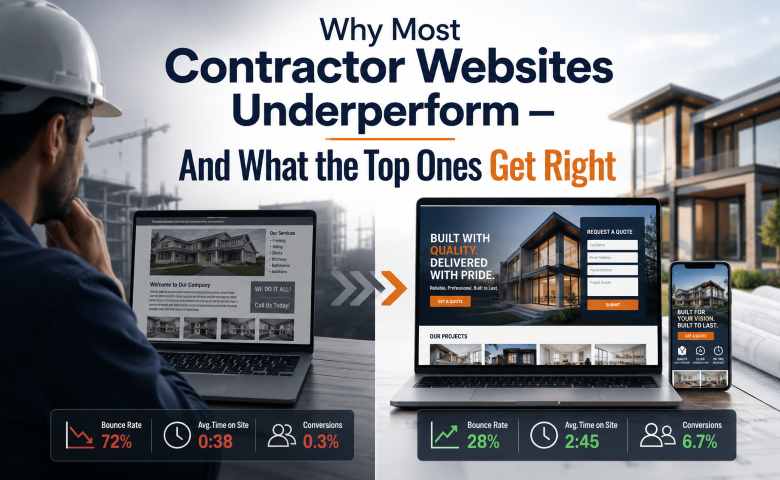
There’s a quiet pattern in the construction industry that anyone who has worked with contractors recognizes. The business is solid. The reviews are good. The crew is reliable. The work speaks for itself. And yet the website — the front door of the entire operation — looks like it was put together by a cousin in 2014 and hasn’t been touched since. The phone still rings, sometimes. But not as much as it used to, and certainly not as much as the smaller competitor across town.
ConstructionCareerHub App is LIVE — built ONLY for construction careers. Don’t apply with a weak resume.
Get ATS-ready Resume Lab + Interview Copilot + Campus Placement Prep (resume screening, skill gaps, interview readiness) — in minutes & Other advanced features.
Explore Smarter Construction Career Tools →Quick check. Big impact. Start now.
The discomfort of that mismatch is what’s pushing more contractors to take their digital presence seriously, often years later than they should have. When you study examples of the best contractor websites, the differences from average ones are not really about design taste. They’re about a small number of structural choices that compound into dramatically different business outcomes.
Table of Contents
The website is doing more work than ever
A contractor’s website used to be a credibility check. A prospect heard about you from a neighbor, looked you up to confirm you were real, and called. That role still exists, but it’s now only a fraction of what the site has to do.
Today, the website also has to:
- Get found in the first place, by people who don’t yet know your name.
- Convince a stranger that you’re more trustworthy than the four other contractors on their tab.
- Communicate your service area, specialties, and pricing tier in seconds.
- Convert a curious visitor into a booked estimate without anyone on your team having to lift a finger.
- Feed the local SEO ecosystem and the AI search layer with the kind of structured, consistent information they need to surface you in answers.
That’s a heavy load. Most contractor sites are built for the first job — credibility — and ignore the other four. The ones leading the industry have rebuilt around all five.
The structural choices that separate top sites
When you compare a high-performing contractor site to a mediocre one, the differences cluster around a few patterns.
Clear service hierarchy. The top sites don’t ask the visitor to figure out what’s offered. Services are organized into logical categories — by trade, by project type, or by customer scenario — each with its own page that goes deep enough to actually be useful. A “Bathroom Remodeling” page isn’t a paragraph and a contact form. It’s a real resource that addresses cost ranges, timelines, common decisions, and what working with this contractor specifically looks like.
Location pages that mean something. A general contractor serving five suburbs needs a real page for each suburb, with content that genuinely differs — local code references, neighborhood-specific examples, mentions of relevant landmarks or housing styles. The temptation to clone one template and swap city names is what makes most location pages worthless to both customers and search engines.
Visible proof. Real project photos, organized by service. Before-and-after sequences that show scope rather than just glamor shots. Reviews pulled in from multiple platforms rather than handpicked testimonials on a static page. Video walkthroughs where possible. Skeptical buyers in 2026 don’t trust polished claims — they trust visible work.
Conversion paths designed for mobile first. Most contractor traffic now arrives on phones, often at odd hours. A quote form that requires fifteen fields and pinch-zooming to read will be abandoned. The top sites use short, mobile-optimized forms, click-to-call buttons that actually work on mobile browsers, and easy scheduling options.
Speed. Page load time has become a quiet conversion killer. Contractor sites loaded with massive uncompressed project photos routinely take five seconds or more to render on mobile networks. That’s enough time for half the visitors to leave.
Local SEO: the layer most contractors still underuse
A website is only half the equation. The other half is whether anyone can find it in the first place.
For service businesses with a defined geographic footprint, that’s wherelocal seo for contractor companies does its real work. Local SEO isn’t a single tactic — it’s a coordinated system that makes a business visible across the surfaces where local searches happen: Google Maps, Google Business Profile, local pack results, directory listings, voice assistants, and increasingly, AI-mediated answers.
The companies dominating local search in their region tend to have done a handful of unglamorous things consistently for years:
- A complete, accurate, regularly updated Google Business Profile with photos, services, hours, and posts.
- NAP (name, address, phone) consistency across every directory, citation site, and social profile. Inconsistencies confuse the algorithms — and now the AI models — about which version of the business is real.
- A steady cadence of fresh, detailed reviews. Not bursts of five-star ratings, but a consistent flow of recent, specific reviews from real customers.
- Service-area pages on their website that match the geography of their Business Profile and actually serve a content purpose.
- Local backlinks — mentions and links from local chambers of commerce, neighborhood blogs, supplier sites, partner trades, regional publications.
None of this is exotic. All of it requires discipline. The contractors who do it well don’t necessarily have the biggest marketing teams. They have the most consistent ones.
The mistakes that keep good contractors invisible
The same handful of mistakes show up in contractor after contractor whose work is excellent but whose digital footprint is invisible.
The first is treating the website as a one-time build. The site goes up, the team celebrates, and then nothing changes for three years. Search engines reward sites that update and grow. Stagnant sites slowly slide.
The second is ignoring reviews because “our work speaks for itself.” It might, but it can’t speak in Google’s local pack. Without a steady review pipeline, even excellent contractors get outranked by mediocre ones who simply ask every customer for a Google review.
The third is buying leads instead of building a brand. Lead-buying platforms fill a calendar in the short term but don’t build any owned asset. The contractor relying on bought leads for five years has nothing to show for it when the platform raises prices or shuts off the tap. The one who built local SEO and a real website has an appreciating asset.
A simple framework for thinking about it
For a contractor evaluating where to focus, a useful framing is this: every dollar spent on marketing either builds an asset you own, or rents attention you don’t. Owned assets — the website, the content, the Google Business Profile, the email list, the review portfolio — compound over time. Rented attention — paid ads, lead-buying services — produces immediate volume but stops the moment you stop paying.
Healthy contractor marketing usually combines both, but tilts heavily toward owned assets over time. The companies still scaling in 2026 are the ones who started building those assets years ago and now have a foundation that produces leads even when the ad budget is paused.
The takeaway
Contractor websites are no longer optional credibility checks. They’re working pieces of a business, doing visible labor every hour of every day. The ones that perform aren’t the prettiest or the most expensive. They’re the ones architected around how customers actually search, decide, and book — and supported by a local SEO foundation that makes them findable in the first place.
The good news is that the gap between average and excellent isn’t unbridgeable. It’s a set of decisions, executed consistently, over enough time to compound. The contractors who start now will look like overnight successes to their competitors in two years. The ones who keep waiting will keep wondering why the phone doesn’t ring like it used to.
Related Posts
- How to position a real estate website
- The Complete Guide to SEO for HVAC Company Success
- Key Strategies To Maintain Equipment Efficiency And Minimize Delays
- Top Advertising Strategies for Construction Companies 2025
- 4 Must Have Software Additions to Building Material Websites
