

Last Updated on June 30, 2026 by Admin
The hidden work beneath every Canadian build
Across Canada, the short building season pushes crews to move fast on the parts no one sees.
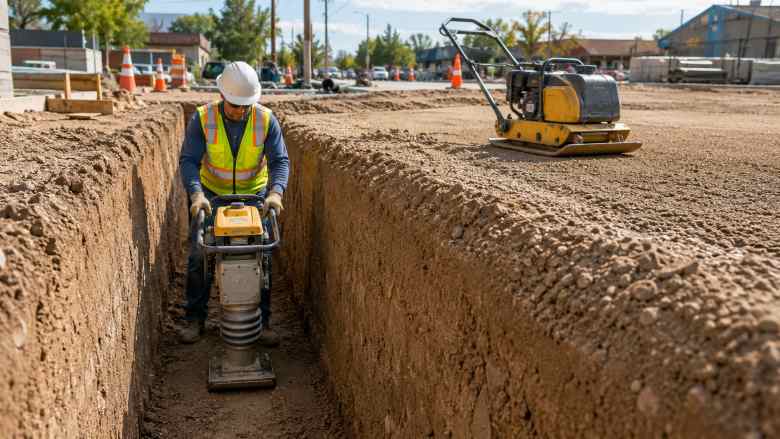
Loose backfill in a utility trench is the classic problem, and the tamping rammer is the tool built to solve it where space is tight and depth matters.
Get this layer wrong and the consequences surface months later as cracked slabs, sunken trenches, and heaving pavement after the first freeze and thaw. Understanding how the machine works explains why the right choice protects the whole structure above.
Compaction is really a fight against air
Soil is not solid. It is a mix of mineral grains, water, and trapped air pockets, and those air pockets are what allow ground to settle and shift under load.
Compaction drives the air out and rearranges the grains so they lock together tightly.
Two ways to deliver that force, two different soils
Soil compactors are best understood by the action they apply. A smooth roller presses with static weight, a vibrating plate shakes granular material so loose grains rattle into place, and an impact tamping rammer hammers the surface with concentrated percussive blows.
The match between action and soil type is everything. Granular soils such as sand and gravel respond to the buzzing energy of a vibrating plate, because loose grains slide easily into a denser arrangement.
Cohesive soils such as clay and silt behave differently. Their fine particles cling together with surface tension and resist rattling, so vibration barely penetrates and only polishes the top. These soils need to be struck.
How the percussive blow reaches deep
Here the impact machine earns its place. The engine drives a spring-loaded foot downward, the spring stores and releases the energy, and the foot pounds the ground with rapid, high-energy strikes that fold soil particles together.
The recoil throws the whole machine upward between blows, which is why crews call it a jumping jack compactor. That bounce is not wasted motion; it resets the foot for the next strike and lets the operator walk the unit forward.
Because the blow concentrates force into a small foot, a tamping rammer drives compaction far deeper than a plate can reach, which is exactly what cohesive backfill in a narrow trench demands.
Reading the trade-offs honestly
No single machine wins everywhere, and matching the mechanism to the job is the whole point. The strengths of the tamping rammer follow directly from its narrow foot and deep, percussive action.
- Reaches deep into thick lifts of cohesive soil
- Fits the bottom of a tight utility trench
- Concentrates high energy where vibration fails
The same traits set its limits. The narrow foot covers ground slowly, the constant jumping demands a steady operator, and on loose granular fill a vibrating plate finishes a wide open area faster.
A field picture from a prairie utility line
Consider a crew backfilling a service trench in clay-heavy prairie soil during a compressed summer schedule. The clay is moist and cohesive, the trench is barely wider than a shovel, and settlement under the eventual pavement is the real risk.
A flat plate would polish the surface while the layers below stayed loose and waiting to sink.
Understood this way, the choice is less about horsepower and more about physics. The tamping rammer succeeds because it sends concentrated energy where cohesive soil and tight trenches need it most.
Related Posts:
- How To Reduce Heavy Equipment Transportation Costs
- What is woodworking? 5 tools that are most used in woodworking
- What is Backfilling? A Guide to Backfill in Mining and Construction
- 100+ Geotechnical Engineering Interview Questions & Answers [2026]
- 8 Must-Have Tools for Concrete Contractors
