

Last Updated on May 11, 2026 by Admin
The global smart cities market, valued at approximately USD 1.96 trillion in 2026 and projected to reach USD 4.06 trillion by 2031 at a CAGR of 15.65% (Mordor Intelligence), is creating a massive surge in demand for a specialized workforce. At the centre of this transformation sits the Smart City Infrastructure Engineer — a multidisciplinary professional who designs, implements, and manages the technology-integrated physical systems that make cities intelligent, sustainable, and livable.
ConstructionCareerHub App is LIVE — built ONLY for construction careers. Don’t apply with a weak resume.
Get ATS-ready Resume Lab + Interview Copilot + Campus Placement Prep (resume screening, skill gaps, interview readiness) — in minutes & Other advanced features.
Explore Smarter Construction Career Tools →Quick check. Big impact. Start now.
Whether you are a civil engineering graduate exploring future-proof career paths, a mid-career infrastructure professional looking to upskill, or a hiring manager seeking to understand this emerging role, this comprehensive 2026 guide breaks down everything you need to know about the smart city infrastructure engineer career — from daily responsibilities and essential skills to real salary data, certifications, and global job market trends.
If you are still exploring which construction career path suits your skills and personality, the AI-powered Career Planner on ConstructionCareerHub.com can help you find out in under 10 minutes.
Table of Contents
What Is a Smart City Infrastructure Engineer?
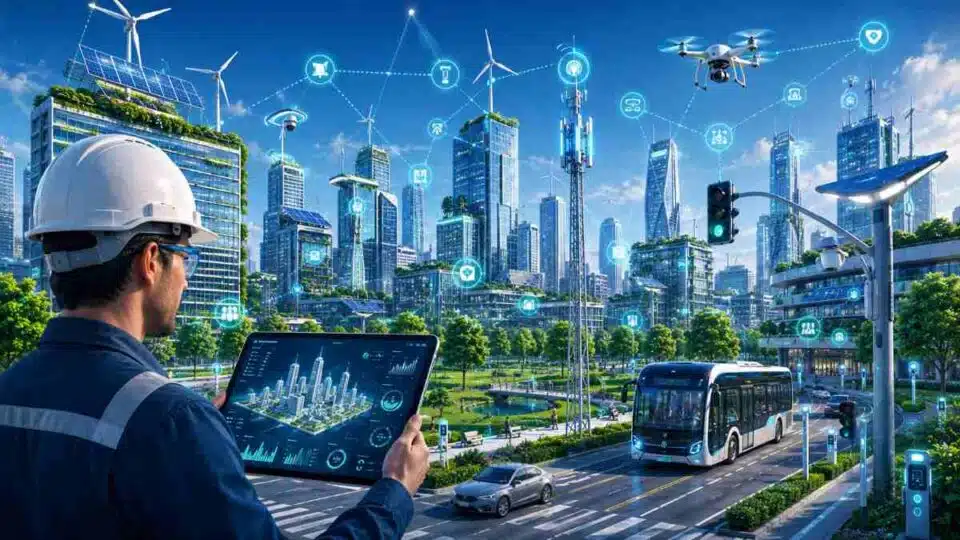
A smart city infrastructure engineer is a professional who plans, designs, deploys, and maintains the interconnected physical and digital systems that power modern urban environments. Unlike a traditional civil or urban engineer who focuses primarily on roads, bridges, and utilities, a smart city infrastructure engineer integrates IoT sensors, 5G connectivity, AI-driven analytics, cloud platforms, and sustainable energy systems into the built environment.
Their work spans intelligent transportation systems, smart water and energy grids, connected street lighting, integrated command-and-control centres, digital twin platforms, and resilient urban infrastructure. They serve as the critical bridge between civil engineering, information technology, data science, and urban planning — ensuring that city infrastructure is not only structurally sound but also digitally connected, data-responsive, and environmentally sustainable.
The role has gained rapid prominence thanks to government-led programmes like India’s Smart Cities Mission (100 cities, 8,000+ projects, over ₹1.64 lakh crore invested), China’s New Urbanization Plan, the European Green Deal, Saudi Arabia’s NEOM, and significant US federal investments under the Infrastructure Investment and Jobs Act (IIJA).
Key Roles and Responsibilities
The day-to-day scope of a smart city infrastructure engineer is broad and varies by employer, project scale, and geography. However, the core responsibilities typically include the following areas.
1. Smart Infrastructure Design and Planning
This involves designing urban infrastructure systems — roads, utilities, transit networks, public spaces — with embedded IoT sensors, real-time monitoring capabilities, and digital twin integration from the conceptual stage itself. The engineer works with BIM platforms, GIS mapping tools, and urban simulation software to create infrastructure that can communicate, adapt, and self-optimize.
2. IoT Network Deployment and Integration
Smart cities rely on thousands of connected sensors and devices — traffic signal controllers, air quality monitors, water pressure sensors, smart parking meters, energy meters, waste-level indicators, and surveillance cameras. The engineer specifies, procures, deploys, and integrates these IoT devices into a unified urban data platform, ensuring interoperability across vendors and communication protocols (LoRaWAN, NB-IoT, 5G, MQTT).
3. Data Platform and Analytics Architecture
Collected sensor data is only valuable when processed, visualized, and acted upon. Smart city infrastructure engineers collaborate with data engineers and urban planners to architect real-time dashboards, predictive analytics models, and automated decision systems. Many cities now operate Integrated Command and Control Centres (ICCCs) — all 100 Indian Smart Cities have them operational — which serve as nerve centres for urban management.
4. Sustainable Infrastructure and Energy Systems
Sustainability is a non-negotiable pillar. Engineers in this role design and integrate smart grids, renewable energy microgrids, EV charging infrastructure, green building systems, and energy-efficient street lighting. They ensure compliance with global standards such as LEED, IGBC (India), BREEAM (UK), and Green Star (Australia). The smart utilities segment alone accounts for approximately 28% of total smart city market revenue (Mordor Intelligence, 2025).
5. Cybersecurity and Data Governance
With critical urban infrastructure becoming digitally connected, cybersecurity becomes a mission-critical responsibility. Smart city infrastructure engineers implement network segmentation, encryption protocols, intrusion detection systems, and regulatory compliance frameworks (GDPR, India’s DPDP Act, NIST guidelines) to protect citizen data and prevent infrastructure sabotage.
6. Stakeholder Coordination and Project Management
These engineers work across multiple stakeholders — municipal authorities, technology vendors, construction contractors, urban planners, utility companies, and citizen groups. Strong project management skills, often backed by PMP or PRINCE2 certification, are essential for delivering large-scale smart city projects on time and within budget.
7. Operations, Monitoring, and Continuous Optimization
Post-deployment, the engineer monitors system performance, conducts predictive maintenance using AI models, upgrades firmware and software, and iterates on infrastructure design based on real-world usage data. This lifecycle management approach differentiates smart infrastructure from traditional build-and-forget civil projects.
Related Reading: Infrastructure vs Construction: Differences & 2026 Outlook
Essential Skills and Competencies
The smart city infrastructure engineer role demands a unique combination of traditional engineering fundamentals and modern digital competencies. Here is a breakdown of the most in-demand skills in 2026.
Technical Skills
- Civil and Urban Engineering Fundamentals: Structural design, transportation planning, water and wastewater systems, utility networks, and site development.
- IoT and Sensor Technologies: Knowledge of sensor types (LiDAR, environmental, acoustic, traffic), communication protocols (MQTT, CoAP, LoRaWAN, NB-IoT, 5G), and edge computing architectures.
- BIM and Digital Twin Platforms: Proficiency in Autodesk Revit, Bentley OpenRoads/OpenCities, Esri CityEngine, and digital twin frameworks (Azure Digital Twins, NVIDIA Omniverse). Read more about BIM and digital construction technologies.
- GIS and Spatial Analysis: ArcGIS, QGIS, Google Earth Engine for urban mapping, flood modelling, and spatial decision support.
- Data Analytics and Visualization: Python, SQL, R for data analysis; Power BI, Tableau, Grafana for visualization; basic machine learning for predictive infrastructure maintenance.
- Cloud and Platform Engineering: AWS IoT, Azure IoT Hub, Google Cloud IoT Core for managing large-scale urban sensor networks.
- Smart Grid and Energy Systems: Understanding of distributed energy resources, battery storage, EV infrastructure, SCADA systems, and renewable integration.
- Cybersecurity Basics: Network security, encryption, vulnerability assessment, and compliance standards for critical infrastructure protection.
Soft Skills
- Cross-Disciplinary Communication: Ability to translate between IT, urban planning, engineering, and government stakeholders.
- Project Management: Agile, Scrum, and traditional waterfall project management for complex multi-phase urban projects.
- Problem-Solving and Systems Thinking: Understanding interdependencies across city systems — how a change in transportation infrastructure affects energy demand, air quality, and citizen mobility patterns.
- Stakeholder Engagement: Working with municipal governments, citizen groups, contractors, and international development agencies.
- Adaptability: Smart city technologies evolve rapidly; continuous learning is essential.
Educational Qualifications and Certifications
There is no single rigid educational pathway for this role, but the most common and competitive profiles include the following qualifications.
Degree Requirements
- Bachelor’s Degree (B.E./B.Tech): Civil Engineering, Urban Engineering, Electrical Engineering, Computer Science, or Environmental Engineering.
- Master’s Degree (Preferred): Smart Cities Construction Management (e.g., RIT’s MS programme), Urban Informatics, Infrastructure Systems Engineering, or Transportation Engineering with a smart systems focus.
Professional Certifications
- PMP (Project Management Professional): Globally recognized; critical for managing large-scale smart city projects.
- LEED AP / IGBC AP: Green building credentials essential for sustainable smart infrastructure.
- AWS/Azure IoT Certification: Validates cloud-based IoT deployment capabilities.
- Cisco Certified Network Associate (CCNA): Networking fundamentals for urban IoT systems.
- ISA/IEC 62443 Cybersecurity Certification: Industrial cybersecurity for critical infrastructure.
- PE (Professional Engineer) License: Especially valuable in the US, where PE-licensed engineers earn approximately $40,000 more annually than unlicensed counterparts (ASCE 2025 Salary Report).
Recommended Online Courses
Upskilling through structured courses is one of the fastest ways to break into this field:
- Smart Cities – Management of Smart Urban Infrastructures (Coursera / EPFL)
- Smart Cities (edX / ETH Zurich)
- IoT and Smart Infrastructure with Raspberry Pi (Udemy)
- Geographic Information Systems (GIS) Specialization (Coursera / UC Davis)
Related Reading: 15 Best Career Options After Civil Engineering (2026)
Smart City Infrastructure Engineer Salary in 2026
Compensation for smart city infrastructure engineers varies significantly based on geography, experience, specialization, and the hiring organization. Smart city engineers often command a 15–30% salary premium over traditional civil or infrastructure engineering roles due to their specialized, cross-domain skill set (Frontlines Media, 2026).
Salary by Country (Annual, 2026 Estimates)
| Country / Region | Entry-Level | Mid-Level (5–8 yrs) | Senior / Lead (10+ yrs) |
|---|---|---|---|
| United States | $75,000 – $95,000 | $100,000 – $140,000 | $145,000 – $185,000+ |
| United Kingdom | £40,000 – £55,000 | £60,000 – £85,000 | £90,000 – £120,000+ |
| UAE / Gulf Region | AED 180,000 – 280,000 | AED 300,000 – 480,000 | AED 500,000 – 720,000+ |
| India | ₹6,00,000 – ₹10,00,000 | ₹12,00,000 – ₹25,00,000 | ₹28,00,000 – ₹50,00,000+ |
| Australia | AUD 80,000 – 100,000 | AUD 110,000 – 150,000 | AUD 155,000 – 200,000+ |
| Singapore | SGD 60,000 – 80,000 | SGD 90,000 – 130,000 | SGD 140,000 – 190,000+ |
Sources: ZipRecruiter (2026), Glassdoor, PayScale, industry job listings. Salary ranges are indicative and vary by employer, city, and specific role scope.
In the US, infrastructure engineers currently earn an average of $127,066 per year (ZipRecruiter, April 2026), with smart city specialists at the higher end of this range due to IoT, AI, and sustainability expertise. Senior professionals in cities like New York ($144,833 average per Glassdoor), San Mateo, and San Jose command the highest premiums.
Also Read: Highest Paying Construction Jobs in the US [2026 Updated] | Civil Engineering Salary Guide [2026 Updated]
Top Industries Hiring Smart City Infrastructure Engineers
Demand for this role spans multiple sectors, reflecting the cross-cutting nature of smart city development.
- Municipal and Government Agencies: Smart city mission SPVs (India), city councils, urban development authorities, and transportation departments worldwide.
- EPC and Infrastructure Companies: Major firms like L&T, Siemens, Schneider Electric, AECOM, Jacobs, and WSP are actively building smart city capabilities. See our guide to Top 50 EPC Companies in India 2026.
- Technology Companies: Cisco, IBM, Microsoft, Huawei, Hitachi, and NEC — the core smart city technology providers — hire infrastructure engineers for solution design and deployment.
- Consulting Firms: McKinsey, BCG, Deloitte, and Accenture have dedicated smart city and urban transformation practices.
- Real Estate Developers: Developers building smart townships, SEZs, and green-certified developments need in-house smart infrastructure expertise.
- Utilities and Energy Companies: Smart grid, water management, and renewable energy companies deploy infrastructure engineers to modernize distribution networks.
- Startups: Urban-tech startups focused on mobility-as-a-service, digital twins, smart parking, waste management, and citizen engagement platforms.
Smart City Infrastructure Engineering: Tools and Technologies
The technology stack for this role is evolving rapidly. Here are the most relevant platforms and tools in 2026.
Design and Modelling
- Autodesk Revit, Civil 3D, InfraWorks
- Bentley OpenRoads, OpenCities Planner
- Esri ArcGIS Urban, CityEngine
- Trimble SketchUp, Tekla
IoT and Connectivity
- AWS IoT Core, Azure IoT Hub, Google Cloud IoT
- ThingsBoard, Kaa IoT Platform
- LoRaWAN, Sigfox, NB-IoT, 5G NR gateways
Data Analytics and Digital Twins
- Microsoft Azure Digital Twins
- NVIDIA Omniverse
- Bentley iTwin, Autodesk Tandem
- Apache Kafka, Apache Spark for real-time streaming
- Power BI, Grafana, Tableau for visualization
Project Management
- Primavera P6, Microsoft Project
- Jira, Asana, Monday.com
- Procore, Autodesk Construction Cloud
Career Path and Growth Trajectory
The smart city infrastructure engineer role offers a well-defined and upwardly mobile career trajectory.
Entry-Level (0–3 Years)
Titles: Junior Smart Infrastructure Engineer, IoT Field Engineer, GIS Analyst, Smart City Project Coordinator
At this stage, professionals typically focus on a specific domain — sensor deployment, GIS mapping, BIM coordination, or data platform support. They work under senior engineers and gain hands-on experience with specific technology stacks and city-scale projects.
Mid-Level (4–8 Years)
Titles: Smart City Infrastructure Engineer, IoT Solutions Architect, Smart Mobility Engineer, Infrastructure Data Analyst
Mid-level professionals lead sub-systems or specific city domains (smart transportation, smart utilities, public safety). They manage vendor relationships, conduct system integration, and contribute to strategic planning for city-wide deployments.
Senior-Level (9–15 Years)
Titles: Senior Smart City Engineer, Smart Infrastructure Lead, Urban Technology Manager, Head of Smart City Programme
Senior professionals oversee entire smart city programmes, manage cross-functional teams, interface with municipal leadership and international bodies, and make strategic technology and investment decisions.
Executive-Level (15+ Years)
Titles: Chief Technology Officer (Smart Cities), VP of Urban Infrastructure, Smart City Programme Director, Smart City CEO (SPV)
At the executive level, professionals shape urban policy, lead multi-city programmes, and drive innovation at the intersection of infrastructure, technology, and governance.
Related: Civil Engineering Career Guide 2026: Jobs, Salary & Growth
Global Smart City Projects Creating Job Demand in 2026
Several landmark programmes and mega-projects are actively generating thousands of smart city infrastructure engineering positions worldwide.
- India’s Smart Cities Mission: 100 cities, 8,063+ projects worth over ₹1.64 lakh crore. As of May 2025, 94% of projects were completed, but the next wave — Smart Cities 2.0 — is expected to expand the programme significantly (smartcities.gov.in).
- Saudi Arabia’s NEOM: A $500 billion futuristic city featuring AI-managed infrastructure, autonomous transport, and 100% renewable energy.
- China’s New Urbanization Plan: China’s smart city market alone is projected at USD 84.63 billion in 2026 (Fortune Business Insights).
- European Green Deal: EU cities are investing heavily in smart mobility, digital energy grids, and climate-resilient infrastructure.
- US Infrastructure Investment and Jobs Act (IIJA): Billions allocated for broadband, smart transportation, and grid modernization through 2026 and beyond.
- Singapore Smart Nation: One of the world’s most advanced smart city programmes, driving continuous demand for IoT, AI, and digital twin professionals.
- Australia’s Smart Cities Plan: Federal investments in smart transport corridors, digital infrastructure, and 5G-enabled cities.
Read More: International Construction Career Opportunities in 2025
Challenges Facing Smart City Infrastructure Engineers
Despite the exciting career prospects, professionals in this field face several real-world challenges that are important to understand.
1. Technology Fragmentation and Vendor Lock-In
Smart city ecosystems often involve dozens of vendors, proprietary protocols, and incompatible platforms. Achieving true interoperability remains one of the biggest technical challenges. Engineers must advocate for open standards (FIWARE, oneM2M, OCF) and modular architectures.
2. Data Privacy and Ethical Concerns
Smart cities collect vast amounts of citizen data — mobility patterns, energy usage, surveillance footage. Balancing data utility with privacy rights requires careful governance frameworks. Engineers must be aware of evolving regulations like GDPR, India’s DPDP Act, and local privacy laws.
3. Cybersecurity Threats
Connected urban infrastructure is a high-value target for cyber attacks. From traffic signal manipulation to water system breaches, the consequences of inadequate security can be severe. This is an area where demand for specialized skills is growing fastest.
4. Budget Constraints and Political Cycles
Smart city projects often span 5–15 years, but political cycles are much shorter. Funding continuity, stakeholder alignment, and long-term commitment remain persistent challenges, particularly in developing economies.
5. Legacy Infrastructure Integration
Most cities are not built from scratch. Retrofitting decades-old water pipes, power grids, and road networks with smart technology requires creative engineering, phased deployment strategies, and careful brownfield vs. greenfield planning.
Future Outlook: Why This Career Is Only Getting Bigger
The macro-trends shaping the next decade strongly favour the smart city infrastructure engineer role.
- Urbanization: About 55% of the world’s population currently lives in urban areas, projected to reach 68% by 2050 (UN DESA). Every additional urban resident increases demand for smart infrastructure.
- Climate Mandates: Net-zero commitments are driving massive investments in smart grids, green buildings, and climate-resilient infrastructure.
- 5G Expansion: By end of 2026, 5G is expected to reach approximately 3.5 billion subscriptions globally (Ericsson), enabling a new wave of connected urban applications.
- AI and Digital Twins: AI-enhanced infrastructure management and city-scale digital twins are moving from pilot to production, creating new roles and specializations.
- Government Investment: India’s Smart Cities Mission alone has invested over ₹1.64 lakh crore. Globally, smart city spending is projected at multi-trillion-dollar levels through 2030.
Smart city technologies market is expected to be valued at USD 841.67 billion in 2026 and is projected to reach USD 1,977.50 billion by 2033 at a CAGR of 15.3% (Coherent Market Insights). This represents an enormous and sustained demand pool for qualified infrastructure engineers with smart city expertise.
Related Posts:
- Become a Smart Building Specialist: A Promising Career in Construction Technology
- How Smart Construction Technology is Transforming the Construction Industry
- BIM + IoT + AI: The Future of Smart Infrastructure Development
- Impact of The Internet of Things (IoT) in the Construction Industry
How to Start Your Career as a Smart City Infrastructure Engineer
If you are ready to pursue this career path, here is a practical step-by-step roadmap.
Step 1: Build Your Engineering Foundation
Complete a B.E./B.Tech in Civil Engineering, Electrical Engineering, or Computer Science. A strong foundation in structural design, transportation, or environmental engineering is essential. Consider our detailed civil engineering job description guide for more context on foundational roles.
Step 2: Add Digital and IoT Skills
Take online courses in IoT, GIS, BIM, data analytics, and cloud platforms. The Coursera and edX courses linked above are excellent starting points. Practice with open-source IoT platforms like ThingsBoard or Home Assistant to build hands-on experience.
Step 3: Pursue a Specialization or Master’s Degree
Programmes like RIT’s Smart Cities Construction Management MS, MIT’s Urban Science programme, or IIT’s Urban Infrastructure programmes provide the cross-disciplinary depth employers value.
Step 4: Gain Industry Experience
Target internships or entry-level roles with EPC firms, smart city consultancies, municipal SPVs, or technology companies working on urban infrastructure projects.
Step 5: Earn Relevant Certifications
Add PMP, LEED AP, AWS IoT, or Cisco CCNA certifications to differentiate yourself in the job market.
Step 6: Build Your Professional Network
Join organizations like the Smart Cities Council, IEEE Smart Cities, ASCE, and ICE. Attend conferences like Smart City Expo World Congress (Barcelona), India Smart Utility Week, and CES (Las Vegas).
To prepare a job-winning resume tailored for smart city roles, use the AI-powered Resume Lab at ConstructionCareerHub.com, which generates ATS-optimized resumes benchmarked against construction industry standards.
Recommended Resources for Smart City Professionals
eBooks from ConstructionPlacements
- Civil Engineering Job Interview Guide (300 Q&A) — Comprehensive interview preparation for engineering roles including smart infrastructure positions.
- Hidden Construction Careers That Pay More Than Engineering — Discover high-paying alternative career paths in the construction and infrastructure sector.
- Construction Career Mastery: The Essential eBook Collection (15 eBooks) — The ultimate career development bundle covering resumes, interviews, salary negotiation, and career planning.
Industry Organizations and Resources
- India Smart Cities Mission (Official Portal)
- American Society of Civil Engineers (ASCE)
- Smart Cities Council
- U.S. Bureau of Labor Statistics — Civil Engineers
Frequently Asked Questions (FAQ)
What does a smart city infrastructure engineer do?
A smart city infrastructure engineer designs, deploys, and maintains the connected physical and digital systems that power intelligent urban environments. This includes IoT sensor networks, smart grids, intelligent transportation systems, digital twin platforms, and integrated command-and-control centres. They work at the intersection of civil engineering, information technology, and urban planning.
What qualifications are required to become a smart city infrastructure engineer?
Most positions require a bachelor’s degree in civil engineering, electrical engineering, computer science, or urban engineering. A master’s degree in smart cities, urban informatics, or infrastructure systems engineering is increasingly preferred for mid-to-senior roles. Professional certifications like PMP, LEED AP, and AWS IoT add significant competitive advantage.
How much does a smart city infrastructure engineer earn in 2026?
In the United States, salaries range from $75,000 at entry level to $185,000+ for senior roles. In India, the range is ₹6–50 lakhs per annum depending on experience and employer. Gulf and European markets fall between these ranges. Smart city engineers typically earn 15–30% more than traditional infrastructure engineers.
Is smart city infrastructure engineering a good career choice in 2026?
Yes. With the global smart cities market valued at USD 1.96 trillion in 2026 and growing at 15.65% CAGR, job demand is strong and expected to accelerate. Government programmes, climate mandates, and urbanization trends all favour long-term growth in this field.
What programming languages should a smart city infrastructure engineer learn?
Python is the most versatile choice, useful for data analysis, IoT scripting, and machine learning. SQL is essential for database management. Familiarity with JavaScript (for web dashboards), R (for statistical analysis), and C/C++ (for embedded systems) is also valuable.
Which countries have the highest demand for smart city infrastructure engineers?
India (Smart Cities Mission), the United States (IIJA-funded projects), Saudi Arabia (NEOM and Vision 2030), the UAE, Singapore, China, the UK, and Australia currently show the strongest hiring activity for these roles.
Can a civil engineer transition into smart city infrastructure engineering?
Absolutely. Civil engineers already possess the foundational knowledge of infrastructure systems. By upskilling in IoT, GIS, BIM, data analytics, and cloud platforms — through online courses and certifications — they can transition effectively within 12–18 months.
What is the difference between a smart city engineer and a traditional infrastructure engineer?
Traditional infrastructure engineers focus on designing and building physical structures — roads, bridges, utilities. Smart city infrastructure engineers go further by integrating digital technologies (IoT, AI, 5G) into these physical systems, enabling real-time monitoring, automated optimization, and data-driven decision-making throughout the infrastructure lifecycle.
This article was researched and written by the editorial team at ConstructionPlacements.com, drawing on publicly available government data, industry reports, salary databases, and expert insights from the construction and smart city sectors. For personalized career guidance, explore the AI-powered tools at ConstructionCareerHub.com.
