

Last Updated on May 11, 2026 by Admin
Ask any construction estimator, quantity surveyor (QS), or planner in 2026 what keeps them up at night, and “AI agents” now sits firmly on the list — somewhere between rising material costs and the next bid deadline. The fear is understandable. In the last 18 months, AI has gone from generating chatty answers to autonomously running quantity takeoffs, drafting cost plans, and simulating hundreds of millions of project schedules. So the question is no longer if AI will reshape preconstruction roles — it’s how far, how fast, and which parts of your job actually survive 2028.
ConstructionCareerHub App is LIVE — built ONLY for construction careers. Don’t apply with a weak resume.
Get ATS-ready Resume Lab + Interview Copilot + Campus Placement Prep (resume screening, skill gaps, interview readiness) — in minutes & Other advanced features.
Explore Smarter Construction Career Tools →Quick check. Big impact. Start now.
This guide gives you a research-backed, no-hype answer. We dig into what AI agents can already do in 2026, what the data says about job displacement, which tasks are at high risk versus safe, role-by-role outlooks for estimators, QS, and planners, salary trends, and a practical upskilling roadmap so you can come out of this transition stronger — not sidelined.
Table of Contents
Short Answer: Will AI Agents Replace Construction Estimators, QS & Planners by 2028?
No — AI agents will not fully replace construction estimators, quantity surveyors, or planners by 2028. They will, however, automate 30–50% of routine tasks within these roles, reshape job descriptions, and shrink the demand for purely manual estimators, junior QS, and Gantt-chart-only planners. The professionals who learn to direct, audit, and add judgment on top of AI agents will see higher salaries and faster promotions. Those who don’t are the ones at real risk.
That’s the headline. The nuance is more interesting — and more useful to your career — so let’s unpack it.
What’s Actually Changed in 2026: From AI Tools to AI Agents
For most of the last decade, “AI in construction” meant narrow point tools — symbol detection in a takeoff plugin, regression-based cost models, or a chatbot summarising specifications. Useful, but you still had to drive every step.
That changed in 2025–2026 with the arrival of agentic AI. Unlike conventional AI, agentic systems can plan, reason, sequence multi-step tasks, call other software tools, and execute work autonomously within guardrails. According to a February 2026 PYMNTS report, construction firms are already piloting AI agents that read drawings, track RFIs, flag scheduling conflicts, and surface cost risks as a coordination layer above existing software.
According to Autodesk’s 2026 AI in Construction Trends report (compiled from 25+ industry leaders), the industry is moving “beyond generic, chat-based tools toward AI agents that can audit documents, review plans, and prepare project information — allowing teams to review and approve rather than build from scratch.”
This matters because AI tools augment your work. AI agents do your work — at least the routine portion of it.
Why 2028 Is the Right Horizon to Worry About
The Archdesk 2026 outlook on agentic AI notes that task-specific AI agents are moving “from experimental prototypes to production-ready autonomous entities by the end of 2026.” That gives the industry roughly 18–24 months of pilot-scale rollout, followed by mainstream adoption through 2027–2028. By 2028, AI agents won’t be a novelty in preconstruction — they will be a default expectation on every mid-to-large project.
What AI Agents Can Already Do in Estimating, QS & Planning (2026 Reality Check)
Here is what is no longer theoretical. These are capabilities deployed on live projects in 2026:
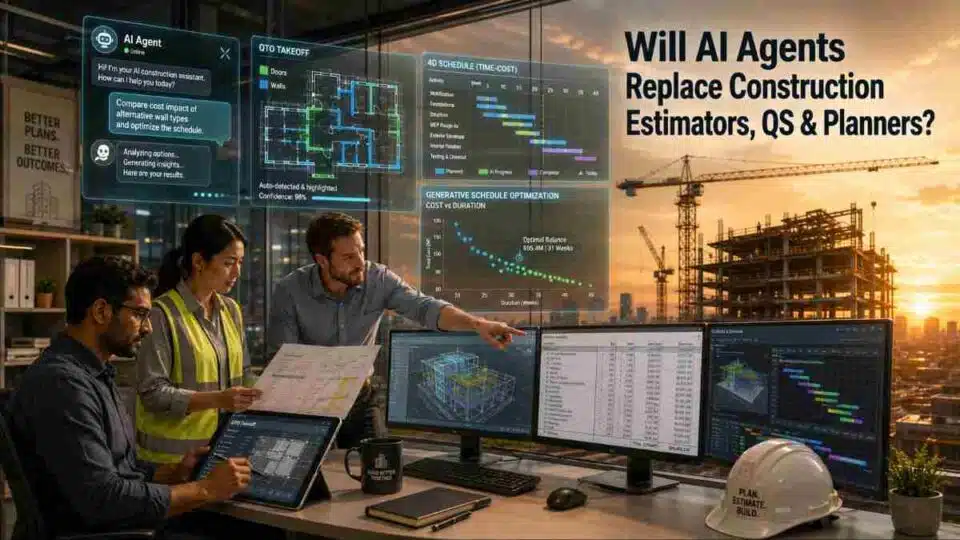
- Automated quantity takeoffs from PDFs, DWGs, IFCs, and point clouds. Tools like Togal.AI claim up to 98% accuracy and run takeoffs 5× faster than manual workflows. STACK Assist AI was independently tested to come within 3% of baseline manual estimates.
- Cost prediction from historical project data. Per industry benchmarks reported by Construction Owners Magazine (April 2026), automated estimating systems are reaching 85–90% accuracy compared to manually prepared estimates, reducing what once took half a day to minutes.
- Generative scheduling. ALICE Technologies can simulate hundreds of millions of schedule permutations in an afternoon — work that traditionally took a senior planner months to attempt for just one or two alternatives.
- AI-driven schedule acceleration. In McKinsey’s April 2026 partnership with ALICE, generative AI scheduling was reported to accelerate construction projects by up to 20%; one highway project trimmed 28 days, and a data center build cut its schedule by 40%.
- Contract and specification review. Document Crunch (recently acquired by Trimble) and similar platforms surface risk clauses, obligations, and inconsistencies in contracts faster than any human reviewer.
- Cost variance and risk flagging. Agents continuously cross-check field progress against budgets, flag deviations, and propose corrective actions — a job that used to be QS quarterly cost reporting.
Adoption Is Real — But Far From Universal
A Bluebeam survey of 1,000 AEC professionals referenced in early 2026 found that only 27% currently use AI in their operations — but 94% of those firms plan to increase usage in 2026. Cost estimation (24%) and bid management (22%) are the two most common AI applications. The barriers blocking the remaining 73% are not money, according to Bluebeam — they are “complexity, culture, and connection.”
Translation: the firms not adopting AI today are creating the conditions for a sharper job-market disruption when adoption inevitably catches up. If you work for one of them, your insulation is temporary.
What Estimators, QS & Planners Do That AI Still Can’t Replicate
Now the counter-side. Even the most enthusiastic vendors concede that AI agents in 2026 cannot replicate the following, and there’s no credible roadmap for closing these gaps by 2028:
- Pricing strategy and risk-adjusted bid decisions. An agent can produce a baseline cost; deciding the bid number — factoring competitor behaviour, client relationships, and risk appetite — remains a human judgment call.
- Site-specific and local condition adjustments. Soil quirks, labour availability, monsoon risk, permit politics, and informal supply chains are tacit knowledge an agent cannot scrape.
- Contractual negotiation and dispute resolution. FIDIC, JCT, and NEC4 disputes require human interpretation, professional indemnity coverage, and credibility in front of a panel.
- Stakeholder management. Clients hire people they trust. No client signs a $100M contract because the AI agent was reassuring.
- Ethical and professional accountability. RICS, AIQS, and similar bodies still require chartered human sign-off. Professional Indemnity Insurance for AI-only output is, as of 2026, an unresolved insurance question.
This split — agents take routine work, humans keep judgment — is the single most important career insight in the entire AI-in-construction debate. Build your future on the right side of it.
Role-by-Role Outlook Through 2028
1. Construction Estimators
Risk level: Moderate to High for purely manual takeoff-focused roles. Low for strategic pre-construction and bid leadership.
Estimating is the most exposed of the three roles because so much of the work — measurement, count, area, volume — is mechanically repetitive. Deloitte Access Economics research commissioned by Autodesk found preconstruction professionals spend an average of 13.4 hours per week researching and analysing data. AI agents are already collapsing that to minutes.
What survives and grows:
- Senior and Chief Estimators who own bid strategy, margin protection, and risk pricing.
- Estimators who can validate, override, and contextualise AI-generated takeoffs.
- Specialists in complex sectors — heavy civil, MEP, EPC, data centers — where AI accuracy is still imperfect.
What shrinks:
- Junior estimators whose primary value was speed at manual takeoffs.
- Roles where deliverables stop at the quantity sheet.
If estimating is your path, see our deeper guides on becoming a construction cost estimator and the 2026 Construction Salary Guide for India, Gulf and Global markets.
2. Quantity Surveyors (QS)
Risk level: Moderate. Reshaping is more accurate than replacement.
The QS profession has been thinking about this longer than most. A widely cited RICS survey from 2023 found 52% of QS believed AI would reduce demand for their role, and 38% feared for their own job security within five years — but only 31% saw AI as an enhancement to their role. The optimistic scenario, favoured by 60% of interviewed UK experts, suggests AI will automate around 40% of current QS time allocation by the long term — freeing capacity for higher-value advisory work.
What survives and grows:
- Contract administration, claims, and dispute resolution under FIDIC, JCT, NEC4.
- Strategic cost advice, value engineering, and life-cycle costing.
- Digital QS roles that combine BIM 5D, AI tooling, and chartered judgment.
- Risk management, ESG cost integration, and embodied carbon costing.
What shrinks:
- Pure measurement and BoQ preparation as standalone roles.
- Junior cost reporting roles that involve only data entry and reconciliation.
If you’re in or aiming for QS, our guides on quantity surveyor career paths and QS salary benchmarks are worth bookmarking.
3. Construction Planners & Schedulers
Risk level: Moderate. The role is shifting from schedule-builder to schedule-strategist.
Planning is where generative AI is most visibly disruptive. Where a planner previously built one or two schedule scenarios over weeks, ALICE-class agents now generate millions of permutations in hours and rank them by cost, duration, or risk. ALICE’s Schedule Insights Agent even lets planners “chat” with their schedule to surface DCMA 14-Point Check issues, resource conflicts, and what-if scenarios in plain English.
What survives and grows:
- Planners who can interpret AI-generated scenarios and challenge their assumptions.
- Owners’ representatives and PMC planners who translate AI output into board-ready narratives.
- Lean construction and Last Planner® System practitioners who anchor AI schedules in field reality.
- Risk-and-claims planners who can forensically defend (or challenge) schedule narratives.
What shrinks:
- Planners whose value is “knowing how to drive Primavera P6 or MS Project” with no analytical layer on top.
- Schedule administrators with no field exposure.
Tasks at High Risk of Automation by 2028
- Manual 2D and 3D quantity takeoffs from drawings.
- Bill of Quantities (BoQ) drafting from standard specifications.
- Basic cost-plan generation from historical benchmarks.
- Routine valuation and interim payment certificate preparation.
- Schedule input from contract documents into Primavera P6 or MS Project.
- Resource levelling and basic optimisation passes.
- DCMA 14-Point schedule quality checks.
- RFI tracking, submittal logging, and contract clause extraction.
- Comparing as-planned vs as-built progress.
- First-draft variation/change order pricing.
Tasks Safe Through 2028 (and Likely Beyond)
- Bid strategy, margin setting, and tender risk pricing.
- Contractual interpretation, claims drafting, and dispute resolution.
- Stakeholder negotiation with clients, consultants, and subcontractors.
- Site-specific risk judgment (geotechnical, labour, weather, political).
- Value engineering and constructability advice during design.
- ESG, embodied carbon, and life-cycle cost advisory.
- Mentorship, team leadership, and cross-functional decision-making.
- Final professional sign-off — chartered RICS/AIQS/PE signatures.
- Ethical decisions where AI recommendations conflict with public-interest duty.
- Client relationship building and business development.
The Data: Will AI Replace or Reshape Your Job?
Multiple credible 2026 sources converge on a consistent picture: AI in construction is reshaping more jobs than it is destroying. According to a recent BCG analysis, “task automation doesn’t equal job loss. Most roles will remain — but will change substantially.”
Key 2026 benchmarks worth remembering:
- 49% — the share of construction tasks AI could potentially automate, per industry estimates cited in current AI-construction reporting.
- 85–90% — accuracy of automated estimating systems against manual estimates in 2026 pilot deployments.
- 40% — the share of current QS time allocation that the optimistic-case UK forecast says AI will eventually automate.
- 20%+ — schedule acceleration McKinsey and ALICE report from generative AI scheduling on infrastructure and data-center projects.
- $1.8B to $12.1B — projected growth of the global AI-in-construction market from 2023 to 2030, at roughly 31% CAGR.
- 500,000 — additional construction workers the US alone needs by 2027 (Fortune), underscoring that AI is a labour-stretching tool, not a labour-replacing one.
The honest takeaway: AI is unlikely to eliminate the estimator, QS, or planner job titles by 2028 — but it will redistribute the work inside them, raise the bar for what counts as a “good” professional, and probably reduce headcount at junior, manual levels.
Salary Outlook: Will Pay Drop or Rise?
This is the question every reader actually cares about. Here’s what the 2026 evidence suggests:
- Junior/manual roles: Wage pressure downward, slower hiring, more contract-based work. Entry-level construction estimator salaries in India currently sit around ₹4–8 LPA per Glassdoor and ERI SalaryExpert data, and growth at this level is likely to compress as AI handles takeoffs.
- Mid-level digitally fluent roles: Premium. Hays GCC 2026 and US recruiter surveys both flag acute shortages of mid-to-senior estimators and digitally fluent QS — with switch-job uplifts of 15–30%.
- Senior/Chief Estimators & Cost Managers: Strong upward pressure. US Chief Estimator pay can exceed $155K in top markets, and Indian senior estimators reach ₹15–25 LPA in Tier-1 contractors and PMC firms.
- Planners with AI tooling: Increasingly compensated like risk analysts and data scientists — particularly in EPC, oil & gas, and data center construction.
For a detailed regional breakdown, see our 2026 Construction Salary Guide: India, Gulf & Global Comparison, or use the ConstructionCareerHub Salary Calculator for a personalised estimate.
Skills to Future-Proof Your Career by 2028
If you only do four things in the next 24 months, do these:
- Master at least one AI estimating/planning platform. Togal.AI, Kreo, Beam AI, STACK Assist, or ALICE — pick one, get good, certify if possible.
- Get fluent in BIM 5D. Revit + Navisworks + CostX or similar. AI agents extract value from clean BIM data; you need to feed and verify that pipeline.
- Build data and analytics literacy. Power BI, Excel power-user skills, basic Python or SQL for handling project data. The non-negotiable skill of 2028 is reading what AI tells you and knowing when it’s wrong.
- Develop contract and claims depth. FIDIC, NEC4, JCT, EOT and delay analysis. This is where chartered humans will be paid the most.
Soft skills aren’t optional any more. Negotiation, written communication for executive audiences, and structured problem solving will be the dividers between the estimators/QS/planners who direct AI agents and the ones who get directed by them.
Free and Paid Learning Resources Worth Considering
- Construction Management Specialization — Columbia University on Coursera.
- BIM Application for Engineers Specialization on Coursera.
- Construction Management courses on edX from RICS, Columbia, and Purdue.
- Primavera P6 courses for planners.
- Generative AI fundamentals on Coursera — a 6–10 hour course is enough to start.
A 12-Month Roadmap to Stay Ahead of AI Agents
- Months 1–2: Audit your current job description. Highlight every task an AI agent could plausibly do today. That is your displacement risk map.
- Months 3–4: Pick one AI platform relevant to your role (estimating, QS, or planning) and complete vendor training or a paid certification.
- Months 5–6: Use AI tooling on at least one live project. Document your before/after time savings — this becomes a resume and interview asset.
- Months 7–8: Strengthen your “judgment” layer. Take a contract law, claims, or value-engineering short course depending on your role.
- Months 9–10: Build a small portfolio — a takeoff comparison, a 5D BIM cost model, a generative schedule case study. This is the new construction CV.
- Months 11–12: Apply for roles that combine AI tooling with judgment work — Digital QS, Preconstruction Manager, Planning & Analytics Lead, Cost Intelligence Manager.
If you’re rebuilding your resume for this kind of pivot, the ConstructionCareerHub Resume Lab is built to position construction professionals against modern, AI-screened ATS systems. For interviews, the Interview Copilot rehearses you against real role-specific questions, and the Career Planner maps a 1–5 year path based on your current role and target market.
Recommended Reading and Toolkits
If you want structured depth beyond this article, these ebooks pair well with the roadmap above:
- The Civil Engineering Career eBook — foundational career architecture for civil and construction professionals.
- The Construction Interview Guide — 200+ Q&A across estimating, QS, planning, and PMC roles.
- Construction Career Bundle — combined resume + interview + career-planning toolkit.
- Remote & Hybrid Construction Jobs Playbook — a focused guide to digital-first construction roles where AI fluency commands the strongest premium.
The Bottom Line: Augmentation, Not Annihilation
By 2028, the construction estimator, quantity surveyor, and planner will all still exist as job titles — but the work behind those titles will look meaningfully different. AI agents will handle the measurement, modelling, and routine reporting. Humans will own pricing strategy, contractual risk, stakeholder trust, and final professional sign-off.
The professionals who treat AI agents as junior teammates — instructing them, auditing their work, and overlaying judgment — will outearn and outlast peers who treat them as either a threat or a toy. Start that shift now, while the adoption curve is still in your favour.
For more on adjacent shifts in the industry, see our deep dives on AI tools transforming construction, construction data analytics careers, and our Top 50 EPC companies rankings, where AI-driven preconstruction adoption is moving fastest.
FAQ: AI Agents, Estimators, QS & Planners by 2028
Will AI completely replace construction estimators by 2028?
No. AI agents will automate roughly 30–50% of routine estimating tasks — primarily takeoffs and first-draft cost plans — but human estimators are still essential for bid strategy, margin setting, local condition adjustments, and client-facing risk decisions through 2028 and well beyond.
Are quantity surveyors at risk of being replaced by AI?
Quantity surveyors are at risk of role reshaping, not elimination. The optimistic forecast cited by UK industry experts suggests AI will automate around 40% of current QS time, freeing capacity for higher-value advisory, contract administration, claims, and strategic cost work — all of which still require chartered human judgment.
What AI tools should construction estimators learn in 2026?
Prioritise one mainstream takeoff and estimating platform such as Togal.AI, Kreo, Beam AI, or STACK Assist AI; one BIM-based 5D tool such as CostX or Autodesk Construction Cloud; and a generative scheduling platform such as ALICE Technologies if you work on infrastructure, data centers, or industrial projects.
Which construction planning tasks will AI agents take over first?
Schedule input from contract documents, DCMA 14-Point quality checks, resource levelling, what-if scenario generation, and as-planned vs as-built comparisons. Planners will increasingly act as scenario reviewers and strategy translators rather than schedule typists.
Will AI reduce construction estimator and QS salaries?
Junior and purely manual roles face wage compression. Mid-senior, digitally fluent, and chartered roles are seeing the opposite — recruiter surveys in the US, UK, India, and the Gulf all flag premium pay for AI-fluent estimators, digital QS, and analytics-driven planners through 2026–2028.
Is it worth becoming a construction estimator or quantity surveyor in 2026?
Yes — if you build the role on top of AI fluency. The career is shifting from manual measurement to digital cost intelligence, which is a higher-paid and more strategic profession. The risk is real only for candidates who plan to compete purely on manual takeoff speed.
What’s the difference between AI tools and AI agents in construction?
AI tools assist a human with a single task (e.g., detect doors in a drawing). AI agents reason, plan, and execute multi-step workflows autonomously within guardrails — for example, ingesting drawings, generating a takeoff, producing a cost plan, drafting a schedule, and flagging risk clauses, with humans reviewing and approving the output instead of building it from scratch.
How can I future-proof my construction career against AI by 2028?
Master one AI estimating or planning platform, get fluent in BIM 5D, build data and analytics literacy, develop contractual and claims depth, and document AI-augmented project outcomes in a portfolio. Use career tools like Resume Lab, Interview Copilot, and Career Planner to position yourself for the next-generation roles.
