

Last Updated on May 11, 2026 by Admin
The cost of work injuries in the U.S. hit $176.5 billion in 2023. That figure includes $53.1 billion in wage and productivity losses and another $36.8 billion in medical expenses. Construction sites remain one of the biggest contributors to those numbers.
ConstructionCareerHub App is LIVE — built ONLY for construction careers. Don’t apply with a weak resume.
Get ATS-ready Resume Lab + Interview Copilot + Campus Placement Prep (resume screening, skill gaps, interview readiness) — in minutes & Other advanced features.
Explore Smarter Construction Career Tools →Quick check. Big impact. Start now.
For project managers, poor site safety isn’t just a compliance problem. It’s a direct hit to capital and operational efficiency. The average cost of a medically consulted work injury is $43,000, enough to throw a project budget off track fast. Waiting for accidents to happen before acting? That strategy is outdated and financially reckless.
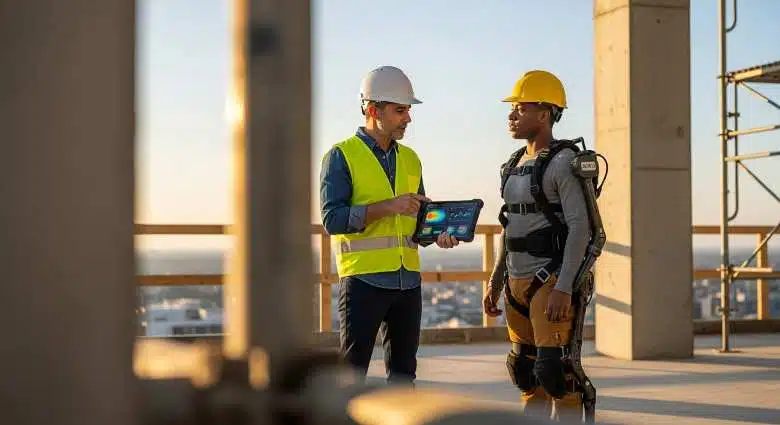
This guide walks you through a practical framework for adopting exoskeletons and biometric sensors on construction sites. Studies confirm that injury prevention tools reduce strain across hazardous industries. By implementing these data-driven solutions, you can protect your crew and get a measurable return on investment.
The Economics and Reality of Construction Site Risks in 2026
Hidden Costs of Safety Failures
Sticking with outdated safety protocols takes a brutal toll, both human and financial. In 2023, the private industry saw 2.6 million nonfatal workplace injuries alongside 5,283 fatal work incidents. The most expensive workers’ comp claims involve severe trauma: amputations average $102,500, and dislocations run about $97,100.
Those kinds of events don’t just hurt people. They blow up project timelines and inflate insurance premiums for years.
Knowing which types of accidents happen most often helps you spend your safety budget more wisely. The top drivers of workers’ comp claims are: overexertion (32%), slips, trips, and falls (27%), and equipment collisions (12%). Despite decades of regulatory progress, construction accounts for nearly 20% of all workplace fatalities. Treating safety as a reactive expense instead of a proactive investment virtually guarantees ongoing losses.
From Reactive to Predictive Safety
The industry is moving away from relying solely on human supervisors for safety oversight. And for good reason. Human-only supervision creates dangerous visibility gaps that delay emergency responses. Predictive safety uses the Internet of Things (IoT), meaning connected sensors and devices, to spot hazards before incidents actually occur.
High-risk industries are already adopting autonomous robotics and monitoring to replace manual periodic audits. Recent incidents involving toxic gas and heat stress at industrial sites only reinforce the urgency. Equipping crews with connected devices means supervisors get critical alerts instantly, not hours later. That transforms raw site data into a genuine risk mitigation tool.
Selecting and Deploying the Right Wearable Technology
Exoskeletons and Biometric Sensors
Not sure which wearables actually deliver results? Start with the two categories offering the highest measurable safety ROI. Exoskeletons directly address the 32% of injuries caused by overexertion and heavy lifting. And biowearable sensors track fluid loss, electrolyte balance, and skin temperature in real time, catching invisible risks like heat stress before they cause shutdowns.
Frontline workers back this up. Recent National Safety Council findings show that over 80% of employees report less physical strain when using injury-prevention tech. Workers using tech to prevent MSDs (musculoskeletal disorders) also demonstrated better posture and sharper risk awareness.
Then there’s the emergency response angle. Modern wearables like the SlateSafety Band V2 use high-fidelity accelerometers and advanced edge processing to distinguish between standard job-site movements and actual medical emergencies. By filtering out the ‘noise’ of routine stumbles, the system eliminates the alarm fatigue that plagues older safety tech, ensuring that emergency responses are triggered only when a worker truly needs intervention.
AI-Powered Smart PPE and Site Monitoring
Traditional personal protective equipment is evolving into something far more active. Smart boots and AI-linked cameras now create closed-loop systems that detect intrusions into danger zones and send instant haptic feedback to workers, actively preventing collisions with heavy machinery. Currently, 40% of construction leaders say AI improves both worker safety and operational efficiency.
The market is expanding to match. Analysts forecast significant growth in smart safety shoes, driven by footwear that detects slip risks and monitors fatigue in real time. Investing in these platforms now positions you ahead of tightening regulations. Plus, it turns your safety program from an administrative chore into a genuine competitive edge.
| Capability | Traditional PPE | AI-Enabled Smart Wearables | Operational Impact |
| Hazard detection | Passive; protects on impact | Active; predicts and alerts before impact | Up to 50% fewer severe incidents |
| Data collection | None | Real-time biometrics, GPS, movement | Targeted ergonomic adjustments |
| Fatigue monitoring | Supervisor visual estimation | Continuous physiological tracking | Prevents overexertion and downtime |
| Incident reporting | Manual, post-accident paperwork | Automated tracking with instant alerts | Lower liability, streamlined compliance |
Implementation Framework
Rolling out smart safety tech takes a structured approach; you don’t want to disrupt active project timelines. The Association of Builders and Contractors Carolinas reported reductions of up to 50% in incidents through technology adoption. So how do you get there? Here’s the step-by-step protocol:
- Conduct a site-specific risk audit. Dig into your historical injury data. Figure out whether overexertion, falls, or machinery collisions are your biggest cost drivers.
- Select targeted technology vendors. Partner with providers offering certified IoT penetration testing. This ensures device reliability in GPS-denied zones and prevents critical signal dropouts.
- Launch a focused pilot program. Deploy wearables (smart safety shoes, biometric sensors, etc.) to a small, high-risk crew first. Don’t try a site-wide rollout on day one.
- Analyze real-time data outputs. Evaluate telemetry over a 30-day period to measure reductions in fatigue markers and minor hazard encounters.
- Scale and standardize. Roll the proven tech into your standard operating procedures and expand across all active job sites. Adjust procurement budgets accordingly.
Combining Tech Innovation with Administrative Safety Nets
Getting Worker Buy-In
Spending money on wearables means nothing if your crew doesn’t trust or use them. Sound familiar? Project managers need to address the surveillance concern head-on. Industry leaders endorse coaching tools over punitive tracking systems, and the results speak for themselves.
Suffolk Construction, for example, used video coaching platforms to highlight exemplary safety behaviors. The result: four times fewer claims and significantly lower incurred losses. Rewarding safe habits builds a resilient culture that drastically outperforms old-school penalty-based enforcement. Clear communication helps workers understand that the tech exists to protect their health, not monitor their bathroom breaks.
Administrative Preparedness for Emergencies
Even with the best tech in place, accidents still happen. Smart project managers know this and plan accordingly. Technology mitigates risk, but it doesn’t eliminate every hazard on a job site. You need a solid administrative safety net ready to go when something goes wrong. State laws require employers to provide specific workers’ compensation coverage.
When a severe accident bypasses your technological defenses, management must quickly execute medical response protocols. Injured workers need guidance through local compensation systems that cover medical expenses and lost wages. Make sure your administrative team is well-versed in the types of benefits for workplace injuries available under state law. That knowledge helps you support affected personnel and maintain operational stability during a crisis.
Executing the 2026 Safety Strategy
The most effective approach for 2026 combines advanced biometrics, AI-driven hazard detection, and strong administrative protocols. Data-backed safety programs lower insurance premiums and prevent the kind of catastrophic delays that sink projects. With the U.S. economy absorbing $176.5 billion in annual workplace injury costs, the urgency couldn’t be clearer.
Start by auditing your current safety expenditures to spot gaps where technology can help. Then implement one pilot program using predictive wearable tech in your next operational quarter. Taking action now protects your workforce and fortifies your balance sheet against future liabilities. The global smart PPE market is expanding rapidly, and getting ahead of regulatory demands gives you a real edge over competitors still relying solely on clipboards and hard hats.
Related Posts:
- The Future of Worker Safety: Construction Mental Health Wearables
- How Smart Helmets and Wearable Tech Are Revolutionizing Safety on Construction Sites
- Top 5 Innovations That Are Rapidly Changing the Construction Industry
- Why Construction Safety is Important: Essential Insights
