
Last Updated on June 26, 2026 by Admin
Filtration rarely gets attention until something goes wrong. A contaminated fluid line, a system failure mid-production, a filter element that’s been underperforming for months without anyone catching it. In industrial operations, that pattern is more common than most engineers care to admit. Contamination control is one of the more technically demanding disciplines in fluid systems management, and yet it’s often treated as an afterthought until the consequences show up in downtime logs or component replacement costs.
ConstructionCareerHub App is LIVE — built ONLY for construction careers. Don’t apply with a weak resume.
Get ATS-ready Resume Lab + Interview Copilot + Campus Placement Prep (resume screening, skill gaps, interview readiness) — in minutes & Other advanced features.
Explore Smarter Construction Career Tools →Quick check. Big impact. Start now.
That’s precisely why engaging a filtration specialist early matters. And when it comes to application-specific filtration guidance, Parker Hannifin’s depth of product expertise and technical support infrastructure makes them a practical starting point.
Table of Contents
What Genuine Expert Guidance Looks Like
There’s a meaningful difference between a sales conversation and a technical consultation. A qualified filtration expert will ask about your system before recommending anything: fluid type, operating pressure, flow rate, contamination targets, and the specific cleanliness standards your application is held to. These aren’t formalities. They’re the variables that determine whether a filter performs as expected or introduces new failure modes.
Parker’s portfolio spans hydraulic filtration, compressed air treatment, fuel filtration, and fluid conditioning systems. The breadth is an asset, but only when someone helps you navigate it with your application in mind. Without that context, the catalog is just a long list of part numbers.
Why Parker’s Technical Range Is Worth Understanding
Parker Hannifin has over a century of engineering behind its filtration product lines. The Parker Finite compressed air filters, for example, are designed around specific contamination challenges: water aerosols, oil vapor, and solid particulates at defined removal ratings. The Velcon and Racor fuel filtration series address water separation and particulate control with a level of application specificity that general-purpose alternatives tend to lack.
What often gets underweighted in procurement decisions is the importance of matching product specifications to actual operating conditions. A Parker specialist will factor in ISO cleanliness codes, differential pressure tolerances, and flow rate requirements alongside the physical constraints of your installation. Without that technical fit between product and application, even a well-manufactured filter housing won’t deliver consistent results.
The Real Cost of a Mismatched Filter
An undersized filter collapses under pressure spikes. An oversized one introduces pressure drops that tax your pump and reduce system efficiency over time. Neither failure is dramatic at first, which is part of what makes them costly. The degradation is gradual, and by the time it shows up in component wear or fluid analysis data, the damage is already compounding.
Contamination control failures carry measurable costs: unplanned downtime, accelerated component wear, fluid degradation, and in some cases, voided equipment warranties. In sectors like aerospace, pharmaceutical manufacturing, or food processing, the tolerance for contamination-related failures is essentially zero. A specialist who understands your industry’s regulatory environment and cleanliness standards brings a different kind of value than a general product recommendation.
What to Have Ready Before the Conversation
You don’t need a complete system specification to start a productive consultation. A working understanding of the following is usually sufficient:
- Application type (hydraulic, compressed air, fuel, process liquid)
- Operating conditions (pressure range, flow rate, temperature)
- Contamination targets or ISO cleanliness class requirements
- Current maintenance issues (frequent element changes, system fouling, fluid discoloration)
From there, an expert can start narrowing the field, whether that’s a Parker FH or FHE series housing, a Finite coalescing element, or a solution from the Hydraulic Filter Division range suited to your flow and pressure profile. The product families make more sense once someone is mapping them against real system parameters.
Smart Filtration and Condition Monitoring
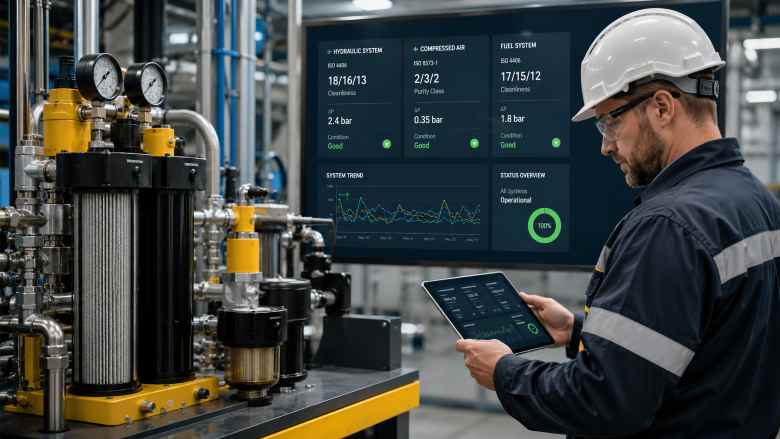
One area worth raising with any Parker specialist is condition monitoring integration. Parker has been developing sensor-enabled filtration systems that connect to broader monitoring platforms, allowing maintenance teams to track filter loading in real time rather than relying on fixed replacement intervals. For high-criticality applications or systems with variable operating loads, this shift from scheduled to condition-based maintenance has demonstrated measurable reductions in both element consumption and unplanned downtime.
Not every application justifies the investment. But it’s a relevant question to put on the table, particularly if your current maintenance model is largely reactive.
Remote or On-Site: Both Have Their Place
A full on-site assessment isn’t always necessary to get solid filtration guidance. Parker’s distributor network and direct technical support channels are well-resourced, and working with authorized Parker filtration distributors is often the fastest route to both product availability and application-specific guidance. A good specialist can work from system schematics, maintenance records, and fluid analysis reports without needing to be on the floor.
That said, complex installations or applications with persistent contamination issues often benefit from a physical walkthrough. Signs of bypass wear, seal degradation, or installation constraints that affect filter sizing aren’t always visible in documentation. For those cases, the on-site assessment pays for itself quickly.
Getting to the Right Recommendation
Choosing the right Parker filtration solution requires a clear picture of your system, honest clarity about where your current setup is falling short, and access to someone who can translate that information into a well-matched product recommendation. The conversation tends to be more straightforward than engineers expect, and the outcome, a filter configuration that’s properly sized, rated, and suited to your contamination targets, is worth the time it takes to get there.
Related posts:
- How the Right Compressed Air and Nitrogen Gas Piping Choices Contribute to Sustainable Industrial Growth
- The Critical Benefits of Installing a Shower Filter
- Construction Debris Removal: Complete 2026 Cost Guide & Strategic Options
- How to handle water scarcity during the summer season in complex apartments?
- Textbooks and Reference Books on Fluid Mechanics
