
Last Updated on May 18, 2026 by Admin
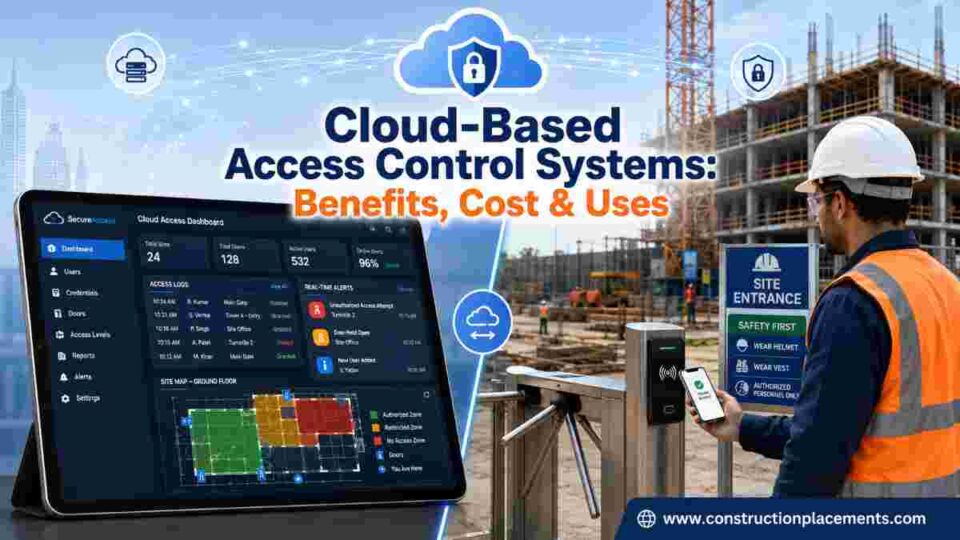
Construction sites, commercial buildings, and smart infrastructure projects are rapidly moving away from traditional lock-and-key security toward intelligent, internet-connected alternatives. Cloud-based access control systems have emerged as a transformative solution, enabling project managers, facility operators, and security teams to manage entry points remotely, monitor real-time activity, and scale security across multiple locations — all without maintaining expensive on-premise servers.
ConstructionCareerHub App is LIVE — built ONLY for construction careers. Don’t apply with a weak resume.
Get ATS-ready Resume Lab + Interview Copilot + Campus Placement Prep (resume screening, skill gaps, interview readiness) — in minutes & Other advanced features.
Explore Smarter Construction Career Tools →Quick check. Big impact. Start now.
The global cloud-based access control market was valued at approximately USD 4.2 billion in 2024 and is projected to reach USD 12.8 billion by 2033, growing at a CAGR of 14.8% (Market Trends Analysis). Meanwhile, the broader Access Control as a Service (ACaaS) market is expected to expand from USD 2.37 billion in 2026 to USD 8.98 billion by 2035, driven by enterprise cloud adoption and digital identity management (Global Growth Insights).
Whether you are a construction professional, building manager, or security technology specialist, understanding cloud-based access control is now essential. In this comprehensive guide, we break down what these systems are, how they work, their benefits and costs, real-world uses in the construction industry, and what the future looks like in 2026 and beyond.
Table of Contents
What Are Cloud-Based Access Control Systems?
A cloud-based access control system is a modern security solution that uses software hosted on remote cloud servers — rather than local on-premise hardware — to manage, monitor, and control who can enter physical spaces such as buildings, construction sites, data centres, and restricted zones.
Unlike traditional systems that store access data on a local server inside the building, cloud-based platforms store all information — including user credentials, access logs, and security policies — on secure cloud infrastructure maintained by the service provider. Administrators can manage access permissions, view audit trails, and receive real-time alerts from any internet-connected device, whether a laptop, tablet, or smartphone.
How Cloud-Based Access Control Works
The architecture of a cloud-based access control system involves three key pillars:
- Authentication: A credential is presented at a door or entry point — this could be a smart card, mobile phone, PIN code, biometric scan (fingerprint, facial recognition), or NFC-enabled wristband.
- Authorization: The reader sends the credential data to the cloud server, which checks it against stored permission rules and determines whether access should be granted or denied.
- Access Decision: The cloud server sends a response back to the reader or controller in milliseconds, unlocking or keeping the door locked accordingly.
This entire process happens in real time. Because the intelligence sits in the cloud, system updates, new user provisioning, and policy changes are pushed instantly across all connected doors and sites — without anyone needing to physically visit the location.
Cloud-Based vs Traditional Access Control: Key Differences
Understanding how cloud-based systems differ from traditional (on-premise) access control is critical for making the right investment decision.
| Feature | Traditional (On-Premise) | Cloud-Based |
|---|---|---|
| Data Storage | Local server on-site | Remote cloud servers |
| Remote Management | Limited or none | Full remote access via web/mobile |
| Software Updates | Manual, on-site | Automatic, over-the-air |
| Scalability | Requires new servers/licenses | Add doors/sites with a few clicks |
| Upfront Cost | High (hardware + installation) | Lower (subscription model) |
| Integration | Complex, limited APIs | Open APIs, IoT/BIM-ready |
| Maintenance | In-house IT team required | Managed by provider |
| Disaster Recovery | Risk of data loss if server fails | Built-in redundancy and backups |
For construction companies managing multiple project sites across different cities or countries, cloud-based access control eliminates the need to maintain separate server infrastructure at every location — a significant advantage over legacy systems.
Top Benefits of Cloud-Based Access Control Systems
Cloud-based access control offers a wide range of advantages over traditional security setups. Here are the most significant benefits that make these systems indispensable in 2026:
1. Remote Access and Centralized Management
The single biggest advantage is the ability to manage all entry points — across buildings, floors, or even countries — from one web-based dashboard. Construction project managers working across multiple job sites can grant or revoke credentials, monitor real-time activity, and respond to security alerts from anywhere, without being physically present.
2. Significant Cost Savings
Cloud systems shift security spending from a large capital expenditure (CapEx) model to a predictable monthly subscription (OpEx). There are no upfront server purchases, no on-site IT maintenance costs, and no manual software upgrade expenses. For small and mid-size construction firms, this reduces the financial barrier to adopting professional-grade security.
3. Effortless Scalability
Need to add 50 new doors across a new construction site? Cloud-based systems make scaling up (or down) seamless. You simply add new readers and connect them to the cloud — no new servers, no re-wiring, no licence negotiations. This is especially valuable in construction, where projects are temporary and workforce size fluctuates constantly.
4. Automatic Software Updates and Patches
Cloud providers handle all software updates, security patches, and feature enhancements automatically. This means your system is always running the latest version, with the newest security protections, without any downtime or IT intervention.
5. Enhanced Security and Data Protection
Reputable cloud access control platforms use enterprise-grade encryption (AES-256), multi-factor authentication (MFA), and data redundancy across geographically distributed data centres. This often provides stronger security than a local server sitting in an on-site IT closet. According to a 2026 industry survey, approximately 54% of organizations express concerns about safeguarding biometric data, which is driving adoption of encrypted cloud platforms over on-premise alternatives (Global Growth Insights).
6. Real-Time Monitoring and Alerts
Cloud platforms provide real-time visibility into every access event. If an unauthorized access attempt occurs at 2 AM on a remote construction site, the system immediately alerts the designated security contact via push notification, email, or SMS — enabling rapid incident response.
7. Seamless Integration with Other Systems
Modern cloud-based access control platforms integrate with CCTV/video surveillance, visitor management systems, HR and payroll software, Building Information Modeling (BIM) platforms, IoT sensor networks, and fire alarm or evacuation systems. This creates a unified, intelligent security ecosystem rather than isolated silos of technology.
8. Detailed Audit Trails and Compliance
Every access event is logged automatically in the cloud — who entered, where, when, and for how long. These detailed audit trails are invaluable for regulatory compliance (OSHA, ISO 27001, GDPR, NIS2), incident investigation, and insurance documentation.
How Much Do Cloud-Based Access Control Systems Cost?
Cost is one of the most common questions construction professionals and facility managers ask. Cloud-based access control pricing typically follows a subscription-based model, though hardware costs still apply upfront. Here is a general breakdown:
Typical Cost Components
| Cost Component | Estimated Range (USD) |
|---|---|
| Cloud-based reader (per door) | $300 – $1,500 |
| Controller hardware | $500 – $2,000 |
| Electronic lock/strike | $150 – $600 |
| Monthly software subscription (per door) | $5 – $25/month |
| Professional installation (per door) | $200 – $500 |
| Mobile credential licences | $1 – $5 per user/month |
| Biometric reader add-on (per unit) | $1,000 – $3,500 |
Cost Comparison: Cloud vs On-Premise (5-Year TCO)
For a mid-size commercial building with 20 access-controlled doors:
- Traditional on-premise system: $40,000 – $80,000 (including server hardware, licences, installation, and five years of maintenance contracts)
- Cloud-based system: $20,000 – $45,000 (including hardware, installation, and five years of subscription fees)
The cloud model typically delivers 30–50% lower total cost of ownership over five years, primarily because it eliminates the need for on-site servers, dedicated IT staff for maintenance, and manual software updates. The subscription model also shifts costs from unpredictable CapEx to manageable OpEx, improving cash flow management for construction firms.
Real-World Uses of Cloud-Based Access Control in Construction
The construction industry presents unique security challenges — temporary project sites, large rotating workforces, valuable equipment, and strict safety regulations. Cloud-based access control addresses these challenges effectively:
1. Construction Site Perimeter Security
Cloud-connected turnstiles, gate barriers, and card readers installed at site entry points ensure only authorised workers, subcontractors, and visitors can enter. When a subcontractor’s engagement ends, their credentials can be instantly revoked from the cloud dashboard — no need to collect physical keys or cards.
2. Worker Time and Attendance Tracking
Cloud access control doubles as a digital time-tracking system. Every badge tap at the turnstile creates an automatic timestamp, eliminating manual sign-in sheets. This data feeds directly into payroll and project management systems, improving accuracy and reducing disputes over hours worked.
3. Safety Compliance and Induction Verification
Construction sites require workers to complete safety inductions and hold valid certifications (such as CSCS cards in the UK or OSHA training in the US). Cloud-based systems can be programmed to deny access to any worker whose safety certification has expired or who has not completed site-specific induction training — automating a critical compliance check.
4. Multi-Site Project Management
A construction company managing projects in Dubai, Mumbai, and London can monitor and control access across all three sites from a single cloud platform. Zone-specific rules can be configured — for example, crane operators only get access to designated crane zones, while safety officers get access to all areas. Learn more about managing multi-site operations in our guide on smart construction technology.
5. Emergency Evacuation and Mustering
In the event of a fire, structural collapse, or chemical spill, knowing exactly who is on site is literally a life-saving capability. Cloud-based systems provide real-time headcounts and mustering reports, enabling emergency coordinators to quickly determine if anyone is unaccounted for.
6. Equipment and Material Theft Prevention
Construction site theft costs the industry an estimated USD 1 billion annually in the United States alone. Cloud-based access control, integrated with CCTV and asset-tracking sensors, creates a comprehensive security layer. Any unauthorized after-hours access attempt triggers instant alerts to the project manager and remote monitoring centre.
7. Visitor and Delivery Management
Visitors, inspectors, and delivery drivers can be pre-registered in the cloud system and issued temporary digital credentials (QR codes or mobile passes) that expire automatically after a set time. This eliminates the bottleneck of manual visitor sign-in at busy construction site gates.
Key Technologies Driving Cloud Access Control in 2026
Several converging technologies are accelerating the adoption and capability of cloud-based access control systems:
Mobile Credentials and Smartphone Access
Physical key cards and fobs are increasingly being replaced by smartphone-based credentials using Bluetooth Low Energy (BLE) and Near-Field Communication (NFC). Workers simply hold their phone near a reader to gain access. Mobile credential usage has increased by nearly 46% across enterprise deployments, making it one of the fastest-growing credential types.
Biometric Authentication
Facial recognition, fingerprint scanning, and palm-vein recognition are being integrated into cloud access control platforms for high-security zones on construction sites — such as server rooms in data centre construction projects or explosive storage areas in mining operations.
AI-Powered Anomaly Detection
Artificial intelligence analyses access patterns and flags unusual activity automatically. For example, if a worker who normally enters a site at 7 AM suddenly badges in at 3 AM on a Sunday, the system raises an alert for investigation. AI-driven analytics also predict potential security breaches before they occur.
IoT and Sensor Integration
Cloud access control platforms are integrating with IoT sensors used in construction — including environmental monitors, wearable safety devices, and equipment trackers — creating a connected job site where security, safety, and operations data converge on a single platform.
Zero Trust Architecture
The cybersecurity principle of “never trust, always verify” is being applied to physical access control. Rather than granting blanket access once a credential is verified, zero-trust systems continuously evaluate context — location, time, device, behaviour — before allowing each individual access event. This approach aligns with frameworks like NIST SP 800-207.
Digital Twins for Security Modelling
Advanced construction firms are integrating access control data into digital twin models of their buildings. This enables simulation of evacuation scenarios, security breach responses, and space utilisation analysis — all powered by real access data from the cloud.
Leading Cloud-Based Access Control Platforms
The following platforms are among the most widely adopted cloud-based access control solutions in the construction and commercial building sectors in 2026:
- Brivo: One of the pioneers in cloud-based access control, serving over 300 million square feet of commercial space globally. Known for open API integrations and mobile credential support.
- Verkada: Combines cloud access control with video surveillance and environmental sensors in a unified platform. Popular in commercial real estate and education sectors.
- Openpath (by Motorola Solutions): Offers touchless smartphone-based access with encrypted cloud management. Strong in multi-tenant commercial buildings.
- Acre Security: A comprehensive cloud-native platform supporting access control, visitor management, and intrusion detection — suitable for single buildings and large-scale enterprise operations.
- SALTO KS (Keys as a Service): A cloud-based solution that integrates with SALTO’s extensive electronic lock hardware portfolio. Widely used across Europe and Asia.
- Kisi: A modern cloud access control platform popular with co-working spaces, technology companies, and multi-site commercial operations.
- Honeywell MAXPRO Cloud: Enterprise-grade cloud access control from one of the world’s largest building technology companies, supporting complex multi-site deployments.
When evaluating platforms, construction professionals should consider factors such as support for ruggedised outdoor hardware, integration with existing site management tools, compliance with regional data privacy regulations, and scalability for temporary project deployments.
Cloud-Based Access Control for Smart Buildings and Smart Cities
Cloud-based access control is a foundational component of smart building solutions. In smart commercial buildings, access data integrates with HVAC, lighting, and space management systems to create responsive environments. When a worker badges into a floor, the system can automatically adjust the temperature, turn on the lights, and activate ventilation — reducing energy waste.
At the smart city level, cloud-based access control enables municipalities and developers to manage access across public infrastructure, transportation hubs, government buildings, and critical facilities from centralised command centres. The Middle East, in particular, is projected to experience 9.22% CAGR growth through 2031 in access control adoption, driven by government-backed smart city investments like NEOM in Saudi Arabia and Abu Dhabi’s digital infrastructure programmes (Mordor Intelligence).
For construction professionals working on smart city infrastructure, understanding cloud-based access control is becoming a core skill requirement. Explore related career paths in our guide on how to become a Smart Building Specialist.
Cybersecurity Considerations for Cloud Access Control
Moving access control to the cloud introduces cybersecurity considerations that must be addressed. Cybersecurity in construction is no longer optional — it is a core operational requirement.
Key cybersecurity best practices for cloud-based access control include:
- End-to-end encryption: All data transmitted between readers, controllers, and cloud servers should use TLS 1.3 or higher.
- Multi-factor authentication (MFA): Administrators accessing the cloud management portal should use MFA to prevent unauthorised system changes.
- Role-based access control (RBAC): Limit administrative privileges based on role — a site supervisor should not have the same system permissions as a company-wide security director.
- Regular penetration testing: Ensure your cloud provider conducts regular third-party security audits and penetration tests.
- Data residency compliance: Verify that your provider stores access data in compliance with relevant data protection laws (GDPR in Europe, India’s DPDP Act, etc.).
- OSDP protocol support: Open Supervised Device Protocol (OSDP) provides secure, encrypted communication between card readers and controllers, replacing the outdated and vulnerable Wiegand protocol.
Career Opportunities in Cloud-Based Access Control
The rapid adoption of cloud-based access control systems is creating significant career opportunities across the construction and security technology sectors:
In-Demand Roles
- Access Control Systems Engineer: Designs, installs, and configures cloud-based access control systems for commercial buildings and construction projects. Average salary: USD 65,000 – $95,000 per year.
- Security Systems Integrator: Integrates access control with CCTV, fire alarm, BIM, and IoT systems. Average salary: USD 70,000 – $110,000 per year.
- Smart Building Technology Manager: Oversees all connected building systems, including access control, energy management, and occupancy monitoring. Average salary: USD 90,000 – $140,000 per year.
- Construction Site Security Manager: Manages physical and digital security across one or more construction projects. Average salary: USD 60,000 – $90,000 per year.
- IoT Solutions Architect (Construction): Designs connected infrastructure including access control, sensors, and cloud platforms for smart construction environments. Average salary: USD 100,000 – $160,000 per year.
For construction professionals looking to pivot into these technology-driven roles, platforms like ConstructionCareerHub.com offer AI-powered career planning tools, resume optimization, and interview preparation specifically designed for the construction industry.
Relevant Certifications
To build credibility in this space, consider pursuing the following certifications:
- PSP (Physical Security Professional) – offered by ASIS International
- CPP (Certified Protection Professional) – also from ASIS International
- CompTIA Security+ – for foundational cybersecurity knowledge
- CCNA (Cisco Certified Network Associate) – for understanding network infrastructure
- LEED AP – for professionals working on smart, sustainable buildings
Implementation Best Practices
Successfully deploying a cloud-based access control system on a construction project or commercial building requires careful planning. Here are proven best practices:
Step 1: Conduct a Security Assessment
Assess the site’s specific security requirements — number of entry and exit points, workforce size, high-security zones, regulatory obligations, and existing infrastructure. For construction sites, evaluate whether the system needs to withstand outdoor conditions, dust, and vibration.
Step 2: Choose the Right Hardware
Select ruggedised readers and controllers rated for outdoor/construction environments (IP65 or higher ingress protection rating). Ensure the hardware supports modern protocols like OSDP and is compatible with mobile credentials.
Step 3: Define Access Policies
Create clear access hierarchies — who can access which zones, during what hours, and under what conditions. Construction sites should map access policies to project phases: during demolition, only demolition crews should access active zones; during finishing works, different trades gain access to completed areas.
Step 4: Integrate with Existing Systems
Connect the access control platform with your project management software, HR/payroll systems, video surveillance, and other construction technologies already in use. Open API support is essential for seamless integration.
Step 5: Train Your Team
Ensure site supervisors, security personnel, and administrative staff are trained on the cloud dashboard, mobile app, and emergency procedures. A system is only as effective as the people using it.
Step 6: Monitor, Review, and Optimise
Use the platform’s analytics to continuously review access patterns, identify bottlenecks (such as long queues at turnstiles during shift changes), and optimise system settings. Track key performance indicators related to construction site safety and efficiency.
Common Challenges and How to Overcome Them
While cloud-based access control offers numerous advantages, organisations should be aware of potential challenges:
| Challenge | Solution |
|---|---|
| Internet dependency | Choose systems with offline failover — readers should cache recent credentials locally and continue operating during network outages. |
| Data privacy concerns | Select providers that offer data residency options, end-to-end encryption, and compliance with GDPR, DPDP, and other regional regulations. |
| Harsh construction site conditions | Use IP65-rated, ruggedised hardware designed for outdoor environments with dust, rain, and temperature extremes. |
| Resistance to change from workforce | Provide training and demonstrate how the system simplifies daily processes (no more lost key cards, instant access for new starters). |
| Vendor lock-in | Choose platforms with open APIs and support for industry-standard protocols (OSDP, ONVIF) to maintain flexibility. |
Future Trends: Where Cloud Access Control Is Heading
Looking ahead, several trends will shape the next generation of cloud-based access control:
- Passwordless and cardless access: The transition to fully mobile and biometric credentials will accelerate, eliminating physical tokens entirely.
- AI-driven predictive security: Machine learning algorithms will move from reactive alerting to predictive threat modelling, anticipating security incidents before they happen.
- Sustainability integration: Access control data will feed into building energy management systems to reduce carbon footprints — occupied floors get climate control, empty floors go into standby mode.
- Edge computing: Processing will shift partially to edge devices (at the reader/controller level), reducing latency and improving offline resilience while maintaining cloud-based central management.
- Regulatory convergence: The European NIS2 directive and similar regulations globally will mandate multi-factor authentication and tamper-resistant audit trails at physical entry points, accelerating cloud adoption for compliance.
- Construction-specific platforms: Purpose-built cloud access control platforms for construction sites — combining security, safety compliance, workforce management, and asset tracking — will emerge as a distinct product category.
Recommended Resources for Further Learning
Online Courses
- Introduction to the Internet of Things (IoT) – Coursera
- Cybersecurity Fundamentals – edX
- Building Management Systems (BMS) – Udemy
- Cloud Computing Concepts – Coursera
Ebooks for Construction Professionals
- The Complete Civil Engineering Career Guide
- Construction Interview Questions & Answers Handbook
- Construction Career Essentials Bundle
- Remote & International Construction Jobs Guide
Build Your Construction Career with AI-Powered Tools
As construction technology roles continue to expand, having the right career tools matters more than ever. ConstructionCareerHub.com provides AI-powered Resume Lab, Interview Copilot, Career Planner, and Salary Calculator — all purpose-built for construction professionals navigating the industry’s digital transformation.
Frequently Asked Questions (FAQs)
What is a cloud-based access control system?
A cloud-based access control system is a security solution that uses internet-connected software hosted on remote cloud servers to manage who can enter physical spaces. Unlike traditional systems that rely on local servers, cloud-based platforms allow administrators to control, monitor, and modify access permissions from any device with internet access.
How much does a cloud-based access control system cost?
Costs vary based on the number of doors, credential types, and features required. Typical hardware costs range from USD 300 to $1,500 per door for readers, plus USD 5 to $25 per door per month for the cloud software subscription. Over five years, cloud systems generally cost 30–50% less than traditional on-premise alternatives when total cost of ownership is considered.
Are cloud-based access control systems safe?
Yes, when implemented correctly. Leading platforms use AES-256 encryption, multi-factor authentication, OSDP-secure reader communication, and data redundancy across multiple data centres. Many cloud solutions are more secure than traditional on-premise systems, which are often left unpatched and physically vulnerable.
Can cloud-based access control work on construction sites?
Absolutely. Cloud-based access control is increasingly used on construction sites for perimeter security, worker time tracking, safety compliance verification, and theft prevention. Systems with ruggedised outdoor hardware (IP65-rated) and offline failover capability are specifically designed for the demanding conditions of construction environments.
What happens if the internet goes down?
Most modern cloud-based access control systems include offline failover functionality. Readers and controllers cache recent credential data locally, so they continue to authenticate authorised users even during internet outages. Once connectivity is restored, all access events sync back to the cloud automatically.
How does cloud access control integrate with BIM?
Cloud access control data can be integrated with Building Information Modeling (BIM) platforms and digital twins. This allows construction teams to visualise access zones within the 3D building model, simulate evacuation scenarios, and correlate occupancy data with facility management insights.
Which industries benefit most from cloud-based access control?
Industries with the highest adoption rates include commercial real estate, construction, healthcare, education, government, data centres, and co-working/flexible office spaces. Any industry requiring multi-site management, high workforce turnover, or strict compliance reporting benefits significantly from cloud-based solutions.
Is cloud-based access control suitable for small construction firms?
Yes. The subscription-based pricing model makes cloud access control accessible to smaller firms that may not have the budget for a large on-premise server installation. Many platforms offer entry-level plans that scale as the business grows.
Also read: Top Safety Protocols & Trends in Construction | Construction Safety Jobs: Ensuring Site Safety
Disclaimer: The information provided in this article is for educational and informational purposes only. Product pricing, market data, and platform features are based on publicly available sources as of May 2026 and may change. Always verify current specifications and pricing directly with vendors before making purchasing decisions.
