

Last Updated on July 17, 2026 by Admin
Construction businesses are profitable on paper and broke in practice more often than most people realize. A subcontractor completes electrical rough-in on a commercial building, submits an approved payment application, and waits 45 to 90 days for the general contractor to release funds. Meanwhile, payroll is due Friday, the material supplier wants payment in 15 days, and the next project needs mobilization capital now.
ConstructionCareerHub App is LIVE — built ONLY for construction careers. Don’t apply with a weak resume.
Get ATS-ready Resume Lab + Interview Copilot + Campus Placement Prep (resume screening, skill gaps, interview readiness) — in minutes & Other advanced features.
Explore Smarter Construction Career Tools →Quick check. Big impact. Start now.
Construction invoice factoring addresses this timing gap by converting approved receivables into immediate working capital — typically within 24 to 48 hours — without adding traditional debt to the contractor’s balance sheet. This guide explains how factoring works for U.S. construction companies, what it costs, which providers serve the industry, and how to evaluate whether factoring is a sound financial decision for your business.
For a broader perspective on managing construction company finances, see our construction finance management guide.
Table of Contents
Quick Answer: What Is Construction Invoice Factoring?
Construction invoice factoring is a financing arrangement in which a contractor sells approved, undisputed invoices to a factoring company (called a factor) at a discount in exchange for an immediate cash advance. The factor typically advances 70% to 90% of the eligible invoice value within one to two business days. When the contractor’s customer pays the invoice in full, the factor deducts its fee and releases the remaining reserve balance to the contractor. Factoring is not a loan — it is the sale of an accounts receivable asset.
What Is Construction Invoice Factoring?
Invoice factoring for contractors is a form of accounts receivable financing specifically structured around the payment realities of the construction industry. Unlike generic small-business factoring, construction factoring must account for progress billing, retainage holdbacks, change orders, lien waivers, payment applications, and multi-tier payment chains that do not exist in most other industries.
In a standard factoring arrangement, a contractor sells a verified receivable — an approved invoice for completed work — to a factoring company. The factor advances a percentage of the invoice value immediately and collects payment directly from the contractor’s customer (usually a general contractor, project owner, or government agency). Once the customer pays, the factor releases the remaining balance minus its fee.
The critical distinction is that factoring companies underwrite the creditworthiness of the contractor’s customer, not the contractor’s own credit score. A subcontractor with limited credit history but strong receivables from a creditworthy general contractor may qualify for factoring even when traditional bank financing is unavailable.
How Construction Invoice Factoring Works
The typical construction factoring process follows these steps:
- Work completion: The contractor completes work, delivers materials, or reaches a billing milestone defined in the contract.
- Invoice submission: The contractor submits a payment application or invoice to the customer (general contractor, owner, or agency) with required documentation including schedule of values, lien waivers, and proof of completed work.
- Customer approval: The customer reviews and approves the payment application. This step is critical — most factors require an approved, undisputed invoice before advancing funds.
- Invoice assignment: The contractor submits the approved invoice and supporting documents to the factoring company.
- Verification: The factor verifies the invoice with the customer, checks customer creditworthiness, and confirms the work has been accepted.
- Advance payment: The factor advances an agreed percentage (typically 70% to 90%) of the eligible invoice amount to the contractor, often within 24 to 48 hours.
- Customer payment: The customer pays the full invoice amount to the factor (or to a designated lockbox account) according to the original payment terms.
- Reserve release: The factor deducts its fee and any agreed charges, then releases the remaining reserve balance to the contractor.
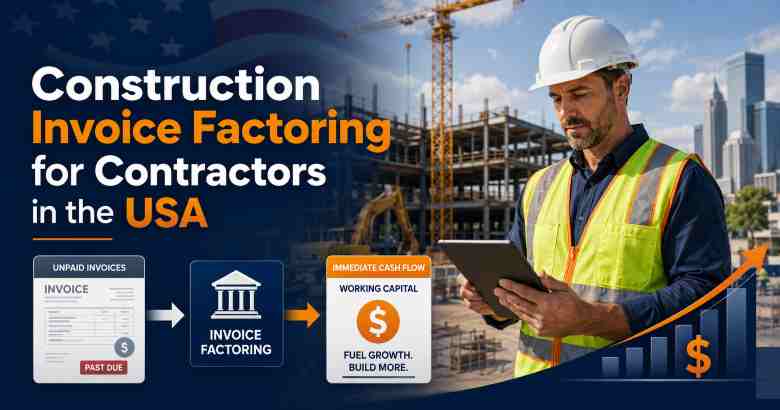
Process flow: Contractor performs work → Customer approves invoice → Factor verifies receivable → Contractor receives advance → Customer pays factor → Remaining reserve released after fees.
For detailed guidance on managing construction payment workflows and documentation, see our comparison of the best construction payment software platforms.
Construction Factoring Cost Example
The following is a hypothetical example using round numbers for illustration only. These figures are not a quote, standard market rate, or guarantee from any provider.
Scenario: A mechanical subcontractor has an approved $100,000 progress payment invoice from a creditworthy general contractor with Net 60 payment terms.
| Component | Calculation | Amount |
|---|---|---|
| Invoice value | — | $100,000 |
| Advance percentage | 85% | $85,000 |
| Reserve held | 15% | $15,000 |
| Factoring fee (3% for 60 days) | $100,000 × 3% | $3,000 |
| Final reserve payment | $15,000 − $3,000 | $12,000 |
| Total net proceeds | $85,000 + $12,000 | $97,000 |
| Total dollar cost | — | $3,000 |
Formulas:
- Initial advance = Eligible invoice value × Advance percentage
- Reserve = Eligible invoice value − Initial advance
- Final reserve payment = Reserve − Factoring fees − Other agreed charges
- Total net proceeds = Initial advance + Final reserve payment
Important cost context: A 3% fee on a 60-day invoice may appear modest, but annualized it represents approximately 18%. Contractors should compare the effective annualized cost against bank lines of credit (which may carry 8% to 14% APR) and evaluate whether the speed of capital access and lower qualification requirements justify the premium. In many construction scenarios — particularly where the alternative is missing payroll or declining profitable work — the cost is justified by the revenue it preserves.
Which Construction Invoices Can Be Factored?
Not all construction invoices are eligible for factoring. Factors typically require invoices that meet these conditions:
- The invoice represents completed, accepted, and undisputed work or delivered materials
- The customer (general contractor, owner, or government agency) has approved the payment application
- The customer is creditworthy with a history of paying invoices
- Clear payment terms are established (Net 30, Net 60, Net 90)
- No existing lien, claim, or legal encumbrance prevents assignment of the receivable
- The contract does not contain an enforceable anti-assignment clause
- Supporting documentation is complete (lien waivers, schedule of values, proof of work)
Invoices that are typically difficult or impossible to factor: unapproved payment applications, disputed invoices, change orders awaiting resolution, retainage amounts withheld until project completion, invoices for work not yet performed, residential invoices to individual homeowners, and invoices already pledged to another lender.
Why Construction Invoices Are Harder to Factor
Construction receivables receive more underwriting scrutiny than invoices in most other industries. The reasons are structural:
Progress billing complexity: Unlike a manufacturer shipping a product with a clean invoice, construction invoices are based on percentage-of-completion or milestone billing. The factor must verify that the billed work has actually been completed and accepted.
Retainage: General contractors and owners routinely withhold 5% to 10% of each progress payment until substantial completion. Most factors will not advance against retainage because it is not due until project completion — which may be months or years away. The effective advance is therefore against only the 90% to 95% of the invoice that is not retainage.
Multi-tier payment chains: In construction, a subcontractor invoices the GC, who invoices the owner, who may require architect certification. Delays at any level affect payment timing and risk.
Change orders and disputes: Construction projects frequently involve scope changes, back charges, punch-list items, and defective-work allegations. Any of these can reduce or delay payment on an otherwise approved invoice. For guidance on managing these situations, see our construction claims management guide.
Pay-if-paid and pay-when-paid clauses: Some subcontracts contain provisions that delay or eliminate the GC’s obligation to pay until the GC receives payment from the owner. These clauses create additional risk for factors.
Lien rights and notice requirements: Construction payment involves mechanics lien rights, preliminary notices, and bond claims with strict deadlines. Factoring an invoice does not automatically preserve these rights, and an assignment may complicate the contractor’s ability to pursue certain remedies.
How Much Does Construction Invoice Factoring Cost?
Construction factoring fees are among the highest in the factoring industry, reflecting the complexity and risk involved. Based on current industry data, typical cost ranges include:
- Factoring fee (discount rate): 1% to 5% per invoice, with construction-specific factors often in the 2% to 4% per 30-day range
- Advance rate: 70% to 90% of the eligible invoice value (after retainage deduction)
Beyond the headline factoring fee, contractors should ask about additional charges that can affect total cost: origination fees, due-diligence fees, credit-check fees, wire or ACH transfer fees, lockbox fees, minimum monthly volume fees, UCC filing fees, aging fees (for invoices that remain unpaid beyond expected terms), early-termination fees, renewal fees, and non-recourse premiums.
Providers that do not publish rates typically provide custom quotes based on invoice volume, customer credit quality, payment terms, contract structure, and other underwriting factors.
Recourse vs. Non-Recourse Factoring
| Feature | Recourse Factoring | Non-Recourse Factoring |
|---|---|---|
| Nonpayment risk | Contractor bears risk if customer does not pay | Factor absorbs certain nonpayment risks |
| Typical obligation | Contractor must repurchase or replace unpaid invoices | Factor may absorb loss from customer insolvency |
| Covered risks | None transferred | Usually limited to customer insolvency or bankruptcy |
| Excluded risks | N/A | Disputes, back charges, offsets, defective work, fraud, dilution, contract defenses |
| Cost | Generally lower fees | Generally higher fees due to additional risk assumed |
| Best for | Contractors with creditworthy customers | Contractors wanting protection against customer insolvency |
Critical clarification: “Non-recourse” does not mean the factor absorbs every reason a customer might not pay. Most non-recourse agreements exclude commercial disputes, performance issues, invoice dilution, back charges, warranty claims, contractual offsets, and fraud. The non-recourse protection typically covers only verified customer insolvency. Contractors should read the agreement carefully and understand exactly which risks are transferred.
Benefits of Invoice Factoring for Contractors
- Faster access to working capital — often within 24 to 48 hours of submitting an approved invoice
- Improved payroll reliability even when customer payments are delayed
- Ability to purchase materials and meet supplier payment terms to negotiate better pricing
- Reduced dependence on the timing of customer payments
- Funding that may scale with the contractor’s sales volume
- Underwriting based primarily on customer creditworthiness rather than the contractor’s personal credit
- Support for business growth — ability to take on larger or additional projects
- Outsourced accounts receivable administration and customer credit monitoring
- No fixed loan repayment schedule in a conventional factoring structure
Disadvantages and Risks
- Factoring fees reduce project margins and represent a higher annualized cost than most bank financing
- Customer notification — most factors require notifying the GC or owner that payments should be directed to the factor
- Reduced control over the collections process and customer communication
- Recourse obligations if customers do not pay
- UCC-1 financing statements filed against the contractor’s receivables (or all assets)
- Personal guarantees may be required
- Minimum volume commitments and long-term contract requirements with some providers
- Restrictions on which invoices qualify — retainage, unapproved applications, and disputed amounts are typically excluded
- Potential conflicts with existing bank loans, bonding, or project contracts
- Risk of dependence on factoring as a permanent financing source rather than a temporary tool
Understanding the broader risk landscape in construction is essential when evaluating any financing decision. Our guide on insurance and liability in construction covers related risk management strategies.
Construction Factoring vs. Invoice Financing
Invoice factoring and invoice financing are different products that are frequently confused:
| Feature | Invoice Factoring | Invoice Financing |
|---|---|---|
| Structure | Sale of receivables to the factor | Loan or line of credit using receivables as collateral |
| Ownership of invoice | Factor owns the purchased invoice | Contractor retains ownership |
| Who collects payment | Factor collects from customer | Contractor collects from customer |
| Customer notification | Customer is typically notified | Customer may not be notified |
| Balance sheet treatment | Generally not recorded as debt | Recorded as a liability |
| Qualification basis | Customer creditworthiness | Contractor creditworthiness and receivables quality |
Factoring vs. Loans, Lines of Credit, and Other Alternatives
| Option | Speed | Cost | Qualification | Best Use Case |
|---|---|---|---|---|
| Invoice factoring | 1–2 days | 1–5% per invoice | Customer credit | Bridging payment gaps on approved invoices |
| Invoice financing | 1–3 days | 1–3% per month | Contractor + receivables | Maintaining customer relationship control |
| Bank line of credit | 2–6 weeks | 8–14% APR | Strong financials, credit history | Ongoing working capital for established firms |
| SBA working capital loan | 3–12 weeks | 6–10% APR | Business plan, financials, credit | Long-term capital for growth |
| Asset-based lending | 2–4 weeks | Varies by collateral | Collateral value | Firms with significant equipment or receivables |
| Equipment financing | 1–4 weeks | 5–15% APR | Equipment value, credit | Purchasing specific equipment |
| Business credit cards | Immediate | 18–24% APR | Personal/business credit | Small, short-term purchases |
| Merchant cash advance | 1–3 days | 40–150%+ effective APR | Revenue history | Last resort — high cost, aggressive repayment |
When is invoice factoring better than a loan? Factoring is typically more accessible for newer contractors, those with limited credit history, or businesses that cannot wait weeks for bank underwriting. It is also useful when a contractor needs funding that scales with invoice volume rather than a fixed credit limit.
When is a line of credit likely better? An established contractor with strong financials, good credit, and an existing banking relationship will usually pay significantly less for a bank line of credit. If the contractor qualifies for traditional financing and does not need same-day funding, a line of credit is typically the lower-cost option.
Contractors exploring business formation and financing options can find additional guidance in our construction management business guide.
Best Construction Invoice Factoring Companies in the USA
The following providers were selected because they demonstrably serve U.S. construction businesses with invoice factoring or closely related receivables financing. Inclusion does not constitute an endorsement. The “best” provider depends on your invoice volume, customer creditworthiness, project type, fee tolerance, contract requirements, and whether you need progress billing or non-recourse protection.
1. CapitalPlus Construction Services
Best for: Contractors and subcontractors who want a factor that works exclusively with the construction industry.
CapitalPlus has focused exclusively on construction factoring for over 25 years (founded 1998). The company offers invoice factoring, spot factoring, volume factoring, contract factoring, and a materials financing product. Advance rates are typically around 80%. The Knoxville, Tennessee-based company serves all U.S. states and works with general contractors, subcontractors, and specialty trades across commercial construction. CapitalPlus staff have both construction and finance backgrounds, which can be valuable when navigating progress billing, lien waivers, and payment application documentation. Pricing is quote-based and depends on contract structure and volume.
Key advantages: Construction-only focus, materials financing product, back-office support including lien monitoring.
Potential limitations: Pricing not published; best suited for commercial (not residential) contractors.
Website: capitalplus.com
2. 1st Commercial Credit
Best for: Subcontractors, infrastructure contractors, staffing companies, and suppliers with $100,000+ monthly revenue.
1st Commercial Credit operates a dedicated construction factoring division serving subcontractors, GCs (through its Vendor Pay Express product), infrastructure and civil contractors, utility and telecom contractors, suppliers, and construction staffing companies. The company requires a minimum of one year in business and $100,000 in monthly revenue from multiple clients. Approval focuses on customer creditworthiness, invoice quality, and performance history rather than the contractor’s personal credit score.
Key advantages: Broad construction specialty coverage, GC product, staffing company support.
Potential limitations: $100,000 monthly revenue minimum may exclude smaller operations.
Website: 1stcommercialcredit.com
3. Riviera Finance
Best for: Contractors who want non-recourse factoring and a company with multiple U.S. office locations.
Riviera Finance offers non-recourse invoice factoring to commercial construction companies across the United States and Canada. The company works with general construction, concrete, electrical, plumbing, HVAC, painting, landscaping, and other construction trades. Riviera emphasizes fast funding turnaround and maintains local offices in multiple states, which can facilitate face-to-face service.
Key advantages: Non-recourse option, local office network, long operating history.
Potential limitations: Rates not published; non-recourse terms should be reviewed carefully for exclusions.
Website: rivierafinance.com
4. eCapital
Best for: Larger commercial construction firms needing substantial facility sizes and government contractor financing.
eCapital is a large-scale factoring and commercial financing company that serves construction among its core industries. The company offers advances up to 100% of invoice value (terms vary), with fees typically ranging from 1% to 5%. eCapital provides 24/7 online account management, free customer credit checks through a database of over 40,000 companies, and dedicated account management. The company also has specific expertise in government contractor financing, including navigating federal payment requirements.
Key advantages: Large facility capacity, government contractor expertise, comprehensive online platform.
Potential limitations: May be better suited for mid-to-large contractors; construction is one of many industries served.
Website: ecapital.com
5. Porter Capital
Best for: Construction product manufacturers, distributors, and service providers needing flexible facility sizes up to $25 million.
Porter Capital, founded in 1991 in Birmingham, Alabama, provides invoice factoring and asset-based credit lines up to $25 million. The company publishes rates starting as low as 0.4% for high-volume clients with strong customer credit. Porter Capital has funded construction product manufacturers and serves contractors through its multi-industry factoring platform. The company emphasizes fee transparency and discloses all charges upfront.
Key advantages: Published low-end rate, high facility limits, fee transparency.
Potential limitations: Not construction-only; the 0.4% rate applies to ideal profiles and higher volumes.
Website: portercap.com
6. TCI Business Capital (Scale Funding)
Best for: Small to mid-size contractors needing month-to-month contracts without long-term commitment.
TCI Business Capital, now operating as Scale Funding, has provided factoring since 1994. The company offers facility sizes from $10,000 to $20 million per month on month-to-month contracts, allowing contractors to factor selectively without being locked into long-term agreements. TCI serves construction and several other industries, and is a bank subsidiary, providing institutional backing.
Key advantages: Month-to-month flexibility, wide facility range, bank-backed stability.
Potential limitations: Not construction-specific; rates may increase with longer customer payment terms.
Website: scalefunding.com
7. Apex Capital Corporation
Best for: Multi-trade contractors who also operate in transportation or distribution alongside construction.
Apex Capital Corporation offers construction invoice factoring with advance rates up to 90% of approved invoice value. With over 30 years of experience, the company evaluates customer credit quality and contract terms rather than the contractor’s own credit profile. Apex serves construction alongside oil and gas, manufacturing, and distribution industries.
Key advantages: Up to 90% advances, 30+ year track record, multi-industry flexibility.
Potential limitations: Best known for freight/trucking; construction is not the primary focus.
Website: apexcapitalcorp.com
8. Gulf Coast Business Credit
Best for: Established contractors who want no minimum volume requirements and professional collection practices.
Gulf Coast Business Credit offers construction invoice factoring with advances ranging from 70% to 90% of approved invoice value. The company does not impose minimum volume requirements for established clients and emphasizes professional, relationship-preserving collection practices. Funding is typically available within one to two business days after invoice verification.
Key advantages: No minimum volume for established clients, fast funding, respectful collection approach.
Potential limitations: Fee structure requires a direct quote; less public information available compared to larger providers.
Provider Comparison Table
| Provider | Best For | Construction Focus | Recourse Options | Public Pricing | Funding Speed | Key Consideration |
|---|---|---|---|---|---|---|
| CapitalPlus | All construction trades | Exclusive | Recourse | Quote-based | 24–48 hours | 25+ years construction-only |
| 1st Commercial Credit | Subs, staffing, suppliers | Dedicated division | Not disclosed | Quote-based | Days | $100K/mo revenue minimum |
| Riviera Finance | Non-recourse preference | Specialty | Non-recourse available | Quote-based | Fast (local offices) | Local office network |
| eCapital | Large contractors, govt | Multi-industry | Both available | 1–5% | 24–48 hours | Govt contractor expertise |
| Porter Capital | Manufacturers, suppliers | Multi-industry | Recourse | From 0.4% | Fast | Up to $25M facilities |
| TCI / Scale Funding | Small-mid contractors | Multi-industry | Not disclosed | Quote-based | 24 hours | Month-to-month contracts |
| Apex Capital | Multi-trade operations | Multi-industry | Not disclosed | Quote-based | Days | Up to 90% advance |
| Gulf Coast Business Credit | Established contractors | Specialty | Not disclosed | Quote-based | 1–2 days | No minimum volume |
Best Provider by Contractor Type
Best for small contractors: TCI Business Capital (Scale Funding) offers month-to-month contracts starting at $10,000, making it accessible for smaller operations. CapitalPlus also works with smaller subcontractors across most trades.
Best for subcontractors: CapitalPlus and 1st Commercial Credit both have deep experience with subcontractor payment applications, progress billing, and GC payment cycles.
Best for government contractors: eCapital has specific expertise in federal contract factoring, including navigating the Assignment of Claims Act and federal prompt payment requirements under FAR Subpart 32.8.
Best for non-recourse factoring: Riviera Finance offers non-recourse options. Contractors should verify which nonpayment risks are actually covered and which are excluded in the non-recourse agreement.
Best for large contractors: eCapital and Porter Capital offer larger facility sizes suitable for contractors with substantial monthly invoice volumes.
Best overall: There is no single best construction factoring company for every contractor. The right provider depends on your invoice volume, customer credit quality, project type, fee tolerance, progress billing requirements, recourse preferences, and contract flexibility. Contractors should request quotes from at least three providers and compare total costs — not headline rates.
Eligibility Requirements
Common eligibility criteria across most construction factoring companies include: B2B or B2G (business-to-government) invoices for completed work, approved and undisputed invoices, creditworthy customers, clear and assignable payment terms, no conflicting UCC liens that prevent receivables assignment, acceptable customer concentration (not overly dependent on a single customer), invoices that are not excessively aged (typically under 90 days), and sufficient supporting documentation.
Documents Contractors May Need
- Completed factoring application
- Articles of incorporation or LLC formation documents
- Employer Identification Number (EIN)
- Owner identification
- Accounts receivable aging report
- Accounts payable aging report
- Customer list with contact information
- Sample invoices and payment applications
- Executed contracts or subcontracts
- Purchase orders and change orders
- Schedule of values
- Proof of completed work (timesheets, delivery tickets, inspection reports)
- Conditional and unconditional lien waivers
- Recent bank statements
- Tax returns or financial statements (if requested)
- Certificates of insurance
- Applicable licenses
- Existing loan agreements and UCC search results
- Bonding and surety information
Requirements differ among factors. Some providers require minimal documentation for initial approval, while others conduct extensive due diligence. Maintaining organized project documentation using construction accounting software can significantly streamline the application process. Professionals seeking roles in construction finance and accounts receivable management can use ConstructionCareerHub.com to assess their skills and prepare for interviews in these specialized positions.
Legal and Contractual Issues
Disclaimer: This section provides general educational information about legal topics relevant to construction invoice factoring. It is not legal, tax, accounting, or investment advice. Construction payment laws vary by state. Contractors should have an attorney and qualified financial adviser review factoring agreements before signing.
Assignment of receivables and UCC Article 9: When a contractor factors an invoice, the contractor assigns (sells) the receivable to the factor. Under UCC Article 9, the factor typically files a UCC-1 financing statement to perfect its security interest in the purchased receivables. Contractors should understand whether the UCC filing covers only purchased invoices or all business assets (a blanket lien), as broader liens can affect other financing relationships.
Anti-assignment clauses: Some construction contracts contain provisions restricting the assignment of receivables or requiring customer consent before assignment. While UCC Article 9 generally makes anti-assignment clauses in most commercial contracts unenforceable against the assignment of payment rights, specific contract language, project type (particularly government contracts), and applicable state law can affect this analysis.
Federal contracts: Factoring federal government receivables involves the Assignment of Claims Act and FAR Subpart 32.8, which impose specific requirements for valid assignments of claims against the federal government, including written notice to the contracting officer and the surety on any payment bond.
Lien rights: Factoring an invoice does not automatically preserve or extend mechanics lien, payment bond, or preliminary notice deadlines. Contractors must continue tracking and enforcing their own lien and notice rights independently of the factoring arrangement.
State-specific considerations: Prompt payment laws, retainage limits, pay-if-paid enforceability, trust fund statutes, and mechanics lien procedures vary significantly across states. For example, some states treat construction funds as trust assets, and diverting them may have legal consequences. Contractors should understand how factoring interacts with applicable state law.
For a deeper understanding of construction contract structures, see our guide on what engineers must know about construction contracts and risk.
How Factoring Affects Customers and Collections
In most factoring arrangements, the contractor’s customer (GC or owner) is notified that payments should be directed to the factor or a designated lockbox account. This notification — called a Notice of Assignment — is a standard and legally required part of most factoring agreements. Some contractors worry this will damage customer relationships. In practice, factoring is common in commercial construction, and professional factoring companies typically handle customer communication with discretion. However, contractors should ask potential factors how they communicate with customers and how disputes, back charges, and payment discrepancies are handled.
How to Choose a Construction Factoring Company
Follow this step-by-step selection framework:
- Calculate your actual cash-flow gap — determine how much you need and when
- Identify which invoices are approved, undisputed, and assignable
- Review customer payment history and creditworthiness
- Review contracts for assignment restrictions or payment-direction clauses
- Check existing UCC liens on your receivables
- Determine whether recourse or non-recourse factoring is required
- Request quotes from at least three providers
- Compare total costs (all fees combined), not just headline rates
- Examine monthly minimums, contract length, and termination provisions
- Review customer notification and collection practices
- Ask about progress billing and retainage policies
- Assess the effect on bonding and existing bank relationships
- Request a complete written fee schedule before signing
- Speak with construction client references
- Have the agreement reviewed by legal and financial professionals
Questions to Ask Before Signing
- Do you regularly factor construction invoices, and what trades do you serve?
- Do you fund progress billings, and must the payment application be fully approved?
- Do you fund retainage amounts?
- Do you work with bonded projects and government receivables?
- Is the agreement recourse or non-recourse, and which nonpayment risks are excluded?
- What is the advance percentage and how is the factoring fee calculated?
- Does the fee increase as the invoice ages past the expected payment date?
- Are there monthly minimums, application fees, wire fees, lockbox fees, or termination fees?
- Is a personal guarantee required, and will you file a UCC-1 financing statement?
- Does the UCC lien cover only purchased invoices or all business assets?
- Is there an exclusivity requirement or obligation to factor every invoice?
- What is the contract length, and how can the agreement be terminated?
- Who communicates with my general contractor or project owner?
- How are disputes, back charges, offsets, and credit memos handled?
- What happens when an invoice remains unpaid past the expected date?
- Can an unpaid invoice be replaced rather than repurchased?
- How quickly is the reserve released after customer payment?
- Can this agreement affect my bonding capacity or existing bank relationship?
Red Flags and Hidden Fees
Exercise caution with any factoring company that exhibits these warning signs:
- Very low advertised rates without full disclosure of all additional fees
- Unclear or missing written fee schedules
- Long automatic-renewal periods with large early-termination penalties
- Mandatory factoring of all invoices, including invoices you would prefer to collect yourself
- Excessive monthly minimums that force you to factor when you do not need capital
- Broad personal guarantees extending beyond factored receivables
- Blanket liens on all business assets rather than just purchased receivables
- Cross-default provisions linking the factoring agreement to other debts
- Confessions of judgment (where legally permitted) waiving your right to contest claims
- Vague non-recourse language that does not clearly define covered and excluded risks
- No construction industry experience or inability to process progress billing documentation
- Pressure to sign immediately without allowing time for legal review
- Unclear reserve-release conditions or unexplained deductions from reserves
- Weak data security practices or no discussion of how financial information is protected
The lowest advertised factoring rate is not necessarily the lowest total cost. Always request and compare complete fee schedules.
Step-by-Step Application Process
- Contact the factoring company and describe your construction business, invoice volume, and customer base
- Complete the factoring application and provide required documentation
- The factor reviews your application, performs customer credit checks, and evaluates invoice quality
- Receive a proposal with advance rates, fees, contract terms, and required commitments
- Have the agreement reviewed by your attorney and financial adviser
- Sign the factoring agreement and complete any required UCC filings
- Set up payment-direction procedures with your customers
- Submit your first approved invoices with supporting documentation
- Receive your first advance and begin the ongoing funding relationship
Implementation Checklist
- Complete legal and financial review of the factoring agreement
- Obtain approval from existing lenders (if required by loan covenants)
- Review existing UCC liens for conflicts
- Confirm with your surety or bonding company that factoring does not affect bonding capacity
- Prepare customer notification letters and coordinate payment-address changes
- Set up internal accounting procedures for factored receivables, reserves, and fees
- Establish invoice documentation standards that meet the factor’s requirements
- Assign internal responsibility for invoice submission and payment reconciliation
- Implement a dispute-management protocol for handling back charges and offsets
- Continue independent tracking of mechanics lien and notice deadlines
- Create cash-flow forecasts incorporating factoring advances and fees
- Schedule monthly cost reviews to evaluate factoring expense against project margins
- Develop an exit strategy — determine conditions under which you will reduce or eliminate factoring
For monitoring project-level financial health alongside factoring, refer to our guide on effective cash flow management in construction.
When Factoring Makes Financial Sense
Construction invoice factoring is most likely to be a sound decision when the invoice represents completed and accepted work, the customer is creditworthy and has a track record of paying, the contractor has a temporary cash-flow gap (not a profitability problem), the project’s gross margin can absorb the full factoring cost and still deliver a profit, fast funding enables the contractor to accept profitable work that would otherwise be declined, the factoring agreement does not create unacceptable legal or contractual exposure, and the contractor has a plan to reduce dependence on factoring over time as the business builds bank credit and reserves.
When Contractors Should Avoid Factoring
Factoring may be unsuitable or financially risky when the invoice is disputed or the work has not been fully accepted, project margins are too thin to absorb factoring fees while remaining profitable, the contractor repeatedly depends on factoring to cover operating losses rather than timing gaps, the factoring agreement contains excessive fees, blanket liens, or onerous termination provisions, a less expensive credit facility (bank line of credit or SBA loan) is available and the contractor qualifies, the project contract restricts assignment of receivables, factoring could conflict with bonding requirements or existing financing covenants, or the contractor has no clear plan to exit or reduce factoring dependence.
Future of Construction Receivables Financing
The construction factoring industry is evolving alongside broader construction technology adoption. Key trends include integration with cloud-based accounting platforms (QuickBooks, Sage, Viewpoint) for automated invoice submission, AI-powered customer credit assessment and fraud detection, digital payment platforms that reduce the administrative burden of payment-direction changes, and growing availability of supply-chain financing and early-payment programs offered by large general contractors and owners. As construction finance becomes increasingly technology-driven, professionals building expertise in accounts receivable management, project controls, and commercial operations can explore career tools at ConstructionCareerHub.com to stay competitive in this evolving field. The Construction Financial Management Association (CFMA) and industry groups such as the Associated General Contractors of America and Associated Builders and Contractors continue to advocate for faster payment practices and legislative reform.
The U.S. Small Business Administration provides additional resources for contractors evaluating financing options and building creditworthiness.
Final Recommendation
Construction invoice factoring is a legitimate and widely used financial tool that can solve real cash-flow problems for U.S. contractors and subcontractors. It is not inherently good or bad — its value depends entirely on whether the cost and contractual terms make sense for your specific situation.
Before applying, complete this pre-application checklist:
- Confirm that your invoices represent completed, approved, and undisputed work
- Verify that your customers are creditworthy and have acceptable payment histories
- Calculate whether your project margins can absorb the total factoring cost
- Review your contracts for assignment restrictions
- Check for existing UCC liens on your receivables
- Confirm that factoring will not conflict with your bonding or banking relationships
- Request complete written fee schedules from at least three providers
- Compare total costs — not headline rates
- Have the agreement reviewed by an attorney and financial adviser familiar with construction
- Develop a plan for when and how you will exit or reduce factoring
Professionals working in construction finance, contract administration, project controls, and commercial management can advance their careers by building expertise in these financial structures. Understanding construction project financial management is foundational, and tools like ConstructionCareerHub.com offer career planning, resume optimization, and interview preparation resources specifically designed for construction industry professionals looking to move into financial and commercial roles.
Recommended courses for deepening your construction finance knowledge:
- Construction Finance — Columbia University on Coursera: Covers time value of money, cash flow analysis, and project finance from a construction management perspective.
- Construction Management Specialization — Columbia University on Coursera: A comprehensive program covering scheduling, estimating, project management, and finance.
- Project Finance: Analyze, Evaluate & Model — EDUCBA on Coursera: Financial modeling and feasibility analysis applicable to evaluating project-level financing decisions.
Recommended resources for construction career development:
- Civil Engineering Interview Questions and Answers eBook — Technical interview preparation for construction professionals.
- Comprehensive Civil Engineering Job Interview Guide — 300 interview questions covering construction management, contracts, and project finance topics.
- Construction Career eBook Bundle — Combined career preparation resources for construction professionals.
- The Remote Job Hunting System — Job search strategies for construction professionals exploring remote opportunities in project controls and construction finance.
Frequently Asked Questions
What is construction invoice factoring?
Construction invoice factoring is a financing arrangement in which a contractor sells approved, undisputed invoices to a factoring company at a discount in exchange for immediate cash. The factor advances 70% to 90% of the invoice value, collects payment from the contractor’s customer, and releases the remaining balance minus its fee. It is not a loan — it is the sale of an accounts receivable asset.
How does invoice factoring work for contractors?
The contractor completes work, obtains customer approval on the payment application, and submits the approved invoice to the factoring company. The factor verifies the invoice, checks customer credit, and advances a percentage of the invoice value — typically within 24 to 48 hours. When the customer pays the full amount, the factor deducts its fee and releases the remaining reserve to the contractor.
Is construction invoice factoring a loan?
No. Invoice factoring is the sale of a receivable asset, not a loan. In a standard factoring arrangement, no debt is created, and the transaction does not typically appear as a liability on the contractor’s balance sheet. However, recourse provisions and personal guarantees can create obligations that function similarly to debt, so the specific agreement terms matter.
How much does construction invoice factoring cost?
Construction factoring fees typically range from 1% to 5% per invoice, with construction-specific factors often charging 2% to 4% per 30-day period. Additional fees may include origination, wire transfer, UCC filing, minimum volume, and early termination charges. Total cost depends on invoice volume, customer credit quality, payment terms, and the specific provider.
Can subcontractors factor invoices owed by a general contractor?
Yes. Subcontractor-to-GC invoices are the most common type of construction invoice factored. The factor evaluates the general contractor’s creditworthiness and payment history. Subcontractors with creditworthy GC clients can often qualify for factoring even with limited business credit history.
Can progress-payment invoices be factored?
Some construction-specialized factors will fund progress billings, but the payment application must typically be approved by the customer. Not all factors accept progress billings — providers that lack construction experience may only fund final invoices. Contractors should confirm progress billing policies before selecting a provider.
Can construction retainage be factored?
Most factoring companies will not advance on retainage because it is not due until project completion, which may be months or years away. The contractor’s effective advance is against the non-retainage portion of the invoice (typically 90% to 95% of the billed amount). A small number of specialized providers may consider retainage under specific circumstances.
What is the difference between recourse and non-recourse factoring?
In recourse factoring, the contractor must buy back or replace an invoice if the customer does not pay. In non-recourse factoring, the factor absorbs certain nonpayment risks — but typically only customer insolvency. Disputes, back charges, offsets, defective work, and fraud are usually excluded from non-recourse protection.
Does invoice factoring require good personal credit?
Factoring companies primarily evaluate the creditworthiness of the contractor’s customers, not the contractor’s personal credit score. Contractors with limited or imperfect credit may qualify if their customers (GCs, owners, government agencies) have strong payment histories. However, some factors may review the contractor’s credit as part of their due diligence.
Will customers know that invoices are being factored?
In most factoring arrangements, yes. The factor sends a Notice of Assignment to the customer, directing payments to the factor or a designated account. This is standard practice in commercial construction. Professional factoring companies handle this communication with discretion to preserve the contractor’s customer relationships.
How quickly can a contractor receive funding?
After the initial account setup (which may take several days for the first transaction), ongoing funding on approved invoices is typically available within 24 to 48 hours. Some providers offer same-day funding for invoices submitted early in the business day.
Can government construction invoices be factored?
Yes, but factoring federal government receivables involves specific legal requirements under the Assignment of Claims Act and FAR Subpart 32.8. The assignment must be properly noticed to the contracting officer and the surety. Some factoring companies specialize in government contractor financing and can navigate these requirements.
Does factoring affect mechanics lien rights?
Factoring an invoice does not automatically preserve or extend mechanics lien deadlines, payment bond claim rights, or preliminary notice requirements. Contractors must continue tracking and enforcing their own lien and notice rights independently. The relationship between receivables assignment and lien rights can be complex and varies by state — consult with an attorney familiar with construction law in your jurisdiction.
What happens if the general contractor does not pay?
Under a recourse agreement, the contractor must repurchase or replace the unpaid invoice. Under a non-recourse agreement, the factor may absorb the loss if the nonpayment is due to a covered risk (typically customer insolvency). If nonpayment results from a dispute, back charge, defective work, or contractual offset, the contractor may still bear the risk under most non-recourse agreements.
Is invoice factoring better than a business line of credit?
It depends on the contractor’s situation. Factoring is faster to obtain, requires less credit history, and scales with invoice volume. However, it costs more than most bank lines of credit on an annualized basis. Established contractors with strong financials will typically pay less for a traditional line of credit. Factoring is often the better choice for newer contractors, those with limited bank access, or businesses needing immediate working capital.
