

Last Updated on May 21, 2026 by Admin
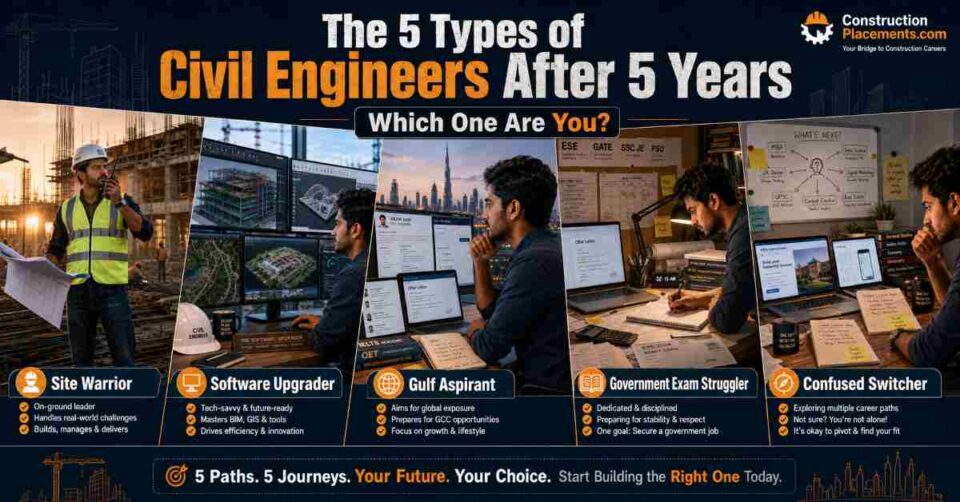
Sit with any group of civil engineering batchmates at a reunion — five years out of college — and you’ll notice something fascinating. The people who once sat in the same classroom, solved the same RCC problems, and complained about the same viva questions have scattered into completely different professional realities.
ConstructionCareerHub App is LIVE — built ONLY for construction careers. Don’t apply with a weak resume.
Get ATS-ready Resume Lab + Interview Copilot + Campus Placement Prep (resume screening, skill gaps, interview readiness) — in minutes & Other advanced features.
Explore Smarter Construction Career Tools →Quick check. Big impact. Start now.
One is sunburned and managing a ₹200-crore highway project. Another hasn’t touched a theodolite since graduation and lives inside Revit. A third is refreshing Gulf job portals at midnight. The fourth is on their ninth attempt at a government exam. And the fifth? They’re wondering if an MBA or data science course is the escape hatch they need.
This isn’t a failure of civil engineering as a profession. It’s the natural divergence that happens when ambition, opportunity, geography, and personality collide with the realities of the Indian construction industry.
Let’s break down the five archetypes — honestly, without judgment — so you can figure out where you stand and, more importantly, where you want to go next.
Table of Contents
1. The Site Warrior

Who They Are
The Site Warrior is the civil engineer who said “yes” to the field and never looked back. They’re the ones in steel-toed boots at 6 AM, managing labour crews, reading drawings under a corrugated tin shade, and negotiating with subcontractors before most people have finished their morning chai.
After five years, a typical Site Warrior has worked on two to four projects — residential towers, highway stretches, metro sections, or industrial plants. They’ve moved cities (sometimes states) multiple times. Their phone gallery is 80% site photos. Their WhatsApp status is probably a drone shot of their latest pour.
The Reality Check
Site Warriors earn respect that no other archetype gets — from labourers, from contractors, and from senior management. They understand construction at a visceral, physical level. They know what 30 cubic metres of M30 concrete looks like when it’s being poured, not just what it looks like on a mix design sheet.
But here’s the trade-off: site life is demanding. The hours are long, the locations are often remote, personal life takes a hit, and salary growth in the first five years — while steady — doesn’t always match peers in IT or consulting. A Site Engineer typically earns ₹4–8 LPA by year five, while a Project Engineer or Planning Engineer at a large EPC firm can push ₹8–14 LPA depending on the company and project scale.
Where They’re Headed
The strong ones evolve into Project Managers, Construction Managers, or Planning Heads by year 8–12. The smartest Site Warriors layer technical certifications on top of their field experience — PMP, CMAA credentials, or Primavera/MS Project proficiency — which fast-tracks their climb.
If you’re a Site Warrior, your experience is your moat. No classroom or YouTube tutorial replicates what you’ve learned standing on actual formwork. The key is to not let the grind become a trap — keep building skills alongside buildings.
👉 Build a resume that showcases your site experience properly → Try the AI Resume Lab
2. The Software Upgrader

Who They Are
The Software Upgrader figured out early — usually within the first two years — that the highest-paying civil engineering roles in 2026 don’t always involve standing on-site. They pivoted toward BIM, computational design, GIS, drone survey analysis, or project controls software and never looked back.
You’ll find them working in air-conditioned offices (or from home), fluent in Revit, Navisworks, Tekla, Civil 3D, Primavera P6, or Python scripting for structural analysis. Many have transitioned into BIM Coordinator, BIM Manager, Digital Construction Analyst, or Construction Technology Specialist roles.
The Reality Check
Software Upgraders often earn more than their site-based batchmates by year five. BIM professionals in India command ₹6–15 LPA depending on software depth and project exposure, with international remote roles pushing significantly higher. Those who’ve moved into construction tech startups or consultancies in the Middle East, Singapore, or Europe can see salaries jump further.
The criticism they face? “You’re not a real civil engineer.” This comes from Site Warriors and professors alike. The Software Upgrader has heard every variation of “you just push buttons” — and they’ve learned to ignore it because their bank statements and work-life balance tell a different story.
Where They’re Headed
This is the archetype with the widest career optionality. BIM Managers become Digital Construction Heads. GIS specialists move into smart city infrastructure planning. Primavera experts become Planning Managers earning ₹20–30 LPA at major EPC firms. Some even jump into pure tech — construction SaaS companies, AI-driven project management tools, or PropTech startups.
If you’re a Software Upgrader, your risk is stagnation inside one tool. Revit alone won’t carry you for a decade. Layer in data analytics, programming fundamentals, or AI/ML applications in construction to stay ahead of the curve.
👉 Map your next career move with AI → Try the Career Planner
3. The Gulf Aspirant

Who They Are
The Gulf Aspirant has one mission: get to Dubai, Abu Dhabi, Riyadh, Doha, or Kuwait — and build something massive. They’ve spent years 3 through 5 preparing IELTS/OET scores, formatting CVs in the “Gulf style,” applying through agencies, networking on LinkedIn with GCC-based recruiters, and waiting for that one offer letter that changes their financial trajectory.
Some have already made it across. Others are still in India, working on domestic projects while applying internationally every single week.
The Reality Check
The Gulf dream is real — and it’s also complicated. Civil engineers in the GCC countries can earn 2× to 5× their Indian salary, with tax-free income, company-provided accommodation, and exposure to mega-projects (NEOM, Expo City legacy developments, Qatar infrastructure expansion, Saudi Vision 2030 builds). A mid-level site engineer in the UAE can earn AED 8,000–15,000 per month (₹1.8–3.5 LPA monthly).
But the flip side is significant: contract-based employment with limited job security, family separation, visa dependency on the employer, aggressive work schedules (often 10–12 hour days, 6 days a week), and the ever-present risk of project cancellation or delayed payments.
The Gulf Aspirant who makes it and stays for 7–10 years typically returns to India (or moves onward to Canada/Australia) with substantial savings and a resume that opens doors. The one who keeps waiting without a clear strategy risks losing momentum in both markets.
Where They’re Headed
Successful Gulf engineers transition into senior construction management roles, start their own contracting firms back in India, or use GCC experience as a stepping stone to markets like Australia, Canada, or the UK through skilled migration pathways.
If you’re a Gulf Aspirant, the single most important thing is to build specialised experience that Gulf employers actually value: MEP coordination, QA/QC systems, high-rise construction, infrastructure projects, or HSE certifications like NEBOSH. Generic “site engineer with 5 years’ experience” gets lost in a pile of 10,000 identical CVs.
👉 Get the Gulf-Ready Career Kit → Grab the eBook on Gumroad
4. The Government Exam Struggler

Who They Are
The Government Exam Struggler is pursuing what millions of Indian civil engineers consider the ultimate destination: a permanent government job. They’re preparing for — or have already attempted — SSC JE, state PSC exams (UPPSC AE, MPSC, RPSC), ESE (Engineering Services Examination), GATE for PSU recruitment, or RRB JE.
Some are working full-time and studying on weekends. Others have left jobs entirely to prepare full-time, often supported by family. By year five, they may have appeared for 4–9 exams with varying results — clearing prelims but missing mains, qualifying GATE but not getting a PSU call, or scoring well in SSC JE but stuck on the waiting list.
The Reality Check
Government jobs in India offer what the private construction sector largely cannot: stability, a pension (in many states), manageable work hours, social status, and a predictable career trajectory. A Junior Engineer in a state PWD or CPWD starts at ₹35,000–50,000 per month with DA benefits, and an ESE-selected officer can start at ₹56,000+ with rapid growth into executive roles.
The harsh reality, though, is the numbers game. The SSC JE exam alone attracts 5–8 lakh applicants for a few thousand posts. ESE has a success rate below 1%. GATE scores high enough for top PSUs (NTPC, IOCL, NHPC, GAIL) require months of focused preparation, and cutoffs fluctuate wildly.
After five years, the Government Exam Struggler faces an identity question: Am I preparing because I genuinely want this, or because I started and now feel unable to stop? Sunk cost fallacy is real and powerful in this group.
Where They’re Headed
Those who crack it — especially ESE or a good PSU through GATE — enter a career track that’s genuinely rewarding and secure. Those who don’t crack it after sustained effort need a clear exit plan: transitioning into private sector roles where their technical knowledge (which exam prep actually sharpens significantly) becomes an advantage.
If you’re a Government Exam Struggler, set a hard boundary — a maximum number of attempts or a cut-off age — and build parallel skills (site experience, software skills, certifications) so that the pivot, if needed, isn’t starting from zero.
👉 Prepare for PSU & government interview rounds with AI → Try the Interview Copilot
5. The Confused Switcher

Who They Are
The Confused Switcher is the civil engineer who has concluded — firmly, tentatively, or somewhere in between — that civil engineering is not their long-term career. They’re exploring MBA programs, data science bootcamps, UX design courses, digital marketing certifications, UPSC (non-engineering), content creation, real estate, or entirely unrelated fields.
This is the archetype that gets the most judgement from family, peers, and professors. “You wasted four years of engineering.” “Civil engineering is a noble profession, why leave?” “What will people say?”
The Reality Check
Here’s the truth that Indian engineering culture doesn’t want to admit: not everyone who studies civil engineering should remain a civil engineer forever. A significant percentage of India’s 15 lakh+ annual engineering graduates enter the field not out of passion but through entrance exam rankings, parental guidance, or limited options.
After five years of working in construction — dealing with low starting salaries, tough site conditions, slow promotions, or simply discovering that their interests lie elsewhere — choosing to pivot is not a failure. It’s a recalibration.
MBA graduates with civil engineering backgrounds are highly valued in infrastructure finance, real estate, project advisory, and construction management consulting. Civil engineers who move into data science bring domain expertise that pure data scientists lack. Those who enter content creation or ed-tech often build audiences precisely because they understand a field that millions of students are entering every year.
Where They’re Headed
The successful switchers are the ones who treat the pivot as a bridge, not a burn. They leverage their construction knowledge in the new field rather than pretending it doesn’t exist. A civil engineer doing product management at a construction-tech company. A structural engineering background powering a career in engineering sales. A site engineer’s project management instincts applied in consulting.
If you’re a Confused Switcher, stop apologising. Start by asking: What part of my civil engineering experience do I actually enjoy? The answer usually points toward the right next step — even if that step leads outside construction.
👉 Explore hidden career paths for civil engineers → Get the AI Career Blueprint eBook
So, Which Type Are You?
Here’s the important thing: none of these five paths is inherently better than the others. The Site Warrior isn’t more “authentic” than the Software Upgrader. The Gulf Aspirant isn’t more ambitious than the Government Exam Struggler. And the Confused Switcher isn’t a quitter — they might be the bravest of the lot.
What matters is intentionality. Are you on your current path because you chose it — or because you drifted into it? Five years into a career is the perfect moment to take stock, be honest with yourself, and either double down or redirect.
A Quick Self-Assessment
Ask yourself these five questions:
- Energy Test: Does my current work give me energy on most days, or does it consistently drain me?
- Growth Test: Am I learning new things this year, or am I repeating Year 1 for the fifth time?
- Financial Test: Is my income trajectory realistic for the life I want in 5 more years?
- Identity Test: When someone asks “what do you do,” am I proud of my answer?
- Optionality Test: If my current role disappeared tomorrow, how many doors could I knock on?
If you answered negatively to three or more, it’s not a crisis — it’s a signal. A signal to invest in yourself.
What Every Type Needs in 2026
Regardless of which archetype you identify with, the construction industry in 2026 rewards three things:
- A Hybrid Skillset: Pure site experience or pure software skills are each becoming less valuable alone. The most promotable professionals combine both — a Site Warrior who can read a Primavera schedule, or a Software Upgrader who has spent time on actual project sites.
- A Digital Presence: Your next employer, client, or business partner will Google you. A LinkedIn profile with project case studies, a certification showcase, or even a simple portfolio website separates you from the pack.
- Career Documentation: An ATS-optimised resume, a strong cover letter, and well-prepared interview talking points are not optional — they’re the entry ticket. Most civil engineers massively underinvest in how they present themselves on paper.
👉 Get your resume reviewed by AI in under 2 minutes → ConstructionCareerHub Resume Lab
Frequently Asked Questions
Is civil engineering a good career after 5 years?
Yes — if you’ve been intentional about building skills and experience. Civil engineers who specialise (in BIM, project management, estimation, QA/QC, or HSE) see significant salary growth after the 5-year mark. The challenge is for those who remain in generalist roles without upskilling.
What is the salary of a civil engineer after 5 years in India?
Salaries vary widely depending on the path. Site Engineers at mid-sized firms earn ₹4–8 LPA, while BIM professionals and Planning Engineers at large EPC companies can earn ₹8–15 LPA. Gulf-based engineers typically earn 2–5× their Indian salary equivalent. Government engineers start lower but benefit from stability, pensions, and perks.
Should I leave civil engineering after 5 years?
Only if you’ve genuinely explored the breadth of the field. Civil engineering is far wider than site work — it includes BIM, construction technology, project controls, estimation, safety management, real estate development, infrastructure consulting, and more. If you’ve explored multiple facets and still want to leave, that’s a valid and smart decision.
How can I switch from site engineering to a software role in construction?
Start by learning BIM tools like Revit or Navisworks, project scheduling with Primavera P6, or GIS/drone survey platforms. Many online courses on Coursera, Udemy, and LinkedIn Learning offer certified pathways. Combine learning with freelance BIM projects to build a portfolio, then target BIM Coordinator or Digital Construction roles.
Which government exams should civil engineers target after 5 years?
The primary exams are SSC JE (Junior Engineer), GATE for PSU recruitment (NTPC, IOCL, NHPC, GAIL), ESE (Engineering Services Examination) for Class-1 gazetted officer roles, and state-level PSC exams (UPPSC AE, MPSC, RPSC, TSPSC). Each has different age limits and eligibility, so check the latest notifications before planning your preparation.
What certifications help civil engineers grow after 5 years?
High-impact certifications include PMP (Project Management Professional), Autodesk Certified Professional in Revit/Civil 3D, NEBOSH IGC for safety roles, LEED AP for green building, Primavera P6 certification for planning, and Six Sigma for quality management. The best certification depends on your chosen archetype and career direction.
Final Word
Five years into a civil engineering career is not the end of the road — it’s the first real fork. The decisions you make between year 5 and year 8 compound dramatically over the next two decades. Whether you’re pouring concrete, pushing pixels, chasing a Gulf visa, cracking exam papers, or charting an entirely new course — own your path.
The construction industry needs all five types. And the industry — in India and globally — is large enough, growing enough, and diverse enough to reward each one, as long as they keep moving forward with intention.
What type are you? Drop a comment below — we’d love to hear your story.
Explore more career resources:
- AI Resume Lab — Get your construction resume ATS-ready
- AI Career Planner — Map your next career move
- Interview Copilot — Practice for PSU & private sector interviews
- Salary Calculator — Benchmark your construction salary
- Construction Career eBook Bundle — All guides in one pack
- Construction Interview Masterclass eBook
