

Last Updated on April 2, 2026 by Admin
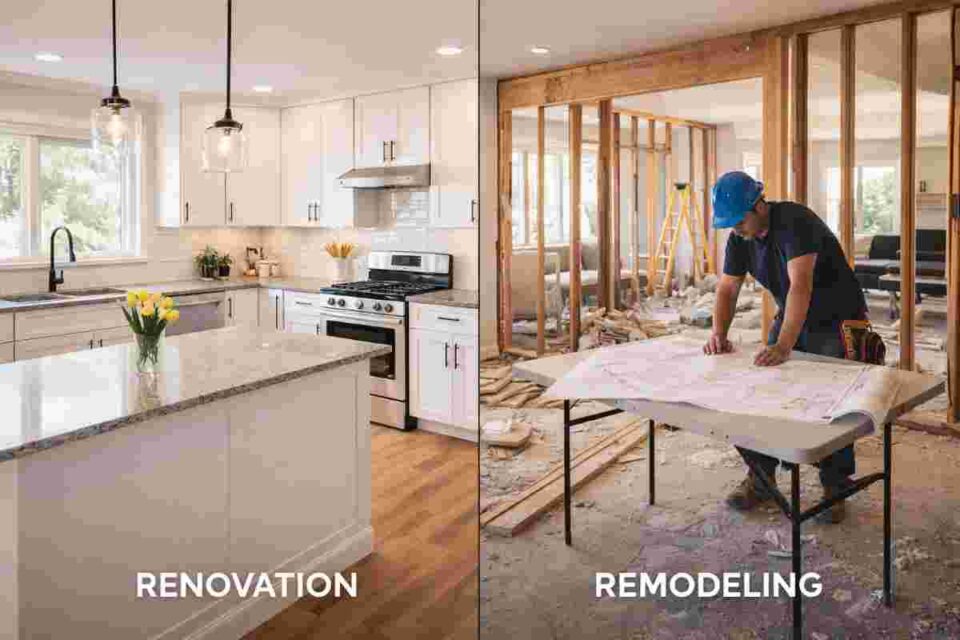
Should you renovate your home or remodel it? If you have ever used these terms interchangeably, you are not alone. Most US homeowners treat renovation and remodeling as the same thing, but the distinction matters — it affects your budget, timeline, permit requirements, contractor selection, and even your return on investment when you sell.
ConstructionCareerHub App is LIVE — built ONLY for construction careers. Don’t apply with a weak resume.
Get ATS-ready Resume Lab + Interview Copilot + Campus Placement Prep (resume screening, skill gaps, interview readiness) — in minutes & Other advanced features.
Explore Smarter Construction Career Tools →Quick check. Big impact. Start now.
With American homeowners projected to spend over $524 billion on home improvements in early 2026 — a record high according to the Harvard Joint Center for Housing Studies — understanding the difference between renovation and remodeling has never been more important. Whether you are refreshing a dated kitchen or converting your garage into a home office, knowing which category your project falls into helps you plan smarter, hire the right professionals, and avoid costly surprises.
This guide breaks down everything you need to know about home renovation vs remodeling in 2026 — from definitions, costs, and ROI comparisons to permits, financing options, and career opportunities in the residential construction sector.
Table of Contents
What Is Home Renovation?
Home renovation refers to the process of restoring, updating, or improving an existing space without fundamentally changing its structure, layout, or purpose. Think of renovation as a refresh — you are making a room look and function better while keeping its bones intact.
Common renovation projects include repainting walls and ceilings, replacing flooring, upgrading light fixtures, installing new kitchen countertops without changing the layout, refinishing cabinets, replacing windows and doors, updating bathroom fixtures like faucets and showerheads, and adding new landscaping or exterior paint.
Renovations typically fall on the lighter end of the home improvement spectrum. Many are manageable as DIY projects, though hiring a professional ensures quality results and code compliance. For a deeper understanding of how renovation differs from ground-up building, see our guide on the difference between renovation and construction.
What Is Home Remodeling?
Home remodeling goes a step further. It involves changing the structure, layout, or purpose of a space. When you remodel, you are not just updating what is already there — you are transforming the space into something different.
Typical remodeling projects include knocking down walls to create an open-concept floor plan, converting a bedroom into a home office or gym, adding a bathroom where one did not exist, expanding a kitchen by merging it with an adjacent dining room, building a room addition or second story, reconfiguring plumbing and electrical systems for a new layout, and constructing an accessory dwelling unit (ADU) in your backyard.
Remodeling almost always requires building permits, licensed contractors, and professional design input. These projects are more complex, more expensive, and take longer to complete — but they also have the potential to increase your home’s functionality and market value dramatically. Learn more about the benefits of hiring a contractor for renovation and remodeling projects.
Renovation vs Remodeling: Key Differences at a Glance
| Factor | Renovation | Remodeling |
|---|---|---|
| Definition | Updating or restoring an existing space | Changing the structure, layout, or function of a space |
| Structural Changes | No or minimal structural work | Significant structural modifications are common |
| Average Cost | $3,000 – $50,000+ | $25,000 – $190,000+ |
| Permits Required | Rarely (unless electrical or plumbing is involved) | Almost always required |
| Timeline | Days to a few weeks | Weeks to several months |
| DIY Friendly | Many projects are suitable for DIY | Professional contractors strongly recommended |
| ROI Potential | 60% – 80% for mid-range projects | 38% – 96% depending on scope |
| Examples | Painting, new flooring, fixture upgrades | Wall removal, room additions, layout changes |
Home Renovation Costs in 2026: What to Expect
Renovation costs vary widely depending on the rooms involved, material quality, and your geographic location. According to current industry data, here is what US homeowners are spending on popular renovation projects in 2026.
Kitchen Renovation Costs
Kitchen renovations remain the most popular home improvement project in the US. A minor kitchen renovation with mid-range finishes — including cabinet refacing, laminate countertops, updated lighting, and a new backsplash — typically costs between $25,000 and $35,000. Mid-range kitchen renovations that include cabinet replacement, quartz or granite countertops, and upgraded appliances fall in the $35,000 to $65,000 range. High-end kitchen remodels with custom cabinetry, premium appliances, and structural changes can exceed $80,000.
Kitchen projects consistently deliver strong ROI. Minor kitchen renovations return approximately 72% to 96% of costs at resale, while major high-end remodels return a lower 38% to 50%.
Bathroom Renovation Costs
Bathroom projects offer some of the best value for money in home improvement. A small powder room update starts at $5,000 to $10,000, covering a new vanity, toilet, lighting, and paint. A standard full bathroom renovation runs $12,000 to $25,000 for mid-range finishes, while upscale bathroom renovations can reach $78,000 or more. Bathroom renovations typically return 60% to 74% of their cost at resale.
Bedroom Renovation Costs
Bedroom renovations are among the most affordable since they typically do not involve plumbing or appliances. Expect to spend $1,500 to $5,500 for updates like new flooring, paint, window treatments, lighting, and furnishings.
Whole-House Renovation Costs
A whole-house renovation for a typical 1,250 to 1,600 square foot home averages around $52,000 in 2026, with costs ranging from $19,500 for basic cosmetic updates to $88,000 or more for comprehensive work. A complete gut renovation to the studs costs $100,000 to $200,000 or more, depending on the home’s size and location.
For detailed information about how renovation spending impacts home values, explore our article on the role of home renovation services in increasing your home’s value.
Why Renovation and Remodeling Costs Are Elevated in 2026
If you are comparing today’s prices to what your neighbor paid five years ago, you will notice a significant increase. Several factors are keeping renovation and remodeling costs elevated in 2026.
Labor shortages remain persistent. The US construction industry needs to attract hundreds of thousands of new workers annually to keep pace with demand, and a large share of contractors still report difficulty finding qualified tradespeople. This shortage drives up labor costs, which now account for 50% to 60% of most project budgets. General contractors charge $50 to $150 per hour, plumbers $45 to $200 per hour, and electricians $50 to $130 per hour.
Material costs have stabilized at higher baselines. While the dramatic price swings of the pandemic era have settled, costs remain substantially above historical levels. Tariff exposure and supply dynamics continue to cause selective price increases on certain building materials.
Demand remains strong. The median American home now exceeds 40 years of age, creating significant maintenance and modernization needs. Homeowners with low mortgage rates from 2020-2021 are choosing to invest in their current properties rather than sell and buy in a higher-rate market — a trend known as the “mortgage rate lock-in effect.”
For career-minded readers, this labor shortage creates outstanding opportunities. Our guide to construction worker salaries in 2025 and the highest paying construction jobs in the US break down earning potential across trades and specializations.
When Should You Renovate vs Remodel?
Choosing between renovation and remodeling depends on your goals, budget, and how long you plan to stay in your home. Here is a practical framework to help you decide.
Choose Renovation When
You are happy with your home’s layout but want a fresh, updated look. Your budget is limited and you want maximum visual impact for your money. You are preparing your home for sale and want to improve curb appeal without overcapitalizing. The space functions well but looks dated or worn. You want to complete the project quickly with minimal disruption to daily life.
Choose Remodeling When
Your home’s layout does not work for your family’s current lifestyle. You need more space — an extra bedroom, bathroom, or dedicated home office. You want to improve accessibility for aging in place. The home’s floor plan is fundamentally outdated, such as small closed-off rooms typical of homes built before the 1990s. You plan to stay in the home for five or more years and want to enjoy the benefits of a transformed space.
Consider a Phased Approach
Many homeowners in 2026 are taking a phased approach — completing renovations in one year and planning a larger remodel for the following year. This strategy spreads costs over time and helps you learn from each phase before committing to larger investments. Our comprehensive guide to home improvement services covers the full range of options available to you.
Building Permits: What You Need for Renovation vs Remodeling
One of the most important practical differences between renovation and remodeling is the permit requirement.
Renovation projects generally do not require permits for cosmetic work like painting, replacing flooring, swapping out fixtures, or installing new cabinets within the existing layout. However, you will need permits if your renovation involves electrical work beyond simple fixture replacement, plumbing modifications, window or door resizing, or structural repairs like foundation work.
Remodeling projects almost always require building permits. Any work that changes the structure, adds square footage, alters plumbing or electrical systems, or changes a room’s designated use will require approval from your local building department. Common remodeling permits include building permits for structural changes, electrical permits for new circuits or panel upgrades, plumbing permits for pipe relocation or new fixtures, and mechanical permits for HVAC modifications.
Permit costs vary by municipality but typically range from $200 to $2,000 depending on project scope. Skipping required permits can result in fines, forced removal of unpermitted work, and complications when you sell your home. Always check with your local building department before starting work.
How to Finance Your Renovation or Remodel in 2026
With project costs running into the tens of thousands, most homeowners need a financing strategy. Here are the most common options in 2026.
Home Equity Loan: Borrow a lump sum against your home’s equity at a fixed interest rate. Best for large projects with defined budgets. More than half of homeowners choose this route according to the National Association of Realtors.
Home Equity Line of Credit (HELOC): A revolving credit line secured by your home equity. Ideal for phased projects where you draw funds as needed. Interest rates are variable.
Cash-Out Refinance: Replace your existing mortgage with a larger one and receive the difference as cash. Best suited for homeowners who can secure a lower rate than their current mortgage — less common in today’s rate environment.
FHA 203(k) Loan: A government-backed loan that rolls purchase and renovation costs into a single mortgage. Best for buyers purchasing a fixer-upper.
Personal Loan: Unsecured loans of $5,000 to $50,000 at rates of 9% to 16%. Best for smaller projects or homeowners with limited equity. Terms usually run three to seven years.
Savings or Cash: The most cost-effective option since you pay no interest. Nearly 30% of homeowners pay for renovations entirely in cash.
ROI Comparison: Renovation vs Remodeling Projects
Return on investment varies dramatically depending on the type, scale, and quality of your project. Here is how popular renovation and remodeling projects compare in terms of cost recovery at resale.
| Project Type | Average Cost (2026) | Estimated ROI at Resale |
|---|---|---|
| Garage door replacement (renovation) | $4,000 – $5,500 | 90% – 100%+ |
| Minor kitchen renovation | $25,000 – $35,000 | 72% – 96% |
| Bathroom renovation (mid-range) | $12,000 – $25,000 | 60% – 74% |
| New siding installation (renovation) | $11,000 – $21,000 | 70% – 80% |
| Deck addition (remodel) | $17,600 – $24,200 | 65% – 75% |
| Major kitchen remodel (high-end) | $50,000 – $80,000+ | 38% – 50% |
| Primary suite addition (remodel) | $100,000+ | 40% – 55% |
The general trend is clear: mid-range renovations and smaller-scale updates tend to recover a higher percentage of costs at resale compared to major high-end remodels. However, remodeling projects deliver greater absolute value increases and significantly improve quality of life — which is why many homeowners pursue them even when the percentage ROI is lower.
Hiring the Right Professionals
Whether you are renovating or remodeling, choosing the right contractor can make or break your project.
For Renovation Projects
Many renovation projects can be handled by specialty tradespeople — a painter, flooring installer, or electrician. For multi-trade renovations, a general contractor coordinates the various specialists, typically charging 20% to 40% of total project costs. For simpler projects, you can hire individual tradespeople directly and save on the coordination markup.
For Remodeling Projects
Remodeling projects almost always require a general contractor or design-build firm. These professionals manage permits, subcontractors, scheduling, inspections, and quality control. General contractor fees for remodeling projects typically run 40% to 50% of total costs — a significant premium, but one that buys you professional management of a complex multi-month project.
When evaluating contractors, verify their license and insurance, check references from recent similar projects, review their Better Business Bureau rating, request detailed written quotes from at least three contractors, and confirm they will handle permit acquisition. For detailed information about construction project management roles, our career guide explains how these professionals oversee residential and commercial projects.
2026 Trends Shaping Home Renovation and Remodeling
Several trends are influencing how US homeowners approach home improvement projects this year.
Bundled Projects
Instead of tackling one room at a time, more homeowners are bundling multiple projects into a single coordinated effort — for example, renovating the kitchen and bathrooms simultaneously. This approach consolidates disruption, reduces overall costs through shared contractor mobilization, and allows for better design cohesion across spaces.
Energy Efficiency Upgrades
Rising energy costs and available tax incentives are driving increased investment in energy-efficient windows, insulation, HVAC systems, and solar panels. The Inflation Reduction Act continues to offer significant tax credits for qualifying energy improvements, making 2026 an excellent year for efficiency-focused renovations.
Aging-in-Place Modifications
With an aging population, more homeowners are incorporating accessibility features into their renovation and remodeling projects — wider doorways, curbless showers, grab bars, single-floor living configurations, and smart home technology for remote monitoring.
ADUs and Flexible Spaces
Accessory dwelling units (ADUs) continue to gain popularity as homeowners seek rental income, multigenerational living arrangements, or dedicated home offices. Many states and municipalities have relaxed zoning restrictions to encourage ADU construction.
Smart Home Integration
Both renovation and remodeling projects increasingly incorporate smart home technology — automated lighting, smart thermostats, security systems, and voice-controlled appliances. These upgrades add convenience and appeal to tech-savvy buyers.
For a global perspective on how the renovation industry is evolving, read our analysis on how the construction industry is being reborn through renovation.
Career Opportunities in Home Renovation and Remodeling
The residential renovation and remodeling sector is one of the fastest-growing segments of the US construction industry. With spending at record levels and a persistent labor shortage, career opportunities are abundant across skill levels.
In-Demand Roles
General Contractor: Manages renovation and remodeling projects from start to finish. Experienced general contractors in residential work earn $75,000 to $150,000+ annually.
Construction Project Manager: Oversees budgets, timelines, and quality for larger remodeling projects. Average salary ranges from $97,000 to $137,000 per year.
Construction Estimator: Develops detailed cost estimates for renovation bids. Median salary ranges from $48,000 to $95,000 depending on experience and market.
Skilled Tradespeople: Electricians, plumbers, carpenters, tile installers, and HVAC technicians are in extreme demand. Many trades offer salaries well above the national median, particularly for workers with certifications and experience.
Explore the full range of roles in our guide to 150+ construction job titles and descriptions, or dive deeper into construction and management jobs in the USA.
Getting Started or Advancing Your Career
If you are considering a career in the renovation and remodeling industry, start by building foundational skills through these recommended courses:
- Construction Management on Coursera — Covers project planning, scheduling, and cost control fundamentals.
- Construction Courses on edX — University-backed programs covering building science, energy efficiency, and sustainable design.
- Construction Management Courses on Udemy — Practical, self-paced courses on estimating, scheduling, and project delivery.
For AI-powered career tools tailored to construction professionals — including resume optimization, interview preparation, and personalized career roadmaps — visit ConstructionCareerHub.com.
DIY vs Professional: A Decision Framework
One of the biggest decisions homeowners face is whether to tackle a project themselves or hire a professional. Here is a practical framework.
Safe for DIY: Interior painting, wallpaper removal, simple landscaping, installing shelving, replacing cabinet hardware, updating light fixtures (swap-outs on existing wiring), basic tile work on small areas, and installing new window treatments.
Hire a Professional: Any work involving structural modifications, electrical panel upgrades or new circuits, plumbing relocation, gas line work, roof repairs or replacement, window and door installation (especially load-bearing walls), and HVAC system installation or modification.
When in doubt, err on the side of hiring a professional. The cost savings from DIY can be wiped out quickly by mistakes, code violations, or safety hazards. Our ultimate guide to home renovation services provides detailed advice on selecting the right service providers for your project.
Step-by-Step Process for a Successful Home Project
Whether you are renovating or remodeling, following a structured process helps ensure your project stays on budget, on schedule, and meets your expectations.
Step 1: Define Your Goals. Be clear about what you want to achieve. Are you updating for personal enjoyment, preparing to sell, improving functionality, or increasing energy efficiency? Your goals drive every subsequent decision.
Step 2: Set a Realistic Budget. Research current costs for your planned scope of work. Add a contingency buffer of 10% to 20% for unexpected issues — this is standard industry practice, not pessimism.
Step 3: Research and Hire Professionals. Get at least three detailed quotes. Verify licenses, insurance, and references. Discuss timelines, payment schedules, and change order procedures in writing before work begins.
Step 4: Secure Permits. Your contractor should handle permit applications, but verify that all required permits are obtained before construction starts. Unpermitted work creates legal and financial risks.
Step 5: Plan for Disruption. Kitchen and bathroom projects can take weeks. Arrange alternative cooking and bathing arrangements. For major remodels, consider temporary housing costs in your budget.
Step 6: Monitor Progress. Maintain regular communication with your contractor. Address concerns promptly. Document the project with photos at each stage — useful for warranty claims and future reference.
Step 7: Final Inspection and Closeout. Ensure all work passes required inspections. Complete a walk-through with your contractor and create a punch list of any items needing correction before final payment.
For a comparative analysis of renovation versus building from scratch, see our detailed guide on home renovation vs new construction.
Common Mistakes to Avoid
Years of industry experience have revealed several recurring mistakes that derail renovation and remodeling projects.
Underestimating costs. The rule of thumb in residential construction is that projects almost always cost more and take longer than initially planned. Budget 10% to 20% above your contractor’s estimate for contingencies.
Skipping permits. Unpermitted work can result in fines, forced demolition, and complications with home insurance claims and resale. Always verify permit requirements with your local building department.
Choosing the cheapest contractor. The lowest bid is rarely the best value. Unrealistically low bids often indicate cut corners, inadequate insurance, or bait-and-switch pricing.
Overcapitalizing for the neighborhood. Investing $150,000 in a kitchen remodel in a neighborhood where homes sell for $300,000 is unlikely to produce a positive return. Keep your renovation investment proportional to your home’s value and neighborhood comps.
Ignoring energy efficiency. With available tax credits and rising energy costs, skipping efficiency upgrades during a renovation is a missed opportunity. Many energy improvements pay for themselves through reduced utility bills within five to seven years.
Renovation and Remodeling Resources
For homeowners and professionals looking to deepen their knowledge, the following resources provide authoritative information.
Government and Industry Resources:
- ENERGY STAR (EPA) — Tax credits, rebates, and energy efficiency standards for home improvements.
- National Association of Home Builders (NAHB) — Industry data, remodeling trends, and contractor resources.
- Harvard Joint Center for Housing Studies — Annual remodeling expenditure reports and housing market analysis.
Career Development:
- ConstructionCareerHub.com — AI-powered resume lab, interview copilot, and career planner for construction professionals.
- Estimation Engineer Career Guide — Detailed career path for construction estimators.
- Construction Manager Job Description and Salary — Complete guide to construction management careers.
Recommended Reading:
- AI Construction Career Blueprint — Comprehensive ebook on building a modern construction career.
- The Construction Job Blueprint 2026 — Step-by-step job search strategies for construction professionals.
Note: Gumroad ebook slugs should be verified before publishing — visit digitslick.gumroad.com to confirm current product URLs.
Frequently Asked Questions (FAQ)
What is the difference between renovation and remodeling?
Renovation involves updating, restoring, or improving an existing space without changing its structure or purpose. Remodeling involves altering the structure, layout, or function of a space — such as removing walls, adding rooms, or converting a garage into living space.
Is it cheaper to renovate or remodel a house?
Renovation is generally less expensive than remodeling. A typical renovation project costs $3,000 to $50,000, while remodeling projects range from $25,000 to $190,000 or more depending on scope and complexity.
Do I need a permit for home renovation?
Most cosmetic renovations like painting, flooring, and fixture replacements do not require permits. However, any work involving electrical, plumbing, or structural changes typically requires a building permit regardless of whether it is classified as renovation or remodeling.
What home renovations have the highest ROI?
Garage door replacement, minor kitchen renovations, and new siding tend to offer the highest ROI at resale — often recovering 72% to 100% of costs. Mid-range bathroom renovations also deliver strong returns in the 60% to 74% range.
How long does a home remodel take?
Timelines vary by project scope. A bathroom remodel typically takes three to six weeks, a kitchen remodel six to twelve weeks, and a whole-house remodel three to six months or longer. Permit processing, material lead times, and weather can extend timelines further.
Should I renovate my home before selling?
Strategic renovations can increase your home’s sale price and reduce time on market. Focus on high-ROI projects like kitchen and bathroom updates, fresh paint, and curb appeal improvements. Avoid major remodels unless they address a significant functional deficit that would deter buyers.
Can I live in my house during a remodel?
For smaller remodels confined to one area of the house, you can usually stay. For whole-house remodels or projects involving kitchen and bathroom work, arranging temporary housing is often more practical and can even speed up the project timeline.
What is the most expensive room to remodel?
The kitchen is consistently the most expensive room to remodel, with costs ranging from $25,000 for minor updates to over $80,000 for major renovations. Kitchens involve multiple expensive components including cabinetry, countertops, appliances, plumbing, electrical, and often structural work.
How much should I budget for unexpected costs?
Industry professionals recommend a contingency budget of 10% to 20% of your total project cost. Older homes, homes with unknown construction history, and projects involving structural changes tend to produce more surprises behind walls and under floors.
What careers are available in the renovation and remodeling industry?
The renovation and remodeling sector offers diverse career paths including general contracting, project management, estimation, skilled trades (electrical, plumbing, carpentry, HVAC), interior design, and construction inspection. The industry faces a significant labor shortage, creating strong demand and competitive wages for qualified professionals. Visit ConstructionPlacements.com for career resources and industry insights.
Final Thoughts
Understanding the distinction between home renovation and remodeling is the first step toward a successful home improvement project. Renovation refreshes your existing space with cosmetic and functional updates, while remodeling transforms your home’s structure, layout, or purpose to better suit your evolving needs.
In 2026, with construction costs elevated but stabilizing, the smartest approach is to clearly define your goals, set a realistic budget with contingency, hire qualified professionals, and focus on projects that align with both your lifestyle priorities and financial objectives.
Whether you are a homeowner planning your next project or a construction professional building a career in residential improvements, the renovation and remodeling sector offers tremendous opportunity. Explore more home improvement insights, career guides, and industry resources on ConstructionPlacements.com, and supercharge your construction career with AI-powered tools at ConstructionCareerHub.com.
Related Posts:
- Why Project Management Matters in Kitchen Remodeling
- The Ultimate Guide to Hiring Home Remodeling Contractors
- What is involved with a kitchen remodel?
- Buying a Fixer-Upper: What to Plan Before Renovations Begin
