
Last Updated on December 12, 2025 by Admin
Artificial intelligence (AI) is transforming the U.S. construction industry. Digital tools are infiltrating every stage of a project – from planning and design to onsite monitoring and lifecycle management. Yet, adoption remains limited: a 2025 Royal Institution of Chartered Surveyors (RICS) survey found that 56% of surveyed investors plan to increase AI funding, but about 45% of construction organisations still report no AI implementation, and another 34% are only piloting AI technologies.
ConstructionCareerHub App is LIVE — built ONLY for construction careers. Don’t apply with a weak resume.
Get ATS-ready Resume Lab + Interview Copilot + Campus Placement Prep (resume screening, skill gaps, interview readiness) — in minutes & Other advanced features.
Explore Smarter Construction Career Tools →Quick check. Big impact. Start now.
At the same time, industry leaders recognise that AI delivers huge productivity and safety benefits. According to research on AI agents in construction, top contractors using AI report cost reductions of 10–15%, schedule and budget deviations cut by 10–20%, workplace accidents reduced by 30–35% and productivity boosted by 10–30%.
This guide explains what construction AI supervision entails, why these roles command high salaries and the most lucrative positions in 2026, with U.S. salary data and career advice.
Whether you’re looking to discover your true calling in an AI-driven construction career or upgrade your current skillset, this comprehensive resource will help you navigate the emerging landscape.
Table of Contents
What Is Construction AI Supervision?
Construction AI supervision refers to overseeing the design, implementation and use of AI‐enabled systems on construction projects. These supervisors ensure that digital tools like machine‑learning models, computer‑vision cameras, digital twins and construction robotics deliver productivity, safety and quality improvements without compromising project goals or regulatory compliance.
Here are the key areas where AI supervision is making an impact:
AI Safety Monitoring: Computer‑vision cameras automatically detect hazards such as workers without personal protective equipment (PPE) or vehicles entering exclusion zones, triggering instant alerts and automated corrective actions. According to industry reports on AI in construction safety, these systems are dramatically reducing workplace incidents.
Digital Twins: Dynamic 3‑D models integrate real‑time data from sensors, BIM models and scheduling tools. Supervisors use AI to predict schedule conflicts, simulate design options and optimise asset performance. Learn more about how to become a digital twin specialist in construction.
Robotics and Automation: Robots lay bricks, tie rebar and perform inspections. AI supervision ensures robots operate safely alongside human crews and that data from robotic sensors feeds back into project management platforms. Discover the top 15 construction robotics companies disrupting the industry.
Predictive Analytics: AI models analyse historical data to forecast equipment failures, budget variances or safety incidents so teams can act proactively.
This combination of traditional construction expertise and advanced analytics creates high demand for professionals who can bridge both worlds. Understanding AI skills every construction professional should learn is essential for career advancement in this space.
Why AI Supervision Roles Pay So Much
Several factors drive the premium salaries of AI supervision roles:
Scarcity of Skilled Personnel: RICS survey respondents cited the lack of skilled personnel as the most common barrier to AI adoption (46%). Construction companies struggle to find professionals who understand both AI technologies and construction processes.
Integration Challenges: 37% of respondents identified integration with existing systems as a key barrier, while 30% cited poor data quality. Professionals with the ability to integrate AI tools with legacy systems are rare and valuable.
High ROI and Risk Reduction: AI‑enabled safety systems increase threat detection, automate alerts and track PPE compliance. AI also cuts costs and accidents; therefore organisations are willing to pay more for supervisors who can deliver these benefits.
Limited Adoption but Rapid Investment: Although more than 56% of investors plan to increase AI spending, actual usage is low – fewer than 12% of organisations report regular use of AI. Companies competing for a small talent pool must offer higher wages to secure specialists.
For those exploring careers in construction technology, the timing couldn’t be better to position yourself for these high-paying opportunities.
Top Highest Paying Jobs in Construction AI Supervision
The roles below combine construction expertise with advanced analytics, robotics and digital twins. Salary estimates use the latest U.S. Bureau of Labor Statistics (BLS) data, with AI skills commanding the top end of the range.
1. AI Construction Supervisor
Overview: Leads construction projects while deploying AI‑driven tools for scheduling, safety and resource optimisation. Works with project management software and AI algorithms to monitor progress and adjust plans in real time.
Key Responsibilities: Manage project lifecycle; integrate AI‑based progress monitoring and predictive scheduling; ensure safety compliance through AI safety systems; liaise with data scientists.
Skills Required: Construction management, AI/ML literacy, BIM, data analytics, leadership. Consider developing essential BIM skills alongside AI capabilities.
Education/Certifications: Bachelor’s degree in construction management or civil engineering; certification in AI or data analytics; OSHA safety training.
Average Salary: According to the BLS Occupational Outlook for Construction Managers, the median annual wage was $106,980 in May 2024, with the top 10% earning over $176,990. AI expertise can push compensation toward the higher end. Learn more about construction manager salaries in the USA.
Future Outlook: Demand will rise as more firms adopt AI for scheduling and risk management. The current shortage of AI‑skilled supervisors suggests strong wage growth.
2. Digital Twin Supervisor
Overview: Oversees creation and operation of digital twins—virtual replicas of physical assets updated in real time with sensor data. Combines BIM models with AI to simulate scenarios, optimise designs and improve maintenance.
Key Responsibilities: Coordinate data from sensors, BIM, and IoT devices; validate models; use AI to forecast performance and maintenance needs; train project teams on digital twin tools.
Skills Required: BIM expertise, system integration, data analytics, simulation, programming (Python, R), knowledge of building systems.
Education/Certifications: Degree in architectural engineering or industrial engineering; certification in digital twin or BIM (e.g., Autodesk Certified Professional); data science coursework.
Average Salary: Industrial engineers earn a median of $101,140 per year and the top 10% exceed $157,140. Supervisors who oversee digital twins may also align with architectural and engineering managers, whose median salary is $167,740.
Future Outlook: Digital twin adoption is accelerating. According to industry analysis on AI-powered digital twins, these enhancements allow predictive maintenance and remote collaboration, making this role highly sought after. Explore how AI will transform BIM by 2030.
3. AI Safety Monitoring Specialist
Overview: Implements AI‑enabled safety systems on construction sites, including computer vision for PPE detection, geofencing and real‑time hazard alerts.
Key Responsibilities: Deploy and calibrate AI safety cameras; interpret analytics; train site personnel; ensure compliance with occupational safety regulations.
Skills Required: Safety regulations, computer vision basics, data interpretation, strong communication.
Education/Certifications: Degree in occupational health and safety or civil engineering; Certified Safety Professional (CSP); training in AI systems.
Average Salary: Occupational health and safety specialists have a median wage of $83,910 and earn up to $84,890 in construction. Health and safety engineers earn a median of $109,660, demonstrating the premium for engineering expertise.
Future Outlook: AI safety solutions can reduce accidents by 30–35%. Adoption will increase to meet regulatory demands, raising salaries for specialists. Learn about how smart construction technology is transforming the industry.
4. Robotics & Automation Site Supervisor
Overview: Manages deployment of construction robots (brick‑laying, rebar tying, welding, inspection drones) and ensures integration with human crews.
Key Responsibilities: Coordinate robotic operations; calibrate sensors; analyse performance data; ensure safety; communicate with vendors and engineers.
Skills Required: Robotics programming (ROS), mechanical and electrical engineering fundamentals, project management, human‑robot interaction.
Education/Certifications: Degree in mechanical or robotics engineering; training in robotics control systems; safety certification.
Average Salary: Robotics engineers (classified under “Engineers, All Other”) have a median wage of $117,750 with the top 10% exceeding $183,510. Mechanical engineers earn a median of $102,320. Supervisors with AI integration skills can command salaries toward the upper range.
Future Outlook: Increasing automation will drive demand for supervisors who can manage robots, ensuring safe, productive collaboration with workers. Explore job opportunities in construction robotics.
5. AI‑Driven Quality Control Specialist
Overview: Uses AI to inspect materials and workmanship, comparing digital models with onsite conditions to detect defects early.
Key Responsibilities: Implement computer‑vision inspection systems; analyse discrepancies between design and construction; oversee corrective actions; produce quality reports.
Skills Required: Quality control techniques, machine vision, data analysis, documentation, communication.
Education/Certifications: Degree in construction engineering or industrial engineering; certifications in quality management (e.g., ASQ Certified Quality Inspector); training in AI or computer vision.
Average Salary: Traditional quality control inspectors earn a median of $47,460, but those with AI expertise and oversight responsibility can see significantly higher compensation, more comparable to industrial engineers (median $101,140).
Future Outlook: AI‑based quality control reduces rework and improves client satisfaction, driving demand for specialists who can interpret AI‑generated quality data.
6. BIM‑AI Integration Lead
Overview: Bridges Building Information Modeling (BIM) and AI platforms, ensuring that AI models use accurate BIM data to deliver insights on scheduling, cost, sustainability and safety.
Key Responsibilities: Manage BIM data; integrate AI predictive models; oversee model versioning; coordinate multidisciplinary teams; enforce data standards.
Skills Required: Advanced BIM (Revit, Navisworks), data governance, Python or Dynamo scripting, AI/machine learning knowledge. Check out the latest BIM job roles and salary trends.
Education/Certifications: Bachelor’s or master’s in architecture, civil engineering or construction technology; BIM certification (e.g., Certified BIM Manager); AI training.
Average Salary: Architects have a median salary of $96,690, but BIM‑AI integration leads often function at a managerial level, aligning with architectural and engineering managers who earn a median of $167,740.
Future Outlook: As AI adoption accelerates, integration with BIM will be essential, creating high‑paying opportunities for those who can merge these disciplines. Learn why BIM is becoming a career multiplier.
7. Construction Data & AI Compliance Supervisor
Overview: Ensures that AI systems comply with data privacy, security and regulatory requirements while delivering business insights. Also monitors data pipelines and orchestrates analytics.
Key Responsibilities: Define data governance policies; audit AI models for bias and compliance; oversee data quality; communicate with legal and IT departments; manage analytics dashboards.
Skills Required: Data governance, privacy regulations (GDPR, CCPA), AI ethics, data analytics, stakeholder management.
Education/Certifications: Degree in data science, information systems or construction management; certifications in data privacy or cybersecurity; AI ethics coursework.
Average Salary: Operations research analysts earn a median of $83,640, while data scientists have a median salary of $112,590. Supervisors responsible for compliance may command salaries within or above this range.
Future Outlook: As AI use increases, regulatory scrutiny will grow, driving demand for compliance professionals who understand both construction and data science.
8. Drone‑AI Surveillance Supervisor
Overview: Manages drone operations and AI analytics for site surveys, progress tracking and safety inspections. Converts aerial imagery into actionable insights.
Key Responsibilities: Plan flight paths; ensure FAA compliance; operate drones; process imagery with computer‑vision algorithms; integrate data with project management systems.
Skills Required: UAV piloting, photogrammetry, GIS, computer vision, regulatory knowledge.
Education/Certifications: Degree in surveying, geomatics or civil engineering; FAA Part 107 certification; training in drone data processing.
Average Salary: Surveyors earn a median of $68,540, with the top 10% earning over $109,660. Supervisors who integrate AI analytics likely earn salaries near or above the upper quartile. Construction and building inspectors, who often oversee compliance, have a median wage of $72,120.
Future Outlook: Drone use is growing rapidly for inspections and progress tracking. AI‑enabled analysis will elevate this role’s importance and remuneration. Explore the top emerging construction roles in 2025.
9. Predictive Maintenance AI Superintendent
Overview: Oversees AI systems that predict equipment failures and schedule maintenance to minimise downtime and extend asset life.
Key Responsibilities: Collect and analyse sensor data; build predictive models; schedule maintenance tasks; liaise with equipment suppliers; ensure regulatory compliance.
Skills Required: Reliability engineering, machine‑learning modeling, mechanical systems, data interpretation, planning.
Education/Certifications: Degree in mechanical engineering or industrial maintenance; certifications in predictive maintenance or reliability engineering; AI training.
Average Salary: Industrial production managers have a median wage of $121,440, with the top 10% earning over $197,310. Mechanical engineering expertise commands a median of $102,320.
Future Outlook: As sensors and IoT devices proliferate, predictive maintenance will become a standard practice; companies will pay premiums for superintendents who can harness AI to save time and money.
10. AI Workforce & Productivity Analyst
Overview: Analyzes workforce productivity data using AI to optimise labour allocation, forecast staffing needs and identify training requirements.
Key Responsibilities: Collect workforce data (hours, output, safety incidents); build predictive models for labour demand; identify training gaps; report on productivity metrics.
Skills Required: Statistical analysis, machine learning, project controls, HR analytics, communication.
Education/Certifications: Degree in statistics, operations research, industrial engineering or business analytics; certifications in data analytics or project management (e.g., PMP); AI coursework.
Average Salary: Operations research analysts earn a median wage of $83,640. Project management specialists (PMPs) have a median wage of $100,750. AI skills can push analysts toward the high end.
Future Outlook: With increasing focus on productivity and efficiency, demand for AI‑enabled workforce analysts will grow, especially as labour shortages persist. Learn about the construction project management career guide for related opportunities.
Salary Comparison Table (US Market)
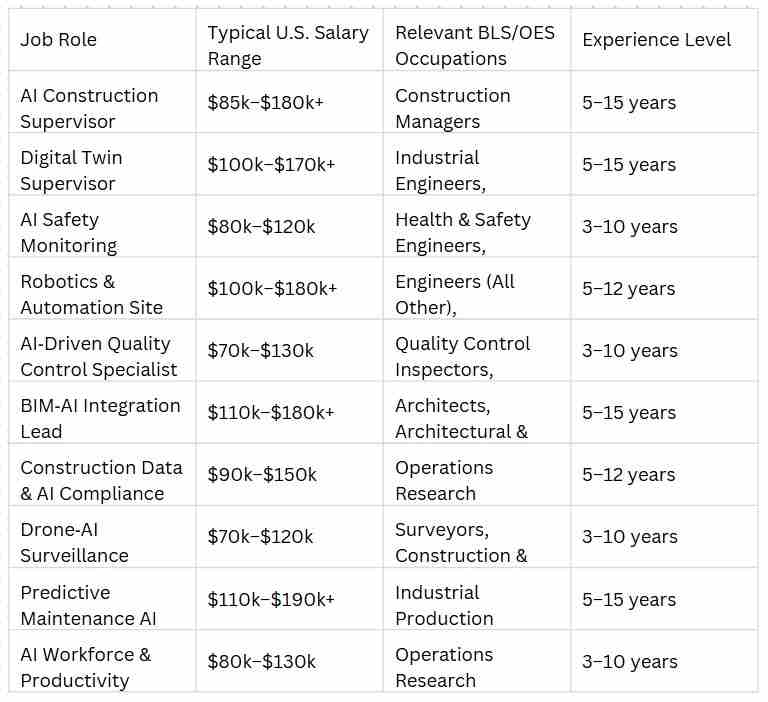
Note: Salary ranges are approximate and can vary by region, company size and experience. AI expertise often leads to compensation at or above the high end of conventional ranges.
Skills Needed for High‑Paying AI Supervision Jobs
Technical Skills
AI/ML Literacy: Understanding machine‑learning algorithms, training datasets and model evaluation. Experience with Python libraries (TensorFlow, PyTorch) or commercial AI platforms. Explore the top AI tools revolutionizing construction in 2025.
Data Analytics and Visualization: Ability to clean, analyze and visualise large datasets to derive insights. Familiarity with SQL, Excel, Tableau or Power BI.
Robotics & Automation: Knowledge of robotics operating systems, sensors, actuators and human‑robot interaction. Basic programming in ROS or similar frameworks. Read about robots and automation transforming the future of construction.
Computer Vision: Experience with image processing techniques used for safety monitoring, quality inspection and drone imagery.
BIM and Digital Twins: Proficiency in BIM tools (Revit, Navisworks) and digital twin software. Understanding of data integration, simulation and IoT connectivity. Learn about the VDC engineer job description and salary for related career paths.
Construction Domain Skills
Project Management: Ability to plan, schedule and coordinate construction activities, budgets and resources. Consider pursuing a construction project manager career.
Safety and Regulatory Compliance: Deep knowledge of OSHA standards, codes and environmental regulations. Understanding how AI systems must adhere to these rules.
Quality Control: Familiarity with inspection procedures, material testing and quality assurance programmes.
Mechanical and Civil Engineering Fundamentals: Understanding of structures, systems and mechanical devices to interpret data from sensors and robotics.
AI Tools and Platforms
Procore AI and Autodesk Construction Cloud AI: Widely used for progress monitoring and predictive analytics.
OpenSpace AI: Provides computer‑vision progress tracking and safety analytics.
Dusty Robotics: Robotics solutions for layout and building automation.
BIM 360, Navisworks, Revit: Integrate with AI modules for digital twins and predictive scheduling.
Career Path: How to Enter Construction AI Supervision
Entry‑Level Pathway
Begin with a degree in construction management, civil engineering, mechanical engineering, industrial engineering, architecture or data science. Develop foundational skills in project management, BIM and safety. Pursue internships or entry-level construction management roles (assistant project manager, BIM technician). Take online courses in AI fundamentals and data analytics.
Skill Development and Certifications
Gain experience in project coordination or engineering. Obtain certifications such as Project Management Professional (PMP), Autodesk Certified Professional (BIM), Certified Safety Professional (CSP) or Certified Quality Inspector (CQI). Supplement with AI certifications (e.g., Coursera’s AI for Everyone, DataCamp’s machine‑learning courses). Explore how to transition from site engineer to BIM specialist.
Mid‑Career Transition
Move into roles like project manager, BIM manager, safety engineer or data analyst. Demonstrate ability to implement new technologies. Pursue advanced education (master’s degree in engineering management or data science) and hands‑on projects using AI or robotics.
Specialise in AI Supervision
Seek positions that emphasise AI integration – digital twin manager, AI programme lead, robotics supervisor. Continue learning through professional associations, conferences and vendor training. Develop a portfolio of AI‑driven projects to showcase expertise. Use resources like the AI Construction Career Mentor for personalised guidance.
Continuing Education
Stay up to date with AI advancements and evolving regulations. Participate in RICS or AGC of America workshops. Pursue micro‑credentials in AI ethics, cybersecurity and data privacy. Learn about how civil engineers can thrive in the age of AI and AGI.
Companies in the USA Hiring for AI Supervision Roles
Many U.S. organisations are investing in AI and hiring professionals to oversee deployment. Here are some leading companies:
Bechtel: Global engineering and construction firm implementing AI for scheduling, safety and digital twins.
Turner Construction: Uses AI for predictive scheduling and risk management across large commercial projects.
DPR Construction: Early adopter of robotics and AI, deploying reality capture and safety analytics.
Skanska USA: Invests in digital twin technology and AI‑driven safety monitoring.
Kiewit: Integrates AI for productivity analysis and predictive maintenance in heavy civil projects.
Procore Technologies: Offers AI‑enabled construction management software and hires specialists to develop and implement AI features.
Autodesk: Develops AI tools for BIM, digital twins and generative design; employs AI product managers and technical specialists.
OpenSpace: Sells computer‑vision solutions for construction; hires site deployment leads and data scientists.
Boston Dynamics: Builds robots like Spot used for construction inspections; requires supervisors to integrate robotics into workflows.
Jacobs, AECOM and Fluor Corporation: Large engineering firms with dedicated AI and digital innovation teams.
For more international construction career opportunities, explore global markets where AI adoption is accelerating.
Future Trends: How AI Will Shape Construction Supervisory Jobs (2025–2030)
Integrated AI Ecosystems
The construction AI market, valued at US$1.53 billion in 2024, is projected to reach US$14.21 billion by 2031. Tools will seamlessly integrate scheduling, cost management, safety, quality and maintenance into unified dashboards. Supervisors will manage interconnected systems rather than isolated applications.
Advanced Digital Twins
AI‑driven digital twins will deliver real‑time monitoring, predictive maintenance and remote collaboration. Supervisors will simulate entire buildings and infrastructure projects, optimising energy, cost and lifecycle performance.
Autonomous Robotics
Robots and drones will perform more tasks autonomously, from 3‑D printing concrete to automated site surveys. Supervisors will need deeper robotics knowledge and the ability to coordinate human‑robot teams. Learn about top construction jobs that will be automated by 2030.
Predictive Analytics and AI Safety
AI models will become more accurate in predicting accidents, equipment failures and labour shortages, enabling preventative strategies. Safety specialists will work closely with data scientists to refine algorithms and reduce incidents.
Ethical and Regulatory Focus
As AI adoption grows, regulators will emphasise privacy, bias and accountability. Compliance supervisors will be critical in designing transparent AI systems and ensuring adherence to emerging standards.
Skills Training and Reskilling
RICS respondents anticipate that AI’s most significant future impact will be on design optioneering (40%) and skills training (13%). Supervisors will need to reskill employees and adopt AI for personalised training programmes. Stay updated with emerging construction technology trends.
Conclusion
AI supervision roles represent one of the most exciting and lucrative career paths in construction. Despite limited adoption today, investment momentum is strong. Companies that embrace AI achieve substantial cost, schedule and safety gains. By developing a blend of construction expertise and digital skills—ranging from BIM and robotics to data analytics and ethics—professionals can command high salaries and shape the future of the built environment.
Ready to advance your career in construction AI? Explore our comprehensive resources on emerging careers in construction in the age of AI and start building your future-proof skillset today.
FAQs
Roles that combine management authority with deep technical expertise—such as AI construction supervisors, digital twin supervisors and robotics & automation site supervisors—tend to command the highest salaries. These positions can exceed US$180,000 annually, especially in large projects and high‑cost regions.
Yes. Although only about 12% of organisations report regular use of AI, 56% of investors plan to increase AI funding. The talent shortage—46% of firms cite lack of skilled personnel—means qualified professionals are highly sought after.
AI construction supervisors typically earn between US$85,000 and $180,000+ per year. The median salary for construction managers is $106,980, with the top 10% earning over $176,990. AI expertise can push compensation toward or beyond the top end.
Most AI supervision roles require a bachelor’s degree in construction management, engineering, computer science or a related field. However, professionals from trades or project management backgrounds can transition with additional training in AI, BIM or data analytics. Certifications (e.g., PMP, BIM, CSP) and AI courses can enhance employability. Learn more about what you can do with a construction management degree.
AI will integrate deeply into construction workflows, enabling real‑time digital twins, autonomous robotics, predictive analytics and personalised training. Supervisors will shift from manual oversight to data‑driven decision‑making and collaboration with AI systems. Roles will emphasise ethics, compliance and continuous learning as regulations evolve.
Major U.S. firms investing in AI include Bechtel, Turner Construction, DPR Construction, Skanska USA, Kiewit, Procore, Autodesk, OpenSpace, Boston Dynamics, Jacobs, AECOM and Fluor Corporation. These organisations offer opportunities for AI supervisors across safety, robotics, data analytics and digital twins
